An opportunity for unforgettable boat trips around the archipelago of Milos.
DAY CRUISES FROM POLLONIA
To leave Milos without seeing its coasts, its beaches, its clear waters and the nearby islands is a missed opportunity. A full day at sea with few people, swimming and picnicking with friends, is something you will not forget.
Come with us on our traditional boat, the Liberty, to the islands of POLIEGOS or KIMOLOS.
Swim in the crystal-clear water and discover beaches that you cannot reach by road.
We will have a nice picnic in good company under the tamarisk trees, on a beach all to ourselves. Or we can enjoy the sunset at Glaronissia with ouzo and mezedes!
We will also take you to KLEFTIKO or to other destinations of your choice!
Milos Advisor collects practical notes for travellers who plan a stay on Milos. The island lies at the south-western end of the Cyclades, and its north-eastern corner holds Pollonia, a small harbour village with a sandy shore. The pages of Milos Advisor set out routes, villages and boat departures for that quiet corner of the island.
Boats that leave this quay cross a narrow channel to Kimolos, pass the uninhabited island of Polyaigos, and turn along the coasts of Milos itself. The water is clear, the rock is pale, and the shoreline carries no road. A day on the water mixes open sea, sheltered coves and a meal under an awning. The sections below follow that day from start to finish.
What are one day cruises from Pollonia and how does such a day run?
One day cruises from Pollonia are boat trips that leave the village quay in the morning and return to it before evening. They follow the coasts of Milos and the nearby islands, with stops for swimming and a meal on board.
One day cruises from Pollonia begin early, while the north wind is still light. The boat slips out of the small harbour and turns east into the channel. The crew keeps close to the shore, so the low cliffs and the white rock pass slowly. Passengers sit on deck, watch the water and listen to the engine. The first swim comes at a sheltered bay, where the boat drops anchor and the sea stays calm and green, with a pale bottom of sand and rock.
The middle of the day belongs to the water. One day cruises from Pollonia stop wherever the sea is clear and the wind allows, and people swim from the deck or from a beach with no road behind it. A simple meal is served on board, with bread, tomatoes, cheese and fish. Shade comes from an awning, and the boat waits until the last swimmer climbs back on deck with dripping hair and salt on the shoulders.
Afternoon brings a change of light and a change of course. One day cruises from Pollonia turn back towards Milos, or cross to the second island, according to the wind. The north wind can rise after midday, so the crew keeps to the sheltered side of a headland. The boat then runs along a wall of pale rock, close enough for photographs, and the water under the cliffs turns deep blue. The light comes from the west, and each cave on the shore turns black.
One day cruises from Pollonia finish where they started, at the quay beside the village. People step ashore with salt on their skin and walk a short way to a room or a table. The boat is tied up, the deck is washed, and the crew checks the forecast for the next departure. Evening settles on the harbour, lights come on along the shore, and the water behind the mole turns dark and quiet. Small boats rock at their moorings.
- Start: One day cruises from Pollonia leave from the village quay, where fishing boats also tie up.
- Route: The course follows the coasts of Milos, Kimolos and Polyaigos and shifts with the wind.
- Swimming: The boat anchors at bays and beaches that no road reaches.
- Meal: Food is served on board or on a beach under tamarisk trees.
- Return: One day cruises from Pollonia come back to the same quay in the evening.
The day has a simple rhythm: leave, swim, eat, sail, return. One day cruises from Pollonia follow that rhythm because the sea sets the pace. Wind, light and the distance between islands decide where the boat stops, and no two departures look the same. A place on deck, a mask and a shared meal are enough for a long day on the water. Nobody needs anything more.


Why does Pollonia harbour suit one day cruises from Pollonia?
One day cruises from Pollonia start at the second harbour of Milos, in a village on the north-eastern coast. Fishing boats tie up along the quay, and a small boat crosses the channel to Kimolos. The harbour opens to the sea.
Pollonia is a seaside village in the north-eastern part of Milos and the second harbour of the island after Adamantas. It took its name from a temple of Apollo that stood to the east of the settlement. The village counted 268 residents at the census of 2021. A short walk covers it: one street along the water, a small church, lanes behind the shore and a row of tables facing the sea. One day cruises from Pollonia leave from the far end of that walk.
The quay is a working place as well as a departure point. Fishing boats land their catch beside the passenger boats, and nets dry on the warm concrete. The village sits about ten kilometres from Adamantas, so visitors reach it by road, by bus or by the local boat that links the two towns. In summer the quay fills early, and one day cruises from Pollonia take their place among the fishermen, with the smell of fuel, coffee and salt in the air.
The channel to Kimolos is short and sheltered, and a small boat crosses it from the village on a regular schedule. That crossing gives the harbour its character. The water between the two islands is close to one kilometre wide, so the far shore stays in view all day. One day cruises from Pollonia begin with that crossing or end with it, depending on the route chosen for the day. The channel also gives the harbour calm water when the open sea is rough.
Departures follow the weather rather than a fixed plan. One day cruises from Pollonia leave in the morning, when the sea is calm, and the crew decides the course from the forecast and the direction of the wind. Places on board are limited, and the boat is small enough to enter narrow coves and to come alongside a beach. Details of the village itself, its beaches and its rooms are gathered on the Pollonia village page.
- Second port: Pollonia is the second harbour of Milos, after Adamantas on the gulf.
- Fishing boats: Small boats land their catch along the same quay that passenger boats use.
- Crossing: A small boat links the village with Kimolos on a regular schedule.
- Beaches: The main beach is sandy, with Polychroni’s beach and Piso thalassa close by.
- Departures: One day cruises from Pollonia leave from the village pier in the morning.
Pollonia works as a starting point because the sea is already there. The harbour faces the channel, the islands lie close, and the boat is small. One day cruises from Pollonia need no long run to reach open water or a quiet cove. The village supplies food, shade and a place to sleep, and the quay supplies the boat. Everything needed for the day sits within a short walk of the water.
What does Polyaigos offer on one day cruises from Pollonia?
One day cruises from Pollonia reach Polyaigos, an uninhabited island of the Cyclades that lies between Milos and Kimolos. Its name refers to the goats that live there, and goats are the only residents. Pale rock, caves and quiet beaches fill the shore.
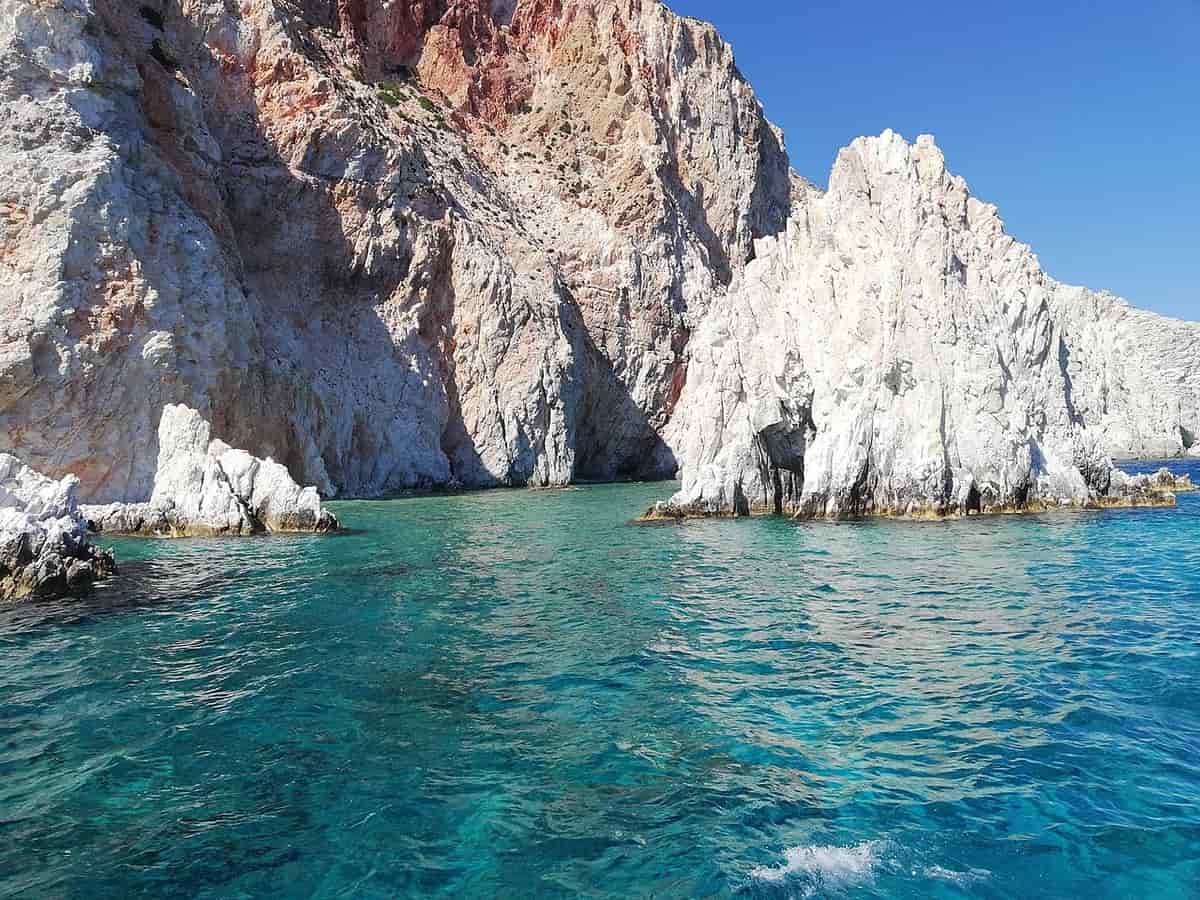
Polyaigos is an uninhabited Greek island in the Cyclades, close to Milos and Kimolos. It forms part of the community of Kimolos and counts as the largest uninhabited island of the Aegean. Its name refers to the goats that live there, since goats are the only residents. The surface covers about eighteen square kilometres, and the coastline runs between twenty-two and twenty-seven kilometres. Two hills rise there, Psilo Vouno at 370 metres and Stroggylo at 330 metres. One day cruises from Pollonia reach it in a short run.
The island is protected ground. Greece has included Polyaigos in the Natura 2000 network, and the area is a zone of special protection for a rare falcon that breeds there. The Mediterranean monk seal gives birth in the sea caves of the island, and those caves serve as a refuge for the animals that remain. Between eight hundred and a thousand monk seals survive across the whole Mediterranean Sea. One day cruises from Pollonia pass a shore that belongs to them.
The shoreline explains the stop. Caves open at the water surface, cut into pale rock, and the boat can enter the widest of them. The beaches lie mainly along the southern part of the island, among them Panagia, Upper Mersini, Lower Mersini and Ammoura. One day cruises from Pollonia anchor in front of one of these coves, and the swimmers have the sand and the shallow water to themselves. Nobody else shares the bay. The goats watch from the slope above.
People have used the island for centuries, though nobody lives there now. The Greek Orthodox church owns a great part of the land, and it sublets sections to herdsmen from Milos and Kimolos. A lighthouse has stood on Cape Maskoula since 1898, at a height of 138 metres. Ruins of a monastery founded in 1622 lie in the north-west, and two quarries once cut trachyte for millstones. One day cruises from Pollonia pass the ruins and the light on every route along the strait.
- Status: Polyaigos is uninhabited and belongs to the community of Kimolos.
- Name: The name comes from the goats that graze across the island.
- Size: The surface is about eighteen square kilometres, with a coastline of twenty-two to twenty-seven kilometres.
- Caves: Sea caves along the shore shelter the Mediterranean monk seal.
- Access: One day cruises from Pollonia approach the island across the channel.
Polyaigos is quiet because nothing is built on it. One day cruises from Pollonia find no harbour, no road and no taverna there, only rock, scrub, goats and water. That emptiness shapes the visit. The boat anchors, people swim, and the island stays as it is: a protected place where the monk seal still raises its young in the dark of the caves. The goats keep their distance and the water keeps its colour.


How does Kimolos appear on one day cruises from Pollonia?
One day cruises from Pollonia cross the short channel to Kimolos, the round island that lies to the north-east of Milos. The boat reaches the small port of Psathi below the hill village, and passes the beaches on the way.
Kimolos lies to the north-east of Milos and is separated from it by a channel close to one kilometre wide. The island covers thirty-six square kilometres and reported 810 residents at the census of 2021. Fewer than six hundred people stay through the winter. The main settlement, the Chorio, stands on a hill in the south-eastern part of the island, and the smaller settlements include Psathi, the port, and the coves of Goupa and Kara. One day cruises from Pollonia cross to it in a short run.
The harbour of Kimolos is the first thing the boat meets. Psathi is a small port below the hill village, with houses at the water and a beach beside them. Rock-cut slipways stand at the port, and local people call them syrma or magazia. Passengers on one day cruises from Pollonia step ashore there, walk uphill to the Chorio, or stay on the boat while it waits in the shelter of the bay. The climb to the village takes a short walk up a stepped lane.
Seen from the water, the island shows a chain of small beaches. The boat passes the coves around Psathi, Goupa, Kara, Prasa, Aliki, Bonatsa and Dekas, each with its own colour of sand or pebble. Above the shore stand wind-broken walls, low terraces and white houses. One day cruises from Pollonia make their longest swim stop on this coast, where the water stays clear over a pale bottom. The hills behind the sand rise in steps of grey stone.
Kimolos carries a long trading past. In the Middle Ages the island was known as Argentiera, and its rocky ground supplied Kimolian earth, a white material that was cut and shipped abroad. The Ottoman Empire ruled the island until 1829, when it joined the Greek state with the rest of the Cyclades. The white rock that gives chalk its name comes from the island. The quarries for that material opened near the shore, and one day cruises from Pollonia pass them without hurry.
- Channel: The channel between Milos and Kimolos is close to one kilometre wide.
- Port: The boat docks at Psathi, the small port below the hill village.
- Village: The Chorio stands on a hill on the south-eastern side of the island.
- Beaches: Prasa, Aliki, Bonatsa and Dekas lie along the shore.
- Past: The island traded Kimolian earth, a white mineral, from the Middle Ages.
Kimolos is small enough to hold in view. One day cruises from Pollonia treat it as a neighbour rather than a destination: a place to land, climb a hill, swim and eat. The channel between the two islands is narrow, so the crossing takes little time and leaves the rest of the day free. The boat moves on when the wind allows, and the hill village slides back towards the horizon.


Which straits and islets do one day cruises from Pollonia cross?
One day cruises from Pollonia sail the strait that separates Milos from Kimolos and the passage between Kimolos and Polyaigos. Four small islets sit inside these waters, and the boat passes close to their bare rock and low cliffs.
The water between the islands is shallow and close. One day cruises from Pollonia work inside a narrow sea, because the land never lies far away. Kimolos stands half a nautical mile from Milos, and the two are separated by a channel that measures about one kilometre across. Polyaigos lies about two kilometres from Kimolos and a little over six kilometres from Milos. These short distances keep the boat within sight of land for much of the day.
Between Milos and Polyaigos lie the islets of Kasseles, Agios Georgios, Manolonisi and Agios Efstathios. The last of them carries a lighthouse that serves shipping in the passage between Kimolos and Polyaigos, and local people call that water the Pyrgi strait. In the past, Milos and Kimolos disputed the ownership of Polyaigos and of two smaller islands, which are taken to be Agios Efstathios and Agios Georgios. One day cruises from Pollonia pass those rocks closely, and the quarrel over that grazing land lasted for centuries.
Wind decides how the strait is crossed. The meltemi blows from the north over the Aegean from late spring to mid-September, and it strengthens in the afternoon. In its strongest spells the wind reaches force seven or eight on the Beaufort scale, and the open passage turns rough. One day cruises from Pollonia therefore take the sheltered side of the channel, and the crew watches the water for signs of change. A white line of foam on the water is the first warning.
The strait also carries traffic. Ferries and small boats move between the islands, and the local crossing to Kimolos runs on a regular schedule from Pollonia. Fishing boats work the shallows, and the water between the islands holds the caves of the monk seal and the pale beaches of Polyaigos. One day cruises from Pollonia share these narrow waters with the people who live and work on them through the summer. Every boat on the water knows the same channels.
- Kimolos channel: About one kilometre of water separates Kimolos from Milos.
- Polyaigos passage: The gap between Kimolos and Polyaigos is called the Pyrgi strait.
- Islets: Kasseles, Agios Georgios, Manolonisi and Agios Efstathios lie inside the strait.
- Lighthouse: A light on Agios Efstathios marks the passage for shipping.
- Old claim: One day cruises from Pollonia cross water that two islands once claimed.
The strait is the spine of the day. One day cruises from Pollonia cross it, turn inside it and use it as shelter when the north wind rises. Every island in view belongs to the same small group, and the sea between them is never wide. That is why the boat can touch Polyaigos, Kimolos and the coast of Milos in a single run, and why the water stays calm enough for a swim.
Why do one day cruises from Pollonia follow the north coast of Milos?
One day cruises from Pollonia pass the north coast of Milos, where Papafragas, Sarakiniko and the islet of Glaronisia stand. The rock there is white, the coves are deep, and the wind has cut the stone into shapes.
Papafragas is the first of the three. One day cruises from Pollonia meet a narrow cove that opens between high walls of bright rock, and a cave carries the water out to the open sea. The rock around the cove belongs to a volcanic layer that takes its name from the place, and it sits above an older layer more than seventy metres thick. Close by stand the ruins of Phylakopi, a Bronze Age settlement on the northern coast, where the first settlers were tuna fishermen.
Sarakiniko lies on the north shore and is the best known of the beaches of Milos. Waves driven by north winds have shaped greyish-white volcanic rock into long curves and hollows, and the place is compared to a moonscape. Local people call the landscape Lunar. One day cruises from Pollonia pass a small beach covered with thin white sand, which fills a gap between the pale rocks, with a couple of trees at the back for shade. Water sits in the hollows like green glass.
Erosion has cut caves along that coast, and the beach took its name from the pirates who sheltered in them. A ship struck the rocks on the eastern side in 2003, and parts of the hull still appear when the swell drops. One day cruises from Pollonia see the white layers of rock that were laid down about 1.85 million years ago, before the sea floor rose above the water. Fossils of shellfish and sea urchins lie inside those layers.
Glaronisia closes the northern run. The islet lies north of Milos and carries tall columns of dacite lava of late Pliocene age, packed side by side like a wall. One day cruises from Pollonia arrive there late, when the light softens and the rock turns gold. Tables come out, drinks are poured, and the boat waits for the sun to touch the water. The columns stand straight out of the sea, and the boat drifts beside them.
- Papafragas: One day cruises from Pollonia pass a narrow cove beside the ruins of Phylakopi.
- Sarakiniko: White rock shaped by the wind gives the shore its lunar look.
- Sand: The beach at Sarakiniko is a small strip of thin white sand.
- Shipwreck: A ship struck the rocks on the eastern side of that shore in 2003.
- Glaronisia: Columns of dacite lava stand on the islet north of Milos.
The north coast packs three different places into a short run. Papafragas offers a cave and a cove, Sarakiniko offers bare white stone, and Glaronisia offers a wall of columns and a sunset. One day cruises from Pollonia can hold all three in one afternoon, because the boat meets no barrier between them. The wind decides the order, and the light decides which one stays in the memory.
What do one day cruises from Pollonia see on the east coast of Milos?
One day cruises from Pollonia can run down the east coast of Milos, where small coves hide old mine workings. Twelve beaches lie on that side of the island, and a part of them are reached only from the sea.
The eastern shore of Milos is a low, dry coast of coves and open bays. One day cruises from Pollonia follow it towards the south, where the water stays clear because the bottom is rock and sand. Twelve beaches lie on this side, among them Polyhroni, Thiorichia, Voudia and Paliorema. A part of these coves has no road at all, and the boat is the only way in or out. The shore behind them is bare, with low scrub and dry stone walls.
Old industry left its mark on this coast. A sulfur mine stands at Thiorichia, and the name of the beach means sulfur works. Two more places on the list carry the same memory: Paliorema and Old Thiorichia. In the past, Milos produced baryte, sulfur, millstones and gypsum, and the workings stood beside the water, where the ore was loaded onto boats that came alongside the rock. Rails and loading frames still stand on the sand.
Mining on Milos did not stop. Bentonite, perlite, pozzolana and a small quantity of kaolin are taken from open pits today and sold around the world. The island has supplied minerals since prehistory, when obsidian from Milos was carried across the Aegean. One day cruises from Pollonia pass the pits at a distance, and the pale terraces of the workings line the shore behind the coves. White dust from the pits reaches the water in dry weather.
Obsidian from Milos was a commodity as early as 15,000 years ago, and the crews who wanted it beached their boats in a suitable cove and cut pieces of the glass from the quarries. Phylakopi, on the north-east coast, was lived in from the middle of the third millennium BC to the twelfth century BC. One day cruises from Pollonia pass the quarries that supplied the whole Aegean. A separate set of trips begins at the other harbour, and the page about cruises from Adamas describes them.
- East shore: Twelve beaches lie along the eastern side of Milos.
- Coves: A part of them has no road, so the boat is the only way in.
- Sulfur: An old sulfur mine stands at Thiorichia beach.
- Ore trade: Baryte, sulfur, millstones and gypsum were mined on the island.
- Obsidian: One day cruises from Pollonia pass coves where volcanic glass was cut.
The east coast holds the working past of Milos. One day cruises from Pollonia pass coves where ore once left the island and where the ground still carries the colours of the mineral trade. Nothing is polished or arranged. The boat moves along a shore that shows its age in terraces, ruins and rusted frames, and the water keeps its clear green over the rock.
Which kinds of boats sail on one day cruises from Pollonia?
Choosing one day cruises from Pollonia gives a choice of small wooden boats, open motorboats and sailing boats with a shaded deck. Each hull suits sheltered water and short crossings, and every craft works close to Milos, Kimolos and Polyaigos, with a beach landing each day.
Pollonia holds the second harbour of Milos, after Adamantas, and the village stands on the north-eastern shore of the island. Boats tie up along a quay that runs beside a sandy beach, and the water beyond the quay belongs to the channel between Milos and Kimolos, one kilometre wide at its narrowest point. One day cruises from Pollonia leave this quay and reach the channel within minutes, with the houses of the village still in sight, and the first swim waits across the channel.
The two islands within reach set the shape of a day. Kimolos lies to the north-east of Milos, separated from it by a channel one kilometre wide, and Polyaigos stands 6.2 kilometres east of Milos and 2 kilometres south-east of Kimolos. Both lie close enough for a slow crossing, so one day cruises from Pollonia spend their hours on the water rather than in transit, and the boat reaches a beach or a cave before the day has warmed. A third stop fits the same day.
The hull decides where a boat can stop. A wooden boat with a flat run of keel takes the sand of a beach, an open motorboat moves fast between two points, and a sailing boat uses the steady summer wind and keeps a motor for the calm hours. Shade matters through the middle of the day, and one day cruises from Pollonia that carry a full party need a deck with room to move. A narrow hull slips into a cave mouth that a wider boat passes by.
A day on the water from this village holds more than the crossing. The boat anchors for a swim in clear water, lands on a beach that no road reaches and sets out a picnic under the tamarisk trees. Later the route turns west for the sunset, with ouzo and small plates on board, and the boat can also run to Kleftiko or to another destination chosen in advance. One day cruises from Pollonia keep the plan open until the wind of the morning is known.
The fleet at Pollonia stays small for a reason. Short crossings, beach landings and swim stops suit a shallow, open hull, and the channel with the two neighbouring islands gives a full day without a long passage. One day cruises from Pollonia offer a morning of water, a picnic ashore and a return in the evening light, and the choice of hull follows the plan for the day.
- Wooden boat: a hull of planks with a low cabin, a shaded stern and a deck for a picnic.
- Open motorboat: a fast hull for the short hop across the channel to Kimolos.
- Sailing boat: a hull that takes the steady summer wind and keeps a motor for calm hours.
- Group boat: a larger deck that carries a full party with space to walk and sit.
- Plan: one day cruises from Pollonia settle the hull after the forecast.

Where do the swimming and snorkelling stops fall on one day cruises from Pollonia?
Booking one day cruises from Pollonia puts the swim stops on the southern beaches of Polyaigos, in the sea caves along that shore and on the coasts of Kimolos. Clear water over rock, a shallow shelf and a cave mouth suit a mask and a snorkel.
Polyaigos is an uninhabited island of 18 square kilometres with a coastline between 22 and 27 kilometres long, and its beaches lie mainly on the southern side. Four of them carry names: the beach of Panagia, the upper Mersini, the lower Mersini and the beach of Ammoura, which also takes the name of the lighthouse on the cape above it. One day cruises from Pollonia reach this southern shore when the wind allows, with clear water over a floor of sand and rock.
The shore of Polyaigos is cut by sea-surface caves, and those caves serve as a refuge for Mediterranean monk seals. A cave mouth gives a boat a place to hold station, and a swimmer who keeps a distance can watch the entrance without entering it. The caves have underwater entries in places and stand along a rugged coast, so access stays difficult for people and easy for the animals. On one day cruises from Pollonia, a stop at a cave stays outside the line of the entrance.
Kimolos adds a second set of stops. The island covers 36 square kilometres, and its settlements include Psathi, the port, with Goupa, Kara, Prasa, Aliki, Bonatsa and Dekas along the coast. Volcanic activity left hot springs and a geothermal field on the island, and the rock of the south coast gave Kimolos its old name, Argentiera, from its silver colour. One day cruises from Pollonia use these beaches for a long swim, with a landing on sand and a rest in the shade.
A snorkel stop needs little. A mask, a snorkel and a pair of fins are the whole kit, and a swimmer lies face down, breathes through the tube and watches the scene below without effort. The shallow shelf beside a sandy beach, the dark line where rock meets sand and the half-light inside a cave mouth are the places where the view changes. One day cruises from Pollonia make the stop with the sun behind the swimmer, and fish gather along the line of the rock.
The water between Milos and the two islands offers three kinds of stop in one day. Sand gives an easy entry, rock gives a reef to follow and a cave gives shade and a wall of fish. One day cruises from Pollonia build the route around those three, and the choice between them rests on the wind of the morning. The first stop sets the pattern for the rest.
- Polyaigos south shore: the beaches of Panagia, the two Mersini and Ammoura.
- Sea caves: the rock shelters along the shore of Polyaigos, used by monk seals.
- Kimolos beaches: Psathi, Goupa, Kara, Prasa, Aliki, Bonatsa and Dekas.
- Warm water: hot springs and a geothermal field on Kimolos.
- Kit: one day cruises from Pollonia carry masks, snorkels and fins for the stops.
Which wildlife appears at sea on one day cruises from Pollonia?
Taking one day cruises from Pollonia crosses the range of the Mediterranean monk seal, the rarest pinniped species in the world, and passes the cliffs of Polyaigos, a protected zone for Eleonora’s falcon. Goats live on that island, and fish fill the water below the boat.
The Mediterranean monk seal is the rarest pinniped species in the world, and between 800 and 1000 animals survive in isolated groups across the Mediterranean. The Aegean holds 250 to 300 of them in Greek waters, with the largest concentration around the island of Gyaros, and about 100 more live in Turkish waters. Polyaigos lies inside this range, and seal pups are born on the island, inside the caves along its shore. On one day cruises from Pollonia the animal keeps to the dark of the rock.
A monk seal keeps to sea caves, and a female gives birth and nurses her pup inside one. Births peak between September and November, and the animals reach maturity at about four years. The diet covers fish, crustaceans and molluscs, with octopus, squid, lobster, mullet, flatfish, tuna, sardines and eels on the list, and an adult takes up to three kilograms a day. One day cruises from Pollonia pass above this hunting ground in shallow coastal water, and a seal that lifts a slab of rock finds prey beneath it.
Birds use the same cliffs and the same air. Greece has included Polyaigos in the Natura 2000 network as a habitat left undisturbed by human presence, and the island holds the status of a Special Protection Area for Eleonora’s falcon, listed as Falco eleonorae. The designation covers the island and the sea around it, and the birds keep to the rock. A boat on one day cruises from Pollonia passes below the cliffs and sees the birds against the sky, with the rock behind them.
The name of the island comes from its other residents. Polyaigos takes its name from the goats that live there, and the animals are the only inhabitants, whose grazing keeps the land bare. The water carries the species that fill the seal’s diet, and tuna drew the first settlers to the north-east coast of Milos, where the Bronze Age town of Phylakopi rose beside the sea. One day cruises from Pollonia cross a working habitat at every stop.
Wildlife at sea keeps its distance, and the distance protects it. A boat that holds off a cave, a swimmer who stays outside the entrance and a picnic that leaves no food on the rock all leave the site as it was found. One day cruises from Pollonia pass through a working habitat, and the day works best as a quiet visit. Silence on the water is part of the method.
- Monk seal: the rarest pinniped species, living in sea caves and giving birth there.
- Numbers: 250 to 300 animals in Greek waters, with the largest group at Gyaros.
- Eleonora’s falcon: the bird named in the protection zone of Polyaigos.
- Goats: the only inhabitants of Polyaigos, and the origin of its name.
- Tuna: the fish that drew the first settlers to the north-east coast of Milos.
How does the meltemi shape one day cruises from Pollonia?
Meeting one day cruises from Pollonia brings the meltemi, the strong, dry north wind of the Aegean, which blows from late spring to mid-September. The wind comes up in clear weather without warning and reaches force 7 to 8 on the Beaufort scale, strongest in the afternoon.
The meltemi is the strong, dry north wind of the Aegean, and it blows from late spring to the middle of September. It comes up in clear weather without warning, reaches force 7 to 8 on the Beaufort scale and turns dangerous for small boats. The wind is at its strongest in the afternoon, it dies down at night, and it can hold for days without a break. A steady push of air is welcome on one day cruises from Pollonia under sail, and a hard gust is not.
On the north-east coast of Milos the wind arrives from the north-east and the north, as it does across the northern Aegean. Pollonia faces the channel in that quarter, and the crossing to Kimolos takes the full force of the wind. The south coast of Kimolos, and the shore of Polyaigos beyond it, lie in the shelter of the land, so one day cruises from Pollonia turn to that side when the wind is strong, and the crossing stays short.
The season of the meltemi fixes the calendar. From late spring to mid-September the wind sets the pattern of each day, so an early start gives calm water for a swim and the afternoon brings the breeze. The etesian weather is fine and clear, and the northerly air tempers the heat of high summer. Outside that window the Aegean lies quieter, and one day cruises from Pollonia meet lighter air and longer days on the water.
Milos holds ninety beaches, with seventeen on the north side, twelve on the east, twenty-one on the south, fifteen on the west and twenty-five inside the gulf. The north-east corner, where the village stands, gives the shortest route to the two islands. A party that reads the wind in the morning picks the sheltered shore, and the day keeps its shape. The natural harbour, the hollow of the principal crater, offers shelter from the open sea. A morning of calm pays for an early start.
The meltemi decides where a boat goes rather than whether it goes. A sailing boat takes the wind as a steady push, and a skipper uses the forecast to choose the leeward shore and the hour of the return. Morning water, an afternoon breeze and a sheltered passage make the plan for one day cruises from Pollonia, and the plan starts with the wind.
- Season: the meltemi blows from late spring to mid-September.
- Strength: force 7 to 8 on the Beaufort scale, strongest in the afternoon.
- Direction: north-east to north along the northern Aegean.
- Shelter: the south coasts of Kimolos and Polyaigos, away from the wind.
- Plan: one day cruises from Pollonia read the forecast before the hour is fixed.
How does an evening in Pollonia follow one day cruises from Pollonia?
Finishing one day cruises from Pollonia at the quay of the village leads into an evening that starts with the sunset over the water and continues at the tables along the shore, where the catch of the day and the local cheese, capers and wine fill the menu.
Pollonia is a seaside village in the north-eastern part of Milos and the second harbour of the island after Adamantas. Its name comes from the temple of Apollo that stood to the east of the settlement, and the census of 2021 counted 268 people in the village. A small boat runs a regular service across to Kimolos, so the quay serves the residents and the day boats, and the tables of the village stand beside the water. One day cruises from Pollonia return to that quay.
The main beach of the village is sandy, and two smaller beaches lie near it, one known as Polychroni’s beach and the other as Piso thalassa, which means the back sea. A swim beside the quay uses the calm water of the channel, and a walk along the shore passes the moored boats. One day cruises from Pollonia end where the evening walk begins, and the sand of the main beach takes the last light of the day.
The sunset closes the day. A boat can hold off Glaronissia for the last light, with ouzo and small plates on board, and the islets of that name lie uninhabited in the channel. Ashore, the light falls across the water of the channel and the hills of Kimolos beyond it, and the colour of the sky changes as the sun goes down. One day cruises from Pollonia offer a seat on the quay with the same view and no crossing.
The evening then moves to the tables of the village. Fish, cheese, capers, tomatoes, honey and wine form the base of the island kitchen, and the dishes built from them belong to food and drink in Milos. The harbour keeps the mood simple: boats, water and a low line of houses along the shore. A plate of fish and a glass of local wine close the day. The evening closes with a short walk beside the moored boats.
An evening in the village gives a day on the water its finish. The boat returns in the late afternoon, the light goes out over the channel, and the tables along the quay fill as the wind drops. One day cruises from Pollonia and a slow dinner belong together, because the harbour of the village is the natural end of the route, and the village keeps the evening slow.
- Harbour: the second harbour of Milos, after Adamantas, with a boat link to Kimolos.
- Beaches: a sandy main beach, with Polychroni’s beach and Piso thalassa nearby.
- Sunset: the last light over the channel, seen from the water or the quay.
- Village: 268 people counted in the census of 2021.
- Evening: one day cruises from Pollonia finish as the tables along the quay fill.
What belongs on the checklist for one day cruises from Pollonia?
Checking one day cruises from Pollonia starts with four points: the licence of the boat, the safety equipment on board, the route chosen for the wind, and the food and drink carried for the day. A booking names the day, the route and the party.
The licence of the boat comes first. A boat that carries passengers works under a licence, and the crew shows the papers on request. Life jackets for every person on board, a radio, a first aid kit and a skipper who knows the straits belong on the same list, and the number of passengers stays within the figure on the licence. One day cruises from Pollonia rest on a boat that answers these points before the party steps aboard.
The route follows the wind. With a calm morning, the boat crosses to Polyaigos for the caves and the southern beaches, and with a fresh north wind it keeps to the shelter of Kimolos. The party states its preference in advance, because the crossing to the two islands differs from a run west towards Kleftiko, and the hour of departure changes with the forecast. One day cruises from Pollonia name a reserve route as well.
What the day includes varies with the boat. A picnic under the tamarisk trees on a beach, a swim in clear water and a stop for the sunset with ouzo and small plates are the elements that the village boats put together. A full day covers the crossings, the stops, the food and the drink, and the party confirms each item before the booking closes. Shade, water and a place to sit belong on the same list for one day cruises from Pollonia.
The bag for the day stays light. A hat, water, sun cream, a towel, a pair of shoes that grip wet rock and a dry bag for a phone cover the needs of a swim stop. A light jacket helps on the return, when the wind drops and the boat runs home. Nothing else is needed, because the boat carries the rest. A camera and a pair of sunglasses complete the kit for one day cruises from Pollonia.
A good booking takes minutes and covers the whole day. The licence, the safety kit, the route, the food and the bag belong on the list, and the forecast settles the last question. Other ways to spend the same hours on the island belong to combined activities in Milos, and a short list keeps the day simple before the boat leaves the quay.
- Licence: the paper that allows a boat to carry paying passengers.
- Safety: a life jacket for every person, a radio and a first aid kit.
- Route: Polyaigos in calm weather, Kimolos under a north wind.
- Included: crossings, swim stops, a picnic and the sunset plates.
- Booking: one day cruises from Pollonia confirm the hour before the day.
What do visitors ask about one day cruises from Pollonia?
Planning one day cruises from Pollonia raises questions about the hour of departure, the choice between Kimolos and Polyaigos, the wind, the water and the booking. The eight answers below cover the points that decide how a day at sea from the village runs.
Which part of the day suits one day cruises from Pollonia?
One day cruises from Pollonia give the calmest water early. The meltemi is at its strongest in the afternoon, so a boat that leaves the quay at first light reaches the caves and the beaches before the breeze builds. A midday swim and a picnic ashore fill the middle hours, and the return runs with the afternoon wind.
Which islands do one day cruises from Pollonia reach?
The village faces the channel between Milos and Kimolos, and both neighbouring islands lie within a short crossing. Kimolos stands half a nautical mile to the north-east, and Polyaigos lies 6.2 kilometres east of Milos. A boat can also turn west along the coast of Milos towards Kleftiko, if the party asks for that route in advance.
How does the wind decide the route of one day cruises from Pollonia?
One day cruises from Pollonia follow the forecast, and the forecast picks the shore. With a light northerly, the boat crosses to the southern beaches and caves of Polyaigos, where the land gives shelter. When the meltemi reaches force 7 to 8, the plan moves to the lee of Kimolos and the skipper names the reserve route before departure.
Are one day cruises from Pollonia suitable for families?
A sheltered crossing and a beach landing suit children and swimmers of every age, because the boat stays close to land and the stops allow a rest ashore. The channel between Milos and Kimolos is one kilometre wide, so no long passage stands between the quay and the first swim. Life jackets are carried for everyone on board.
Is snorkelling part of one day cruises from Pollonia?
Snorkelling fits one day cruises from Pollonia, because the water beside Polyaigos and Kimolos is clear and shallow in places. A mask, a snorkel and a pair of fins are the whole kit, and the sea caves of Polyaigos serve as a refuge for monk seals, so a swimmer stays outside the entrance and watches from a distance.
Which wildlife appears during one day cruises from Pollonia?
One day cruises from Pollonia pass through the range of the Mediterranean monk seal, which lives in the caves of the area. Between 800 and 1000 animals survive in isolated groups across the Mediterranean, and Greece keeps 250 to 300 of them in Aegean waters, with the largest concentration around Gyaros. Polyaigos also holds protection for Eleonora’s falcon.
What happens when the weather turns during one day cruises from Pollonia?
A skipper watches the sky and the forecast through the day. The meltemi comes up in clear weather without warning, so a boat that sees the wind build moves to the sheltered side of Kimolos or returns to the quay. The swim stops come first in the plan, and the crossing home takes the short line through the channel.
How does a booking for one day cruises from Pollonia work?
A booking for one day cruises from Pollonia names the day, the route and the number of people, and the boat confirms the hour of departure. The party states whether it wants Polyaigos, Kimolos or a run west towards Kleftiko, and the skipper answers with the plan for the wind. The licence and the food are settled before the day.