Archontoula Restaurant, Plaka
Plaka is the capital of Milos, set on a hill at 220 metres above the gulf. Its narrow paved lanes carry small shops, churches and tables, while cars stay outside the village. This Milos island page opens the kitchen of the hill village, from the first plate of the evening to the last cup of coffee.
The village gives its tables a setting rather than a menu. Stone lanes climb past white houses toward a castle on the summit, and the ground drops away to the water below. Food in Plaka Milos follows the seasons of a volcanic island, the catch of the Aegean, and the habits of the small community that lives on the hill.
Where do the tavernas of food in Plaka Milos stand?
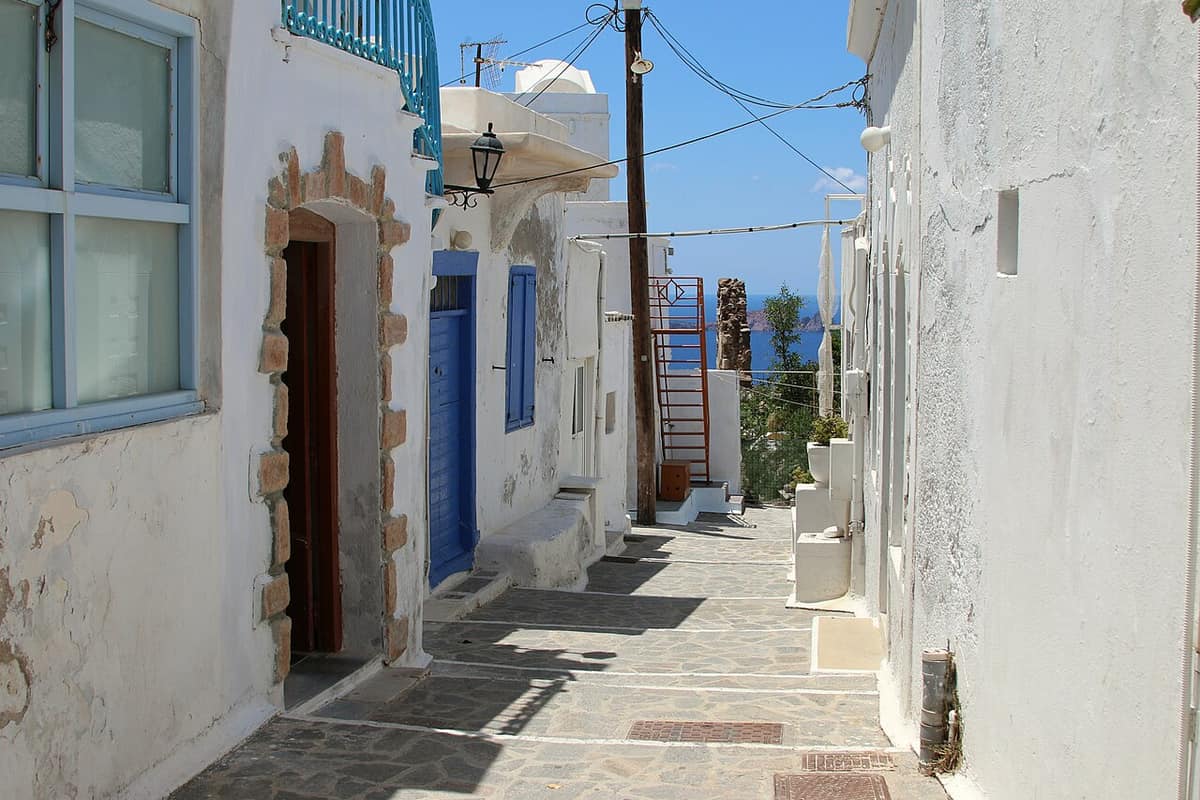
Food in Plaka Milos sits inside the paved lanes of the capital, where small tables stand beside white walls, church corners and low doorways. The village is built at 220 metres above the gulf, so the meal looks down over the bay of Milos.
The lanes of Plaka are narrow because houses and walls stand close together. Cars do not enter the settlement, and motorbikes and mopeds are the usable vehicles in the passages. The village has been listed as a traditional settlement since 1978, and its fabric keeps white surfaces, small openings and courtyards. Tables for food in Plaka Milos appear in these passages, beside small shops and church fronts. The streets are made for walking, so a meal is reached on foot.
Plaka is the chief town of Milos and the seat of the municipality. It stands on a rocky height above the gulf and shares that height with Triovasalos, Pera Triovasalos, Plakes and Tripiti. The name of food in Plaka Milos comes from the level ground where houses were built when the castle no longer held the population. Zefyria was the earlier capital, and the village is not called Chora. It grew outside a fortress rather than inside one.
The capital holds the public services of the island and its museums. A neoclassical building on the main square houses the archaeological collection, and the rooms behind the cathedral keep the folklore and history display. The cathedral of Milos, the church of the Nativity of the Virgin, was built in 1820 in a Byzantine and Cycladic style. The village counted 902 people in the 2021 census, and food in Plaka Milos is served between those courtyards and doors.
From the upper lanes the view opens across the bay. The natural harbour of Milos is one of the largest in Greece, and Adamantas, the port town, sits at the foot of the height. Ships enter and leave that water while the tables above stay quiet. The distance between the harbour and the village keeps food in Plaka Milos apart from the traffic of the port, and the height gives every plate a horizon over the water.
- Height: The hill village stands at 220 metres above the gulf of Milos.
- Traffic: Cars stay outside the settlement, and motorbikes and mopeds fit the passages.
- Status: The settlement has been listed as traditional since 1978.
- Population: The census of 2021 counted 902 people in the island capital.
- Role: Plaka is the chief town of Milos and the seat of the municipality.
Food in Plaka Milos begins with the shape of the village. The lanes are narrow, the cars stay below, and the tables sit between white walls that hold the heat of the day. Above them stands the castle, and below them lies the bay. That arrangement decides the evening: a slow climb and a view that keeps the water in sight to the last plate.
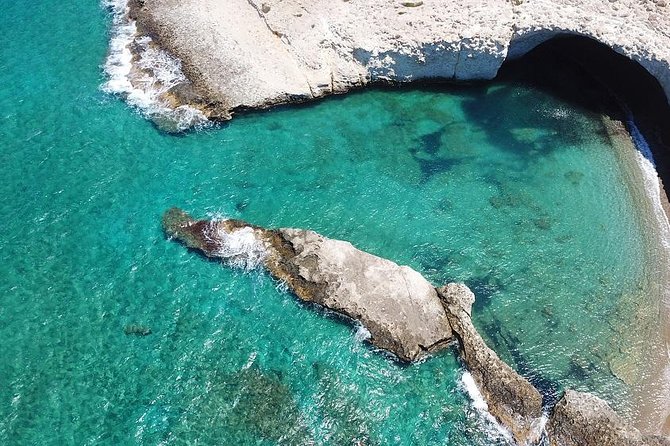
Why does food in Plaka Milos fill the western edge at sunset?
Food in Plaka Milos gathers near the western end of the village, where the cathedral court faces the open sea and the castle stands above. The sunset light reaches that side of the hill first, and the tables hold a view of the gulf.
The castle on the summit is the landmark of the western sky. Venetian builders raised it in the thirteenth century, and its foundation is placed after 1204. The rock beneath it is volcanic, and the position allowed control of ship traffic in the gulf of Adamantas. The castle is protected as an ancient monument, and the medieval town grew on the plateau under it, which is where food in Plaka Milos begins. That order places the tables below a fortress.
Two churches mark the climb, and a third closes the western side. The church of the Dormition of the Virgin, also called Mesa Panagia, stands on the castle summit, while the Presentation of Christ, or Panagia Thalassitra, sits lower on the approach. At the western end stands the cathedral of Milos, built in 1820, which keeps relics and icons. Food in Plaka Milos gathers around those three churches. The folklore and history museum stands behind the cathedral.
When the sun drops, the light leaves the harbour first and the upper lanes keep it longer. Plates arrive through the evening, and the talk slows as the sky darkens over the water. The heat of the day lifts from the stone, and the corridors between the houses cool down. Food in Plaka Milos fills the western side of the village before the rest of it, and the gulf holds the last colour of the day.
The table follows a Greek order rather than a single course. Small dishes arrive first, and octopus is a superb meze beside a glass of ouzo. Groups share what stands in the middle, and bread takes up the oil and tomato juice left on the plate. Food in Plaka Milos is a long sitting, and nobody at the table watches the clock. Coffee follows the food, and the talk continues until the street grows quiet.
- Castle: Venetian builders raised it on the volcanic summit in the thirteenth century.
- Monument: The castle of Plaka is protected as an ancient monument.
- Summit church: The church of the Dormition of the Virgin crowns the castle summit.
- Cathedral: The cathedral of Milos was built in 1820 and keeps relics and icons.
- Height: The village looks down from 220 metres across the gulf of Milos.
The western edge of Plaka carries the meal into the evening. Above the tables stands an old fortress, behind them a cathedral raised in 1820, and in front the gulf keeps its colour until the light goes. Diners stay because the setting holds them: a wall that reflects warmth and a sky that changes once more before the lamps come on.
Which island dishes belong to food in Plaka Milos?
Food in Plaka Milos draws on the Aegean and on the volcanic ground of the island. Octopus comes to the table grilled or chilled in a salad, stuffed vegetables carry rice, and the plate of the day follows the vegetables that the season gives.
Octopus is a dish of its own on the Greek islands. It is caught by spear fishing close to the shore, and the fisherman tenderises the flesh by beating it against a stone. The arms then hang in the sun from a rope, much like washing on a line. Later they are served grilled or chilled in a salad, with olive oil, garlic, oregano, pepper and lemon juice. Food in Plaka Milos treats it as a meze for ouzo.
A meze is a selection of small dishes served as appetisers, and it can form a meal in itself. In Greece it includes tzatziki, melitzanosalata, taramosalata, fava, saganaki, fried squid, giant beans, meatballs, stuffed vine leaves, stuffed vegetables and grilled meat on skewers. Food in Plaka Milos follows that pattern, and ouzo is the drink that goes with it. Bread sits beside the plates, and the table fills again as the plates empty. The order follows the kitchen.
The village salad is the plate that appears beside the rest. It is made with pieces of tomato, cucumber, onion, feta cheese and olives, dressed with salt, oregano and olive oil. Lemon juice, green pepper and caper berries are common additions, and the caper berries belong especially to the Cyclades. Food in Plaka Milos puts the bowl on the table unmixed, and bread goes into the juice and oil that remain. Tomato wedges and rings of onion keep their shape.
Pies and filled pastries stand with the plates of the island. Dough or thin sheets of pastry close over a filling, and the same idea returns in stuffed vegetables. Peppers, aubergines and courgettes are filled with rice and meat, and squash blossoms take a stuffing of their own. Fava is a paste rather than a pie: the seeds are boiled and mashed with olive oil and chopped onion. Food in Plaka Milos serves it cool, and the plate stays plain.
- Octopus: Grilled or chilled in a salad, it is a meze that suits ouzo.
- Village salad: Tomato, cucumber, onion, feta cheese, olives, oregano and olive oil make the bowl.
- Capers: Caper berries join the salad on the islands of the Cyclades.
- Fava: The seeds are boiled and mashed with olive oil and chopped onion.
- Stuffed vegetables: Peppers, aubergines and courgettes are filled with rice and meat.
The dishes of the hill village keep to plain cooking. Octopus comes off a grill or out of a cool bowl, the salad carries the oil and the capers of the island, and the pies and the stuffed vegetables use what the garden gives. Nothing on the table is complicated, and that is the point: the sea, the volcanic ground and the oven do the work. The wider food of Milos follows the same pattern.
What sweets and coffee follow food in Plaka Milos?
Food in Plaka Milos finishes with a slice of watermelon pie, a plate of fried dough dressed with honey and cinnamon, and finally a small cup of coffee brewed in a briki with a thick foam on top.
Watermelon pie is a traditional pie of the Cyclades, and the island of Milos belongs to its home ground. Watermelon, flour, baking powder, sugar or honey, seed oil or olive oil, raisins, walnuts, cinnamon and clove go into the mix. The melon takes the place of a liquid such as juice, water or milk, and it releases its juice as it bakes. Food in Plaka Milos keeps that soft pie for the end. The oven does the rest.
Sesame is the mark of the pie. A thick layer of it is sprinkled in the baking tray and another layer goes over the top before the pie enters the oven. The rind of the melon is used as well, and in the past it became a spoon sweet or a pickle, so that nothing from the fruit went to waste. Food in Plaka Milos uses the whole melon. The kitchen of the island works that way.
Fried dough brings the second sweet. A yeast batter is dropped into hot oil, and the pieces take a round or a ring shape. Honey or syrup is poured over them, and cinnamon or icing sugar goes on top. The name means a bite, and versions of the sweet belong to the kitchens of the Balkans and the Middle East. Food in Plaka Milos keeps it for the end of the meal. It arrives when the savoury plates are clear.
Coffee closes the sitting. The beans are roasted and ground to a fine powder, then stirred into water with sugar in a small pot. The mixture is brought almost to the boil, and the foam that forms on the surface is the sign of a good cup. It is poured into a small cup and served slowly, and food in Plaka Milos can take it plain, lightly sweetened, medium or sweet. It arrives after the plates are cleared.
- Watermelon pie: The melon replaces the liquid in the mix and softens the pie.
- Sesame: A layer goes under the pie in the tray and another over the top.
- Spices: Cinnamon, clove, raisins and walnuts join the watermelon in the mix.
- Spoon sweet: The rind of the melon becomes a spoon sweet or a pickle.
- Coffee: Beans, water and sugar are brought almost to the boil.
Sweet things close the meal in the hill village. A slice of watermelon pie arrives with its sesame crust, fried dough comes under a pour of honey, and a small cup of coffee finishes the sitting. Dessert here is not an extra course but the last part of a long evening above the gulf. More sweets in Plaka sit beside this final course. The customs are old and the kitchen plain.

How does a walk shape an evening of food in Plaka Milos?
Food in Plaka Milos sits between two walks: down the slope to Tripiti, or up the lanes to the castle on the summit. Both directions begin at the table and end with a wider view of the island.
Tripiti stands at 150 metres, and a hiking route links it with the capital, Plaka. Its name comes from the pierced rock of the area, where caves cut into soft volcanic stone were once family burial chambers and now serve as storerooms and stables. Triovasalos stands at 143 metres, and it formed one settlement with Pera Triovasalos until 1908. Food in Plaka Milos sits on the same height. Its streets carry banks, coffee houses and shops.
The climb to the castle passes the lower church and ends at the summit, where the church of the Dormition of the Virgin stands. From that point the gulf of Milos lies open below, and the whole rim of the bay comes into view. The castle itself is protected as an ancient monument, and food in Plaka Milos carries the walker up to it. The path is short, and the climb fits between two plates.
Below Tripiti the ground holds an older layer. The catacombs are an underground Christian cemetery of the first to fifth centuries, cut in porous volcanic rock beside the market place of the ancient city and 200 metres from the ancient theatre. The galleries vary in width and height, and graves are cut into both the walls and the floor. Food in Plaka Milos sits above that older ground. Seven rows of marble seats hold about 700 spectators there.
The walk back to the village is the last course of the day. Lanes rise from the lower ground to the tables, and the lights of the houses mark the route. A marble statue of Aphrodite was found in a rural area of Milos in 1820, and a copy of it stands in the museum of the capital. Food in Plaka Milos ends where the ground below meets the tables. That last climb is short, and the table waits.
- Tripiti: The village stands at 150 metres at the end of a hiking route.
- Route: A hiking route links the capital with Tripiti across the raised ground.
- Windmills: The restored windmills of Tripiti once ground grain for the island.
- Catacombs: The underground Christian cemetery lies in soft volcanic rock.
- Theatre: Seven rows of marble seats survive from the Roman phase of the theatre.
A walk gives the meal its shape. The slope down to Tripiti leads to the windmills and to the old ground where the catacombs and the theatre stand, and the climb up to the castle leads to the church of the Dormition of the Virgin. Either way, the return is to a table. The village of Plaka keeps the evening where the first plate arrived.
What do travellers ask about food in Plaka Milos?
Food in Plaka Milos raises practical questions about the village, the view, the dishes, the sweets, the walks and the coffee. The answers below explain where the tables stand, what fills them and how the meal fits the hill.
Where is food in Plaka Milos served?
Food in Plaka Milos is served inside the lanes of the capital, where tables stand beside white walls, low doorways and church fronts. Cars stay outside the settlement, so the passages belong to walkers. The village sits at 220 metres above the gulf, and the settlement works as the dining room of the hill.
Why does food in Plaka Milos look over the water?
Food in Plaka Milos looks over the water because the village stands on a rocky height above the gulf. The natural harbour of Milos is one of the largest in Greece, and the port town of Adamantas lies at the foot of the hill. The castle on the summit once watched the ships that crossed.
Which dishes shape the menu of food in Plaka Milos?
Food in Plaka Milos leans on octopus, small plates and the village salad. Octopus is grilled or served chilled, and it works as a meze beside ouzo. The salad mixes tomato, cucumber, onion, feta cheese, olives, oregano and olive oil, and caper berries are added on the Cyclades. Fava and fried squid fill the rest.
Which sweet closes food in Plaka Milos?
Food in Plaka Milos closes with watermelon pie, which belongs to the Cyclades. Watermelon, flour, sugar or honey, olive oil, raisins, walnuts, cinnamon and clove go into it, and sesame covers the tray and the top. Fried dough with honey is another ending, and a spoon sweet made from the rind follows the same fruit.
How does a walk extend food in Plaka Milos?
Food in Plaka Milos sits between the castle and Tripiti. The climb up the lanes reaches the church of the Dormition of the Virgin on the summit and a view of the bay. The walk down reaches Tripiti at 150 metres, the windmills, the catacombs and the ancient theatre. Either route turns a meal into a journey.
What is drunk with food in Plaka Milos?
Food in Plaka Milos comes with ouzo. Coffee follows the meal: the beans are ground to a fine powder and stirred into water with sugar in a small pot, then brought almost to the boil. The foam on the surface is the mark of a good cup, and the drink arrives in a small cup.