The Glikofilema, Adamas
Aggeliki Icecreams, Adamas
Adamas is the harbour town of the island of Milos, and the sweets in Adamas are the sweets of the whole island. Watermelon pie, sesame bars, fried dough and almond sweets are its traditional sweets, and this port is the gate of the island. This page follows them through the day at the harbour and explains what goes into each.
The first section covers the port, the waterfront and the moments of the day when a sweet appears. The second section names the traditional sweets of Milos and gives the ingredients and the method of each. Spoon sweets, pastry-shop desserts and the sweets of weddings, Easter and feast days follow in the later sections of the page.
What are the sweets in Adamas at a glance?
Sweets in Adamas are the traditional sweets of Milos, served in the main port of the island. Watermelon pie, sesame and honey bars, fried dough and almond sweets share the list with the spoon sweet, and the port is the first stop for a traveller.
Adamas stands on the north-eastern shore of the gulf of Milos, in a bay that counts among the largest and safest natural bays of the Mediterranean. The harbour is the main port of the island, and its view is the first one a traveller sees on arrival by boat. The village was called Alamanto before, and today it is the largest tourist centre of Milos. The sweets in Adamas are the sweets of this port, the first stop on the island table.
The sweets in Adamas fall into two groups. The first group is local: karpouzopita, the watermelon pie, and koufeto, the almond and pumpkin sweet, rank among the representative dishes of Milos cooking. The second group is shared Greek tradition: pasteli, the bar of sesame and honey, xerotigana, the strips of fried dough, and loukoumades, the fried dough balls that Milos calls kourtalides. Honey ties the groups together, because honey sweetens the bar, the syrup of the strips and the dough balls.
The savoury table comes first. The restaurants, taverns, steakhouses and wineries of the island serve fresh fish, grilled octopus, octopus in wine, local meats such as rooster and baked lamb, and ladenia, a pie of oil, tomato and onion. The sweets in Adamas close a meal of that kind. The spoon sweet is the sign of welcome at this point of the meal: a small portion, offered to a guest, beside Greek coffee and a glass of cold water.
- Streets: White houses with small flower-decorated courtyards line narrow, quiet streets.
- Honey: Small units on Milos produce thyme honey.
- Coffee: A spoon sweet is served with Greek coffee or tea and cold water.
- Summer: Watermelon ripens in the Greek summer, which sets the season of the pie.
- Evening: The village combines rest and tranquillity with nightlife and entertainment.
The sweets in Adamas follow the day of the port. A meal of fish, octopus or ladenia comes first, a coffee with a small sweet follows, and the evening belongs to the waterfront. Watermelon pie waits for summer, while honey sweetens the bars and the syrups. The next section takes the traditional sweets of Milos one by one, with their ingredients.

Which traditional sweets in Adamas come from the island of Milos?
Traditional sweets in Adamas come from the island table: karpouzopita, koufeta, pasteli, xerotigana and kourtalides. Watermelon, honey, sesame, almonds, pumpkin and fried dough carry the list, and the methods run from baking to deep frying to pressing the bars.
Among the sweets in Adamas, karpouzopita counts as a representative dish of Milos cooking. It is a sweet pie of watermelon, baked on Milos, Ios, Folegandros and Kimolos. The cook cuts the flesh into small pieces or purees it, and the fruit takes the place of a liquid such as juice, water or milk. Watermelon is 91 percent water and gives it up in the oven, which keeps the pie soft. Flour, baking powder, sugar or honey and oil complete the batter.
Pasteli joins the sweets in Adamas as the bar of sesame and honey. Sesame seeds are bound with honey and pressed into a flat oblong bar, and nuts can join them or replace the sesame, almonds above all. The bar comes in a soft form and a crunchy form, and it keeps for a long time. Herodotus already mentions sweet cakes of sesame and honey, the Byzantine sesamous is its ancestor, and the modern name comes from the Italian word pastello.
Among the sweets in Adamas, xerotigana are the strips of fried dough. In the Cretan recipe the thin dough takes a spiral shape in the pan, and two people share the work: one shapes the strip as it leaves the oil, and the other keeps it from creasing as it enters. Hard flour, olive oil, raki or tsipouro, salt and water make the dough. The cooled strips take a honey syrup, sesame, cinnamon or walnuts.
- Sesame: Generous sesame lines the tray and covers the pie before baking.
- Names: The watermelon pie also goes by karpouzenia and angourenia.
- Diples: The Peloponnese knows the same strips by this name.
- Koufeta: Small almond sweets under icing sugar are made from sweet pumpkin pulp, honey and almonds.
- Kourtalides: Milos uses this name for loukoumades, leavened dough balls fried and served with honey.
Two of the five sweets carry a firm label of Milos: koufeto is known in Greek cuisine as the koufeto of Milos, and karpouzopita belongs to Milos with three other islands of the Cyclades. The other three belong to wider Greek tradition. The sweets in Adamas mix the local and the shared, and the full list of sweets in Milos covers the rest of the island.
How do spoon sweets fit among the sweets in Adamas?
Sweets in Adamas include the spoon sweet, a fruit preserve that Greek hosts serve to a guest in one small spoonful, together with a glass of cold water. Fruit boils in sugar until a thick syrup sets around whole pieces.
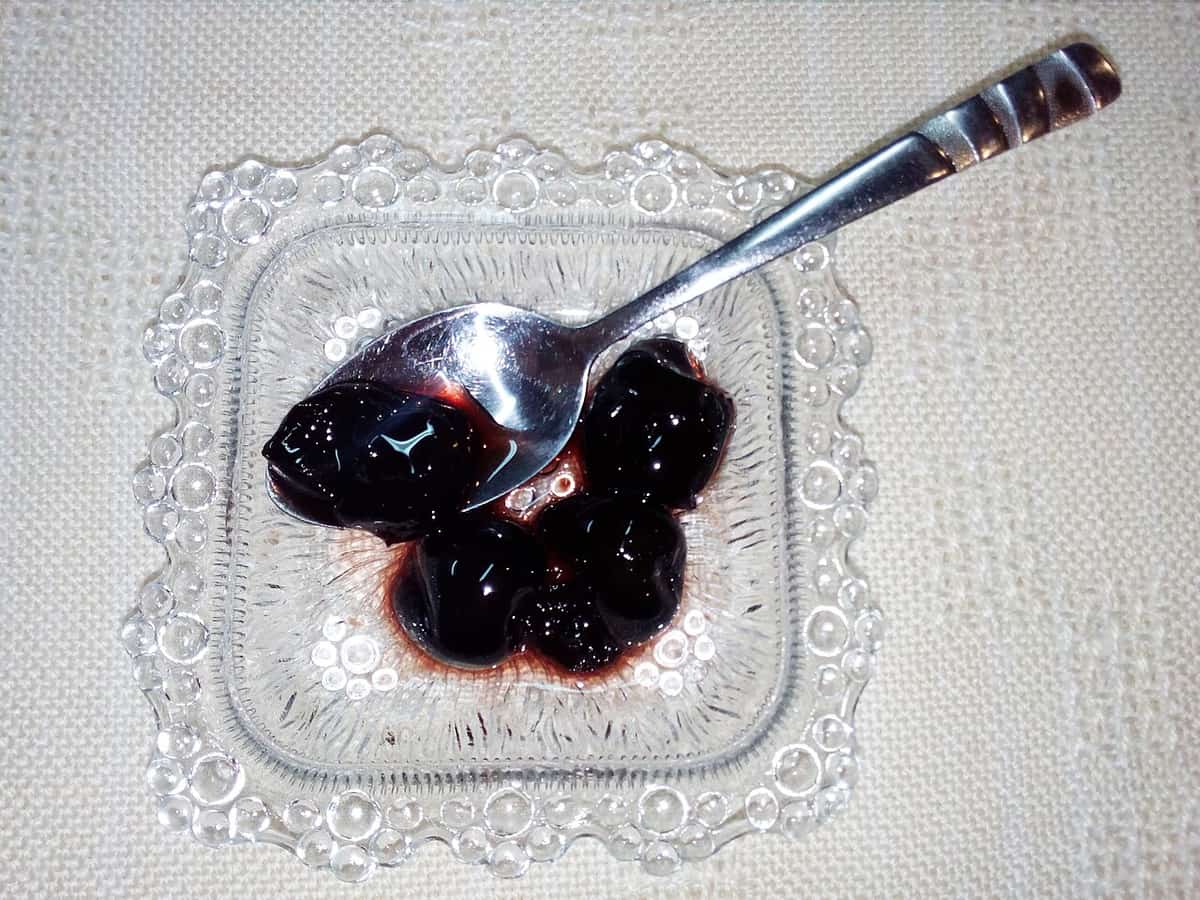
The spoon sweet, called glyko tou koutaliou in Greek, means sweet of the spoon. It is fruit in thick syrup, which sets it apart from jam, and from compote, whose syrup runs thin. The custom is Greek, shared with Cyprus, the Balkans and Turkey, so the sweets in Adamas, the harbour village of Milos, take part in a tradition that no single town owns. Hosts serve small portions, and the portion gives the sweet its name.
The method asks for patience. Soft fruit such as apricot and cherry tomato soaks in limewater first, so that it hardens and survives the boil. The fruit then rests in sugar, boils, and rests again in the syrup. Next the fruit leaves the pot, and the syrup boils down once more until it sets. Lemon goes in so that the syrup does not turn to sugar, and the finished sweet fills sterilised jars with screw-top metal lids.
The sweets in Adamas that come from a jar follow the order of the Greek table. The sweet arrives on a teaspoon in a small porcelain or crystal dish, beside Greek coffee or tea and a glass of cold water. The same sweet tops ice cream or yoghurt, spreads on toast or sits beside cheese. One white sweet, called vanilla, is made from the mastic resin of Chios and rests on a table spoon in a tall glass of iced water.
- Beyond fruit: Baby aubergine, cherry tomato and rose petals also become spoon sweets.
- Flavourings: Cinnamon bark, mint or apple geranium leaves simmer in the pot and are removed.
- Almonds: Blanched almonds add crunch to baby aubergine, apple and grape sweets.
- Texture: Pieces stay whole, so a well-made spoon sweet is chewy.
- Shop jars: Packaged sweets use glucose syrup more frequently than homemade ones.
The spoon sweet is a gesture before it is a dessert. A host sets out a small dish, a teaspoon and a glass of cold water, and the guest takes a single spoonful. The sweets in Adamas that follow, from filo and syrup to fried dough and ice cream, belong to the pastry shops of Greece, and each one is a dessert in its own right.

Which pastry-shop desserts of Greece belong with the sweets in Adamas?
Sweets in Adamas include the desserts that Greek pastry shops sell across the country: baklava, galaktoboureko, loukoumades, bougatsa and, in summer, ice cream. Filo, custard, honey, syrup and cream carry the list, and each dessert has a history of its own.
Baklava and galaktoboureko, the two filo desserts among the sweets in Adamas, rest on syrup. Baklava layers filo with chopped nuts and takes a syrup of sugar, honey, water and citrus zest, plus cinnamon in Greece. In the south of Greece the nuts are almonds, in the north walnuts. Greek baklava is supposed to carry 33 filo layers, one per year of the life of Jesus. Galaktoboureko bakes semolina custard inside the filo. Its name joins the Greek word for milk with the Turkish börek, a filo pie.
Loukoumades, balls of leavened dough, are fried and served with honey, cinnamon, walnuts or chocolate sauce. The dessert is a mainstay of Greek cooking, in particular in the south, and enkrides, an ancient fried dough eaten with honey, is its forerunner. Bougatsa, the next of the sweets in Adamas, is a pastry: filo wraps a filling, and the pie is baked, cut small and served hot. The cream version, filled with semolina custard, takes icing sugar or cinnamon. Serres and Thessaloniki in northern Greece are known for it.
Summer brings ice cream to the table of the sweets in Adamas. Milos has warm to hot dry summers, and ice cream is a frozen dessert of milk or cream, flavoured with sugar and with cocoa, vanilla or fruit. The flavours of Greek ice cream include watermelon, melon and fig. A scoop also sits beside a pie or beside a syrup dessert such as baklava or kataifi, so the cold and the warm desserts of the pastry shop meet on one plate.
- Baklava: Melted butter separates the filo layers, and syrup soaks the baked pieces.
- Galaktoboureko: The tray is cut into squares, or single portions are rolled.
- Loukoumades: The Byzantine dough held no dairy or meat, so it suited Lent.
- Bougatsa: Shops that sell only bougatsa are called bougatsadika.
- Ice cream: Milk-free ice cream is called granita, in lemon or apricot flavours.
These desserts show how far the sweets in Adamas reach beyond Milos. Filo and syrup, custard, fried dough and a cold scoop all belong to Greek pastry shops across the country. Refugees from Asia Minor spread the custard pastries after 1922, while loukoumades go back to ancient Greece. A traveller who follows the sweets in Adamas reads a short history of Greek pastry, from the Byzantine table to the cold scoop of summer.
Which sweets in Adamas belong to weddings, Easter and feast days?
Sweets in Adamas follow the Greek Orthodox calendar. Koufeta, sugar-coated almonds, mark weddings, tsoureki and koulourakia mark Easter, and the festival of the Holy Trinity church beside the port opens a festive table on the day of the Holy Spirit.
Weddings put koufeta on the table, and sweets in Adamas share the custom with traditional Greek Orthodox weddings. Koufeta are almonds in a hard sugar shell, tinted in pastel colours and offered as wedding favours in containers called bonbonnieres. Packs of five are common, standing for happiness, health, longevity, wealth and fertility. The ceremony itself includes the crowning of the couple with stefana and a walk around the altar, and the almonds stand for spiritual unity and family blessings.
At Easter the sweets in Adamas turn to the oven. Tsoureki is a sweet holiday bread of flour, milk, butter, eggs and sugar, seasoned with lemon or orange zest, mastic resin or mahleb. The Easter loaf called lampropsomo carries whole red eggs pressed into the dough before baking. Koulourakia come after Holy Saturday. These butter biscuits are shaped by hand into rings, spirals, figure eights or Greek letters, brushed with egg and sprinkled with sesame seeds.
The church of Agia Triada keeps its memorial feast on the day of the Holy Spirit. A panigyri, the open-air festival of a parish, comes with a meal, folk songs and traditional dances. Four tiers on the west and north sides of the church courtyard stand like the seats of an open-air theatre. The tiers were added later, in all probability once the parish began to hold the festival, and women sat there to watch or join in.
- Tsoureki shapes: The dough is formed into a braid, a ring or a ball.
- Fasting loaf: A simpler recipe for the fast uses water, sunflower oil, sugar or honey, mastic and mahleb.
- Mahleb: This spice comes from the seeds of a wild cherry, Prunus mahaleb.
- Godparents: Tsoureki can be an Easter gift from children to their godparents.
- Afterfeast: Fasting is not permitted during the week that follows Pentecost.
The calendar decides the sweets in Adamas: koufeta at the wedding, tsoureki and koulourakia after the Easter fast, and a festive table when the Holy Trinity comes round. Koulourakia are eaten with Greek coffee, so the biscuit belongs beside the coffee and drinks of the port. Each sweet ties a date to a taste: a wedding day, the end of the fast and the fiftieth day after Easter.

What do travellers ask about the sweets in Adamas?
Sweets in Adamas raise questions about origins, names and dates. The six answers below explain where koufeta came from, why Easter bread carries red eggs, what tsoureki means, how old koulourakia are, when the Holy Trinity feast falls and which church holds it.
Where do the koufeta served with sweets in Adamas come from?
Koufeta are thought to descend from the honey-covered almonds of ancient Rome, which were served to celebrate births and weddings. Sugar replaced honey once it became easier to buy in the fifteenth century. The name Jordan almonds is thought to come from the French word jardin, meaning garden, which points to a cultivated almond.
Why does the Easter bread of the sweets in Adamas carry red eggs?
The red eggs stand for the blood of Christ and the promise of eternal life. In Greece the dyed eggs are cracked together to celebrate the opening of the Tomb of Christ. Lent bars eggs, so they return with the feast, and the lampropsomo carries them pressed into the dough before it goes into the oven.
What does the name tsoureki mean among the sweets in Adamas?
The word tsoureki comes from the Turkish word çörek, which means round bread, and Greek adopted it under Ottoman rule. Other Greek names for the loaf are lampropsomo and lamprokouloura. In Greece and Cyprus the bread is baked all year, mainly at Easter or Christmas, and the shape varies from place to place.
How old are the koulourakia among the sweets in Adamas?
Koulourakia have been prepared since at least Minoan times. The Minoans sometimes shaped the pastries like small snakes, because they worshipped the snake for its healing powers. The word itself is the diminutive of a ring-shaped loaf. Cooks keep the biscuits dry in a jar with a lockable lid, and they go with morning coffee.
When is the Holy Trinity feast among the sweets in Adamas?
The feast falls on the day of the Holy Spirit, the Monday after Pentecost. Pentecost is the fiftieth day after Easter, so the date moves each year with Easter. The Orthodox feast lasts three days, from Trinity Sunday to the third day of the Trinity, and the Monday is a public holiday in Greece.
Which church holds the feast among the sweets in Adamas?
The church of Agia Triada stands about halfway along the eastern side of Adamas, close to the sea, and before the land built up it stood on the shore. It is one of the two oldest churches on Milos. Until 1833 it carried the name Panagia Theofani, and it took the name Agia Triada between 1833 and 1834.