Sweets in Pollonia, Milos: see our Sweets in Milos section for the island.
Pollonia is a small fishing village at the north-eastern tip of the island of Milos, and the sweets in Pollonia follow the rhythm of its harbour. Strained yoghurt with honey, sweet drinks, milk puddings and feast-day sweets fill the day there. This page sets them out in order and explains what goes into each one, from the breakfast bowl to the feast-day table.
The first section places the sweets in Pollonia in the village and in the hours of the day. The second section turns to the breakfast table by the harbour, where Greek yoghurt meets honey and walnuts. Sweet drinks, rice pudding and cream, and the sweets of saints’ days follow in the later sections of the page, each one explained in turn.
What are the sweets in Pollonia at a glance?
Sweets in Pollonia are the Greek and island sweets of a fishing village at the north-eastern tip of Milos. Strained yoghurt with honey opens the day, sweet drinks and milk puddings follow, and feast-day sweets mark the church calendar.
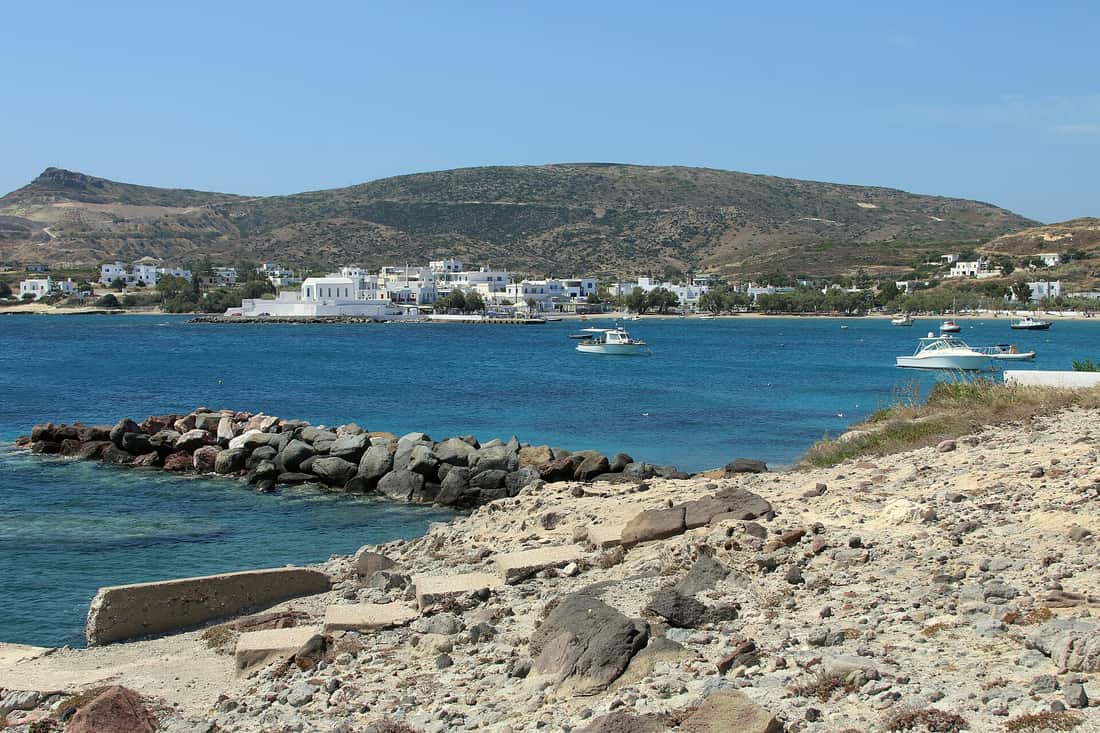
Pollonia, also called Apollonia, is a seaside village at the north-eastern tip of Milos, set 10 metres above the sea. A temple of Apollo once stood at the lighthouse of Pelekouda, and the name of the village recalls it. The settlement was attached to the community of Pera Triovasalos in 1940. The sweets in Pollonia are the sweets of that small settlement, taken one hour of the day at a time, so the account below follows the day from the first light to the last table.
The village lies along one cove between two small churches. On the left side, the church of Agios Nikolas stands on Pelekouda, a peninsula with a small chair-shaped rock where, by tradition, a couple who sit together stay together forever. On the right side, the church of Agia Paraskevi ends the row of taverns and restaurants. The sweets in Pollonia fill the stretch from the peninsula on one side to the row of taverns on the other.
Honey runs through the sweets in Pollonia as it runs through the whole Greek table. It was the first sweetener in the Greek diet and, for a long time, the only one, and it remains the sweetener of highest standing today. Milos adds thyme honey from small units on the island. Loukoumades, the fried dough balls, take a drizzle of honey, and pasteli presses sesame seeds into a bar with it, so one jar connects the different hours of the day.
The sweets in Pollonia follow the order of a harbour day. Strained yoghurt with honey and walnuts comes at breakfast, a sweet drink cools the afternoon, a milk pudding closes the evening meal, and the sweets of the church calendar mark the feast days. Each moment takes one sweet, small enough to sit between a walk and a meal. Watermelon pie, almond sweets, spoon sweets, baklava and ice cream fit between those hours, and the full list of sweets in Milos describes each of them.
- Altitude: The village stands 10 metres above the sea.
- Left end: The church of Agios Nikolas stands on the Pelekouda peninsula.
- Right end: The church of Agia Paraskevi closes the row of taverns and restaurants.
- Sweetener: Honey was the first sweetener in the Greek diet.
- Order: Yoghurt, drinks, puddings and feast-day sweets follow the hours of the day.
The harbour day gives the sweets in Pollonia their order, and honey gives them their thread. A village between two churches has a morning, an afternoon, an evening meal and a calendar of saints’ days, and each of them takes a sweet of its own. The next section starts at the beginning of the day, with strained yoghurt, honey and walnuts at breakfast.

Why does Greek yoghurt with honey and walnuts belong among the sweets in Pollonia at breakfast?
Sweets in Pollonia begin with strained yoghurt, a thick Greek yoghurt drained of its whey. Honey runs over it, walnuts sit on top, and the bowl needs no cooking, which suits a morning at a harbour where the boats land their catch.
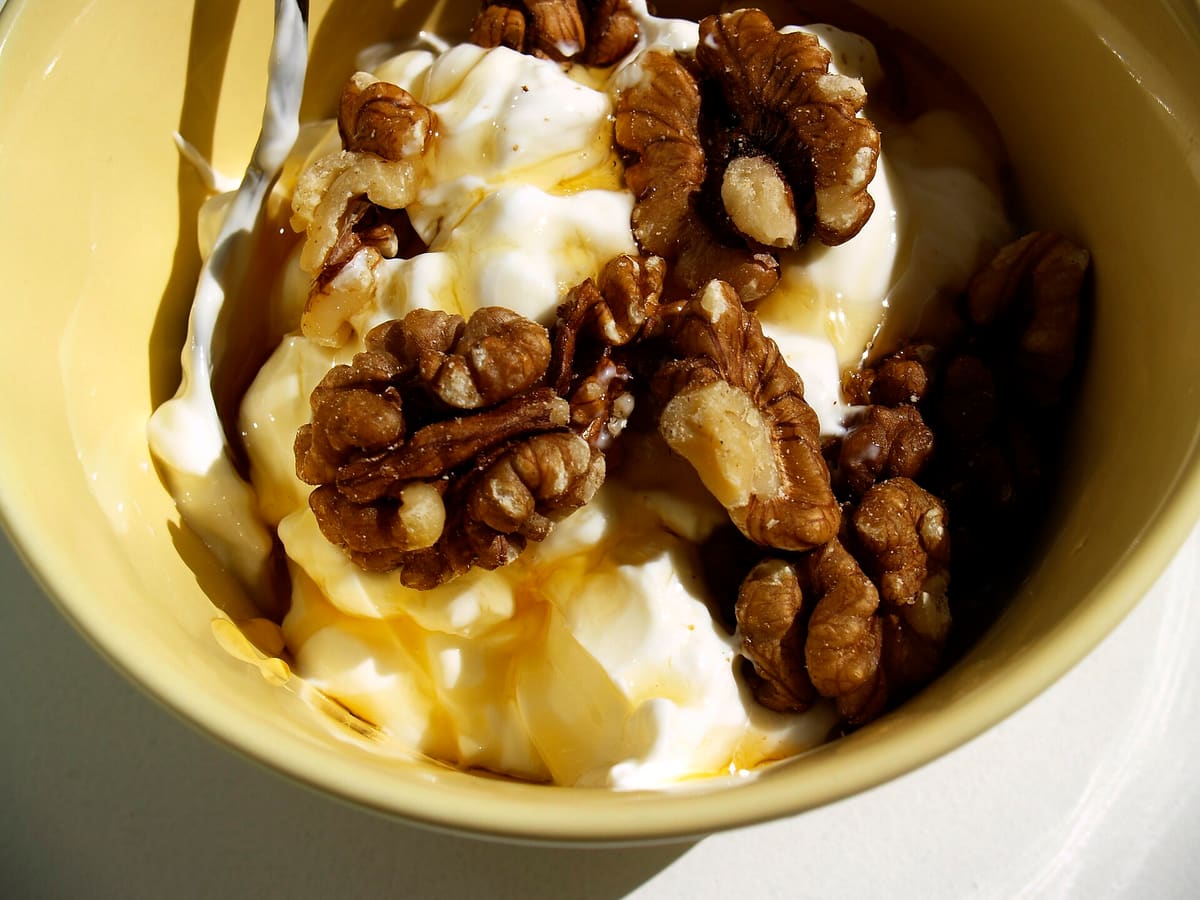
Strained yoghurt is yoghurt that has been strained to remove its whey. The straining leaves it thicker while the sour taste stays. Even a lean yoghurt turns richer and creamier this way, and the loss of whey also takes away part of the lactose, so strained yoghurt holds less sugar than the unstrained kind. Greek calls it strangisto giaourti. It is the plainest of the sweets in Pollonia: milk, a bacterial culture and a strainer make the base.
Greek cooking uses strained yoghurt mostly as the base of tzatziki and as a dessert, with honey or spoon sweets on top. By tradition, Greek yoghurt, like yoghurt in general, is made from sheep’s milk. The pairing is old: ancient Greece knew a form of yoghurt called oxygala, and an ancient author recorded that it was eaten with honey, much as thick Greek yoghurt is eaten today. The sweets in Pollonia at breakfast repeat that old pairing of yoghurt and honey.
Honey gives the bowl its sweetness. Fructose and glucose make up the sugars of honey. Bees thicken the nectar in the hive until the water falls to between 15.5 and 18 percent, and the honey stays thick. Its sugar and acid keep microorganisms from growing, and stored well, honey does not spoil. Ripe honey flows from a knife in one straight stream and settles into a bead. In Greece, pine honey makes up 60 to 65 percent of production, and it sits beside the thyme honey of Milos.
Walnuts add the crunch. The walnut is the edible seed of a tree, and the shell holds a kernel that splits into two halves. A brown coat covers the kernel and carries antioxidants that protect the oil-rich seed from the air. Greek cooking uses seeds and nuts in everything from pastry to main dishes, and the Greek name of the dish is giaourti me meli kai karydia, yoghurt with honey and walnuts. With the walnuts, the sweets in Pollonia at breakfast gain a nut as well as a sweetener.
- Texture: Straining makes even lean yoghurt thicker, richer and creamier.
- Milk: Greek yoghurt is made from sheep’s milk by tradition.
- Honey: Fructose and glucose give honey its sweetness.
- Walnuts: The kernel splits into two halves under a brown coat.
- Breakfast table: A Greek breakfast also holds fruit, jam, bread rings called koulouri and bougatsa.
Yoghurt, honey and walnuts need a strainer, a hive and a tree, and nothing else. At a harbour where the boats land the catch each morning, a bowl of strained yoghurt starts the day of the sweets in Pollonia without a stove. The sweet drinks of the village come next, followed by the milk puddings of the evening meal and the sweets of the feast days.
Which sweet drinks sit beside the sweets in Pollonia?
Sweets in Pollonia include three cold drinks of the Greek table: vyssinada from sour-cherry syrup, homemade lemonade and the almond drink soumada. Each drink starts as a syrup or a squeeze of fruit, and water carries the flavour to the glass in every case.
Vyssinada comes from the sour cherry, a fruit more acidic than the sweet cherry, and Greeks have known the fruit since 300 BC. Its pulp is sour but edible. In Greece and Cyprus, cooks boil pitted sour cherries slowly with sugar to make a spoon sweet. The syrup left in the pot becomes vyssinada when ice-cold water dilutes it, so a tart, cold glass comes from the same pot as the spoon sweet. Among the sweets in Pollonia, it is the drink that arrives with ice instead of a spoon.
Soumada is a white soft drink made from an almond emulsion, and another Greek name for it is amygdalopoma. Cooks grind or pound peeled almonds and leave them in water for a time, which takes up their juice. After draining, the water boils with sugar until the syrup sets. The syrup then dissolves in water, the way vyssinada does, and the glass is served cold. The ancient Greek name was thiasion, and the Byzantine word was thasorrofon. Among the sweets in Pollonia, soumada is the drink that starts with a nut.
Soumada belongs to the islands. A similar almond syrup carries that name in Cyprus and on Chios and Nisyros, and the drink in Cyprus goes back to the Roman period. Crete produces it too. Because of its white colour, Greeks treat soumada as a wedding drink and serve it mainly at weddings. Guests answer with the wish kai stis soumades sou, which carries the same meaning as kai sta dika sou, or and to yours. Soumada marks an occasion, unlike the everyday lemonade among the sweets in Pollonia.
Lemonade is the simplest of the three drinks, with the shortest list of ingredients. Home cooks squeeze lemons and drink the juice plain, with sugar or with a syrup of boiled sugar. Mint or basil goes in for flavour, and bicarbonate of soda makes the glass fizz. Before bottling began, street sellers called lemonadopoles mixed water, sugar and squeezed lemon themselves. Volos saw the first factory bottling in 1924. Attica calls the drink lemonita. Among the sweets in Pollonia, lemonade is the drink that needs no long boil.
- Vyssinada: Sour-cherry syrup dilutes in ice-cold water to fill the glass.
- Soumada: An almond emulsion becomes a white syrup that dissolves in water.
- Lemonade: Lemon juice, water and sugar make the base of the drink.
- Flavourings: Mint or basil lifts homemade lemonade in the glass.
- Occasion: The white colour of soumada makes it a drink for weddings.
The three drinks show how the sweets in Pollonia stretch from the spoon to the glass. Vyssinada shares its fruit with the spoon sweet, soumada carries the almond of the island weddings, and lemonade needs only a lemon, water and sugar. All three refresh, which suits the sandy main beach of the village. The hot cup of the morning belongs to coffee and drinks in Pollonia, and the next part turns from the glass to the bowl of pudding.

How do rizogalo and krema fit among the sweets in Pollonia?
Sweets in Pollonia include two milk puddings of the Greek table: rizogalo, rice cooked in milk and dusted with cinnamon, and krema, a custard sweet made with vanilla, chocolate and yogurt. Cornflour or egg sets each pudding into a soft, creamy dessert for the spoon.
Rizogalo is a creamy sweet made from rice boiled in milk with sugar and cornflour. The cornflour makes the mixture set faster and better, though long stirring sets it without cornflour too. Vanilla, cardamom, orange and rose water give the pudding its scent, and cocoa can join them. Cooks make the Greek dish on the stovetop or bake it in the oven. Among the sweets in Pollonia, rizogalo is the pudding that starts with a grain of rice, and milk carries the grain to a creamy finish.
In Greece, cooks sprinkle cinnamon over the top of rizogalo as the garnish, and orange zest, plain or candied, can join it. An egg added to the pot makes the flavour richer. Coconut milk, coconut cream and plant milk from almond or soy replace animal milk in the dairy-free versions. Rice puddings appear in nearly every region of the world, and recipes vary even within a single country. A pudding with that reach belongs among the sweets in Pollonia as a dish of the whole country, not of one village.
The pudding has a long place on the Greek table. Rizogalo was a favourite sweet of Greeks under Ottoman rule, and in the town of Kozani it was served on Protomagia with cinnamon sprinkled in elaborate designs. The recipe is easy, so small workshops make it, and in recent decades large dairy firms have sold it in standard packs, so a bought pot sits beside the homemade bowl. Sweden, Norway and Denmark serve a rice pudding at Christmas, so the sweets in Pollonia share this dish with the north of Europe.
Krema is the second pudding, a custard sweet made with vanilla, chocolate and yogurt. A custard is sweetened milk or cream cooked with egg yolk until it thickens, and flour or corn starch can help. With starch added, the mixture becomes pastry cream, flavoured with vanilla, chocolate or lemon. Muhallebi, a related milk pudding thickened with rice flour, starch or semolina, also appears on Greek dessert lists. Among the sweets in Pollonia, krema is the pudding of the custard family, set by egg and starch rather than by rice.
- Rice: Rizogalo cooks rice in milk with sugar until the mixture turns creamy.
- Setting: Cornflour helps the mixture set faster.
- Scent: Vanilla, cardamom, orange and rose water flavour the rice.
- Topping: Cinnamon goes over the top, with orange zest as an option.
- Krema: The custard sweet among the sweets in Pollonia carries vanilla, chocolate and yogurt.
The two puddings share a soft, spoonable body but follow different rules: rice and cornflour for rizogalo, milk and egg for the custard of krema. Both belong to the family of milk puddings, and both turn up on the Greek table in different forms. Among the sweets in Pollonia, they sit at the gentle end of the list, away from honey and syrup, with cinnamon, vanilla and chocolate as their flavours, and with a spoon as the only tool they need.
Which sweets in Pollonia belong to church feasts and kollyva?
Sweets in Pollonia follow the church calendar of the village. The churches of Agia Paraskevi and Agios Nikolaos keep their feasts on 26 July and 6 December, and kollyva, the sweetened boiled wheat of memorial services, is shared with everyone who attends.
Two small churches give the village of Pollonia its feast days. Agia Paraskevi stands on a rise opposite the small pier where the fishing boats tie up. The church is a basilica under a double-pitched tiled roof. The Germans pulled down the earlier chapel to build a machine-gun post, and the people of Pollonia raised the church again from the foundations after the Second World War. The Church commemorates Agia Paraskevi on 26 July. Any account of festive sweets in Pollonia begins with that date.
The chapel of Agios Nikolaos is the second church of the village, a quiet building with a fine view. Greeks count its saint as a favourite of sailors and fishermen, and Greek folklore calls him the Lord of the Sea. The Church commemorates him on 6 December. Both churches belong to the parish of Agios Spyridon in Triovasalos. A parish festival, the panigyri, grows from such a feast, and the liturgy, the procession of the icon and an open-air market give the day its shape.
Kollyva is the sweet of remembrance. Cooks boil wheat until it is soft, drain it well and dry it on a cloth, then sweeten it with honey or sugar. Recipes draw on almonds, ground walnuts, sesame seeds, cinnamon, raisins, anise, parsley and pomegranate seeds. A cover of powdered sugar finishes the dish, a habit of recent years. Family or friends of the departed prepare it, and the priest blesses it with holy water. Among the sweets in Pollonia, it is the one placed before the memorial table in church.
The name carries a long history. Kollybos was an ancient Greek word for a small coin, and in Hellenistic times the plural kollyba took the meaning of small pies of boiled wheat. Among the sweets in Pollonia, kollyva has the oldest roots, since cooked seeds and nuts, the panspermia, were offered at the festival of the Anthesteria before Christianity began. The dish then passed through Byzantium into the Orthodox world. At church, those present receive kollyva, and portions go on to relatives and friends.
- Liturgy: Matins and the Divine Liturgy mark the morning of the feast of Agia Paraskevi.
- Icon: A procession of the icon belongs to the festival of a parish.
- Market: An open-air market can open beside the church on a feast day.
- Pine nuts: Pine nuts and hazelnuts join the almonds and walnuts in the wheat.
- Coriander: Coriander and pomegranate seeds sit in the Greek version of the dish.
Two clocks run behind the festive sweets in Pollonia. The calendar of the Church fixes the feasts of Agia Paraskevi and Agios Nikolaos, and the family of the departed fixes the day of a memorial service. Kollyva belongs to the second clock and to the quiet of remembrance, while koufeta, small almond sweets covered in icing sugar, serve the celebrations of Milos. Panigyri is the word for the first kind of day, and mnemosyno the word for the second.

What does a visitor ask about sweets in Pollonia, kollyva and the feasts?
Sweets in Pollonia raise questions about memorial days, Lenten customs and festive tables. The six answers below explain how kollyva is served, which days call for it, when Lent brings it, why it stays religious, and which fried sweets and dishes belong to a festival.
How is kollyva served beside the sweets in Pollonia at a memorial?
The wheat looks like earth and is shaped into a mound. Powdered sugar covers it, and the initials of the deceased are outlined on top. A candle stands in the centre, lit at the start of the memorial service and put out at its end. Afterwards those present share the kollyva and ask God to forgive the departed.
Which days bring kollyva to the sweets in Pollonia?
Memorial services take place at the request of relatives on the third, ninth and fortieth day after a death, at three and six months, and on the first anniversary. Soul Saturdays add general commemorations of all the departed, mainly in Great Lent. Sundays and the days from Holy Thursday through Bright Week stay free of memorial services.
Which Lenten Saturday brings kollyva to the sweets in Pollonia?
The blessing of koliva falls at the end of the first week of Great Lent, on a Saturday named for a saint. The custom goes back to a story about food in the markets of Constantinople that was unfit for Christians, so they ate only boiled wheat mixed with honey. Another tradition uses it on the first Friday.
Is kollyva an everyday sweet among the sweets in Pollonia?
No. Kollyva is a ritual food of the Orthodox Church, made for commemorations of the dead. In Greece and Cyprus it is not eaten on nonreligious occasions, although certain other countries serve it outside the church. The Greek description calls it a sweet offered in memory of the dead, so a memorial service, not the season, creates the occasion.
Which fried sweets of Milos stand among the sweets in Pollonia?
Loukoumades, fried dough balls served with honey, carry the name kourtalides on Milos. Xerotigana are fried dough strips. The island also lists pasteli, bars of sesame and honey, and karpouzopita, a watermelon pie. The yeast batter of loukoumades rises before it is dropped into hot oil, and the balls are soaked in syrup or honey. Honey runs through the list.
Which dishes of Milos sit beside the sweets in Pollonia?
Tomato fritters and courgette fritters, fried in olive oil, are distinctive flavours of Milos. At panigyria and in tavernas, the island also serves skoufomakarono, a traditional pasta with myzithra cheese and browned butter, and lemonato, goat cooked with lemon. Pitarakia, small fried pies with cheese or herbs, arrive hot with honey. Simple methods and inherited knowledge shape all of it.