The museum opened in September 2008 and is housed above Adamantas harbor, in the building of the island’s old Community.
It was created through the efforts of Dr. Petros Armenis to gather many exhibits relating to naval activity on Milos. The exhibits go back to the prehistoric age, with tools made of obsidian, then move through history to the battle of Salamis and finally reach modern times.
In the Naval Museum you can also admire rare maps made by specialist cartographers as well as the wooden boat “Irene”.
Naval Museum Milos
Adamas, Milos (Cyclades)
Tel: +30 22873 60100, +30 22870 60105, +30 22870 22445
The museum opened in September 2008 and is housed above Adamantas harbor, in the building of the island’s old Community.
It was created through the efforts of Dr. Petros Armenis to gather many exhibits relating to naval activity on Milos. The exhibits go back to the prehistoric age, with tools made of obsidian, then move through history to the battle of Salamis and finally reach modern times.
In the Naval Museum you can also admire rare maps made by specialist cartographers as well as the wooden boat “Irene”.
Naval Museum Milos
Adamas, Milos (Cyclades)
Tel: +30 22873 60100, +30 22870 60105, +30 22870 22445
Tweet
The Milos travel pages place the island’s naval museum within a long relationship with water. Its setting above Adamantas harbour brings the collection close to the gulf that carried stone, crews, refugees and vessels across changing periods. The rooms give this local maritime story a clear indoor focus beside the working port, where boats still enter and leave.
Adamantas is the harbour town of Milos and the island’s cultural and commercial centre. The island’s naval museum adds maritime objects to a settlement shaped by arrivals and departures. Its displays connect prehistoric obsidian with the Battle of Salamis, later navigation and a wooden boat, while the nearby bay explains why seafaring remained central to island life.
Where does the naval museum of Milos stand in Adamantas?
The naval museum of Milos stands above Adamantas harbour in the island’s old Community building, joining a harbour setting with displays about maritime activity. Opened in September 2008, it sits in the main port town, where the gulf and settlement give the collection a direct local frame.
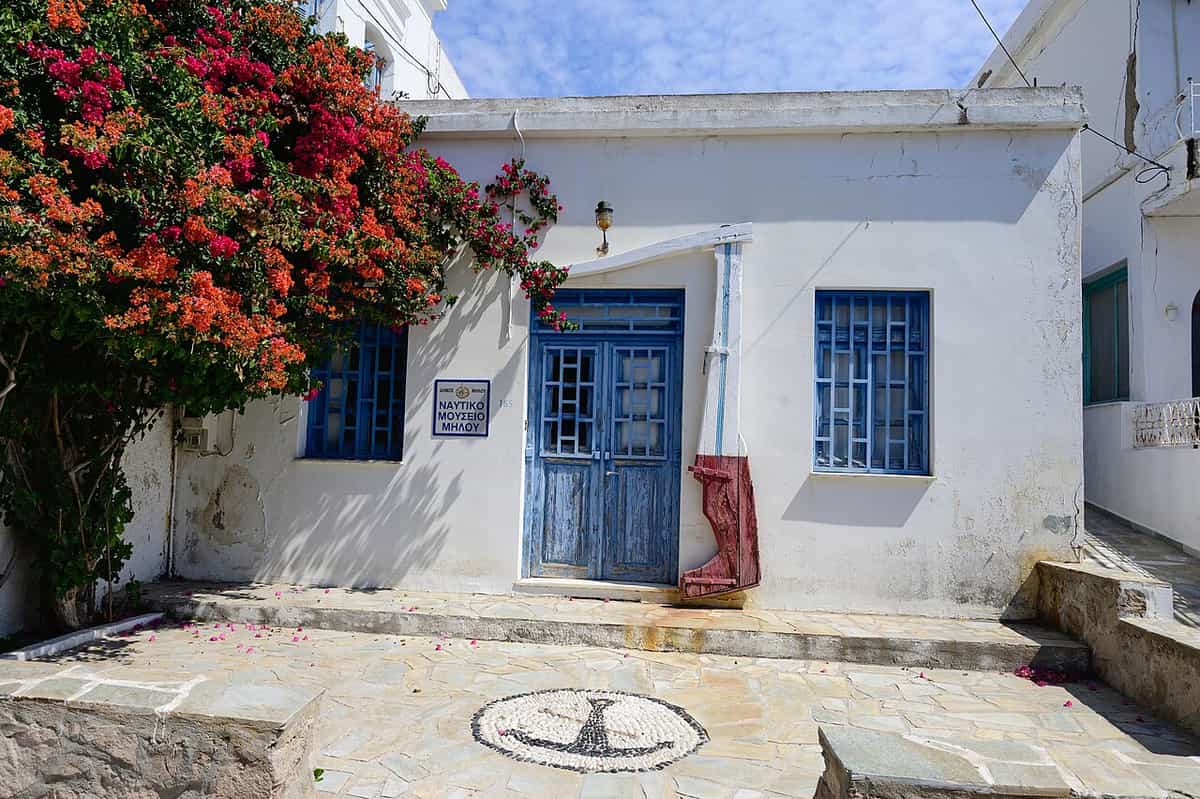
The naval museum of Milos occupies the island’s former Community building, so the visit works on two distinct levels. The rooms hold maritime material, while the building belongs to Adamantas itself. The collection stands above the harbour rather than apart from it, and the port below marks the place where sea travel reaches the settlement. This position sets objects about boats, trade and navigation beside the waterway that linked the island with other parts of the Aegean.
Adamantas lies on the north-east coast of the gulf of Milos, and it is the main port of the island. The settlement is also the cultural and commercial centre of Milos, so the naval museum of Milos stands within a working harbour town rather than an isolated site. The location gives a simple geographic order to a visit: the bay comes first outside, Adamantas forms the shore settlement, and the collection continues the maritime subject indoors.
The settlement was created by Cretan refugees in 1831 after a decision of the Kapodistrias government, and their descendants are called Milokritikoi. This origin adds a human sea story to the town, because Adamantas grew from movement between islands. The naval museum of Milos does not stand in an abstract port landscape. It belongs to a place formed by people arriving across the water, settling on the north-east shore, and making the town the island’s main port.
The place of the building above the harbour makes the naval museum of Milos a useful point for reading the town’s shape. Water, quays and the settlement lie below, while the collection is held on the slope above. The rooms bring these elements together without separating sea history from its setting. Adamantas has long been the island’s principal port, and the museum uses that harbour relationship as part of its identity, from the old Community building to the maritime exhibits.
- Setting: The museum stands above Adamantas harbour.
- Building: It occupies the island’s former Community building.
- Opening: The museum opened in September 2008.
- Town: Adamantas is the main port of Milos.
- Shore: Adamantas lies on the north-east coast of the gulf.
The naval museum of Milos makes its own location part of its subject. A visit begins in Adamantas, then moves from the harbour below to rooms in the old Community building above it. That short change of level joins the present port with the stories carried by the displays. The setting also keeps the collection tied to the gulf, which shaped movement, settlement and sea work around the island over a long period.
What does the naval museum of Milos collection show?
The naval museum of Milos collection brings ship models, navigation instruments, charts, photographs and objects of sea life into one maritime story, alongside prehistoric obsidian tools, material connected with Salamis and the wooden boat Eirini. The displays move from early sea activity to more recent objects.
Ship models give the naval museum of Milos collection a clear way to show vessels as working forms rather than distant names. Their hulls, sails and fittings point to the skills needed for travel across open water. Navigation instruments add the practical side of passage, where direction and position mattered to crews. Together, these objects turn maritime history into a sequence of tasks: building a vessel, preparing a route, reading conditions, and bringing a boat into harbour after a long run.
Charts and photographs give the naval museum of Milos collection two ways to look at the sea. A chart sets out coast, water and route in drawn form, while a photograph holds a later view of people, craft or shore life. Rare maps drawn by expert mapmakers are part of the collection. These paper objects place the island within a wider maritime world, where information about coastlines and crossings had to be gathered, made clear and carried from one voyage to another.
Objects of sea life widen the naval museum of Milos collection beyond vessels alone, placing work, domestic memory and the harbour environment beside instruments and charts. The display also holds prehistoric obsidian tools, creating a long line from volcanic stone to later maritime material. Melian obsidian moved along long trade routes and was worked into very sharp stone tools long before farming began. The rooms therefore connect objects made on land with the sea routes that carried them onward.
The wooden boat Eirini is an important physical point in this sequence, since it was built in the traditional boat-building manner of the Cyclades. It stands beside material from prehistoric times, obsidian tools, objects linked with the naval battle of Salamis and more recent objects. The naval museum of Milos keeps early and later periods in view together. A boat, a map, a model, a photograph and an instrument each offer a different entry into the maritime experience of the island.
- Models: Ship models show forms of vessels in the maritime story.
- Instruments: Navigation instruments bring route finding and sea travel into focus.
- Charts: Rare maps drawn by expert mapmakers form part of the collection.
- Photographs: Photographs add later views of maritime life and the harbour.
- Boat: Eirini shows the traditional boat-building manner of the Cyclades.
The naval museum of Milos presents different kinds of evidence. Stone tools point to early exchange, while charts and instruments concern planned movement on water. Photographs and objects of sea life bring people and shore activity into the frame. Eirini supplies the presence of a full-sized wooden craft. Read together, these items make the harbour’s history more than a line of dates or a display of separate things kept apart, and the rooms set each one beside the next.
How does the naval museum of Milos explain Milos and the sea?
The naval museum of Milos explains a sea history shaped by the gulf, a natural harbour in the hollow of the principal crater, and by the island’s place between mainland Greece and Crete. Obsidian, boats and seafaring linked Milos with distant places from very early times.
The gulf of Milos works as a natural harbour, since it fills the hollow of the main crater. It enters from the north-west and divides the island into two broad parts that are joined by a narrow isthmus. Its water becomes shallower inland, from 130 to 55 metres. The naval museum of Milos faces this maritime setting through Adamantas. The gulf is not only a view from the port, but a physical feature that gave boats a protected place.
Milos lies midway between the Greek mainland and Crete, and that setting, with its obsidian, made the island a major centre of early Aegean civilisation. Obsidian was a commodity from Milos as early as 15,000 years ago. Crews came for it by boat, hauled their craft into a sheltered cove and cut chunks of the volcanic glass from the quarry faces. The naval museum of Milos uses prehistoric tools to bring this older maritime movement close to the present harbour.
The story of navigation is also a story of skill. The history of Milos names Petros Mikelis, a Melian navigator who led the English fleet at the naval battle of Navarino, where his death helped to start the battle. It gives the naval museum of Milos a human link with the Mediterranean. Seafaring involved more than vessels and ports, because it depended on people able to read the sea, lead ships and carry local knowledge from one crossing to the next.
In 480 BC, the Melians refused the Persian demand for submission and contributed two warships to the Greek effort at Salamis. The naval museum of Milos includes finds that date from this naval battle. It can therefore set a major ancient conflict beside the longer pattern of island movement. The same bay that shelters Adamantas belongs to a coastline whose sea connections included trade in stone, crews in conflict and later pilots in Mediterranean fleets during the age of sail.
- Harbour: The gulf lies in the hollow of the principal crater.
- Depth: Its water diminishes from 130 to 55 metres inland.
- Obsidian: Milos obsidian was traded over long distances before farming began.
- Salamis: Melians contributed two warships to the Greek effort in 480 BC.
- Pilot: Petros Mikelis was the Melian navigator of the English fleet at Navarino.
The naval museum of Milos gives visitors a compact way to connect the harbour with the wider geography of the island. The gulf made shelter possible, while the island’s position supported contact across the Aegean and the Mediterranean. Obsidian shows an early movement of material by sea, and it travelled long distances from the island. Salamis and Navarino show later roles for Melian crews. Together, the displays and the bay describe an island whose history travelled across water.

What wartime history does the naval museum of Milos place beside the bay?
The naval museum of Milos stands near a bay linked with foreign fleets and wartime change: Adamantas was a base for the French fleet during the Crimean War, Allied navies occupied Milos in 1915, and German occupation reached the island in 1941.
During the Crimean War, Adamantas served as a base for the French fleet. A war cemetery holding British and French graves stands close to the town, and a French warship arrives once each year to pay respects to the dead. The naval museum of Milos stands within the same harbour town, so this nineteenth-century episode remains part of the local setting. The cemetery gives the military past of the bay a fixed place on land.
The bay also entered the story of the First World War. In November 1915, Allied navies occupied Milos while the Greek government faced pressure over the movement of Allied forces in Greek territory. The Allies later withdrew from the island after an agreement reached at Thessaloniki. The naval museum of Milos helps place such events against the geography of a harbour that made the island significant beyond local traffic, when foreign fleets required position, shelter and freedom of movement.
The history of Milos includes the island’s role in the Greek Revolution. On 11 April 1821, men from Spetses captured two Turkish ships in the strait between Milos and Kimolos, described as the first sea victory of the Greek War of Independence. This episode fits a longer maritime timeline. Sea conflict touched the waters around the island well before later fleets and military occupation made the bay a strategic concern for commanders on both sides of a war.
German occupation was imposed on the island in 1941. On 21 February 1943, English aircraft sank the fuel-laden cargo ship Artemis. The wartime story reached ordinary people too, because 14 residents were executed after material from the sunken vessel came ashore. The naval museum of Milos stands in Adamantas, where a large shelter was later restored. The harbour and the town still carry traces of that period, when control, bombardment and wreckage shaped daily life and the need for protection.
- Crimea: Adamantas was a base for the French fleet during the Crimean War.
- Cemetery: British and French war dead lie in a military cemetery near Adamantas.
- Allies: Allied navies occupied Milos in November 1915.
- Occupation: German occupation was imposed on the island in 1941.
- Artemis: English aircraft sank the cargo ship Artemis on 21 February 1943.
The naval museum of Milos places sea history within a bay that drew attention in war as well as in peace. French, British, Allied and German forces appear in separate periods, while the Greek Revolution brought fighting to the strait near Milos. The sheltered form of the gulf helps explain why fleets looked to it for anchorage. The town, the cemetery, the shelter and the collection keep those events linked to a present-day harbour landscape.
How does the naval museum of Milos fit a visit to Adamantas?
The naval museum of Milos fits naturally into Adamantas because it stands above the harbour in the old Community building, while the town also holds the Mining Museum, the Ecclesiastical Museum, the Church of the Assumption and the Catholic church of St Nicholas.
Adamantas gives the naval museum of Milos a setting where maritime, mining and church history sit in the same harbour town. The position above the port keeps the sea at the centre of a walk through the settlement. The other museums cover minerals and church material, creating different ways to approach the island’s past. Each subject has a distinct focus, yet all belong to Adamantas, the principal port where arrivals by sea remain part of daily life.
The museums of Milos include the Naval, Ecclesiastical and Mining Museums in Adamantas. The naval museum of Milos differs by concentrating on vessels, navigation and the sea connections of the island. The Ecclesiastical Museum is close to the port, in the Church of the Holy Trinity. The Mining Museum presents mineral history and geological wealth. Together, these nearby collections give Adamantas a varied cultural route without leaving the harbour town, and each can be reached on foot from the port.
The Adamantas page names the Church of the Assumption, the Catholic church of St Nicholas, the Mining Museum and the Ecclesiastical Museum among the sights of the town. It also notes the German refuge and the spas. The naval museum of Milos adds a further stop to this group. Its old Community building and harbour position create a practical connection between the port outside and displays that follow sea activity across the long periods of island history.
A visit can use the harbour as the starting point and the museum as the place to pause over the wider story. The naval museum of Milos gives context to what the gulf shows: a natural harbour, a main port and a route into the island. The town adds religious, mining and wartime places to the same area. This makes Adamantas suitable for a visit that moves between waterfront, buildings and collections without treating maritime history as a separate subject.
- Port: Adamantas is the main port and cultural centre of the island.
- Naval: The maritime collection stands above Adamantas harbour.
- Mining: The Mining Museum is among the sights of Adamantas.
- Church: The Ecclesiastical Museum is housed in the Church of the Holy Trinity.
- Refuge: Adamantas includes a German refuge among its sights.
The naval museum of Milos works well as one element of Adamantas rather than a stop without context. The harbour explains the maritime theme, and the surrounding sights extend the story of the town into religion, minerals and wartime memory. Its position in the old Community building also adds a civic layer to the visit. A route through Adamantas can move from the waterfront to the collection and then to the other local landmarks nearby.

What do visitors ask about the naval museum of Milos?
The naval museum of Milos is above Adamantas harbour in the old Community building and presents maritime material from prehistoric obsidian tools through Salamis finds to more recent objects. The answers below cover its setting, collection, the gulf and the sea history that surrounds Adamantas.
Where is the naval museum of Milos?
The museum itself is above Adamantas harbour, in the island’s former Community building. Adamantas is the main port of Milos and lies on the north-east coast of the gulf. The hill-side setting keeps the collection close to the waterfront, linking its rooms with the harbour and the wider bay below.
What objects does the naval museum of Milos hold?
The collection has ship models, navigation instruments, charts, photographs and objects of sea life. It also includes prehistoric obsidian tools, material linked with the naval battle of Salamis, rare maps and the wooden boat Eirini. This range brings early exchange, route making, vessels and later maritime memory into one display.
Why does the naval museum of Milos stand near a natural harbour?
The naval museum stands by the gulf of Milos, a natural harbour that fills the hollow of the main crater. The water becomes shallower inland, from 130 to 55 metres. Adamantas developed on the north-east coast of this gulf as the main port of the island, placing the collection beside the setting that shaped maritime movement.
Does the naval museum of Milos hold prehistoric material?
The collection includes prehistoric obsidian tools. Melian obsidian moved along long routes and was worked into sharp tools long before farming began. People seeking this volcanic glass arrived by boat and pulled their vessels into suitable coves. The objects connect early trade with the sea routes that made such movement possible.
What wartime events surround the naval museum of Milos in Adamantas?
The naval museum stands in Adamantas, which was a base for the French fleet during the Crimean War. Allied navies occupied Milos in November 1915, and German occupation was imposed on the island in 1941. The nearby military cemetery and the restored Adamantas shelter keep parts of this wartime story visible around the harbour.
What else is near the naval museum of Milos in Adamantas?
The naval museum is in Adamantas, which also has the Mining Museum and the Ecclesiastical Museum in the Church of the Holy Trinity. The Church of the Assumption, the Catholic church of St Nicholas, a German refuge and the spas are among the other named sights of the town. These places extend a harbour walk beyond maritime exhibits.