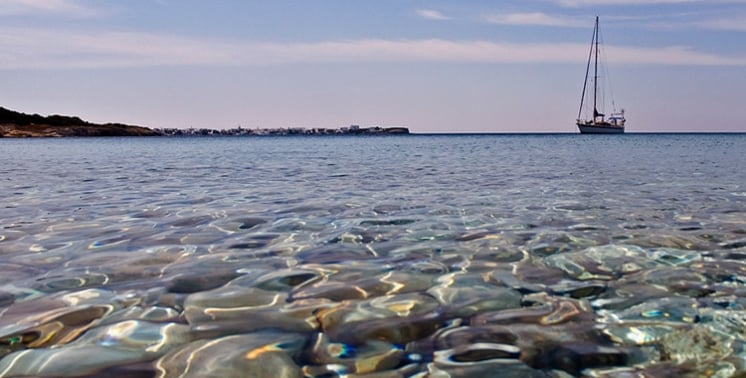
Two things played an important role in shaping the history of the island: its mineral wealth and its privileged position in the southwestern part of the Cyclades, halfway between mainland Greece and Crete. Many experts argue that in prehistoric times obsidian was already being mined on Milos, even before the island was inhabited. But certainly, after the island was settled, obsidian was worked and exported.
At the archaeological site of Phylakopi, visitors can still see today the waste from the processing of obsidian: fine, sharp black stones scattered across the settlement. In Greece, obsidian, this hard black volcanic rock, is found only on Milos and Nisyros. Because the composition of the rock differs from place to place, archaeologists who find obsidian objects at various prehistoric excavations are able to recognize where it came from.
As on other Cycladic islands, the first inhabitants of the island were probably settlers from the nearby coast of Asia Minor or Phoenician navigators. Milos took part in all phases of the development of the Cycladic civilization. The next inhabitants of the island were Dorians from Laconia, who moved the center of the island from Phylakopi to Klima, where they built a fortified settlement.
The inhabitants of Milos honored their ancestors, the first Dorian settlers, and always cherished friendly feelings toward their mother city, Sparta. The Doric origin also played a role during the Persian Wars. Milos was one of the few islands that resisted the Persians. It even took part in the famous battle of Salamis, which proved Greek supremacy at sea, and in the battle of Plataea, which sealed the Greek victory.
During the Peloponnesian War, despite all its friendly feelings for Sparta, Milos wanted to remain neutral, and it paid in the worst way. The Athenians conquered Milos in 416 BC, killed all the men and sold the women and children as slaves. Thucydides describes this black page in the history of imperialist Athens in the fifth book of his history.
Thucydides describes in masterly fashion the dialogue and negotiations between the leaders of the island and the Athenian representatives. This dialogue is a hymn to the love of freedom and free will and, at the same time, a condemnation of the strongest, who cynically impose their will by force.
Despite the destruction, Milos was able to recover in the following centuries and was in full bloom in the Hellenistic era. In this period of bloom the famous statue of Aphrodite, which graces the halls of the Louvre, was made. The bloom continued into the Roman era, when the ancient theater, which still survives, was completed. During that time, Milos had a large Christian community, which built catacombs for its religious needs. After the Romans, Milos shared the common fate of all the Cyclades, belonging successively to the Byzantines, the Duchy of Naxos and finally the Ottoman Empire. During the Ottoman period, Milos, with its volcanic formations, became an anchorage and a base for pirates, and from that time we have the place names Sarakiniko and Kleftiko.
The Melians took an active part in the Greek Revolution from the first moments, giving money and crews to the revolutionary fleet. On 11 April 1821, the first naval success of the revolutionary forces in Greece became a reality when men from Spetses captured two Turkish ships in the strait between Milos and Kimolos. The Melians are known for their seamanship throughout the Mediterranean, and especially as pilots (navigators). It is characteristic that the pilot of the English fleet in the naval battle of Navarino was the Melian hero Petros Mikelis. His death played a major role in the start of the battle that led to the destruction of the Turkish fleet and the freedom of Greece.
Since 1830, Milos has followed the historic course of the poor, newly founded Greek state. In 1836, Sfakian rebels found refuge on Milos and settled in Adamas. Things changed for Milos from the interwar period, when the intense exploitation of its mineral wealth began. It continues to this day and has brought prosperity to the island. In recent years, tourism has also developed, with the right infrastructure: a new harbor, a marina, good roads, museums and traditional villages that highlight the particular character of the island, and hotel accommodation of every level in a wide variety.
Milos Advisor presents the past of a volcanic island in the south-western Cyclades. Its story reaches from stone tools cut fifteen thousand years ago to a fishing harbour built in the nineteenth century. This page follows the history of Milos in seven periods, from the first quarries to the tombs below the fields of Trypiti.
The island lies between mainland Greece and Crete, and that position shaped its fortunes. Volcanic glass, good harbours and a sheltered bay drew traders, settlers and fleets. Athens, Sparta, Rome, Byzantium and Venice all left marks on the place. Each period added something to the landscape, and old sites across the island preserve the sequence in stone.
What are the main periods in the history of Milos?
The history of Milos runs through seven periods. Stone Age quarrymen cut volcanic glass, Bronze Age settlers built Phylakopi, Dorian Greeks founded a city, Athens besieged it in 416 BC, Rome and Byzantium followed, Venice ruled, and the island joined Greece.
The first people reached the island before farming. They came by boat for volcanic glass and left no villages at that time. Bronze Age Phylakopi followed on the north coast, and people lived there from the middle of the third millennium BC to the twelfth century BC. Dorians settled later, no earlier than the first millennium BC, and placed their city on the eastern shore. Trade, war and writing came later, and the history of Milos never ran straight.
The classical city minted its own coins and stood apart from Athens. In 416 BC an Athenian force took the place, killed the men of fighting age and enslaved the women and children. Five hundred Athenian colonists moved in, and Sparta removed them in 405 BC. The following centuries belonged to Macedon and then to Rome, and the harbour below Trypiti stayed busy. Wealth returned again, and the history of Milos recorded it in marble.
Byzantium held the island for centuries, and a document of 1198 names it as valuable. After the Fourth Crusade a Venetian nobleman took Milos with the other Cyclades and ruled as Duke of Naxos. Venice handed the duchy to the Ottoman Empire in 1566, and the Ottomans annexed it in 1579. Taxes were heavy, pirates used the bays, and the population fell below five hundred people by 1798, so the medieval history of Milos turned quiet.
The island joined the Greek War of Independence in 1821, and the first naval success of the revolt took place off its coast on 11 April 1821. Cretan refugees founded the port town of Adamantas in 1841. Mineral mining began between the two world wars and brought money to the place. Tourism grew later, and the population reached 5,193 people at the census of 2021. The modern history of Milos rests on that base.
- Stone work: Quarrymen cut glass at Nychia and Demenegaki.
- Bronze Age: Phylakopi began in the third millennium BC.
- Classical era: Dorian Melos struck silver coins.
- Roman rule: Roman influence began in 197 BC.
- Modern state: The island joined Greece in 1821.
The history of Milos is a chain of short chapters, and each one left something on the ground. A quarry, a ruined town, a coin, a siege, a statue without arms and a set of underground tombs mark the stages in order. The periods fit together, from the first boats that came for glass to the harbour that serves the island now.
Why does obsidian matter to the Neolithic history of Milos?
The history of Milos begins with obsidian, the glass-like volcanic rock that traders carried across the Aegean Sea long before farming. Quarrymen cut it at Nychia and Demenegaki and sent sharp blades to settlements from Crete to Macedonia.
Obsidian is a volcanic glass that forms when lava cools quickly. It is hard and brittle, and it breaks with very sharp edges, which suits the cutting of tools. On Milos the rock was a commodity as early as 15,000 years ago, and it travelled long distances well before farming began. No early farming village in the Near East was without it. The history of Milos starts with exports rather than with a town.
Quarrying did not create a settlement. People in search of obsidian arrived by boat, beached the craft in a cove and cut pieces of glass from the rock. During the Neolithic period there were temporary camps for extraction and processing, and fishing played a part. Sailors knew the route by the sixth millennium BC, because Melian obsidian has been found from Knossos on Crete to Nea Nikomedeia in Macedonia. The trade is the early history of Milos.
The main workings lay at Nychia and Demenegaki, two sites on the island. The position of Milos between mainland Greece and Crete helped, and the place grew into an important centre of early Aegean civilisation. Human presence on Milos reaches back to the Mesolithic period, the eighth millennium BC, and the first inhabitants are named as Phoenicians or Carians. Obsidian gave the history of Milos its first importance. The glass came first, the farms later.
The value of the glass faded as metal took over. When bronze became the preferred material for weapons, Milos lost its arms-making importance and the quarries went quiet. That trade closed, and the stone still marks the start of the story on the island. Fine chips of black glass lie on the ground at Phylakopi, and a museum collection in Plaka holds examples of the rock. The early history of Milos belongs to this trade in volcanic glass.
- The rock: Obsidian breaks with very sharp edges.
- Trade: Melian glass reached Crete and Macedonia.
- Quarries: Nychia and Demenegaki served the trade.
- Boats: Sailors beached their craft and cut glass.
- Decline: Bronze weapons ended the demand.
Obsidian opened the history of Milos. It drew sailors to a coast that had no town, no fields and no ruler, and it gave the island a place on a map that stretched from Crete to the northern Aegean. When bronze arrived, that place changed, and the people moved inland to build Phylakopi. The first chapter of the story closed there.
What did work at Phylakopi reveal about the Bronze Age history of Milos?
The history of Milos in the Bronze Age is written at Phylakopi, a settlement on the northern coast that lasted from the middle of the third millennium BC until the twelfth century BC. Excavations revealed a town wall, frescoes and a Mycenaean hall.
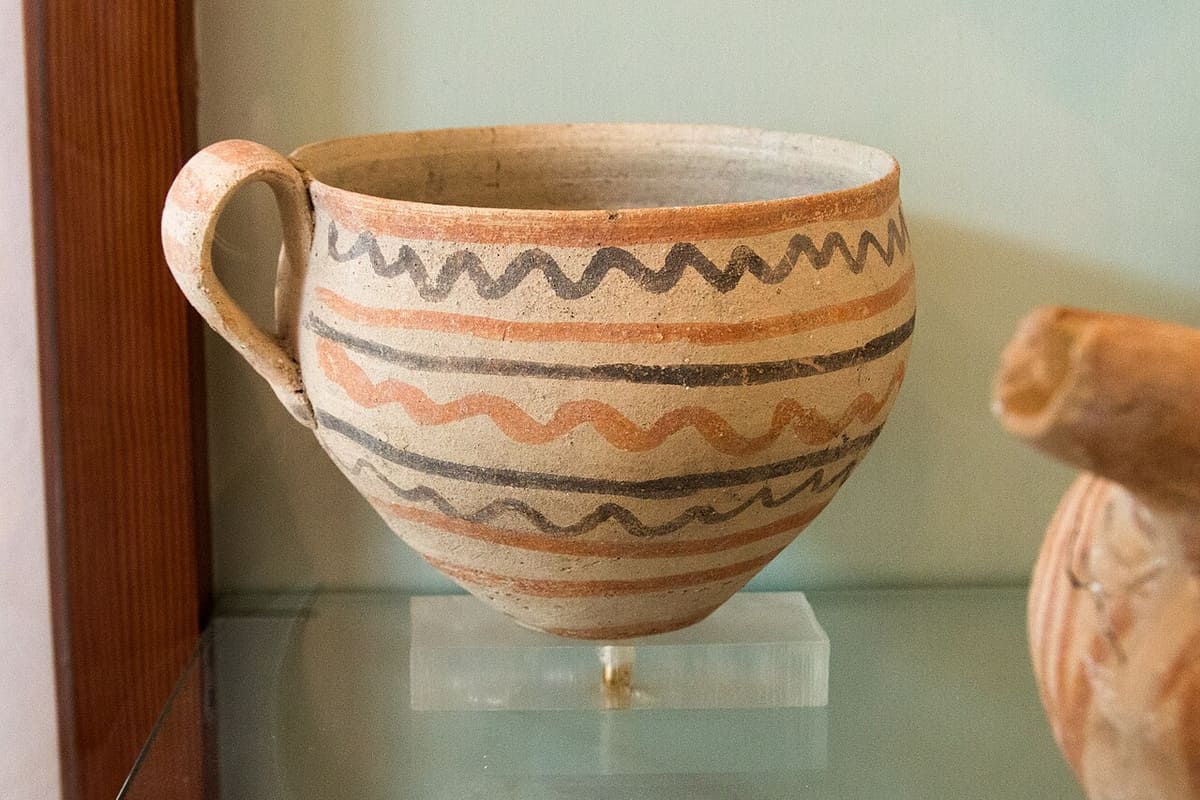
Phylakopi ranks among the great Bronze Age settlements of the Cyclades. Its value lies in continuity, since people lived there from the middle of the third millennium BC until the twelfth century BC. That long span made it the reference site for the Bronze Age of the region. Work began in 1896 and named three phases, the last two linked to Cretan and Mycenaean influence. The history of Milos in those centuries is read from its floors.
The first settlers were tuna fishermen who arrived as the obsidian trade declined. They built a small village, which grew during the Middle Bronze Age. Pottery from Crete appeared in quantity, and the settlement took on Cretan habits. A pillar room held vivid paintings, and the fresco of a flying fish came from its ruins. Part of the site has been washed away by the sea. The early chapters of the history of Milos begin here.
Mycenaean power followed. A hall of the Mycenaean palace type, a megaron, stood at Phylakopi and appears nowhere else in the Cyclades. Its main room measured 8.6 by 6.2 metres, with a hearth about 2.4 by 1.65 metres and a stone threshold 2.2 metres long. Beneath lay an older building, the Mansion, with a Linear A tablet fragment and ash from the eruption of Thera. In this phase the history of Milos was tied to Mycenae.
A shrine found in the 1970s held collections of figurines, among them the Lady of Phylakopi. The shrine is without parallel in the Bronze Age Cyclades and gave a view of belief and ritual at the site. The town was abandoned in the twelfth century BC and never occupied again. Its ruins stand close to the modern village of Phylakopi on the north coast. The later history of Milos starts with an empty green hill.
- Phases: Three phases span the Bronze Age.
- Wall: A town wall protected the settlement.
- Fresco: A flying fish adorned the pillar room.
- Shrine: Figurines include the Lady of Phylakopi.
- End: The town was abandoned and never reoccupied.
The Bronze Age history of Milos rests on this one hill above the sea. A fishing village grew into a walled town, took Cretan fashions and then came under Mycenaean rule. Its shrine, its painted rooms and its imported pots show a community linked by sea to the whole Aegean. Then the place emptied, and later settlers chose another shore.

How did the Dorians and the classical city shape the history of Milos?
The history of Milos in the classical age belongs to Dorian settlers who arrived no earlier than the first millennium BC and built a city on the eastern shore of the bay, south-west of Trypiti. It minted its own coins.
The Dorians belonged to the same ethnic group as the Spartans, but the settlers made themselves independent. They honoured the first settlers and kept friendly feeling toward Sparta. Their city stood on the eastern shore of the bay, just south-west of the present village of Trypiti, and the ancient town also reached the slope between Trypiti and the landing place at Klima. From that point the history of Milos became the story of a city.
The coins followed the Milesian standard, with a stater of just over 14 grams, and Melos was the only Aegean island to use it. An apple appeared on the coins, a play on words, because the Greek word for apple sounded like the island name. The coins carried the name of the people, and the history of Milos remembers them. From the sixth century BC until the siege of 416 BC the city struck silver.
The Melians learned to write by the sixth century BC and used an archaic Greek script with Cretan and Theraic features. That script was dropped after the siege. Workshops exported terracotta reliefs for doors and chests, decorated with myth scenes. The island stood apart from the Athenian alliance, and the city kept its own walls, its market place and its sanctuaries on the slope above the shore. This period is the classical history of Milos.
In 480 BC the Melians refused to submit to Persia and sent two warships to the Greek fleet at Salamis. Dorian kinship did not pull them into a war they did not want. During the long struggle between Athens and Sparta the city stayed neutral and paid no tribute, a decision that brought ruin later. The classical history of Milos ends with a siege, and the stones of the walls still lie on the hillside.
- Origin: Dorian settlers from Laconia founded the city.
- Coinage: The stater followed the Milesian standard.
- Writing: An archaic script served the city.
- Craft: Terracotta reliefs were exported abroad.
- Defence: The Melians refused tribute to Athens.
The classical city shows how a small community on a rocky island lived by trade, by craft and by its own rules. Its coin, its script and its pottery travelled abroad, while its rulers kept out of the alliances of the great powers. That choice cost the city everything in 416 BC, and the history of Milos turned again after that.
What happened in the history of Milos during the siege of 416 BC?
The history of Milos turned in 416 BC, when Athens sent at least 3,400 men against a neutral island. The Melians refused to surrender, the city fell in the winter, and the Athenians executed the men and enslaved the women and children.
Melos was the only significant Aegean island that Athens did not control at all. The people were Dorians, like the Spartans, but they stayed out of the war. In 426 BC Athens sent 2,000 men to raid the countryside, and the Melians refused to submit. In 425 or 424 BC Athens demanded a tribute of fifteen talents of silver, about 390 kilograms. The island declined to pay, and the history of Milos moved toward disaster.
The attack came in the summer of 416 BC. Athens landed at least 3,400 men: 1,600 heavy infantry, 300 archers and 20 mounted archers from the city, with 1,500 from allied states. A fleet of 38 ships carried them, 30 from Athens and the rest from Chios and Lesbos. Envoys demanded that Melos join the alliance and pay tribute or face destruction. The Melians refused, and the history of Milos turned to a siege.
Thucydides set down the talks as the Melian Dialogue in the fifth book of his history. He was in exile and did not hear the words, so the text is a reconstruction. In it the Athenians give no moral reason for the attack and say that the strong do what they can and the weak suffer what they must. The Melians put their hope in the gods and in Sparta. The dialogue is central to the history of Milos.
The siege lasted into the winter of 416 to 415 BC. The Melians attacked the besieging line and at one point took part of it, but no rescue arrived. The city surrendered. The city lost its people in one season. The men of fighting age were executed and the women and children sold into slavery. Five hundred Athenian colonists were settled there, and a new chapter of the history of Milos opened under foreign rule.
- Transfer: Five hundred colonists were settled there.
- Reversal: Lysander drove the colonists out.
- Return: The survivors came back to their fields.
- Change: The coinage moved to the Rhodian standard.
- End: The city became Spartan territory.
The siege of 416 BC left a mark on the history of Milos that later wealth did not erase. A neutral city with an old name and its own coin lost its people in a single winter. The dialogue written about the talks still carries the argument, and the walls above the harbour still show where the line of defence ran.
How did Hellenistic and Roman rule shape the history of Milos?
The history of Milos in Hellenistic and Roman times brought wealth and building. The city prospered, a theatre was completed, and a statue of Aphrodite was carved that a farmer found in 1820 and that now stands in the Louvre.
In 338 BC Philip II of Macedon defeated the Greeks at Chaeroneia and became overlord of the Cyclades. Milos and Kimolos fell into a quarrel over the islands of Polyaigos, Heterea and Libea. The two communities took the case to Argos instead of to war, and the Argives gave the islands to Kimolos. The island recovered from the siege and entered a prosperous age. Money returned to the island, and the history of Milos rose again.
The Hellenistic period was a time of bloom. Public building and sculpture flourished, and the statue known as the Venus de Milo, or Aphrodite of Melos, was made then. Study places it in the second century BC, between 160 and 110 BC, though the date is not settled. Its marble is Parian, it stands over two metres high, and both arms are missing. The find is the best known event in the history of Milos.
Roman influence arrived in 197 BC, when Rome forced Philip V to withdraw from Greece. The city kept its harbour and its trade, and the theatre above the shore was completed in Roman times, cut into the hill. The ancient town stood nearer the bay entrance than the modern port, on the land between Trypiti and Klima. Remains of walls, a mosaic and public buildings have been found there. The Roman years close the ancient history of Milos.
Other works came from the same ground. A statue of Asclepius went to the British Museum, and a Poseidon and an archaic Apollo went to Athens. On 8 April 1820 a farmer dug up the Venus de Milo in a niche. A French sailor interested in antiquities urged him to keep digging. That discovery changed the modern history of Milos, and today a plaster cast of the statue stands in the Archaeological Museum of Milos.
- Overlord: Macedon ruled the Cyclades.
- Dispute: Argos gave the small islands to Kimolos.
- Prosperity: Hellenistic Milos built, carved and exported.
- Theatre: The theatre was finished in Roman times.
- Find: The Venus de Milo was found in 1820.
Hellenistic and Roman rule gave the history of Milos its richest years. A city on a slope produced sculpture that filled the museums of Europe, and its theatre and walls served a settled community. The wealth of the period rested on the harbour, on the ground itself and on the skill of its artists, and the island kept that standing for a long time.
What do the catacombs show about the early Christian history of Milos?
The history of Milos in early Christian times is preserved in the catacombs near Trypiti, an underground cemetery cut into soft volcanic rock. Three galleries served a Christian community, and one of them is open to visitors today.
The cemetery dates from the first to the fifth century AD. It lies near Trypiti, beside the market place of the ancient city and 200 metres east of the ancient theatre. The name Trypiti comes from the holes cut in the soft rock around the village. In ancient times those caves served as family burial chambers, and local people still use them as stores and stables. The early history of Milos sits in this ground.
The galleries were cut into porous rock, with a width of one to five metres and a height of 1.6 to 2.5 metres. Arched recesses in the walls held tombs, and a number of graves were cut into the floor and covered with rough stones. Certain recesses carry painted decoration with a red border and a deep blue drum, though only traces of the colour survive. These tombs belong to the Christian history of Milos.
The catacombs hold three large galleries, each once joined to smaller ones, and the three form a single complex through passages made in the twentieth century. A rectangular burial chamber in the Roman cubicula style completes the whole group. The main entrance was opened at the beginning of the twentieth century, so a visitor walks into the second gallery, the only one open at this time. The plan belongs to the early history of Milos.
A two-level tomb stands on the right of that gallery, beside a long inscription in red capitals. A block of rock was left in the middle of the gallery as an altar. Traces at the four corners, found in 1928, suggest a canopy stood over it. A figure shaped like a sarcophagus led to the idea that a bishop was buried on the spot. The history of Milos keeps the memory of this community, and the Catacombs of Milos remain open.
- Date: The tombs date from early Christian times.
- Shape: The galleries are one to five metres wide.
- Walls: Arched recesses held the tombs.
- Worship: A rock block served as an altar.
- Later life: Byzantium valued the island in 1198.
The underground cemetery closes the first part of the story, when the island held a Christian community on the edge of the Roman world. The tombs, the altar and the painted recesses show a faith that organised its own burial ground in rock. The same ground later held Venetian, Ottoman and modern Greek life, and the later history of Milos runs above.
What marks the Byzantine and Venetian history of Milos?
The history of Milos in these centuries follows the wider Cyclades. Rome gave way to Byzantium, and early Christian communities cut the catacombs near Trypiti. After 1204 Venetian nobles took the island and folded it into the Duchy of the Archipelago.
Roman rule arrived after the Macedonian wars, and the island passed to the eastern empire when Rome lost its western provinces. Christianity reached Melos early, and the history of Milos in late antiquity belongs to a community of traders and sailors. The island held a Jewish community, and the new faith spread quickly through the harbour towns. During the early ninth century Arab raiders harassed the Cyclades, and the fate of Melos then is unclear.
The early Christian community left the catacombs of Melos, an underground cemetery cut beside the agora of the ancient city. Burial galleries run between 1 and 5 metres wide and stand 1.6 to 2.5 metres high. Tombs were cut into the walls, and other graves were sunk into the floor and covered with rough stones. The site belongs to the first centuries of Christian worship, one of the early chapters of the history of Milos.
Venetian power entered the history of Milos in the aftermath of the Fourth Crusade. Marco Sanudo seized the island with the neighbouring islands and took the title Duke of Naxos. He refused to hold the duchy as a vassal of Venice and swore loyalty to the Latin emperor. His family governed for nine generations before the Crispo family replaced it. Both houses were Catholic while the islanders stayed Orthodox, and a Catholic bishop arrived in 1253.
The duchy changed hands inside the Latin world. Byzantine forces under an admiral recovered part of the archipelago at the end of the thirteenth century, yet the recovery ended in 1310. Catalan raiders struck the remaining islands in 1317. In 1383 the Crispo family took the ducal throne by force, and farming declined while piracy grew stronger still. Milos passed under the dukes at Naxos after 1418, and the duchy became a formal vassal of Venice.
- Seat: The dukes ruled the islands from Naxos.
- Religion: Catholic bishops served an Orthodox population.
- Catacombs: Early Christian burials survive near Trypiti.
- Lordship: William Sanudo gave Milos to his son Marco.
- Legacy: The duchy shaped the medieval history of Milos.
The Byzantine and Venetian centuries left the island with a Latin aristocracy, a Greek-speaking population and a landscape of fortified villages. Plaka grew on its rock above the gulf, and the castle beside it watched the sea lanes. The old ruins stayed in place through those years, and the next chapter of the history of Milos opened when Ottoman fleets entered the Aegean.
What changed in the Ottoman history of Milos?
The Ottoman history of Milos opened in 1566, when the duchy passed to Sultan Selim II. A governor collected taxes, while elected magistrates handled daily affairs. Pirates and foreign fleets ruled the sea lanes around an island with a great harbour.
The Ottoman period of the history of Milos began in 1566, when the Venetians handed the duchy to the empire and the last Catholic duke sailed away to Venice. Sultan Selim II named a Portuguese merchant of Jewish descent, Joseph Nasi, as governor of the Cyclades. When Nasi died in 1579, the islands became an Ottoman province. Melos kept its own courts and paid its taxes, and the history of Milos stayed Greek in character.
Early in the eighteenth century the population passed 6,000 people, almost all of them Greek and Christian. A Turkish judge heard cases and a Turkish governor gathered taxes. Three elected magistrates managed the island’s business, although their decisions went to the judge on appeal. Two bishops still served the island, one Orthodox and one Catholic, and the Orthodox bishop drew the larger income. The history of Milos in this period is a story of self-rule under foreign demands.
Piracy shaped daily life. The volcanic coast offered hidden coves, and the island became an anchorage and a base for pirate crews during the Ottoman centuries. Two beaches still carry local names from that era, Sarakiniko and Kleftiko. Shipping suffered, and islanders learned to read the sea for danger. Foreign navies patrolled the same waters, and American and British ships used the harbour for years. Raids at sea stayed part of the history of Milos.
Russian ships held the island for three years from 1771 and then handed it back to Ottoman control. The population fell sharply afterwards, dropping below 500 people by 1798, while visitors described two thirds of the buildings in ruins. Recovery came later, and 5,000 people lived on the island by 1821. French interest in the harbour lasted longer: a military cemetery near Adamas holds soldiers of the Crimean War, and a French warship arrives each year.
- Annexation: The Cyclades became an Ottoman province.
- Taxation: A governor collected taxes for the empire.
- Self-rule: Three elected magistrates handled daily business.
- Piracy: Hidden coves made Melos a base for raiders.
- Russians: The imperial fleet held the island from 1771.
The Ottoman centuries left marks that visitors still notice. Churches and chapels kept the Orthodox faith alive under a Catholic and then a Muslim administration, and place names on the coast recall the crews that hid there. The population rose and fell with war and taxation, and the next stage of the history of Milos belongs to the new Greek state.
How did the Venus de Milo shape the history of Milos?
The modern history of Milos turns on a single morning in 1820, when a farmer dug up a marble goddess in two large pieces. French officers recognised the find, and the statue left the island for Paris, where it entered the Louvre.
The discovery happened on 8 April 1820. The farmer was working among the ruins of the ancient city when his spade struck marble, and the history of Milos changed in a single day. A French sailor with an interest in archaeology watched the digging and urged him to continue. They lifted two large pieces of the figure and a small fragment. A hand holding an apple and two square pillars lay nearby in a shallow niche.
News of the find travelled quickly. A French naval officer who reached the island soon after wrote an account and carried the story to Constantinople, where he told an assistant of the French ambassador. The ambassador agreed to send an agent to Melos to buy the statue. By then the farmer had received another offer and the figure had been loaded onto a ship. The French delegation intervened, bought the figure and carried it to Paris.
The statue reached France as a gift for King Louis XVIII, who placed it in the Louvre, where it has stayed since 1821. It is carved from Parian marble, stands over two metres high and has lost both arms. Scholars date it to the second century before Christ, between 160 and 110 BC. A lost inscription links the work to a sculptor from Antioch, and the statue remains the best-known object in the history of Milos.
Local memory of the discovery survived in the villages. In the account told on Milos, the farmer used the marble as a fence in his field before anyone understood its value, and treasure hunters later tried to steal the statue without success. A full-size copy made in the Louvre workshops stands in the archaeological museum of Milos. Two marble hands from the harbour belong to another statue, and the niche where the marble lay is empty today.
- Date: The figure was lifted in 1820.
- Farmer: Georgios Kentrotas found the marble on his land.
- Material: The statue is carved from Parian marble.
- Height: The figure stands over two metres tall.
- Display: The Louvre has shown the Venus since 1821.
The departure of the Venus gave the island a fame that no other discovery matched. Travellers came to see where the goddess had slept in her niche, and the ancient city beside Klima gained new attention. Excavations followed, and museums on the island filled with finds from the same ground. The story remains the best-known chapter of the history of Milos.
How did independence reshape the history of Milos?
The nineteenth-century history of Milos begins with revolution. Melian crews joined the Greek rising of 1821, and the first naval clash of the war was fought off the island. After independence the old inland capital emptied, and Cretan families settled the harbour.
Milos was among the first islands to join the Greek War of Independence in 1821. On 11 April the first naval engagement of the war took place off the coast, in the strait between Melos and Kimolos, where crews from Spetses captured two Turkish vessels. Melian sailors were known across the Mediterranean for their skill, and the island gave money and crews to the fleet. The rising opened a new phase in the history of Milos.
The London Protocol of 1830 brought the island, with the other Cycladic islands, into the newly founded Greek state. Melos then followed the course of a poor young kingdom. Public offices, schools and churches were organised from scratch, and the harbour became the busiest place on the island. Families left the land for the coast, and ship owners and merchants settled around the bay. From that moment the history of Milos ran with the Greek state.
The old capital lay inland. Zefiria, founded in the Venetian period and in the thirteenth century, had served as the island’s capital before the seat of government moved to Plaka. Strong earthquakes in the middle of the eighteenth century drove much of the population away, mainly towards Adamas, and the town never recovered. Today it is a village 5.5 km from Adamas, and Zefiria keeps the Old Cathedral beside the walled church of Saint Nicholas.
Adamas grew from a settlement of Cretan refugees. The community took shape in 1831, after a decree of the Greek government, and its descendants are still called Milokritiki. Families from Sfakia found refuge on the island in 1836 and settled at Adamas, and the port received another wave of Cretan refugees after the Cretan Revolt of 1841. A military cemetery near the shore holds British and French soldiers of the Crimean War, when the French fleet anchored.
- 1821: The island joined the Greek rising.
- Battle: The first sea fight happened off Melos.
- Navarino: A Melian sailor piloted the British fleet.
- Statehood: The protocol of 1830 joined the island to Greece.
- Refugees: Cretan families settled the new port at Adamas.
By the end of the nineteenth century the island had a new shape. The harbour town held the ships and the shops, Plaka kept the government and the museums, and the inland villages kept the fields. A traveller in 1883 noticed that trade had moved to Syros. Those years gave the modern history of Milos its lasting map of harbour and hill town.

What did mining add to the history of Milos?
Mining runs through the history of Milos from the stone age to the present. Obsidian from the island travelled across the Aegean before farming began, sulfur and millstones came later, and bentonite, perlite and pozzolana now leave the harbour.
Obsidian was the island’s first export. The glassy volcanic stone was gathered at Melos 15,000 years ago and carried to settlements far from the Aegean, where it was shaped into cutting tools. Melian earth, a pale material rich in kaolin, served painters as a white pigment, and sulfur from the island was counted the richest source in the ancient world. Mining opened the history of Milos long before any city stood on the island’s soil.
Sulfur, millstones, gypsum and baryte were worked in the nineteenth and twentieth centuries. Sulfur mining lasted until the middle of the twentieth century, millstone cutting ended in the early years of the same century, and baryte was extracted until 2000. Old workings still mark the western half of the island, where pits, shafts and ruined loading piers stand above quiet beaches, and one sulfur pit on the coast kept a small settlement for its workers.
The trade changed after the First World War. From the interwar years the island’s mineral wealth was exploited on a large scale, and that activity continues, bringing prosperity to the island. Bentonite, perlite, pozzolana and small quantities of kaolin are taken from open pits and sold abroad. In Adamas the mineral museum of Milos opened in 1998 and presents the minerals mined here from the Neolithic age, with films and the memories of old miners.
Volcanic ground also promised power. The island group of Milos, Kimolos and Polyaigos holds the first high-temperature geothermal field identified in Greece, with a potential of about 120 megawatts of electricity. A pilot station of two megawatts began operating in December 1986 and covered the island’s own electricity needs for two years. Local reaction to the smell of hydrogen sulfide stopped the programme in 1989, and hot springs still show the heat below the surface.
- Obsidian: The island supplied stone tools across the Aegean.
- Sulfur: Coastal pits produced sulfur for centuries.
- Baryte: Extraction continued until 2000.
- Bentonite: Open pits still send bentonite abroad.
- Pozzolana: One pit still works today.
Mining gave the island a second identity. Miners, engineers and shippers arrived, roads and piers were built, and the port of Adamas became a place of trade rather than a shelter for fishing boats. Museums, geological walks and old workings tell that story to visitors. The mineral chapter of the history of Milos is not closed, and ships still load industrial minerals at the quay.
How does the war appear in the history of Milos?
War reached the modern history of Milos in the spring of 1941, when German forces occupied the island alone among the Cyclades. A garrison stayed for years, shelters were built, and in 1943 fourteen islanders were shot. Tourism and mining shaped the decades that followed.
German troops took the island in the spring of 1941, at a time when the other Cycladic islands fell inside the Italian zone. A permanent garrison stayed, and engineers built air raid shelters and defence works along the coast, including the castle above Plaka. Remains of those works survive, and they mark the darkest years of the history of Milos. Residents suffered hunger and bombing, and fifty deaths from starvation and air raids were counted.
The worst day came in February 1943. A cargo ship loaded with fuel and ammunition was moored at Adamas when Allied aircraft attacked it, and the vessel blew up. Barrels from the wreck drifted onto a beach, and islanders who went to collect them were arrested. Twenty-five people were detained and fourteen were chosen for execution; they were shot by a firing squad at Alyki beach. A plaque with their names was placed in 1992.
The occupation also left the shelters beneath the island. The refuge at Adamas was built on the orders of the German army and consists of twelve large chambers that open on both sides of a central passage below the modern town. For years it served as a water reservoir, since the entrance was hard to reach, and later it was restored and opened to the public. Artists re-inhabited the space, as the Refuge Project records.
After the war the island rebuilt its economy. The population had peaked in 1928 at 6,562 people, fell to 4,977 in 2011 and reached 5,193 in 2021. Mining and tourism now carry the island, and the harbour town of Adamas is the commercial centre, while Plaka keeps the government offices and the museums. Milos also served as a place of exile for political prisoners in the twentieth century, a darker thread in the history of Milos.
- Occupation: German forces took the island in 1941.
- Shelters: Twelve chambers were cut below Adamas.
- Executions: Fourteen civilians were shot at Alyki.
- Memory: A plaque with their names was placed in 1992.
- Population: The island counted 5,193 residents in 2021.
The twentieth century left the island with a difficult memory and a working economy. Fortifications crumble on the headlands, the shelters under Adamas draw visitors, and the annual service at Alyki keeps the names of the dead. The modern history of Milos is a story of recovery, and the island looks forward while its old walls keep the past visible.
What are the main questions about the history of Milos?
The history of Milos stretches from obsidian gathering in the stone age through Roman, Byzantine, Venetian and Ottoman rule to the Greek state, the mineral industry and the war years. Its best-known moment remains the discovery of the Venus de Milo in 1820.
Where does the history of Milos begin?
The earliest chapter belongs to obsidian. The glassy volcanic stone was collected on Melos 15,000 years ago and shipped across the Aegean for tools, before farming reached the region. Settlements followed at Phylakopi and Klima, and the island prospered on trade. Its place between the mainland and Crete kept it busy.
Which empires ruled during the history of Milos?
Rome took Melos after the Macedonian wars, and the eastern empire inherited it. Venetian nobles seized the island after 1204 and ruled through the Duchy of the Archipelago, whose dukes held it until 1566. Ottoman rule followed for more than two and a half centuries. The London Protocol of 1830 then joined Melos to the Greek state.
How did pirates affect the history of Milos?
Piracy touched every century of the island’s sailing life. Under the Crispo dukes sea raids grew stronger, and in Ottoman times Melos became an anchorage and a base for pirate crews, who used its hidden coves. Two beaches, Sarakiniko and Kleftiko, carry names from those years. Foreign ships patrolled the same waters.
How does the Venus de Milo belong to the history of Milos?
The statue entered the history of Milos in 1820, close to the ruins of the ancient city. A farmer uncovered the marble figure, French officers arranged its purchase, and it reached Paris as a gift for King Louis XVIII, who placed it in the Louvre. The original remains there, while a copy stands on Milos.
What changed in the nineteenth-century history of Milos?
Revolution came first. Melian crews joined the Greek rising in 1821, and the first naval battle of the war was fought off the coast on 11 April. After the London Protocol of 1830 the island entered the new kingdom. The inland capital at Zefiria lost its people to earthquakes, and Adamas grew into the port town.
How did mining shape the history of Milos?
Mining has supported the history of Milos from prehistory to the present day. Obsidian, sulfur, millstones, gypsum and baryte were worked in turn, and today bentonite, perlite and pozzolana leave the harbour for markets abroad. The mineral museum at Adamas explains that record, with films and the memories of the miners who cut the pits.
How did the war enter the history of Milos?
German forces occupied the island in 1941, alone among the Cycladic islands. The garrison built shelters and defence works, and the refuge beneath Adamas survives with twelve chambers. In February 1943 a cargo ship was sunk at the port, and fourteen islanders were shot at Alyki beach after collecting material from the wreck.
Where can the history of Milos be seen today?
The past is close to the surface. The catacombs near Trypiti, the ancient theatre above Klima, the castle at Plaka and the archaeological museum hold the early chapters, while the mineral museum at Adamas explains the industrial years and the shelters below the town recall the war. Zefiria keeps its cathedral.