Tarantella Restaurant, Agios Sostis
Kipos restaurant, Kipos
Food in Provatas is a beach meal on the south coast of the volcanic island of Milos. The settlement is small, the sand is golden red and the water is very shallow.
This page describes food in Provatas as a place first, then the dishes of Milos cooking that belong on a table by the sea: fresh fish, salad, pies and local cheese.
What is food in Provatas at a glance?
Food in Provatas is the beach-side cooking of a small settlement on the south coast of Milos, where golden-red sand meets very shallow water. Taverns and rooms to let belong to the shore, and the beach is set up with sunbeds and umbrellas.
Provatas is a settlement and a beach in the south of Milos, within the Municipality of Milos. Food in Provatas belongs to the south coast, between Fyriplaka to the east and Kipos further west. The island is shaped like a horseshoe, is the south-westernmost of the Cyclades and counts twenty-one beaches on its south side. Lists of those beaches run from east to west, and Provatas comes after Fyriplaka, with Agios Sostis and Kipos following it.
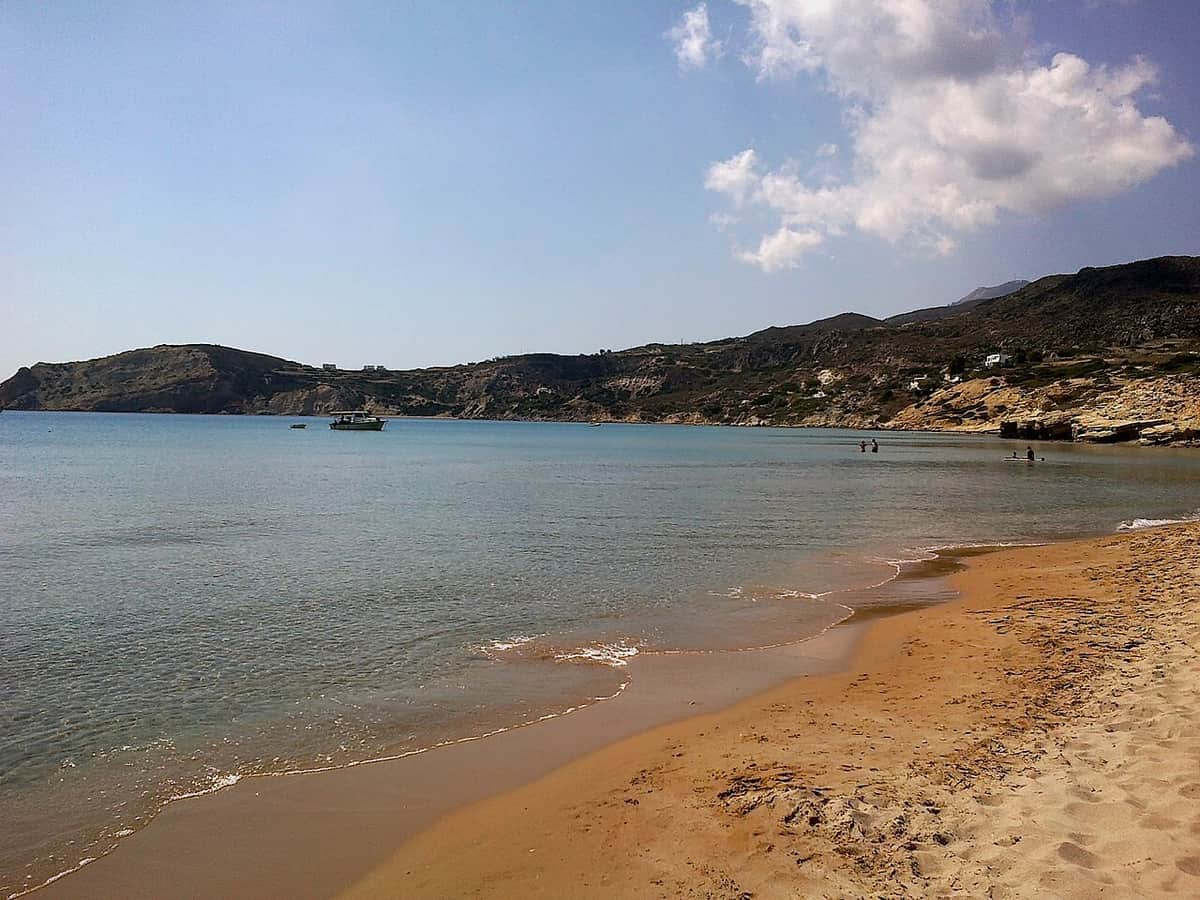
Three small coves, divided by rocks, make up the beach of Provatas. The sand is abundant and golden red, and iron oxides give it that colour. Iron oxides are pigments that come in red, yellow and black. The water is very shallow, so children can play in it, and the beach is ideal for families. Food in Provatas is eaten in that family setting, with sunbeds and umbrellas on the sand and rooms to let on the same shore.
The settlement is very small. The census of 2021 counted 33 permanent residents, up from 27 in 2011, the year when Provatas was first recorded as a separate settlement. It belongs to the Community of Milos, which is part of the Municipal Unit of Milos. Plaka, the island capital and the seat of the municipality, lies about twelve kilometres from Provatas. Food in Provatas comes from a place that is known mainly for its beach.
Eating happens on the beach itself, because the shore holds taverns next to the sand. A taverna is a small Greek restaurant that serves Greek cuisine, and it is an integral part of Greek culture. The earliest evidence of a Greek restaurant came from the Agora of Athens, where excavations found plates, mixing bowls, lidded casseroles and spits. A simple eating house is an old Greek idea, and the beach of Provatas has taverns of that kind.
- Island: Milos covers 151 square kilometres and is the fifth largest island of the Cyclades.
- Width: Only thirteen kilometres separate the north coast of Milos from the south coast.
- Access: A paved road with clear signs leads to the beach, and a bus runs there.
- Hot springs: The baths of Provatas appear among the hot springs of Milos.
- Wartime: Remains of German fortification works survive at Provatas.
Provatas is a small south-coast settlement with a beach of three coves, golden-red sand and very shallow water. Taverns, sunbeds, umbrellas and rooms to let stand on the shore, and a paved road leads to it. Food in Provatas is therefore the food of a family beach, and the next section turns to the dishes of Milos cooking that suit its tables.

Which dishes of Milos cooking go with food in Provatas by the beach?
Food in Provatas by the beach rests on four dishes of Milos cooking: fresh fish from the sea, salad from the garden, small pies from the oven and cheese from sheep and goat milk. Each one is plain, shared and easy to eat on a warm shore.
Fresh fish comes first. Because of its volcanic geology, Milos has reefs, caves and rocky shores where a wide variety of fish live. Tavernas across Greece list baked fresh fish, fried squid and baby octopus, and on Milos fresh fish and octopus, grilled or cooked in wine, head the recommended dishes. The earliest Greek restaurant found in Athens left fish bones and shellfish remains behind. Food in Provatas begins with that same habit of eating from the sea.
Salad follows, and Greek cuisine counts salads as appetizers. Horiatiki, the village salad, leaves out lettuce: tomatoes are cut into wedges, cucumber and onion into thin slices, and a slab of feta sits on top. Spreads such as tzatziki and taramosalata also count as salads in Greek. The caper salad, kaparosalata, is built on capers, which grow in abundance on the rocky soils of Milos. Food in Provatas can begin with any of them, dressed in olive oil, an ancient element of Greek cuisine.
Pies need an oven or a pan, and Greek kitchens bake countless kinds. Filo wraps spinach in spanakopita, greens in hortopita, zucchini in kolokythopita and cheese in tiropita, either in bite-size triangles or in large sheets. Milos adds two pies of its own: the small fried pitarakia, which come hot with honey, and the tomato pie called ladenia. Food in Provatas can include a pie in bite-size form, and bite-size pies pass easily from hand to hand.
Cheese closes the order. The name of Milos is said to come from an old Greek word for sheep, and the climate and terrain of Greece favour goats and sheep over cattle. Milos names five cheeses of its own: arseniko, xino tyri, manoura, touloumotyri and xinomyzithra. Greek tavernas also fry cheese in a small pan as saganaki and serve it with lemon juice and bread. Food in Provatas can end on a plate of local cheese.
- Fresh fish: Red mullet, red snapper and sea bream are among the fish around Milos.
- Taramosalata: This dip mixes fish roe with olive oil, lemon juice and bread or potato.
- Ladenia: A pie of oil, tomato and onion is listed among the dishes recommended on Milos.
- Touloumotyri: This cheese of Milos is aged in an animal skin.
- Thyme honey: Small units on Milos produce thyme honey and herbs, including thyme, oregano and sage.
Fish, salad, pies and cheese make a complete table. Fish comes from the reefs and rocky shores of Milos, capers from its rocky soil, pies from the oven and cheese from sheep and goat milk, and all of them can be passed around one table. Food in Provatas can be built from them, and the wider food of Milos adds sweets, wine and slow oven dishes.
How does the coast of Fyriplaka and Tsigrado frame food in Provatas?
Food in Provatas sits at the western end of a volcanic stretch of coast. Fyriplaka lies next to it, with towering rocks, white-grey sand and shallow turquoise water, and the white-sand cove of Tsigrado follows beyond it, reached by a steep sandy path.
Fyriplaka is the nearest neighbour of food in Provatas, on the east side. The beach is extensive, with tall volcanic rocks, fine white-grey sand and white pebbles. A beach bar, sun loungers and parasols serve the main stretch. Near the shore, a large rock stands in the water with a cave beneath it, shaped out of volcanic material long ago. The road is asphalt for the larger part, and the last section is a gravel track.
Fyriplaka ranks among the popular beaches of the island, yet it also holds quieter shore. The first beach is the organised one, and visitors who want to avoid the crowds walk on, parallel to the sea and the volcanic rocks, to the two loneliest beaches that follow it. The walk keeps the water on one side and the cliffs on the other. Food in Provatas waits back at the western end, so a meal there marks the start or the finish of the walk.
Tsigrado lies beyond Fyriplaka to the east. Towering rocks embrace the cove, the sand is white and the water is emerald. A relatively easy dirt road gives access, but the way down from the height is a steep path covered in sand. The cove has no organisation, and the essentials come from the nearby beach of Fyriplaka. Lunch therefore belongs to the organised beaches on either side: food in Provatas to the west and the beach bar of Fyriplaka to the east.
The coast stands on volcanic ground. Milos has two extinct volcanoes, and one of them is the volcano of Fyriplaka. Its crater measures 1,700 metres across and 200 metres in depth, a pyroclastic cone from the Middle to Upper Pleistocene, between 480,000 and 90,000 years ago. Layers of ash, sand and perlite fragments of rhyolite alternate across the crater, and pyroclastic sands along the road show that the volcano stood below sea level during certain periods. Food in Provatas belongs to this volcanic coast.
- Kaolin: Old kaolin mining galleries at Kalamos lie on the outskirts of the Fyriplaka cone.
- Sulfur: Hot vapours rich in hydrogen sulfide altered the older rock, and clear yellow crystals of native sulfur mark the vapour points.
- Vents: Active fumaroles reach 100 degrees Celsius at Agia Kyriaki and Paleochori, and submarine vents release gas as bubbles.
- Springs: Hot springs on Milos reach 55 degrees Celsius, and the baths of Provatas are among them.
- Cave: In one cave on the south coast, the heat from the volcano is still great.
Fyriplaka and Tsigrado give this coast its scale, with a volcanic cone, white-grey sand and a white cove within one stretch of shore. Rocks around the beaches of Milos run white, red, yellow and black, and the heat of the volcano still shows in vents and springs. Food in Provatas is the meal that fits between these bays, with the coves to the east, and the page on the beaches of Milos lists the others along the same shore.

How is a beach day planned around food in Provatas?
Food in Provatas fits a beach day of very shallow water, golden-red sand and shade under umbrellas. A swim comes before lunch and another after it, and the south side of Milos is the better side for swimming when the summer north wind, the meltemi, blows.
The plan starts with the shallows. The beach suits families, because the sea at Provatas is very shallow and children can play at the edge of the water while adults stay close to the sand. The sand is abundant and golden-red, a colour that comes from iron oxides, and the beach is made of three small coves divided by rocks. A swim before lunch uses the shallow sea first, and food in Provatas follows when the children leave the water.
Summer on Milos is warm to hot and dry, and the record highs reached 41.0 degrees Celsius in July and 39.8 in August. July averages only 0.3 millimetres of rain. Shade therefore matters in the middle of the day. The beach at Provatas is organised with sunbeds and umbrellas, so the hours around lunch pass under cover. Taverns stand on the beach itself, which keeps food in Provatas within a short step of the umbrellas and the shore.
The meltemia are the dry north winds of the Aegean, and they blow from the second half of spring until about mid-September. They peak in the afternoon and can ease at night. The weather stays fine and clear, and the north wind tempers the summer heat. When north winds blow, beaches inside the bay are better, and the south side of the island is better still. Provatas lies on that south side, so food in Provatas and the swim that follows both sit on the better side of the island.
- Getting there: The road to the beach is paved, well signed and served by a frequent bus.
- Before lunch: The first swim uses the very shallow water, where children can play.
- Shade: Umbrellas on the organised beach cover the hours of the strongest sun.
- Lunch: Food in Provatas comes from taverns on the beach, so the meal needs no change of place.
- After lunch: A second swim returns to the same shallows while the meltemi is at its strongest in the afternoon.
A beach day at Provatas runs in a plain order: shallow water first, shade and a table at the middle of the day, and a second swim after the meal. Food in Provatas sits between the two swims, and the sand, the umbrellas and the taverns all share one stretch of shore. The same plan carries over to the neighbouring bays when a change of beach is wanted, with lunch as the fixed point of the day.
Which village and farmland lie inland from food in Provatas?
Food in Provatas sits on the south coast, while Zefiria, the old capital of Milos, lies inland in the centre of eastern Milos. A large plain spreads around the village, which is an agricultural settlement, and the road through it runs on to the south coast.
The drive to food in Provatas starts on the coastal road of Adamas, the main port of the island and a town that Cretan refugees founded in 1841. A central crossroads on that road turns left to Zefiria, 2.3 kilometres along from the mining museum. The village stands 5.5 kilometres from Adamas and 9 kilometres from Plaka. Past it, the road carries on to the beaches of Agia Kyriaki and Paleochori, on the same south coast as Provatas.
Venetians created Zefiria in the 13th century, and the village flourished as the capital of Milos because pirates were active. It was abandoned in 1767, after earthquakes wrecked it and epidemics, caused by gases from cracks in the ground, drove the residents out. The whole island emptied in those years. By 1798 the population had fallen below 500, and up to two thirds of the buildings lay in ruin. Growth returned in the early 19th century, and the island reached 5,000 people by 1821.
Zefiria is an agricultural settlement, and a large plain spreads around it. The village also appears under the name Kampos, and it belongs to the community of Tripiti, within the municipality of Milos. The older name Zephyria once named the whole island of Milos and recalls Zephyrus, the west wind, because Milos belongs to the western Cyclades. In the 1880s the fertile centre of the island stayed under-farmed, because the Cretan exiles living there waited for a chance to return to their own island.
A geological route shows the farmland of the interior on its way south to the crater of Fyriplaka. The track crosses rural land with olive groves, vineyards and cereal fields. Its surface is a soft layer of perlite that looks like sand. The track then climbs through a forest of cedars to a meadow of centuries-old cedar trees. On the hillsides below, breeders have dug artificial pits to hold rainwater, and the view opens over Zefiria and its plain.
- Founded: Venetians created the village in the 13th century, and it grew into the island capital.
- Abandoned: Earthquakes and epidemics emptied Zefiria in 1767, and the island count fell below 500 by 1798.
- Plain: A large plain lies around the village, which is also called Kampos.
- Pits: Breeders dig artificial pits on the hillsides that overlook Zefiria to hold rainwater.
- Produce: Small units make thyme honey, and local winemakers have revived wine on volcanic soil.
Wine, thyme honey and the herbs thyme, oregano and sage are the produce that local winemakers and small units bring from the island. Inland from the coast lie an old capital, a wide plain and hillsides worked by breeders, and food in Provatas sits on the sea side of that land. The south coast gets its beaches from the volcano, while the interior keeps the olive groves, the vineyards and the cereal fields.

Which practical questions come up about food in Provatas?
Food in Provatas raises practical questions about the road, the size of the settlement, the family beach, the neighbouring cove of Agios Sostis, island wine and honey, and the oldest church of Milos. The six answers below take each point in turn.
Which road leads to food in Provatas?
A paved road with good signage leads to food in Provatas, and a frequent bus service runs along it. Access is easy. The settlement lies in the south of Milos, 12 kilometres south-south-east of Plaka, the capital. Beyond the settlement, the same coast continues west to Agios Sostis and Kipos, where the road reaches the sea again.
How large is the settlement beside food in Provatas?
Provatas is a very small settlement. The census of 2021 counted 33 permanent residents, up from 27 in 2011, the year it was first counted as a separate settlement. It belongs to the community and the municipal unit of Milos. The beach behind food in Provatas has three small coves, divided by rocks.
Which beach features suit families at food in Provatas?
The sand is golden red, a colour that comes from iron oxides, and the water is very shallow, so children can play at the edge. The beach is organised with sunbeds and umbrellas. Taverns and rooms to let stand on the beach itself, which places food in Provatas right beside the sand.
What is Agios Sostis next to food in Provatas?
Agios Sostis is a small, shallow sandy beach that takes its name from a church standing a little above it. It forms an extension of Provatas beach, and it has a restaurant and rooms for rent. The cove lies west of Provatas, and Kipos follows beyond it along the same shoreline.
Which island wine and honey belong with food in Provatas?
Local winemakers have revived wine making on Milos, and the wines reflect the volcanic soil of the island. Small units produce thyme honey and herbs such as thyme, oregano and sage. Honey also tops the pitaraki, the small fried pie with cheese or herbs. These products come from the whole island, not from one village.
Which old church stands near food in Provatas?
Panagia tou Kipou stands at Kipos, in the south, and it is the oldest church of Milos. It dates from the Byzantine years, the 5th century AD. It keeps one of the two baptisteries of the island and pieces of a Hellenistic marble sarcophagus. Kipos has a sandy beach and a small harbour for boats to Kleftiko.