Glaronisia Hotel is one of the places to stay in Milos listed in our Hotels in Milos section.
Glaronisia Hotel Milos is a place to stay in Pollonia, the seaside village at the north-east tip of Milos. The hotel takes its name from the Glaronisia, a small group of islets that lie in the sea north of the island. The page sets out where the hotel stands and what surrounds it. The island is described on the Milos page.
Pollonia is the second harbour of Milos after Adamantas, and the village keeps a small boat for the crossing to the neighbouring island of Kimolos. The hotel sits inside that village, beside the sandy main beach and within reach of two more beaches. The Glaronisia islets stand in the water to the north, and the cape of Pelekouda closes the bay on the east side.
Where does Glaronisia Hotel Milos stand in Pollonia?
Glaronisia Hotel Milos stands in Pollonia, the seaside village at the north-east tip of Milos. The village is the second harbour of the island after Adamantas, and the hotel stands beside a sandy main beach and two more beaches.
Pollonia lies at the north-east tip of Milos, and the village stands ten metres above the sea. The name comes from the temple of Apollo that stood at the lighthouse of Pelekouda, east of the settlement. The village is listed as a settlement for the first time in 1940, when it was attached to the community of Pera Triovasalos. Today it belongs to the community of Triovasalos, inside the municipality of Milos. Glaronisia Hotel Milos stands in the middle of that small community, near the shore.
The village stands beside the water, and the main beach is sandy and popular with holidaymakers. Two more beaches lie near the houses: Polychroni’s beach, which is organised, and Piso Thalassa, a name that means Back Sea. A small boat links Pollonia with the neighbouring island of Kimolos, and the crossing starts at the harbour of the village. That harbour makes Pollonia the second port of Milos after Adamantas, and Glaronisia Hotel Milos shares the same water through the year.
The village counted 268 inhabitants at the census of 2021. The main port of the island, Adamantas, lies at the head of the great bay, and the chief town, Plaka, stands on the hill above it. Pollonia keeps its own small harbour on the north-east coast, so boats arrive and leave at the edge of the houses. Glaronisia Hotel Milos therefore stands in a working harbour village, not in a resort built for visitors alone.
Around the hotel, the village spreads along the shore in low houses. The sea stays within a short walk of the rooms, and the harbour sits at the edge of the settlement. The headland of Pelekouda closes the bay on the east side, and the islets of Glaronisia lie out in the water to the north. The position gives Glaronisia Hotel Milos a base for the beach, the harbour and the boats that leave for the neighbouring islands.
- Village: Pollonia is a seaside village at the north-east tip of Milos and the second harbour of the island.
- Altitude: The village stands ten metres above the sea, and the harbour and the houses sit at the same level.
- Name: The name of the village comes from the temple of Apollo that stood at the lighthouse of Pelekouda.
- Beaches: The main beach of the village is sandy, and Polychroni’s beach and Piso Thalassa lie near the houses.
- Population: The census of 2021 counted 268 inhabitants in Pollonia.
Glaronisia Hotel Milos stands in a village that works as a harbour, a beach and a small community at the same time. Boats leave for Kimolos from the same shore, the sand lies beside the houses, and the north-east tip of Milos puts the rest of the island within reach by road. A stay here keeps the harbour, the beach and the boats within a short walk. The page on the village of Pollonia covers the settlement in full.

How is the complex of Glaronisia Hotel Milos built and laid out?
Glaronisia Hotel Milos is a complex of buildings in the Cycladic architecture of Pollonia, with 26 rooms. The complex carries the name of the islets that lie in the sea to the north, and it welcomes visitors to the village.
Glaronisia Hotel Milos is a complex of buildings rather than a single house, and the whole complex follows the Cycladic architecture of the island. The group of buildings carries the name of the Glaronisia, the islets that lie in the sea to the north of Milos. The complex stands inside Pollonia, so the village, the harbour and the sandy beach all sit beside it. The rooms of the complex number 26, and the group reads as part of the village rather than as a block apart.
A stay in the complex comes with warm and friendly service and with the comforts that the group of buildings provides. The complex is set out for visitors who come to the island for the sea, and the village around it keeps the water at hand. Glaronisia Hotel Milos keeps a level walk from the buildings to the shore, because Pollonia stands ten metres above the sea. The harbour of the village lies at the same level as the houses.
The rooms of the complex look towards the village and the coast. Pollonia is the second harbour of Milos, and the small boat to Kimolos leaves from that harbour. The main beach of the village is sandy, and two more beaches lie near the houses. Glaronisia Hotel Milos therefore places a stay between the built village and the water that surrounds the north-east tip of the island. The sand and the small boat lie within a short walk of the rooms.
The Cycladic architecture of the complex belongs to the same tradition as the houses of the village, and the group of buildings keeps to the scale of the settlement around it. The islets stand in view to the north, and the strait to Kimolos opens to the east. A visitor who stays at Glaronisia Hotel Milos walks to the beach, to the harbour and to the small boat without leaving the village. The complex of Glaronisia Hotel Milos holds 26 rooms and stays small beside the shore.
- Complex: Glaronisia Hotel Milos is a group of buildings in the Cycladic architecture of the island, and the group keeps the scale of the village.
- Rooms: The complex holds 26 rooms inside a group of buildings in the Cycladic style of the island.
- Setting: The buildings stand inside Pollonia, ten metres above the sea and beside the harbour of the village.
- Service: A stay comes with warm and friendly service and with the comforts of the complex.
- Name: The complex takes the name of the Glaronisia islets to the north.
The complex keeps a small scale and a position inside the village, and that combination decides how a stay works. The beach, the harbour and the boat to Kimolos all lie within walking distance, and the islets stay in view across the water. The range of places to stay on the island is set out on the page about hotels in Milos, and this page keeps to the complex at Pollonia.
What are the Glaronisia islets behind the name of Glaronisia Hotel Milos?
Glaronisia Hotel Milos takes its name from the Glaronisia, a small group of uninhabited islets in the sea north of Milos. Their rock holds thousands of upright columns, and the islets lie opposite the coastal settlements of Pachaina and Agios Gerasimos.
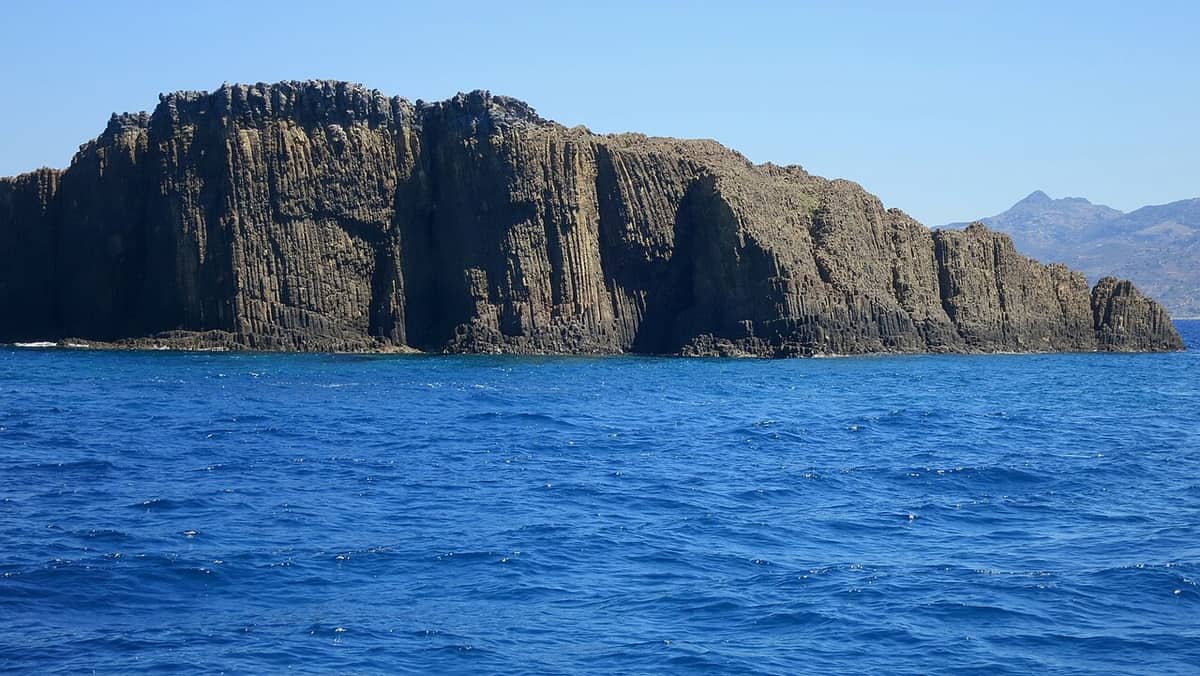
The islets form a small group inside the Cyclades, and they belong to the municipality of Milos. Under the Kallikratis plan they fall inside the municipal community of Triovasalos. The census of 2021 found no inhabitants on the group at all. The islets stand north of Milos, across the water from the coastal settlements of Pachaina and Agios Gerasimos. Glaronisia Hotel Milos carries their name, and the group holds islets alone, with no harbour and no houses.
The rock of the islets is andesite, and the shape of that rock sets the group apart. Thousands of upright columns rise in it, and the columns take pentagonal and hexagonal forms. Their diagonals measure from 20 to 30 centimetres, and the group lies in the water that Glaronisia Hotel Milos faces. Andesite is a volcanic rock, and it hardens into these forms when the lava cools in place. The lava arrived 800 to 700 thousand years ago, and the pattern repeats across the whole group.
Andesite is not limited to the islets. The volcanic domes of Milos are mainly andesite too, and the castle of Chora and the peak of Profitis Ilias belong to that group. Both domes consist of lava that hardened before it flowed. The rock of the islets therefore belongs to the same volcanic story as the rock of the island. Glaronisia Hotel Milos stands in sight of that story, and the columns of the group share one origin with the domes of the island.
The islets are reached by sea. Excursion boats leave for them from Adamantas, the main port of the island, and the group can be visited from the water. In recent years a climbing field has been made on the islets, and climbers go there for the columns. The columns rise straight out of the water, and a boat can pass close to them. Glaronisia Hotel Milos looks out on that sea, and the group stands in open water to the north of the island.
- Inhabitants: The census of 2021 counted no inhabitants on the Glaronisia.
- Columns: Thousands of upright columns rise in the andesite of the group, with pentagonal and hexagonal shapes.
- Size: The diagonals of the columns measure from 20 to 30 centimetres.
- Age: The lava of the group came from geological upheavals 800 to 700 thousand years ago.
- Access: Excursion boats from Adamantas reach the group, and a climbing field has been made on the columns in recent years.
The Glaronisia give the hotel its name, and the group gives the north-east sea its character. The columns, the andesite and the empty islets stand in the water beyond the village, and the boats from the main port pass that way. The name on the building comes from that empty group of rocks. Glaronisia Hotel Milos takes a place in a landscape built by lava, and the next section follows that landscape across the whole island.
What shape and land does Milos show from Glaronisia Hotel Milos?
Glaronisia Hotel Milos looks over a volcanic island with the shape of a horseshoe. Milos measures about 23 kilometres from north-east to south-west and 13 kilometres from north to south, and volcanic rock covers the greater part of the island.
The island holds the fifth place in size among the Cyclades, and its surface is estimated at 151 square kilometres. From the north-east tip, where the village of Pollonia stands, the land runs away to the south-west along a coast of rock and beach. The great bay cuts into the island from the north-west and divides it into two parts that are nearly equal. Glaronisia Hotel Milos faces the open water on the outer side of that bay, which forms one of the largest natural harbours of Greece.
Volcanic rock covers the greater part of the island, and the rock takes different forms in different places. White rocks with layers of material stand at Sarakiniko on the north coast, and fossils have been found inside them. Sedimentary and metamorphic rock lies on the island as well. Two volcanoes are extinct on Milos, the volcano of Fyriplaka and the volcano of Trachilas to the north-west, and no eruption has come from them in historical times. Glaronisia Hotel Milos stands on the same volcanic ground.
Volcanic activity on the island began 2 to 3 million years ago and stopped 90,000 years ago. Milos is a stratovolcano, and it has not erupted in historical times. Obsidian, a glassy volcanic material, has been known on the island for 15,000 years, and the rock served for tools across the Aegean. The highest point is the peak of Profitis Ilias at 751 metres, in the western part of Milos, and Glaronisia Hotel Milos keeps that height far away on the other side of the island.
The west half of the island holds no villages. Only minimal settlements and old mines stand there, and almost the whole western part belongs to the Natura 2000 network. The south-western side is a habitat of the Mediterranean seal, and the rest of the west is a habitat of the Milos viper. From Glaronisia Hotel Milos the settled land lies to the south and the west, and the empty land stays beyond it, where the two halves of the island meet.
- Shape: Milos has the shape of a horseshoe and forms a large bay.
- Size: The surface of the island is estimated at 151 square kilometres, and the island is the fifth largest of the Cyclades.
- Width: The island measures 23 kilometres from north-east to south-west and 13 kilometres from north to south.
- Peak: The highest point is Profitis Ilias at 751 metres.
- Rock: Volcanic rock covers the greater part of the island, and the volcanoes of Fyriplaka and Trachilas are extinct.
The shape of the island explains the place of the village. Pollonia sits at the north-east tip, on the outer edge of the horseshoe, and the bay opens behind it. Glaronisia Hotel Milos therefore keeps the sea on three sides and the road to the rest of the island on the fourth, and that position decides what a stay sees from the village. The next section crosses the water to the island that lies opposite.
What lies across the strait from Glaronisia Hotel Milos?
Glaronisia Hotel Milos looks across a channel about one kilometre wide to Kimolos, the neighbouring island to the north-east. A small boat runs from the harbour of Pollonia to Kimolos, and the crossing forms the shortest sea route from the village.
Kimolos lies to the north-east of Milos, and a channel of about one kilometre separates the two islands. The island is round in shape, and it measures 36 square kilometres. Its municipality includes the uninhabited islands of Polyaigos, Agios Efstathios and Agios Georgios, and the land of the whole municipality comes to 53.251 square kilometres. The census of 2021 counted 810 inhabitants there. Polyaigos is the largest uninhabited island of the Aegean, and it stands east of Kimolos, across from Glaronisia Hotel Milos.
The main settlement of Kimolos is the Chorio, and it stands on a hill in the south-east of the island. Smaller settlements lie around it: Psathi, which serves as the port, Goupa, Kara, Prasa, Aliki, Bonatsa and Dekas. The highest point of the island is the mount Paleokastro at 364 metres. Psathi lies close to the Chorio, and Glaronisia Hotel Milos sits at the other end of the crossing from Pollonia, while the port stays within a short walk of the main settlement.
The name of Kimolos comes from the first resident of the island, and Echinousa was an older name for it. In the Middle Ages the island was known as Argentiera, after the silver-coloured rocky land of its southern coast. That land gave Kimolian earth, a material that served as fuller’s earth and made the island a trading place. Glaronisia Hotel Milos stands at the end of the route that carries visitors between the two islands.
Kimolos, Milos and the smaller islands around them belong to the volcanic arc of the Aegean, and acidic volcanic rock makes up the group. Tuff covers large areas of Kimolos, and hot springs and a geothermal field show the volcanic past. Silica minerals and industrial minerals lie on the island as well. A mushroom-shaped stone called Skiadi stands in a valley in the interior, and Glaronisia Hotel Milos stands on the same volcanic arc of the Aegean.
- Strait: A channel about one kilometre wide separates Kimolos from Milos.
- Size: Kimolos measures 36 square kilometres on its own, and its municipality holds 53.251 square kilometres.
- Population: The census of 2021 counted 810 inhabitants on the island of Kimolos.
- Settlements: The Chorio is the main settlement of the island, and Psathi serves as the port below it.
- Boat: A small boat runs from Pollonia to Kimolos, and the crossing is regular.
The strait keeps two islands apart and joins them at the same time. The boat from the harbour of Pollonia carries people and goods between the two shores, and the Chorio of Kimolos sits close to its own port. Glaronisia Hotel Milos therefore stands at the edge of the island and at the door of another one. A short crossing puts a second island within reach of the village. The next section follows the coast back to the west.

Which sites of the north-east coast lie near Glaronisia Hotel Milos?
Glaronisia Hotel Milos stands on the north-east coast near Phylakopi, Papafragas and the cape of Pelekouda. Phylakopi is a leading Bronze Age settlement of the Aegean, Papafragas lies west of Pollonia, and Pelekouda closes the bay to the east.
Phylakopi lies on the north coast of Milos, and the site holds a leading Bronze Age settlement of the Aegean and of the Cyclades. The settlement lasted through the whole Bronze Age, from the middle of the third millennium BC until the twelfth century BC. The first settlers were tuna fishermen. The site stands on the coast, and the position of Milos between the mainland and Crete gave the settlement its place in the trade of the Aegean. Glaronisia Hotel Milos shares the north coast with that history.
Excavations at Phylakopi began between 1896 and 1899, and later work followed in 1910 and 1911 and again in the 1970s. The digs found a town wall and a structure called the Pillar Room, which held fragments of wall paintings. The fresco of the flying fish came from that room. Part of the site has been washed away by the sea. A sanctuary was found at the site in 1974, and Glaronisia Hotel Milos stands a short way along the same coast.
The phases run from the first phase, in the years 2300 to 2000 BC, through the second and the third. The buildings of the last phase include a megaron, a hall with a plan that belongs to the palaces of the Greek mainland. A figurine called the Lady of Phylakopi, 45 centimetres high, was found in the west shrine and stands in the Archaeological Museum of Milos. Pottery from the site shows the styles of the Cyclades and of Crete, and Glaronisia Hotel Milos shares the same coast.
Papafragas is a beach on the north coast, and it lies west of Pollonia between Kapros and Phylakopi. The cape of Pelekouda lies east of Phylakopi and closes the bay of the village on its eastern side. The temple of Apollo that gave Pollonia its name stood at the lighthouse of Pelekouda, east of the settlement. The north coast holds 17 of the beaches of Milos, and that coast runs from Sarakiniko in the west to Pollonia in the east, where Glaronisia Hotel Milos stands.
- Phylakopi: The Bronze Age settlement lies on the north coast and lasted until the twelfth century BC.
- Finds: The fresco of the flying fish came from the Pillar Room, and a sanctuary was found in 1974.
- Museum: The Lady of Phylakopi, a figurine 45 centimetres high, stands in the Archaeological Museum of Milos.
- Papafragas: The beach lies on the north coast of the island, west of Pollonia.
- Pelekouda: The cape closes the bay to the east, and the temple of Apollo stood at its lighthouse.
The north-east coast packs a long history into a short stretch of shore. Phylakopi brings the Bronze Age, Papafragas brings a beach in the rock, and Pelekouda brings the headland that shelters the village. Glaronisia Hotel Milos stands in the middle of that stretch, with the past on one side and the water on the other. All three places lie within a short drive of the village. The next section turns to the boats.
Which boat trips start from Pollonia near Glaronisia Hotel Milos?
Glaronisia Hotel Milos sits beside a harbour where boats leave for the coast and the neighbouring islands. Excursion boats reach the Glaronisia islets from the main port of Milos, and the sea route from Pollonia crosses to Kimolos and to the shores that no road reaches.
Pollonia serves as a smaller port of Milos, and the traffic of the village runs mainly between Milos and Kimolos. The small boat that crosses the strait leaves from the harbour, and the crossing is regular. Glaronisia Hotel Milos sits beside that harbour, and boats use the same water. Beaches that lie away from the road can be reached only from the sea, and a boat is the way to see them. The day trips are set out on the page about one-day cruises from Pollonia.
The coasts of the island change with every mile. The south coast holds long beaches and deep water, and the west coast holds rock and empty land. The north coast holds the white rocks of Sarakiniko and the beach at Papafragas, and the islets of Glaronisia stand in the water beyond it. Glaronisia Hotel Milos looks out on that shore, and a boat can turn either way from the village. The turn to the east crosses the strait, and the turn to the west follows the north shore.
Excursion boats leave for the Glaronisia from Adamantas, the main port of the island. The columns of the islets can be seen from the water, and the climb on the rock has made the group known to climbers. Further south, the coast cuts into bays and caves that stay out of reach by road. The caves of the south coast open only to the sea, and Glaronisia Hotel Milos puts a day on the water within reach.
A day at sea also shows the island from the outside. The horseshoe shape of Milos appears in full only from the water, and the bay opens in the middle of the ring. Glaronisia Hotel Milos stands at the north-east corner of that ring, so a boat that leaves the village begins the circle at its edge. The water around the north-east tip stays calm in the shelter of the land, and that shelter keeps the crossing short.
- Harbour: The small boat to Kimolos leaves from the harbour of Pollonia on a regular crossing.
- Islets: Excursion boats leave for the Glaronisia from Adamantas, the main port of the island.
- Coast: Beaches on the south and west coasts of the island can be reached only from the sea.
- Route: A boat from the village can turn east towards Kimolos or west along the north coast.
- View: The horseshoe shape of Milos shows in full only from the water.
The boats turn the north-east tip of Milos into a starting point rather than a dead end. A short crossing reaches Kimolos, and a longer day reaches the islets, the caves and the beaches that no road serves. Glaronisia Hotel Milos stands beside that harbour, and the sea that gives the island its shape gives the village its routes. A stay at the harbour keeps both the near island and the far coast within a day.


What do visitors ask about Glaronisia Hotel Milos?
Glaronisia Hotel Milos stands in Pollonia, the seaside village at the north-east tip of Milos, with 26 rooms in a complex of Cycladic architecture. The questions below cover the village, the rooms, the islets, the neighbouring island and the boats that leave from the harbour.
Where exactly does Glaronisia Hotel Milos stand?
The complex stands inside Pollonia, the seaside village at the north-east tip of Milos. The village is the second harbour of the island after Adamantas. The harbour and the small boat to Kimolos sit beside Glaronisia Hotel Milos, and the places to eat in the village appear on the page about food in Pollonia.
How are the 26 rooms of Glaronisia Hotel Milos arranged?
The 26 rooms of Glaronisia Hotel Milos sit in a group of buildings in the Cycladic architecture of the island, and the complex carries the name of the Glaronisia islets to the north. A stay comes with warm and friendly service and the comforts of the buildings. The shore stays within a short walk of Glaronisia Hotel Milos.
Which islets give Glaronisia Hotel Milos its name?
Glaronisia Hotel Milos takes its name from the Glaronisia, a small group of uninhabited islets north of Milos, opposite the coastal settlements of Pachaina and Agios Gerasimos. Their andesite holds thousands of upright columns in pentagonal and hexagonal shapes. The lava behind the columns arrived 800 to 700 thousand years ago. The census of 2021 found no inhabitants there.
How does a visitor reach Glaronisia Hotel Milos from the main port?
Adamantas is the main port of Milos, and Pollonia is the second. The road from the main port crosses the island and ends in the village where Glaronisia Hotel Milos stands. A small boat crosses the strait from Pollonia to Kimolos as well, so the harbour of the village works in two directions at once.
What lies across the water from Glaronisia Hotel Milos?
Kimolos lies to the north-east of Milos, and a channel about one kilometre wide separates the two islands. The island measures 36 square kilometres and counted 810 inhabitants in 2021. Its main settlement is the Chorio, and Psathi serves as the port. A small boat runs between Pollonia and Kimolos, and Glaronisia Hotel Milos sits at the near end.
Which archaeological site lies near Glaronisia Hotel Milos?
Phylakopi lies on the north coast of Milos and counts among the leading Bronze Age settlements of the Aegean. The site lasted from the middle of the third millennium BC to the twelfth century BC. Excavations between 1896 and 1899 found a town wall and the Pillar Room, which held the fresco of the flying fish.
When do boats leave the harbour near Glaronisia Hotel Milos?
The small boat to Kimolos leaves from the harbour of Pollonia, and the crossing is regular. Excursion boats leave for the Glaronisia islets from Adamantas, the main port. Beaches that lie away from the road can be reached only from the sea, and Glaronisia Hotel Milos puts a boat within reach.
What does the name of Glaronisia Hotel Milos refer to?
The name refers to the Glaronisia, the group of islets in the sea north of Milos. The columns of andesite in those islets give the group its form, and the name ties the complex in Pollonia to the water in front of it. The complex takes the Cycladic architecture of the island and holds 26 rooms beside the water.