Liofito Restaurant, Pollonia
Armura restaurant, Pollonia
Armenaki Restaurant, Pollonia
Enalion restaurant, Pollonia
Apanemia restaurant, Pollonia
Kapetan Nikolas Fish tavern – Restaurant, Pollonia
Food in Pollonia belongs to a fishing village at the north-eastern tip of the island of Milos. Tavernas, restaurants and island cafés stand around a small cove, and the fishing boats tie up at the pier in front of the church at the end of the row. Sand, tamarisk trees and the neighbouring island of Kimolos complete the setting.
The sections below cover the waterfront, the daily catch, the dishes of the island, the evening meal by the sea and the coast and ruins close to the village. Each answer starts with the plain facts, and every section stays inside the village and the water around it. Food in Pollonia is therefore a small seaside setting.
What is food in Pollonia at a glance?
Food in Pollonia means tavernas, restaurants and island cafés in a fishing village built around a cove. The pier with the fishing boats, a sandy beach with tamarisk trees and the island of Kimolos across the strait all belong to the same small setting.
Pollonia, also known as Apollonia, is a fishing village built around a cove at the north-eastern tip of Milos. Food in Pollonia spreads through the whole seaside settlement, because tavernas and restaurants extend as far as the church of Agia Paraskevi, which marks the right-hand end of the village. In a village this small, the tables form a single row beside the sea, and the cove sets the line of the whole waterfront from end to end.
Three kinds of places serve food in Pollonia: tavernas, restaurants and island cafés. A taverna is a small Greek restaurant that serves Greek cuisine, and it is an integral part of Greek culture. Its menu runs from bread, salads and dips such as tzatziki to baked dishes, grilled dishes and fish and seafood, with wine, beer and spirits such as ouzo and tsipouro alongside. An island café, the kafeneio, serves Greek coffee, beer, retsina and ouzo, and it rarely serves full meals.
The church of Agia Paraskevi marks more than the end of the row of tables for food in Pollonia. The pier in front of it is where the fishing boats of the local people tie up, so the working harbour and the kitchens share one end of the village. Adamas is the main port of Milos, and Pollonia takes second place as a smaller harbour on the north-eastern shore, one that mainly serves the crossing between Milos and Kimolos.
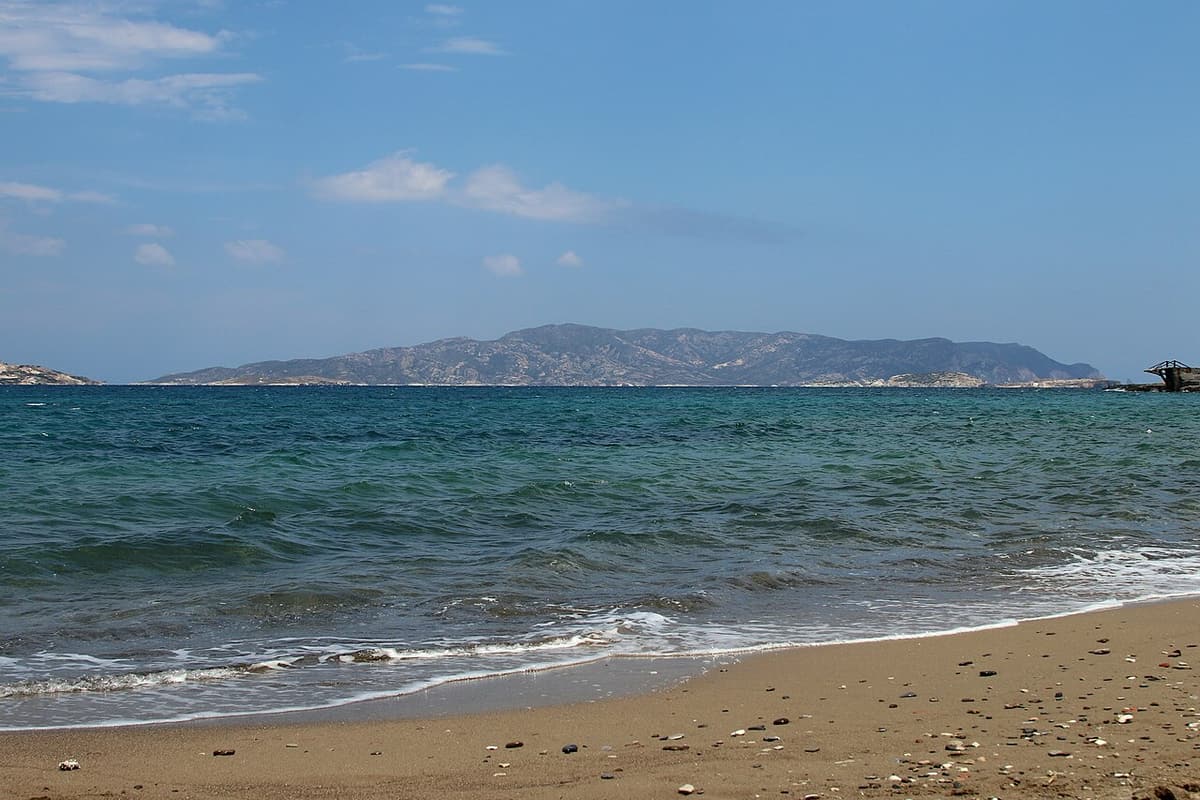
The cove holds a beach of rich sand with tamarisk trees. Tamarisks suit this kind of shore, because they grow on salty soil and tolerate a high level of salt, and their small scale-like leaves can carry a crust of salt. Their pink to white flowers appear in dense masses on short spikes. Kimolos, the nearest of the larger islands around Milos, lies just across the strait to the north-east, and the island can be seen from the beach of Pollonia.
- Names: The village carries two names, Pollonia and Apollonia.
- Stays: Rooms to rent and hotels stand in the same village as the tables of food in Pollonia.
- Church: Agia Paraskevi stands at the right-hand end of the village, beside the pier.
- Sea links: A small boat links the village with Kimolos, and the Glaronissia islets are reached from the same shore.
- Beach: The sand of the cove is rich, and tamarisk trees grow along it.
Together these points describe food in Pollonia as one compact stretch of shore, with tables, a pier, a beach and a neighbouring island all in the same frame. For the wider range of dishes eaten across the island, the page on food in Milos sets out the island table. The next section stays at the pier and follows the catch from the boat to the plate.

How do fish and seafood shape food in Pollonia?
Food in Pollonia is built on the morning catch: local boats land fish, octopus and lobster at the pier in front of the church. Greek tavernas grill or fry such fish and dress it with olive oil and lemon, so the sea decides the plate.
Each morning the fishing boats of the local people come back to the pier in front of the church of Agia Paraskevi, loaded with fish, octopuses and lobsters. The same church closes the row of tavernas and restaurants, so the landing place and the kitchens lie along one stretch of shore. That layout is the plainest fact about food in Pollonia: the boat, the quay and the table follow each other in a line, and the catch of the day starts the menu.
The sea around Milos is rich in fish because of the volcanic geology of the island. Reefs, caves and rocky shores form natural habitats for a wide variety of species. The fish vary with the season and with the area where the boat worked, so a plate of food in Pollonia changes through the year. Greece has the largest fishing fleet in Europe, and the Aegean catch includes sardines, mackerel, grouper, grey mullet, sea bass and seabream.
Octopus arrives with the morning boats, which makes it part of food in Pollonia, and Greek menus carry octopus on the grill, dressed with olive oil, garlic, oregano, pepper and lemon juice. A version marinated in vinegar sits beside it. Red porgy on the grill is another name on the list. Cuttlefish, called soupies, and swordfish, called xiphias, appear on Greek fish menus too. Olive oil and lemon juice rank among the important ingredients of Greek cooking, so the dressing of a fish plate stays simple.
Anchovy and boops are fried and served as plates of their own, and a thick garlic and potato dip called skordalia goes with fried fish. Taramosalata, a spread of fish roe with olive oil, lemon juice and bread or potato, is a fish-based starter on Greek menus. Fish has a long record on Greek tables, and it suits food in Pollonia: the earliest known Greek restaurant, found in the Agora of Athens, left large amounts of fish bones and shellfish remains.
- Red porgy: Fagri sti schara is red porgy cooked on the grill.
- Octopus: Htapodi sti schara is grilled octopus, and htapodi ksidato is octopus marinated in vinegar.
- Anchovy: Gavros tiganitos is the Greek name for fried anchovy.
- Boops: Gopes tiganites is the Greek name for fried boops boops.
- Garlic dip: Skordalia is a thick garlic and mashed-potato dip that goes with fried fish.
From the pier to the plate, food in Pollonia is a short chain of boat, kitchen and table. The morning catch meets fire or hot oil, and olive oil and lemon finish the plate. Octopus, red porgy and fried anchovy show how little a fish dish needs once the sea has done its part. The next section turns from the sea to the island dishes that sit beside the fish on a table by the water.
Which island dishes does food in Pollonia put on the table?
Food in Pollonia puts the dishes of Milos and its neighbours on the table: pitarakia pies, ladenia from Kimolos, tomato and courgette fritters, soft whey cheese and capers. Each dish rests on plain ingredients, local produce and olive oil, and the names travel between islands.
Island dishes in Pollonia come from two circles. The Cycladic kitchen is a body of traditional recipes passed from one generation to the next, with a strong Mediterranean character, built on pulses, meat and fresh vegetables cooked with virgin olive oil, spices and herbs. Its characteristic dishes each carry the name of one island: ladenia from Kimolos, mastelo from Sifnos and tomato fritters from Santorini. Milos adds pitarakia, one of the types the island names as representative of its cuisine. Food in Pollonia draws on both circles.
Ladenia is the clearest case, because the regular small boat from Pollonia crosses to Kimolos, the home island of the pie. It is a traditional Greek tomato pie, also called ladopita, and cooks on Kimolos have made it since Venetian rule. The dough holds flour, yeast, olive oil, water and salt, and the topping holds tomatoes, dry onion, oregano, olive oil, salt and pepper. A winter version swaps the fresh tomato for paste. Food in Pollonia borrows this pie from the island across the strait.
Fritters follow the same island logic. Cyclades kitchens once made fritters from greens, pulses and vegetables, because meat reached the table only on feast days. The island repertoire holds fennel, courgette, chickpea and tomato fritters, and octopus and fish fritters. Boats land fish and octopus at Pollonia every morning, so the sea versions of food in Pollonia have a local source. Milos names domatokeftedia and kolokythokeftedia, tomato and courgette fritters, among its local flavours. Cooks drain the tomato juice to save flour, add herbs such as mint and sometimes capers.
A meze gathers these plates. In Greece it arrives as a plate of snacks beside ouzo or tsipouro, and it can form a meal in itself. Xinomyzithra suits that plate. It is the sour variant of myzithra, a whey cheese of ewe or goat milk, and it is soft, snow-white, creamy and moist. Cooks serve it with honey as a dessert, at the table, in salads and in baked goods. Milos lists it as creamy and tangy, and food in Pollonia can carry it beside the fritters.
- Ladenia: A fasting tomato pie from Kimolos, with dry onion and oregano on an olive oil dough.
- Tomato fritters: Ripe tomatoes, onion and mint are bound with flour or semolina, then fried in oil.
- Courgette fritters: Milos names them beside the tomato version as a local flavour of the island.
- Xinomyzithra: A soft, snow-white, sour whey cheese made from ewe or goat milk and served with honey.
- Meze: A plate of snacks served beside ouzo or tsipouro, which can form a meal in itself.
Four threads run through these dishes: a pie from Kimolos, fritters from the lean kitchens of the Cyclades, a sour whey cheese and the meze plate that holds them together. Food in Pollonia shows how closely the islands share a table. A menu of food in Pollonia can be sorted name by name into Milian dishes and shared dishes, and the same ingredients return in each: tomato, onion, flour, olive oil and herbs.

What is an evening by the sea like for food in Pollonia?
Food in Pollonia moves to the cove in the evening, with the sea beside the tables and Kimolos across a strait one kilometre wide. The summer meltemi can ease after the afternoon, and the quiet season changes the mood of the shore.
The village is built around a cove at the north-eastern tip of Milos, only ten metres above the sea. A sandy beach and tamarisk trees belong to the cove. The taverns and restaurants extend to the right end of the village, at the church of Agia Paraskevi, where the pier holds the fishing boats of the locals. Food in Pollonia therefore stays at water level, and an evening meal happens beside the cove, with the boats moored at the pier.
Across the strait lies Kimolos. The island sits north-east of Milos, and the Ammoni strait that separates the two is one kilometre wide. Pollonia is the northern port of Milos for the crossing, so food in Pollonia looks towards that coast. Smaller settlements on Kimolos, Psathi among them, are inhabited mainly in summer. The lights of the group stand further out: a lighthouse on the islet of Agios Efstathios serves the Pyrgi passage between Kimolos and Polyaigos, and Polyaigos has carried one on cape Maskoula since 1898.
The meltemi sets the summer evening for food in Pollonia. These are the strong, dry north winds of the Aegean, and they blow from late spring into early October at an average force of 6 to 7 on the Beaufort scale. The wind peaks in the afternoon and can die down at night, although a spell can last for days. The weather is fine and clear: dry air makes the sky look deep blue and improves visibility. The sea turns choppy, and small-boat services can be halted.
The quiet season follows the summer. Milos is a popular tourist destination during the summer, and visitors choose it for a less crowded setting than Santorini or Mykonos. The climate brings mild, rainy winters and warm to hot, dry summers, and the meltemi season ends in early autumn. Pollonia is a small fishing village of fewer than 300 residents. Food in Pollonia then follows the rhythm of the village, with the same cove, the same pier and the same view of Kimolos.
- Setting: The village stands ten metres above the sea, around a cove with a sandy beach and tamarisks.
- Strait: The Ammoni strait between Milos and Kimolos is one kilometre wide.
- Wind: The meltemi peaks in the afternoon and can die down at night, though a spell can last for days.
- Sky: Dry air makes the sky look deep blue and improves visibility on meltemi days.
- Season: Milos draws visitors in summer, and its winters are mild and rainy.
An evening in the village of Pollonia ties the cove, the strait and the wind together. The tables stand at water level, the neighbouring island sits one kilometre away, and the season decides whether the meltemi blows or the weather turns mild and rainy. Food in Pollonia ends the day where the boats are moored, and the sea stays in view from the first plate to the last.
Which sights lie around food in Pollonia?
Food in Pollonia sits beside four stops on the north-east coast of Milos: the Pelekouda cape with its chapel, the Bronze Age town of Phylakopi, the sea caves of Papafragas, and the small boat across the water to Kimolos.
Pelekouda is a peninsula on the left side of the village, with a small chapel beside it. The village church and the fishing pier stand at the opposite end. A small rock on the cape is shaped like a chair. Tradition says that a couple who sit on it stay together forever. The point is also known as the Lighthouse of Pelekouda. The two ends of the village therefore frame food in Pollonia: the pier, where the boats unload, and the cape, where the chapel stands.
Phylakopi is the Bronze Age town on the north coast of Milos. The site is open to the public and laid out with information material and plans. Its Pillar Rooms complex ranked among the largest buildings of the second town and measured 21 metres from west to east and 13 from north to south. Two square limestone pillars rose in its rooms, and the east room had no door at ground level, so a staircase led down into it from above. Wall paintings showed lilies, rosettes and a blue monkey.
Papafragas lies west of the village, next to the ruins of Phylakopi, and gathers three caves around one small beach. Rock walls in light colours ring the beach, and a path cut into the rock leads down to the water. In Byzantine times pirates used the cove as a base, and the name goes back to the last Frankish priest, who used the beach to shelter his boat. Caves and rocky shores like these are natural habitats for a wide variety of fish, which ties the cove to the catch.
A small boat links the village with Kimolos on a regular connection. Kimolos is a volcanic island and a miniature of the Cyclades, with whitewashed stone streets and sheltered coves. Its capital, Chorio, is made of two settlements, one of them built around the medieval castle, and its harbour has small boat houses and courtyards with flowers. The working population combines tourism with farming. In antiquity the island was known for its figs and for its fuller’s earth, made from a white porous stone.
- Pottery: Finds from Phylakopi include Dark Burnished ware, Cycladic white ware and bird jugs that were exported to Knossos.
- Ash: Volcanic ash from the eruption of Thera lay in the layers of the building beneath the megaron.
- Megaron: The later hall at Phylakopi, built in the Mycenaean style, resembles buildings found at Tiryns, Pylos and Mycenae.
- Cave: Swimmers at Papafragas move through turquoise water between grey and white rocks towards the open sea.
- Chalk: Kimolos is known as the island of chalk, and the rock is called kimolia.
Together the four stops give food in Pollonia a setting of legend, Bronze Age ruins, a pirate cove and a neighbouring island. All of them lie on the same coast or across the same water, each has a history older than the modern village, and the pier ties them to the daily work of the fishing boats, which bring the catch each morning. The page on sweets in Pollonia covers the end of the meal.

What do travellers ask about food in Pollonia?
Food in Pollonia raises practical questions about the places that serve it, the pier that supplies it and the sights around it. The six answers below cover the places in the village, the catch, the coast, the museums, the neighbouring island and the goat island.
Which kinds of places serve food in Pollonia?
Taverns and restaurants extend along the settlement, and island cafes called kafenia stand in the same village. Rooms to rent and hotels share the bay with them, and a sandy beach fronts the village. The village is small and built around one creek, so the places that serve food in Pollonia lie close together and close to the water.
Where does the catch reach food in Pollonia?
The catch reaches the pier in front of the village church, at the end of the settlement. Boats of local fishermen arrive there every morning loaded with fish, octopuses and lobsters. The taverns and restaurants extend as far as the same church, so the quay and the tables stand at the same end of the village.
In what order do the sights near food in Pollonia lie along the coast?
The list of north-coast beaches runs from west to east and ends with Kapros, Papafragas, Phylakopi, Kalogeros, Pelekouda and Pollonia. Papafragas is therefore the westernmost of the three stops, Phylakopi lies between it and Pelekouda, and the cape stands in the village itself. Pollonia closes the list at the north-eastern tip of the island.
Which dish ties food in Pollonia to Kimolos?
Ladenia, a pie of oil, tomato and onion, is listed as a dish of Kimolos as well as of Milos. Kimolos lies across the water from Pollonia, and the small boat between the two connects them. The pie shows how food in Pollonia shares dishes with the neighbouring island and not only with the rest of Milos.
Where are finds from near food in Pollonia displayed?
Finds from the first digs at Phylakopi, in the 19th century, are shown in the national archaeological museum in Athens. Finds from the later digs are shown in the archaeological museum of Milos, in Plaka, the capital of the island. The wall paintings of flying fish from the Pillar Rooms are among the pieces in Athens.
Which island of goats lies close to food in Pollonia?
Polyaigos lies east of Kimolos and is named for its goats. No one lives on the island, and herdsmen from Milos and Kimolos rent parts of it for their flocks. It belongs to the municipality of Kimolos and has two peaks, Stroggylo and Psilo Vouno, beaches mainly on the south side, and sea caves that shelter Mediterranean monk seals.