Coffee and drinks in Pollonia, Milos: see our Coffee – Drinks in Milos section for the island.
Pollonia stands at the north-eastern tip of the island of Milos, a fishing village wrapped around a small cove where sand meets the quay. Mornings begin early here, with boats, nets and the first cups of the day. This account follows coffee and drinks in Pollonia along the waterfront, the harbour and the bay that give the village its rhythm.
Around the cove the village holds three beaches, a small harbour and a row of taverns, restaurants and island coffee houses. The water stays close to the sand, and tamarisk trees stand along the shore. Visitors come for the calm of the bay, and coffee and drinks in Pollonia follow the same slow pattern as the boats.
What does coffee and drinks in Pollonia look like at a glance?
Coffee and drinks in Pollonia line the waterfront of a fishing village on the north-eastern coast of Milos. The bay holds a sandy beach, tamarisk shade and a small harbour that connects the island with Kimolos, while the village counts 268 residents.
Pollonia is a seaside village in the north-eastern part of Milos. Houses stand close to the water, and the quay works as the front room of the village. Boats tie up within a short walk of the tables, so coffee and drinks in Pollonia arrive with the sound of ropes and engines. Fishing gear dries beside the water. The village belongs to the community of Triovasalos, inside the municipality of Milos.
The waterfront is short and easy. Sand runs along one side of the cove, and the village counts three beaches: the central sandy beach of the bay, an organised beach, and a smaller shore known as the back sea. Tamarisk trees stand above the sand, and their shade slows the day down. Coffee and drinks in Pollonia are taken in that shade or on the quay, with the bay in front and the hills behind.
The census counted 272 residents in 2011 and 268 in 2021, so the village stays small. The waterfront holds taverns, restaurants and island coffee houses, and the sand of the bay lies close to the tables. At one end stands the church of Agia Paraskevi, and the fishing boats moor at the pier in front of it. Fish, octopus and lobster come ashore each morning, and coffee and drinks in Pollonia follow the catch from deck to quay within minutes.
Pollonia is the second harbour of Milos after Adamantas, and its quay also serves the boat that crosses to Kimolos. The waterfront keeps taverns, restaurants and island coffee houses, so drinks stay close to the water. Administratively the village belongs to the community of Triovasalos, inside the municipality of Milos. Coffee and drinks in Pollonia therefore sit at the edge of a working harbour rather than in a resort square, and the tables face the boats.
- Harbour: The quay of Pollonia is the second harbour of Milos after Adamantas.
- Beach: The central beach of the cove is sandy and popular with visitors in summer.
- Shade: Tamarisk trees line the sand and give cover through the hot hours.
- Boats: Fishing boats moor at the pier in front of the church of Agia Paraskevi.
- Population: The village counted 268 residents at the 2021 census.
Section one sets the scene: a small cove, a working quay, three beaches and a handful of places to sit. Coffee and drinks in Pollonia belong to that frame, and the day there follows the water. Boats leave early, the shade fills at midday, and the quay keeps its tables busy until the light goes. The next part looks at the morning itself, when the harbour is still the busiest corner of the village.

How does the morning begin with coffee and drinks in Pollonia by the fishing harbour?
Coffee and drinks in Pollonia start early at the fishing harbour, where boats come in with the night catch. Nets dry on the quay, the first cups are poured, and the village wakes in its own order before the road fills.
Boats moor at the pier in front of the church of Agia Paraskevi, at one end of the settlement. Each morning they arrive loaded with fish, octopus and lobster, and the catch moves from deck to quay in minutes. The pier is the working heart of the village, and coffee and drinks in Pollonia are taken a short walk from it. The harbour therefore sets the hour for the waterfront. Crates and cold boxes line the edge of the water.
The morning cup follows the sea rather than a clock. Fishermen take their coffee standing, with the boat in sight, and the tables fill slowly as the heat builds. Greek coffee is the drink of that hour, and the kafeneio is the place that keeps the habit: a family business with plain furniture and whitewashed walls, where talk runs longer than the drink. Coffee and drinks in Pollonia carry that pattern into the village.
Crates and gear appear on the quay once the boats are tied. The work is quiet and steady, and it belongs to the village rather than to the visitor season. A coffee house and a line of tables serve the people who work there. Milos is the fifth largest island of the Cyclades and has the shape of a horseshoe, so the north-eastern corner holds its own weather and hours. Coffee and drinks in Pollonia keep the same company.
By mid-morning the quay belongs to a slower round: a second cup, a glass of water, a chair turned to the sun. The village has 268 residents, and the working side of it is small enough to recognise. Greek coffee, frappé and cold water are the drinks of that hour, and the kafeneio serves beer, retsina and ouzo as the day moves on. The morning sets the tone for coffee and drinks in Pollonia, and the harbour keeps it.
- First cup: The harbour sets the hour, and the first coffee follows the boats in.
- Catch: Fish, octopus and lobster come ashore at the pier by the church.
- Kafeneio: The traditional coffee house serves Greek coffee and frappé beside beer, retsina and ouzo.
- Meze: A small plate or a free snack arrives with the drinks, and full meals stay rare.
- Cards: People meet after work for a game of cards and a long conversation.
The morning shows why coffee and drinks in Pollonia keep their early rhythm. The pier is a workplace first, and the tables around it follow the landing of the catch. A cup there is part of the harbour rather than a pause from it. Later hours bring shade, a slower pace and the cold drinks of summer, and the next part looks at how Greek coffee house culture settles into a small harbour like this one.
How does Greek café culture live inside coffee and drinks in Pollonia?
Coffee and drinks in Pollonia borrow the habits of the Greek kafeneio, the traditional coffee house of the villages and islands. The kafeneio serves Greek coffee and frappé with beer, retsina and ouzo, and it works as a social centre.
The word kafeneio comes from the earlier Greek kafenés, which was borrowed from the Turkish kahvehane, itself taken from the Persian phrase for a coffee house. Kafenia were family businesses, furnished simply, and whitewashed walls are a common sight in them. In villages and on islands the kafeneio serves as a social centre where people meet after work or play cards. Coffee and drinks in Pollonia belong to that line of habit, and they run on the same slow clock.
The drinks list of a kafeneio is short. Greek coffee and frappé stand beside beer, retsina and ouzo, and a small plate of meze or a free snack comes with the order in nearly all of them. Full meals stay rare, so the table is kept for drinking and talking. In previous centuries women were not welcome in the kafeneio, and today girls and women sit there freely. Coffee and drinks in Pollonia keep that list unchanged.
Summer changes the order of the day. Milos is a busy destination in the warm months, and the harbour fills with visitors who want a cold glass near the water. Iced coffee takes the place of the hot cup, and frappé joins it as the drink of the afternoon. Coffee and drinks in Pollonia shift with the season rather than with fashion, and the pace stays slow either way, in the shade of the tamarisks.
From the port of Adamantas to the villages inland, the same customs hold, and coffee and drinks in Milos gathers the island picture. Here the harbour stays the frame. A small coffee house in a fishing village keeps the essentials: a chair, a table, a view of the water and a drink that lasts. Coffee and drinks in Pollonia work at that scale, without a crowd and without a schedule, and the harbour sets the measure of the day.
- Kafeneio: The traditional coffee house serves Greek coffee and frappé with beer, retsina and ouzo.
- Meze: A small plate or a free snack comes with the drinks, while full meals stay rare.
- Furnishing: Family businesses with plain furniture and whitewashed walls keep the old look.
- Cards: A game of cards and a long conversation fill the hours after work.
- Frappé: The cold coffee of summer joins the hot cup at the same table.
Café culture in Greece travels well, because it needs little more than shade, a chair and time. In a small harbour the kafeneio holds the old habits, and the summer adds iced coffee to the list. Coffee and drinks in Pollonia sit between the two, with a hot cup in the morning and a cold glass after a swim. The next part moves to the sand, where the drinking day takes its midday shape.
Where does the sandy bay meet coffee and drinks in Pollonia?
Coffee and drinks in Pollonia sit beside a sandy bay that carries the village beach, an organised shore and a smaller one known as the back sea. Swimming comes first, and a cold drink in the shade follows.
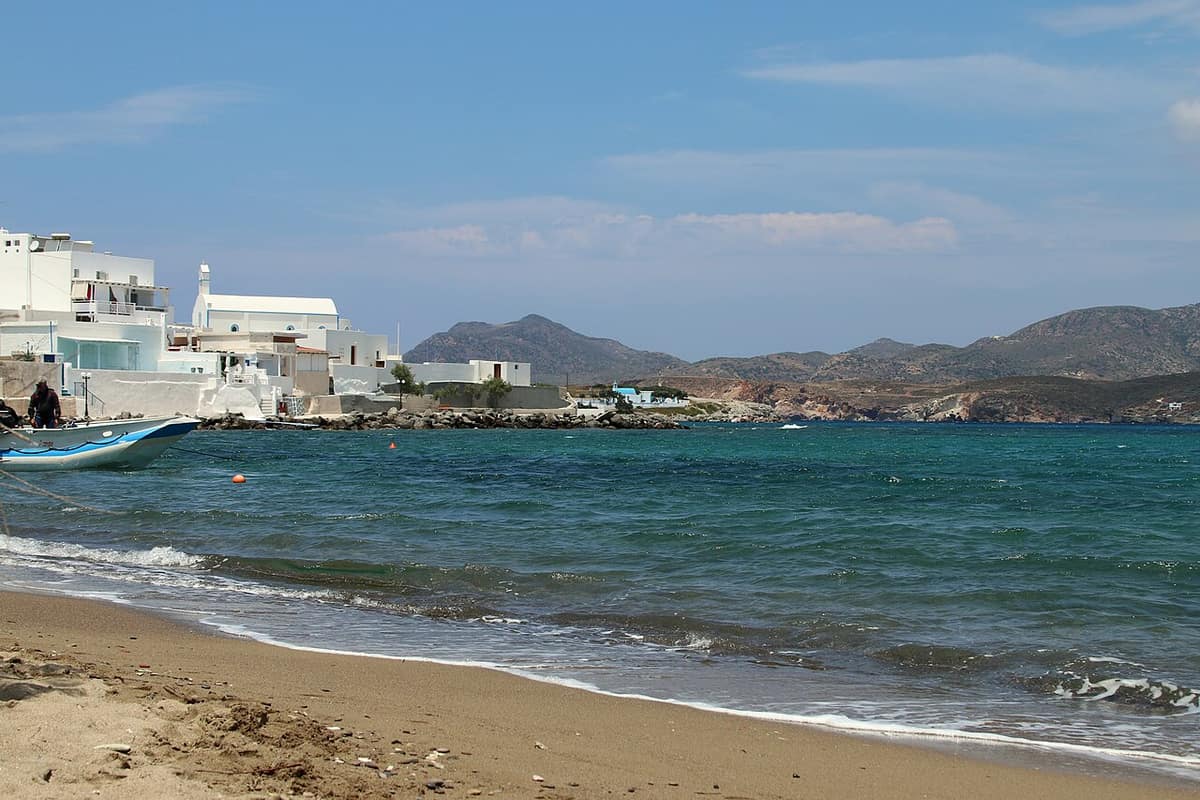
The central beach of Pollonia is sandy and popular with visitors. It runs along the cove that holds the village, so a swim and a table sit within a short walk of each other. Two more beaches belong to the settlement: an organised one, and a smaller shore that local speech calls the back sea. Together they give coffee and drinks in Pollonia three points on the same stretch of coast, at the water’s edge.
Tamarisk trees stand above the sand, and their cover makes the middle of the day bearable. Shade, a cold glass and the sound of the water form the afternoon order in the bay. The sea stays close to the tables, so a drink can follow a swim without a change of plan. Coffee and drinks in Pollonia at midday belong to that strip of sand and shadow rather than to a room or to a closed door.
The bay faces north-east, and the view across the water reaches two islands. Kimolos lies about 985 metres from the Milos coast, and the uninhabited Polyaigos sits about 6 kilometres to the east. Both belong to the same group of western Cyclades, and both shape the light and the wind on the beach. Coffee and drinks in Pollonia are taken with that horizon in front, and a swimmer who looks up from the sand sees both islands at once.
Polyaigos is the largest uninhabited island of the Aegean, and it belongs to the municipality of Kimolos. The sea between the islands stays calm in the right weather, and small boats cross it through the day. The beach in the bay is the easiest place to watch that traffic. Coffee and drinks in Pollonia give the afternoon a seat with a view of the channel, and the shade of the tamarisks keeps it comfortable until the light drops.
- Central beach: The sandy beach of the cove is the main shore of the village.
- Second shore: An organised beach stands beside the central one.
- Back sea: A third and smaller shore carries that name in local speech.
- Shade: Tamarisk trees above the sand cover the midday hours.
- View: The bay looks towards Kimolos and the uninhabited Polyaigos.
The bay gives the drinking day its middle hours. A swim, a cold glass and a chair in the shade make one continuous act, and the village keeps the table close to the water for that reason. Coffee and drinks in Pollonia change with the sun rather than with a menu. The coast east of the village holds a different kind of shoreline, with a pebble beach and the remains of the mining years.

What lies on the coast east of coffee and drinks in Pollonia at Voudia bay?
Coffee and drinks in Pollonia belong to the north-eastern coast of Milos, and the shoreline continues east to Voudia, a small settlement and beach with a pebble shore. A loading pier and mining installations stand at one end of the bay.
Voudia lies on the north-eastern tip of Milos, at 20 metres, about 13 kilometres east-north-east of Plaka and 12 kilometres east-north-east of Adamantas. The beach there is long, with fine pebbles and clear water that form an open bay. One end holds the loading pier and the buildings of the mining activity. The settlement counted 11 residents in the 2021 census. Coffee and drinks in Pollonia sit a short way west along the same coast.
The mining history of Milos reaches back a long way. Obsidian from the island was a commodity thousands of years ago, and the ground later gave kaolin, pozzolana, bentonite and perlite, which are still taken from it. Baryte, sulfur, millstones and gypsum were mined in the past. That industrial past explains the pier at Voudia, built to move heavy loads by sea, and coffee and drinks in Pollonia still look out on the works of those years.
Milos is a volcanic island, and tuff, trachyte and obsidian are ordinary rocks there. Volcanic activity began between two and three million years ago and last erupted 90,000 years ago. The ground still carries the marks of that history in its colours and its stones. The beach at Voudia shows the same mixture, with fine pebbles under clear water and the works of the mining years along one edge. Coffee and drinks in Pollonia look across a coast of that kind.
A walk along that coast leaves the tables of the village behind. The route passes a shoreline where a loading pier once served the mines, and it ends at a bay that stays quiet through the greater part of the year. The contrast is part of the appeal for anyone who follows coffee and drinks in Pollonia out of the village. The next part returns to the waterfront, where a boat connects Milos with its neighbour.
- Voudia: A settlement and beach on the north-eastern tip of Milos, at 20 metres above the sea.
- Shore: Fine pebbles and clear water form an open bay on that coast.
- Pier: A loading pier and mining installations stand at one end of the beach.
- Minerals: Kaolin, pozzolana, bentonite and perlite are still collected from the island ground.
- Population: Voudia counted 11 residents at the 2021 census.
The eastward coast tells the other half of the story of the village: work rather than leisure, and cargo rather than tables. Voudia keeps a pier, a pebble beach and a handful of houses, and the mining years are still visible along the shore. Coffee and drinks in Pollonia gain a wider frame from that view. Across the water the island of Kimolos waits, and a small boat has linked the two shores for a long time.
How does the boat to Kimolos appear in coffee and drinks in Pollonia?
Coffee and drinks in Pollonia take place a short distance from the quay where a small boat crosses to Kimolos. The neighbour island stands across a channel about one kilometre wide, and its main village and port can be seen from the waterfront.
Kimolos lies to the north-east of Milos, separated from it by a channel one kilometre wide, the Ammouni strait. The island covers 36 square kilometres, and mount Paleokastro reaches 364 metres. The main settlement, called Chorio, stands on a hill in the south-east. Its port, Psathi, sits 800 metres away, and smaller settlements such as Goupa, Kara, Prasa, Aliki and Bonatsa appear along the coast, and coffee and drinks in Pollonia face that shore.
The census counted 810 residents on Kimolos in 2021, and the number drops outside the warm months, when no more than 600 people remain. A year-round ferry and a catamaran link the island with Piraeus and with other islands of the western Cyclades. The two islands connect through the northern port of Milos, which is Pollonia, more than once a day. Coffee and drinks in Pollonia therefore sit beside an island route rather than at the end of one.
Polyaigos lies beyond Kimolos, about 1.1 nautical miles from it, and it is the largest uninhabited island of the Aegean. A lighthouse on Agios Efstathios serves shipping in the strait between the two islands, and another stands on the eastern side of Polyaigos. The name of Kimolos gave the Greek word for chalk, because of the white ground of its southern coast. Coffee and drinks in Pollonia face a sea that holds islands, straits and old sea marks.
The history of the two islands crosses the same water. Milos and Kimolos argued over the ownership of Polyaigos in the time of the battle of Chaeroneia, and a court at Argos decided in favour of Kimolos. In older times the island was known as Echinousa, after the viper that still lives there. Coffee and drinks in Pollonia look out on a channel with a long memory, and the boat keeps the two shores in touch.
- Crossing: A small boat links Pollonia with Kimolos across a channel one kilometre wide.
- Chorio: The main settlement of Kimolos stands on a hill in the south-east.
- Psathi: The port of Kimolos sits 800 metres from the main settlement.
- Polyaigos: The largest uninhabited island of the Aegean lies beyond Kimolos.
- Lighthouse: A light on Agios Efstathios marks the strait between the two islands.
The waterfront of Pollonia faces a working sea. A small boat crosses to Kimolos more than once a day, and the island opposite shows its hill village and its port. That view keeps coffee and drinks in Pollonia tied to the water rather than to the road. A day on the coast can end with a day cruise from Pollonia to the islands opposite, a swim from a quiet shore, or a long afternoon in the shade of the village.

What do visitors ask about coffee and drinks in Pollonia?
Coffee and drinks in Pollonia raise a set of practical questions: where the waterfront sits, what is poured, when the day starts and how the village connects with the islands across the water. The answers stay with the place and its habits.
Where do coffee and drinks in Pollonia sit in the village?
The waterfront of the cove holds them. Taverns, restaurants and island coffee houses stand along the sand and the quay, and the fishing boats moor at the pier in front of the church of Agia Paraskevi. The village lies at the north-eastern tip of Milos, so the light and the wind arrive from the sea.
Which drinks belong to coffee and drinks in Pollonia?
Greek coffee and frappé are the two coffees of the traditional coffee house, and beer, retsina and ouzo stand beside them. A small plate of meze or a free snack comes with the order in nearly all kafenia, while full meals stay rare. The list stays short and steady through the day.
When does the day start for coffee and drinks in Pollonia?
Morning sets the order. Boats come in with the night catch, and the first cups follow the landing at the pier. The heat then moves the day towards the shade, where iced coffee and cold drinks take over. Summer brings the busiest weeks, and the harbour fills with visitors from the island and beyond.
How large is the village behind coffee and drinks in Pollonia?
The census counted 268 residents in 2021, after 272 in 2011. The settlement stays small through the year, and the working life of the harbour is easy to follow at that size. Milos as a whole had 5,193 residents at the 2021 census, and the capital, Plaka, keeps the island’s administration.
What is Voudia bay on the coast east of coffee and drinks in Pollonia?
Voudia is a settlement and beach on the north-eastern tip of Milos, about 13 kilometres east-north-east of Plaka and 12 from Adamantas. The beach is long, with fine pebbles and clear water. A loading pier and mining installations stand at one end, and 11 residents were counted there in 2021.
How does the boat from the waterfront of coffee and drinks in Pollonia reach Kimolos?
A small boat crosses the channel between the two islands, and the crossing takes place through the northern port of Milos, which is Pollonia. Kimolos lies about 985 metres from the Milos coast, and its port, Psathi, stands 800 metres from the main settlement. The route runs more than once a day.