Bar Gatis, Plaka
Utopia Cafe, Plaka
Aragosta Cafe Bar, Adamas
Cafe Bar Rifaki, Pollonia
Cafe Bar I Akri, Adamas
Cafe Bar Plori, Adamas
Yankos Cafe, Adamas
Egoist Cafe, Adamas
Milors cafe, Adamas
EN PLO CAFE BAR
Remvi Cafe – Bar
Adamas Cafe, Adamas
- Coffee – Drinks in Adamas
- Coffee – Drinks in Palaioxori
- Coffee – Drinks in Plaka
- Coffee – Drinks in Pollonia
- Coffee – Drinks in Provatas
- Coffee – Drinks in Triovasalos
- Coffee – Drinks in Tripiti
- Coffee – Drinks in Zefiria
Coffee and drinks in Milos belong to daily life on the island of Milos, from morning Greek coffee to ouzo with meze. Cafes, cafe bars and the traditional kafeneio share the villages and the port, and each one serves its own mix of coffee, cold drinks and spirits. This page shows how coffee and drinks in Milos fill the day.
The page begins with what coffee and drinks in Milos cover, from cafe culture and the coffee house to the drinks of each hour. It then turns to Greek coffee itself, with the briki, the order and the customs of the cup. Dishes, cheeses and pies have their own place on the food and drink in Milos page.
What do coffee and drinks in Milos cover?
Coffee and drinks in Milos cover village cafes, port cafe bars, the traditional kafeneio, Greek coffee, iced coffee and spirits. The offer runs from breakfast coffee through the cold coffees of summer to the ouzo and beer served with meze.
The cafe is the everyday meeting place, and coffee and drinks in Milos start there. Plaka, the capital, has cafes among its small shops and restaurants on lanes closed to cars. Adamas, the main port, has cafe bars alongside its nightlife. Pollonia, the fishing village at the north-eastern tip, has island cafes and is the point of connection with the neighbouring islands of Kimolos and Glaronissia. Hill lane, port and fishing village each give coffee and drinks in Milos a different scene.
The kafeneio is the traditional coffee house of Greece. It serves Greek coffee and frappe, beer, retsina and ouzo, and in the majority of kafeneia a meze or a free snack comes with the drinks. The furniture is plain, the walls are frequently whitewashed and the business traditionally belongs to one family. On islands and in villages the kafeneio works as a social centre, where people meet after work or play cards. That role gives coffee and drinks in Milos a seat and a long conversation.
Coffee and drinks in Milos begin with breakfast. The Greek breakfast pairs Greek coffee or frappe with mountain tea, hot milk or fruit juice. The frappe is a refreshing cold coffee, above all in summer, and it is ordered glykos, metrios or sketos, with four, two or no spoonfuls of sugar, and milk only on request. The freddo espresso, first made in Athens in 1991, sits beside it. Before a meal, ouzo, mixed with water until cloudy and served with ice, comes with a plate of meze.
- Freddo cappuccino: A freddo espresso topped with a cold milk foam that carries the name afrogala.
- Mountain tea: A breakfast drink listed with Greek coffee, hot milk and fruit juice.
- Ouzo: A dry aperitif flavoured with anise, protected as an exclusively Greek and Cypriot name.
- Tsipouro: An un-aged brandy distilled from grape pomace, the residue left in the winepress.
- Beer: A drink of the kafeneio that sits beside ouzo and retsina on the same table.
Coffee and drinks in Milos therefore cover more than a single cup. The village cafe serves the coffee, the port cafe bars sit within the nightlife, and the kafeneio keeps the traditional habit of sitting, talking and playing cards over a small drink. Cold coffees and spirits fill the rest of the list. These places share one drink with its own method, its own vocabulary and its own customs, Greek coffee, and the next section sets that drink out.
How is Greek coffee served as part of coffee and drinks in Milos?
Coffee and drinks in Milos include Greek coffee, made in a small briki from very fine grounds and served in a small cup with its foam, the kaimaki, on top. The order names the sugar: sketos for none, metrios for medium, glykos for sweet.
The briki is a small pot, wider at the base than at the neck, with a lip for pouring. Coffee, water and sugar go in together and are stirred at the start, then the mixture heats until it almost boils. A thick foam, the kaimaki, forms during the boil, and the coffee counts as well made when the kaimaki survives the serving. The fine powder stays in the cup, and part of it sinks to the bottom. That method defines Greek coffee in coffee and drinks in Milos.
Within coffee and drinks in Milos, the measures define the Greek coffee order. For a sketos, 60 ml of water takes one teaspoon of coffee and no sugar. A metrios adds half a teaspoon of sugar, a glykos adds a full teaspoon, and a coffee ordered with oligi receives a little sugar on the tip of the spoon. A se miso coffee uses 30 ml of water and comes out thick, an elafrys coffee halves the coffee, and a double order doubles every measure in the briki.
Patience shaped the method, so older kafeneia worked slowly. The coffee cooked over a low fire on hot embers for ten to twenty minutes, while the tabis, the person who made the coffees, stirred it gently or tapped the stirrer against the bottom of the briki. A tabis knew 48 kinds of coffee, built from the amounts of water, coffee and sugar and the way of serving. Two cups existed: a normal one and a thick one with walls twice as thick, which kept the coffee hot for longer.
- Water: A glass of cold water arrives with the coffee, and a first sip clears the mouth.
- Barys: A coffee ordered barys is poured with the briki held low, giving a smooth kaimaki without bubbles.
- Vrastos: A coffee ordered vrastos is poured with the briki lifted high, making bubbles and a thinner kaimaki.
- Sand: The tradition of heating the pot on sand over hot embers belongs to the old kafeneia.
- Name: Turkish coffee became Greek coffee in Greece after political tension with Turkey in the 1950s.
Greek coffee ties the whole subject together. Coffee and drinks in Milos begin with a briki, a small cup with foam on top and an order that names the sugar, and they continue with cold coffee and spirits. A visitor who orders by the measure, sketos, metrios or glykos, and waits for the grounds to settle receives the drink as the Greek kafeneio serves it, slowly and in a small cup.
How are iced coffees ordered within coffee and drinks in Milos?
Coffee and drinks in Milos include three Greek iced coffees: the frappé, the freddo espresso and the freddo cappuccino. The frappé is ordered by sweetness and milk, and the freddo cappuccino adds cold milk foam to a freddo espresso.
A frappé order has two parts: how sweet the glass is and whether milk goes in. Sweetness is counted in spoonfuls of sugar against two spoonfuls of coffee, and milk stays out unless the order asks for it. The list below gives the five words that carry the whole order. Coffee and drinks in Milos use the same order words as the rest of Greece, because a frappé is ordered this way across the whole country.
The foam comes first. Coffee, sugar and a little water are beaten until a thick foam forms, and the foam then goes into a glass with ice cubes and cold water. Spray-dried instant coffee holds nearly no oil, so its foam is thicker and lasts longer than the crema of an espresso, and water drains from it slowly. The foam is considered unpleasantly bitter, so a straw almost always comes with the glass. This oil-free foam sets the frappé apart among coffee and drinks in Milos.
The freddo espresso is the iced coffee built on espresso. It was first made in Athens in 1991 and is seen as a higher-quality frappé. The espresso is mixed with ice and then poured over ice. The freddo cappuccino is the same drink with a layer of cold frothed milk poured on top, and Greek calls that cold milk foam afrógala. The two names state the build of the glass, so coffee and drinks in Milos offer an espresso-based choice beside the frappé.
Order words also cover the variations. A frappé with milk is called a frapógalo, and locals in tourist resorts of Greece call a sweet frappé with milk a tourist frappé, because visitors drink it so frequently. When no shaker is at hand, the coffee is stirred with a spoon, and these versions are called koutalátos, meaning spoon-made, or karavísios, meaning of the ship, after sailors at sea. A ball of vanilla ice cream can replace the milk. The order words stay the same across coffee and drinks in Milos.
- Skétos: The word means plain, a frappé with no sugar.
- Métrios: The word means medium, a frappé with two spoonfuls of sugar to two spoonfuls of coffee.
- Glykós: The word means sweet, a frappé with four spoonfuls of sugar to the same coffee.
- Me gála: The phrase means with milk, normally evaporated milk, and milk is added only on request.
- Horís gála: The phrase means without milk and states outright that the glass stays free of it.
A complete order joins three parts: the drink, the sugar word and the milk word. The words métrios and me gála after the name frappé therefore mean a medium-sweet frappé with milk. The freddo espresso and freddo cappuccino are named for the espresso and the cold foam instead. Together, the three iced coffees show how coffee and drinks in Milos are ordered in one short phrase.
How does the village kafeneio fit into coffee and drinks in Milos?
Coffee and drinks in Milos include the kafeneio, the traditional Greek coffee house of villages and islands. A kafeneio serves Greek coffee, frappé, beer, retsina and ouzo with meze or free snacks, and it works as a social centre where people meet after work.
The word kafeneio comes from the earlier Greek kafenés, which was borrowed from the Turkish kahvehane, a coffee house. The Turkish word came in turn from the Persian qahveh-khaneh, built from qahve, coffee, and khane, house. Kafenia were traditionally family-run businesses with simple furnishings, and whitewashed walls are a common sight. The name alone carries the route of coffee drinking from Persian to Turkish to Greek, and coffee and drinks in Milos still use it.
Greek coffee is the popular drink of the traditional kafeneio, and it forms the hot side of coffee and drinks in Milos. It is cooked in a small pot called a briki and carries a thick froth called kaïmaki. The sugar word decides the cup: skétos for none, métrios for medium and glykós for sweet. Older kafenia had a coffee maker, the tambís, who knew 48 kinds of coffee and cooked them on sand in hot embers. Cups with walls twice as thick kept the coffee hot for longer.
Village life explains why the kafeneio matters more than the cup. Kafenia serve as social centres of the villages and islands where they stand, and people meet there after work or play a game of cards. In earlier centuries women were not welcome inside, and today girls and women frequent kafenia as well. The kafeneio rarely serves full meals, so a visit there is built around coffee and drinks in Milos rather than around dishes.
The kafeneio puts coffee and drinks in Milos on the daily map of the island. Triovasalos and Pera Triovasalos form the commercial and daily core of Milos, with banks, public services, kafenia, shops and small businesses, and they keep their traditional Cycladic character. The Karodromos, a central point of the island, holds kafenia beside banks and shops. Tripiti has taverns, kafenia and churches, and Pollonia has island kafenia beside its taverns and restaurants. The villages of Milos keep a coffee house within reach of daily errands.
- Coffee: Greek coffee and frappé are the drinks of the kafeneio table.
- Drinks: Beer, retsina and ouzo stand beside the coffee.
- Meze: Meze or free snacks arrive with the coffee and drinks in Milos that a kafeneio serves.
- Furnishing: Traditional kafenia are furnished simply, and whitewashed walls are a common sight.
- Cards: A game of cards fills the hours after work.
The kafeneio and the iced coffee describe two sides of one habit. The kafeneio holds hot Greek coffee, the card game and the talk of the village, while the frappé, the freddo espresso and the freddo cappuccino suit the cafe table. Because a kafeneio also serves frappé, both sides of coffee and drinks in Milos can meet at a single village table.
Which Greek spirits belong to coffee and drinks in Milos?
Coffee and drinks in Milos include three Greek grape spirits: tsipouro, a distilled pomace brandy, ouzo, a dry anise aperitif, and raki, the eastern Cretan name for tsikoudia. All three come in small glasses beside small plates of food.
Tsipouro is an un-aged brandy made from grape pomace, the residue of the winepress, and it holds 40 to 45 percent alcohol by volume. Distillers discard the first and last runs from the still and keep only the middle run, called the heart. Tradition credits Orthodox monks on Mount Athos with the first batch in the 14th century. Within coffee and drinks in Milos, tsipouro keeps the aroma of the pomace, because its lower degree of distillation preserves it.
Tsipouro arrives in shot glasses, straight from the fridge, or with water or ice added. Depending on the season, it serves as a cool refreshment or as a hot drink, and depending on the hour, it replaces a coffee or a glass of wine. Nuts, dried fruit, raisins, cheese, olives, seafood, meat, halva and paximadi, a hard rusk, make up the meze beside it. Since tsipouro can replace a coffee, it belongs to the same list as coffee and drinks in Milos.
Ouzo is a dry aperitif flavoured with anise. Distillers start from rectified spirit at 96 percent alcohol by volume and distil it in copper stills, with anise added alongside star anise, fennel, mastic, cardamom, coriander, cloves or cinnamon. The finished spirit holds between 42 and 55 percent. When water or ice meets the glass, the clear liquid turns milky white, a change called louching. Ouzo can also be drunk straight from a shot glass, so coffee and drinks in Milos include a clear and a cloudy pour.
Raki is the name used in eastern Crete for tsikoudia, a pomace brandy of Cretan origin that holds 40 to 65 percent alcohol by volume. It is distilled once, with no added flavourings, so the grape taste stays whole. Villages in Crete make it at home, and restaurants serve it chilled as a free digestif with fruit and sweets after the meal. Raki rounds out coffee and drinks in Milos as the Cretan relative of tsipouro.
- Tsipouro: A pomace brandy of 40 to 45 percent alcohol that is served in shot glasses.
- Ouzo: An anise aperitif that turns milky white when water or ice is added.
- Raki: The eastern Cretan name for tsikoudia, a pomace brandy distilled once.
- Meze: Small plates of cheese, olives, grilled meat or seafood that go with spirits in Greece.
- Ouzeries: Cafe-like places across Greece that serve ouzo with mezedes.
The European Union protects ouzo, tsipouro and tsikoudia as spirit drinks with a protected geographical indication, so the three names form one family. The word meze comes from a Turkish term for an appetizer, and the custom began in the Byzantine Empire. Local appetizers of Milos, such as beltes with olive oil and tomato fritters, are described on the food in Milos page, and they follow the same small-plate logic as coffee and drinks in Milos.
How does wine shape coffee and drinks in Milos and the Cyclades?
Coffee and drinks in Milos include wine from a volcanic island where grapes are a main crop and winemaking has revived. The wider Cyclades add Santorini and Paros, which are two of the wine appellations of the Aegean islands.
Grapes, cotton and barley are the main crops of Milos, an island too dry for a profusion of vegetation. A route inland from the coast crosses olive groves, vineyards and cereal fields on a road of soft perlite. Wine production has revived in recent years, and local winemakers make wines that reflect the volcanic soil of the island. Local wine is therefore a product of that volcanic ground, and it sits within coffee and drinks in Milos beside the island spirits.
The Cyclades, an archipelago of about 220 islands in the Aegean Sea, are the peaks of a submerged mountainous terrain, and Milos and Santorini are the two volcanic exceptions. The climate is dry and mild, and the soil is not very fertile, with the exception of Naxos. Agricultural produce of the group includes wine, fruit, wheat, olive oil and tobacco. Wine is therefore a crop of a dry climate and ground that is not very fertile, and the same setting frames coffee and drinks in Milos.
Santorini, the other volcanic island, is the Cycladic wine region whose wine became famous worldwide in the Middle Ages. Assyrtiko, the white grape native to Santorini, grows on Paros and other Aegean islands, and it keeps its acidity when fully ripe. Growers train the vines low in basket shapes called kouloura to shelter the grapes from strong wind and sun. Old Assyrtiko vines stand ungrafted on their own roots, because the island is described as free of phylloxera. Santorini therefore gives coffee and drinks in Milos its Cycladic wine reference.
Greece grows about 200 vine varieties. Athiri, an ancient white grape, comes originally from Santorini, and Mavrotragano, a red grape of the Cyclades, almost became extinct because of the special treatment it needs. Vinsanto, the sweet wine of Santorini, comes from grapes dried in the sun for 12 to 14 days and aged for a minimum of 24 months in oak. Each style adds range to coffee and drinks in Milos for anyone who follows the wines of the islands.
- Assyrtiko: A white grape of Santorini that stays high in acidity when ripe and also grows on Paros.
- Athiri: A low-acid white grape of ancient origin that comes from Santorini.
- Mavrotragano: A red grape of the Cyclades that grows on the volcanic ground of Santorini.
- Kouloura: The basket-shaped vine training that shelters grapes from wind and sun.
- Vinsanto: The sweet Santorini wine made from sun-dried grapes.
Wine links coffee and drinks in Milos to the wider Cyclades. Milos grows grapes on dry volcanic ground and has a revived wine production, while Santorini and Paros hold appellations among the Aegean islands. Wine, tsipouro, ouzo and raki together fill out coffee and drinks in Milos beyond the cup of coffee, and each of them traces back to the grape.

Where are coffee and drinks in Milos found by area?
Coffee and drinks in Milos are found in five areas: the harbour of Adamas, the cobbled lanes of Plaka, the waterfront of Pollonia, the village of Tripiti and the beach bars of the south coast. Each area has its own setting and its own time of day.
Adamas is the first place to look for coffee and drinks in Milos, because it is the main port and the first view for anyone arriving by boat. Cretan refugees from Sfakia built the village, which has been inhabited since 1824 and now has 1,268 residents. White houses with flower-decorated courtyards and narrow quiet streets stand behind the water. The French cemetery, the 600-year-old church of the Holy Trinity and two museums are among its sights, so a coffee stop fits between visits.
Plaka is the capital of Milos and stands on top of a large rock above the gulf. Its cobbled lanes were built to protect the first houses from pirates, and the name comes from the flat ground where those houses stood once the Castle no longer had room for the whole population. Cafes share the lanes with small shops. Plaka is also the start of the sunset route in the next section, so coffee and drinks in Milos at Plaka combine a daytime coffee with an evening climb.
Pollonia is the second port of Milos, built around a cove at the north-eastern tip of the island. A sandy beach with tamarisk trees borders the village, and taverns, restaurants and island cafes stretch to the church of Agia Paraskevi at its right end. At the other end, the Pelekouda peninsula and the church of Agios Nikolaos close the waterfront, and a chair-shaped rock there is said to keep a couple together forever. Coffee and drinks in Milos at Pollonia therefore come with a short stroll to the headland.
Tripiti is a traditional settlement almost united with Plaka, and it has 766 residents. Its name refers to the holes in the soft volcanic rock on which it stands, and the houses rise like an amphitheatre over the ruins of the classic city of Klima. The church of Agios Nikolaos dominates the centre. Taverns and restaurants make the village the place for a drink with a meal, and coffee and drinks in Milos here come with a panoramic view of Adamas Bay.
- Firiplaka: Coffee and drinks in Milos here come from a beach bar beside sun loungers and parasols on the organised first stretch.
- Agia Kyriaki: Beach bars stand on the large organised beach, and a restaurant is within walking distance.
- Tsigrado: The beach has no organised services, and the essentials come from nearby Firiplaka.
- Provatas: A paved road and a frequent bus service link the red-gold sand to Adamas.
- Agios Sostis: The small shallow beach extends the Provatas shore and has a restaurant.
Each area gives coffee and drinks in Milos a different setting: the harbour of Adamas, the lanes of Plaka and Tripiti, the waterfront of Pollonia and the beach bars of the south coast. A morning coffee, a drink with a view and a cold glass after swimming sit in different parts of the island. Planning the day by area keeps the distances short and lets the setting decide the order of the stops.
Which sunset viewpoints suit coffee and drinks in Milos?
Coffee and drinks in Milos at sunset suit two hill viewpoints and two shore settings: the Venetian Kastro and the Korfiatissa courtyard in Plaka, then Klima and Firopotamos at the waterline. The first two look down on the bay, and the last two sit beside the water.
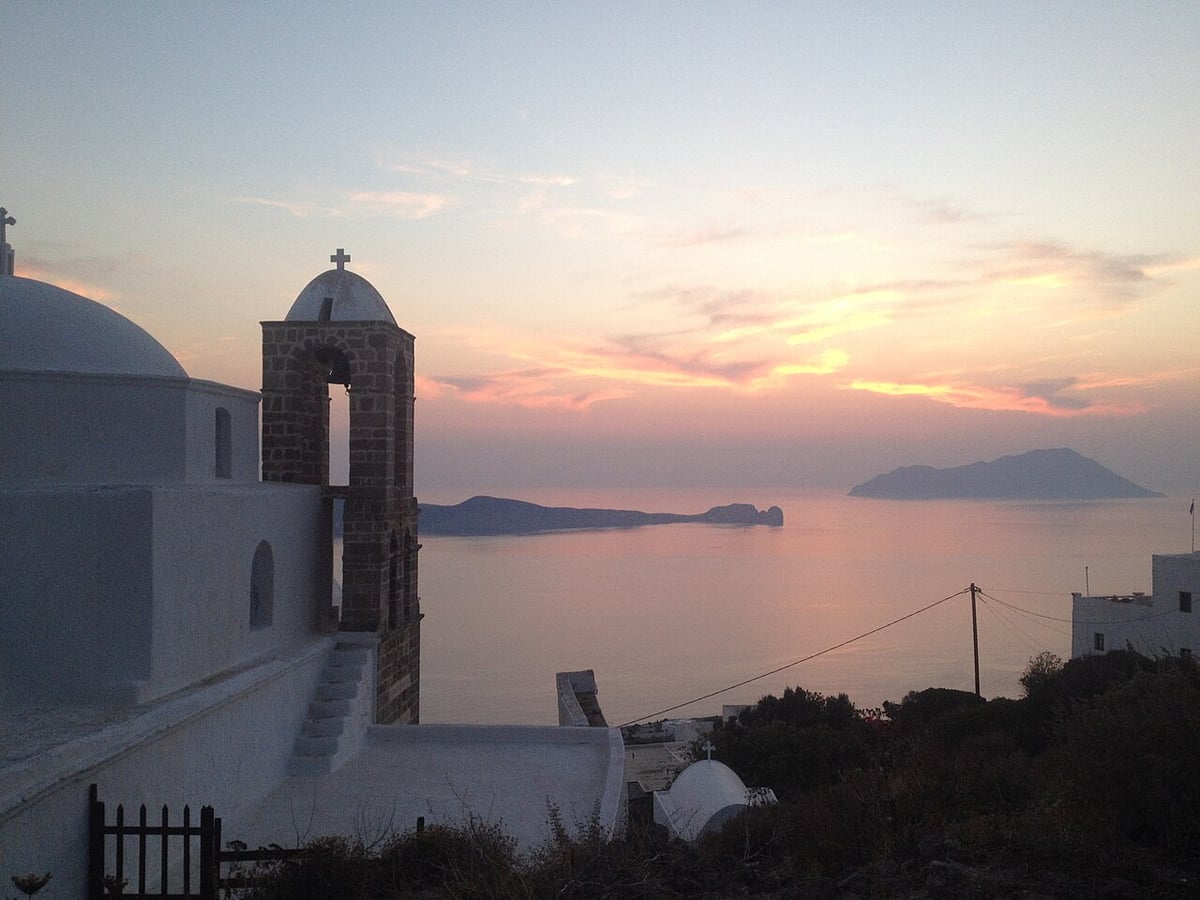
The Kastro is the hill-top viewpoint for coffee and drinks in Milos at sunset. The Venetian castle dates from the 13th century and stands at the top of Plaka hill. At its top, the small vaulted church of Panagia Skiniotissa is a post-war building, because the older chapel was blown up during the German occupation and the inhabitants rebuilt it after 1944. The village below holds the cafes, so coffee and drinks in Milos fit before the climb and after the descent.
The second viewpoint of Plaka is the church of Panagia Korfiatissa, built in 1810 on steep rocks at the western end of the village. Sea views and sunsets draw visitors to its courtyard, and the church keeps relics from the old abandoned churches of the island, a small wood-carved gilded iconostasis and a gilded epitaph of 1600 brought from Smyrna. Coffee and drinks in Milos at Korfiatissa therefore suit the hours before sunset at the edge of the village.
Klima and Firopotamos belong to the fishing villages of Milos, and both give the evening a shore setting. Klima has 8 residents, and its wider area holds the ruins of the old town and the first port of the island, the ancient theatre and the place where the Venus de Milo was found. Firopotamos has a small but organised sandy beach with tamarisk trees and a beach bar, and coffee and drinks in Milos there come with a swim and a walk along the cove.
- Panagia Thalassitra: The church of the patron saint of sailors stands on the way up to the Castle.
- Skiniotissa: The name is said to come from an icon of the Virgin Mary found on a skin.
- Halara: The rocky site of Korfiatissa carries this name, and the ground before the church is called Marbles.
- Klima citadels: The hill of Profitis Ilias and Pyrgaki are the two citadels of the settlement.
- Firopotamos: An abandoned loading ladder and the church of Agios Nikolaos stand beyond the fishing houses.
Two hill viewpoints and two shore settings give coffee and drinks in Milos a clear evening route. The Kastro and Korfiatissa offer height above the bay, while Klima and Firopotamos offer the water’s edge and the fishing houses. The choice of viewpoint decides whether the evening is spent above the bay or beside it, and pairing a viewpoint with an area from the first section shapes the whole outing.

How do coffee and drinks in Milos work at organised and natural beaches?
Coffee and drinks in Milos at the beach depend on the kind of shore. Organised beaches have beach bars beside the sunbeds, while natural beaches carry no such service, so visitors bring their own water, ice and snacks from the harbour or from an organised beach nearby.
Milos has two kinds of beach: fully organised ones and lonelier, wilder ones. That split decides how coffee and drinks in Milos reach the shore. An organised beach offers sunbeds, umbrellas and a beach bar, so a cold drink sits close to the towel. A natural beach offers sand and sea only, so the same drink has to arrive in a bag. Fresh water is also scarce on the Greek islands, so the bottle is filled before leaving the harbour.
An organised beach sells its services as a set. Sunbeds, umbrellas or parasols, a beach bar and a volleyball court or a nearby restaurant make up the offer. Coffee and drinks in Milos on such a beach come from the bar on the sand, which keeps the swim and the drink in one stop. Three examples are listed below, followed by two natural beaches where the bar is replaced by a dirt road and a walk.
Natural beaches ask for planning. Kalogries, in the north-west, is a secluded beach where calm water and the bay form a natural pool. Rivari is a natural lagoon and a refuge for migratory birds, ringed by small vegetation and low hills. Alogomandra is a strip of sand closed in by high cliffs and hidden from the road. These shores stay natural, so coffee and drinks in Milos here come from the bag, packed before the drive.
A good beach day on the island can combine both kinds. The west side of Milos has not developed much in tourism, so the wild shores there stay quiet. A morning at an organised beach keeps the bar close by, and an afternoon at a natural beach gives privacy. Coffee and drinks in Milos then split into two parts: the drink bought at the bar and the bottle carried to the cove.
- Agia Kyriaki: Large and organised, with beach bars, sunbeds, umbrellas and a restaurant within walking distance.
- Firiplaka: The first beach has a beach bar, sun loungers and parasols beside shallow turquoise water.
- Firopotamos: A small organised beach with sand and tamarisk trees, where a beach bar serves coffee and drinks in Milos.
- Patrikia: Three isolated beaches that need a dirt road and a walk, so the cooler travels along.
- Agios Ioannis: Three parts at the end of a dirt road of about 12 kilometres, two of them on foot.
The page on the beaches of Milos covers every shore, including which ones are organised and which stay natural. With that picture in mind, coffee and drinks in Milos on the sand follow one rule: an organised beach supplies the drink, and a natural beach asks for it to be packed. The choice of shore sets the choice of bag.
How do evenings and nightlife change coffee and drinks in Milos?
Coffee and drinks in Milos shift from daytime cafes to evening cafe bars, taverns and music events around Adamantas, Plaka and Pollonia. The island is less crowded than Santorini and Mykonos, so the evening stays relaxed and centres on these three settlements.
Milos has become a popular destination in recent decades, yet it receives fewer visitors than other Cyclades islands. Its setting is less crowded than Santorini or Mykonos, and the evening follows that pace. The west side has not developed much in tourism, so evening life gathers in a short list of places. Coffee and drinks in Milos after dark mean a choice between three settings: the harbour town of Adamantas, the capital Plaka and the fishing village of Pollonia.
Adamantas is the harbour town and the cultural and commercial centre of the island. It stands on one of the largest and safest natural bays in the Mediterranean, and its narrow, quiet streets hold white houses with small flower-decorated courtyards. Rest sits beside nightlife and entertainment here, and the cafe bars of the harbour town give coffee and drinks in Milos a seaside setting. Its port is the first sight of the island for visitors arriving by boat.
Plaka is the capital of Milos and took its name from the flat ground where houses rose when the Castle was too small for the whole population. It is a designated traditional settlement, and no cars enter because the spaces between walls and buildings are narrow. A bar and a cafe serve coffee and drinks in Milos on the hill. The church of Panagia Thalassitra, photographed more than any other on the island, stands on the way up to the Venetian Castle, where sunsets look over the bay.
Pollonia is a seaside village at the north-eastern tip, the second harbour of Milos after Adamantas. Its sandy main beach is popular, and the village holds taverns, restaurants, island cafes and a cafe bar. A small boat links it with Kimolos. On the left side of the village, the peninsula of Pelekouda carries a tradition: the couple who sit on the small chair-shaped rock there stay together forever. Coffee and drinks in Milos at Pollonia gather around the cove on which the village is built.
- Theatre: The ancient theatre above the port holds up to 700 people and is available for theatre and music events.
- Ouzo: Mixed with water, it turns cloudy white and comes with ice in a small glass.
- Tsipouro: This strong spirit is served in shot glasses with nuts, cheese, olives or seafood.
- Meze: Small plates of fresh fish, fries, olives and feta come with ouzo at the table.
- Distances: Pollonia lies almost 10 kilometres from Adamas and 14 from Plaka.
The Greek table marks the turn from day to night: depending on the time of day, tsipouro replaces coffee or wine. Coffee and drinks in Milos follow the same rhythm, with cafe bars in Adamantas, lanes and a castle in Plaka and a fishing cove in Pollonia. Each of the three settlements gives the island evening its own pace and its own setting.
How do water and soft drinks fit into coffee and drinks in Milos?
Coffee and drinks in Milos start with plain water, because water resources are especially scarce on the Greek islands and the summer is dry. Bottled water is widely available on Milos, and soft drinks, lemonade and rehydration habits follow from the same heat.
Water supply shapes every glass poured in coffee and drinks in Milos. Greece has abundant water resources on average, yet the average hides large differences between years, seasons and regions. Water is especially scarce on the Greek islands, and a number of them receive water by tanker ship or have turned to seawater desalination. Droughts also recur throughout the country, and the drought of 1993 was considered the worst in at least 50 years, so island water is a topic of its own.
Milos has a volcanic setting that suits one answer to the water problem. The Milos Island Project in Greece relied entirely on geothermal energy to produce desalinated water, and it was built because geothermal energy is readily available in a volcanic region such as Milos. The plant combined direct and indirect desalination and produced drinkable water at low cost without polluting the environment. Volcanic heat therefore ties coffee and drinks in Milos to the geology of the island.
The Aegean islands as a group draw partly on local groundwater. Smaller islands with too little groundwater depend on tanker ships, and the neighbouring island of Kimolos was supplied partly or entirely by tankers as of 2008. Historically, the inhabitants of Greek islands also harvested winter rains from rooftops for use during the summer. On Milos the rain falls in winter: January averages 74.7 millimetres, November 60.7 millimetres, and the whole year 410.8 millimetres.
Heat sets the pace of the summer day. The mean daily maximum reaches 28.1 °C in July and 27.6 °C in August, the mean daily minimum is 21.8 °C in July, and a record of 44.0 °C was set in June. Exerting oneself in hot and humid weather is a recognised risk factor for dehydration, a lack of total body water that appears when water loss through sweating exceeds intake, and coffee and drinks in Milos answer that need.
- Bottled water: Drinking water packed in plastic or glass, still or carbonated.
- Soft drinks: Non-alcoholic drinks with added sweetener, such as cola and orange soda.
- Lemonade: A sweetened lemon drink of lemon juice, water and sugar.
- Sugar: High sugar content gives soft drinks the name sugary drinks.
- Rehydration: Water with modest sugar and salts forms oral rehydration therapy.
Water, soft drinks and steady hydration set the daily rhythm of coffee and drinks in Milos. Heat exhaustion is treated by moving to a cooler place, rehydrating and cooling the body, and loose, lightweight clothing with steady hydration helps prevent it. The health centre and the pharmacies of the island, listed on the information page for Milos, answer any case that water alone does not solve.
Which hydration questions do visitors ask about coffee and drinks in Milos?
Coffee and drinks in Milos bring eight hydration questions: bottled water, mineral water, dry summers, warm evenings, soft drinks, lemonade, signs of dehydration and the people who need extra water. Each answer below covers one of them in plain terms.
Is bottled water easy to find with coffee and drinks in Milos?
Bottled water is widely available on Milos. It is drinking water packed in plastic or glass bottles, still or carbonated, in small single-serving sizes or large containers. Mineral water, spring water, well water and distilled water all count as bottled water when packaged this way.
What does mineral water add to coffee and drinks in Milos?
Mineral water comes from a mineral spring and contains minerals such as salts and sulfur compounds. In the European Union, bottled water can carry the name mineral water when it is bottled at the source with minimal treatment. No disinfection treatment is permitted, and carbon dioxide is the only permitted addition.
How dry is the summer for coffee and drinks in Milos?
The summer is close to rainless. June has 0.3 days with 1 millimetre or more of rain, while July and August have 0.1 days each. September rises to 0.9 days, and the wet season returns in winter, with December recording 9.0 such days and January 8.8 days.
How warm are the evenings for coffee and drinks in Milos?
Evenings stay warm in summer. The mean daily minimum is 21.8 °C in July and 21.6 °C in August, and the daily mean reaches 25.0 °C in July. September still holds a daily mean of 22.3 °C and an average relative humidity of 66.8%.
What counts as a soft drink in coffee and drinks in Milos?
A soft drink is a non-alcoholic beverage, carbonated in the main, with an added sweetener such as sugar, fruit juice or a sugar substitute. Examples include lemon-lime drinks, orange soda, cola and ginger ale. Soft drinks come in cans, glass bottles and plastic bottles, and can be served over ice cubes.
How does lemonade differ from other soft drinks in coffee and drinks in Milos?
Lemonade is a sweetened lemon-flavoured drink. Homemade lemonade traditionally uses lemon juice, water and a sweetener such as cane sugar, syrup or honey, while the carbonated version is called lemon soda. The suffix -ade also names drinks of other fruits, such as limeade and orangeade.
Which signs of dehydration matter for coffee and drinks in Milos?
Thirst, headache, tiredness, nausea and a drop in urine volume mark dehydration. A loss of 1 to 2 percent of body water is mild and already impairs cognitive performance, while a loss of 5 to 8 percent causes fatigue and dizziness. Heat exhaustion adds profuse sweating, weakness and lowered blood pressure.
Who needs extra water with coffee and drinks in Milos?
Children, older adults and people with pre-existing health conditions are more susceptible to heat exhaustion, because they regulate core body temperature less well. Certain medications, among them diuretics and antihypertensives, increase fluid and electrolyte losses. Limited access to water or cooling also raises the risk.