Sweets in Plaka, Milos: see our Sweets in Milos section for the island.
Plaka is the capital of the Cycladic island of Milos, a hill village above the gulf. Cars stay outside its paved lanes, so every stop on the way is made on foot. This page follows the sweets in Plaka Milos in two steps: the village and its pauses, then the hour after dinner, when a dessert closes the evening.
The sweets in Plaka Milos branch out in the later sections: watermelon pie, winter sweets, honey, a sweet at sunset below the Kastro, festival evenings and sweets to carry home. The first section here sets the village and the place of a sweet in a visit. The second walks the lanes after dinner, from the table to the last spoonful of the day.
What are the sweets in Plaka Milos at a glance?
Sweets in Plaka Milos belong to a hill capital closed to cars, where restaurants, cafes and small traditional shops share paved lanes. The island supplies the recipes, the village supplies the pause, and a sweet fits after a meal, beside a coffee or between two sights.
From the port of Adamas, an ascent leads to the plateau above the harbour, and Plaka stands on it. The village is the chief town of Milos and the seat of the municipality that covers the island and its nearby islets. It sits 220 metres above the sea, on a rock that overlooks the gulf, and the Kastro rises on the hill above its houses. Sweets in Plaka Milos therefore come with a view and with a climb.
Three kinds of places share the lanes: restaurants, cafes and small traditional shops. The paved lanes were laid at first as a shelter from pirates, and cars have no entry today, so the whole round runs at walking pace. Sweets in Plaka Milos reach the table in two ways. A traveller who wants coffee with a sweet finds the cafes, and a traveller who wants a sweet after dinner starts from the restaurants.
Milos cooking names three dishes as its representative ones, and two of them are sweets. Karpouzopita is a sweet pie of watermelon, and koufeto is made from the pulp of sweet pumpkin with honey and almonds. The third dish is savoury: the small pitaraki pie, filled with peppery dry cheese or with mizithra and mint. The sweet side of the island is a main part of its table, and sweets in Plaka Milos draw on both local dishes.
Everything else on a sweet tray in Plaka belongs to wider Cycladic or Greek tradition. The spoon sweet and the sesame bar called pasteli are found across Greece, almond sweets appear on other islands, and Syros is known for its loukoumia. A sweet also fits between two sights. The Archaeological Museum, the cathedral and the Kastro all stand in Plaka, and the walk from one to the next passes the lanes where cafes and restaurants stand.
- Capital: Plaka is the chief town of Milos and the seat of its municipality.
- Height: The village stands 220 metres above the sea, on a rock over the gulf.
- Traffic: The lanes are closed to cars, so every sweet is reached on foot.
- Local pair: Watermelon pie and koufeto are two of the three dishes named as representative of Milos cooking.
- Shared sweets: The spoon sweet, the sesame bar and almond sweets belong to Greek tradition at large.
Sweets in Plaka Milos start with a place and a short list. The place is a car-free hill capital with restaurants, cafes and small traditional shops. The list holds two local sweets and a handful of shared Greek ones. The next section moves to the hour after dinner, and the sweets of the whole island have a page of their own.
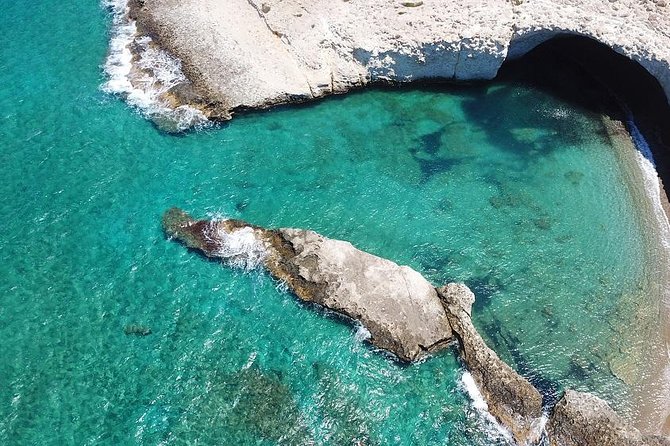
How do sweets in Plaka Milos end an evening in the lanes?
Sweets in Plaka Milos end an evening after dinner in the lanes: the savoury plates are cleared, a sweet arrives as a treat, and a coffee follows. The car-free paving then carries the walk home, so the dessert hour is also a stroll.
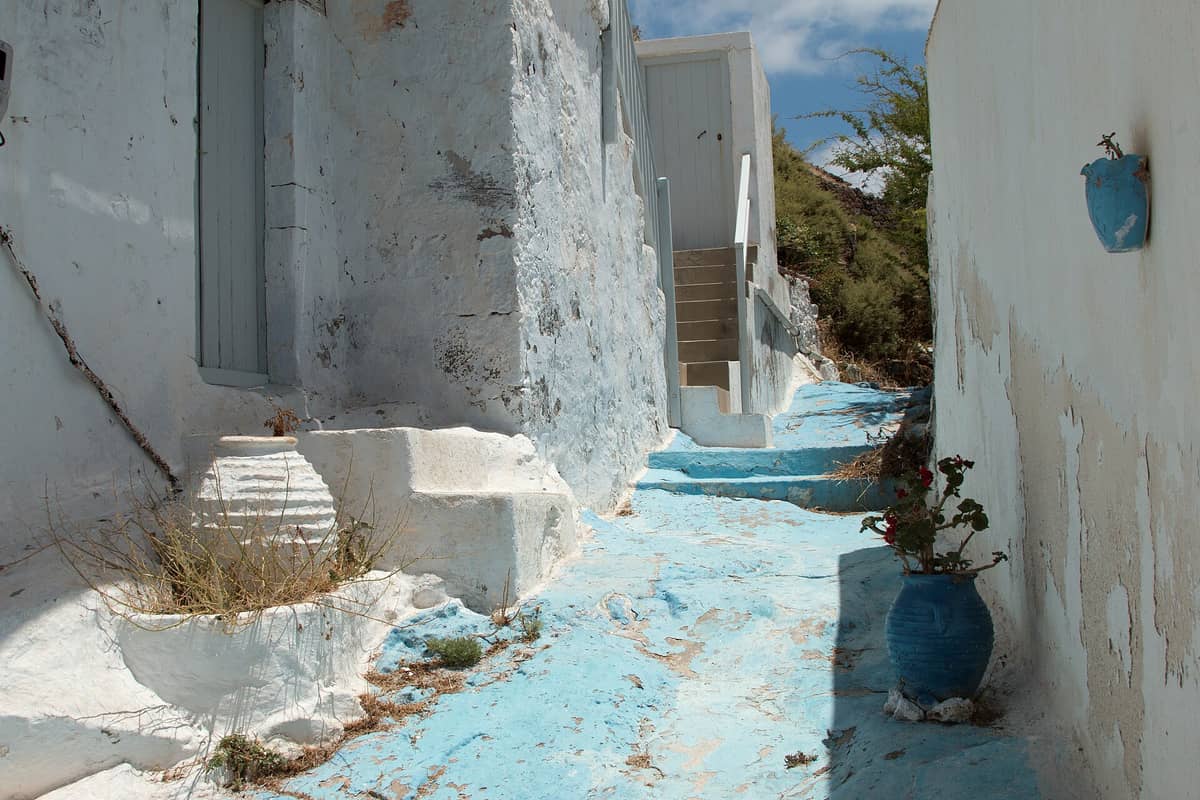
The evening has an order, and sweets in Plaka Milos come last. Dining out is common in Greece, and the taverna and the estiatorio serve home cooking to locals and tourists. Milos has restaurants, taverns, grill houses and wine kitchens, and the restaurants of Plaka sit among them. A traveller who wants a meal before the sweet starts at a restaurant table, and the cafes of the village take over for the coffee.
At the end of the meal, sweets in Plaka Milos work as a treat. Spoon sweets are fresh fruit cooked in syrup, and nuts such as walnuts and almonds also become spoon sweets. Unripe green walnuts are one example. Greek cooks offer them as a dessert or as a treat. Koufeto, the sweet of Milos, is itself a spoon sweet, so the sweet of the island follows the same custom as the fruit preserves of the rest of Greece.
Plainer Greek desserts also close a dinner. Strained yogurt with honey and walnuts, walnut cake, halva with tahini and almond sweets of almonds, sugar and flower water all belong to Greek cooking at large. Halva came from the Ottoman table, and pasteli, the sesame and honey bar, reaches back to ancient Greece. Nuts, honey, fruit, sesame and filo pastry are the common dessert ingredients, so sweets in Plaka Milos share their base with the sweets of the whole country.
After the last spoonful the lanes take over. The village has been a traditional settlement since 1978. Cars cannot enter it, and the walls of the houses stand close together, so the stroll runs on paved ground between Cycladic houses. The Kastro, a Venetian work of the 13th century, stands above them on a hill of volcanic origin, and the gulf lies below. Sweets in Plaka Milos therefore end with a walk, not with a drive.
- Order: Savoury plates come first and the sweet comes last.
- Treat: Spoon sweets are offered as a dessert or as a treat.
- Plain choices: Strained yogurt with honey and walnuts is a Greek dessert.
- Halva: Halva is a Greek dish inherited from Ottoman cuisine.
- Stroll: Cars cannot enter the settlement, so the walk home is on foot.
An evening of sweets in Plaka Milos follows a simple line: a restaurant table, a sweet at the end, a coffee and a walk through the lanes. The local pair, watermelon pie and koufeto, sit beside shared Greek desserts. The remaining sections of the page take one sweet or one moment at a time, from the old kitchen rooms to the sunset below the Kastro.
What goes into karpouzopita, the watermelon pie among the sweets in Plaka Milos?
The sweets in Plaka Milos include karpouzopita, a baked pie in which watermelon replaces milk, water or juice. Raisins, walnuts, cinnamon and clove flavour the batter, and sesame seeds cover the top. The pie belongs to the Cyclades and to summer, when the fruit is ripe.
Among the sweets in Plaka Milos, karpouzopita carries more than fruit and flour. Raisins and walnuts go into the batter, and cinnamon and clove season it. Seed oil or olive oil supplies the fat, and honey can take the place of sugar. Flour and baking powder form the dry base. Sugars make up 6 percent of the fruit, so the watermelon adds sweetness as well as liquid. Watermelon, honey and sesame seeds are the three ingredients that define the island version.
The fruit explains why the pie is a summer sweet among the sweets in Plaka Milos. Watermelon is an annual vine that trails along the ground or climbs, and its large fruit is a berry with a firm rind and no internal divisions. The plant needs temperatures above 25 °C to thrive, and in Greece the fruit ripens in summer. Growers first valued the fruit for its water and stored it to eat in dry seasons. Dessert watermelons spread across the Mediterranean in Roman times.
The old household shaped the pie through thrift. While watermelons were in season, part of the flesh was eaten as fresh fruit and the rest went into the pie, a way of saving ingredients. The rinds were cooked into a spoon sweet or kept as a pickle. A rind turns edible once cooked, and a thick rind is desirable for pickles. The pie therefore belongs to the thrifty side of the sweets in Plaka Milos, beside the spoon sweet.
Karpouzopita is a traditional pie of the Cyclades, especially of Ios, Folegandros, Kimolos and Milos, so the sweets in Plaka Milos belong to a family of island pies. Kimolos lies northeast of Milos, across a channel 1 km wide, and the two islands face each other over the water. The Milos table stays close to nature and to the self-sufficiency of its people. Its kitchens also make small fried pies, pitarakia, with cheese or herbs, served hot with honey.
- Fruit: A watermelon is a berry with a firm rind and no internal divisions.
- Batter: Raisins, walnuts, cinnamon and clove join the flour and the oil.
- Warmth: The plant needs temperatures above 25 °C to thrive.
- Rind: The rind went into a spoon sweet or a pickle.
- Sesame: The seed tolerates drought and grows where other crops fail.
The watermelon pie marks summer among the sweets in Plaka Milos. It shows how an island table turns one fruit, one season and a short list of pantry goods into a baked sweet. Honey meets the pie in the batter and meets the fried pitarakia on the plate. Plaka is the capital of Milos, so its table draws on the whole island, and the savoury dishes of the village sit with the food in Plaka.
What are melomakarona and kourabiedes, the Christmas sweets in Plaka Milos?
The sweets in Plaka Milos at Christmas are melomakarona and kourabiedes. Melomakarona are egg-shaped cakes of flour, olive oil and orange, dipped in honey syrup and topped with walnut. Kourabiedes are almond shortbread shaped into crescents or balls and rolled in icing sugar.
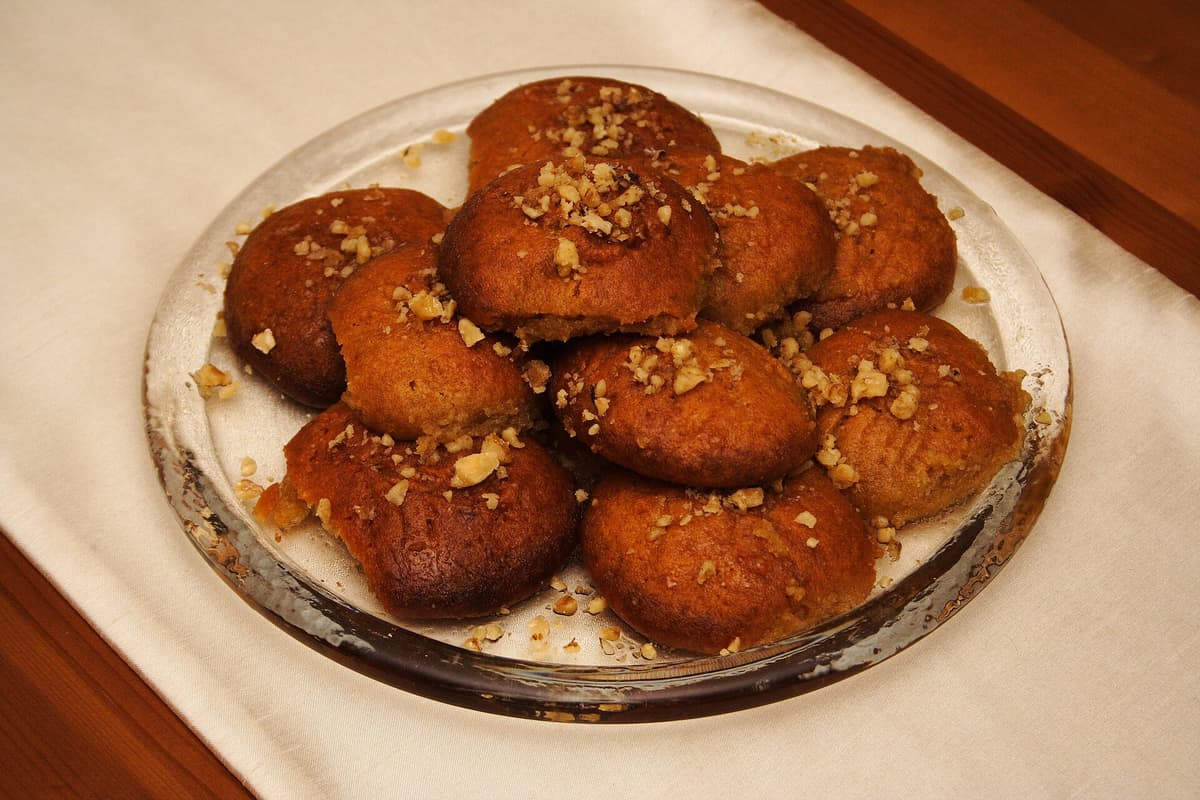
Among the sweets in Plaka Milos at Christmas, the melomakarono is an egg-shaped cake of flour or semolina, sugar, orange zest or juice, olive oil, cinnamon and clove, with cognac or a similar drink added. The dough can take a filling of ground walnuts. Straight from the oven, the cakes go into a cold syrup of honey and sugar dissolved in water. Ground walnut and larger walnut pieces decorate the top. Pastry cooks now also coat the cakes in dark, milk or white chocolate.
The name joins meli, the Greek word for honey, with makaria, an ancient and medieval bread eaten at funerals. Gradual changes to the recipe and the dip in honey led from that bread to the cake. A second name, finikia, was in use in the Byzantine Empire for the reddish colour of the cakes. Greeks from Asia Minor and Constantinople made them a sweet of the twelve days of Christmas. Today the cakes link the sweets in Plaka Milos at Christmas to family, hospitality and a festive mood.
The kourabies is a light shortbread that Greece and Cyprus rank among their traditional national sweets, beside the melomakarono and baklava. Almonds go into the dough, and brandy, vanilla, mastic or rose water flavour it. The cook shapes crescents or balls and bakes them until slightly golden, then rolls them in icing sugar while hot. In parts of Greece, each Christmas kourabies carries one whole clove. The sweets in Plaka Milos at Christmas follow this Greek pattern.
The winter feast days frame the sweets in Plaka Milos. Christmas opens the twelve days that run from 25 December to 6 January, and Greek folklore sends the goblins called kallikantzaroi to the surface until Epiphany. Epiphany, called Theophany or the Lights, centres on the Great Blessing of the Waters, when a cross is thrown into the water, and it ends the traditional ban on sailing. Plaka has a church named for Hypapante, the Orthodox feast of the Presentation of Christ.
- Syrup: Melomakarona take a dip in cold honey syrup straight after baking.
- Walnut: Ground walnut fills the cakes and covers the top.
- Name: Kourabies takes its name from the Turkish kurabiye.
- Clove: One whole clove sits in each Christmas kourabies in parts of Greece.
- Church: The Hypapante church of Plaka is also called Panagia Thalassitra, protector of sailors.
Two recipes carry the winter table: honey syrup and walnut for the melomakarono, and butter, almonds and icing sugar for the kourabies. Both belong to the days from Christmas to Epiphany. The sweets in Plaka Milos in winter are the sweets of Greece. Plaka itself is the capital of Milos, a village of cobbled alleys closed to car traffic, below a Venetian castle of the 13th century.
What do the old kitchens of the Folklore Museum say about sweets in Plaka Milos?
Sweets in Plaka Milos belong to the home kitchen of the past, and the Folklore Museum shows that setting: a two-storey urban household of the 19th century with a kitchen, a cellar for rural products and a loom workplace, among housewares and old photographs.
The Folklore and History Museum sits in Plaka, the capital of the island, behind the metropolitan church of Milos, Panagia Korfiatissa, which was built in 1820 in the Byzantine-Cycladic style. A visitor who follows the sweets in Plaka Milos from the small shops and cafes of the paved lanes to their background can read it at the Folklore Museum of Plaka. The museum presents the life of the Melians after the 17th century, mainly between 1850 and 1930, the years when Melian society was at its peak.
The museum works as a house of two floors. A living room, a workplace with the loom, a kitchen and a bedroom share the building with a cellar that also stored rural products, and a top floor serves as a historical archive. Furniture, textiles, needlework, clothing, housewares, decorative objects and old photographs fill the rooms. The display does not copy one particular home. It builds a picture of daily life from a variety of objects, and sweets in Plaka Milos belong to that picture.
The objects speak about more than furniture. The museum lists the dealings of the inhabitants inside and outside the house, their influences from other regions, their food and dress preferences, their ways of entertainment, the organisation of space and time, and the use of local resources. Food sits beside dress and leisure, so the kitchen belongs to the social story and not only to recipes. Of those themes, food preferences and the use of local resources are the two that reach the sweets in Plaka Milos.
Greek sweets carry long histories. Ancient Greek cuisine knew itrion, a thin cake of sesame seeds and honey, and Herodotus mentions sweet cakes of sesame and honey. In the Byzantine period a sesame sweet called sesamous was eaten at weddings for fertility and good offspring, and it is regarded as the ancestor of pasteli, the sesame and honey bar of modern Greece. A bar of honey and sesame among the sweets in Plaka Milos continues that old pairing.
- Location: The museum stands behind the church of Panagia Korfiatissa in Plaka.
- Kitchen: The kitchen is one of the rooms of the two-storey household.
- Cellar: The cellar also served for storing rural products.
- Loom: A workplace with the loom shares the building with the kitchen.
- Objects: Housewares, textiles, needlework and old photographs fill the rooms.
The Folklore Museum gives the sweets in Plaka Milos a place in history. The kitchen, the cellar and the household objects show a home that stored, cooked and entertained under one roof, and the museum counts food among the daily habits it preserves. A visit adds background to every plate of sweets in Plaka Milos and sets the paved lanes of the village against the life of the 19th century.

How do honey and thyme shape the sweets in Plaka Milos?
Honey carries the sweets in Plaka Milos, and thyme honey is one of the main kinds in Greece. Bees favour wild thyme, which covers dry, rocky ground, and hives stand near the plants. Thyme honey sits beside pine honey and the honey of fruit and citrus trees.
Wild thyme covers large areas of dry, rocky ground in southern Europe, and Greece, like Malta, is especially famous for its thyme honey. The country has 23 native kinds of thyme, and bees favour the plant. Wild thyme grows in rocky, mountainous, dry areas of mainland Greece. Hives stand near the areas where wild thyme grows, and the honey they give is of excellent quality. That honey belongs to the wider table of the Cyclades, the table of the sweets in Plaka Milos.
In Crete and Mycenae a high-status system of beekeeping existed, shown by hives, smoking pots and honey extractors found at Knossos. In 594 BCE, with beekeeping widespread around Athens, Solon passed a law that set a distance of 300 feet, or 90 metres, between new hives and those already installed. Hellenistic beekeepers moved their hives over long distances to follow the flowering of different regions. A long craft therefore stands behind the honey that goes into sweets in Plaka Milos.
The movable frames of modern hives are considered to descend from the traditional basket top-bar hives of Greece, which let the beekeeper keep the bees alive. Today two methods exist: the hives stay in one place, or they move to the area where flowers bloom. Pine honey takes the largest share of Greek production, thyme honey comes second at 15 percent, and fir honey adds 5 to 10 percent. Greek honey of these kinds goes into Greek sweets, the sweets in Plaka Milos among them.
Honey turns into sweets across the islands. In Santorini the cheese pastry melitini takes its name from the words for honey and cheese, and its honey was always thyme honey. Related pastries exist on Anafi, Tinos and Crete, and Sifnos is linked with melopita, a honey cheesecake. On Milos the pumpkin sweet is cooked with honey and almonds, and the honey stands for the sweet life of the couple. These island dishes frame the sweets in Plaka Milos.
- Plant: Wild thyme grows on dry, rocky ground and tolerates drought well.
- Bees: Bees favour thyme, and thyme honey is of excellent quality.
- Hives: Beekeepers set hives near the places where wild thyme grows.
- Share: Thyme honey makes up 15 percent of Greek honey.
- Sweet: The honey in Santorini melitini was always thyme honey.
Thyme and honey link the sweets in Plaka Milos to the wider table of the Cyclades. The plant grows on dry ground, the bees work it, and the craft of the beekeeper reaches back to Knossos and Solon. The result is a sweetener used in cheese pastries, cheesecakes and the wedding sweet of Milos, where the honey stands beside the almonds and the pumpkin.
How do sweets in Plaka Milos suit a sunset below the Kastro?
Sweets in Plaka Milos suit the hour below the Kastro because the climb passes the church of the sailors, the western light fades over the gulf, and loukoumades, fried dough balls with honey, make a dessert that fits the evening walk.
Anyone going up to the Kastro meets Panagia Thalassitra on the way. The church is the patron church of sailors, and no church on the island is photographed more. A small chapel stood on the spot in 1739. It was pulled down, and the larger church of 1839 took its place, with the neighbouring Frankish church of Panagia Eleousa joined to it as the south aisle. This stop is the first half of an evening that ends with sweets in Plaka Milos.
At the top of the Kastro stands the small vaulted church of Mesa Panagia, also called Panagia Skiniotissa. The present building is post-war, because the older chapel was blown up during the German occupation, and the residents rebuilt it after 1944. A visitor who reaches it has passed the lanes of Plaka and the church of the sailors, and the way back down to the lanes is where sweets in Plaka Milos come into view again.
The light that falls on sweets in Plaka Milos at this height follows plain rules. Sunset is the moment the upper edge of the sun vanishes below the horizon, yet refraction bends the rays so far that the disc has already dropped about one diameter below it. Sunset colours are stronger than sunrise colours, because evening air holds more particles than morning air. The green flash, a green spot above the upper edge of the sun, is seen over an unobstructed horizon such as the ocean.
Among sweets in Plaka Milos, loukoumades suit the walk down. A yeast batter is dropped into hot oil and fried to a golden brown, and the dough balls are served with honey, cinnamon, walnuts or chocolate sauce. The sweet is a mainstay of Greek cooking, above all in the south, and a popular street food. Milos calls them kourtalides. The older enkrides, dough fried in oil and eaten with honey, stayed popular in the Byzantine period, above all in Lent, because the dough has no dairy or meat.
- Church: Panagia Thalassitra, the patron church of sailors, stands on the way up.
- Rebuilt: A small chapel of 1739 gave way to the church of 1839.
- Summit: Mesa Panagia is a small vaulted church rebuilt after 1944.
- Light: The disc of the sun is about one diameter below the horizon when sunset is seen.
- Dessert: Loukoumades are fried dough balls with honey, called kourtalides.
The evening below the Kastro has three stops: a church built over an older chapel, a small vaulted church on the summit, and a sweet at the end of the walk. Light and dough follow simple rules. Sweets in Plaka Milos belong to the hour when the climb is finished and the lanes cool, and the descent ends where the first table stands.

Which sweets in Plaka Milos follow a summer festival evening?
Sweets in Plaka Milos suit the end of a summer festival evening, after the concerts and theatre of the Milos Festival. Xerotigana, strips of fried dough in honey syrup, are a sweet of weddings, baptisms and other celebrations in Crete, and Milos counts them among its own.
The Milos Festival is a living institution that makes the cultural life of the island more intense through the summer. It stands under the auspices of the Municipality of Milos, and Plaka is the seat of that municipality, so the capital and the festival share one administration. The programme is open to the permanent residents and to all visitors of the island. A night of this kind ends late, and sweets in Plaka Milos fit the hour that follows it.
The festival invites its audience to taste moments of aesthetic and artistic pleasure, and the same verb fits sweets in Plaka Milos once the show ends. Artistic events and exhibitions sit beside concerts, theatrical performances, music and dance events and book exhibitions in a programme that runs through the summer. Each part of the programme fills an evening in its own way, and each leaves the audience free to choose how to finish the night.
Night festivals are old in Greece. Ancient texts name them pannychis, and they describe a cake eaten at them, the charisios, a word tied to the Greek for joy. The cakes are called grace cakes or joy cakes, and they are said to have been given as prizes at drinking games. The recipe for the charisios has not been recorded, and loukoumades have been likened to it. The habit of a sweet at a night festival is the habit that sweets in Plaka Milos keep.
Among sweets in Plaka Milos, xerotigana belong to celebrations. Milos lists them as strips of fried dough. In the Cretan version the thin dough takes a spiral shape in the pan, and once it has cooled it is coated with a syrup built on honey and finished with sesame and cinnamon. In Crete it is served at weddings, baptisms and other events. A cup of coffee can follow, and the village habit of coffee and drinks in Plaka has its own page.
- Institution: The Milos Festival is a living institution of the cultural life of the island.
- Auspices: The Municipality of Milos, seated in Plaka, stands behind the festival.
- Audience: The programme is open to permanent residents and all visitors.
- Night cake: Ancient texts name the charisios, a joy cake eaten at night festivals.
- Dough: Xerotigana are fried dough strips with honey syrup, sesame and cinnamon.
A festival evening and a sweet share one logic: the first gives the night its shape, and the second closes it. The Milos Festival offers concerts, theatre and exhibitions, and the capital of the island is the seat of the municipality behind it. Xerotigana bring honey, sesame and cinnamon to the table. Sweets in Plaka Milos continue the old habit of a cake at a night festival.
Which sweets in Plaka Milos travel home best?
Sweets in Plaka Milos that travel home best are koufeta, pasteli and jars of spoon sweet. A hard sugar shell, a sesame bar with a long shelf life and a sealed jar of thick syrup each suit a suitcase, and each one makes a gift.
The cobbled alleys of Plaka, the capital of the island, are closed to car traffic, so every purchase leaves the village on foot. The sweets in Plaka Milos that suit that walk are hard or sealed. Koufeta are small almond sweets covered in icing sugar, and that coat forms a hard outer shell around the nut. Weddings and celebrations bring them to the table, and the sweet has served as a symbol of luck and prosperity from the start.
Pasteli follows koufeta because it also keeps well. This flat, oblong bar of sesame and honey has a long shelf life. Towards the end of the twentieth century it circulated in Greece in rectangular pieces of 120 to 150 grams with a fairly soft texture, and pieces of that size weigh little in a bag. Today the packs are smaller, the texture is soft or crunchy, and bars exist in which nuts, almonds above all, replace the sesame.
Jars of spoon sweet complete the set. The cook places the finished fruit in sterilised jars with a screw-top metal lid, and the pieces rest in a thick syrup. Milos adds a local jar of its own, the watermelon spoon sweet. The keeping rules follow from the make of each sweet. Honey absorbs moisture from the air, so honey is stored in sealed containers, and it has an indefinite shelf life while its water content does not rise much above 18 percent.
- Koufeta: A hard sugar shell surrounds the almond.
- Pasteli: The bar has a long shelf life and rests on honey, so a closed pack suits it.
- Jars: Sterilised jars with a screw-top metal lid hold the fruit in thick syrup.
- Lemon: A little lemon in the syrup keeps it from turning to sugar.
- Honey: Honey that turns grainy has crystallised, and warming returns it to liquid.
The three sweets divide the work between them. Koufeta bring the shell, pasteli brings the long shelf life and the jar brings the thick syrup, so each gift keeps in its own way. A traveller who leaves Plaka with one of each carries the sweets in Plaka Milos home in a hard form, a firm form and a sealed form, and the table at home repeats the welcome of the island.

What do travellers ask about the sweets in Plaka Milos?
Sweets in Plaka Milos raise questions about names, almonds, sesame, watermelon and walking. The eight answers below explain what koufeto and koufeta mean, what pasteli offers, why the rind goes into the jar and how a visitor reaches the village.
Does koufeto mean the same as koufeta among the sweets in Plaka Milos?
No, the two words name two different sweets. Koufeto, in the singular, is the Milos sweet of sweet pumpkin, honey and almonds, which the mother of the bride serves at weddings and engagements. Koufeta, in the plural, are small almond sweets covered in icing sugar. Both rest on the almond, and both belong to celebrations.
Do koufeta always hold an almond among the sweets in Plaka Milos?
On Milos the koufeta are almond sweets, and the classic koufeto is an almond in a sugar coat, a dessert in its own right. Variants now also use a core of pistachio, hazelnut or chocolate under the same coat. Spain and, above all, Italy hold the main centres of production of these sugared sweets.
Do other countries share the koufeta among the sweets in Plaka Milos?
Sugared almonds belong to a wider European tradition. In Portugal, the Easter almonds called amêndoas de Páscoa are the traditional treat and gift in place of chocolate eggs. The town of Verdun in the northeast of France became known for its dragées, and Sulmona in the Italian province of L’Aquila uses its confetti in decorative arrangements.
Is pasteli rich in minerals among the sweets in Plaka Milos?
Pasteli is a tonic sweet of sesame and honey, rich in vitamin E, calcium, phosphorus, potassium, magnesium and iron. It takes the form of a flat, oblong bar, and nuts can join the honey. The island of Rhodes knows a similar candy under the name melekouni, so the same family of sesame sweets reaches beyond Milos.
Does pasteli belong to weddings among the sweets in Plaka Milos?
A Byzantine writer records the sesame sweet at weddings, where it stood for fertility and good offspring, just as in Greece today. The wish matches the almonds of the Milos wedding sweet, which stand for the fruits of fertility. Pasteli therefore joins the koufeto and the koufeta on a wedding table.
Why does the watermelon spoon sweet use the rind among the sweets in Plaka Milos?
The flesh of watermelon and melon is too delicate to keep its texture in the pot, so a spoon sweet takes the rind instead. Milos lists the watermelon spoon sweet beside the watermelon pie of watermelon, honey and sesame seeds, so one fruit fills both a jar and a baking tray.
Which pie with honey stands beside the sweets in Plaka Milos?
The pitaraki is a small fried pie of Milos, filled with peppery dry cheese or myzithra with mint and served hot with honey. The honey joins the savoury table to the sweet one. The pitarakia stand in the same list of local dishes as the watermelon pie and the koufeto.
Can a car reach the sweets in Plaka Milos?
No. Car traffic is prohibited in Plaka, so the village is a place for walking. It stands at an altitude of 220 metres, and its cobbled alleys were first built as protection from pirates. The village holds small traditional shops, restaurants and cafes, and a visitor reaches all of them on foot.