Coffee and drinks in Plaka, Milos: see our Coffee – Drinks in Milos section for the island.
Plaka is the capital of Milos, a hill village above the gulf, and its lanes hold small shops, restaurants and cafes. The pages of Milos Advisor follow the island village by village. This page looks at coffee and drinks in Plaka Milos as a daily habit and a place to sit, not as a list of businesses.
The village stands high above the water, and the climb from the harbour changes the view at every turn. Coffee, cold drinks, wine and spirits belong to this setting. Six parts follow: the lanes and the terraces, the kafeneio, the view over the gulf, the Kastro with its church, the hour of sunset, and the wines of the islands by the glass.
How do the lanes and terraces shape coffee and drinks in Plaka Milos?
Here, coffee and drinks in Plaka Milos sit inside narrow cobbled lanes where cars stay outside, and small shops, restaurants and cafes share the street. The settlement stands at 220 metres above the sea and has been a traditional settlement since 1978.
Plaka is the chief town of Milos and the seat of the municipality. It stands on a large rock above the gulf, at a height of 220 metres, and looks across the water from the western side of the island. The official name of the village is Milos, the same as the island, so two names describe one place. The village took the name Plaka from the flat ground where houses rose when the Kastro no longer held the whole population.
The lanes are narrow, and the walls of the houses stand close together. Cars do not enter the settlement, because the space between walls and buildings leaves no room for them, and motorbikes and mopeds are the only usable vehicles. Small traditional shops, restaurants and cafes fill the ground floors along the paved streets. The village has been a traditional settlement since 1978, and coffee and drinks in Plaka Milos keep that scale today, with stone underfoot and church fronts at the turns.
Terraces open above the lanes. Stone-paved platforms with bougainvillea look over white churches and the gulf of Milos from a height, and coffee and drinks in Plaka Milos sit above the roofs of the village. The paved lanes were first built as protection from pirates, and the same stone now carries chairs, small tables and shade. A terrace is the natural end of a walk through the village, because the view belongs to the settlement and to the height of the hill.
The day sets the rhythm of coffee and drinks in Plaka Milos. Coffee comes first, in the morning, when the lanes are quiet and the shade is long. Cold drinks follow in the middle of the day, and a glass of wine or a spirit arrives later, when the light turns. Local people and visitors share the same seats, and the village is small enough to cross on foot. For coffee and drinks in Plaka Milos, no address is needed, because the walk is short and the lanes meet again at the top.
- Capital: Plaka is the chief town of Milos and the seat of the municipality.
- Height: The village stands at 220 metres above the sea.
- Lanes: Narrow cobbled lanes run between houses whose walls stand close together.
- Traffic: Cars stay outside the settlement, and motorbikes and mopeds are the usable vehicles.
- Terraces: Stone-paved terraces look over the gulf of Milos from the height of the village.
The lanes and the terraces give coffee and drinks in Plaka Milos their shape. A visitor moves on foot, past shops and church fronts, and stops where the stone opens toward the water. The reason to sit is coffee and drinks in Plaka Milos, and the setting does the rest. The village has kept this pattern for a long time, and the height of the hill explains why the view and the seat belong together.
Why does the kafeneio matter to coffee and drinks in Plaka Milos?
In Greece, coffee and drinks in Plaka Milos follow a long habit of the coffee house. The kafeneio serves Greek coffee, frappe, beer, retsina and ouzo, and it works as a meeting place where people gather after work or play a game of cards.
A kafeneio is a Greek cafe. It serves different types of Greek coffee, including Greek coffee and frappe, as well as beer, retsina and ouzo. The majority of kafenia provide meze or free snacks and rarely serve full meals. The furniture is plain, and the walls are frequently whitewashed. The business belonged to one family in the past, and the room stays simple today, with tables and chairs rather than decoration.
In villages and on islands the kafeneio works as a social centre. People meet there after work, talk, and play cards. In earlier centuries women were not welcome in the room, and now girls and women sit there as well. The habit crossed the sea with the word itself, and other Balkan languages borrowed the same term for the coffee house. The seat is the point: a table, a cup, and time with neighbours. The same room serves coffee and drinks in Plaka Milos at any hour.
The word comes from an earlier Greek form, kafenes, which was borrowed from the Turkish kahvehane or kahvene, meaning coffeehouse. That Turkish word comes from the Persian qahveh-khaneh, built from the Arabic qahve, coffee, and the Persian khane, house. Other Balkan languages borrowed the Turkish term in forms such as kafana and kavane. The name therefore carries the route of the drink through the eastern Mediterranean and into the Greek village. The Greek form of the word stayed in use.
The kafeneio belongs to the slow part of the day. For coffee and drinks in Plaka Milos, a cup arrives with a glass of water, and the table stays occupied for a long while. The plain room and the whitewashed wall keep the attention on the company. In an island village coffee and drinks in Plaka Milos return in the morning and again in the evening. The coffee house is part of coffee and drinks in Plaka Milos, and its customs pass from one generation to the next without ceremony.
- Coffee: The kafeneio serves Greek coffee and frappe, beer, retsina and ouzo.
- Meze: The majority of kafenia bring meze or a free snack with the drink.
- Furniture: The room is furnished plainly, and the walls are frequently whitewashed.
- Family: The business belonged to one family, and the room keeps that simple scale.
- Meeting place: On islands the kafeneio works as a social centre after work.
The kafeneio gives coffee and drinks in Plaka Milos a room that belongs to everybody. It is older than the modern cafe bar, and its customs are small and steady: a cup, a chair, a game of cards, a conversation at the end of the working day. The coffee and drinks in Plaka Milos follow this older pattern, and the word itself records how the drink travelled. The habit stays, and the room stays simple.
What does the gulf add to coffee and drinks in Plaka Milos?
A seat on the height looks over the gulf of Milos, a deep bay that gives the island the shape of a horseshoe. The water lies below the village, and the view runs from the entrance of the bay toward the open sea.
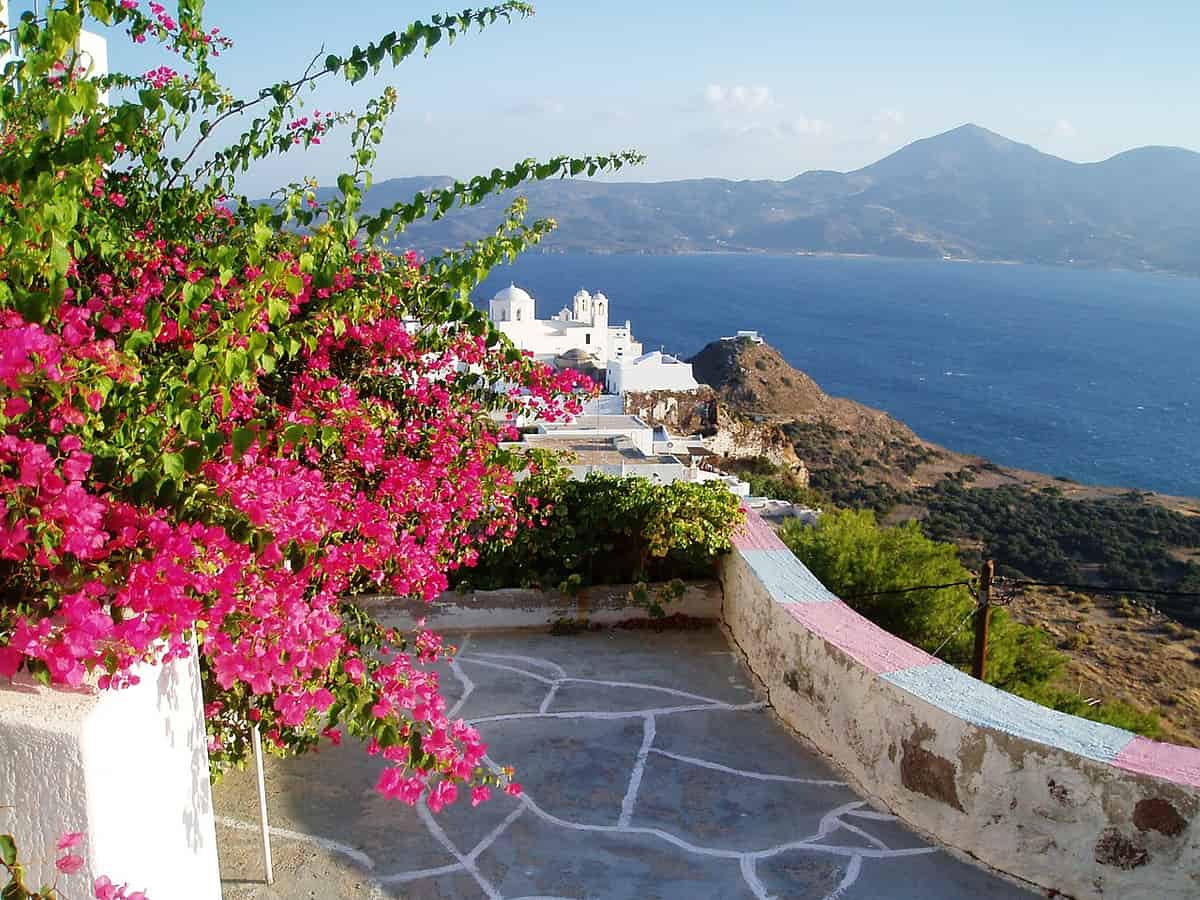
Milos is the south-western island of the Cyclades and the fifth largest island of the group. It has the shape of a horseshoe, and the deep gulf in the middle forms a large natural harbour and a safe anchorage. The bay is one of the largest natural harbours of Greece. The water reaches far inland, so the island wraps around it, and coffee and drinks in Plaka Milos look down on a wide basin of sea.
Plaka stands at 220 metres above the gulf, and the main port lies below on the same western side of the island. The plateau above the harbour carries the village and the hill settlements beside it. The ancient city stood lower, on the slope between Tripiti and Klima, near the entrance of the bay, and the ancient marble statue of the island was found in that area. The height explains the view from coffee and drinks in Plaka Milos, and the climb between the two levels is short.
The eye follows the rim of the bay and then the open water. Kimolos lies 985 metres to the north-east, Antimilos 9 kilometres to the north-west, and Polyaigos 6 kilometres to the east. The island measures 23 kilometres from north-east to south-west and 13 kilometres from north to south, with a surface of 151 square kilometres. The highest mountain, Profitis Ilias, reaches 751 metres, and the neighbouring islands close the horizon on clear days.
The view belongs to the village rather than to one stopping point. The Kastro holds the summit, the streets sit lower, and the bay lies beyond the slope. The coffee and drinks in Plaka Milos therefore change with the hour: the water takes the colour of the sky, and the wind moves across the surface. A coffee at that height comes with a map of the island in front of the eyes. A seat for coffee and drinks in Plaka Milos holds the whole geography in one view.
- Shape: Milos has the form of a horseshoe around a deep gulf.
- Harbour: The gulf forms one of the largest natural harbours of Greece.
- Height: The village sits at 220 metres above the water.
- Neighbours: Kimolos, Antimilos and Polyaigos lie close to the island.
- Below: The main port stands on the same western side, under the hill.
The gulf gives coffee and drinks in Plaka Milos their horizon. From the height, the sea fills the middle of the picture, with the rim of the bay and the neighbouring islands around it. A cup of coffee or a cold drink is enough reason to sit and follow the water. The view is not a single landmark but the whole shape of the island, and that shape is the reason why coffee and drinks in Plaka Milos above the bay hold their value.
What do the Kastro and Panagia Thalassitra add to coffee and drinks in Plaka Milos?
The Kastro stands on the highest point of the hill, above the lanes of the village. A climb leads to the fortified site, and the church of Panagia Thalassitra stands on the way up, below the summit. Both belong to the upper village.
The Kastro occupies the highest point of Plaka, on a hill of volcanic origin. Venetian builders created it in the 13th century, and its foundation is placed after 1204. The rocky height stands above the ancient city, and from there the movement of ships in the gulf of Adamantas stayed in view. The medieval town of Plaka grew on the plateau immediately below the Kastro, as its natural extension. The site is classified as an ancient monument.
Panagia Thalassitra stands below the summit on the climb. The church is also known as the Presentation of Christ, and it sits on the route between the village streets and the castle rock. At the top, the church of the Dormition of the Theotokos, called Mesa Panagia, crowns the castle. The two churches mark the upper part of the village, one on the approach and one at the highest point of the hill. A short path links the two levels of the upper village.
The climb is short and steep. Lanes pass houses and church fronts, and the ground becomes bare rock near the top. From the summit the gulf and the neighbouring Cycladic islands lie open. Remains of later fortification works also survive on the hill, beside the older walls. The Kastro is a monument rather than a settlement now, and the walk to it is part of the daily route of coffee and drinks in Plaka Milos. The height is small, and the climb takes minutes.
The upper site gives coffee and drinks in Plaka Milos their vertical order. Houses gather on the plateau, the lanes climb, and the castle rock closes the composition. On the hill, coffee and drinks in Plaka Milos therefore have a destination in view. The churches keep their place in the life of the village, and the monument keeps its protection. The result is a small height with a long history, visited on foot and seen from below in every street. The monument keeps its place over coffee and drinks in Plaka Milos.
- Summit: The Kastro stands on the highest point of the Plaka hill.
- Origin: Venetian builders created the castle in the 13th century.
- Thalassitra: Panagia Thalassitra stands below the summit, on the climb.
- Mesa Panagia: The church of the Dormition of the Theotokos crowns the castle.
- Status: The site is classified as an ancient monument.
The Kastro and the church above coffee and drinks in Plaka Milos give the hill a second level. The lanes lead to a height where the gulf opens and the old defences stand. The streets below hold coffee and drinks in Plaka Milos, yet the climb is what gives those streets their shape. The village is read from the top down, and the monument at the summit explains why the settlement grew on the plateau beneath it.
How does sunset shape coffee and drinks in Plaka Milos?
The western end of the village faces the open sea, and the light at the end of the day falls across the water. A drink taken at that hour belongs to the western side of the hill, where the sun goes down beyond the gulf.
At the western end of Plaka, on steep rocks, stands the church of Panagia Korfiatissa, the cathedral of Milos. The location is called Halara, and the space in front of the church is called Marmara. The churchyard is paved with marble grave slabs taken from the old city. The building dates from 1820 and joins Byzantine and Cycladic forms. The court faces the open direction of the sea. The cathedral keeps a collection of relics and icons.
The Kastro offers a second place for coffee and drinks in Plaka Milos at the end of the day. Sunsets are seen from the castle hill as well, with the gulf and the neighbouring Cycladic islands in front of the eye. The height above the water and the western exposure of coffee and drinks in Plaka Milos combine at that hour. The rim of the bay darkens first, and the water keeps the light after the houses have lost it. The result is a slow change of colour over a wide basin.
The western half of Milos is the wildest part of the island. Villages are absent there, and only a small number of settlements and old mines remain. Almost all of the western island belongs to the Natura 2000 network, and the south-western side is a habitat of the Mediterranean monk seal. The light that reaches the village therefore arrives across open water, with little between the hill and the horizon. The horizon from coffee and drinks in Plaka Milos is open water, with no village in between.
The evening has its own sequence of coffee and drinks in Plaka Milos. The lanes empty slowly, the terraces fill, and the last walk of the day goes to the western edge. A glass of wine, a cold drink or a coffee can hold the hour. The village is small, so the return to the centre takes minutes. The sun leaves the hill, the water keeps a last band of light, and the day closes over the gulf.
- West end: Panagia Korfiatissa stands at the western edge, on steep rocks.
- Names: The location is called Halara, and the space before the church is Marmara.
- Churchyard: The court is paved with marble grave slabs from the old city.
- Kastro: Sunsets are also seen from the castle hill above the village.
- Wild west: The western half of Milos has no villages, only a small number of settlements.
Sunset gives coffee and drinks in Plaka Milos their evening shape. The walk turns west, the terraces fill, and the water carries the last of the light. At that hour, coffee and drinks in Plaka Milos are a simple act with a wide view behind them, and the height of the hill does the rest. The western end and the castle hill offer the two directions of the same hour, one toward the open sea and one over the gulf.

How does Greek wine join coffee and drinks in Plaka Milos by the glass?
Greece is one of the oldest wine-producing regions in the world, and the Aegean islands hold their own appellations. A glass in the village belongs to a long tradition of the vine on dry island ground. The same tradition reaches the table in the hill village.
Wine-making in Greece goes back 6,500 years, and the earliest evidence of Greek wine is dated to that period, when wine was produced on a household or communal basis. In ancient times trade in wine became extensive, and the drink travelled from end to end of the Mediterranean. Greek wine held high prestige in Italy under the Roman Empire. In the medieval period, wines exported from Crete, Monemvasia and other Greek ports fetched high prices in northern Europe.
A system of appellations was introduced to assure buyers of the origin of their wine. The categories are protected designation of origin, protected geographical indication and table wine, and the last group includes aged reserve blends and retsina, the traditional wine flavoured with pine resin. Among the Aegean islands, Lemnos, Paros, Rhodes, Samos and Santorini hold appellations. Retsina became the national beverage in the 1960s and, with growing tourism, became linked with Greece and Greek wine around the world.
Greece grows about 200 vine varieties. Mavrotragano is one of the oldest red Greek varieties, and it comes from the Cyclades, from the volcanic ground of Santorini, where it almost disappeared because of the special treatment it needs. Limnio, from the Aegean island of Lemnos, has been used in red wine production for more than 2,000 years and carries a taste of bay leaves. Mandilaria, also called amorgiano, grows on Rhodes and Crete.
A glass among coffee and drinks in Plaka Milos joins these islands to the table. Assyrtiko, the white grape native to Santorini, keeps its acidity as it ripens, and its old vines have resisted phylloxera. Moschofilero gives a crisp and floral wine, Robola a mineral and lemony one that sits well with seafood, and Savatiano the base of retsina. The list for coffee and drinks in Plaka Milos is long, and each name ties the drink to a place, a soil and a climate. The wider section on the coffee and drinks of the island continues the theme.
- Age: Wine-making in Greece goes back 6,500 years.
- Appellations: Lemnos, Paros, Rhodes, Samos and Santorini hold Aegean appellations.
- Retsina: Retsina is the traditional wine flavoured with pine resin.
- Cyclades: Mavrotragano is one of the oldest red varieties of the Cyclades.
- Varieties: Greece grows about 200 vine varieties.
Wine by the glass closes the day for coffee and drinks in Plaka Milos. The vineyards of Greece are older than the towns around them, and the islands keep their own names and styles. A glass at a table above the gulf connects coffee and drinks in Plaka Milos to the dry ground and the sea wind. The choice among coffee and drinks in Plaka Milos is wide, from a white with fish to a red with meat. More on the setting is in the page about the village of Plaka.
How do the lanes shape coffee and drinks in Plaka Milos after dark?
Tonight, coffee and drinks in Plaka Milos move through paved lanes and small squares, where cars stay outside and people walk between close walls. The village stands on a rock above the gulf, and its official name is Milos.
The village is perched on the top of a large rock and looks over the gulf of Milos. Cars cannot enter because the space between walls and buildings is narrow, so motorbikes and mopeds are the vehicles that fit the lanes. The paving, the short flights of steps and the turns place coffee and drinks in Plaka Milos close to the doors of the houses. After dark the street pattern does the work of a room, holding tables and passing figures together.
The name comes from the level ground on which houses were built, when the castle no longer held the whole population. The settlement carries two names, because the official name is Milos and the everyday name is Plaka. In 1835 the place was named the seat of the newly founded municipality, and in 1912 it was renamed Milos. Signs and speech hold both names together, and evening rounds of coffee and drinks in Plaka Milos pass under them.
Since 1978 the settlement has been listed as a traditional one, a status that keeps the Cycladic forms and the small scale of the building line. Ground floors open onto the paving, and evening trade happens at the edge of the street rather than inside a separate zone. Seating that belongs to the lane itself is the pattern that shapes coffee and drinks in Plaka Milos. Movement after dark is slow and on foot, because nothing larger than a moped fits between the houses.
Squares form where church courts and public buildings break the line of the houses. These open patches give the evening a rhythm: a stretch of paving, two or three short steps, then a small space with room for a group of friends. The pockets suit coffee and drinks in Plaka Milos, since the settlement offers no promenade of the usual kind. A walk after dark passes doors, walls and the low light of ground-floor windows.
- Lanes: The inner streets are narrow, because walls and buildings leave little space between them.
- Cars: Cars stay outside the settlement, and motorbikes and mopeds are the vehicles that fit the lanes.
- Paving: The ground inside the village keeps a paved surface, with short steps and repeated turns.
- Name: The official name of the settlement is Milos, and the everyday name is Plaka.
- Status: The settlement has been listed as a traditional one since 1978.
An evening on foot is, then, the practical shape of coffee and drinks in Plaka Milos. The lanes set the pace, and the absence of cars keeps the scale small. Tables sit against walls, and the squares hold short pauses between one turn and the next. The table side of the same hill belongs to food in Plaka. The village at night is a quiet sequence of paved passages and low light.
How do the museums stand beside coffee and drinks in Plaka Milos?
Here, coffee and drinks in Plaka Milos sit beside the Archaeological Museum, a neoclassical building of 1870 that has kept the island collection since 1985. Its rooms run from the late Neolithic to the Byzantine period, with a lapidary in the porch.
The Archaeological Museum of Milos stands in Plaka, on the main square of the village. Its collections include exhibits from the late Neolithic to the Byzantine period, with Cycladic art and finds from the prehistoric settlement of Phylakopi. The square where coffee and drinks in Plaka Milos are served is the same ground that holds the museum door, so a visit to the rooms and a pause at a table belong to one short walk. The building is a neoclassical structure of 1870.
The first room holds large pottery vessels that run from the late Bronze Age to the archaic period, and a collection of obsidian tools from the Neolithic to the early Bronze Age. The second room keeps Bronze Age material, with Cycladic, Minoan and Mycenaean pieces from Phylakopi and the Lady of Phylakopi, a figure of the 14th century BC. The sequence of rooms begins two or three steps from coffee and drinks in Plaka Milos.
Ancient Greek pottery fills the third room, with a geometric amphora of the 8th century BC, Corinthian pieces and a black-figure lekythos. The fourth room turns to sculpture, with Hellenistic and Roman works, a portrait herm of a priest of Dionysos from the 2nd century AD, and Roman portraits of the 3rd century AD. Inscriptions in the local alphabet and a lapidary of late antique torsos stand in the porch and the courtyard. The material stays inside the circle of coffee and drinks in Plaka Milos.
Behind the church of Panagia Korfiatissa stands the Folklore Museum, and the building that holds the archaeological collection also houses public services of the island. A further collection occupies the space of an old shelter built during the Second World War, and a small quarter of exhibitions gathers around the square. The two collections stand short distances apart, and the walk between them passes the church front, the square and the paved lane. The village thus keeps its museum rooms around coffee and drinks in Plaka Milos.
- Building: The museum occupies a neoclassical building of 1870 on the main square.
- Sequence: Four rooms move from prehistoric pottery to Roman sculpture.
- Figure: The Lady of Phylakopi comes from a shrine and dates to the 14th century BC.
- Folklore: The Folklore Museum stands behind the church of Panagia Korfiatissa.
- Shelter: A collection occupies the space of an old shelter of the Second World War.
The museums give coffee and drinks in Plaka Milos a second layer, because the village square answers both to stone exhibits and to evening tables. A visitor moves from prehistoric pottery to a chair in the open air within a short distance. The lapidary in the porch and the courtyard stands at that threshold, between the room of objects and the paved ground outside. The doorway of the building opens straight onto the life of the lane.

Where do walks from coffee and drinks in Plaka Milos lead?
Below, coffee and drinks in Plaka Milos open paths toward Trypiti, the Catacombs, the ancient theatre and the seaside houses of Klima at the water. The route leaves the paving and drops toward the slope of the ancient city.
Trypiti is a small town on Milos with 766 residents, and it stands next to the Catacombs and the Roman theatre. Its name comes from the porous volcanic rock, which is full of holes, and the surrounding caves have served as storerooms and stables. The last paved ground before that lower settlement belongs to coffee and drinks in Plaka Milos. Old windmills still survive in the place, and they once ground grain for the island.
The Catacombs are the largest underground cemetery outside the walls of the ancient city, in use from the mid-1st to the 7th centuries AD and known as the Greek cave. Halls and corridors were cut into soft porous volcanic rock, and the galleries run about 200 metres, with widths of 1 to 5 metres and heights of 1.6 to 2.5 metres. Tombs take the form of arched niches, rectangular niches and pits dug into the floor. The plan lies below coffee and drinks in Plaka Milos.
The ancient city occupied the slope between Trypiti and Klima. The construction of the theatre dates to the Hellenistic period, and the visible remains belong to its Roman phase: the cavea with seven marble rows of seats, the orchestra and the floor of the stage building. A mosaic was excavated in 1896, and the Venus de Milo was found in 1820, a marble figure 2.02 metres tall. The ground that carries coffee and drinks in Plaka Milos stands above the slope where the ancient city spread.
Klima lies at the water below. The village is known for its fishermen houses, called syrmata, which are two-storey buildings: the family lived on the first floor, and the ground floor stored the boat through the winter. Their doors and windows are painted in bright colours, and part of the row now serves as accommodation. Eight residents were counted there in 2021. The hill holds coffee and drinks in Plaka Milos, but the sea path ends in that narrow coastal strip.
- Trypiti: The town stands next to the Catacombs and the Roman theatre.
- Catacombs: The galleries run about 200 metres through soft volcanic rock.
- Theatre: Seven marble rows of seats survive from the Roman phase of the building.
- Klima: The seaside village keeps two-storey fishermen houses called syrmata.
- Return: The walk back climbs from the water to the paved lanes of the village.
A walk that begins with coffee and drinks in Plaka Milos ends in three different periods: an early Christian underground cemetery, a Roman theatre, and the boat houses of fishing families. The ground between them carries the ancient city, the walls and the mosaic floor that excavations uncovered. The descent is part of the settlement, because the slope below the hill holds the oldest layer of island life. The return to the paved lanes closes the circle on foot.
How do Plakes and Triovasalos join coffee and drinks in Plaka Milos?
Nearby, coffee and drinks in Plaka Milos share a capital of two settlements, Plaka and Plakes, with Triovasalos and Pera Triovasalos on the neighbouring hills. The whole cluster gathers above the main port on one raised ground of the hill.
The capital of the island is made of two settlements, Plaka and Plakes. The two parts share one built area on the hill above the gulf, and the name of the capital covers both of them. A walk for coffee and drinks in Plaka Milos therefore begins in one settlement and ends in another without leaving the town. Houses, lanes and church fronts follow the same pattern across the short gap, and the paving runs from one to the next.
Triovasalos is a village and a community with 1,379 residents. It lies next to Pera Triovasalos, and the two settlements occupy two neighbouring cliffs. Until 1908 they formed one settlement, which explains why the pair of villages is still read as a single place on the hill. The ridge line that carries coffee and drinks in Plaka Milos reaches those villages, and the road from the port meets them before it climbs to the top.
Two churches mark the villages. Saint Spyridon is dated to the start of the 19th century, and Saint George is dated to 1849 and stands in Pera Triovasalos. The second building stands in the other village, and the pair works as a set of landmarks for coffee and drinks in Plaka Milos. The churches give the group of settlements clear points for a walk on foot, and each village keeps its own centre.
The whole group stands above Adamantas, the main port of the island, and Pera Triovasalos is about one kilometre from Plaka. Trypiti lies close to the capital, on the same hill ground. The cluster of settlements shares one raised position over the gulf, and coffee and drinks in Plaka Milos belong to that grouping. A visitor passes from one village to the next without leaving the hill, and the route stays on the same level of paving and steps.
- Plakes: Plakes is one of the two settlements that make up the capital of Milos.
- Capital: The capital of the island consists of two settlements, Plaka and Plakes.
- Triovasalos: The village counted 1,379 residents in the census of 2021.
- Merger: Triovasalos and Pera Triovasalos formed one settlement until 1908.
- Churches: Saint Spyridon dates to the start of the 19th century, and Saint George to 1849.
The neighbouring villages extend coffee and drinks in Plaka Milos beyond a single street, because the capital and its neighbours share one hill above the port. Plakes adds its streets to the same built area of the capital, and the two neighbouring villages add their cliffs to the group. A walk between them stays on the same raised ground and passes churches, lanes and house fronts. The cluster works as one settlement area with village names.

How do the seasons change coffee and drinks in Plaka Milos?
Seasonally, coffee and drinks in Plaka Milos follow a Mediterranean climate, with mild and rainy winters and warm to hot dry summers over the gulf. Summer draws visitors, and the quiet months return the settlement to its residents.
The island has a Mediterranean climate, with mild, rainy winters and warm to hot dry summers. July brings a mean daily maximum of 28.1 degrees Celsius, and the same month averages 0.3 millimetres of rain, while December averages 90.3 millimetres. The contrast reaches the hill, where the paving holds warmth late into the evening and winter water runs down the lanes. Both faces of the year concern coffee and drinks in Plaka Milos, because the season decides whether the tables stand outside.
Summer evenings are the long season of the village. Tables in the open air and movement late in the day belong to coffee and drinks in Plaka Milos, and the paved lanes carry the heaviest footfall of the year. The island is a popular destination during the summer months. Dry air and a clear sky keep the paved ground warm, and the windmills of nearby Trypiti recall an older use of the same wind on the hill.
The quiet months of the year bring rain and mild temperatures. January has a mean daily minimum of 8.5 degrees Celsius, and annual rainfall reaches 410.8 millimetres, the greater part of it between October and March. Indoor seating replaces the open table, and the lanes stay empty for coffee and drinks in Plaka Milos. The settlement counted 830 residents in 2021, and the wider community counted 902, so the winter village is small, quiet and calm.
The island receives fewer visitors than other islands of the Cyclades, and it has become an increasingly popular destination in recent decades. Visitors come for traditional architecture, a varied coastline and a setting that stays quieter than the busiest islands of the same group. The hill keeps its scale through every season of the year, and coffee and drinks in Plaka Milos gain from that balance. The municipality of Milos counted 5,193 inhabitants in the census of 2021.
- Summer: July averages a daily maximum of 28.1 degrees Celsius.
- Rain: July averages 0.3 millimetres, and December averages 90.3 millimetres.
- Winter: January averages a daily minimum of 8.5 degrees Celsius.
- Residents: The settlement counted 830 residents in 2021, and the community 902.
- Visitors: The island draws fewer visitors than other islands of the Cyclades.
The seasons give coffee and drinks in Plaka Milos two distinct moods. Summer fills the paved lanes and holds the evening outside, with dry days and warm stone underfoot. Winter returns the village to a small resident population, with rain, mild air and closed doors. Between those poles the hill keeps its shape, its paving and its short distances unchanged. The calendar alters the crowd, not the setting.
What do visitors ask about coffee and drinks in Plaka Milos?
Together, coffee and drinks in Plaka Milos cover paved lanes, two museums, nearby ancient sites and linked settlements, and the answers below treat light, weather, walking and access. The capital keeps a pedestrian core, and the hill villages and the coast complete the setting.
Which lanes hold coffee and drinks in Plaka Milos after dark?
The village core is paved and closed to cars, because walls and buildings leave narrow space between them. Motorbikes and mopeds are the vehicles that fit the lanes. After dark, movement happens on foot, and tables stand against the walls of the lanes and in the small squares that open at church courts and public buildings.
How do the museums stand beside coffee and drinks in Plaka Milos?
The Archaeological Museum of Milos occupies a neoclassical building of 1870 on the main square, and its rooms run from the late Neolithic to the Byzantine period. Behind Panagia Korfiatissa stands the Folklore Museum, and a collection fills the space of an old shelter nearby. Both sit inside the village, two or three steps from the paved lanes.
Where do walks from coffee and drinks in Plaka Milos lead?
Paths lead toward Trypiti, the Catacombs, the ancient theatre and Klima. The Catacombs are an underground cemetery with galleries of about 200 metres, cut into soft volcanic rock, and they were in use from the mid-1st to the 7th centuries. The theatre keeps seven marble rows of seats from its Roman phase. Klima, below, holds two-storey fishermen houses called syrmata.
How do Plakes and Triovasalos join coffee and drinks in Plaka Milos?
The capital consists of two settlements, Plaka and Plakes, and the neighbouring group includes Triovasalos and Pera Triovasalos. The two neighbouring villages lie on two cliffs and formed one settlement until 1908. Saint Spyridon and Saint George stand in them as landmarks for a walk on foot through the group, and the road from the port meets them first.
How do the seasons change coffee and drinks in Plaka Milos?
The island has a Mediterranean climate, with mild, rainy winters and warm to hot dry summers. July brings a mean daily maximum of 28.1 degrees Celsius and an average of 0.3 millimetres of rain, while December averages 90.3 millimetres. The summer draws visitors, and the quiet months leave the settlement to its residents.
Do cars reach coffee and drinks in Plaka Milos?
Cars cannot enter the settlement, because the space between walls and buildings is narrow. Motorbikes and mopeds are the vehicles that fit the lanes. Vehicles stay at the edge, and the inner ground is given to pedestrians. That rule keeps the evening tables and the walks on foot within the same small scale.
How large is the resident population near coffee and drinks in Plaka Milos?
The settlement of Milos, called Plaka, counted 830 residents in 2021, and the wider community counted 902. Triovasalos counted 1,379 residents, Trypiti counted 766 and Klima counted 8. The municipality of Milos had 5,193 inhabitants. These figures describe a small capital on a hill above the port, with a resident core that stays through the year.
Is the name behind coffee and drinks in Plaka Milos official?
The official name of the settlement is Milos, and Plaka is the everyday name. The place was named the seat of the newly founded municipality in 1835 and renamed Milos in 1912. The name Plaka itself comes from the level ground where houses were built when the castle no longer held the whole population.