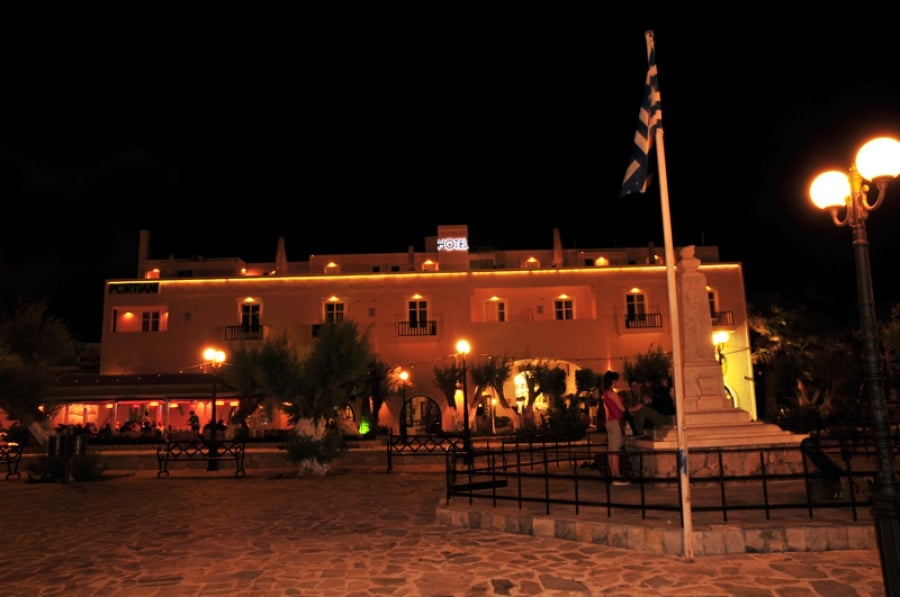
Category Apartments: 3 keys
Location: Plakes
Number of apartments: 6
We welcome you and invite you to take a tour of our group of independent apartments for rent.
All the information we give about Milos, and all our suggestions to visitors, come from personal experience that we have gathered over the years of living on our beautiful island.
Your stay in our independent apartments can be unforgettable.
Vivere a Plakes Milos is a small group of independent apartments in Plakes, the quarter that forms part of the capital of Milos. The capital of the island rises on the plateau above the harbour, and the apartments stand inside that upper cluster of villages. Milos Advisor keeps a plain record of the island for travellers who plan a stay.
The setting gives the apartments a quiet base above the port, close to the lanes of Plaka. The bay of Milos opens below, and the villages of Tripiti and Triovasalos stand on the same height. The pages that follow set out the position, the apartments, the walk into the capital and the short trips on the island.
Where does Vivere a Plakes Milos stand above the gulf?
Vivere a Plakes Milos stands in Plakes, one of the two settlements of the island capital, on the plateau above the harbour where Plaka, the chief town, occupies the top of a large rock that overlooks the gulf of Milos.
Plakes forms one of the two settlements that make up the capital of Milos, together with Plaka. Both stand with Triovasalos, Pera Triovasalos and Tripiti on the same height above Adamantas. Plaka itself is built at 220 metres, and its view looks toward the gulf of Milos. The name of the town comes from the level ground where houses were built once the Kastro no longer held the population. A stay at Vivere a Plakes Milos therefore begins on a height, not at the water.
Plaka has been named a traditional settlement since 1978, and cars stay outside the village because the space between walls and buildings is narrow. Motorbikes and mopeds are the vehicles that fit the lanes. The road rises from the port through the lower villages and ends among Cycladic houses, shops, restaurants and cafés. Vivere a Plakes Milos keeps its guests on this upper level, a short climb from the Kastro and the streets of the capital.
The view belongs to the height. From the plateau, the bay of Milos spreads below and the rim of the island closes it. The gulf is one of the larger natural harbours of the country, and ships cross it toward Adamantas. Evenings bring the setting sun over the water, and the west side of the hill faces the open sea. Vivere a Plakes Milos sits inside this outlook, where the day ends over the bay.
The village cluster above the port holds more than one settlement. Tripiti stands at about 150 metres beside the ancient town, above the catacombs. Triovasalos and Pera Triovasalos formed one place until 1908. Plakes lies beside Plaka on the same height, so Vivere a Plakes Milos has the capital, the ancient slope and the everyday shops of the hill villages within a short walk of the door, with the harbour road running below the quarter.
- Quarter: Plakes is one of the two settlements that make up the island capital.
- Height: Plaka is built at 220 metres above the sea.
- Outlook: The view from the plateau looks toward the gulf of Milos.
- Traffic: Cars stay out of the settlement because the lanes are narrow.
- Status: Plaka has been a traditional settlement since 1978.
The position explains the character of the place. Houses sit close on the plateau, the Kastro rises at the highest point, and the water lies below the streets. Vivere a Plakes Milos takes its name from this quarter. A traveller finds a hill town above a deep bay, with the capital a short walk away and the port on the shore.
What do the independent apartments at Vivere a Plakes Milos offer?
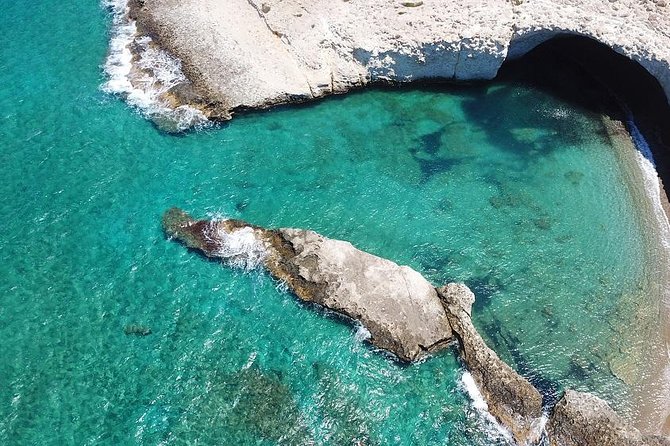
Vivere a Plakes Milos offers six independent apartments in Plakes, listed in the category of apartments with three keys. The group stands as a set of rented units, each one self-contained, with the hosts’ own knowledge of Milos behind every suggestion made to guests.
Six apartments form the group, a short list of independent apartments in Milos, and each unit is self-contained, so a stay runs without the routines of a larger building. The number stays small, which suits the quiet of the quarter and the scale of the hill. Vivere a Plakes Milos keeps its addresses close together on the same raised ground, a short walk from the lanes of Plaka and a short drive from the port below.
The rooms carry air conditioning, internet access, mini bars, parking, a television and a kitchen. Special events are part of the offer, and the welcome is open to every guest. The distance to Adamantas is 4.5 kilometres, so the port, its shops and its waterfront stay within a short drive. Vivere a Plakes Milos combines the comfort of a furnished flat with the position of a hill village, and the harbour road begins below the quarter.
The hosts live on the island and pass on what years of daily life have taught them. Suggestions for beaches, walks and meals come from that experience rather than from a printed list. Milos holds 75 beaches, and the island rewards slow travel between them. Vivere a Plakes Milos gives guests a local view of the gulf, the villages and the ancient ground that surrounds the hill, and the advice changes with wind and season.
A holiday here follows two moods. One guest looks for rest, another for movement, adventure and amusement, and the island answers both. The apartments give a base after a day on the water or on the paths, and the hill brings the evening back to the village. Vivere a Plakes Milos stays close to that rhythm, with the capital above and the bay below, and the walk between them takes a short time on foot.
- Number: The group holds six independent apartments.
- Category: The units are listed as apartments with three keys.
- Comfort: Air conditioning, internet, mini bars, parking, television and a kitchen are part of the offer.
- Distance: Adamantas lies 4.5 kilometres from the apartments.
- Advice: The hosts share knowledge gathered over years of living on Milos.
The apartments suit a stay that mixes a base with discovery. Rooms are self-contained, the quarter is calm, and the port is a short drive away. Vivere a Plakes Milos gives the holiday a firm practical base: a bed on the hill, a kitchen for simple meals, and hosts who know the island. The capital, the Kastro and the coastal road lie within reach of the door.
How is a walk into Plaka from Vivere a Plakes Milos?
Vivere a Plakes Milos stands below Plaka, so the walk from the apartments climbs into the capital through narrow lanes, past churches and the Kastro at the summit, and into the museums that hold the island’s ancient past.
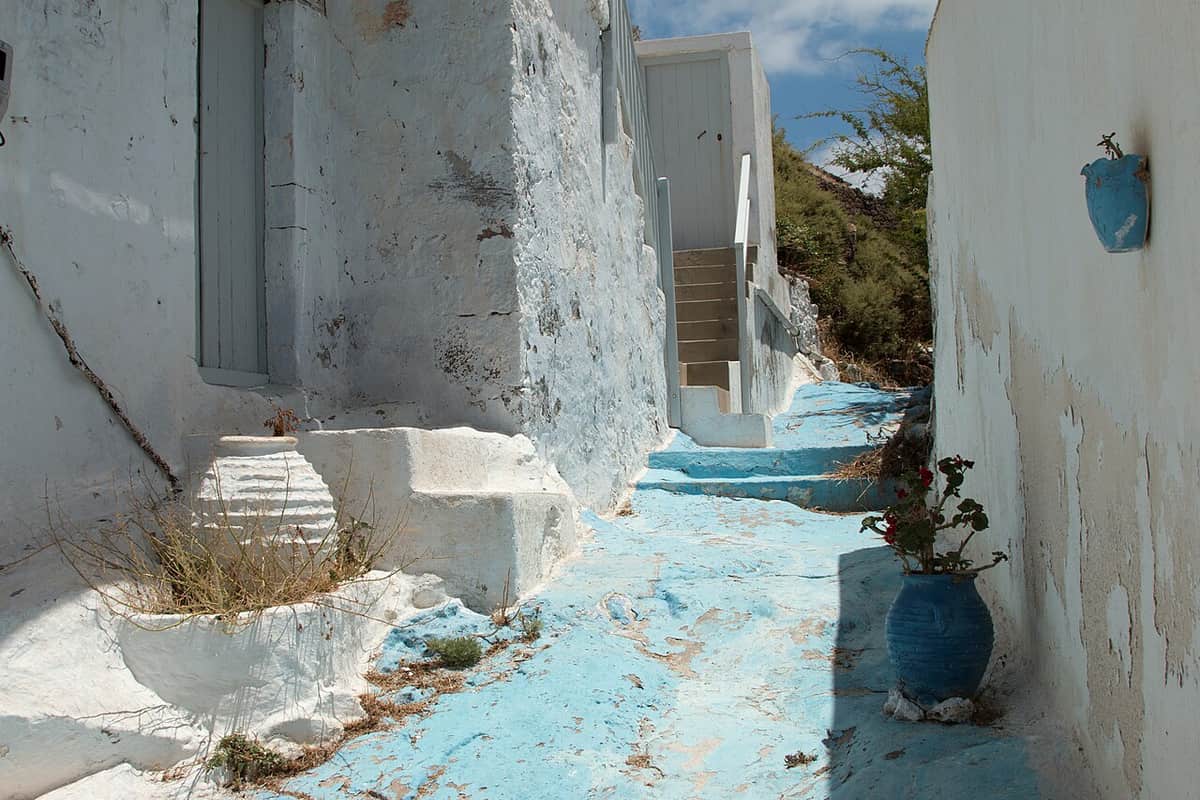
The climb into the capital is short, and the lanes do the rest of the work. Cars stay out of Plaka, so the route passes walls, doorways and church fronts on foot. The Kastro occupies the highest point of a hill of volcanic origin, and the path to it runs from the plateau through the built streets. Vivere a Plakes Milos puts this ascent at the start of the day, before the light grows strong.
Venetian builders raised the Kastro in the 13th century, and its foundation is placed after 1204. From that height the movement of ships in the gulf of Adamantas came under watch. The church of the Dormition of the Virgin, known as Mesa Panagia, stands at the summit. Lower down, on the way up, is the church of the Presentation of Christ, or Panagia Thalassitra. Vivere a Plakes Milos gives the walk two landmarks above the houses.
The western end of the town holds the cathedral of Milos, the church of the Nativity of the Virgin, known as Panagia Korfiatissa, built in 1820 in a Byzantine and Cycladic manner. The island counts its sunsets among the sights that draw visitors, and the western edge of the town faces the open water where the day ends. Vivere a Plakes Milos keeps that evening light within a walk of the door, with the sun going down over the bay.
Museums fill the remaining hours. The archaeological museum of Milos occupies a neoclassical building, and the same building holds the public services of the island. The war museum is housed in the rooms of an old shelter built during the Second World War. The folklore museum stands behind Panagia Korfiatissa. Vivere a Plakes Milos gives the collections of the town a place in a walk that starts at the apartments and ends above the gulf.
- Kastro: The Venetian fortress of the 13th century stands at the highest point of the town.
- Mesa Panagia: The church of the Dormition of the Virgin crowns the castle summit.
- Thalassitra: The church of the Presentation of Christ stands lower on the climb.
- Korfiatissa: The cathedral of Milos was built in 1820.
- Museums: The archaeological, war and folklore museums stand inside Plaka.
The walk joins height, worship and history in one circuit. The lane climbs from the plateau to the Kastro, the churches mark the stages of the ascent, and the museums keep the objects that the island has given up. Vivere a Plakes Milos sits at the lower end of this route, so the capital of Milos can be read on foot.
Which short trips start from Vivere a Plakes Milos?
Vivere a Plakes Milos sits on the plateau above Adamantas, and four short trips lead from the village: the seaside houses of Klima, the catacombs of Milos, the ancient theatre and the white rock of Sarakiniko on the north shore.
Klima lies below the ancient ground, on the coast below Plaka, and the road down to it is short. The village is known for the fishermen’s houses called syrmata, two-storey buildings where the family lived on the upper floor and the boat was kept below through the winter. Their doors and windows are painted in bright colours. Vivere a Plakes Milos places this small seaside settlement within a short trip from the door and the ancient ground.
The catacombs of Milos form the largest communal cemetery of the early Christian period on the island. The galleries are cut into soft porous volcanic rock on a hillside southwest of Tripiti, in the area of the ancient city, and their total length runs to about 200 metres. Arched wall tombs line the passages, and graves lie in the floors. Vivere a Plakes Milos stands a short distance above this underground monument and the ancient town.
The ancient theatre stands on the same slope, about 200 metres east of the cemetery and above the bay. It was built in Roman times, and seven marble rows of seats, the orchestra and the stage floor survive from that phase. The ancient town of Melos occupied the ground between Tripiti and the landing place at Klima, and its walls and buildings left traces there. Vivere a Plakes Milos gives this archaeological slope a place among the short trips.
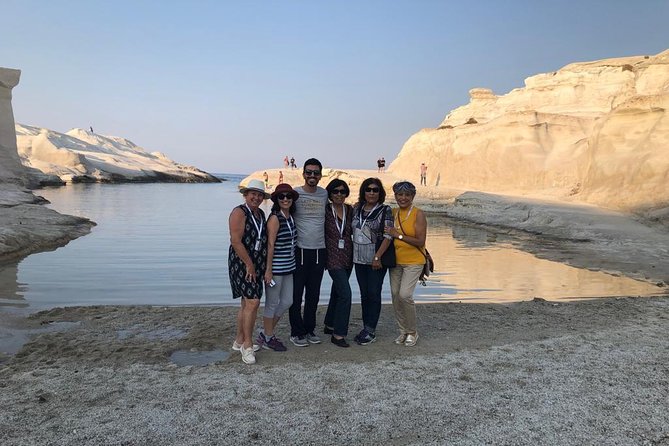
Sarakiniko lies on the north shore. Wind and waves have shaped the greyish-white volcanic rock into forms that people compare to a moonscape, and the bone-white surface comes from the same erosion. The beach itself occupies a small part of the site and is made of thin white sand. A wrecked ship rests on the eastern side. Vivere a Plakes Milos keeps this coast within reach of the hill villages and the north shore road.
- Klima: The seaside village keeps the fishermen’s houses known as syrmata.
- Catacombs: The galleries of the early Christian cemetery run about 200 metres through soft rock.
- Theatre: The Roman theatre preserves seven marble rows of seats above the bay.
- Sarakiniko: The north shore holds white volcanic rock shaped by wind and waves.
- Route: All four places lie on the western side of the island, close to the hill villages.
Each trip answers a different part of the island. Klima shows the working coast, the catacombs and the theatre hold the ancient town and its first Christian community, and Sarakiniko carries the volcanic story to the north shore. Vivere a Plakes Milos sits at the centre of this short list, above Adamantas, with the road to each place beginning on the plateau.
What do visitors ask about Vivere a Plakes Milos?
Vivere a Plakes Milos is a group of six independent apartments in Plakes, the quarter below Plaka on the island of Milos. The questions below cover the position, the apartments, the walk into the capital and the short trips from the village.
Where does Vivere a Plakes Milos stand on the island?
The apartments stand in Plakes, one of the two settlements that make up the capital of the island. Plaka is the chief town of Milos, built at 220 metres above the sea on the plateau above the harbour. Vivere a Plakes Milos sits on the raised ground above Adamantas, with the gulf of Milos in view below.
What number of apartments does Vivere a Plakes Milos hold?
The group holds six independent apartments, listed in the category of apartments with three keys. Air conditioning, internet access, mini bars, parking, a television and a kitchen are part of the offer, and special events are hosted there. Adamantas, the port of the island, lies 4.5 kilometres away. Vivere a Plakes Milos gives each unit its own space.
Where can a walk from Vivere a Plakes Milos lead?
The lanes climb from the plateau into Plaka, the capital, and end at the Kastro, the fortress of the 13th century at the highest point of the hill. Churches mark the way: Mesa Panagia at the summit, Panagia Thalassitra lower down, and Panagia Korfiatissa, the cathedral, at the western end. Vivere a Plakes Milos stands below all of them.
Which museums are near Vivere a Plakes Milos?
Plaka holds three museums. The archaeological museum of Milos occupies a neoclassical building that also holds the public services of the island. The war museum stands in the rooms of an old shelter built during the Second World War. The folklore museum sits behind Panagia Korfiatissa. Vivere a Plakes Milos keeps all three within a walk of the apartments.
Which short trips begin near Vivere a Plakes Milos?
Klima, the catacombs, the ancient theatre and Sarakiniko all lie within a short trip of the village. Klima keeps the fishermen’s houses called syrmata on the coast below the ancient ground. The catacombs run through soft volcanic rock near Tripiti, and the Roman theatre stands about 200 metres east of them. Vivere a Plakes Milos sits above all four.