Artemis restaurant fish tavern, Palaioxori
Sirocco restaurant, Palaioxori
Paleochori sits on the south coast of Milos, an island of the Cyclades with a volcanic past and a dry, sunny climate. The settlement is small, the beach is long, and the table beside it draws on the sea and the hills. The volcanic island of Milos keeps its own way of cooking, shaped by rock, wind and salt water.
Food in Paleochori belongs to a shoreline of coloured stone, warm ground and deep clear water. Plates stay plain, because the island grows capers, tomatoes, barley and grapes, and the sea beside the sand supplies the rest. This page looks at the beach, the cooking, the local dishes and the season, one by one, from the sand to the hills.
What is food in Paleochori at a glance?
Food in Paleochori belongs to a long south-coast beach of coloured pebbles, coarse sand and deep clear water, where a small settlement holds rooms to rent and a short row of eating places that stand close to the sand.
Paleochori is both a small settlement and a beach of the Municipality of Milos, on the south coast of the island. Food in Paleochori belongs to a beach that runs for almost two kilometres, with coloured pebbles, coarse sand and cool, clear, deep water. Rocks in red, pink, yellow and white-grey stand around the bay, and warm water rises through the ground close to the shore. The name of the place also appears as Palaiochori. The bay faces south.
The settlement counts seventeen residents, a number that rises sharply in the warm summer months. Rooms to rent stand near the sand, and a short row of dining places serves the beach. The village of Zefiria lies inland on the road from the harbour, and the two places share a community with Trypiti, Kanava, Klima, Agia Kyriaki and Schinopi. Food in Paleochori sits on the sixth beach of the south-coast list, counted from the east.
Dining places stand along the back of the beach, a short walk from the water. Guests sit under shade and look at the coloured cliffs while plates arrive from the kitchen. Food in Paleochori is a slow affair, and the table fills with shared dishes rather than single portions. The sea air, the warm sand and the long view keep people at the table long after the last plate is finished. No clock runs the meal.
The beach draws visitors in the warm season, and the settlement stays quiet for the rest of the year. Fishing boats work from the harbours of the island, and the catch reaches the south coast by road. Bread, cheese, tomatoes and capers arrive from the fields and the ovens of Milos, and olives and grapes come from the same dry ground. Food in Paleochori therefore mixes what the sea gives with what the hills grow.
- Beach: Almost two kilometres of coloured pebbles and deep clear water.
- Rocks: Red, pink, yellow and white-grey stone stands around the bay.
- Warm water: Hot water rises through the ground near the shore.
- Settlement: Seventeen residents, rooms to rent and a short row of dining places.
- Distance: About thirteen kilometres from Plaka and fourteen from the harbour.
The beach and its tables form one place, and the meal follows the beach day. Swimming comes first, then shade, then a long lunch beside the pebbles. Food in Paleochori keeps that order through the season. The sections below follow the same path: the warm ground, the fish, the island dishes, the road and the season that fills the tables.

How is food in Paleochori cooked in the hot volcanic sand?
Food in Paleochori is cooked over ground that still holds volcanic heat, and the sand beside the water stays warm long after the sun goes down. The shoreline kitchen works with slow, steady warmth rather than a fierce flame.
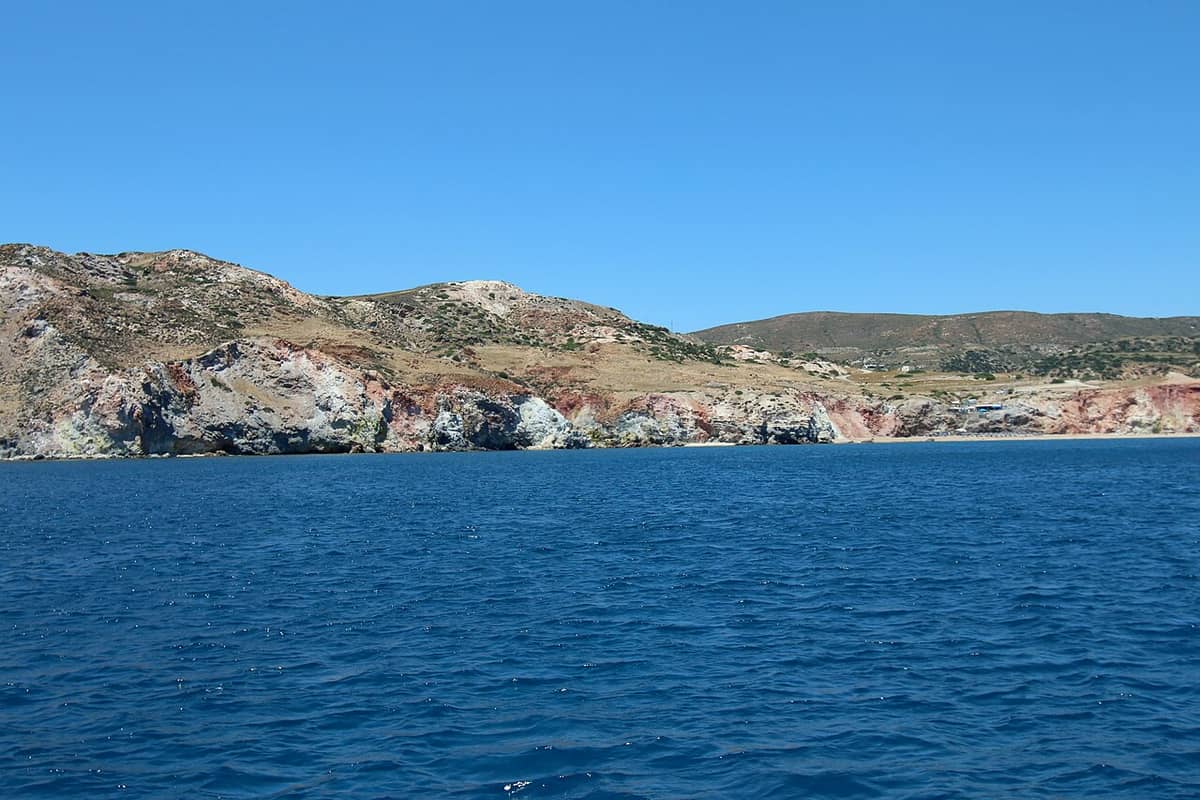
Milos was formed by volcanic activity in the distant past. Food in Paleochori stands on ground that belongs to that past. The activity began between two and three million years ago and stopped ninety thousand years ago. Two extinct volcanoes stand on the island, one at Fyriplaka and one at Trachilas to the north-west. Volcanic rock covers the greater part of the surface, and tuff, trachyte and obsidian count among the ordinary stones of the island.
Active fumaroles and solfataras still work on the island. Their temperature reaches one hundred degrees Celsius at Agia Kyriaki, at Paleochori, at Pyromenes and at Adamas. Gases from deep inside the earth leave through them, and sulphur is strong in those places. Springs of hot water rise on the island too, and they reach fifty-five degrees Celsius. A cave on the south coast keeps great heat from the volcano. Food in Paleochori sits on warm ground through the year.
At Paleochori the heat shows in the water as much as in the rock. Warm water gushes from the ground beside the beach, and the sea stays mild close to the shore. Submarine vents send gas to the surface as bubbles, and the water near them carries salts that shine in the daylight. Bathers feel the change within a couple of steps. Food in Paleochori comes from a shore that mixes cold deep water with warm patches beside the sand.
Cooks work with that steady warmth. The sand holds heat for hours, and food placed in it cooks slowly and evenly, without a fierce flame. The method suits fish, vegetables and bread, and it keeps the flavours of the island plain. Plates leave the ground tender and moist. Food in Paleochori carries the character of the volcano, because the ground itself takes part in the cooking. The heat stays low and even, and the food keeps its juice.
- Volcano: Activity began two to three million years ago and stopped ninety thousand years ago.
- Vents: Fumaroles at Paleochori reach one hundred degrees Celsius.
- Springs: Hot water on the island reaches fifty-five degrees Celsius.
- Warm sea: Water gushes from the ground beside the beach.
- Slow cooking: Sand holds heat for hours and cooks food evenly.
The heat under Paleochori comes from the volcano, and the measurements are plain: one hundred degrees Celsius at the vents and up to fifty-five degrees in the springs. The sand keeps that warmth and passes it to the food. A slow method suits the ingredients of the island. Food in Paleochori belongs to a kitchen that trusts time more than flame.
Which fish and seafood belong to food in Paleochori?
Food in Paleochori leans on the sea that runs along the south coast, where deep clear water lies beside the sand. The catch reaches the shore from the harbours of the island and lands on the tables of the beach.
Milos lies at the south-western edge of the Cyclades, the fifth island of the group by size, and the sea around it is deep and clear. Food in Paleochori draws on that water. The island stands one hundred and two kilometres, or fifty-five nautical miles, from Cape Maleas on the Peloponnese. Kimolos lies nine hundred and eighty-five metres to the north-east, and Polyaigos lies six kilometres to the east. Boats cross these waters through the year.
Fishing belongs to the long history of the island. The first settlers at Phylakopi, on the north-east coast, were tuna fishermen. A fresco of a flying fish was found in the ruins of that settlement, and fish appear as symbols on later inscriptions found on Milos. Boats are still kept in the syrmata, the small carved shelters at Klima, Mandrakia and Fyropotamos, where fishing gear stands beside the water. Food in Paleochori shares that working coast.
The south coast faces open water, and the beaches there lie in deep bays. Agia Kyriaki, east of Paleochori, keeps an ancient harbour on land, with storerooms that still stand. The same coast gives shelter when the north wind blows, and boats work close to the shore. A catch of fish of different sizes comes to land through the harbours of the island and reaches the beach kitchens by road. Food in Paleochori depends on that daily arrival.
Fish on the island is treated plainly. It goes on the grill, into the pan or into a pot, and it keeps its own flavour. Olive oil, lemon, oregano and salt carry the flavour, and the plate arrives without a heavy sauce. Small fried fish, squid and shrimp fill the meze table beside bread, cheese and olives. Food in Paleochori keeps the sea at the centre of the meal. The catch decides the plates of the day.
- Tuna: The first settlers at Phylakopi were tuna fishermen.
- Flying fish: A fresco of a flying fish was found there.
- Symbols: Fish appear as symbols on inscriptions found on the island.
- Boats: Syrmata at Klima, Mandrakia and Fyropotamos shelter fishing boats.
- Old harbour: Agia Kyriaki keeps an ancient harbour with storerooms.
The sea gives the south coast its fish, and the beach tables keep the cooking simple. Deep clear water, small boats and an old harbour all belong to this shore. The catch arrives fresh and goes straight to the grill or the pot. Food in Paleochori stands between the water and the table, and the next section turns to the fields, the ovens and the dairy.

Which island dishes go with food in Paleochori?
Food in Paleochori shares the table with the pies, cheeses, tomatoes and sweets of Milos, and the island keeps its own names for them. The list below follows the local kitchen from the oven to the spoon sweet.
The pitaraki is the small pie of Milos. It is a little fried pie with cheese or herbs, served hot with honey. Food in Paleochori belongs to that baking tradition. In yards, gardens and traditional kafenia, capers dry in the sun, pitarakia bake and tomatoes wait to be picked. The kitchen of the island stays close to nature and to the self-sufficiency of its people, and the work of the house shows on every plate.
Cheese has a long list. Arseniko comes from sheep or goat milk and matures in stone storerooms, where it turns spicy. Xino tyri is a fresh cheese with a mild acidity. Manoura comes from goat milk, touloumotyri ages inside an animal skin, and xinomyzithra is creamy and tangy. Food in Paleochori meets the same dairy, because myzithra, the whey cheese, fills the pies, and the aged form is grated over hot pasta with butter in the dish called skoufomakarono.
The local tomato is called bournela, and it becomes beltes, the tomato paste of the island, which is served as an appetiser with olive oil. Capers grow in abundance on the rocky soils, are collected by hand and dried in the sun before they go into vinegar or salt. Domatokeftedia and kolokythokeftedia are tomato and courgette fritters, lightly fried in olive oil. Food in Paleochori also keeps fouskoma, a sourdough bread baked in a wood-fired oven.
Sweets have their own place. Koufeta are small almond sweets covered in icing sugar and served at weddings and celebrations. Watermelon spoon sweet, karpouzopita or watermelon pie, pasteli bars of sesame and honey, xerotigana and loukoumades, called kourtalides on the island, complete the group. Grapes, cotton and barley count among the main crops. Food in Paleochori ends a long lunch with lemonato goat and festival pasta, and the cooking keeps knowledge passed down through generations.
- Pitaraki: A fried pie with cheese or herbs, served hot with honey.
- Arseniko: A sheep or goat cheese that matures in stone storerooms.
- Beltes: Tomato paste from the bournela tomato.
- Capers: Collected by hand and dried in the sun.
- Koufeta: Small almond sweets in icing sugar, served at weddings.
The dishes of Milos are plain in method and clear in flavour. Pies, cheeses, tomatoes, capers, bread and sweets come from the same dry ground. Food in Paleochori belongs to that wider kitchen, and the beach tables serve it beside the water. More of the same list sits on the page for the food of Milos, and the next section follows a beach day.
How does a beach day shape food in Paleochori?
Food in Paleochori follows the shape of a beach day, with a morning swim, a long stay in the shade and a slow meal in the middle of the afternoon. The beach sets the rhythm of the table.
The day starts early on the south coast. Water at Paleochori is cool, clear and deep close to the shore, and the beach runs for almost two kilometres, so swimmers find room when the coast is busy. Food in Paleochori waits until the first swim is over. The sea stays calm on the south side when the meltemia blow from the north. A morning swim, a walk along the pebbles and a cold drink fill the hours.
Shade matters a great deal at midday. The rocks around the bay throw long shadows, and the back of the beach offers cover under trees and awnings. Visitors who arrive late find the shore crowded in the warm months, so an early start brings a better place. The coloured cliffs hold the heat, and the sand stays warm underfoot long after the water has cooled the skin. Food in Paleochori comes after that pause in the shade.
Lunch begins late and lasts. Plates arrive in the middle of the table and pass from hand to hand: fried small fish, a pie, a bowl of fritters, a plate of cheese, tomatoes with oil and a dish of greens. Bread, capers and olives sit beside them. Food in Paleochori turns into the main event of the day rather than a break in it, because conversation slows and the sea keeps working in the background.
The afternoon belongs to the water again. A second swim, a coffee in the shade and a slow walk along the beach follow the meal. The warm water near the vents feels different from the deep cold further out, and bathers move between the two. Food in Paleochori stays close to that rhythm, and the same coast is seen from the water on a kayak route that leaves the sand. The day ends slowly and quietly.
- Morning: Swimming in cool, clear, deep water close to the shore.
- Shade: Rocks, trees and awnings at the back of the beach.
- Lunch: Shared plates in the middle of the table, served late.
- Afternoon: A second swim and a walk along the pebbles.
- Warm patches: Water near the vents feels mild.
A beach day at Paleochori is built around water, shade and a long meal. The morning belongs to swimming, the middle of the day to the table, and the afternoon to a second swim. Food in Paleochori suits that pace, because the cooking of the island is plain and made for sharing. The next section turns to the road that brings visitors here.

How do travellers reach food in Paleochori and the village of Zefiria?
Food in Paleochori lies at the end of a road that crosses the island from the harbour, and the inland village of Zefiria stands on the way. The drive from Adamas runs about fourteen kilometres, and the capital lies about thirteen kilometres away.
Adamas is the main harbour of Milos, where boats from the mainland and other islands arrive. The town stands at the head of a large natural bay, and the road south crosses the island. Plaka, the capital, sits on the plateau above the harbour, at about two hundred and twenty metres. Food in Paleochori lies beyond that plateau. The airport stands about four kilometres from the harbour, and the drive takes in open country and dry hills.
The village of Zefiria stands inland, about five kilometres south-east of Adamas and nine kilometres from Plaka. It was the first capital of the island, and it began to be left behind in the eighteenth century, when strong earthquakes pushed residents towards the harbour. In 1835 it became the seat of its own municipality. Food in Paleochori is reached by the same road, and the village keeps a rural character, with 190 residents counted in 2021.
The old cathedral of the island stands in the centre of Zefiria. The church of the Virgin Portiani is joined to the neighbouring church, and it is the only church left from the old village. An inscription places the building before 1576, and in 1864 the icon of the Virgin was moved to the new church at Adamas. Food in Paleochori shares in that calendar, because every August the village holds one of the island’s main festivals.
From Zefiria the road continues to the coast, and the beaches of Agia Kyriaki and Paleochori lie beyond. Agia Kyriaki sits about ten kilometres from Adamas and about thirteen kilometres south-east of Plaka. Further east, at the small bay of Paliorema, stand the old sulphur mines, where ore was worked until 1956 and where wagons and tools still rest. Food in Paleochori waits at the end of the same road, and the beach there has yellowish pebbles.
- Harbour: Adamas is the main port of the island.
- Capital: Plaka stands above the harbour, at about 220 metres.
- Zefiria: Inland, about 5 kilometres from Adamas and 9 from Plaka.
- Paleochori: About 14 kilometres from Adamas and 13 from Plaka.
- Airport: About 4 kilometres from the harbour.
The road from the harbour is the practical way to reach this coast. Adamas is the main port, Plaka is the capital, and Zefiria stands between them and the beach. The south coast keeps the mines, the ancient harbour and the long beach. Food in Paleochori waits at the end of that drive, and the next section turns to the season.
When is the season for food in Paleochori?
Food in Paleochori follows a long warm season, from late spring into early autumn, when the island is dry, sunny and busy. The south coast stays calm when the northern wind blows, and the sea beside the beach stays clear.
Milos has a Mediterranean climate, with mild, rainy winters and warm to hot, dry summers. Rain falls mainly between October and March, and the total for a year is about four hundred and eleven millimetres. July brings almost no rain, and August brings very little. Food in Paleochori sits in the driest part of that year. The mean daily maximum reaches twenty-eight degrees Celsius in July and about twenty-eight in August, while the spring and the autumn months stay mild.
The heat of the summer shows on the ground as well as in the air. The vents at Paleochori reach one hundred degrees Celsius through the year, and the sand beside the water holds warmth long after sunset. Visitors who walk on the beach in the middle of the day feel that heat through thin soles. Food in Paleochori cooks on ground that never really cools, and the warm sand and the deep cold sea sit a short distance apart.
Wind decides the day on Milos. The meltemia blow from the north in the summer months, and the advice on the island is simple: in meltemia and north winds, choose beaches inside the bay or on the south side. Paleochori faces south, so it holds its calm when the north coast turns rough. Food in Paleochori stays on the sheltered side, and on days of southerly wind the north side of the island becomes the quieter choice.
The island receives fewer visitors than other Cyclades islands, but it has become more popular in recent decades, and the warm months bring the crowds. The beach fills early, and the tables beside the sand fill later. Spring and early autumn stay quiet, and the water is still mild. Food in Paleochori keeps to the same calendar, with light plates and cold dishes in the heat of July and August and longer meals as the season cools.
- Summer: Dry weather, with maximums of about 28 degrees Celsius.
- Rain: The heaviest rain falls from October to March.
- Meltemia: North winds in summer make the south side calm.
- Spring and autumn: Mild days, fewer visitors and warm water.
- Winter: Mild and rainy, with the beach at rest.
The season at Paleochori runs from spring into autumn, and the weather decides the shape of the day and the pace of the table. Rain belongs to winter, and the summer brings dry heat and steady wind. Food in Paleochori suits an early start and a late lunch. The final section answers the questions that visitors ask about the beach and its table.
What do visitors ask about food in Paleochori?
Food in Paleochori raises questions about the beach, the warm ground, the fish, the local dishes, the drive from the harbour and the best time to come. The six answers below take each point in turn, from the sand to the season.
Where does food in Paleochori stand beside the sea?
The tables stand at the back of the beach, a short walk from the water. The beach is almost two kilometres long, so there is room along the shore. Guests eat in the open air or under shade, with the coloured cliffs behind them and the sea in front. The walk from the water to the table takes a minute.
Why is the ground warm near food in Paleochori?
The island is volcanic. Activity began between two and three million years ago and stopped ninety thousand years ago. Fumaroles and solfataras still work at Paleochori, and their temperature reaches one hundred degrees Celsius. Warm water gushes from the ground beside the beach and reaches the sea. A cave on the south coast keeps great heat from the volcano.
Which fish reach food in Paleochori from the south coast?
The catch comes from the waters around the island and lands at the harbours before it travels by road. The first settlers at Phylakopi were tuna fishermen, and fish appear as symbols on inscriptions found on Milos. The south coast faces open water and holds deep bays. Fish arrives fresh and goes to the grill or the pot.
Which Milos dishes belong to food in Paleochori?
The small fried pie called pitaraki comes with cheese or herbs and a little honey. Arseniko, xino tyri, manoura, touloumotyri and xinomyzithra cover the cheese list, and myzithra fills the pies. Beltes, the tomato paste made from the bournela tomato, is served with olive oil. Capers, tomato fritters, courgette fritters, sourdough bread and lemonato goat complete the table.
How far is food in Paleochori from the harbour?
Adamas, the main harbour, lies about fourteen kilometres from Paleochori. Plaka, the capital, lies about thirteen kilometres away. Zefiria stands on the road, about five kilometres south-east of Adamas and about nine kilometres from Plaka. The airport is about four kilometres from the harbour, and one road crosses the island to the beach.
When is the best season for food in Paleochori?
The warm season runs from late spring into early autumn. July and August are dry and hot, with mean daily maximums of about twenty-eight degrees Celsius, and the beach fills early. Rain belongs to the winter months, and July brings almost none. Spring and early autumn stay mild, with fewer visitors and warm water.