
Travellers who plan a summer in the Cyclades ask one plain question: is Milos expensive? The answer depends on the month of travel and on the choices each visitor makes on the ground. This page sets out what pushes costs up and what holds them down on the island of Milos.
Exact prices are left out here, since they shift with every season and every year. The sections below explain the forces behind those prices: demand, timing, comfort and the location of a room. Together, these forces turn the question “is Milos expensive” into a short set of clear choices.
Is Milos expensive at a glance?
Is Milos expensive? The answer turns on the season and on each visitor’s own choices of room, transport, food and trips. In summer, demand pushes costs up, yet beaches, village lanes and marked walking routes cost nothing to enjoy.
The question “is Milos expensive” has no single answer, since one week costs more than another. Demand for rooms, hire cars and boat seats climbs in summer and falls back in the cooler months. The choices made before arrival therefore matter just as much as the travel date itself.
A large part of what draws visitors to the island costs nothing to enter. The coast holds more than 75 beaches, from small coves to long bays of sand or pebbles. An organised beach, meaning one with sunbeds and other services, adds cost, while a wild one adds none.
Village lanes are open to all, across eight villages and a set of small fishing ports in coves. Seven geological walking routes, called geo-routes, are also marked out across the island. A walker on these routes needs little more than water, good shoes and a printed or phone map.
The paid parts of a trip are rooms, car or scooter hire, meals out and boat trips. Is Milos expensive for a visitor who wants all four of these in the peak of August? Far more so than for a visitor who picks one or two and skips the rest.
- Season: Summer demand raises costs, and the quieter months bring them down again.
- Room: Size, comfort and a sea view all add to the cost of each night.
- Transport: A hired vehicle adds a daily cost that a walk does not.
- Food: A picnic from a village shop costs less than a seated meal by the sea.
- Extras: Boat trips and sea sports are paid extras, chosen one at a time.
So, at a glance, is Milos expensive for a careful visitor or only for a big spender? The answer rests on two levers: the time of year and the paid extras on the list. Free beaches, quiet village lanes and marked walking routes give every budget a solid base to build on.

Is Milos expensive in high season and low season?
Is Milos expensive in high season? Costs reach their peak in those summer weeks, because they bring the largest crowds of the year. Spring and autumn bring fewer visitors and lower costs, and winter is the quietest season of all.
Greek tourism as a whole peaks in the warm months, from late spring to the end of September. About three in four of all visits to Greece fall inside that window. Milos follows the same pattern, and its appeal as a summer island has grown over recent decades.
Demand explains the summer jump: when more people want the same rooms and boat seats, each costs more. Is Milos expensive in the heart of August for that reason alone? Largely, yes, because the number of beds on a small island stays fixed while the summer crowds grow.
Spring and autumn are the quieter, lower-cost seasons on either side of the summer peak. Spring days are mild, and September keeps much of the summer warmth with far less rain than winter. Heat and rain for each month appear in the notes on the best time to visit Milos.
Winter is the low season, with mild but wet weather and the fewest visitors of the year. The Greek state aims to spread tourism across all four seasons, with winter included. For a visitor, the question “is Milos expensive” has its mildest answer in these cool, quiet months.
- Peak summer: The hottest, driest weeks draw the largest crowds and the highest costs.
- Spring: Mild days and fewer visitors keep costs below the summer level.
- Autumn: September stays warm and dry while summer demand starts to ease.
- Winter: Rain returns, visitor numbers drop, and demand sits at its lowest.
- Events: A summer festival livens up island culture in the busiest months.
Timing is the first lever on the cost of any trip to Milos. A stay in the quieter months meets lower demand, calmer village streets and more space on the sand. The sections that follow show how travel, rooms, transport and food add to the bill in any season.
Is Milos expensive to reach by ferry or plane?
Is Milos expensive to reach? The ferry from Piraeus is the lowest-cost way in. The direct flight from Athens costs more. It lands close to Adamas. Booking early in the busy summer months keeps both options open and the fares lower.
Ferries from the port of Piraeus land at Adamas, and this sea link costs the least. A regular ferry makes the run without stops. Slower boats call at Kythnos, Serifos, Sifnos and now and then Kimolos before reaching Milos.
So is Milos expensive for ferry travellers who pack light and walk on board? Not really, since a car on board and a private cabin raise the fare. Leaving the car at home and taking a deck seat keeps the crossing cheap.
Flights from the main Athens airport land directly on the island, southeast of the harbour. The runway is short, so only small planes of about 50 seats can use it. With so little space on board, summer flights sell out early, and late seats cost more.
Arrival adds one more cost for flyers, because no bus serves the airport. A taxi or rented car covers that stretch, while ferry passengers step off in Adamas. In summer, boats also link Milos with Paros, Naxos and Santorini for island-hoppers.
- Cheapest route: The Piraeus ferry costs the least.
- Faster route: The direct flight costs more.
- Small planes: Limited seats sell out early.
- Car on board: A car raises the ferry fare.
- Airport transfer: A taxi or car replaces the missing bus.
The route, step by step, is covered on the page about getting to Milos by sea or air. Is Milos expensive to reach, then? Only for late bookers who fly in peak summer, because the ferry remains the cheaper way across.
Is Milos expensive to stay in, and does the base matter?
Is Milos expensive for a place to stay? The answer depends on the base. Adamas, Pollonia, Plaka and the inland villages each shape the bill differently. Seaside spots fill first in summer. Bases far from the bus routes add transport costs.
Adamas is the harbour town and the commercial heart of the island. A base here trims transfer costs, because the ferry docks in the town itself. Shops and services gather in one place, so daily errands need no rented car.
Pollonia is a seaside village on the north-east coast and the second port after Adamas. Small boats cross from here to Kimolos, and the main beach is sandy. The beach draws visitors, so rooms in Pollonia fill fast in busy months.
Plaka is the chief town, and it sits high on a big rock over the gulf. Cars cannot enter its narrow lanes, so only motorbikes and mopeds get through. Guests park outside the village, so a moped or the bus suits a Plaka stay.
Triovasalos, Pera Triovasalos and Trypiti share the high ground above Adamas with Plaka, away from the coast. So is Milos expensive from one of these inland bases? The room skips the sea-view premium, but every swim then needs a bus or a rental.
- Adamas: The port base saves on transfers.
- Pollonia: Its sandy beach keeps demand high.
- Plaka: Cars stay outside the narrow lanes.
- Inland villages: High ground means a bus or car ride to the sea.
- Cost driver: Rooms near the sea fill first.
Room types, and the areas where they stand, are listed among the places to stay on Milos. Is Milos expensive to stay in, then? The answer lies in two costs: the room itself and the daily ride to the beaches.
Is Milos expensive to get around by bus, car or quad?
Is Milos expensive to get around? Not for walkers and bus riders in summer. A rented car, quad or scooter adds a daily cost. In return, it reaches far beaches. Mixing buses on main routes with a short rental keeps the total low.
Public buses serve certain parts of the island, with frequent runs in the summer months. Riders pay on the bus itself, and the fare varies with the stop they choose. Buses cost the least to ride, but they do not reach every beach.
Taxis fill the gaps, yet only 15 of them serve the whole island. They wait at the port and airport, but free ones are scarce in peak weeks. Groups who share one ride split the fare and cut the cost per head.
A rented car gives full freedom and suits families with bags and beach gear. Milos has the largest web of dirt tracks in the Cyclades, and parts are rough. A quad, meaning a four-wheeled motorbike, handles those tracks, while fuel adds to the daily bill.
Scooters and mopeds cost less to run than a car and can enter the narrow lanes of Plaka. So is Milos expensive on foot? Not at all, because Plaka and its neighbour villages share one plateau, a flat area above the harbour.
- Bus: It runs frequently in summer on main routes.
- Taxi: Only 15 serve the whole island.
- Car: Fuel and parking add to the rental cost.
- Quad or scooter: It copes with rough tracks and lanes.
- Walking: It costs nothing on the plateau.
Is Milos expensive to tour, then? Not when the bus covers the main routes and short walks link the hill villages on the plateau. A car, quad or scooter is needed only for trips to far beaches and the uninhabited west.
Is Milos expensive for eating out?
Is Milos expensive for eating out? Not by default, because home-style island dishes share menus with fresh fish and lobster pasta. Across restaurants, taverns and steakhouses, the dish and the setting shape the bill more than the island.
Local cooking on Milos starts with pitarakia, which are cheese pies. The filling is either a peppery dry cheese or myzithra cheese with mint. Ladenia is another local pie, made with oil, tomato and onion.
Meat dishes follow the same home style. Rooster is braised or roasted in wine, and lamb is baked in the oven. Grapes, cotton and barley are the main crops, and olive and orange trees grow across the island.
Fresh fish is a large part of eating out on the island. Reefs, sea caves and rocky shores give a home to red mullet, red snapper and sea bream. Octopus, squid, cuttlefish and lobster live there too, and the catch shifts with the season.
Is Milos expensive by the water? Busy seafront tables lead with fish and lobster pasta, which sit at the dearer end of any menu. Diners can ask to see the whole fish and hear its cost before it goes to the grill.
- Village taverns: home-style pies, rooster in wine and baked lamb.
- Seafront tables: fresh fish, octopus and lobster pasta.
- Plaka: small traditional shops, restaurants and cafes.
- Watermelon pie: a traditional sweet pie of the island.
- Coufeto: pumpkin with honey and almonds, served at weddings.
So is Milos expensive for food in the end? The answer depends on the chosen table and dish far more than on the island itself. Pies and rooster in wine keep a meal simple, while whole grilled fish by the harbour costs more.

Is Milos expensive for beaches, walks and views?
Is Milos expensive for a day of sightseeing? Hardly, because the main sights on the island cost nothing to visit. Beaches, marked geo-routes, a car-free hilltop village and a castle sunset view are all open to everyone.
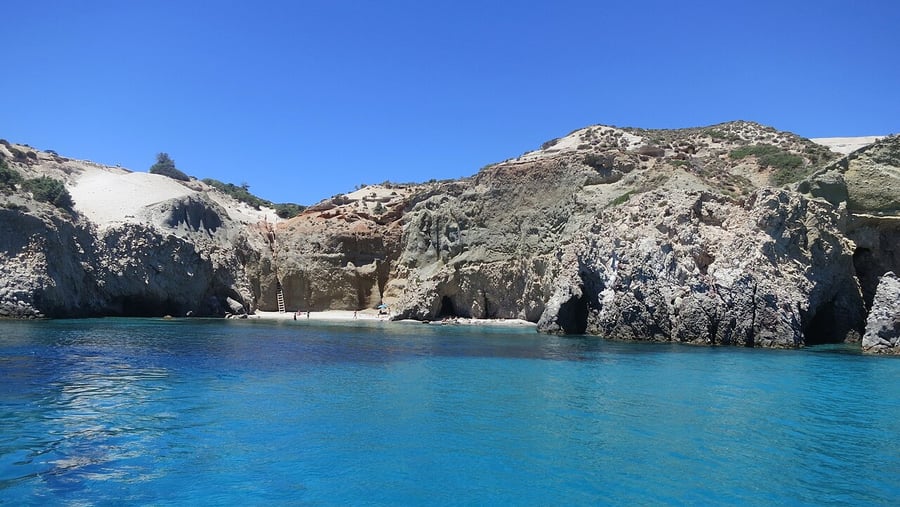
Beaches cost nothing, and Milos has more than 75 of them, both large and small. Volcanic ground gives them pale sand, pebbles, and rocks in white, red, yellow or black. Longer notes on each shore sit in a round-up of the beaches of Milos.
Wind decides which free beach works on a given day. With north winds, coves inside the bay or on the south coast are the calmer choice. With a south wind, the north coast is the better pick.
Seven geo-routes are marked across the island, each covering its geology, nature and history. The shortest one, 4.5 km long, crosses Sarakiniko, a bare white landscape of volcanic rock. Pirates once sheltered there, and bollards for tying ships are still cut into the stone.
Plaka sits 220 metres above the sea, on cobbled lanes closed to cars. Is Milos expensive for a sunset view? Not from the 13th-century Venetian castle above the village, which looks over the bay to nearby islands.
- Organised or wild: fully organised beaches sit beside quiet, wild coves.
- Syrmata: boat houses cut into rock at Klima, Mandrakia and Firopotamos.
- Fossils: the white rock at Sarakiniko holds plenty of them.
- Wild west: a protected Natura 2000 area with over 800 plant kinds.
- Profitis Elias: the highest point, at 748 metres, in the west.
On days spent outdoors like these, the honest reply to “is Milos expensive” turns into a clear no. A morning swim, a geo-route walk and a castle sunset can fill a whole day. Food, water and transport between spots are the only costs left.
Is Milos expensive for boat trips, kayaks and museums?
Is Milos expensive for paid trips and museums? These cost more than free walks, yet boats and kayaks reach coves that no road touches. Museums in Plaka and Adamas add the island’s long story of mining, ancient art and the sea.
Part of the coast has no road at all. Adamas and Pollonia are the main harbours where sea trips start. They head for beaches that land routes miss, with clear water, sea caves and rocks coloured by minerals.
Kleftiko, on the south coast, is a cluster of gray and white rocks full of caves and holes. Wind and sea carved them over centuries, and pirates once used the spot as a base. Only a boat or sailing boat gets there, such as on a Kleftiko boat tour.
Is Milos expensive for kayaking? A paddle trip costs more than a swim from shore, yet reaches sea caves, tunnels and empty beaches. Escorted trips run from April to October, and reach nearby islands where no one lives.
The Archaeological Museum in Plaka shows obsidian, sculptures, inscriptions and a copy of the Venus de Milo. The Mining Museum near Adamas, set up in 1998, covers minerals mined here since the Neolithic era. Films show how minerals are dug and processed, and old miners tell their stories on screen.
- Maritime Museum: rare maps and an old wooden boat.
- Folklore Museum: in Plaka, just behind Panagia Korfiatissa church.
- Church museum: inside the Holy Trinity church in Adamas.
- War Museum: on the site of a World War II shelter.
- Sea trips: boats and sailing boats head for roadless beaches.
Is Milos expensive once these paid extras join the plan? The cost grows with each trip added, so a short list keeps spending in check. One boat trip and one museum still show the roadless coast and the island’s long past.
Is Milos expensive, and which habits keep a trip cheaper?
The answer to “is Milos expensive” depends mostly on timing and daily habits. Six habits keep costs down. They are spring or autumn dates, early bookings and a well-placed base. Summer buses, picnic food and shared boat trips complete the list.
Demand for rooms and boats peaks in the summer months. Spring and autumn bring smaller crowds and a wider choice of places to stay. For July or August, early bookings secure a room before the well-placed ones fill up.
A base close to the planned sights cuts daily travel costs. Adamas, the island’s commercial centre, puts the port and the shops within walking range. No bus serves the airport, so arrivals by air take a taxi or a car.
Town buses serve parts of Milos, with frequent routes in summer. Riders buy the ticket on board. A picnic from local shops can replace a café lunch. Fouskoma, a sourdough bread, and xino tyri, a mildly sour cheese, suit it.
Part of the coast can be reached only from the sea. Boats and sailboats leave from Adamas and Pollonia. A shared trip spreads the cost of the boat across every passenger. A seat on a Milos catamaran cruise is one shared choice.
- Dates: Spring and autumn avoid the summer peak in demand.
- Bookings: Early plans for July and August keep the choice wide.
- Base: A room near the port and shops cuts taxi rides.
- Food: Local bread, cheese and tomatoes make a simple picnic.
- Boats: A shared trip costs less per person than private hire.
Each habit trims a small part of the bill, but together they add up. Beaches, village walks and viewpoints cost nothing and fill the days between paid trips. The wider range of activities in Milos mixes free and paid choices.

Is Milos expensive in practice?
Broken into parts, the question “is Milos expensive” gets clearer answers. The eight answers below cover quiet months, food, beaches, cars, boat trips, families, short stays and the off-season. Each one names a habit that keeps the cost in check.
Is Milos expensive in quiet months?
The quiet months sit outside summer, the peak season for visitors. Rooms and boat seats are easier to find then. April averages 18.4 °C by day and October 21.3 °C. October also brings the first real rain. Late spring and early autumn balance mild weather with lower demand.
Is Milos expensive for food?
Food spending depends on where and what people eat. Pitarakia are little fried pies of cheese or herbs, served hot with honey. Ladenia, a pie with oil, tomato and onion, is another local choice. Fresh fish and lobster pasta suit a special night out. Shop-bought picnics fill the other meals.
Is Milos expensive at the beach?
Under Greek law, every shore and beach is public land for common use. Milos has over 75 beaches. Fully organised ones rent out sunbeds and umbrellas, while others stay lonely and wild. A towel, hat, water and packed lunch are enough there. Such a wild beach day costs almost nothing.
Is Milos expensive without a car?
A car is not essential for a base near Adamas and the bay. Town buses cover parts of the island and run frequently in summer. The island’s 15 taxis wait at the port and the airport. The isolated west needs a car, as the island has the Cyclades’ largest dirt-road network.
Is Milos expensive for a boat trip?
A boat trip is one of the larger costs of a stay. Yet it shows coast that no road reaches. Trips stop at sea caves and show the island’s mineral wealth. A shared boat keeps the cost per person low. One boat trip can replace long drives on dirt roads.
Is Milos expensive for a family?
Family costs rise with every ticket, bed and meal, so each saving counts more. A paved road and a frequent bus serve Provatas beach, which also has sunbeds and taverns. Achivadolimni has an organised campsite and a bus link. Bakery pies and a beach picnic feed hungry children for less.
Is Milos expensive for a short stay?
A short stay has little room for long transfers or wasted rides. One base in Adamas, the harbour town, keeps the port and the shops close. Each day then covers a single part of the island. One shared boat trip shows the far coast without the need for a rental car.
Is Milos expensive outside summer?
Outside summer, demand for rooms and boats falls, and the island grows quiet. Winter stays mild, with average highs above 12 °C even in January. Frequent bus routes belong to summer, so a taxi or car plan matters more. Calm, sunny weeks in spring and autumn give the best balance.