Tourist Information Office
Tel: +30 22870 41020
Port Police Milos
Tel: +30 22870 23360
Piraeus Port Police
Tel: +30 210 4226000-4, +30 210 4593140
Milos Airport
Tel: +30 22870 22381
Olympic Airlines
Tel: +30 22870 22380, +30 8011144444
Taxi
Taxi in Adamas
Tel: +30 22870 22219
Taxi in Triovasalos
Tel: +30 22870 21306
How to go to Milos is the first question for anyone who plans a trip to the island of Milos. Two routes lead there from the mainland: a ferry from Piraeus and a flight from Athens. This page follows each route from its departure point to its arrival point on the island.
The first section explains how to go to Milos by sea, with the ports of call, the sea distance and the two kinds of ship. The second section covers the air route from Athens, the position of the island airport, its runway and the way an arrival works at that airport.
How to go to Milos by ferry from Piraeus, and which ports lie on the way?
How to go to Milos by ferry begins at Piraeus, the port of Athens. The ferry line runs through Kythnos, Serifos and Sifnos before it reaches Milos, and Kimolos is added on certain sailings. Conventional ships and high-speed craft both serve the line.
Piraeus is where the sea route starts, and a metro line and an express bus both reach the port. Piraeus metro station stands next to the port and is the southern terminus of Athens Metro Line 1. A direct express bus, route X96, also links Athens International Airport with the port. Travellers who work out how to go to Milos by sea can therefore reach the port by metro train or by airport express bus.
The line that serves Milos follows the western Cyclades in a fixed order: Piraeus, Kythnos, Serifos, Sifnos, Milos and Kimolos. Each island on the way has a main port. Merichas is the port town of Kythnos, Livadi is the largest settlement and main port of Serifos, Kamares is the main port of Sifnos, and Psathi is the port of Kimolos. The answer to how to go to Milos by ferry includes a choice: boats that call at Kythnos, Serifos and Sifnos first take longer than the direct conventional boat.
The sea distance grows with each port. Kythnos lies 56 nautical miles, or 104 kilometres, from Piraeus. The planned route from Piraeus to Psathi on Kimolos measures 89 nautical miles, and Kimolos lies 150 kilometres south-east of Piraeus. Milos stands 1.6 kilometres south-west of Kimolos, so the crossing to Adamantas covers a similar distance. Milos itself lies about halfway between Piraeus and Crete. These figures give the sea side of how to go to Milos a clear scale.
- Conventional ships: Roll-on/roll-off ferries are large conventional ships named for easy vehicle boarding.
- Direct boat: A conventional boat with a direct connection to the port of Milos also serves the line.
- High-speed ships: A high-speed ship is a vessel with a service speed above 15 knots.
- Catamarans: Catamaran and monohull designs became more popular among high-speed craft in the 1990s.
- Seasonal mix: Kythnos has mainly conventional ships and adds high-speed ships in summer, while Kimolos has a catamaran only in the tourist season.
Choosing between the two kinds of ship comes down to the route. A direct conventional boat sails straight to Milos, while boats that call at Kythnos, Serifos and Sifnos make the crossing in stages. Both reach Adamantas, the main port of the island. Anyone who still needs to decide how to go to Milos can compare this sea route with the flight from Athens, which the next section describes.
How to go to Milos by air from Athens, and what is the island airport like?
How to go to Milos by air means a flight from Athens International Airport to Milos Island National Airport. The airport lies 5 kilometres south-east of the harbour, has one asphalt runway of 1,030 metres and accepts only small aircraft.
Anyone who works out how to go to Milos by air lands at Milos Island National Airport, which stands in the eastern part of the island at Zefyria. That inland settlement lies 5 kilometres south-east of Adamantas and was the capital of the island before Plaka took the role. It was founded in the Venetian period, and strong earthquakes in the middle of the 18th century forced a large part of its residents to leave, mostly for Adamantas. Zefyria stands at 10 metres above sea level.
The airport has a single runway, numbered 08/26, with an asphalt surface 1,030 metres, or 3,380 feet, long. Runway numbers give the compass heading in tens of degrees, so the strip runs from about 80 degrees to about 260 degrees, which is roughly east to west. The runway is quite short, and that sets the limits of how to go to Milos by air, since only aircraft of the Dash 8 and ATR 42 class or smaller can use it.
The apron adds to the small scale of an arrival. It covers 7,800 square metres, and it holds one Dash 8-sized aircraft or two light aircraft at one time. The traffic figures show how small the air side of how to go to Milos is. In 2018 the airport handled 2,259 aircraft movements and 77,501 passengers, which was a rise of 65.9 per cent on the year before, and in 2001 it had handled 8,782 passengers.
- Departure airport: Flights to Milos run directly from Eleftherios Venizelos Airport in Athens.
- Second route: Besides Athens, the airport has a seasonal link to Thessaloniki.
- Taxis: Taxis wait both at the port and at the airport, and the island has 15 taxis in all.
- Elevation: The airport stands 3 metres above sea level.
- Coordinates: The airport lies at 36.6969 degrees north and 24.4769 degrees east.
The air route from Athens is the second way to reach the island, next to the ferry line described above. Anyone who compares how to go to Milos by ferry and by air meets a long sea distance on one side and a small airport on the other. Further practical details for visitors, from money and language to emergency numbers, sit on the page with information for visitors to Milos.
How to go to Milos from Kimolos, Sifnos, Serifos, Folegandros, Santorini and Crete?
How to go to Milos from a neighbouring island depends on the line that serves it. Kimolos has a local ferry boat, Sifnos and Serifos lie on the western Cyclades ferry line, and Folegandros, Santorini and Crete have frequent summer connections.
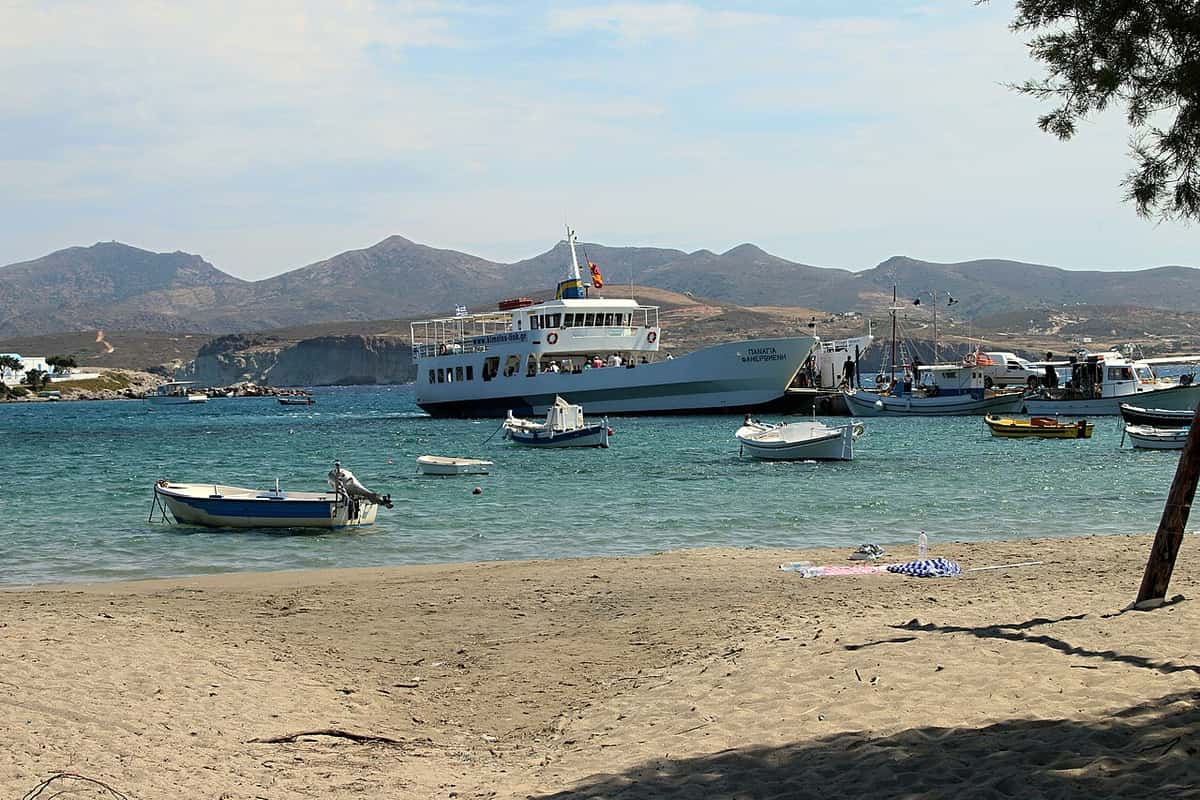
Kimolos is the closest neighbour. It lies north-east of Milos, separated from it by a channel 1 kilometre wide, and its harbour is Psathi. A local ferry boat connects the two islands frequently, and a small boat also runs from Pollonia, the second harbour of Milos, to Kimolos. The port authority of Kimolos is a department of the Milos Coast Guard. Travellers who ask how to go to Milos from Kimolos meet the two harbours of the island, Adamantas as the main port and Pollonia as the second.
Sifnos and Serifos belong to the western Cyclades. Sifnos lies between Serifos and Milos, and the ferries on that line run from Piraeus through Kythnos, Serifos and Sifnos to Milos and Kimolos. A connection via Naxos also serves Sifnos, and sailings from Sifnos to other Cyclades islands are infrequent. Serifos lies south of Kythnos and north-west of Sifnos, in the Milos regional unit. Island hopping along this chain is the simplest answer to how to go to Milos from Serifos, because Sifnos is the next stop before Milos.
Folegandros, Santorini and Crete are served in summer. Folegandros forms part of the southern Cyclades together with Sikinos, Ios, Anafi and Santorini, and it had 719 inhabitants in 2021. Santorini is the other volcanic island of the Cyclades besides Milos. Crete lies south of the Cyclades, across the Sea of Crete, and Heraklion is the Cretan port with links to the Cyclades. Syros, Paros, Naxos, Tinos, Ios and Sikinos also have a frequent summer connection with Milos, which widens how to go to Milos by island hopping.
- Kimolos: Chorio is the main settlement of the island, and Psathi is its port.
- Sifnos: The island is 15 kilometres long and 7.5 kilometres wide.
- Serifos: The island covers 75.207 square kilometres and had 1,241 residents at the 2021 census.
- Folegandros: A paved road links its three villages, Chora, Karavostasis and Ano Meria.
- Santorini: The island has two ports, Athinios as the ferry port and Skala as the old port.
The Cyclades hold about 220 islands, and their name refers to the circle they form around Delos. Milos sits at the south-western end of that circle, and Kimolos is a station for the local connections. Anyone who knows how to go to Milos from each neighbour can build one journey out of two or more islands. The next section explains how to go to Milos with a vehicle and what the port of Adamantas offers.

How to go to Milos with a car or scooter and what waits at the port of Adamantas?
How to go to Milos with a car or scooter calls for a roll-on roll-off ferry, the ferry type named for the ease with which vehicles board and leave. The crossing ends at Adamantas, the main port of Milos, where the main road to Plaka begins.
The vehicle ferry is a large conventional ferry, and a conventional boat links Piraeus directly with the port of Milos. Piraeus records vehicle traffic of 2.5 million, and its central port serves ferry routes to almost every island in the eastern part of Greece, including the Cyclades. A traveller who plans how to go to Milos with a car or scooter therefore starts from a port that handles vehicles on a large scale. Adamantas receives the vehicle at the other end of the crossing.
Adamantas is the main port of Milos and the first image of the island on arrival by boat. The village stands in the north of the gulf, so a traveller who has worked out how to go to Milos with a car or scooter lands in the largest tourist centre of Milos. Hotels, inns, cafes, restaurants and bars stand around the harbour, and the Church of the Assumption stands in the village. A military cemetery from the Crimean War recalls the French fleet that once used Adamantas as its base.
The main road to Plaka runs north from the port. A concrete road leaves it for Tripiti and ends at a parking lot, from which a path leads on to the catacombs, and a passable dirt road continues to the ancient theatre. Plaka is closed to cars because the spaces between its walls and buildings are narrow, so travellers who settle how to go to Milos with a scooter find that mopeds and motorbikes are the vehicles that enter. Pollonia, the second harbour of Milos, is easily reached by car.
- Vehicle traffic: The port of Piraeus records vehicle traffic of 2.5 million.
- Main road: The main road to Plaka runs north from the port of Adamantas.
- Plaka: Motorbikes, mopeds and similar vehicles are the only ones that can enter the chief town.
- Pollonia: The second harbour of Milos is easily reached by car and by public transport.
- Dirt roads: The dirt road network of Milos is the largest in the Cyclades, and in places the routes are very difficult.
A vehicle that leaves the ferry at Adamantas reaches the plateau villages, Pollonia and the dirt roads on its own wheels. Kimolos also permits all vehicles, but parking space is short there in summer, especially in Chorio and Psathi. Travellers who settle how to go to Milos with a car or scooter can read more about the harbour village on the page about Adamantas, the starting point of the main road to Plaka.


How to go to Milos in each season of the year?
How to go to Milos changes with the season. Ships from Piraeus and flights from Athens run all year, but sailings reach up to seven a day in summer, fall to one or two ships a day in winter, and strong meltemi wind can halt inter-island ferries.
Summer fills the sea route. Daily high-speed and conventional ships link Piraeus with Milos, and up to seven sailings a day run in the season. Frequent summer links also join Milos with Syros, Naxos, Tinos, Ios, Sikinos, Crete and Rhodes, so Milos works as an island-hopping stop. July and August bring the largest crowds to the island, so the plan for how to go to Milos in those weeks starts earlier than in late spring or early autumn.
Winter thins the schedule without closing the island. Ships from Piraeus keep sailing at one or two a day, and flights from Athens continue through the year. Seasonal links drop out, and certain shops close in the quietest months, so the island runs at a slower pace. The plan for how to go to Milos in winter therefore rests on the Piraeus ship and the Athens flight, with a spare day built in for wind.
A ferry stopped by wind leaves a traveller in port until the next sailing, so a tight link between a ship and a flight home carries risk. Clear skies give no warning of the meltemi, and a calm morning does not settle the afternoon. In July and August the same wind can also disturb boat tours to Kleftiko, Polyaigos and other sea trips, and tours in spring and autumn still depend on the weather as well.
Booking ahead matters where capacity is fixed. A 50-seater plane serves the Athens route, so the seat count is small. Ships carry vehicle decks and numbered seats, which allows a car or a seat to be reserved ahead of the day. Taxis are available but limited, so a transfer from the port or the airport is best arranged in advance. The sailing schedule changes with the season and needs a fresh check before any booking.
- Piraeus: the chief port of Greece sends ferries to the Cyclades, Crete and the Dodecanese.
- Metro: the Piraeus metro station stands next to the port.
- Routes: boats from Piraeus run direct to Milos or call first at Kythnos, Serifos, Sifnos and sometimes Kimolos.
- Runway: only Dash 8, ATR 42 or smaller aircraft can use the airport of Milos.
- Taxis: fifteen taxis serve the island, with cars at both the port and the airport.
How to go to Milos comes down to three checks: the season for the number of sailings, the wind for the risk of delay, and the ship or aircraft for the seats. Once the crossing or the flight is fixed, the stay can follow, and the places to stay on the island are listed on the page about accommodation in Milos.
Which questions about how to go to Milos do travellers ask?
How to go to Milos raises six practical questions: the Lavrio route, force 7 or 8 wind, small aircraft, links from other islands, arrival by private boat and the route from abroad. Each question below has its own short answer.
How to go to Milos from Lavrio?
A conventional ship from Lavrio serves Milos only in the summer months. The route is seasonal, so it drops out of the winter plan. Piraeus remains the main mainland port, and its ships keep the connection alive through the year, which makes Piraeus the starting point for any trip outside summer.
How to go to Milos when the meltemi stops ferries?
Inter-island ferries stop sailing when the wind reaches force 7 or 8, and the crossing waits until the wind eases. Greece uses the Beaufort scale, and its force numbers appear in shipping forecasts, so those numbers signal a delay. The flight from Athens offers a second way to the island.
How to go to Milos by plane on a small aircraft?
Milos Airport has regular flights from Athens all year, the fastest way to arrive. Two or three daily flights serve the Athens route. The apron handles only one Dash 8 sized aircraft or two light aircraft at a time, so capacity stays small and an early reservation secures a seat.
How to go to Milos from Kimolos and other islands?
Kimolos keeps a year-round ferry link, and its catamaran service runs only in the tourist season. The local ferry between Kimolos and Milos is frequent, which gives a route via Milos. In summer, direct boats also join Milos with Folegandros, Santorini and Paros, so an island-hopping route can start or end on Milos.
How to go to Milos with a private boat?
Private boats moor in the marina of Adamas or in Pollonia, and the marina of Adamas offers fuel, water and electricity. Coves such as Provatas, Kleftiko and Paliochori also serve for mooring, depending on the wind direction. Etesian winds are dangerous to sailors, yet leisure sailors favour their steady strength.
How to go to Milos from abroad?
No direct international flights serve Milos, so travellers from abroad connect through Athens. Athens International Airport links to the port of Piraeus by the Airport Express bus, route X96, and flights from the same airport reach Milos Airport directly. The ship or the flight then forms the second leg of the journey.