The Catacombs are the largest communal cemetery of the Early Christian period in Melos. Three large and independent subterranean galleries (A, B, C), carved into the porous volcanic rock, formed the initial structure, and each gallery was connected to other, smaller ones. Today, the three galleries form a single complex through artificial passages constructed in the 20th century. A rectangular funeral chamber in the form of the cubicula of Rome’s catacombs completes the complex. Gallery width varies between 1 and 5 m, and gallery height between 1.60 and 2.5 m. The walls have been carved to form arched recesses, arcosolia, for tombs, while a considerable number of graves are found in the floor of all the galleries. Certain arcosolia have painted decoration, with the border usually colored red and the drum painted deep blue. Only traces of this decoration have survived, as well as fragments of inscriptions. These few inscriptions are significant for the information they give us concerning the names of Christians, the ranks of the ancient clergy, and the belief of the first Christians in angels as patrons of the tombs.
The present main entrance to the catacombs was opened at the beginning of this century. Visitors therefore enter the second gallery (B), which is the only one that can be visited at present. On the right side of gallery B’ survives the only “two-level” tomb of the catacombs, as well as fragments of a very significant inscription, written in red capital letters within a rectangular frame. The Catacombs, besides having been a cemetery, were also a place of worship, as indicated by a piece of rock left in the middle of gallery B’ to be used as an altar. During the 1928 excavation research, the traces of bases found at the four corners of the roof, corresponding to those revealed on the ground, suggested that originally above the altar there was probably a “ciborium”. The figure resembling a sarcophagus led to the assumption that this was the tomb of an official or of one of the first bishops of Christian Melos.
Gallery A’, to the west of the present central gallery, is distinguished by its width, its general spaciousness and the double family tombs carved in its wall. The entrance on the south side is obstructed today. Gallery C’, to the east of the central gallery, survives only partially, as its south part, which had the original entrance, has now collapsed.
The catacombs of Milos form the largest Christian burial ground of the early centuries on the island. They lie carved in the soft volcanic rock near the village of Tripiti, in the wider area of the ancient city of Melos. Practical notes for the island and its monuments appear at milosadvisor.gr. The underground cemetery belongs to the first Christian community of Milos.
The monument occupies a slope of volcanic rock beside the ruins of the ancient city, and its galleries run underground between the village and the coast. The surrounding hillside is full of cavities cut into the rock, partly by erosion and partly by hand. The sections below cover the setting, the long use of the site, the plan of its galleries and its excavation.
Where do the catacombs of Milos lie?
The catacombs of Milos lie on a hillside southwest of the village of Tripiti, in the area of the ancient city of Melos, above the sea. The ancient theatre stands about 200 metres to the east, and Plaka, the chief town, occupies the plateau close by.
The catacombs of Milos run through the porous volcanic rock of a slope that falls toward the sea, inside the wider area of the ancient city whose ruins reach the seaside settlement of Klima. The galleries sit between the modern village above and the water below. The ancient town of Melos occupied this slope, and its remains spread from the village of Tripiti down to the landing place at Klima, where boats once came ashore.
The village of Tripiti takes its name from the holes in the rock around it, and the cavities served the older inhabitants as storerooms and stables. In ancient times the caves served as family burial chambers, a habit that prepared the ground for the later cemetery. The village stands at an elevation of about 150 metres, beside the ancient town and above the catacombs of Milos, with the ancient theatre and the find spot of the Aphrodite of Melos nearby.
The complex is cut into the soft, porous volcanic rock of the area, known as tuff. Its galleries differ in width from one metre to five metres, and their height runs between 1.6 and 2.5 metres. The galleries have a total length of about 200 metres. Three groups of chambers, labelled A, B and C, form the plan, and artificial corridors join them into one complex with a rectangular family burial chamber, which gives the catacombs of Milos their shape.
Above the site, Plaka forms the chief town of Milos, placed on the plateau that rises behind the harbour of Adamantas, with the older quarter of Kastro on the hill above it. Between the plateau and the water lies the ground of the ancient town, where stretches of wall, a mosaic floor and the remains of public buildings survived into modern times. That ground holds the market place of the ancient city, beside which the catacombs of Milos were cut.
- Village: Tripiti stands on the hillside above the cemetery, and its name comes from the holes in the rock.
- Theatre: The ancient theatre lies about 200 metres east of the catacombs of Milos, on the same slope.
- Sea: The ground falls from the galleries toward the bay, and the ruins continue down to the shore at Klima.
- Rock: Soft volcanic tuff let the first diggers cut chambers and corridors without heavy tools.
- Town: Plaka, the chief town of the island, sits on the plateau above the harbour of Adamantas.
Position shapes the experience of the site. The catacombs of Milos rest in the middle of a wide archaeological landscape, within reach of the theatre, the market place and the ancient roads, and a short distance above the water. The village above keeps the everyday life of the island close to the graves, a pairing that marks the setting of the monument.
When were the catacombs of Milos in use?
The catacombs of Milos served as a communal cemetery from the middle of the first century AD, and finds from later work place the end of their use in the sixth century AD. Other studies extend the burial period into the seventh century AD.
The site was a community cemetery rather than a private group of tombs, and its galleries served the Christian population of the ancient town. Grave offerings date the first burials to the middle of the first century AD, while the latest burials belong to the sixth century AD. The excavations of 2007 to 2009 placed its use between the first and the seventh century AD. The catacombs of Milos fell out of use at the end of that span.
Tradition links the first Christians of Melos with families who left Palestine after a series of persecutions, after the fall of Jerusalem in AD 70 or after later persecutions, and who settled in places such as Milos. The inscriptions that survive in the galleries are written in Greek and carry Greek names, a detail that points to use by the local population. The catacombs of Milos therefore hold the traces of a community rooted in the island itself.
The cemetery also served as a place of worship. Inscriptions name the ranks of the ancient clergy, listing presbyters, deacons and virgins, and they show the belief of the first Christians in angels as patrons of the tombs. One text, painted in red capitals inside a rectangular frame, is known as the inscription of the Elders. Together these texts make the catacombs of Milos a valuable witness to the early chapters of the history of Milos.
Later centuries brought damage and change. Earthquakes and raids struck the island at the end of the burial period, and the cemetery lost its place in the life of the town. The catacombs of Milos stayed known to local people, who called the site the Greek cave. In time, a tomb that served as an altar gave the monument a second life as a place of worship, and one annual service took place in the galleries from 2002 onward.
- Date: Grave offerings place the first burials in the middle of the first century AD.
- Community: The cemetery served the Christian population of the ancient town, and the catacombs of Milos stayed in use for centuries.
- Faith: Inscriptions in the galleries show the belief in angels as patrons of the tombs.
- Clergy: Texts name presbyters, deacons and virgins among those buried in the chambers.
- End: Earthquakes and raids brought the long use of the cemetery to a close.
The long life of the cemetery shows how the first Christian community grew around its dead. The catacombs of Milos began as chambers cut in the rock, became a communal burial ground, then a place of worship, and lost their use after earthquakes and raids. Each stage left traces, from burial offerings to the inscriptions on the drums of the tombs.
What lies inside the catacombs of Milos?
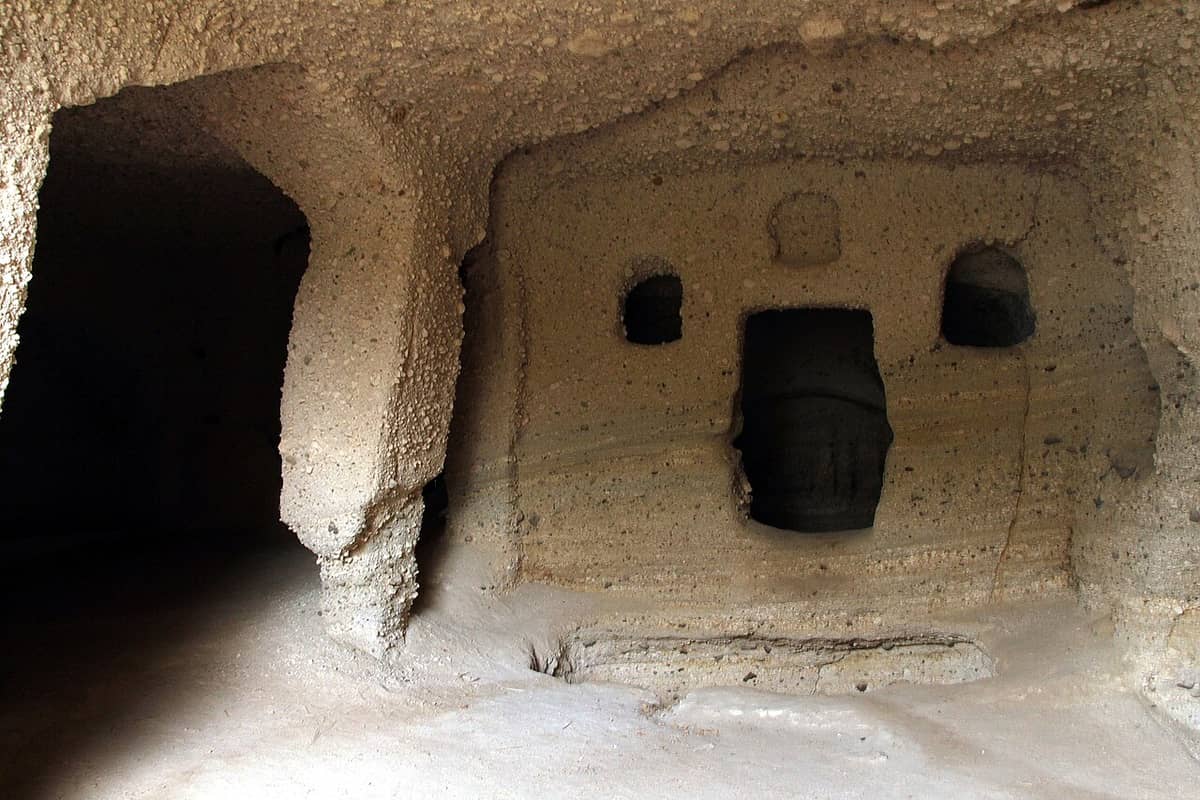
The catacombs of Milos hold about 200 metres of galleries cut into soft volcanic rock. Arched wall tombs, known as arcosolia, and horizontal wall tombs, known as loculi, line the passages, pit graves cover the floors, and a rectangular family burial chamber completes the plan.
Three groups of chambers, known as A, B and C, formed the original plan, and five corridors run through the whole complex. Artificial passages now link the groups, so the catacombs of Milos read as a single set of rooms. Gallery A stands out for its width and for the paired family tombs cut into its walls. Gallery C survives in part only, because its southern section collapsed, and the present entrance lies in the hall of gallery B.
The galleries measure between one and five metres across, and their height ranges from 1.6 to 2.5 metres, with the widest stretches in gallery A. Two types of tomb are cut into the walls of the catacombs of Milos: arched recesses, known as arcosolia, and horizontal recesses, known as loculi. A large number of graves were also cut into the floors of the galleries. Slabs of different sizes covered the tombs, and successive layers of plaster sealed them.
Early counts of the graves differ widely. One estimate gave a total of 1,500 to 2,000 graves holding 7,000 to 8,000 people, while a later estimate put the number at 300 graves and no more than 1,500 burials. The campaign of 2007 to 2009 uncovered nine arcosolia and four loculi on the walls of the catacombs of Milos, together with two built tombs, a marble sarcophagus and thirty-three pit graves, and pottery brought from Asia Minor, Cyprus and North Africa.
Certain arcosolia keep painted decoration, with a red border and a deep blue drum, and a number carry fragments of inscriptions or a niche for offerings and lamps, used in certain cases for the burial of an infant. In gallery B, small columns with gypsum panels stood in front of certain tombs. The middle of the hall holds a free-standing tomb shaped like a sarcophagus, known as the tomb of the witness, which served as an altar.
- Plan: Three groups of chambers, A, B and C, joined by artificial corridors, form the complex.
- Walls: Arcosolia and loculi are cut into the rock of the catacombs of Milos at different heights.
- Floor: Pit graves run along the galleries and were sealed with slabs of unequal size.
- Chamber: A rectangular family chamber holds three arcosolia and a built tomb.
- Symbols: A Christogram, the letters omega and alpha, flowers and two birds survive on the plaster.
The cemetery works on more than one level. Corridors of different widths open into halls, wall tombs take the dead at chest height, and floor graves take them at the level of the walker’s feet. The catacombs of Milos keep this arrangement in gallery B, and the marks of plaster and paint show how carefully the community finished the places it cut.
How were the catacombs of Milos rediscovered?
The catacombs of Milos stayed out of view for centuries and were known to local people as the Greek cave. They were found again during the years of Ottoman rule, and the discovery was made public in 1840, after looters had already opened the graves.
Local diggers came upon the chambers during the period of Ottoman rule, and word of the find reached a wider public in 1840. By the time the first scholars arrived, the tombs had already been looted and much of their contents had gone. The German archaeologist Ludwig Ross visited in 1844, and the French scholar Charles Bayet followed in 1878. Bayet counted the graves and noted the painted decoration, blue on the drums and red on the borders.
The Greek scholar George Lampakis examined the galleries in 1907 and arranged the clearing of fill that had gathered in them. Systematic research followed in 1928 under George Sotiriou, who found that a number of the slabs that had covered the tombs were gone. He argued that the catacombs of Milos had begun as three separate chambers, and he located traces of capitals above the sarcophagus-shaped tomb in gallery B. His study shaped the later reading of the site.
Further excavations took place in the 1950s and the 1960s. A rescue campaign ran between 2007 and 2009 at the catacombs of Milos and uncovered the southern part of the halls of galleries A and B along about fifteen metres. The roof of that section had almost all fallen in, while the walls stood with nine arcosolia and four loculi. A transverse corridor joined the two halls and overturned the old idea of three independent chambers.
The same campaign revealed a small new burial chamber above the surviving southern part of gallery B, together with two built tombs, a marble sarcophagus and thirty-three pit graves. A large share of the excavated tombs had been looted or disturbed. Finds included pendants, a metal ring, glass vessels, glass beads, bronze and iron nails and lamps. Traces of fire, cooking pots, jugs, plates and animal and fish bones point to funerary meals held at the graveside.
- Name: Local people called the site the Greek cave long before scholars reached it.
- Rediscovery: Local diggers opened the chambers under Ottoman rule, and the find became public in 1840.
- Looting: The tombs had been emptied before the first scholars arrived, and the loss was permanent.
- Study: Research ran through the twentieth century, and a rescue campaign followed between 2007 and 2009.
- Protection: Opened graves were covered again, and one hall was fenced off for its preservation.
Protection has shaped the site as much as research. The hall uncovered to the west of gallery A was fenced off, and the graves that came to light in the southern section were covered again. Flooding in October 2009 closed the chambers for months. The catacombs of Milos reopened after that event, and the route through the galleries has served visitors since.
How do the catacombs of Milos compare with the catacombs of Rome?
The catacombs of Milos belong to the same early Christian tradition as the catacombs of Rome. The family burial chamber at Milos follows the form of the cubicula of Rome’s catacombs, and the tombs carry the same names, from arched arcosolia to horizontal loculi.
Underground burial outside the walls of a city was the common practice of early Christian communities, and the monument at Milos belongs to that broad pattern. It stands as an extra muros cemetery, a burial ground beyond the walls of the ancient town, in galleries and chambers cut into soft stone. Its galleries follow the pattern of rooms cut into rock and joined by corridors. The catacombs of Milos share this framework with the underground cemeteries of Rome.
The shared vocabulary of burial is plain in the plan. Arcosolia, loculi, cubicula and the framed inscription panel known as a tabula ansata all appear at Milos, and all are forms that belong to the catacomb tradition of the Roman world. Paired family tombs appear in gallery A. The two-level tomb in gallery B, the altar tomb with its canopy and the red capital letters of the Elders inscription place the catacombs of Milos in direct line with that tradition.
Scale and setting give the monument its own character. The galleries run for about 200 metres and hold three groups of chambers, a family chamber and a single free-standing tomb, all cut into volcanic rock by one community. The plan stays compact, and the cemetery served one town alone. Within Greece, the catacombs of Milos are noted above all for their size, and the same hillside holds smaller underground cemeteries of the same type, cut in the same soft stone.
The way the dead were honoured also matches the wider practice. Fragments of inscriptions name the Christian dead and their ranks, a painted fish marked the head of one grave, and the niches above the tombs held lamps and offerings. Painted scenes with flowers and two birds survive on the walls of one corridor. Traces of fire, cooking pots and bones show that meals were shared at the graveside, a custom of early Christian burial rites.
- Tradition: The cemetery lies outside the walls of the ancient town, in the manner of the catacombs of Rome.
- Chambers: A family burial chamber follows the form of the cubicula found in Rome’s catacombs.
- Names: Arcosolia, loculi and a tabula ansata give the catacombs of Milos the terms used across the Roman world.
- Worship: An altar tomb with a canopy shows that the cemetery also served as a place of prayer.
- Region: The same hillside holds smaller underground cemeteries of the same type.
The comparison shows how a small island community worked. The catacombs of Milos took the burial forms of the wider Christian world and adapted them to a hillside of soft stone. The result is a compact cemetery with the same vocabulary as the underground cemeteries elsewhere, and a body of inscriptions that keeps the names of the people who used it.
How is a visit to the catacombs of Milos planned?
A visit to the catacombs of Milos begins at the hall of gallery B, which holds the entrance and the only two-level tomb, and continues into the hall of gallery A. The ancient theatre, the ruins of the ancient city, Tripiti, Klima and Plaka stand close by.
Two halls can be entered today: the hall of gallery B, which holds the entrance, and the hall of gallery A. The rest of the complex stays closed, including gallery C, the family chamber and the hall found west of gallery A. Visitors to the catacombs of Milos pass the two-level tomb and the fragments of the inscription of the Elders on the right wall of gallery B. The cemetery forms one entry in the sights of Milos.
The ancient theatre of Melos stands about 200 metres east of the cemetery on the same hillside, built in Roman times and set above the bay. The statue of Aphrodite of Melos, known outside Greece as the Venus de Milo, came to light in the area of the ancient town near the theatre, and that ground also produced the Asclepius of Melos, the Poseidon of Melos and an archaic Apollo. The theatre is a monument of the ancient town.
Below the cemetery, the ground falls to Klima, the small seaside settlement that served the ancient town as its landing place. Its houses stand close to the water, and the ruins of the ancient city reach down to the shore. The coastline here holds the traces of the ancient harbour that served the town above. The route from the galleries to the coast crosses the same slope, so the catacombs of Milos sit inside a continuous field of ancient remains.
Tripiti holds the church of Agios Nikolaos in its centre, windmills that once ground grain, and the chapel of Panagia Faneromeni on the way to the site, with two arched tombs and traces of wall paintings. Plaka, the chief town, occupies the plateau above, and the archaeological museum of Milos keeps finds from the island. Both villages offer a starting point for a morning on the slope, since the cemetery, the theatre and the ruins lie close together.
- Entrance: The present entrance opens in the hall of gallery B, the group that visitors can walk through.
- Tombs: The only two-level tomb of the site survives inside gallery B, beside a painted inscription.
- Theatre: The ancient theatre of Melos stands about 200 metres away, looking out over the bay.
- Coast: Klima, the seaside settlement below, served the ancient town as its landing place.
- Villages: Tripiti and Plaka above it hold the churches, the windmills and the museum of the island.
One route covers the monuments of the ancient town, and the cemetery forms the deepest point of that walk. The theatre, the ruins, the find spot of the Aphrodite of Melos, the shore at Klima and the villages follow in turn. Visitors who plan the day around the slope see the catacombs of Milos in the setting that gave them purpose.

What do visitors ask about the catacombs of Milos?
The catacombs of Milos raise practical questions about position, age, size and contents, and they also raise questions about the way the cemetery was used and explored. The answers below set out the facts, and they leave aside hours, prices and booking details.
Where exactly do the catacombs of Milos lie?
The site occupies a hillside southwest of Tripiti, in the area of ancient Melos, above the sea. Its galleries run through soft volcanic rock, and the ancient theatre stands about 200 metres to the east. The ruins of the ancient town reach from the village down to the shore at Klima.
How old are the catacombs of Milos?
Grave offerings date the earliest burials to the middle of the first century AD, and the last burials belong to the sixth century AD. Work between 2007 and 2009 placed the period of use from the first to the seventh century AD. Earthquakes and raids ended the burial use of the place.
How far do the catacombs of Milos extend?
The galleries together run for about 200 metres. Their width varies between one and five metres, and their height ranges from 1.6 to 2.5 metres. Three groups of chambers, A, B and C, formed the original plan, and artificial corridors joined them. A rectangular family burial chamber completes the complex.
What tombs can be seen in the catacombs of Milos?
Two types of tomb are cut into the walls: arched recesses, known as arcosolia, and horizontal recesses, known as loculi. Pit graves were cut into the floors and covered with slabs of different sizes. In gallery B the only two-level tomb of the site survives, beside the inscription of the Elders.
Why do the catacombs of Milos carry that name?
The name comes from the form of the cemetery, a set of underground galleries and chambers used for burial, in the manner of the catacombs of Rome. Local people knew it as the Greek cave. The family burial chamber follows the cubicula of Rome’s catacombs, which links the site to the same tradition.
Were the catacombs of Milos ever looted?
The tombs had already been looted before the first foreign scholars reached the site, and local diggers had opened the chambers during the period of Ottoman rule. The rescue excavation of 2007 to 2009 found that a large share of the graves it uncovered had been plundered or disturbed, and that covering slabs were gone.
How do the catacombs of Milos connect with the other sights of Milos?
The cemetery stands on the same slope as the ancient theatre, the ruins of the town and the find spot of the Aphrodite of Melos. Klima lies below, and Plaka, the chief town, occupies the plateau above. A single route can take in the theatre, the village and the catacombs of Milos.