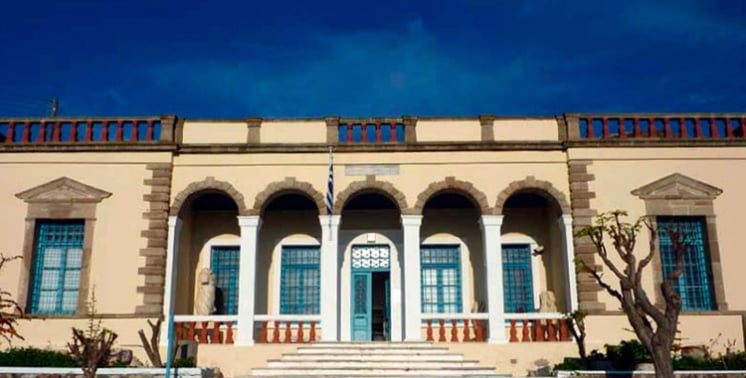
Once you rent a car, an ATV or a buggy from Rac SA, you can go and see the Archaeological Museum of Milos.
The Archaeological Museum of Milos is in Plaka and includes collections of characteristic samples from throughout the history of the island. It is housed in a 19th-century neoclassical building that was converted into a museum in 1985.
Without a doubt, the most impressive exhibit in the museum is a plaster copy of the Venus de Milo in the front hall, at the entrance of the museum. The replica was offered by the Louvre, which holds the famous original statue of the goddess. Another stunning exhibit is the famous Lady of Phylakopi.
The Archaeological Museum of Milos includes important artifacts from the prehistoric settlement of Phylakopi and from the archaeological site at Klima.
To get a complete picture of the finds from the excavations on Milos, you should also see the Cycladic collection of the Archaeological Museum of Athens, where the exhibits from the four settlement periods of Phylakopi (3300-1100 BC) are an important part (ground-floor hall 6). The collection in the Archaeological Museum of Milos also includes fine examples of obsidian, which played such an important role in the early development of the island.
Major exhibits are also displayed outdoors at the Archaeological Museum of Milos. The outdoor exhibits are real gems that fit the museum perfectly and prepare you in the best way for your visit to the indoor collections.
Archaeological Museum of Milos
Plaka, Milos (Cyclades)
Tel: +30 22870 21620
The archaeological museum of Milos stands in Plaka, a hilltop village on the island of Milos. A German-born architect designed its neoclassical building. Inside, a replica of the Venus de Milo recalls the statue found on the island in 1820. This page covers the building first and the statue second.
The building has a history of its own. Its architect, Ernst Ziller, shaped public architecture across Greece. The statue has its own history: it was found in a field, bargained over and carried to Paris. The archaeological museum of Milos holds both stories, and each section below takes one in turn.
Who designed the building of the archaeological museum of Milos in Plaka?
The archaeological museum of Milos fills a neoclassical building of 1870 in Plaka, designed by the German architect Ernst Ziller. Ziller designed and built at least five hundred buildings in Greece, and this museum is one of his works.
Ernst Ziller was born in 1837 in Serkowitz, in the Kingdom of Saxony. After he graduated from the Dresden Academy of Fine Arts in 1858, he worked for the Danish architect Theophilus Hansen. In 1861 Hansen sent him to Athens. From 1868 Ziller worked in Greece as an independent architect. His friendship with King George I and his standing with the middle class of the Greek state brought hundreds of commissions for public buildings and homes.
Ziller varied his style by building type. Public buildings and houses took neo-Renaissance details, and churches took neo-Byzantine and Romanesque ones. He helped to shape mature Greek classicism, where Greek classical forms replaced Roman ones. He also designed terracotta caryatids and rosettes, made in large numbers, which helped to spread neoclassical taste. His works include the Presidential Mansion in Athens and the Town Hall of Ermoupoli on Syros. The archaeological museum of Milos is a neoclassical work too.
The neoclassical Plaka building dates from 1870, two years after Ziller began to work as an independent architect. More than a century later, in 1985, it opened as a museum. A renovation of the archaeological museum of Milos added a display in the vestibule, titled «τάφω κτερίζειν», after the gifts buried with the dead. It showed new finds from Mycenaean, Archaic and Roman cemeteries, uncovered by salvage digs when the island’s mines asked to expand.
The archaeological museum of Milos stands on the main square of Plaka, a village perched on a large rock. The cobbled alleys around it were first built as protection from pirates. The narrow spaces between walls and buildings keep cars out and only motorbikes and mopeds pass. The castle stands at the top of the village, on a rocky hill above the ancient city, and the hill allowed control of ship movements in the gulf of Adamantas.
- Aigio: The old municipal market of Aigio is an archaeological museum today.
- Pyrgos: The municipal market of Pyrgos houses the archaeological museum of that town.
- Athens: Iliou Melathron, the home of Heinrich Schliemann, houses a numismatic museum.
- Thessaloniki: The Greek consulate of 1894 is the Museum of the Macedonian Struggle.
- Plaka: The list of Ziller’s works includes the archaeological museum of Milos, dated 1870.
Seen as a whole, the archaeological museum of Milos joins two histories. One is the career of an architect who designed public buildings across Greece and gave towns markets that became museums. The other is the story of a hill village built with defence in mind, under a castle above the ancient city. The Plaka building stands where the two meet.
What does the archaeological museum of Milos show of the Venus de Milo?
The archaeological museum of Milos shows a faithful modern replica of the Venus de Milo, sent later as a donation from the Louvre. The marble goddess was found on the island in 1820 and has stood in the Louvre since 1821.
The goddess whose replica the archaeological museum of Milos shows came out of the ground in spring 1820, in a field on Milos. Digging on his terrace, the farmer pulled stones out of ancient ruins and struck worked marble. Accounts name him as Georgios Kentrotas, Theodoros Kentrotas or Botonis. Two French sailors who dug nearby ran to help him. The statue lay in pieces, and the two main ones were the torso and the legs.
Olivier Voutier, a young French officer digging beside the field, drew the find on the spot. His drawing shows the goddess without arms from the first moment. A later tale said that the arms broke in a brawl in transport, but the statue was armless when it left the ground. Two herms, a plinth, a block naming the sculptor and worn parts of a left arm that seemed to hold an apple lay close by.
Voutier told Louis Brest, the French vice-consul on Milos, who began to bargain. The French representative at the Sublime Porte received word at once. Meanwhile Nikolaos Mourouzis, the chief dragoman of the Ottoman fleet, persuaded the Milians to sell the statue to him. The Vicomte de Marcellus arrived, and with arguments and a threat of force he convinced the islanders to load the goddess on a French ship. A priest resisted the French officers with force.
The statue was handed to King Louis XVIII on 1 March 1821, and he gave it to the Louvre. It was shown as found, without restored arms. It has left France only once, for Tokyo and Kyoto in 1964. In the Second World War a plaster replica took its place in Paris, while the original was stored in the Château de Valençay. Since 2010 it has a new setting. The archaeological museum of Milos keeps only the replica.
- Sculptor: A lost signature from Antioch on the Maeander has a disputed link to the goddess.
- Missing parts: Both arms, the left foot and the earlobes are missing.
- Arm support: A filled hole below the right breast once held a metal tenon.
- Viewing side: The drapery is richer on the right, and the back is less finished.
- Reconstruction: In 1876 Fröhner proposed an apple in the left hand and drapery in the right.
Casts of the statue travelled early. A plaster cast reached the Berlin Academy in 1822, one year after the Louvre acquired the original. The replica in the archaeological museum of Milos belongs to that line of copies. The page on the museums of Milos lists the other museums of the island, from the Folklore Museum in Plaka to those of Adamantas.
What does the Archaeological Museum of Milos show about Phylakopi?
The Archaeological Museum of Milos shows Phylakopi through the finds of the later digs, with Bronze Age pottery, a goddess figurine and fresco themes. Together they describe a trading port that took ideas from Crete first and from the Mycenaean mainland after.
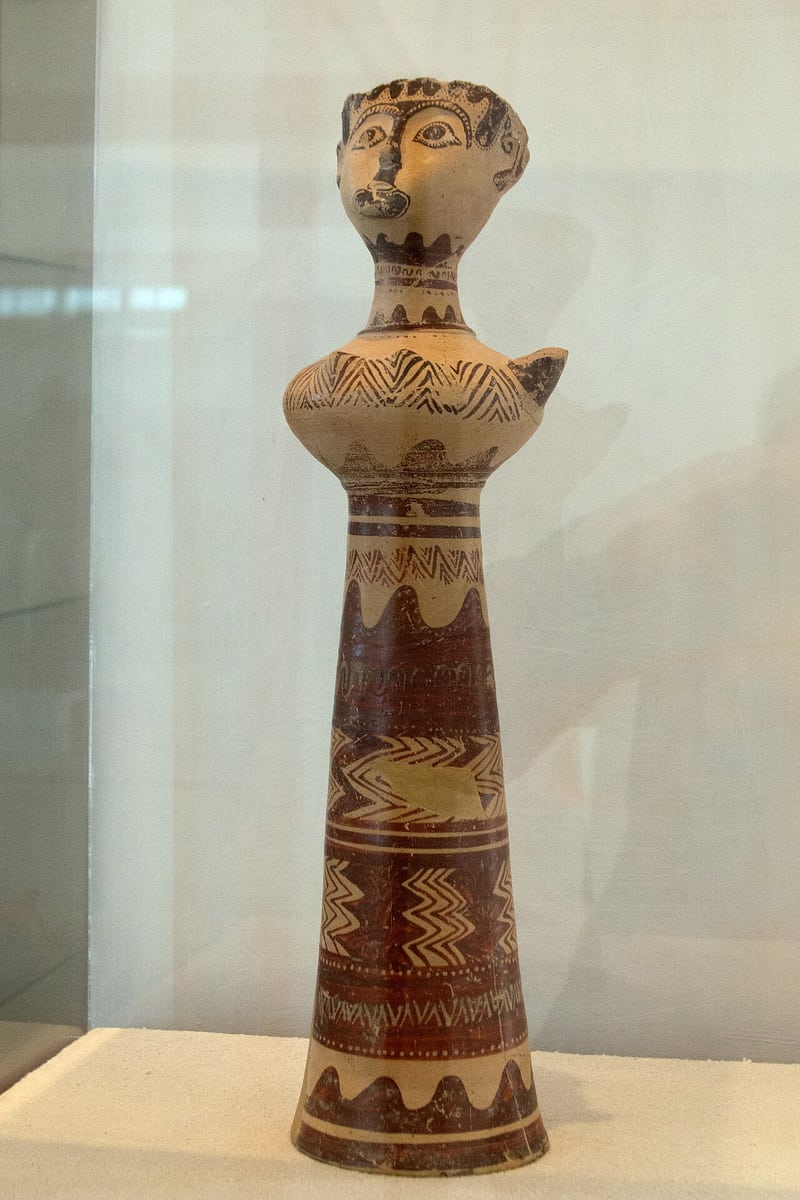
The Phylakopi collection of the Archaeological Museum of Milos covers one part of a wider story. The best pieces from the town stand in the Ashmolean Museum in Oxford, the British Museum in London and the National Archaeological Museum in Athens, and the island keeps the finds of the later seasons. Pottery gives the clearest line through them. The spread of duck vases suggests that the first city overlaps, at least in part, with Troy V in Anatolia, and its culture points to influence from Keros-Syros and Lefkandi I.
The third-city pottery in the Archaeological Museum of Milos marks a change of fashion. In its first phase, potters took over Minoan forms and motifs so closely that scholars ask whether Crete ruled the town. Whatever the answer, Minoan ideas became popular among the elite of the Aegean and served as a mark of rank. Pottery also served ritual. Five pierced pedestalled bowls stood at the foot of a column in the West Pillar Room, like Cretan bowls used for pouring libations.
The figurine known as the Lady of Phylakopi comes from the sanctuary of the town, and the Archaeological Museum of Milos shows it among its exhibits. The terracotta goddess belongs to a rare organised place of public worship in the Aegean, founded in the early 14th century BC. The West Shrine measured 5.8 by 6 metres, with an altar platform and sets of niches that point to ritual. Distinctive male figurines with emphasised anatomy are linked to male gods and foreshadow the Twelve Gods of later times.
Painted plaster adds scenes to the picture. A fragment shows a woman in blue cloth, and another shows a woman with outstretched hands. Scholars call this mix of human cult and natural scenes particularly Cycladic. The blue monkey is known in this period only at Knossos and Thera besides Phylakopi, and the Phylakopi monkey is less lifelike. The reconstructed flying fish friezes, 22 and 32 centimetres high, stand in Athens, and the Archaeological Museum of Milos presents the same town through its pottery and figurines.
- Palette: White plaster is the largest share, then red, pink, blue, blue-grey, black and yellow.
- Lilies: A band about 21 centimetres high shows white lilies with yellow-tipped stamens on a red ground.
- Pigment: Broken vessels in the West Pillar Room held scarlet earth.
- Technique: Painters used fresco and secco on the friezes.
- Fish detail: The painted fish has a rounded pectoral fin and no large pelvic fin.
Taken together, the pottery, the figurine and the wall paintings describe a town that grew into an important trading port between Crete and the mainland. Minoan influence led in its first phase, and Mycenaean influence followed. The Archaeological Museum of Milos keeps the later finds on the island where they were made, while the best pieces stand abroad. Phylakopi became a town with urban features, wide outside contacts and a significant place in the Aegean.
How does the Archaeological Museum of Milos present obsidian and the earliest finds?
The Archaeological Museum of Milos keeps a collection devoted to obsidian, the volcanic glass that Milos exported across the Aegean. Obsidian from Milos reached Franchthi Cave in the 11th millennium BC, and sea trade later linked Bronze Age ports of the Cyclades with Crete and the mainland.
The obsidian collection of the Archaeological Museum of Milos points to a landscape of workshops on the island. The two source hills of eastern Milos, Nychia and Demenegaki, are scattered with thousands of blade cores and blades. Knapping is the fracturing of stone to produce sharp blades or arrowheads, as with flint, and Stone Age workers used it on obsidian. Because of its quality, Melian obsidian became the preferred raw material for tools in the prehistoric Aegean.
The earliest dated use of the stone lies off the island. Melian obsidian turns up in Franchthi Cave in Argolis, in Upper Palaeolithic layers of the 11th millennium BC, and no earlier sign of the material leaving the Melian sources has been documented. The trip to the mainland meant a sea crossing, so the find also shows early seafaring by modern humans in Greece. Obsidian is therefore the oldest chapter of Aegean trade, and the Archaeological Museum of Milos gives it a collection of its own.
Human presence on Milos reaches back to the Neolithic, and the island became an important centre of the prehistoric Aegean in the Bronze Age. A systematic surface survey by the British School led to the archaeological map published in 1982. That map lists 111 sure ancient sites with traces of settlement or other activity, from Neolithic times to late antiquity. The Archaeological Museum of Milos opens that long past with its obsidian tools, and the later rooms follow the same island forward.
The trade did not end with the Stone Age. Vases made on the mainland and on Crete reached Phylakopi, Ayia Irini on Kea and Akrotiri on Santorini, and those three sites mark a route from mainland Greece to Crete along the western Cyclades. Bronze took over weapons, yet obsidian from Milos stayed the dominant material for tools, because it was cheaper. In the Archaeological Museum of Milos, the obsidian collection and the Phylakopi finds therefore belong to one trade story.
- Flakes: The two source hills hold millions of knapping flakes.
- Distance: The sea crossing to Franchthi Cave spans at least 150 kilometres.
- Sources: X-ray fluorescence traces Greek obsidian to Milos, Nisyros or Gyali.
- Dating: Obsidian hydration dating gives a relative age for a blade.
- Mirrors: Workers also polished obsidian into early mirrors.
The obsidian collection opens the story of the museum, and sea trade links it to the Bronze Age finds that follow. A visitor who reads the stone tools first will read the pottery of Phylakopi with the same routes in mind. The wider history of Milos follows these routes from the first quarries to the later cities, and the Archaeological Museum of Milos gives the starting point.

What Archaic, Classical and Roman finds does the archaeological museum of Milos hold?
The archaeological museum of Milos holds statues, funerary stelae, inscriptions, coins and grave goods from the Archaic, Classical and Roman periods. The finds come mainly from the ancient city and its cemeteries and span the 8th century BC to the 5th or 6th century AD.
The historical halls of the archaeological museum of Milos follow the prehistoric hall. One hall shows reliefs, funerary stelae and statues, and the next shows pottery of different kinds. Excavations, surface collection and hand-overs supplied the pieces on show, and the ancient city of Milos and its cemeteries are the main source. The collection therefore reads as a record of one city, with its public life, its daily wares and its burials set out in sequence.
Inscriptions hold a notable place among the finds of the archaeological museum of Milos. Texts cut into funerary stelae and statue bases give details on the political system of Milos, on prominent citizens and ordinary residents, on temples and cults, on buildings of the city, and on the sculptors who made its statues and the people who dedicated them. One room pairs Greek and Roman sculpture with inscriptions in the local version of the alphabet, so the written record and the carved figures stand side by side.
The island’s own coinage gives the coin finds in the archaeological museum of Milos their setting. From the 6th century BC until the siege of 416 BC, Melos struck coins on the Milesian weight standard, and it was the only island in the Aegean to use that standard. The base coin, the stater, weighed just over 14 grams. An apple appears on the coins as a pun on mêlon, the Greek word for apple. The name ΜΑΛΙΟΝ, meaning of the Melians, or an abbreviation of it, appears as well.
Grave goods show the ritual side of the ancient city. A temporary exhibition in the vestibule presented new finds from cemeteries and burials of Mycenaean, Archaic and Roman times. The offerings that accompanied the dead reflect the societies of their time and reveal aspects of their beliefs. They served as gifts for the afterlife and, at the same time, as evidence of life itself, so the cemetery finds of the archaeological museum of Milos record ritual and daily life together.
- Courtyard: Column fragments, funerary stelae and reliefs from the island’s sanctuaries stand in the internal courtyard.
- Toy horse: A small terracotta horse, a child’s toy from Milos, dates back 2,500 years.
- Script: The archaic Melian script shows Cretan and Theraic influences and ended after 416 BC.
- Later coins: Later coinage followed the Rhodian standard and no longer carried the name ΜΑΛΙΟΝ.
- Rescue digs: Building requests and mine expansion set off the excavations behind the cemetery finds.
Read together, the Archaic, Classical and Roman finds of the archaeological museum of Milos show a city that wrote in its own script, struck its own coins, recorded its citizens on stone and buried its dead with gifts. Each group of finds answers a different question about the ancient city, and the stelae, coins and grave goods gain meaning when the sites outside Plaka follow.
How is the archaeological museum of Milos combined with the Kastro, the catacombs and the ancient theatre?
The archaeological museum of Milos stands on the main square of Plaka, on the plateau above the harbour of Adamantas, and the Kastro rises on the hill above the village. The ancient theatre and the catacombs lie lower, near Tripiti, in the area of the ancient city.
Plaka lies on the plateau above the harbour, and from Adamantas there is an ascent to it. Motorbikes, mopeds and similar vehicles are the only usable vehicles in the narrow lanes of the village. Taxis wait at the port and at the airport, which lies 4 kilometres from the port, and 15 taxis serve the island. City buses cover parts of the island, but no bus links the airport. From either arrival point, the archaeological museum of Milos lies on the main square.
The Kastro is the nearest of the three sites to the archaeological museum of Milos. It stands on a rocky hill above the ancient city, and its position allowed control of the movement of ships in the gulf of Adamantas. The Kastro is a declared ancient monument. From the hill, the ground of the ancient city lies below, on the slope between Tripiti and the landing place at Klima, and the museum shows finds from that slope.
The Roman theatre belongs to the same ancient city as the finds in the archaeological museum of Milos. A cemetery of the Hellenistic period, from the late 4th to the 1st century BC, appears to have stood on its site, and traces of it survive in the rock of the stage and at the west end of the orchestra. The excavated part holds about 800 spectators, an estimated one tenth of the whole, and eight marble stairways divide it into seven sections.
The catacombs complete the picture of the cemeteries. They form the largest underground cemetery outside the walls of the ancient city, in use from the middle of the 1st century AD to the 7th century AD. Carved into soft volcanic tuff, they hold arched tombs called arcosolia, horizontal loculi and pit graves in the floor. Certain arcosolia keep niches for offerings and lamps, and in places for the burial of infants, which ties them to the grave goods of the archaeological museum of Milos.
- Entrance: The visit enters through Catacomb B, where the only intact two-storey arcosolium survives.
- Elders: Fragments of an inscription of the Elders, in red capital letters, survive in the same hall.
- Martyr’s tomb: The sarcophagus-shaped tomb of the martyr is thought to have served as a Holy Table.
- Arena: The theatre orchestra lies 1.60 metres below the first row, for gladiator and beast fights.
- Local name: Islanders once knew the catacombs as the Greek Cave.
A visit that starts at the archaeological museum of Milos in Plaka gains its context from the Kastro, the theatre and the catacombs. The museum holds the finds, the Kastro hill overlooks the ground of the ancient city, and the theatre and the catacombs mark its public life and its dead. Taken in that order, the four stops follow one ancient city from its objects to its monuments.
How did the Archaeological Museum of Milos gather its collection?
The Archaeological Museum of Milos gathered its collection from digs on the island, chiefly the British School excavations at Phylakopi, and from surface finds and handovers. The best-known sculptures of the ancient city left in the 19th century and stand in Paris, Athens and London.
The Bronze Age town of Phylakopi supplied the majority of the exhibits of the Archaeological Museum of Milos. The British School at Athens opened the first dig in 1896, and Duncan MacKenzie, who later served as foreman to Sir Arthur Evans at Knossos, recorded the layers until 1899. A second campaign followed in 1911. After a gap of 63 years the school returned in 1974, and that work lasted until 1977. The finds of the 19th-century seasons went to Athens.
MacKenzie found the Pillar Rooms at the end of the 1898 session and finished their first excavation in 1899. In the same year he uncovered a megaron and called it a Mycenaean palace. In the 1970s a trench tested the view of Sinclair Hood that the fresco fragments of the Pillar Rooms belong to the Late Bronze Age. The fragments lay in deposits formed after the eruption of Thera, and Colin Renfrew moved the complex from the Middle to the Late Bronze Age.
The Christian cemetery of the ancient city has a dig history of its own. Local diggers rediscovered the catacombs near Trypiti under Ottoman rule, and the find became public in 1840. The tombs were already plundered when the German archaeologist Ludwig Ross visited with Anton Prokesch von Osten, and the Frenchman Charles Bayet followed in 1878. Georgios Lampakis cleared the fill from the site in 1904, and Georgios Sotiriou studied them in 1927. More digs followed in the 1950s and 1960s.
Antiquities also left the island long before the Archaeological Museum of Milos opened. Foreign visitors crowded the busy harbour, which made the finds sought after and encouraged illegal digging. The majority of the finds from the area of the ancient city were chance finds or the product of illegal digs. They include important sculptures, vases and small objects, and a large number of those works now fill museums and collections abroad. The Poseidon of Melos came out of the ground at Klima in 1877 and stands in Athens today.
- Estimates: Ross put the catacombs at 1,500 to 2,000 tombs, while Bayet estimated 300.
- Tomb slabs: A large number of the cover slabs that Ross saw were missing by 1927.
- Arcosolia: A study of 1972 recorded 126 surviving arched tomb niches, called arcosolia.
- Asclepius: A marble head from the island’s shrine of the god reached the British Museum with the Blacas collection.
- Looting: Looters were reported at Phylakopi shortly before the first digs.
The Archaeological Museum of Milos is therefore a collection built from digs of different centuries, surface finds and handovers, with gaps where the best-known sculptures once stood. Each dig added a layer of evidence, from MacKenzie’s records of the first seasons to the work of the Ephorate in the cemeteries. Each departure of a statue explains why the halls of Plaka show a copy of the Venus de Milo and why Paris, Athens and London hold the best-known originals.

Which questions come up about the Archaeological Museum of Milos and its excavations?
The Archaeological Museum of Milos draws on digs run by the Ephorate of Antiquities of the Cyclades and by earlier foreign teams. The answers below cover the digging service, the theatre, the Poseidon, the Phylakopi remains, the Venus findspot and the archaeologists after MacKenzie.
Which service runs the digs behind the Archaeological Museum of Milos?
The Ephorate of Antiquities of the Cyclades runs them for the Ministry of Culture and Sports. It carried out the rescue digs on the island and made a limited dig west of the wall of Phylakopi. It also laid out the present visitor area of the Phylakopi site, a project that ran from 2003 to 2008.
Who bought the ancient theatre of the city shown by the Archaeological Museum of Milos?
Ludwig of Bavaria did. The architect Carl Haller von Hallerstein reached Milos in August 1816 on the order of the crown prince Ludwig and made two digs with important finds. After thefts and damage, Ludwig acquired the site. In 1836 he visited the island with his son Otto, King of Greece, and gave him the monument.
Did one sculptor link the Venus copy of the Archaeological Museum of Milos to the Poseidon?
Christofilis Maggidis suggests so: one sculptor carved both the Venus de Milo and the Poseidon of Melos. Isméni Trianti assigns three further sculptures found on the island to the same artist, two statues of women and a colossal statue of a god. The Poseidon stands in the National Archaeological Museum in Athens.
What does Phylakopi add to the Archaeological Museum of Milos?
The site shows a wall of large volcanic blocks, the sanctuary area and the megaron. Erosion has carried part of the headland and its ancient remains into the sea, and silt has filled the bay that lay east of the town. The site gives the Phylakopi finds of the Archaeological Museum of Milos their setting on the north coast.
Where did the Venus copied by the Archaeological Museum of Milos stand in antiquity?
The place is debated. The statue lay in a niche, and a dedication by an assistant gymnasiarch came to light with it, which suggests that the Venus stood in the gymnasium of Melos. Salomon Reinach proposed instead that the findspot was a lime kiln. Christofilis Maggidis dismisses that theory as having no factual basis.
Who continued the Phylakopi digs of the Archaeological Museum of Milos after MacKenzie?
R. M. Dawkins and J. P. Droop re-dug the town in 1911 to refine the pottery sequence, and later reports criticise their work in the megaron area for lacking an adequate record. Colin Renfrew led the work of the 1970s, with Sinclair Hood among the excavators, and the digs appeared in two monographs.