Category Rooms: 3 keys
Location: Pollonia
Number of rooms: 11
Apollon Rooms offer a comfortable and pleasant holiday to everyone who chooses us for their stay on the island of Milos, with the most fascinating view of the eternal blue of the Aegean Sea and the best sunrise.
Apollon Rooms are built in the traditional architectural style, in white and light blue. You can enjoy a swim at our private beach, a drink in the bar or dinner in our restaurant with a view of the sea.
We have double rooms equipped with all the modern comforts to meet all your needs. Each room has been decorated with particular taste and keeps its unique “character”.
We look forward to welcoming you for a wonderful summer!
Pollonia is a seaside village at the north-east end of Milos, and the village holds the second harbour of the island. Apollon Rooms Milos stands close to the water, and the Milos travel notes gathered here open with this small coast. The house faces the open Aegean, and the sun comes up over the sea in front of it.
Rooms in this corner of the island look over a calm bay, a sandy beach and a fishing harbour. The village keeps a slow winter and a full summer, and a small boat leaves for the neighbouring island of Kimolos during the day. Apollon Rooms Milos sits inside that pattern, and the pages below set out what is known about the house.
Where does Apollon Rooms Milos stand in Pollonia and what do the rooms look out on?
Apollon Rooms Milos stands in Pollonia, the seaside village at the north-east end of Milos, on the coast above the water. The village holds the second harbour of the island after Adamantas, and the rooms look out on the open Aegean and the sunrise over the sea.
The village stands at an altitude of ten metres, on a small bay that opens towards the north-east. Apollon Rooms Milos keeps a place near that water, so the walk from the door to the sand takes a short time. Adamantas, the main port, lies almost ten kilometres away, and Plaka, the seat of the island, almost fourteen. Local buses stop close to the village beach, and small private boats find a berth in the same bay.
The rooms look out on the open sea, on the blue of the Aegean that fills the frame from the windows. The building stands beside its own private beach, and a swim sits near the door. Apollon Rooms Milos takes its position on this coast, and the view stays open from morning to night. The water in front of the house is calm at the start of the day, and the light on it changes through the hours. The sand and the sea share the same frame.
The harbour of the village is the second of the island, after the main port. Fishing boats of local families come to the pier each morning with fish, octopus and lobsters, and the catch reaches the tables of the village the same day. A small boat links the bay with the island of Kimolos, and the crossing takes twenty-five minutes. The village is also the second harbour of Milos, and small private boats take a berth in the same bay beside the fishing craft.
The village is built around a small cove, and the main beach is sandy and shaded by tamarisk trees. A second, organised beach lies in the village, along with a third spot known as the back sea. To the east, the Pelekouda peninsula carries the chapel of Agios Nikolaos, and boats leave from the same coast for the islets. Apollon Rooms Milos sits inside this pattern of sand and water, with the village on one side and the open sea on the other.
- Village: Pollonia is a seaside settlement at the north-east end of Milos and the second harbour of the island.
- Height: The village stands at an altitude of ten metres.
- Main port: Adamantas lies almost ten kilometres from Pollonia, and the seat of the island, Plaka, almost fourteen.
- Transport: Local buses stop near the village beach, and small private boats take a berth in the bay.
- Neighbouring island: A small boat links the village with Kimolos, and the crossing takes twenty-five minutes.
The position of the house shapes the whole stay. Apollon Rooms Milos keeps the sea in front and the village behind, so mornings start with the light on the water and evenings end with the sound of the harbour. Adamantas and Plaka stay within a short drive, and the sand lies at the door. The second harbour of Milos is a quiet base, and the coast around it fills the days.

What rooms and what building make up Apollon Rooms Milos?
Apollon Rooms Milos holds eleven rooms in a building in the traditional island style, painted white and light blue. The rooms are double rooms, and the house holds a three-key category. Each room keeps its own character and offers the comforts of a modern stay.
Apollon Rooms Milos holds eleven rooms in one building, and the category of the rooms is three keys. Each room is a double room, equipped with the comforts that a holiday on the island needs. Air conditioning, a television, internet access and parking belong to the offer, and the house stands by the sea. A bar, a restaurant and a private beach stand on the same ground, so the day begins and ends within a short walk of the room.
The building follows the traditional architecture of the island and is painted white and light blue, the two tones that mark the houses of the Cyclades. Apollon Rooms Milos keeps that look on the outside and repeats it inside, and every room carries its own decoration. The white walls and the blue trim stand beside the water, and the sea remains the strongest element of the scene. The two colours carry the light of the coast, and the building stays low against the ground.
Each room keeps its own character, and the decoration follows the taste of the house. The doors open to the sea air, and the sound of the water reaches the rooms at night. The building stays small, with eleven rooms in one block, and the windows face the water. A swim, a drink at the bar and a meal with the sea as a backdrop belong to the same stay. The list of apartments in Milos sets out the rest of the choice on the island.
The beach of the house is private, and a swim sits close to the room. The bar serves drinks by the water, and the restaurant sets its tables with the sea in front. A pool is part of the comforts of the building. Apollon Rooms Milos adds these places to the stay, and each of them stays within the grounds. Dinner on the terrace comes with the same view that the rooms hold, and the ground floor opens to the sand.
- Rooms: The house holds eleven rooms, all of them double rooms.
- Category: The rooms carry a three-key category.
- Style: The building follows the traditional architecture of the island in white and light blue.
- Comforts: Air conditioning, a television, internet access and parking belong to the offer.
- On the water: A private beach, a bar and a restaurant with a view of the sea stand on the grounds.
The building gathers the simple parts of an island stay in one place. Apollon Rooms Milos offers a room, a beach, a bar and a restaurant, and the sea frames all four. The village around it adds the harbour and the sand, and the main port and the island seat stay a short drive away. Eleven rooms keep the house small and the walk to the water short.
What makes the sunrise at Apollon Rooms Milos different, and how does a day in Pollonia run?
Apollon Rooms Milos faces east across the Aegean, and the sun comes up over the water in front of the house. The village sits at the north-east end of the island, so the light reaches this coast early in the morning.
The first light arrives from the sea, and the sky in front of the house turns pale before the water takes colour. Sunrise at Apollon Rooms Milos is a question of direction rather than of a fixed hour, because the coast of Pollonia looks to the north-east and the sun climbs out of the water. The beach and the terrace catch the light before the village wakes. The horizon fills with colour before the boats move, and the sea keeps the tone of the sky.
The name on the door carries the god of light. From the fifth century BC, Apollo was identified with Helios, the personification of the sun, and the two figures stood close in the thought of the ancient world. Apollon Rooms Milos keeps that old link in plain view, and the sun over the Aegean gives the house its oldest connection. The temple east of the village stood under the same sky, and the god of light still opens the day.
Mornings in Pollonia belong to the water. Fishing boats of local families come to the pier with fish, octopus and lobsters, and the catch reaches the tables of the village the same day. The summer days on Milos are warm to hot and dry, and the bay stays calm in the early hours, so a swim before breakfast is easy. Tamarisk trees along the sand give shade at noon, and the water stays clear in the bay.
Afternoons slow down, and the small boat to Kimolos takes twenty-five minutes across the strait. Apollon Rooms Milos keeps the beach, the bar and the restaurant within the grounds, so the hours pass between the room and the water. In the evening the harbour quietens, the boats return, and dinner comes with the sea in front of the table. The bay keeps a soft light after the sun goes down, and the village keeps the sound of the water.
- Light: The coast of Pollonia faces north-east, so the sun rises from the water.
- Morning: Fishing boats come to the pier with fish, octopus and lobsters.
- Summer: The days are warm to hot and dry, and the winters are mild and rainy.
- Afternoon: The small boat to Kimolos takes twenty-five minutes for the crossing.
- Evening: The harbour quietens and the village serves dinner by the water.
A day on this coast follows the light. Apollon Rooms Milos opens to the east, and the sun sets the order of the hours: a swim at dawn, the shade at noon, the boat in the afternoon, dinner at dusk. The village keeps the same slow pace through the season, and the water stays in sight from the first coffee to the last glass. The season brings the boats and the visitors.
Where can a swim be had east and south of Apollon Rooms Milos?
Apollon Rooms Milos stands beside a private beach, and the coast around Pollonia adds more places for a swim. Twelve beaches lie along the eastern side of the island, and the south holds Paleochori, Agia Kyriaki and Provatas.
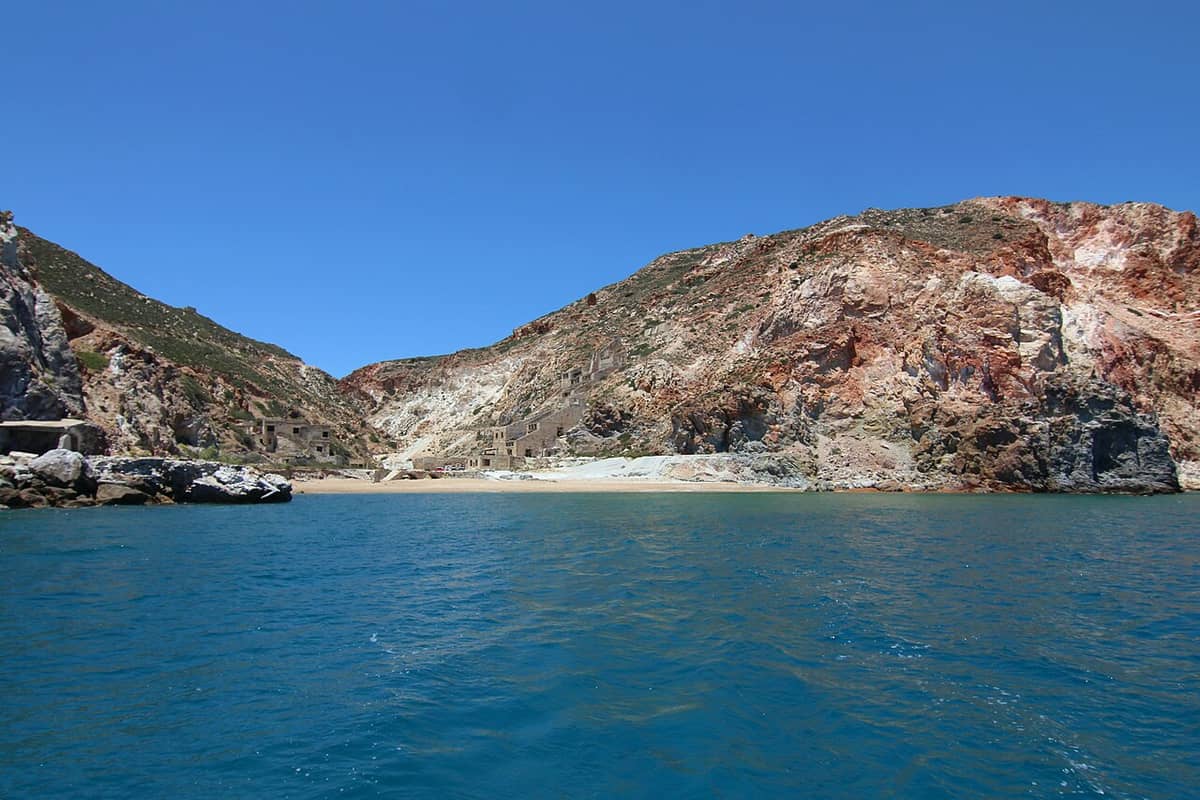
The beach of the house is private, and the sand of the village lies close by. The main beach of Pollonia is sandy and shaded by tamarisks, and two more spots sit inside the village: an organised beach and the one known as the back sea. Apollon Rooms Milos adds its own stretch of water to this small list, so a swim needs no drive. The three spots sit within a short walk, and the water stays clear over the sand.
East of the village, the coast holds twelve beaches. Kastanas, Tria Pigadia, Voudia, Kolympisionas, Agkali and Kampanes are part of that line, and the small cove of Paliorema carries yellowish pebbles and clear water. The ruins of the old sulfur workings stand on its shore, and the mines stopped work in 1956. The cove counts among the geological sights of Milos, and old tools and rails stay on the shore. Apollon Rooms Milos sits a short drive from this line of coves.
South of Pollonia, the colours change. Paleochori lies almost thirteen kilometres south-east of Plaka, its sand stretches for nearly two kilometres, and red and yellow rock surrounds it. Agia Kyriaki has coarse sand and white pebbles, and the remains of an ancient harbour with storerooms stand there. Provatas is a group of three small coves divided by rock, with gold-red sand that takes its colour from iron oxides. The rock around these bays comes from the volcanic ground of the island.
Apollon Rooms Milos sits between these two directions, and the drives are short. The island counts ninety beaches in all, seventeen in the north and twelve in the east, and the volcanic ground gives them white, red, yellow and black rock. The distances stay short, and a car or a bus covers the land routes. The colours of the sand change from one bay to the next. A fuller account of the swimming spots is set out under beaches of Milos.
- Private beach: A stretch of sand and water belongs to the house itself.
- East coast: Twelve beaches line the eastern side of the island.
- Paliorema: Yellowish pebbles, clear water and the ruins of sulfur workings closed in 1956.
- Paleochori: Nearly two kilometres of sand with red and yellow rock around it.
- Provatas: Three small coves and sand coloured gold-red by iron oxides.
The swimming choices around Apollon Rooms Milos run from the private beach at the door to the coves of the east and the bays of the south. The water stays clear across the island, and the rock changes colour with each shore. Part of the coast is reached from the road, and part of it only from the water. The eastern and southern shores keep their own colours.

Why does Apollon Rooms Milos carry the name of the god Apollo?
Apollon Rooms Milos takes its name from Apollo, the god who gave the village of Pollonia its own name. The village was named after a temple of Apollo that stood east of the settlement, on the Pelekouda peninsula.
Apollo is one of the Olympian deities of ancient Greek religion, and his functions include light, healing, prophecy, music, poetry and archery. He is the son of Zeus and Leto, and the twin brother of Artemis, goddess of the hunt. The god stood as the model of the young man, and the lyre is a common mark of his image. His image carries a silver or golden bow and a quiver of arrows, and the god was seen as the helper who wards off evil.
As the patron deity of Delphi, Apollo was the oracular god, and his oracles were consulted before laws were set in a city. He was also the patron of herdsmen and shepherds, and the protection of flocks and crops counted among his duties. In the fifth century BC his worship reached Rome. Medicine and healing are linked with the god as well, and the protection of the young counted among his tasks. Apollon Rooms Milos carries a name that points to that old world.
The island keeps its own link with the god. An archaic statue of Apollo found on Milos is kept in Athens, beside the better known works of the same ground. Milos lies at the south-western edge of the Cyclades, and its obsidian was traded across the Aegean fifteen thousand years ago, long before the temple of the village stood. The island lies 120 kilometres due east from the coast of Laconia, and its large bay counts among the natural harbours of Greece.
The village took its name from the temple of Apollo that stood to the east of the settlement, on the Pelekouda peninsula, and the place is known as Apollonia as well. The god of light stands behind the name on the door, and the sunrise over the water keeps the connection alive. Apollon Rooms Milos carries that name in the village today, under the same sky. More of that past is set out under history of Milos.
- God: Apollo is one of the Olympian deities and the son of Zeus and Leto.
- Twin: Artemis, goddess of the hunt, is his twin sister.
- Delphi: Apollo was the patron deity of Delphi and the oracular god.
- Light: From the fifth century BC he was identified with Helios, the sun.
- Milos: An archaic statue of Apollo found on the island is kept in Athens.
The name on the door reaches back to the temple that once stood east of the village. Apollon Rooms Milos carries that old word, and the coast in front of it answers with the light of the sun. History and holiday meet in the same small bay, and the god of light still opens the morning over the water. The bay holds that light every morning.
What do readers ask about Apollon Rooms Milos?
Apollon Rooms Milos is a house of eleven double rooms in Pollonia, on the north-east coast of Milos. The rooms look out on the Aegean, the village holds the second harbour of the island, and a private beach lies at the door.
Where in Pollonia does Apollon Rooms Milos stand?
Apollon Rooms Milos stands in Pollonia, the seaside village at the north-east end of Milos. The village lies at an altitude of ten metres and holds the second harbour of the island, after Adamantas. The main port lies almost ten kilometres away, and Plaka, the seat of the island, almost fourteen. Local buses stop near the village beach.
What is the room count at Apollon Rooms Milos?
Apollon Rooms Milos holds eleven rooms, and the category of the rooms is three keys. Each room is a double room, equipped with the comforts of a modern stay. Air conditioning, a television, internet access and parking belong to the offer, and a bar, a restaurant and a private beach stand on the same ground.
What do the rooms of Apollon Rooms Milos look out on?
Apollon Rooms Milos looks out on the blue of the Aegean Sea and on the sunrise over the water. The building stands near the beach, and the open sea fills the view from the rooms. The village sits around a small cove, so the harbour and the sand stay inside the same frame.
Which style marks the building of Apollon Rooms Milos?
The building follows the traditional architecture of the island and is painted in white and light blue. Apollon Rooms Milos keeps that look through eleven rooms, and each room carries its own decoration and its own character. The white walls and the blue trim belong to the Cycladic manner of building. The house stays low against the ground.
Which swims lie near Apollon Rooms Milos?
A private beach belongs to the house, and the sandy beach of the village lies close by. East of Pollonia the coast holds twelve beaches, among them Paliorema, with yellowish pebbles and the ruins of old sulfur workings. South of the village, Paleochori, Agia Kyriaki and Provatas offer sand, pebbles and coloured rock.
How does a traveller reach Apollon Rooms Milos from Adamantas?
The drive from Adamantas to Pollonia covers almost ten kilometres, and local buses stop near the village beach. Small private boats take a berth in the bay, and a small boat links the village with the neighbouring island of Kimolos. The crossing to Kimolos takes twenty-five minutes. The airport stands close to the main port of the island.
When does the sun rise over Apollon Rooms Milos?
The coast of Pollonia faces the north-east, so the sun comes up over the water in front of the house. Apollon Rooms Milos catches that first light on the beach and the terrace, before the village wakes. The position of the coast, rather than a fixed hour, gives the sunrise its place.
Why does the name of Apollon Rooms Milos point to Apollo?
Pollonia takes its name from the temple of Apollo that stood east of the settlement, on the Pelekouda peninsula. Apollon Rooms Milos carries that name, and Apollo is the god of light, healing, prophecy and music. From the fifth century BC the god was identified with Helios, the sun. The village is known as Apollonia as well.