Coffee and drinks in Tripiti, Milos: see our Coffee – Drinks in Milos section for the island.
Coffee and drinks in Tripiti belong to a village on a ridge of Milos, between the chief town of Plaka and the seaside village of Klima. The view over the bay, the restored windmills and the ruins below give every pause its setting. The island as a whole is set out in the main pages on the island of Milos.
The sections below run from the ridge down to the shore: the windmills, the catacombs, the ancient theatre, the find spot of the Venus de Milo, the churches, the walk to Klima and the sunset. Each stop gives coffee and drinks in Tripiti a reason to pause, and the ruins lie within walking distance of the village.
What are coffee and drinks in Tripiti at a glance?
Coffee and drinks in Tripiti belong to a traditional village on a ridge between Plaka and Klima, 150 metres above the sea. The village offers a panoramic view of the bay, food in its meze shops and restaurants, and walks to the catacombs and the ancient theatre.
Tripiti is almost united with Plaka, the chief town of Milos, which occupies the plateau above the harbour of Adamas. The houses of Tripiti are built in tiers, like the seats of an amphitheatre, over the ruins of the classical city. Below the village the slope falls toward the sea, and the ancient town of Melos once occupied the ground between Tripiti and the landing place at Klima. Coffee and drinks in Tripiti therefore belong to a village built over an ancient town.
Three levels mark the descent. Plaka stands at 220 metres above the sea, Tripiti at 150 metres, and Klima lies at the water, where boats once came ashore. Tripiti sits on the middle step and looks toward the sea entrance of the bay of Milos from the northern part of the island. Klima also belongs to the community of Tripiti, which takes in Zefyria, Paliochori, Agia Kyriaki, Kanava and Schinopi and forms part of the municipality of Milos.
The village offers two things at once: a panoramic view of the bay and food in its meze shops and restaurants. The Greek word for a meze shop, mezedopolio, is another name for an ouzeri, a tavern that serves ouzo with small dishes. Unlike a traditional kafenio, an ouzeri prepares its meals on the premises. Coffee and drinks in Tripiti belong to the same setting, where the view and the table meet on the same ridge.
The village is known for its position next to the catacombs and the Roman theatre, and both lie within walking distance. The ancient town lies on the slope below the village, so the walk to the ruins begins with a descent and ends with a climb. A pause for coffee and drinks in Tripiti therefore fits at either end: before the descent or after the return to the ridge. The village appears as Tripiti and as Trypiti, and its Greek name is Τρυπητή.
- Position: The village stands between Plaka above and Klima at the shore.
- Height: The village stands 150 metres above the sea.
- View: A panoramic view opens over Adamas Bay.
- Table: Meze shops and restaurants serve food in the village.
- Pause: Coffee and drinks in Tripiti fit before or after the walk to the ruins.
At a glance, the village gives coffee and drinks in Tripiti three fixed points: a position between Plaka and Klima, a height of 150 metres and a view over the bay. The ruins and the meze shops complete the picture. Cups and glasses across the island are set out in the coffee and drinks of Milos, and the sections below stay with Tripiti.
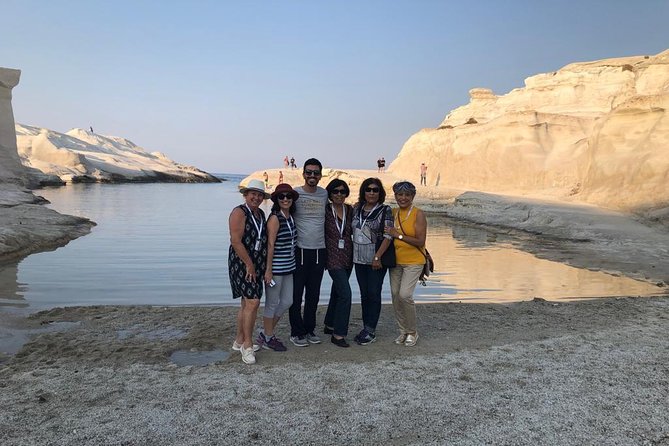
How do the windmills and the gulf view add to coffee and drinks in Tripiti?
Coffee and drinks in Tripiti come with two sights: restored windmills that once ground grain and now serve as lodgings, and a panoramic view of Adamas Bay. The mills stand in the village, and the bay opens at the sea entrance of the gulf of Milos.
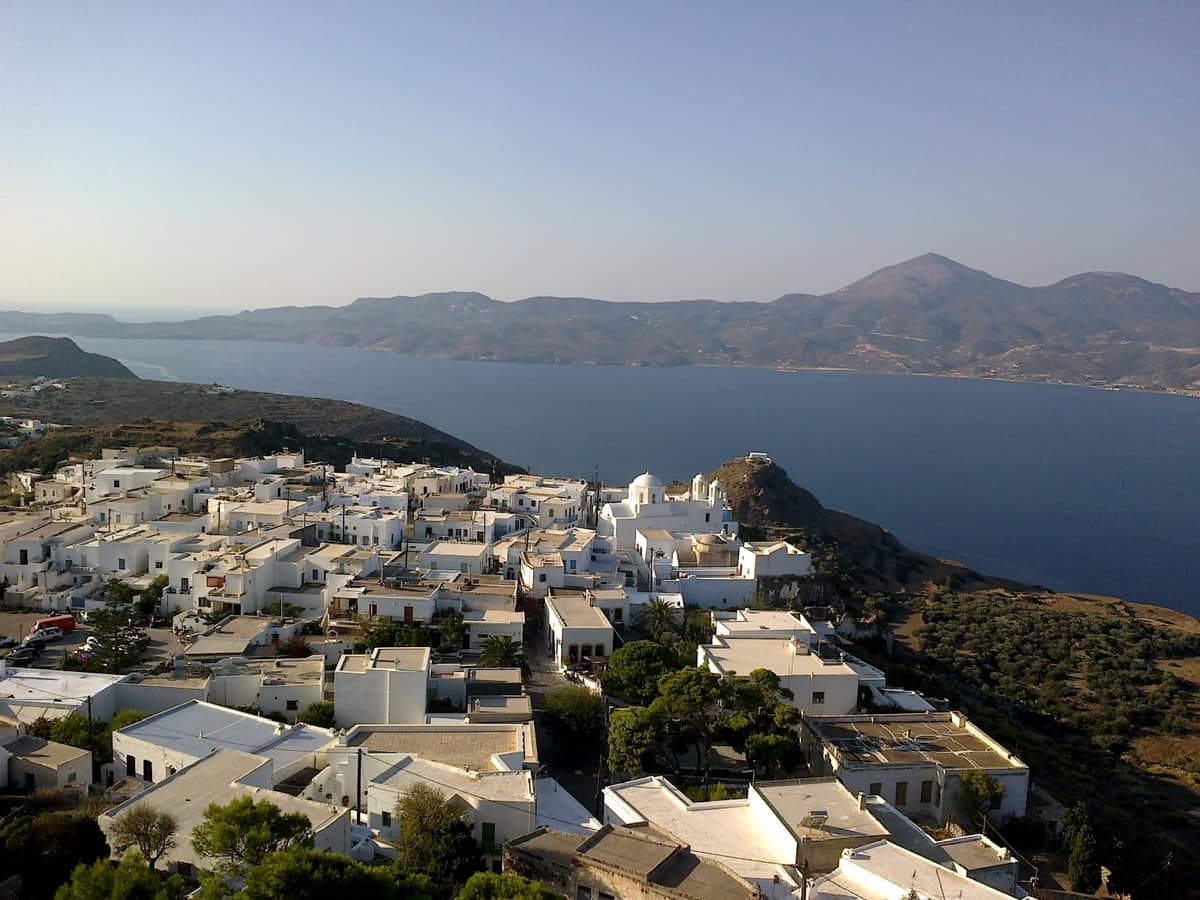
The windmills of Tripiti, called anemomyloi in Greek, have been restored and count among the sights of the village. They once ground grain. Today the greater part of them serve as lodgings, so buildings that once handled flour now receive guests. A mill that grinds grain is a gristmill, a word that names both the grinding mechanism and the building that holds it. Coffee and drinks in Tripiti share a well-preserved village with these restored mills.
A windmill is a machine driven by the force of wind on vanes or sails, built to mill grain. Gears and a shaft carry the turning of the sails to a pair of millstones. The lower stone, the bedstone, stays fixed. The upper stone, the runner stone, rotates above it and grinds the grain trapped between the two. The shape of the stones channels the ground flour to the outer edges, where it is collected.
Builders shaped mills to the wind of their region. Around parts of the Mediterranean, tower mills were built with fixed caps, because the direction of the wind varied little. Common sails consist of a lattice framework covered with sailcloth, and the miller adjusts the amount of cloth to the wind and the power needed. The majority of windmills have four sails. On Milos itself, barley is among the main crops, and millstones were among the materials mined on the island in the past.
A panoramic view of Adamas Bay opens from the village. The bay is the natural harbour of Milos, and it cuts into the island from the north-west. Its depth ranges between 130 and 55 metres, and twenty-five beaches are counted inside the gulf. The ancient city of the Melians stood on the eastern shore of the same bay, just south-west of Tripiti. From the village, coffee and drinks in Tripiti come with that whole view.
- Mills: The restored windmills of the village once ground grain.
- Use today: The greater part of the mills now serve as lodgings.
- Stones: A fixed bedstone and a rotating runner stone grind the grain.
- Bay: A panoramic view opens over Adamas Bay.
- Setting: Coffee and drinks in Tripiti share the village with the mills and the bay view.
The mills and the bay give the village two fixed references, one made by hand and one made by the volcano. Between them, coffee and drinks in Tripiti stay simple: a seat, a cup or a glass, and a long view of the water. The sections that follow leave the ridge and turn to the ground below it, where the ancient city and its cemetery lie.
How do coffee and drinks in Tripiti fit around a visit to the Catacombs of Milos?
Coffee and drinks in Tripiti fit both ends of a visit to the Catacombs of Milos, because the cemetery lies close to the village and is reached on foot, while the whole monument stays underground, out of sight from the lanes above.
The village and the cemetery belong to one outing, and the order of the two stops is open. The catacombs lie on the hillside southwest of Tripiti, and the way to them is walked on foot. Coffee and drinks in Tripiti suit the start, because the village looks over the bay of Adamas while the monument below it stays hidden. In 2009 the Holy Synod declared Milos a sacred island, since the catacombs are the oldest monument of Christianity.
The galleries did not always look as they do now. Electric bulbs lit them when they opened to the public in the 1960s, and the bulbs were taken out years later, after the cables had worn away. The present form of the catacombs comes from works of the twentieth century, and a wooden platform now carries visitors through gallery B. Back in the village, coffee and drinks in Tripiti are taken on the same soft volcanic rock that holds the galleries.
The bases of the arches carried plant motifs, and Christian symbols are very limited in number. Texts were written in red letters on panels of 50 to 60 centimetres by 10 centimetres. One opens with the words “In the Lord” and calls the tomb a thekion, the term used there in place of arcosolium. Another, in gallery A, refers to an adjuration of mothers in the name of Christ. Reading about these panels over coffee and drinks in Tripiti helps a visitor find them.
Finds from the dig of 2007 to 2009 include a lamp that carries Jewish symbols. One view traces Christianity on Milos to Jews who left Palestine and, it is thought, worked as slaves in the mines of the island. The first entrance is thought to have stood at the southern meeting point of the halls, where a semicircular wall and an unfluted column survive. These open points suit conversation over coffee and drinks in Tripiti after the visit.
- Approach: The cemetery lies southwest of the village, so coffee and drinks in Tripiti sit within a walk of it.
- Lighting: Electric bulbs of the 1960s were removed once the cables had worn.
- Platform: A wooden platform carries visitors through gallery B.
- Floor graves: Unworked slabs, thought to come from older buildings, cover them.
- Bishop: The free-standing tomb in gallery B is thought to hold one of the first bishops.
The catacombs make a quiet stop, and the village above sets its frame. Coffee and drinks in Tripiti come before the descent or after it, and the order changes nothing in the monument. The visit shows how the early Christians of Milos buried their dead, wrote on the tombs and prayed under the soft rock. The full account of the catacombs of Milos gives the plan, the dates and the excavations.
How do the ancient town of Milos and its theatre frame coffee and drinks in Tripiti?
Coffee and drinks in Tripiti stand above the ancient town of Milos, founded by Dorian settlers on the east side of the narrow entrance to the great gulf, and its Roman theatre lies on the slope between the village and Klima.
Dorian settlers from Laconia founded the ancient town on a height that commands the narrow entrance to the gulf. People lived there without a break from the ninth or eighth century BC to the sixth or seventh century AD. The Athenians destroyed the town in 416 BC and settled colonists of their own, until survivors of the old population came home at the start of the fourth century BC. Coffee and drinks in Tripiti are served above this record of more than a thousand years.
The ruins of the town, its harbour and its burial grounds cover a wide area, from the hills of Pyrgiante and Profitis Ilias to the valleys of Tramythia and Klima. The market place is placed on the plateau between the hills, and walls once enclosed both heights. In places they still stand high. An alley continues on foot from the end of the road between Tripiti and the catacombs, and the walls are the first remains it meets. Coffee and drinks in Tripiti suit the start of that walk.
The theatre was built in the Roman period, south of the flat ground taken for the market place. Its seating rests largely on the natural slope of volcanic tuff, and strong retaining walls of squared stone with a rubble core hold the fills at the ends. The orchestra lies 1.60 metres below the first row of seats, so it worked as an arena for gladiator and wild-beast fights. A pause for coffee and drinks in Tripiti comes at the upper side of this slope.
After the theatre closed in the fourth century AD, the site held houses and workshops until the end of the sixth or start of the seventh century. Tombs were cut in the arena walls, and two lime kilns seem to have run in the orchestra and the stage front for centuries. In 1930 it opened to the public for wrestling shows. Works between 2010 and 2015 restored it, and it reopened on 9 July 2016, so coffee and drinks in Tripiti now sit near a working stage.
- Burial ground: The necropolis lay outside the walls to the east, and the catacombs belong to it.
- Stage building: It is thought to have risen two storeys, and the vaulted rooms of its lower level survive.
- Stage front: Two marble stairs led up to the wooden stage floor.
- Seat inscriptions: Inscriptions on the seats name places for young men, hymn singers and councillors.
- Earlier use: A cemetery of the Hellenistic period lay on the spot.
The ancient town and its theatre explain the ground below the village. The town lived for over a thousand years, its stones fed later buildings, and its theatre has become a stage again. The part of the theatre that has been dug is about a tenth of the whole, so the slope between Tripiti and Klima still holds more than it shows. Coffee and drinks in Tripiti sit at the top of that slope.
How do coffee and drinks in Tripiti connect with the spot where the Venus de Milo was found?
Coffee and drinks in Tripiti pair with a walk to the ground where a farmer found the Venus de Milo in 1820. A sign marks the spot on the ancient city slope, at the end of the village road toward the Catacombs.
The road from Tripiti to the Catacombs runs downhill to a point where visitors leave the car and continue on foot. First come the walls of the ancient city. Further along lies the ground where the gymnasium of that city is thought to have stood, and a sign there names the place where the statue was found. Coffee and drinks in Tripiti make a natural pause before this walk, because the village stands at the top of the slope where the ancient city lay.
Coffee and drinks in Tripiti share their slope with a find made on 8 April 1820. A Greek farmer was lifting stones from ancient ruins on his terrace when he struck cut marble, and a French sailor with an interest in archaeology, who saw the discovery, urged him to keep digging. Together they uncovered two large pieces of the figure and a smaller third piece. The sailor sketched the find on the spot, and the sketch already shows the goddess without arms.
Other pieces lay beside the statue: a fragment of an arm, a hand holding an apple and two herms. Two inscriptions were recorded with the find. One commemorates a dedication by an assistant gymnasiarch, and the other keeps part of a sculptor’s signature; both are lost today. A French naval officer who reached the island soon afterwards wrote that the statue stood in a four-sided niche, and the niche and the dedication point to the gymnasium of ancient Melos as its home.
A sale followed. The naval officer reported the find in Constantinople, and the assistant to the French ambassador went to Milos to buy the statue. By then the farmer had received another offer and the figure sat loaded on a ship, but the French stepped in and bought it. The statue went to France, where the king had it installed in the Louvre in 1821. On the advice of a scholar, the museum kept the figure in the state in which it was found.
- Date: The farmer made the find on 8 April 1820.
- Sign: A sign beyond the walls of the ancient city names the place.
- Statue: The figure is Parian marble, 2.02 metres tall, dated to about 150 to 50 BC.
- Pause: Coffee and drinks in Tripiti suit the start or the end of the walk.
- Museum: The Louvre has shown the statue since 1821.
The statue itself stands in Paris, so the island keeps the ground, the walls of the old city and the sign that names the place. A walker who plans coffee and drinks in Tripiti around this descent has a clear order: village first, ancient walls next, sign last, then the climb back. The farmer’s terrace, the niche and the gymnasium all belong to one slope, and coffee and drinks in Tripiti sit at the top of it.

Which churches frame coffee and drinks in Tripiti?
Coffee and drinks in Tripiti sit within a parish of four churches: Agios Nikolaos at the village centre, Panagia Faneromeni by the road to the Catacombs, Panagia Tourliani on the hill above Klima and Prophet Ilias on top of the Klima hill.
At the centre of the village of Tripiti stands the church of Agios Nikolaos, which replaced a smaller church on the same site. The plot gave little room, so the building is an architectural oddity: its length is less than its width. The marble screen before the altar came from a sculptor of Tinos, and the church also holds wood carvings and a pulpit by a maker from Milos. Coffee and drinks in Tripiti sit in a village whose centre this church dominates.
The icons connect the village to the older capital. Icons by artists of the Cretan School hang in the church, and they were carried there from the Old Town, the medieval capital of the island. The parish takes its name from the same saint, and Panagia Faneromeni, Panagia Tourliani and Prophet Ilias are counted within it. Coffee and drinks in Tripiti therefore belong to a community with one parish centre and three smaller churches on its slopes and hills.
Panagia Faneromeni stands on the right-hand side of the road that leads down from Tripiti to the Catacombs, on a green site full of cypress trees. At the end of the road, beyond the parking area, the walk continues among age-old olive trees. The same road leads on to the walls of the ancient city and to the sign at the find spot of the Venus de Milo. The way down from coffee and drinks in Tripiti to the ancient city passes the chapel.
Two more churches stand on the hills above the shore. Panagia Tourliani occupies Klimatovouni, the hill above Klima, and holds very old icons; it offers a view over the upper villages and the entrance of the bay of Adamas. Prophet Ilias, a small church built on the ruins of an ancient temple, crowns the hill of Klima, one of the two citadels of the ancient settlement, and remains of columns survive there. A longer outing from coffee and drinks in Tripiti can end at either hill.
- Centre: Agios Nikolaos stands in the middle of the village and names the parish.
- Plan: The church is shorter than it is wide, because the site left no room.
- Cypress: Panagia Faneromeni stands among cypress trees by the road to the Catacombs.
- Icons: Panagia Tourliani holds very old icons on the hill above Klima.
- Temple: Prophet Ilias stands on the ruins of an ancient temple.
Each of the four churches ties the village to a different layer of the island: the parish church of the nineteenth century, the cypress chapel by the road to the ancient city, the old icons above Klima and the temple ruins under Prophet Ilias. These layers place coffee and drinks in Tripiti in a village built on, and around, the island’s older towns.
Why walk down to Klima before coffee and drinks in Tripiti?
Coffee and drinks in Tripiti follow the walk down the slope to Klima, the small fishing village at the foot of the ridge. A marked path reaches the shore and its painted boathouses, called syrmata, and the climb back returns to the village.
The walk begins on a downhill concrete road from Tripiti, a village at an altitude of 150 metres. The road runs for 700 metres and stops at a parking area. The way on leads among age-old olive trees toward the Catacombs, while coffee and drinks in Tripiti stay at the top of the slope, behind the walker. A signed dirt road then leaves the Catacombs plateau and runs for 400 metres to the ancient theatre, which looks over the gulf.
A marked path of 850 metres leaves the Catacombs road on a plateau and crosses the ground of ancient Milos down to the area called Tramythia. At about 180 metres the path splits. The left branch climbs for 150 metres to the chapel of Prophet Elias, which stands at the top of the hill, while the main path drops on to the shore and ends at a chapel of Agios Nikolaos. The same slope has to be climbed again on the way back to coffee and drinks in Tripiti.
After the decline and destruction of Fylakopi, the Dorians built the second largest city of the island from the southern part of Tripiti down to the area of present Klima, so coffee and drinks in Tripiti sit at the top of a town that once reached down to the sea. The ruins at Klima are those of the first port of the island, and the settlement keeps two citadels, the hill of Profitis Ilias and Pyrgaki, with parts of the market wall and of the ancient theatre.
Klima itself is small. The fishing village of Klima counted 13 residents in 2011 and 8 in 2021, and it has been classed as a traditional settlement from 1978. Colourful two-storey houses stand in natural hollows of the rock, and cats lie in the sun among the painted doors and windows. The beach of the village and the nearby beach of Skinopi suit swimming, and a cave church of Agia Paraskevi stands in the village. Coffee and drinks in Tripiti wait uphill for the walker who comes back.
- Road: The downhill concrete road from Tripiti runs for 700 metres to a parking area.
- Path: The marked path down to Tramythia and the shore is 850 metres long.
- Fork: A branch of 150 metres climbs to the chapel of Prophet Elias on the hill.
- Shore: The path ends at a chapel of Agios Nikolaos beside the water.
- Return: The climb back to the ridge ends at coffee and drinks in Tripiti.
The walk down gives coffee and drinks in Tripiti a clear shape. Tripiti stands high, Klima stands at the water, and the marked path joins the two. The route starts among olive trees, crosses the ground of the old city and ends at a sea edge with painted houses, a cave church and a swimming beach. The return climb leads back to the ridge, where the taverns and restaurants of the village wait.
How does the western light over the gulf shape coffee and drinks in Tripiti?
Coffee and drinks in Tripiti look out from the eastern shore of the bay, so the evening view runs west across the water. In summer the sun sets to the north-west, and the light reaches the amphitheatre of houses at a low angle.
Tripiti lies on the north coast, at the point where the sea enters the bay of Milos. The Dorian city lay on the eastern shore of that bay, just south-west of the present village, and the village rises in the shape of an amphitheatre. From this side of the gulf the evening view runs to the west. Rows of houses face the water, and coffee and drinks in Tripiti come with a panoramic view of the bay of Adamas.
A second viewpoint lies on the road to Tripiti. A side road leaves the main road, crosses the settlement of Klimatovouni, on the hill above Klima, and runs west to the old chapel of Panagia Tourliani, which belongs to the parish of Tripiti. The courtyard looks over the upper villages of the island and the entrance to the bay of Adamas, and the balcony of the chapel also takes in west Milos and Antimilos, an uninhabited island also called Desert Milos.
The hour before sunset changes the light. Daylight turns redder and softer than when the sun stands high, because the low sun sends its rays through more air, and shadows grow longer while contrast falls. Coffee and drinks in Tripiti belong to the golden hour, the stretch of daylight shortly before sunset. Once the sun is below the horizon, twilight follows, and deeper in twilight the remaining light takes on a blue shade over the gulf. That shade gives the hour its name, the blue hour.
One drink that suits this hour is ouzo, a dry aperitif flavoured with anise and widely drunk in Greece and Cyprus. Mixed with water, ouzo turns cloudy white, sometimes with a faint blue tinge, and it comes in a small glass with ice cubes. A small plate of appetisers called mezes goes with it, such as small fresh fish, fries, olives and feta cheese. The taverns and restaurants of the village serve local dishes, and a glass of ouzo fits coffee and drinks in Tripiti at sunset.
- Position: Tripiti lies on the northern coast, where the sea enters the bay of Milos.
- Old city: The Dorian city lay on the eastern shore of the bay, south-west of the village.
- Balcony: The chapel of Panagia Tourliani looks over the bay of Adamas, west Milos and Antimilos.
- Light: The hour before sunset gives coffee and drinks in Tripiti redder, softer daylight.
- Aperitif: Ouzo is a dry anise-flavoured aperitif that turns cloudy white with water.
The evening on the ridge follows a fixed order. The sun drops, daylight turns redder and softer, twilight turns the light blue, and lit windows match the brightness of the sky. Antimilos lies north-west of Milos, in the same quarter of the sky as the summer sunset. Coffee and drinks in Tripiti belong to that order, from the last warm light to the first lamps.

What does the volcanic rock mean for coffee and drinks in Tripiti?
Coffee and drinks in Tripiti sit on soft volcanic rock, and that rock gave the village its name. The stone looked pierced, and holes carved by hand still mark the slope on which the village stands, almost joined to Plaka.
The name of the village describes the ground. In Greek the village is Τρυπητή, formed from τρύπες, the word for holes, and the name means made with holes. The same village is also spelled Trypiti. The local rock looked pierced to the eye, and people added to the work by carving holes into the slope. A visitor who asks about coffee and drinks in Tripiti is asking about a village named after the stone beneath its houses.
The soft rock of this area is tuff, the stone that forms when volcanic ash hardens. Builders have cut tuff since ancient times because it is relatively soft. Along the road from the obsidian hill of Nychia to Tripiti, the rocks are tofites, formed from older volcanic fragments that the sea altered, and they hold marine fossils. Plaka, next door, has another base: its Kastro rises on a volcanic dome of solidified lava, mostly andesite. Coffee and drinks in Tripiti rest on tuff instead.
Soft rock is easy to cut, and the Catacombs show how far people went. Halls and corridors were carved into the porous tuff and are now joined by artificial passages, and local people knew the complex as the Greek Cave. Soft rock also gives way. The excavation of 2007 to 2009 found part of the southern end largely collapsed, and the galleries flooded in October 2009 after rain. Coffee and drinks in Tripiti sit above a hillside that water and time have worked on.
The village stands in the shape of an amphitheatre above the ruins of the classical city, and its houses climb the slope one tier above the next. Caves, ruins and houses share one hillside, and each one rests on the tuff. The village offers panoramic views of the bay of Adamas from that slope, and its taverns and meze shops sit on the same stone. Coffee and drinks in Tripiti belong to a place where the slope decides the layout.
- Name: Τρυπητή means made with holes, from the Greek word for holes.
- Stone: The soft rock of the area is tuff, formed from hardened volcanic ash.
- Fossils: The rocks between Nychia and Tripiti hold marine fossils from an older sea.
- Cuts: The Catacombs are halls and corridors carved into porous tuff.
- Setting: Coffee and drinks in Tripiti sit in a village built in amphitheatre form over the ruins of the classical city.
The rock explains more than the name. It gave early builders a stone that took the chisel, it holds the fossils of an older sea, and it still reacts to rain. Coffee and drinks in Tripiti rest on that tuff, on a slope shaped like an amphitheatre. The name, made with holes, remains the plainest description of the ground beneath the village and of the cuts that people made in it.
How do the seasons and feast days shape coffee and drinks in Tripiti?
Coffee and drinks in Tripiti follow a hot, dry summer swept by north winds, a wet and quiet winter, and the feast days of the parish, which run from the prophet Ilias in July to Agios Nikolaos on 6 December.
Summer on Milos is hot and dry. The highest reading on the island, 44.0 degrees Celsius, fell in June, and July and August average 0.1 rainy day each. Relative humidity stands at 58.8 percent in June and 60.1 percent in July. Nights stay warm, with a mean daily minimum of 21.8 degrees in July and 21.6 in August. Coffee and drinks in Tripiti belong to those dry, warm evenings, in a village set on the northern side of the island.
The meltemi is the wind of the season. It is a strong, dry north wind of the Aegean, and it blows from late spring to mid-September. The shape of the land decides its direction, which runs anywhere from north-east to north-west. It is strongest in the afternoon and eases at night, although it sometimes holds for days without a break. It also tempers the summer heat. The village faces the sea entrance of the bay, so coffee and drinks in Tripiti sit on the side that a north wind reaches.
The Milos Festival runs from the end of June until September, and concerts, theatre, music and dance events and book exhibitions take place under the auspices of the Municipality of Milos. When it ends, the quiet months begin. December averages 9.0 rainy days and January 8.8, against 0.1 in July, and the lowest reading on the island, minus 2.0 degrees Celsius, fell in January and February. Coffee and drinks in Tripiti move into a season of rain and cool air.
Feast days give the village fixed dates. The chapel of Prophet Ilias stands on the top of the hill of Klima and belongs to the parish of Tripiti, and the prophet is remembered on 20 July. The church of Agios Nikolaos marks its saint on 6 December. From 2002 the Catacombs also served once a year as a church on the feast of All Saints, which Eastern Orthodox churches celebrate on the first Sunday after Pentecost. Coffee and drinks in Tripiti meet those dates.
- Heat: June brought the highest reading on the island, 44.0 degrees Celsius.
- Wind: The meltemi blows from late spring to mid-September.
- Festival: The Milos Festival runs from the end of June until September.
- Rain: December averages 9.0 rainy days, against 0.1 in July.
- Feasts: The prophet Ilias is remembered on 20 July and Agios Nikolaos on 6 December.
The year in Tripiti runs in three parts: dry heat and the meltemi in summer, the festival through the warm months, and rain and cool air in winter. The prophet in July and the patron saint in December sit at both ends of that calendar. In Greece a name day is celebrated like a birthday, so those two dates also carry celebrations, and coffee and drinks in Tripiti follow each part of the year.
How do visitors reach coffee and drinks in Tripiti from Adamas and Plaka?
Coffee and drinks in Tripiti are reached from the port of Adamas by a climbing road that runs north toward Plaka and then north-west to the village, five kilometres away. Walkers from Plaka, where cars are banned, follow a walking route down.
The port of Adamas is where the climb starts. From the harbour town an ascent leads to the plateau above the harbour, where Plaka, the chief town, stands with Kastro rising on a hill above it. Triovasalos, Pera Triovasalos and Tripiti stand on the same height above the port. Anyone who plans coffee and drinks in Tripiti leaves the quay of Adamas, the port village, and joins the main road that runs north toward Plaka.
A signed geological route from the port shows the first turns. It follows the main road to Plaka for 400 metres, and signs mark the left turn onto a side road. After 200 more metres the route turns right onto an uphill concrete road, which runs for 1.2 kilometres to its top. A junction on the left, about 350 metres further along, leads to Klimatovouni, and the main road then continues north-west into Tripiti.
Plaka is the second starting point. The chief town stands at 220 metres, and car traffic is banned inside it, so motorbikes and mopeds are the only vehicles between its walls. Its lanes hold small traditional shops, restaurants and cafes, and the Venetian castle of the thirteenth century crowns its hill. Tripiti is almost united with Plaka, and a walking route links the two villages, so walkers descend toward coffee and drinks in Tripiti on the lower slope.
Drivers meet the end of the road below the village. A downhill concrete road leaves Tripiti and stops after 700 metres at a parking lot, and a path continues from there between age-old olive trees toward the catacombs. Above the lot, the village rises in rows up the slope to the centre, where the church of Agios Nikolaos stands. The village holds taverns and restaurants, and the way to them from the lot is on foot.
- Start: The road to Plaka leaves the port of Adamas toward the north.
- Turns: The route turns left after 400 metres and right after 200 more.
- Plaka: Cars are banned inside the chief town, so the approach from there is on foot.
- Parking: A downhill concrete road below Tripiti ends at a parking lot after 700 metres.
- Path: The path from the parking lot runs between age-old olive trees toward the catacombs.
Both approaches end in the same place, the lanes of Tripiti. Drivers from Adamas leave the car at the lot below the village and climb on foot, and walkers from Plaka arrive along the walking route. A stop for coffee and drinks in Tripiti then sits between the road and the catacombs and the ancient theatre, which lie within walking distance.

What do visitors ask about coffee and drinks in Tripiti?
Coffee and drinks in Tripiti raise questions about the road, the parking lot, the walk from Plaka, the food, the wine and the iced coffees of Greece. The answers set out the facts of the approach and the setting and leave prices and hours aside.
Can cars reach coffee and drinks in Tripiti?
Cars reach the village by the hill road from Adamas, five kilometres to the south-east. A downhill concrete road leaves Tripiti and ends at a parking lot after 700 metres. Plaka differs: car traffic is banned inside the settlement, so drivers who begin there leave the car outside and walk on.
Is Plaka close to coffee and drinks in Tripiti?
Plaka stands at 220 metres and Tripiti at 150 metres, so the two settlements lie 70 metres apart in height, and Tripiti is almost united with Plaka. A walking route links them. The cobbled lanes of Plaka were first built as protection from pirates, and only motorbikes and mopeds pass between its walls.
What lies on the road to coffee and drinks in Tripiti?
A narrow side road at the top of the climb leads to Nychia, a hill area that is one of the two prehistoric obsidian quarries on Milos north of Cape Bombarda. Through Klimatovouni, a narrow cement road runs west to the old chapel of Panagia Tourliani, a balcony with views of west Milos, the bay of Adamas and Antimilos.
Which food and spirits go with coffee and drinks in Tripiti?
The taverns and restaurants of the village serve gastronomic delicacies. A meze is a small dish served as an appetizer, and ouzo, a dry anise-flavoured aperitif, is one of the spirits that meze accompany. Milos adds the pitaraki, a small fried pie with cheese or herbs, served hot with honey.
Do the wines of Milos suit coffee and drinks in Tripiti?
Winemakers on Milos produce wines that reflect the volcanic soil of the island, and wine production has revived in recent years. Tripiti stands on soft volcanic rock full of holes, so a local wine at a village table ties the glass to the ground under the lanes. Small units also produce thyme honey and herbs.
Which Greek coffee styles fit coffee and drinks in Tripiti?
The frappé is a Greek iced coffee made from instant coffee, water, sugar, ice and milk, and it counts as a popular form of coffee in Greece and Cyprus. The freddo espresso is a Greek iced espresso, and the freddo cappuccino adds a topping of cold milk-based foam called afrogala.
Which villages stand near coffee and drinks in Tripiti?
Plaka, Triovasalos and Pera Triovasalos stand on the same height above Adamas, and Plaka is the chief town of the island. The community of Tripiti also takes in Agia Kyriaki, Zefyria, Kanava, Klima, Palaiochori and Schinopi, so the name covers a wider area of the island than the village alone.
Which view opens beside coffee and drinks in Tripiti?
Tripiti is built amphitheatrically over the ruins of the classic city of Klima, so its houses climb the slope in rows facing the water. The village offers panoramic views of Adamas Bay. From the Venetian castle on the Plaka hill, the view reaches the bay of the island and the neighbouring Cycladic islands.