
A Kleftiko boat tour is a sea trip to a wild corner of the island of Milos. The trip heads for Kleftiko, a coast of white rocks and caves in the south-west. This page explains the trip in plain words. It also shows where Kleftiko lies on the map of the island.
A Kleftiko boat tour uses the sea as its road. White cliffs rise from the water there, and the west half of the island has no villages. The first section gives the trip at a glance. The second section explains where Kleftiko lies and why visitors come by boat.
What is a Kleftiko boat tour at a glance?
A Kleftiko boat tour is a boat trip to the white rocks and sea caves of Milos. They lie on the south-west coast. The boat is the way in and the viewpoint. The day is built around rocks, caves and a swim in clear turquoise water.
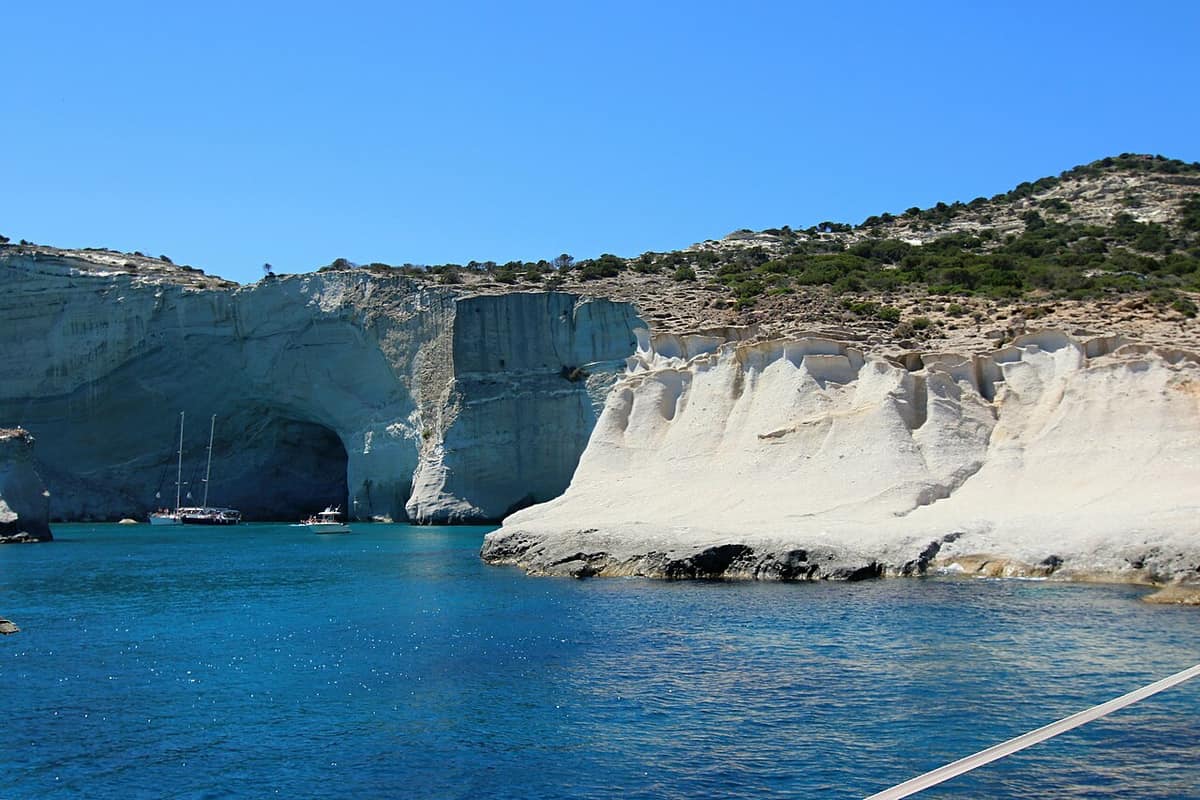
The rocks of Kleftiko are grey and white, and their shapes look strange. Caves and pits cut into them over the centuries. A pit is a hollow in the rock face. Air and sea made these holes. A Kleftiko boat tour shows the rocks from the water. The whole trip is built around them.
On the map, Kleftiko sits on the south-west side of Milos. Three small bays hold white cliffs and islets in the sea. An islet is a small island. The island of Milos itself sits at the far south-west of the Cyclades. That is a group of islands in the Aegean Sea. Milos is a volcanic island.
Two kinds of vessel make the trip to Kleftiko. One is the excursion boat. The other is the sailboat. Both bring passengers to the clear turquoise water and the odd rock shapes. The choice between them depends on need and mood. Both go to the same place and show the same rocks.
Boat tours in Milos sail from two harbours, Adamas and Pollonia. The town of Adamas is the harbour of the island. Pollonia is a village by the sea in the north-east, and it is the second harbour. A Kleftiko boat tour is one of these trips. It has one goal, the rocks of the south-west coast.
A sea cave is a cave cut mainly by the waves of the sea. Erosion, the wearing away of rock by water and wind, does the work. Sea caves exist on coasts around the world. Kleftiko has caves of this kind. A Kleftiko boat tour can add a ride into the caves by inflatable boat.
Sea trips go to beaches with no access from land. Passengers swim in crystal-clear water at these places. Snorkeling is swimming face-down with a mask and a breathing tube. It lets swimmers watch the underwater scene with little effort. On a Kleftiko boat tour, a snorkel stop can be added.
Excursion boats call at Sykia too, not only at Kleftiko. Sykia is a cave found along the west coast of Milos. Its roof has collapsed, so the cave lies open to the sky. A Kleftiko boat tour can include both stops. Both places lie on the wild western side of the island.
- Place: Kleftiko is an area in the south-west of Milos, an Aegean island of the Cyclades.
- Rocks: Grey and white rocks with strange shapes stand beside white cliffs and islets in the sea.
- Caves: Air and sea cut caves and pits into the rock over the centuries, and boats explore them.
- Water: The sea at Kleftiko is clear and turquoise, and passengers swim and snorkel in it.
- Boats: A Kleftiko boat tour runs on excursion boats and sailboats from the ports of Adamas and Pollonia.
A Kleftiko boat tour is a sea trip with a clear plan. A boat carries passengers to grey and white rocks, caves and turquoise water in the south-west of Milos. The boat is both the road and the viewpoint. The next section shows where Kleftiko lies and why visitors come by sea.

Where does a Kleftiko boat tour go, and why do visitors come by sea?
A Kleftiko boat tour sails to the south-west tip of Milos. Three small bays there hold white cliffs and islets. The wild west of the island has no villages. Visitors who want the clear water and the odd rock shapes arrive by boat or sailboat.
The island stretches about 23 km east to west and about 13 km north to south. It covers about 151 square km in all. The Sea of Crete lies just south of the island. Kleftiko sits in the south-west part of Milos. A Kleftiko boat tour sails to that corner.
No part of Milos is wilder than its west half. It has no villages. Besides a handful of settlements, it holds only old mines. Only one of those mines still works. The beaches in this part of the island are isolated. Isolated means set apart, and reaching them means covering a distance.
Almost all of west Milos belongs to Natura 2000. This is a network of nature protection areas in the European Union. Its laws protect threatened habitats and species across Europe. The network covers land and sea. Kleftiko lies on this wild coast. The wild west has plants, herbs, wildflowers and protected birds.
A cliff is a rock face that is vertical or nearly vertical. Cliffs form through weathering and erosion. They are common on coasts. White cliffs stand in the sea at Kleftiko, and the white volcanic rocks there look sheer. A Kleftiko boat tour shows these cliffs from the foot of the wall.
Islets also stand in the sea there. The coast folds into three small bays, one after the other. A bay is a part of the sea that reaches into the land. These bays and islets make Kleftiko a coast to see from the water. All the rock here is volcanic.
Much of Milos is rugged and hilly. Its high point is Prophet Elias, in the west. A road to the top gives views of the sea and of Kleftiko. No other island of the Cyclades has a bigger dirt-road network than Milos. Such roads reach coastal sites, chapels and mines. A footpath also leads to Kleftiko.
Excursion boats reach Kleftiko, and so do sailboats. Sea trips stop at beaches that have no link to the land. Sea trips also let passengers explore caves. For the clear turquoise water and the rock shapes, visitors come by boat or sailboat. Visitors who want those sights choose a Kleftiko boat tour.
- Position: Kleftiko lies in the south-west of Milos, in the wild west of the island.
- West coast: The west half of the island has no villages and only a handful of settlements.
- Cliffs: Three small bays hold white cliffs and islets, and all the rock is volcanic.
- Access: A Kleftiko boat tour is one way in to Kleftiko, and a footpath is the other.
- View: A road up Prophet Elias gives views of the sea and of Kleftiko from above.
Kleftiko lies in the south-west of Milos, in the wild west of the island. White cliffs and islets stand there in three small bays. Excursion boats and a footpath lead in. A road up Prophet Elias gives a view from above. A Kleftiko boat tour shows the place from the water.
Is a Kleftiko boat tour better than walking to Kleftiko?
A Kleftiko boat tour shows the white rocks, sea caves and clear water from the sea. The walk shows the same coast from the land. Each way reveals what the other cannot, so the right choice depends on the traveller and the day.
Strange shapes mark the grey and white rocks of Kleftiko. Over the centuries, air and sea cut caves and pits into them. The place also goes by the name Thalassina Meteora, which means sea Meteora. A Kleftiko boat tour is the way by sea.
Two ways lead to Kleftiko: excursion boats and a path. The rocks and the clear turquoise water are best enjoyed from a boat or a sailboat. The white cliffs and small islets lie in three bays in a row.
On a Kleftiko boat tour, passengers see the cliffs rise straight out of the sea. Caves cut by the sea are easiest to see from the sea. A boat rides low on the water, so the cliffs tower above it. The boat also moves along the coast, so the view keeps changing.
Sykia is a place that only boats reach. This cave on the west coast has lost its roof. Sunlight falls straight onto the emerald water inside. Excursion boats visit both Sykia and Kleftiko. A walker cannot enter it, because the cave opens only to the sea.
The walk to Kleftiko starts at Platorahes in western Milos. A car takes walkers there from Adamas. From Platorahes, a natural path leads on foot toward Kleftiko. The area is a protected Natura 2000 zone and a landscape of special natural beauty.
A Kleftiko boat tour views the rocks from the water. A walker stands on the rocks themselves and looks down on the sea from the path. The walker also sets the pace and stops wherever the view is good. After a short break, the route reaches the caves, which walkers explore by snorkelling.
Both ways depend on the weather. Strong wind makes the sea rough, and rough water changes a boat trip. Summer sun makes a long path hard work. A Kleftiko boat tour needs calm water, and the walk needs a cool day.
- Sea level: A Kleftiko boat tour shows the white cliffs and islets rising straight from the water.
- Sea caves: The sea cut these caves, so a boat shows their openings from the outside.
- Sykia: Only boats reach this cave, whose roof has fallen in and lets the sunlight reach the water.
- Starting point: The walk begins at Platorahes in western Milos, and a car carries walkers there from Adamas.
- Snorkelling: The walk includes a swim around the caves after a short break.
A Kleftiko boat tour wins on caves, islets and places that no road reaches. The walk wins on time spent on the rocks themselves. A traveller who wants both can plan a boat trip and a separate walk. Each way shows Kleftiko in a different light.

What does a Kleftiko boat tour from Adamas pass on the way?
A Kleftiko boat tour from Adamas leaves the bay of Milos and follows the west coast south. On the way it passes fishing villages, the Arkoudes rocks and the Vani mine. Then come sandy beaches and the Sykia cave, just before Kleftiko.
Adamas stands on the north side of the bay of Milos, the hollow of an old volcanic crater. A Kleftiko boat tour from Adamas leaves through the opening in the north-west. Inside the bay, the shore holds the fishing villages of Skinopi, Klima, Areti and Fourkovouni.
Areti and Fourkovouni are tiny villages with a small beach each. Klima has syrmata, two-storey houses built into hollows of the rock. Downstairs sat the boats, and the family lived upstairs. Near Klima, visitors find what is left of the old town and of the island’s first port.
The Arkoudes stand at the mouth of the bay. This is a group of rocky islets, and the name means bears. The rocks seem to show a mouth, a nose, eyes and ears. They lie near Plathiena beach, and only a boat that tours the island shows them.
The west coast starts at Cape Vani, the site of an old mine that shares its name. Strong wind carries salt, and it has cut small hollows into the hard volcanic rock. A Kleftiko boat tour passes this cape before the long run of west-coast beaches.
Farther south lies Kalogries, a quiet beach in the north-west of Milos. Calm turquoise water and a sheltered bay form a natural pool there. Next is Agkathia, a long sandy beach beside shallow blue water. Walkers cross a dirt road to reach Agkathia, but a Kleftiko boat tour needs none.
Next in the line come Triades, Ammoudaraki and Agios Ioannis. Rich blonde sand covers Ammoudaraki, which lies next to Triades. Agios Ioannis is named after a monastery. Its sand lies in three parts joined by paths. Dirt roads lead to both beaches by land.
After Agios Ioannis comes Sykia, the cave without a roof. Beyond it, the coast turns toward the south-west corner of the island. There stand the white cliffs and islets of Kleftiko, spread over three small bays. On a Kleftiko boat tour from Adamas, this is the goal of the trip.
- Bay villages: Skinopi, Klima, Areti and Fourkovouni are the fishing villages inside the bay.
- Arkoudes: Bear-shaped rocky islets stand near the mouth of the bay and near Plathiena beach.
- Cape Vani: An old mine of the same name marks the start of the west coast.
- West beaches: From north to south come Kalogries, Agkathia, Triades, Ammoudaraki and Agios Ioannis.
- Sykia: The cave without a roof comes just before the white rocks of Kleftiko.
The page about day cruises from Adamas covers these trips in more detail. A Kleftiko boat tour from Adamas shows the whole west coast from the sea. No dirt road is needed on the way. The tour ends where the coast meets the white rocks.
Where else does a Kleftiko boat tour start besides Adamas?
A Kleftiko boat tour also starts from Pollonia in the north-east and from Kipos on the south coast. Each start gives a different view. The boat passes a different stretch of coast on its way to the south-west corner of Milos.
Sea excursions start mainly in the harbours of Adamas and Pollonia. Pollonia is the second port on the island. It stands at the north-east tip, around a small creek. Adamas lies almost 10 kilometres away. The village has a sandy beach and a pier for fishing boats.
Day trips from Pollonia go to Polyaigos or Kimolos, to Glaronissia, or to Kleftiko. A Kleftiko boat tour from Pollonia starts at the opposite end of Milos from the rocks. Kimolos lies across a channel one kilometre wide. Small boats link the island with Pollonia.
Glaronissia is a cluster of small islands near Pollonia. Their rock is basalt, a dark volcanic stone, in the shape of six-sided bars. Pachaina beach looks out over the islands. Trips from Pollonia also name Glaronissia as a place to watch the sunset.
Polyaigos is an uninhabited island, and only goats live there. It lies 6.2 kilometres east of Milos. Its southern side has beaches. Sea caves along the coast shelter a shrinking group of Mediterranean monk seals. Boats from Pollonia can go there instead of a Kleftiko boat tour.
Pollonia lies in the north-east of Milos and Kleftiko in the south-west. The island has the shape of a horseshoe. A Kleftiko boat tour from Pollonia must therefore round the island. That means a long stretch of coast before the white rocks come into view.
The south coast has its own start. Boats for Kleftiko also sail from the small port at Kipos. The place also has a sandy beach. On the list of south-coast beaches, Kipos comes after Provatas and Agios Sostis. A Kleftiko boat tour from Kipos starts on the same coast as the rocks.
A boat heading west from Kipos passes Tsigkoulia, Psathi, Akrotiraki, Katergo and Gerontas. Then Kleftiko comes into view. Gerontas is a cove between white rocks and caves, with dark sand. A bridge-shaped rock links the sea and the land there.
- Pollonia: The second port of Milos stands at the north-east tip, almost 10 kilometres from Adamas.
- Kimolos: This neighbour island lies across a channel one kilometre wide from Milos.
- Glaronissia: These small islands near Pollonia are made of basalt in six-sided bars.
- Kipos: The small south-coast port of Kipos sends boats to Kleftiko.
- Gerontas: In this cove, a rock in the form of a bridge ties the sea to the land.
Boats tie up in coves that suit the wind direction. Provatas, Kleftiko and Paliochori are three such coves. Whichever harbour a Kleftiko boat tour leaves from, the goal is the same white rocks in the south-west. Only the coast on the way changes.

What are the rocks on a Kleftiko boat tour made of?
A Kleftiko boat tour passes cliffs of tuff, a rock made of hardened volcanic ash. The tuff here is built from pieces of pumice, a light, foamy volcanic stone. It formed about 3.1 million years ago, and its colour runs from white to dark.
Tuff is a rock made from volcanic ash. A volcano throws the ash into the air during an eruption. The ash falls, settles, and hardens into solid rock over time. A Kleftiko boat tour sails along cliffs of this rock.
Volcanic ash is not like campfire ash. It is made of tiny pieces of rock, glass, and crystals. Each grain is under 2 millimetres, about the size of sand. When the grains pack together and harden, tuff is the result. Water in the ground or the sea helps glue the grains into rock.
The tuff at Kleftiko is built from broken pieces of pumice pressed together. Pumice is a light volcanic stone full of tiny gas holes. It looks like a frozen sponge. Pumice is pale, from white and cream to grey. On a Kleftiko boat tour, the white cliffs are this foamy stone in solid form.
Pumice forms when hot rock shoots out of a volcano. The rock cools fast, and its gas bubbles freeze in place. That leaves a stone with holes all through it. Pumice is so light that it floats on water. A lump of it can drift on the sea for years.
The pumice at Kleftiko formed about 3.1 million years ago. It lies in layers, one stacked on the next like pages in a book. Basalt also lies in the area around Kleftiko. Basalt is a volcanic rock that gives dark ash.
The tuff at Kleftiko varies in colour, from white and pale yellow to dark. From the water on a Kleftiko boat tour, the rocks look grey and white. Tuff is a fairly soft rock, so builders have used it since ancient times. On Milos, boat shelters are dug into tuff at Klima, Mandrakia, and Fyropotamos.
Waves cut caves by attacking weak spots in a cliff. Water and trapped air push into cracks and widen them. Sand and stones in the waves scrape the walls. Wind adds wear, because airborne grains rub the rock. At Kleftiko, this slow work cut hollows and caves over the centuries.
- Tuff: Hardened volcanic ash makes up the white cliffs of Kleftiko.
- Pumice: A light, foamy volcanic stone forms the broken pieces inside the tuff.
- Basalt: This dark volcanic rock also lies in the area around Kleftiko.
- Sea: Waves widen cracks and scrape the cliff with sand and stones.
- Wind: Airborne grains rub the rock and wear it down.
A Kleftiko boat tour is a trip along soft volcanic rock. Ash and pumice hardened into tuff, and sea and wind cut the caves into it. These forces also left islets standing in the water. Those islets and rock shapes come next.
Which islets and rock shapes does a Kleftiko boat tour pass?
A Kleftiko boat tour passes white cliffs and rock islets across three small bays in a row. The grey and white rocks have strange shapes, with caves and pits cut into them. Sea and wind erosion shaped the whole landscape over the centuries.
The white cliffs and islets of Kleftiko lie in the south-west of Milos. All of this rock is of volcanic origin. It spreads over three small bays that follow one another. A Kleftiko boat tour moves along this chain of bays from the water.
A Kleftiko boat tour shows rocks with strange shapes and formations. Their colours are grey and white. Caves and pits are cut into them. Hollows break up the cliff faces. The surfaces are not smooth, because sea and wind worked on them for centuries.
Thalassina Meteora, meaning Sea Meteora, is a second name for the place that a Kleftiko boat tour reaches. Meteora is a Greek word that means lofty or elevated. It is also the name of a rock formation of giant natural pillars on the mainland. That formation lies in Thessaly, in north-west Greece.
In geology, a steep column of rock standing in the sea is called a sea stack. Steep-sided islets of volcanic origin are loosely called stacks too. Stacks form where waves wear away a point of land that sticks out into the sea.
The process runs in steps. The sea finds cracks and weak spots in the rock. The cracks grow into caves. In time, the cave roofs fall in. What remains is a free-standing block of rock in the water. Waves keep cutting at such blocks, so none of them lasts forever.
At Kleftiko, sea and wind erosion made the landscape. It cut hollows and caves into the white rock. The cliffs and islets belong to that same landscape. On a Kleftiko boat tour, they appear as one long, carved shoreline.
Excursion boats call at one more place, Sykia. This cave lies along the west coast of Milos. Its roof has collapsed, so the cave is open to the sky. Only a boat can reach it. On a Kleftiko boat tour, it is one more rock shape seen from the water.
- Bays: Three small bays follow one another along the Kleftiko coast.
- Cliffs: The white and grey cliffs are volcanic rock cut by sea and wind.
- Islets: White rock islets stand in the sea beside the cliffs.
- Caves: Caves and pits open in the rock faces along the shore.
- Sykia: This cave on the west coast has lost its roof.
A Kleftiko boat tour covers three bays of white rock, islets, caves, and pits. None of it was built by people. Sea and wind cut every shape over the centuries. The views from the deck, and how to photograph them, come next.
What views and photos does a Kleftiko boat tour give from the deck?
A Kleftiko boat tour gives views of sheer white rock against clear turquoise water. The deck gives a close look at the cliffs, islets, and cave mouths. A wide frame, a steady stance, and a dry phone cover the basics.
White rock and turquoise water make a strong pair of colours. The pale cliffs stand out against the blue-green sea. On a Kleftiko boat tour, this contrast fills the frame at every turn. The rock reads as grey and white, and the water is clear to the eye.
On a Kleftiko boat tour, a wide frame suits the three bays best. Near the front of the boat, one photo can show cliffs and islets together. Phones with a wide-angle lens fit more rock into the picture. Photographers stand with both feet planted and the elbows tucked in.
The side rail gives a different view. From there, the cliffs run along the frame in a long line. This angle shows how the grey and white rock follows the shore. The phone turns sideways for it, so the whole line of rock fits in.
Cave mouths make strong subjects on a Kleftiko boat tour. Dark openings frame the bright rock around them. Phones struggle when white rock sits beside deep shade. A tap on the bright rock sets the brightness. Then the shaded cave does not turn the whole photo dark.
Sykia, the cave with no roof, adds its own view. Sun rays pour in from above and light up the emerald water inside. A photo of the cave can catch that light as it falls through the open top. The bright water is the subject, so a tap on it keeps its colour.
Salt water harms phones. On a Kleftiko boat tour, spray flies up when the boat picks up speed. A waterproof pouch on a wrist strap keeps the phone safe. A dry cloth wipes the salt film off the lens. Phones go back into the pouch between shots.
On a Kleftiko boat tour, the deck moves with the waves, so photos blur easily. Photographers brace against the rail, breathe out, and press the shutter. One hand stays on the rail while shooting. Video looks better when the phone turns slowly and stays level.
- Wide shot: Standing near the front of the boat fits cliffs and islets together.
- Side view: The side rail gives a long view that follows the cliff line along the shore.
- Cave mouths: A tap on the bright rock keeps shaded openings clear in the photo.
- Sykia: The sunlit water inside the roofless cave makes a clear frame from the boat.
- Dry phone: The phone stays in a waterproof pouch between shots.
Photos from a Kleftiko boat tour show white rock, clear water, and carved caves. A dry phone and a steady stance carry the shot. Back on shore, there is more to see on the island. Other places to visit are listed on the page about the sights of Milos.
Does a Kleftiko boat tour feel different in the morning and the afternoon?
A Kleftiko boat tour changes with the time of day in three ways. The light is softer when the sun is low. The wind and the sea build up through the day. The number of boats in the bay also shifts.
The light is the first change. Shortly after sunrise and before sunset, the sun is low. Its light is redder and softer than when the sun is high. Shadows are longer and less dark. On a Kleftiko boat tour at those times, the white rock takes on warm colour.
At midday the sun stands high. Bright overhead sun makes strong highlights and dark shadows. The volcanic rock at Kleftiko runs from white to dark. That contrast shows clearly in strong light. A Kleftiko boat tour at midday looks harsher than one in low light.
Kleftiko lies in the south-west of Milos. A Kleftiko boat tour that follows the west coast from Adamas reaches the bay in the afternoon. The boat then sails home as the sun goes down. A sunset cruise is a separate idea, and other pages on this site cover it.
The wind follows a daily pattern in summer. The Aegean’s dry north wind is called the meltemi, and it peaks in the afternoon. At night it can die down. A strong meltemi raises waves. The afternoon sea can be rougher than the morning sea.
A sea breeze adds to the afternoon wind. A sea breeze is a wind that blows from the water toward the land. Land warms faster than the sea in the sun. That difference drives the breeze, which blows in the afternoon.
Wind direction also decides where a boat can anchor. Kleftiko is one of the coves that suit mooring, depending on the wind direction. On a Kleftiko boat tour, the crew reads the wind and the sea. The crew then picks a safe spot for the stop.
The number of boats changes through the day as well. Boats leave Adamas and Pollonia daily. Cruises on the west coast stop at other places first and reach Kleftiko in the afternoon. A Kleftiko boat tour that arrives before or after them can meet fewer boats.
- Low sun: Light is redder and softer shortly after sunrise and before sunset.
- High sun: Midday sun makes strong highlights and dark shadows on the rock.
- Meltemi: The north wind blows hardest by afternoon and can calm down after dark.
- Sea breeze: A wind from the sea toward the land blows in the afternoon.
- Boats: A Kleftiko boat tour along the west coast from Adamas reaches the bay in the afternoon.
A Kleftiko boat tour is never the same twice, because light, wind and traffic move through the day. Low sun gives soft colour, and the afternoon brings more wind. Boat numbers rise and fall with the cruise routes. The crew, not the clock, makes the final choice of stop.

Which boats go on a Kleftiko boat tour?
A Kleftiko boat tour runs on four kinds of boat: wooden boats, speedboats, catamarans and sailing yachts. Each feels different on the way. A wooden boat looks traditional and a speedboat is quick. A catamaran stays steady, and a sailing yacht leans with the wind.
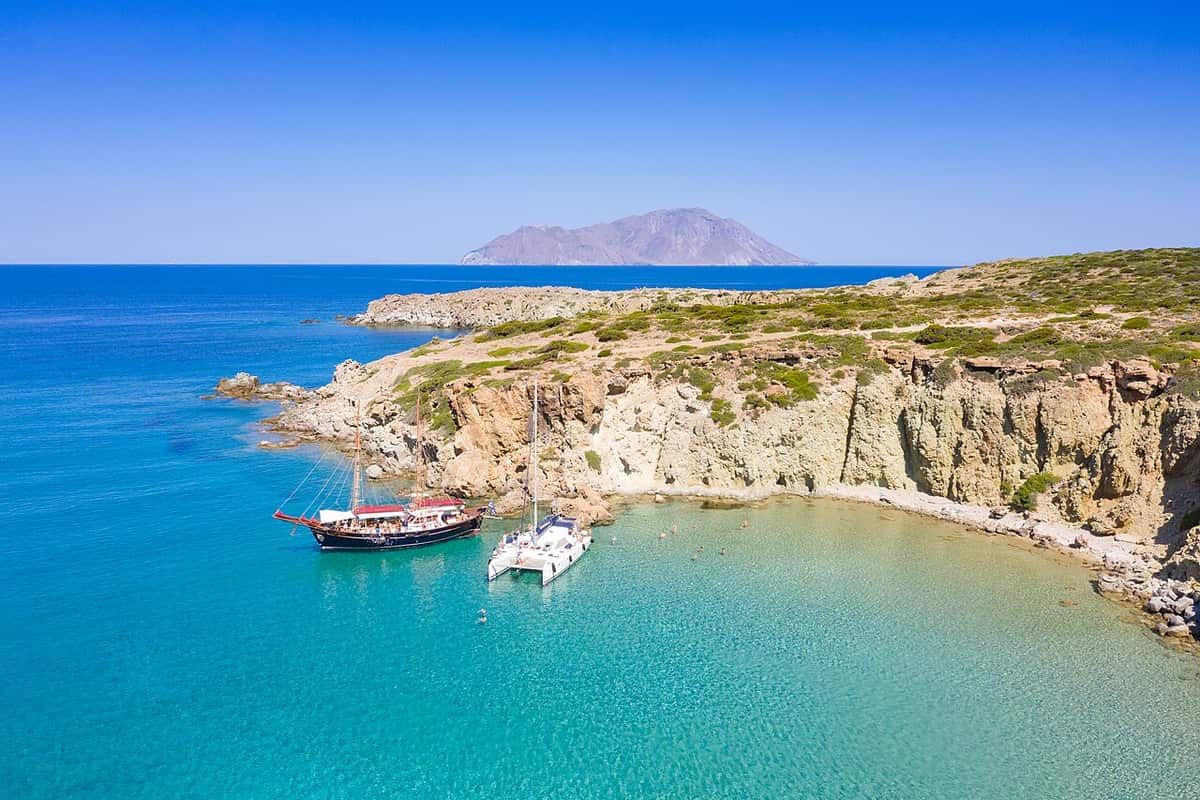
Boats and sailboats leave Adamas and Pollonia daily for trips around the island. The traveller picks one by need and mood. A Kleftiko boat tour uses four main types. Each type moves differently on the sea.
The traditional wooden boat is called a kaiki in Greek. It was built for fishing and small trade in the Aegean. It has a long, sharp bow, meaning the front of the boat, and a short mast. A kaiki is painted white against the strong sun, with bright colours along the sides.
Today the kaiki also serves as an excursion boat. A boatbuilder makes it from pine wood, working from memory rather than from plans. On a Kleftiko boat tour, a kaiki offers a traditional feel on the way to the bay.
A speedboat is a boat with a motor and no sails. It cruises much faster than an ordinary motor boat. A V-shaped hull lets the boat slice through water and stay steadier in rough sea. On a Kleftiko boat tour, a speedboat covers the distance quickly.
A catamaran has two equal hulls with a wide gap between them. That gap resists rolling and tipping. It can also reduce heeling, the sideways lean, and the motion that waves cause. On a Kleftiko boat tour, a catamaran feels steadier than a boat with one hull. Another page covers the Milos catamaran cruise.
A sailing yacht moves by wind in its sails. When the wind pushes on the sails, the boat leans to one side. Sailors call that lean the heel. A very strong meltemi can keep a sailing yacht in port. A separate page covers sailing and wind in detail.
A small inflatable boat can join the trip too. On one cruise route from Adamas, an inflatable boat tours the caves of Kleftiko. A group that wants a whole boat to itself can read about a Milos private boat tour. That page covers speedboats, motor yachts and kaikis.
- Kaiki: A wooden Aegean boat, painted white with bright colours along the sides.
- Speedboat: A boat with a motor and no sails, built to cruise fast.
- Catamaran: Two equal hulls set wide apart keep the boat steadier in waves.
- Sailing yacht: Wind in the sails pushes the boat, and it leans to one side.
- Inflatable: A small inflatable boat tours the caves of Kleftiko on one cruise route.
Every boat on a Kleftiko boat tour reaches the same white rocks. Each takes a different road there. The kaiki adds tradition and the speedboat adds speed. The catamaran adds a steady deck, and the sailing yacht adds wind. The choice depends on the traveller’s mood and the sea of the day.

What do the pirates of the Aegean add to a Kleftiko boat tour?
A Kleftiko boat tour passes a coast with a long pirate past. Pirates raided the Aegean in ancient times, and Milos was one of their winter bases in the 1600s. Small hidden bays gave their light ships shelter and a safe place to wait.
A Kleftiko boat tour sails a sea where piracy is very old. A people known as the Sea People threatened ships here in the 14th century BC. Ancient Greek texts, such as Homer’s Iliad and Odyssey, speak of piracy as normal. By the Classical era, it was seen as a disgrace.
The Cyclades, the island group that includes Milos, suffered raids too. Around 362 to 360 BC, a tyrant named Alexander of Pherae led pirate raids there. His ships brought back a large number of slaves. In 67 BC, Pompey made piracy disappear from the region.
Raiders came again in the Middle Ages. From 829, Saracens who held Crete sent raids to the Cyclades for more than a century. Naxos had to pay them a tribute. The islands lost people, and Paros stood deserted in the 9th century.
Around 1566, Milos began to turn into a stronghold of pirates. Venice failed to control the raids. The Ottoman rulers had no way to place troops on every island. The full story of those centuries is told in the history of Milos.
The pirates of the 1600s came from Italy, Corsica and France. They spent the winter on Paros, Antiparos, Ios or Milos. A Kleftiko boat tour sails the waters around one of those bases. In spring and summer, the pirates hunted ships on the route between Egypt and Constantinople. They spent the loot in the islands.
Small bays suited pirate ships. Their craft were small, quick and lightly armed, and patrol boats found them hard to catch. A Kleftiko boat tour passes three small bays that served as a base against passing ships. The caves gave shelter from bad weather.
The pirates’ regular passage had a cost. Quarantine rules were not obeyed, and plague reached Milos in 1687, 1688 and 1689. The plague of 1689 killed 700 of the island’s 4,000 people. In the early 1700s, the foreign corsairs faded away.
- Ancient times: The Sea People threatened ships in the Aegean in the 14th century BC.
- Cyclades raids: Alexander of Pherae led pirate raids on the Cyclades around 362 BC.
- Crete: Raiders from Crete threatened the Cyclades for more than a century from 829.
- Kimolos: Pirates pillaged the island of Kimolos in 1638.
- Winter bases: The pirates of the 1600s spent the winter on Milos, Paros, Antiparos or Ios.
A Kleftiko boat tour today is a trip for swimming and sightseeing among white rocks. The same bays once hid pirate boats from passing ships. From the water, the narrow bays and caves show why pirates chose them. That past is one more layer in the story of this coast.
Is a Kleftiko boat tour a good first boat day for families and first-timers?
A Kleftiko boat tour suits a first boat day for families and first-timers. The rocks and caves are enjoyed from the water, so the day needs no climbing or long walk. Children look at the caves, swim when ready and rest on deck between the stops.
Gray and white rocks stand at Kleftiko, in strange shapes and formations. Air and sea cut caves and pits into them over the centuries. A first-timer sees all of this from the boat. A Kleftiko boat tour therefore asks for looking, not climbing.
Visitors enjoy the turquoise water and the rock formations of Kleftiko by coming in a boat or sailboat. Sea trips on Milos reach beaches that roads do not reach, and the water there is crystal clear. A first swim beside the boat is easy to enjoy on a Kleftiko boat tour.
Milos has both boats and sailboats for sea trips. The boat for a Kleftiko boat tour depends on the needs and the mood of the family. Boats for sea trips set off from two ports, Adamas and Pollonia. A family can pick the port that is nearer to its stay.
On a Kleftiko boat tour, a life jacket keeps the wearer afloat with no swimming or treading water. It works even for an unconscious wearer, and a quality jacket can turn a face-down floater face up. Commercial sea vessels must carry life jackets that every passenger can reach.
A foam vest that gives a swimmer the lift needed to float is called a buoyancy aid. Versions made for children can have a headrest flap that keeps the head out of the water. A grab handle on the flap lets an adult lift a child out.
A wetsuit gives a degree of flotation, but it is not a life jacket. A person who cannot move in the water can float face down in a wetsuit. A life jacket is made for that job. Swim safety gets more room on the page about a Milos snorkeling cruise.
Water reflects the sun’s rays and can cause sunburn. Children younger than six and adults older than sixty are more sensitive to sunlight. A wide-brim hat, sunglasses and loose, tightly woven clothing give cover. On a Kleftiko boat tour, a wet shirt gives less cover than a dry one.
- Crew: A first-timer on a Kleftiko boat tour can ask the crew where the life jackets are kept.
- Group: Children stay with the group on deck and keep away from the edge of the boat.
- Snacks: Snacks travel in reusable boxes, which cuts the waste from wrappers and bags.
- Water: Each child carries a refillable bottle of drinking water, which also cuts plastic waste.
- Seasickness: Families who worry about seasickness can read about a Milos catamaran cruise on two hulls.
A Kleftiko boat tour makes an easy first boat day on Milos. The rocks, the clear water and the open deck carry the day, while children set the pace. A life jacket that fits, sun cover and a bag of snacks finish the plan. The rest of the day is looking, swimming and resting.
How can a Kleftiko boat tour respect the rocks, the sea and other visitors?
A Kleftiko boat tour stays kind to the place with four habits. Visitors take litter back, leave the rocks as found, keep voices low and feed no animals. Boats and sailboats both share Kleftiko, so small habits add up for everyone who visits.
The Leave No Trace code is a set of ethics that promotes the care of the outdoors. It began in the United States, in response to damage caused by wilderness recreation. Its idea is to leave a place unchanged by human presence. In 1994, a non-profit centre was formed to teach these ideas.
Boats and sailboats both bring visitors to the rocks of Kleftiko. By the 1960s and 1970s, writers warned that wild places were being loved to death. They also wrote about overcrowding and damage to nature. A Kleftiko boat tour avoids that fate when every visitor takes care.
Tuff is among the ordinary rocks on Milos, a volcanic island. Tuff forms when volcanic ash turns into solid rock, and it is relatively soft. Builders have carved it since ancient times. A boot or a hammer can scar soft rock with one blow.
The Leave No Trace code asks visitors to leave rocks, plants and other natural objects as found. Air and sea took centuries to carve the caves and pits of Kleftiko. Climbing and chipping can undo that work in a single visit. A broken piece cannot be put back.
The Leave No Trace rule for waste is pack it in, pack it out. It covers trash, leftover food and litter. Wind can carry a light wrapper off a deck and into the sea. On a Kleftiko boat tour, small items stay in a bag until the boat returns.
Litter can last a long time before it breaks down. Waterborne plastic is a serious threat to fish, seabirds, marine reptiles and marine mammals. Sea animals can eat floating litter by mistake, because it can look like their prey. On a Kleftiko boat tour, each piece kept on board stays out of the sea.
The last Leave No Trace principle is to be considerate of other visitors. That means respecting others and protecting the quality of their visit. The code adds a simple tip: let nature’s sounds prevail. On a Kleftiko boat tour, loud voices and noises give way to the sounds of the sea.
- Principles: The Leave No Trace code has seven principles, and the list was final by 1999.
- Plan: A Kleftiko boat tour starts with the first principle: plan ahead and learn the local rules.
- Wildlife: Visitors watch animals from a distance and never feed them, because feeding harms their health.
- Hygiene: The code asks visitors to pack out toilet paper and hygiene products too.
- Groups: The first principle also suggests visiting in small groups when possible and avoiding times of high use.
A Kleftiko boat tour is a shared visit to a place shaped over centuries. Visitors take litter back, keep voices low and leave every rock in place. That keeps the caves and pits of Kleftiko ready for the next boat. These small habits cost nothing and keep the rocks as they were.
How is a Kleftiko boat tour chosen?
A Kleftiko boat tour is chosen on four points. These are day length, boat type, start harbour, and the swim and food details in the description. The tour must name Kleftiko as a stop, because not every sea trip from Milos goes there.
Milos has ordinary boats, traditional boats called caiques, and sailing boats for sea trips. Day boats depart from two ports, Adamas and Pollonia. The choice therefore starts with one plain question. Does the day need to reach Kleftiko, or is any swim at sea enough?
A day boat from Pollonia can sail to Polyaigos or Kimolos. It can also stay for the sunset at Glaronissia. Kleftiko is one destination on that list, not the only one. A Kleftiko boat tour names the rocks as a stop in plain words.
A full day gives room for more stops. A day cruise from Adamas stops at the Sykia cave before it sails on to Kleftiko. A half-day trip, where one is offered, has less room. Its description needs to say which stops it keeps. Kleftiko needs to be one of them.
Boat size changes the day too. A small group can spend a full day on a traditional boat, with swims and a picnic. A smaller group means fewer people at the rocks and in the water at once. Other pages of this site compare shared and private boats in full.
The start harbour sets the shape of the day. Adamas is the harbour town of Milos. Pollonia is a village in the north-east and the second harbour of the island. Kleftiko lies in the south-west, so each start means a different sea route. A harbour near the visitor’s stay keeps the day simple.
On a Kleftiko boat tour, a clear description names the swim stops. It says whether masks and fins are lent for the rocks. A day cruise from Adamas lends them and offers diving from the boat and the rocks at Kleftiko. The words “swim stop” alone leave the place unclear.
Food needs the same plain wording. The description says what is served and where it is eaten. On a day cruise from Adamas, a fishermen’s meal is served aboard or at Thieves’ Beach. What to bring is short, and the list below covers it.
- Sun cover: A hat and sunscreen protect the skin from sunburn out on the open deck.
- Swim gear: A swimsuit and a towel cover the swim stops, and a mask suits the clear water.
- Water: A full bottle of water helps through the summer heat on deck.
- Light layer: The meltemi, a strong north wind, can make the deck feel cool even on a hot day.
- Dry bag: A small waterproof bag keeps a phone and papers dry near the sea.
Once these points are settled, the day takes a clear shape. It has one start harbour, a named stop at Kleftiko, named swim stops and a stated meal. Other activities in Milos fit around it. A spare day on land helps if wind stops the Kleftiko boat tour.

What else do people ask about a Kleftiko boat tour?
A Kleftiko boat tour from Milos raises eight practical questions. They cover cave entry, landing, swimming ability, wind, the name, toilets, the season and the Sykia cave. The answers stay with what is known about Kleftiko and the sea around it.
Can boats enter the caves on a Kleftiko boat tour?
Yes, by inflatable boat. A day cruise from Adamas lets passengers tour every cave of Kleftiko this way. Snorkelling at the rocks is a separate activity on that cruise. Air and sea cut the caves and pits into the rock over the centuries. Each tour description states whether the cave ride is included.
Is there a beach to land on during a Kleftiko boat tour?
White cliffs and islets gather around three small coves at Kleftiko. On the same cruise, passengers can dive from the boat and the rocks. A day cruise from Adamas names Thieves’ Beach for a meal ashore. That meal can also be eaten on the boat. The description of each tour says whether the boat lands.
Can non-swimmers join a Kleftiko boat tour?
Yes, because the cave ride by inflatable boat needs no swimming. Swim stops are optional, and a non-swimmer can watch from the deck. A life jacket keeps the wearer afloat without any swimming. The crew can say whether one is on board. Asking before the boat leaves the harbour avoids doubt on the day.
What happens on windy days during a Kleftiko boat tour?
The summer meltemi is a strong, dry north wind over the Aegean. Even in clear weather it can rise without warning, and the sea turns wavy. Small boats can lose trips on such days. Ferries face the same limit. A spare day in the plan protects a Kleftiko boat tour from a lost sea day.
Why is a Kleftiko boat tour called Kleftiko?
Kleftiko took its name in the days of piracy in the Mediterranean. The coves worked as a base for attacks on ships. The caves gave shelter in bad weather. In Ottoman times Milos became an anchorage and base for pirates, and Sarakiniko took its name then. The name has stayed on the rocks to this day.
Are there toilets on a Kleftiko boat tour?
On a sailing boat, the toilet is called the head. Whether a boat has one depends on the vessel. The description of a Kleftiko boat tour or the crew can confirm it. Kleftiko itself is reached by boat or by a path. The harbour toilets before boarding are therefore the sure choice.
Does a Kleftiko boat tour run in spring and autumn?
The meltemi season runs from late spring to mid-September. It can last into early October. Spring and autumn lie at the edges of that window. A trip then can meet the wind or miss it. Whether a trip runs in those months is stated in its description. A light jacket suits the deck.
Can a Kleftiko boat tour be combined with the Sykia cave?
Yes, excursion boats visit both Sykia and Kleftiko. A collapsed roof makes Sykia an open cave on the west coast. Sunlight enters and lights the emerald water inside. The cave is reachable only from the sea. A day cruise from Adamas swims inside Sykia before it sails to Kleftiko.