
A Milos private boat tour is a sea trip for one group on its own boat. It tours the island of Milos. Milos is volcanic and sits at the south-western edge of the Cyclades. The group alone decides where the boat goes and where it stops to swim.
A shared trip carries other travellers, and you can read about those under boat tours in Milos. A Milos private boat tour has no one else on board. This page explains what that means. It also lists the boats a group can hire, from a speedboat to a wooden kaiki.
What is a Milos private boat tour at a glance?
A Milos private boat tour is a sea trip where only one group is on board. The group sets the pace and picks the stops. The coves of Milos suit this trip, because certain beaches are open only to boats.
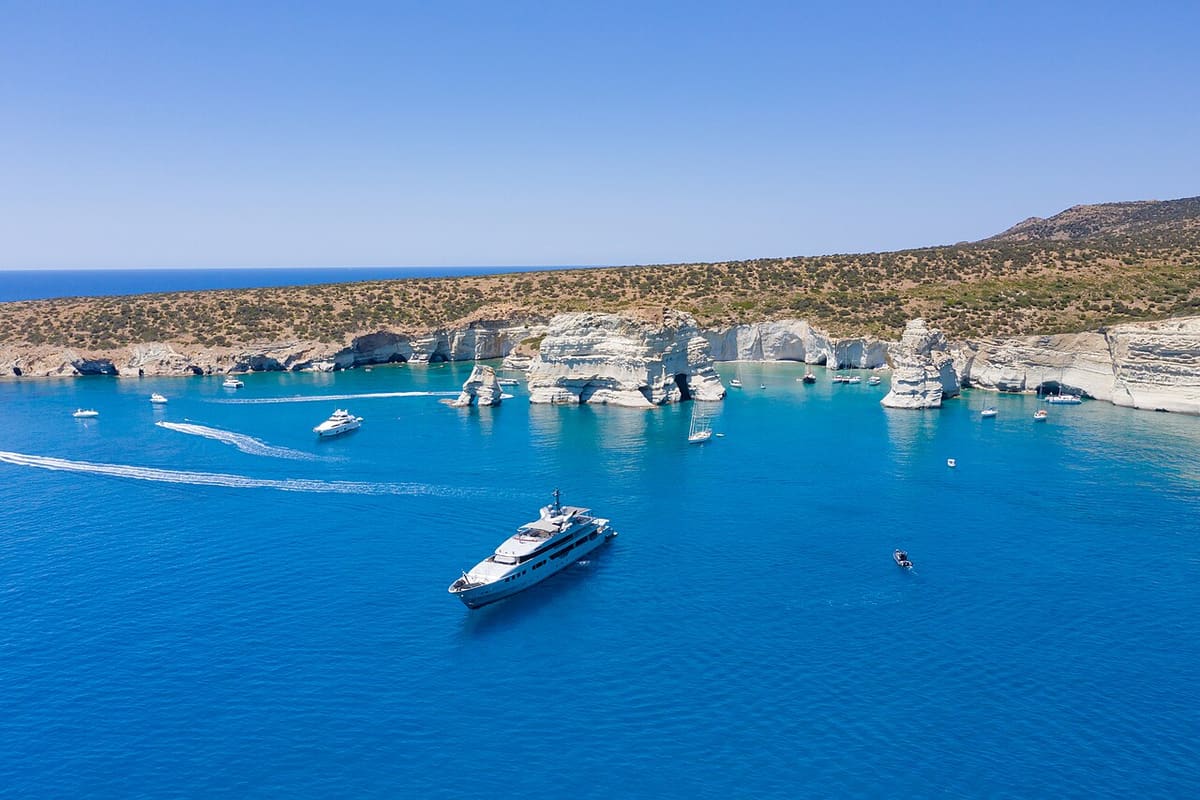
On a Milos private boat tour, the whole boat is kept for one party. Friends, a family or a couple can share the deck. Nobody else joins them. The trip stays calm, and the group can talk, swim and rest in its own way.
The group also sets the pace of the trip. Nobody has to hurry a swim. If a cove is calm and the water is clear, the boat can stay there longer. When the group wants to move on, the boat leaves as soon as everyone is ready.
A Milos private boat tour has no fixed list of stops. The group can ask for a quiet cove or a sandy beach. The group can also ask for a rock to swim from. A stop that does not suit the group can be skipped.
Milos is a compact island, and its size suits a trip by boat. Measured east to west, the island spans about 23 km. Measured north to south, it spans about 13 km. The coves sit close to one another, so the boat moves easily from one to the next.
Milos has beaches on its north, east, south and west coasts. More lie inside the large bay. Land routes lead to certain beaches. Others are open only from the water, so a Milos private boat tour reaches them.
A Milos private boat tour follows a very old pattern on this coast. Obsidian is a glass-like volcanic rock from Milos. It was traded as early as 15,000 years ago. People who came for it sailed in and beached their boats in a suitable cove.
Visitors are drawn to Milos by its varied coastline and its beaches. Milos feels less crowded than Santorini and Mykonos, two islands that get more visitors. A private boat adds to that calm. The group meets no other passengers on deck.
- Group: Only the group’s own party is on board, with no other travellers.
- Pace: The group decides when to swim, rest or move on to the next cove.
- Stops: The group picks each cove and can change the plan on the way.
- Coves: Beaches on every coast lie close together on a compact island.
- Access: Certain beaches can be reached only from the sea, which is where a boat helps.
A Milos private boat tour gives one group the boat, the pace and the stops. The compact coast of Milos, with its coves on every side, rewards that freedom. The next section looks at the boats a group can hire. It also shows what each type does best.

Which boats can a Milos private boat tour use?
A Milos private boat tour can use six kinds of boat. These are the speedboat, the RIB, the motor yacht, the sailing yacht, the catamaran and the wooden kaiki. Each has its own speed, space and comfort, and each suits a different group.
Boats differ in speed, size, comfort and the shelter they give from sun and wind. A Milos private boat tour can be fast and light, or slow and roomy. The choice shapes the trip. It decides the places the boat reaches and the comfort on deck.
A motorboat with a much higher cruising speed is known as a speedboat. A V-shaped hull lets a boat slice through the water. It also keeps the boat steady in rough sea. A speedboat reaches distant coves fast, which leaves room for more stops and more swimming.
A RIB is short for rigid inflatable boat. It has a hard hull below and air-filled tubes along the sides. The tubes keep it afloat even if water gets in. On a Milos private boat tour, a light RIB needs little depth and enters small coves.
A motor yacht is driven by engines, not by sails. Its bridge, the control area, sits forward and gives a wide view ahead and to the sides. That view helps the crew steer near rocks. The cabin gives shade and shelter, so a motor yacht suits a group that wants comfort.
On a Milos private boat tour, a sailing yacht moves mainly by its sails. Cruising yachts are built for comfort, not for racing. That suits a group that enjoys the water and the view more than a fast ride. An engine still helps when the wind drops.
A catamaran is the roomy choice for a group that wants space on deck. Its wide stance on the water cuts rolling and wave motion. This gives a steadier ride, which helps anyone who dislikes a rocking boat. It also needs less depth than a one-hulled boat of the same length.
A kaiki is a traditional wooden boat of the Aegean Sea. It is painted in bright colours. It was built for fishing and small trade, but today it also serves as an excursion boat. On a Milos private boat tour, a kaiki suits a group that likes tradition.
- Speedboat: Fast and light, it reaches distant coves and leaves room for more stops.
- RIB: Light and easy to steer, it enters small coves and brings divers to dive sites.
- Motor yacht: A cabin gives shade, shelter and a seat out of the wind.
- Sailing yacht: Sails move it at an easy speed, which suits a calm trip.
- Kaiki: This wooden Aegean boat gives the trip a traditional feel and a slow, easy pace.
Each boat gives a Milos private boat tour a different character. Speed reaches distant coves, and a RIB enters tight spaces. A yacht or catamaran adds comfort and room. The kaiki adds tradition. A group that knows its mood at sea can match the boat to it.
What does a skipper do on a Milos private boat tour?
A Milos private boat tour puts a skipper in command of the boat. The skipper steers, reads the wind and the sea, chooses safe anchorages and looks after everyone on board. The group can swim and enjoy the coast while the skipper handles the boat.
A skipper is the person in command of a boat. On a Milos private boat tour, that person leads the whole crew. People say skipper more than captain for private boats and small yachts, and the title sounds less formal.
Two kinds of hire matter on a Milos private boat tour: bareboat and skippered. A bareboat hire leaves navigation, docking and anchoring to the renter. A skippered hire gives those jobs to a professional skipper, sometimes with help from other crew.
Before the boat leaves the dock, the skipper runs checks. The engine fluids, the bilge pumps, the lights and the safety gear all get a look. The skipper also keeps the boat’s papers in order and follows the rules of the place.
The Aegean has a strong north wind called the meltemi, and it can rise without warning. A skipper reads the sky and the sea, and heads for calmer water when needed. When a north wind blows, the better choice is the bay or the south side of Milos.
Anchoring lets a boat park in the water and stay in one place. On a Milos private boat tour, it gives swimmers a steady base beside the rocks. Before the anchor drops, the skipper checks that the water under the boat is deep enough.
A good anchor line is at least four times the depth of the water. A short chain between rope and anchor keeps the pull low, so the anchor grips the bottom. A careful skipper also avoids seagrass beds, which the anchor can damage.
On a Milos private boat tour, safety on board is the skipper’s duty too. Life jackets for everyone, a first-aid kit and a radio or phone belong on every boat. If a passenger needs help, the skipper gives care and works with doctors on shore.
- Command: The skipper leads the crew and answers for the boat and everyone on it.
- Wind: A north wind makes the bay and the south side the better choice.
- Anchorage: The skipper picks a spot with enough water under the boat.
- Safety: Life jackets for everyone on board are the first item on the list.
- Certificate: In Greece, charter firms ask bareboat renters for a recognised yachting certificate.
On a Milos private boat tour, the skipper turns a hired boat into a safe day at sea. The skipper handles the wind, the anchorage and the safety checks. That leaves the group free to swim, look at the coast and plan the route.
How can a group shape the route of a Milos private boat tour?
A Milos private boat tour route is built from blocks. The blocks are the west, south and north coasts, the sheltered gulf and the nearby islets. The group picks the blocks, and the skipper fits them to the wind.
Milos has the shape of a horseshoe, which forms a large gulf. That shape splits the coast into five blocks: the gulf and four sides. Over 75 beaches lie along these blocks. A separate page on the beaches of Milos covers all of them.
The gulf is the calm block, and 25 beaches lie inside its shelter. Waves at Papikinou rank among the mildest anywhere on Milos. A Milos private boat tour can start or end there when a north wind blows.
The north coast has 16 beaches. The west end starts at Plathiena, and the east end finishes at Pollonia. Sarakiniko, Papafragkas and Pachaina lie along it. On a Milos private boat tour, this is the better block when the wind blows from the south.
The south coast has 21 beaches, ordered from the east end to the west end. Palaiochori, Firiplaka and Provatas sit along it, and Kleftiko closes the western end. On a Milos private boat tour, this block is the better choice when the meltemi blows.
The west coast holds 15 beaches, listed from south to north. Tourism has not developed much on the west side of Milos. A Milos private boat tour along it gains privacy, with Sykia, Triades and Kalogries as stops.
The east coast holds 12 beaches. Kastanas is a wild beach there. Its multicoloured pebbles and rocks show red, orange and purple. Tria Pigadia, also on the east coast, is a small beach that is rocky and remote. It lies between Kastanas and Agali.
A Milos private boat tour can close a route at an islet. A narrow channel separates Milos from Kimolos in the north-east, with Polyaigos beyond it. Antimilos lies to the north-west, and the Glaronisia islets face Pachaina on the north coast.
- Swimming: The clear water lets swimmers enter straight from the boat.
- Roadless beaches: Sea trips visit beaches that are not accessible from land.
- Mineral wealth: The coast shows the mineral wealth of the island.
- Caves: Sea trips explore secret caves along the shore.
- Neighbouring islands: The nearby islands give a route a clear end point.
A Milos private boat tour lets one group build a route from these blocks in its own order. The wind decides which blocks suit the day, and the skipper adjusts the plan. The next section turns to the coves that only small boats reach.

Which hidden coves does a Milos private boat tour reach by sea?
A Milos private boat tour reaches coves that land routes make hard to visit. Gerakas, Tsigrado, Agkathia, Triades and Kalogries lie on the south and west coasts. A small boat anchors close to the rocks, and swimmers enter clear water straight from the deck.
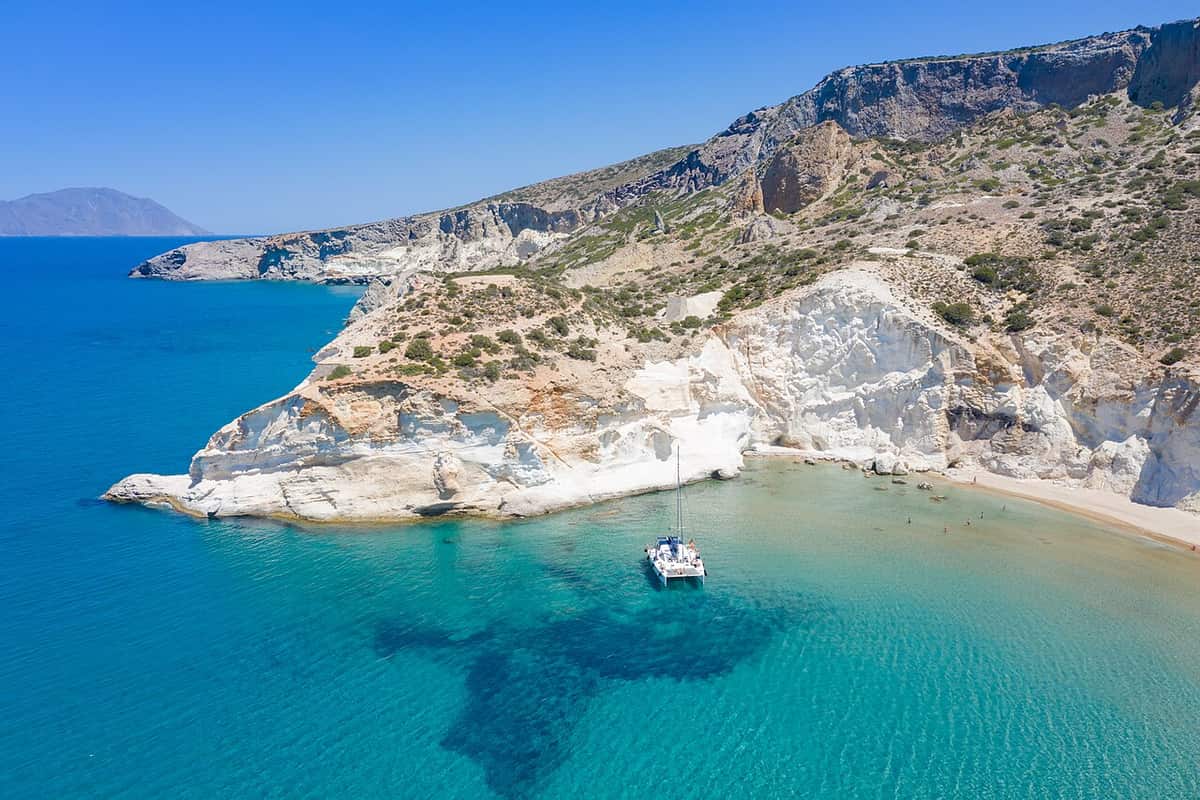
The wildest part of Milos is its west half, which has no villages. Nearly the whole uninhabited west belongs to a Natura 2000 site. Dirt roads lead to its coves, but a Milos private boat tour arrives by sea.
Tsigrado is a beach with white sand, emerald water and tall rocks around it. A fairly easy dirt road reaches the hilltop above the beach. From there, a steep path covered in sand drops to the beach, which is not organised.
Gerakas lies on the south coast, between Tsigrado and Agia Kyriaki. Only boats that make cruises reach this beach. On a Milos private boat tour, it is a cove for a boat, not a car.
The dirt road that leads to Agkathia makes it quite inaccessible by land. The effort pays off with shallow blue water, a sheltered bay and a long sandy beach. A Milos private boat tour skips the road and anchors in the bay.
Triades is a row of three sandy, secluded beaches, with blonde sand set between rocks. The land journey to them is tedious, and the beaches stay secluded. A boat follows the same line along the water and spares the tedious trip.
Kalogries lies in the north-west and is a secluded beach with turquoise water. The bay and its calm water create a natural pool. A Milos private boat tour anchors at the edge of that pool, and swimmers drop straight in.
A boat’s draft is its depth below the waterline. Draft sets the least water a boat can use, and a heavy load makes it deeper. A small boat built for shallow water can therefore edge closer to the rocks of a cove.
- Ammoudaraki: This beach of rich blonde sand sits beside Triades, where a dirt road ends.
- Agios Ioannis: The beach has three parts joined by paths, and only the first can be reached by car.
- Sykia: This cave has no roof and can be reached only from the sea.
- Kleftiko: The rocks and caves of Kleftiko are best seen from a boat or sailboat.
- Gerontas: The farthest south beach has white rocks and caves, plus a rock that looks like a bridge.
A Milos private boat tour turns these coves from names on a list into real stops. Clear water suits snorkeling, and a page about a Milos snorkeling cruise covers the gear. The skipper then picks the cove that suits the wind and the group on the day.

What does a Milos private boat tour show at Antimilos and the wild islets?
A Milos private boat tour shares the sea with Antimilos, an uninhabited island north-west of Milos. Steep volcanic cliffs rise to 671 metres. A rare wild goat lives on the slopes, and the whole island sits inside a protected nature area.
Antimilos belongs to the municipality of Milos, yet a Milos private boat tour finds nobody living there. The island is a mass of trachyte, a volcanic rock. People also call it Erimomilos, which means Desert Milos. The name fits an island with no people.
Antimilos is an old volcano, and its crater is still easy to see. The cliffs are cut in lava and tuff, a rock made of packed ash. Scientists put the age of the rock at 320,000 years. From a Milos private boat tour, the steep walls are the clearest sight.
Ancient people turned the crater into an open rain tank, a basin that collects rainwater. East of the island, three further volcanic domes sit on the sea floor. A dome is a rounded hill of cooled lava. The island is small, with an area of 8.8 square kilometres.
The island had other names long ago. In ancient times it was called Ephyra or Ephora. Ephora means watchtower, because the high point gives a long view over the sea. One reading of the Odyssey, an ancient Greek epic poem, makes it the island of the sun god.
Finds point to people on Antimilos in prehistoric times. Walls and arrowheads of obsidian, a glass-like volcanic rock, were found there. A cistern, which is a water tank, also remains. It is thought to be Roman or early Christian. Milos itself was a source of obsidian.
Antimilos belongs to Natura 2000, which is a European Union network of protected places. Its label is Site of Community Importance. A rare wild goat lives here, and so does a rare falcon. The Milos wall lizard lives here too.
The last wild goats face danger. Water shortage and mating with other goats threaten them. A visit to the island needs an official permit. A group on a Milos private boat tour needs to know this before it plans any stop.
- Antimilos: An uninhabited volcano north-west of Milos, with a crater at the top.
- Akradies: Uninhabited islets that belong to the municipality of Milos.
- Arkoudes: Rocky islets shaped like bears, which a Milos private boat tour around the island brings close.
- Glaronisia: Basalt islets near Pollonia, shaped like six-sided columns.
- Poliegos: An uninhabited island south-east of Kimolos.
Together, these islets give a Milos private boat tour a wilder side than the bay. Cliffs, bear-shaped rocks and basalt columns each look different from the water. Plathiena beach also looks out on Akradies and Arkoudes. Antimilos stays the far, protected island of goats and falcons.
What old mines does a Milos private boat tour pass along the coast?
A Milos private boat tour can pass the old sulphur mines of Thiorichia on the east coast. The mines exported sulphur until 1956. The ruins lie in a small cove with yellowish pebbles, and the site now has protected status.
Thiorichia is the name of the old sulphur mines. In Greek it is written Θειωρυχεία. Ancient writers called Milos the richest source of sulphur in their world. On a Milos private boat tour, this coast shows how the island once earned its living.
The mines sit in the small cove of Paliorema on the east side of the island. The beach there has yellowish pebbles and very clear water. A dirt road runs down to the cove along the ravine of Paliorema.
Old mine buildings stand in the cove. Rail wagons still rest on their tracks. Rusty tools and unused spare parts lie in a warehouse. The setting is wild and mysterious. The cove is one of the geological sights of the island.
This is the only industrial site on Milos with protected status. The culture ministry of Greece named it a historic site. A Milos private boat tour looks at a key piece of industrial heritage. Here the buildings fit the needs of the work.
The slopes above the cove carry thin plant cover. Salty wind carves the hard volcanic rock until it forms odd shapes, which are called noches. Their forms can look like animal heads with open mouths. Old tunnels, once dug for white kaolin clay, open in the walls of the ravine.
Other old workings line the coast. At Agathia beach, old tunnels and open-air workings show on the shore. The old port buildings have survived too. Near Mersinia, old tunnels once gave kaolin and baryte, a mineral. At Agathia, a Milos private boat tour can see the old port from the water.
Cape Vani has a mine of the same name. Hard volcanic rock and low plants cover the cape. Sea kayakers paddle this coast too. The kayak route to the sulphur mines runs from Tria Pigadia to Thiorichia. A Milos private boat tour can cover the same coast with a skipper at the helm.
- Thiorichia: Sulphur mines in the cove of Paliorema, worked until 1956.
- Agathia: Old tunnels, open-air workings and port buildings beside a beach.
- Mersinia: Old tunnels that once gave kaolin and baryte.
- Cape Vani: A mine of the same name, with salt-carved noches.
- Voudia: A large pebble beach beside working mine plants.
A Milos private boat tour turns these mines into a short lesson in how Milos earned its living. Yellow pebbles, rusty wagons and old tunnels tell the story from the shore. The ruins are protected, so a group looks and photographs but leaves everything in place.
Where does a Milos private boat tour start: Adamas or Pollonia?
A Milos private boat tour starts at a harbour. Boats leave from Adamas, the main port, and from Pollonia, the second port. Adamas lies on the bay’s north-eastern shore. Pollonia sits at the island’s north-eastern tip.
Adamas is the largest tourist centre on Milos and also its main port. Cretan refugees built the village on the north-eastern shore of the bay. This natural bay is among the biggest in the Mediterranean, and among the safest. A Milos private boat tour from Adamas starts in safe water.
The town of Adamas holds the Maritime Museum and the Mining Museum. The 600-year-old church of the Holy Trinity stands there too. The houses are white, with small courtyards full of flowers, and the streets are narrow and quiet.
East of the harbour, the coast road leads to the beach of Papikinou. The beach begins about 500 metres east of the port and runs on toward Alykes. At Alykes lie old salt works, now abandoned. They have become an important wetland.
Milos has a second port in the village of Pollonia. It is a fishing village built around a small creek at the north-eastern tip of the island. Local fishing boats bring in fish, octopus and lobster at the pier. A Milos private boat tour from Pollonia starts beside this working harbour.
The main beach of Pollonia has sand. Piso Thalassa, which means Back Sea, lies close to the village. Kastanas lies just south. This wild beach of pebbles has rocks coloured red, orange and purple. For a Milos private boat tour, all three places sit close to the village.
On the left side of Pollonia lie a church and Pelekouda, a peninsula that is worth a visit. Once, a temple of Apollo occupied the site of the Pelekouda lighthouse. The village takes its name from that temple.
Kimolos, the neighbouring island, lies north-east of Milos. Of the larger islands near Milos, it is the closest. Pollonia has a regular link to it by small boat. A Milos private boat tour from Pollonia leaves from the village with that link. In ancient times Kimolos was famous for its figs.
- Adamas: The main port, on the north-eastern shore of the bay.
- Pollonia: The second port, at the north-eastern tip of the island.
- Papikinou: A beach east of the harbour of Adamas.
- Kastanas: A wild beach just south of Pollonia.
- Kimolos: The neighbouring island, linked to Pollonia by a small boat.
Each harbour gives a Milos private boat tour a different first view. Adamas opens on the wide bay and its museums. Pollonia opens on a fishing creek, with the island of Kimolos beyond. Both harbours sit on the north-eastern side of Milos.
Why do couples and groups choose a Milos private boat tour for a honeymoon or a celebration?
A Milos private boat tour gives a couple or a group the whole boat. No strangers share the deck. The group sets the mood, the music and the stops. It suits a honeymoon, a proposal, a birthday or any day worth marking.
A honeymoon is a holiday that newlyweds take after the wedding to celebrate the marriage. Honeymoon trips tend to go to places seen as exotic or romantic. One common purpose is to relax, share a memorable time and adjust to married life. A Milos private boat tour fits that purpose.
The custom began in early 19th-century Britain. Upper-class couples took a bridal tour, sometimes with friends or family. By the late 1800s, honeymoons for the couple alone were widespread. They were one of the first forms of mass tourism, meaning travel for the wider public. A private boat suits a couple or a party.
On a private boat, no other passengers share the deck. The group can stop in a quiet cove for a swim, a toast or a photo. Milos is a less crowded island than Santorini or Mykonos. That quiet setting suits a Milos private boat tour built around one group.
Quiet coves suit a celebration. Boats reach small beaches that have no road. The group can have a small beach to itself while the crew keeps watch. The west side of Milos is uninhabited, so evening light falls on rugged hills and open sea.
The island holds a link to love as well. A statue found on Milos in 1820 is believed to show the Greek goddess of love. It has been on show in Paris since 1821. A Milos private boat tour gives couples a view of the island where it was found.
Simple ideas mark the day. A couple can bring flowers, a card or a small cake. A toast at anchor in a quiet cove is enough. A proposal needs only a quiet word with the crew in advance. The plan stays secret on a Milos private boat tour.
Groups mark other days the same way. A birthday, an anniversary or a farewell trip all fit. Friends and relatives share one deck and one plan. The group picks the music and the snacks, and the crew looks after the sailing.
- Honeymoon: A Milos private boat tour keeps the day between the couple and the crew.
- Proposal: A quiet cove and a private deck give the question its own setting.
- Birthday: The group picks the music, the snacks and the mood.
- Reunion: Friends and relatives share one deck without other passengers.
- Anniversary: A toast at anchor marks the day with no fuss.
A Milos private boat tour turns a honeymoon or a party into a day with its own pace. The group chooses the mood, the cove and the moment to mark. The crew handles the boat. Flowers, a card or a toast are all it takes.

Is a Milos private boat tour a good choice for families with children?
A Milos private boat tour lets a family move at the pace of its children. Rest, shade, snacks and short swims fit around the children. There is no fixed plan. Every child wears a life jacket that fits for the whole trip.
A family on a private boat does not follow a plan made for strangers. Young children tire, get hungry and want to swim at different moments. The family tells the crew, and the plan changes. A Milos private boat tour can stop early or turn back to the harbour.
Milos has dry summers that run from warm to hot. Shade on deck gives children a place to rest between swims. Limiting sun damage matters for everyone, and it matters even more for children. Hats, light shirts and a cover over the deck all help.
Children are in the risk group for dehydration, which means too little water in the body. So are adults who exert themselves in hot weather. Water within reach helps, and so do regular snacks. On a Milos private boat tour, the family sets the snack breaks.
Life jackets are commonly worn on small boats, where an accidental fall into deep water can happen. A child wears the jacket from the first step on board. A child’s foam vest has a grab handle at the headrest. An adult can use the handle to lift a child out of the water.
A Milos private boat tour can stop in a sheltered cove for short swims. A child who cannot swim can still enter the water in a life jacket. A foam vest called a buoyancy aid lets the wearer move freely. An adult stays within arm’s reach and ends the swim when the child tires.
Milos reaches about 23 kilometres along its east-west line and 13 kilometres along its north-south line. Distances are short on an island of that size. A family can leave a stop that tires the children. It can move to a calmer cove or head straight back to the harbour.
- Pace: A Milos private boat tour lets the family decide when to swim, eat, rest or head back.
- Shade: A cover over the deck gives children a place out of the sun.
- Water: Drinks within reach protect children from dehydration.
- Vests: A child’s foam vest with a grab handle lets an adult lift the child from the water.
- Swims: Short swims in a sheltered cove, with an adult close by, suit young children.
A Milos private boat tour works for families because the day bends around the children. Rest, shade, drinks and snacks come when needed, and life jackets stay on. Families who prefer a wider, steadier deck can also read about a Milos catamaran cruise.

What makes a Milos private boat tour good for photos and filming?
A Milos private boat tour gives its best photos in soft morning and late light. The white rocks look bright and the water turns turquoise. Phones and cameras stay dry in a sealed bag. Other people stay out of the frame unless they agree.
Photographers call the light after sunrise and before sunset the golden hour. The sun is low then. Daylight turns redder and softer. The name is just a label, so the effect has no fixed length. A Milos private boat tour can plan its stops around this light.
At midday the high sun makes strong bright spots and dark shadows. In softer light, shadows are less dark. Bright areas are less prone to burn out. A private group sets its own pace. A Milos private boat tour can wait for better light.
The coast of Milos is volcanic, and its rocks show white, red, yellow and even black. At Sarakiniko the rock is all white, beside deep blue water. Kleftiko has grey and white rocks, caves and turquoise water. Kleftiko is best reached by boat, so a Milos private boat tour brings it into the frame.
Sun on the sea creates glare that hides the colour below. A polarizing filter is a clear filter in front of a camera lens. It cuts reflections off the water. Natural colour and detail then come through. Polarizing sunglasses give the eyes the same effect.
Spray and wet hands are the main risks for phones and cameras. At anchor, the boat sits still and spray is rare. On a Milos private boat tour, the camera can come out then. Between shots, it goes back into a dry bag. The next section explains dry bags.
Other boats, swimmers and beach visitors end up in the frame. Privacy is a person’s ability to keep parts of life out of public view. Privacy laws in a range of countries protect that right. On a Milos private boat tour, a photographer asks before filming a face up close.
A drone is an aircraft with no pilot on board, and it can film from the air. Drone flying falls under the civil aviation authority of each country. A traveller who wants aerial film asks the skipper first and reads the current local rules. Until then, the drone stays in its case.
- Low sun: Light after sunrise and before sunset is redder and softer.
- Glare: A polarizing filter cuts reflections from the sea surface.
- Flare: Aiming straight at the sun adds a washed-out haze to the frame.
- Dry gear: Phones and cameras wait in a sealed bag between shots.
- Privacy: Other people stay out of the frame unless they agree.
A Milos private boat tour gives the group control of the stops. Photos and film can wait for good light. Soft light, a dry lens and polite framing make the best results. After the last frame, the phones go back in the bag and the water takes over.
What food, drinks and gear suit a Milos private boat tour?
A Milos private boat tour calls for plenty of water, easy snacks, a hat and sun cream. Swimwear, a towel, a light layer, soft-soled shoes and a dry bag complete the list. Each item solves one small problem on the water.
Water comes first. The body loses water through sweat. Dehydration starts when that loss is greater than the water drunk. Thirst, a headache and tiredness are early signs. On a Milos private boat tour, the group carries plenty of water and drinks at every stop.
Snacks keep energy steady between swims. Milos makes its own cheeses, capers, thyme honey and herbs. People pick capers by hand, then dry them in the sun. Small tastes of these local products need no cooking, so they suit a Milos private boat tour. Hot dishes served on deck belong to a Milos catamaran cruise.
Sun cream, also called sunscreen, helps protect skin against sunburn. A broad-spectrum type covers UVA and UVB. These are two kinds of ultraviolet light from the sun. Any sun cream is put on again as the label directs. Active ingredients also differ in how they affect marine life.
A sun hat shades the head, face, neck and shoulders from direct sunlight. Its brim does the main work. Sea wind can lift a hat, so a chin cord helps. On a Milos private boat tour, sunglasses and a light long-sleeved shirt add more cover.
Swimwear goes on under the clothes, so a swim stop needs no changing. A towel dries the skin after the swim. A light layer matters because moving air makes skin feel colder. That effect is called wind chill. On a moving boat, a thin top cuts the breeze.
Shoes with soft soles protect the deck and grip when it is wet. Boat shoes have non-marking rubber soles with fine cuts, called siping. The cuts give grip on a wet deck. Non-marking soles leave no scuffs. On a Milos private boat tour, the skipper can ask guests to go barefoot.
A dry bag is a flexible bag that seals in a watertight way. The usual closing is a roll-top. Two firm strips fold over and clip shut with a buckle. A dry bag protects phones, cameras and spare clothes from water. Small sizes fit a camera or a smartphone.
- Water: Plenty for everyone on board, kept in a shaded spot.
- Sun cream: Broad-spectrum, put on before boarding.
- Hat: A brim that shades the face and neck.
- Light layer: A thin top for the breeze after a swim.
- Dry bag: A roll-top bag for phones, cameras and spare clothes.
The packing list for a Milos private boat tour is short and simple. Water, shade, a dry bag and a light layer cover the basics. A galley is the small kitchen on a yacht. Life on board, galley included, is explained under a Milos sailing tour.
How does a visitor choose a Milos private boat tour and plan for the weather?
A Milos private boat tour is easy to choose with four checks. They are the boat type, the start point, what the day includes and the length of the day. Wind can shift the plan, so a flexible route is normal on a private trip.
In summer, the Aegean has a strong, dry north wind called the meltemi. On the Beaufort scale of wind strength, this wind can climb to force 7 to 8. On such days, a skipper moves a Milos private boat tour to a calmer coast.
From its eastern edge to its western edge, the island is about 23 km. From its northern edge to its southern edge, it is about 13 km. A boat can cover only part of that coast in one trip. The length of the day sets how far the route goes.
A half day suits a first trip, a short wish list or guests who tire fast. It covers one stretch of coast with swim stops along the way. The rest of the day stays free for a beach or a meal on land.
A full day suits a long wish list or a trip to the far side of the island. It leaves room for longer swim stops and a meal on board. On a Milos private boat tour, a full day also lets the skipper wait for calmer water.
The description starts with the boat type, which shapes the ride, the shade and the deck. A motorboat runs on an engine, and a sailboat runs on sails. A catamaran rides on a pair of hulls that match in size and sit next to each other.
On a Milos private boat tour, the start point is the next check. Sea excursions on Milos leave from ports such as Adamas and Pollonia. A start in the right port saves a long drive on land before the boat even leaves.
The last check is what the day includes, because the list differs from boat to boat. The description names items such as the skipper, fuel, snorkel gear, drinks or a meal. Five questions to ask before booking turn that list into a clear plan.
- Boat: Which boat carries the group, and how does it handle small waves?
- Start: Where is the meeting point, and how does a guest reach it?
- Included: What does the day include, and what does the guest bring?
- Route: Who picks the stops, and how does the plan change on a windy day?
- Safety: Are life jackets on board in the sizes the group needs?
With the boat, the start point and the list settled, the choice is simple. A Milos private boat tour then slots easily into the rest of the holiday. Visitors who want sea and land in one stay can browse more activities in Milos before they choose.

Which small questions matter before a Milos private boat tour?
Before the day starts, a Milos private boat tour raises practical questions. They cover route changes, food, beaches, music, pets, mobility, seasickness and weather. Each answer below is brief and simple, giving a first-time visitor a clear picture of the day ahead.
Can the route change on the day of a Milos private boat tour?
Yes, because the boat carries only the group and no other passengers. Guests tell the skipper if they want a longer swim stop or a skipped stop. The skipper agrees when wind, waves and the rest of the plan allow it. The skipper has command of the boat, so safety comes before the plan on paper.
Can guests bring their own food and drinks on a Milos private boat tour?
Guests ask the skipper first, because the answer depends on the boat and the trip. A cooler bag keeps food and drinks cold on deck. Dehydration sets in once the water leaving the body outweighs the water entering it. A full water bottle is worth packing, and all rubbish goes back to land.
Can guests land on beaches during a Milos private boat tour?
Yes, where the sea and the shore allow it. Certain beaches on Milos have no road access, so a boat is the way in. Guests swim in, or ride a dinghy, a small boat that carries people to shore. The skipper decides on the day, because wind and waves change the landing.
Is music allowed on a Milos private boat tour?
The skipper sets the rule, so guests ask before the day starts. A small speaker is the common choice on a private boat, and guests bring it along. Volume stays low enough to hear the skipper’s calls and the engine. Swimmers close to the boat also need to hear its engine and the skipper.
Are pets welcome on a Milos private boat tour?
Pets are a question for the skipper, so guests ask before the day. A private boat takes a pet only when the skipper agrees. Dogs cannot sweat across the whole body to cool down, so a sunny deck gets hot for them. Shade and a full bowl of fresh water come first on any hot day.
Is a Milos private boat tour possible with reduced mobility?
Yes, a private trip lets the group plan around mobility. Guests ask how people get on board, by gangway, ramp, steps or ladder. A gangway is a bridge or ramp used to board a boat. A flat deck and a calm start help, and the group can pick the easiest port.
What helps against seasickness on a Milos private boat tour?
Two things help: a steady gaze on the horizon and a head kept still. Guests stay on deck in open view of the sea, because going below deck makes seasickness worse. Water has no fixed points to judge motion by, so the horizon is the best reference. A pharmacist can advise on medicine before the trip.
What happens to a Milos private boat tour in rain or clouds?
Summer on Milos is warm and dry, and rain falls as showers or thunderstorms. A cloudy day alone does not end the trip. Clouds block only part of the sun’s UV rays, so sun cream and a hat still matter. If the sky turns stormy, the skipper decides whether the trip goes on.