
A Milos speedboat tour is a fast boat trip along the coast around the island of Milos. The boat is small and light, and a strong engine drives it. It skims across the water, so it covers more coast than a slower boat in the same time.
This opening part explains how a Milos speedboat tour works and why the boat is so fast. It starts with the boat, the island and the coast it runs along. Then it sets the speedboat beside a RIB and beside the slower boats on other tours.
What does a Milos speedboat tour look like at a glance?
A Milos speedboat tour is a trip on a small, fast motorboat with a skipper at the wheel. The boat carries a small group along the coast of Milos. Its speed lets it reach more bays and beaches in the same time as a slow boat.
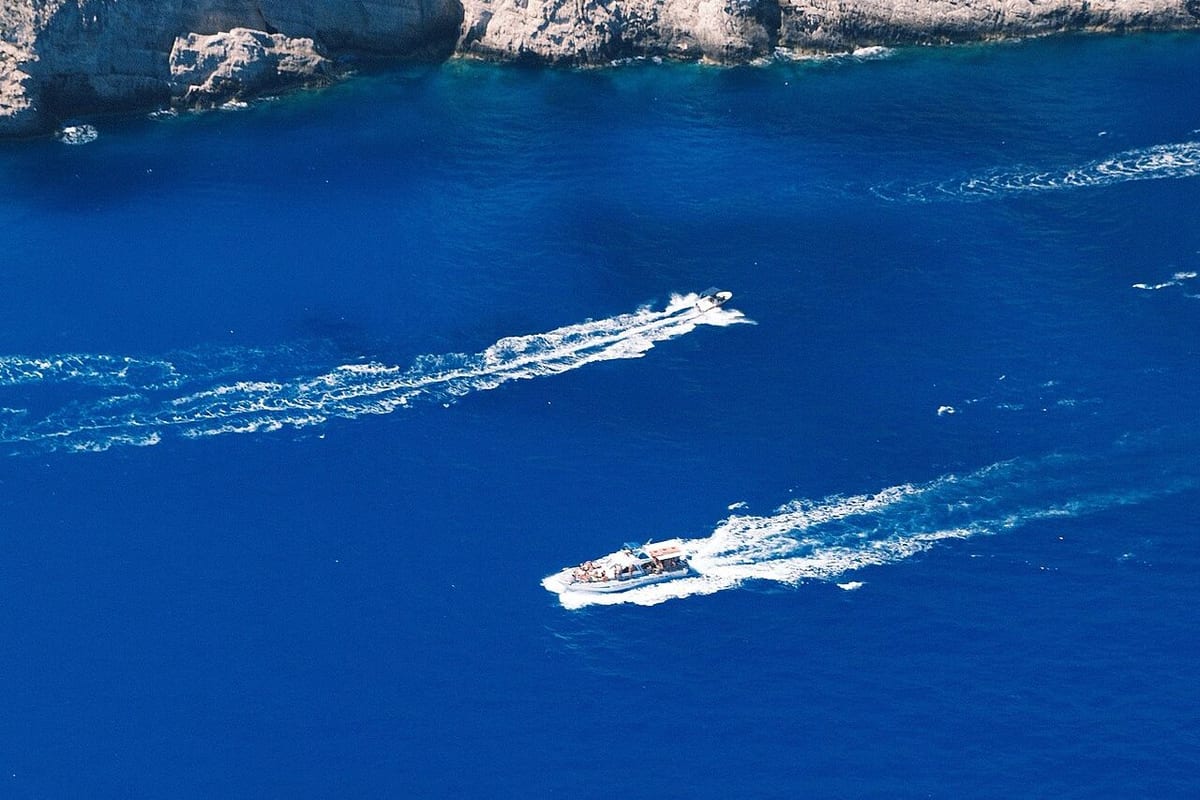
A motorboat gets all its push from a motor, never from wind or muscle. A motorboat that cruises much faster than others is called a speedboat. A Milos speedboat tour uses this kind of boat to run along the island coast.
A small motorboat can carry an outboard motor on its stern, meaning the rear end of the boat. An outboard motor packs the engine, the gearbox and the propeller into one portable unit. Bigger motorboats can place the engine inside the hull, the body of the boat, instead.
Milos, a volcanic island, sits in the Aegean Sea. It is the south-westernmost of the Cyclades islands, and the Sea of Crete is just south of it. Its length is about 23 kilometres, measured east to west. Its width is about 13, measured north to south.
A horseshoe shape gives the island a large bay in the middle. At least 90 beaches are known, and they ring the whole coast. The count is 17 north, 12 east, 21 south, 15 west and 25 inside the bay.
Land access stops short of other beaches, so only a boat can take you to them. On a Milos speedboat tour, the boat can run to beaches with no land access. From the water, the rocks and the mineral wealth of the island also come into view.
A speedboat is a small craft, so the group on board is small as well. A skipper, the person at the wheel, steers the boat and runs the trip. Boats depart from Adamas, the harbour town, and from the port of Pollonia.
The gain of a speedboat is distance. The coast of Milos is long and varied, and a fast boat passes along more of it. A Milos speedboat tour turns that speed into more bays and beaches seen in one outing.
- Trip: A Milos speedboat tour is a coast run on a small, fast motorboat.
- Boat: A speedboat is a motorboat that cruises much faster than others.
- Engine: A small motorboat can carry an outboard motor at the stern.
- Island: Volcanic Milos sits at the south-western tip of the Cyclades.
- Coast: Beaches line the island on every side, and more lie inside the bay.
A Milos speedboat tour is a simple idea built on speed. A small, fast motorboat runs along a long volcanic coast with a skipper at the wheel. The next section shows why the boat is fast and how a RIB or slower boat differs.

Which boat suits a Milos speedboat tour: a speedboat, a RIB or a slower boat?
A Milos speedboat tour runs on a motorboat with a planing hull that skims over the water. A RIB is a similar fast boat with air tubes along its sides. A slower boat stays low in the water and rides more gently.
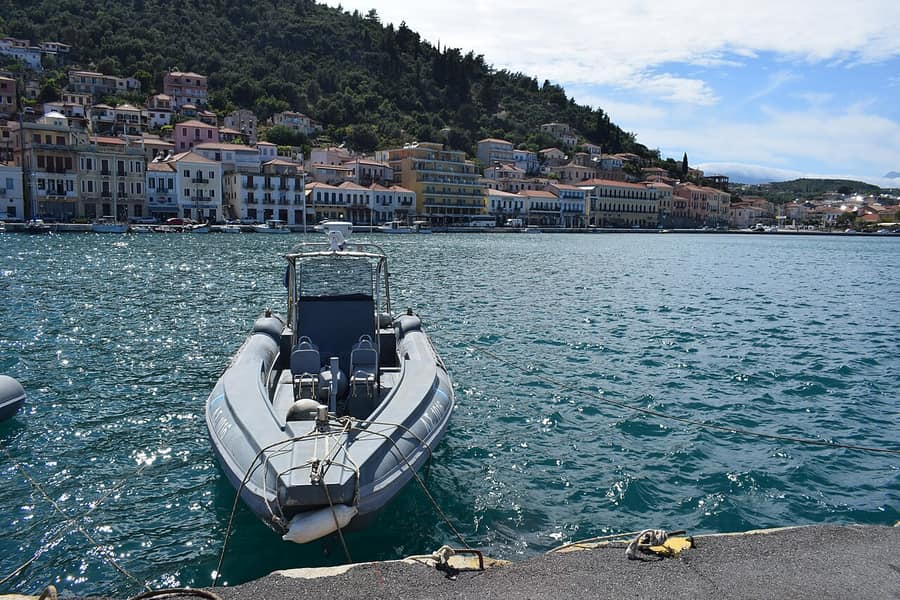
A boat at rest floats on buoyancy, which is the upward push of the water. As the boat speeds up, moving water also pushes up on the hull from below. That second push, a force from moving water, is called lift.
At a certain speed, lift becomes the main force holding the boat up. The hull then rises out of the water and skims along the top. This is called planing, and a Milos speedboat tour depends on it for speed.
Once the hull rises, less of it stays wet, and less wet hull means less drag. Drag is the force of the water that holds a boat back. A Milos speedboat tour therefore uses a light boat with a strong engine, because planing needs both.
A V-shaped hull slices through water more easily and holds the boat steadier in rough seas. A deep V cuts through waves easily but needs more engine power to start planing. A shallow V planes at a lower speed but gives a rougher ride.
RIB stands for rigid inflatable boat. Its hard bottom carries air tubes along both sides. The tubes keep the boat afloat even when water gets in. A RIB also has a planing hull, so it skims in the same way.
A slower boat sits in the water as a displacement hull, meaning its weight rests mainly on buoyancy. Its speed stays within a limit set by the length of the hull where it meets the water. Every hull works this way at low speed, even the hull of a speedboat.
A slower boat has strengths that a Milos speedboat tour does not offer. A rounded hull rides more softly in waves and does not need the extra energy that planing takes. Sailboats and other slower boats run on other boat tours in Milos.
- Speedboat: A Milos speedboat tour runs on a motorboat that skims on a planing hull.
- Planing: Lift takes over from buoyancy, and the hull rises out of the water.
- V hull: A deep V cuts through waves but needs more power to start planing.
- RIB: A RIB has a hard bottom and air tubes that keep it afloat.
- Slower boat: A displacement hull rides on buoyancy at a limited speed.
A Milos speedboat tour runs on a planing hull, which lifts the boat and lets it skim. A RIB skims the same way, while a slower boat trades speed for a softer ride. The next parts cover how the ride feels, the Kleftiko run and the swim stops.
How does a Milos speedboat tour feel on the water?
A Milos speedboat tour feels quick and lively. The bow lifts as the boat gains speed. Small waves send short bumps through the hull, and wind and spray reach the riders. Seats toward the back ride smoother than the front.
A speedboat does not sit in the water like a slow boat. At low speed, the water holds up the hull, the body of the boat. As speed grows, the hull climbs onto the water and skims across it. Designers call this planing. A Milos speedboat tour spends its fast stretches this way.
The bow, the front of the boat, rises first. Riders feel the nose tilt up as the engine pushes harder. Weight placed toward the back helps lift the bow. Once the boat is up on the water, the nose settles down and the ride levels out.
Small waves feel different at speed. A slow boat rolls over them. A fast boat meets each wave in quick steps, and riders feel each tap through the seat. Hull shape changes the bumps. A deep V hull, one with a sharply pointed bottom, cuts through waves easily. A shallow V hull rides rougher.
Wind is part of the ride. At speed, the air hits the face and pulls at hair and clothes. Summers on Milos are warm and dry, so the moving air feels cool. Spray rises where the bow meets a wave, and the wind throws a little of it back.
On a Milos speedboat tour, the back of the boat rides calmer. The front lifts and drops with each wave, like a see-saw. The rear sits on the flat part of the hull and moves less. A seat toward the back suits riders who dislike bumps.
Open air helps riders who feel unwell. Looking at the horizon, the far line where sea meets sky, steadies the head and eyes. Going below deck makes motion sickness worse. On a Milos speedboat tour, a rider who feels queasy can sit still and watch the horizon.
- Lift: The hull rises out of the water as speed grows.
- Bumps: Small waves reach the seat as quick taps.
- Wind: Moving air hits the face and carries a little spray.
- Back seats: The rear of the boat rides smoother than the bow.
- Horizon: Watching the far line of the sea steadies the stomach.
A Milos speedboat tour trades a slow roll for speed and a lively ride. The bow lifts, the waves tap, and the wind blows. Riders who pick a back seat feel fewer bumps. Riders who watch the horizon keep the stomach calm. Both tips suit a Milos speedboat tour.
Why does a Milos speedboat tour suit the run to Kleftiko?
A Milos speedboat tour suits the run to Kleftiko. The rocks lie at the south-west tip of the island. A fast boat covers that long coast quickly. That leaves more of the trip for the rocks, the caves and the water.
Milos is the island in the far south-west of the Cyclades. It runs about 23 kilometres east to west and about 13 north to south. Its horseshoe curve wraps around a large gulf. A Milos speedboat tour shortens the long trips between its far corners.
Kleftiko lies in the south-west of Milos. Three small bays hold its white cliffs and islets. Excursion boats reach it, and so does a path. A separate page explains a Kleftiko boat tour in full, with its rocks and caves.
The ports of Adamas and Pollonia are where boats mainly set off. Both lie in the north of Milos, far from the south-west tip. On the south coast, Kipos is a small port that serves as a start for Kleftiko boats. Speed makes each of these starts shorter.
Milos is at its wildest in the west half. No villages stand there, only tiny settlements. Nearly all of this land falls inside the Natura 2000 network of protected areas. The beaches there are isolated, and the way to them is long.
The list for the west coast has 15 beaches. It starts at Akrotiri Psalida in the south and ends at Vani in the north. Sykia, Agios Ioannis, Ammoudaraki, Triades, Vourlidia, Agkathia and Kalogries are among them. On a Milos speedboat tour, the whole chain can pass by in one run.
By road, the same places need long dirt tracks. The road to Agios Ioannis is a dirt road of about 12 kilometres. Agkathia also needs a dirt road. The journey to Triades is tiring. A boat skips all of it and follows the water.
Excursion boats call at Sykia and at Kleftiko. Sykia is a cave found on the west coast. Its roof has fallen in, so sunlight lights the water inside. Only boats can reach it. A Milos speedboat tour can fit this stop in with the rocks.
- Location: Kleftiko lies in the south-west of Milos.
- Distance: Milos is about 23 kilometres wide, measured east to west.
- Start points: Boats leave from Adamas, Pollonia and the small port of Kipos.
- West coast: A chain of 15 listed beaches runs from Akrotiri Psalida to Vani.
- Roads: Dirt tracks make the same places slow to reach by land.
A Milos speedboat tour turns a long coast into a short run to Kleftiko. The west side has no villages and only dirt roads. The sea is the easy way along it. The rocks at the tip then get more of the trip.

How does a Milos speedboat tour link more coves in one trip?
A Milos speedboat tour links more coves in one trip because speed shortens each crossing between bays. The south and west coasts hold a long chain of coves. A fast boat can join more than one of them in a single outing.
Milos has over 70 beaches. You can get to part of them by land. For the others, the sea is the only way in. The coast is a long line of coves. A boat can stop at those that roads do not reach.
Every extra cove adds one stop and one crossing. On a slow boat, the crossings take up much of the trip. A Milos speedboat tour makes each crossing short. That leaves time at the next cove for a swim and a look around.
Paliochori is almost 2 kilometres long. Its rocks are red, pink, yellow and white-grey. Warm water gushes up there, a result of the volcanic energy under the island. Fyriplaka combines volcanic rocks with fine white-grey sand and white pebbles. Both lie on the south coast of the island.
Tsigkrado is a white beach with emerald water, held between huge rocks. By land, it needs a steep, sandy path down from a dirt road. The beach is not organised. A boat arrives from the sea, so the climb is not needed.
Iron oxides colour the golden-red sand of Provatas, where the water is very shallow. Agios Sostis extends Provatas and is named after a church above it. Kipos offers a sandy beach and a small port. All three sit together on the south coast list.
On the west coast, Triades is a row of three sandy beaches, one after the other. Ammoudaraki lies next to Triades and has rich blonde sand. Agkathia has shallow blue water and a sheltered bay. Kalogries has calm water that forms a natural pool.
For more detail on each cove, see the beaches of Milos, a separate page. It covers sand, rocks, water and access cove by cove. A Milos speedboat tour simply strings them together along the water.
- South coast: Paliochori, Fyriplaka, Tsigkrado, Provatas, Agios Sostis and Kipos sit on one list.
- West coast: Triades, Ammoudaraki, Agkathia and Kalogries lie along the west coast.
- Sea only: The sea is the only way to reach part of the island’s beaches.
- Speed: A fast boat keeps each crossing between bays short.
- Stops: Each extra cove adds one stop to the same run.
A Milos speedboat tour joins coves that roads reach slowly or not at all. The south coast gives colourful rocks and red sand. The west coast gives blonde sand and calm bays. Speed lets a Milos speedboat tour fit more of them into one outing.
Why does a Milos speedboat tour make quick crossings to Kimolos and Polyaigos?
A Milos speedboat tour makes quick crossings because the three islands sit close together. A channel 1 kilometre wide separates Milos from Kimolos. Polyaigos is 2 kilometres away from Kimolos and 6.2 kilometres away from Milos. A fast boat turns each gap into a short hop.
Milos, Kimolos and Polyaigos form a tight group of islands in the south-west Cyclades. Kimolos lies north-east of Milos. Polyaigos lies south-east of Kimolos and is uninhabited, so it has no town of its own.
The first gap is the shortest of the three crossings. A channel 1 kilometre wide separates Milos from Kimolos. A fast boat crosses that narrow strip of water in one short burst, then carries on.
The second gap is 2 kilometres wide, and it lies between Kimolos and Polyaigos. Both belong to one municipality, which is a local council area, so they are close neighbours. A fast boat links them in one short hop.
The third gap is the longest of the three, at 6.2 kilometres. Milos lies west of Polyaigos, with four rock islets between the two. A Milos speedboat tour covers this open water in one fast run.
A local ferry also joins Milos and Kimolos, but a ferry sails from port to port. A Milos speedboat tour is free to leave that line and head for a cove. Speed and freedom together make the gaps feel small.
On a Milos speedboat tour, no crossing leaves land far behind. The widest gap is still only 6.2 kilometres. A short way to the nearest shore also keeps the day simple if the wind rises.
Polyaigos has its own page about a Polyaigos boat trip, with its beaches and wildlife. This section only covers how a speedboat gets there. The short gaps let one Milos speedboat tour reach both Kimolos and Polyaigos.
- Milos to Kimolos: A channel 1 kilometre wide separates the two islands.
- Kimolos to Polyaigos: The two islands lie 2 kilometres apart.
- Milos to Polyaigos: The gap is 6.2 kilometres, the longest of the three.
- Stepping stones: Four rock islets lie between Milos and Polyaigos.
- Ferry link: A local ferry also joins Milos and Kimolos, port to port.
In short, the islands are close, and a fast boat shrinks the gaps even more. A Milos speedboat tour crosses the 1, 2 and 6.2 kilometre gaps in short runs. That leaves room in the day for swimming and for looking at the coast.

Who is a Milos speedboat tour right for?
A Milos speedboat tour suits people who enjoy speed, spray and a small group. A calmer boat is the better choice for anyone with back or neck problems. Pregnant women and very small children also do better on a calmer boat.
A Milos speedboat tour is a lively ride from start to finish. The boat moves fast, turns sharply and sends up spray. Tourist RIBs, which are rigid inflatable boats, are built for thrill rides with high speeds and turns.
People who like fairground rides enjoy this kind of trip. Fit teenagers and adults who can sit upright and hold on through every bump do well. It is a lively day at sea, not a slow float.
Small boats carry fewer passengers than a big cruise boat. A Milos speedboat tour therefore means a small group, and everyone sits close together. A RIB also has a shallow draught, so its hull sits only a little way below the surface.
A fast boat also suits people with a busy day. It covers the gaps between islands quickly, so one outing can include more than one stop. Travellers who dislike long boat rides tend to like that.
Anyone with back or neck problems is better off skipping a Milos speedboat tour. Waves make a fast hull bounce, and the bumps pass up through the seat into the spine. A doctor can say whether a fast ride is safe.
Pregnancy is another reason to pick a calmer boat over a Milos speedboat tour. Pregnancy is a risk factor for motion sickness, and fast jolts call for extra care. Pregnant women ask a doctor before planning any boat trip at sea.
Very small children are a poor fit for a fast boat. They cannot hold a handle through every bump or turn, and loud engines and spray can upset them. A catamaran cruise, with two hulls, is a steadier choice for them.
- Thrill seekers: Speed, sharp turns and spray are the whole point of the ride.
- Small groups: A small boat holds fewer passengers, so the group stays close.
- Back or neck pain: A calmer boat gives the spine a gentler ride.
- Pregnancy: A calmer boat is the safer pick, after a word with a doctor.
- Small children: A slower boat with a steadier deck suits them better.
A Milos speedboat tour is a lively day for people who like speed and a small group. People with back or neck problems, pregnant women and very small children do better on a calmer boat. About one person in three is prone to motion sickness, so a gentler boat suits that group too.
Where do passengers sit and stay dry on a Milos speedboat tour?
On a Milos speedboat tour, passengers sit on jockey seats or benches and hold the handles. Spray is part of the ride. A strapped hat, sunglasses on a cord and a phone in a waterproof pouch keep the day easy.
Tourist RIBs use jockey seats. A jockey seat is a padded saddle that passengers sit astride, with a grab rail in reach. The saddle helps the body move with each bump, so the ride stays steadier.
Where a passenger sits decides how wet and how bumpy the ride is. On a Milos speedboat tour, front seats meet the spray first. Seats toward the back stay drier, so passengers who want dry clothes choose them.
Passengers hold the handle with a firm grip and keep both feet on the floor. Turns come fast on a speedboat, and the body leans with them. A loose hand, with a phone in it, is the first thing to slip.
Spray is salt water that flies over the sides when the hull hits a wave. It wets clothes, hair and skin, and it leaves a salty film when it dries. Quick-dry clothes and a light windproof layer suit the ride, because wind makes wet skin feel cold.
A loose hat flies off at speed and lands in the sea. A hat with a chin strap, or a cap kept in a bag, stays on board. Sunglasses on a cord hang from the neck, and a headband keeps hair out of the eyes.
A phone in a waterproof pouch stays dry on a Milos speedboat tour. The pouch hangs from the neck or wrist on a cord, so it cannot fall into the sea. Reading on a moving boat can add to motion sickness, so the horizon is better to watch.
Large bags are a poor fit for a small, fast boat. A small zipped bag is enough for a towel, water, sun cream and a dry top. Keys and cards go in a sealed pouch inside the bag on any Milos speedboat tour.
- Seat: Seats toward the back stay drier and ride smoother than seats at the front.
- Grip: Both feet stay on the floor and one hand stays on the handle.
- Hat: A chin strap, or a bag, keeps it from flying off.
- Sunglasses: A cord around the neck stops them dropping into the sea.
- Phone: A waterproof pouch on a cord keeps it dry and safe.
A Milos speedboat tour is easy with a good seat, a firm grip and the right gear. A strapped hat, corded sunglasses and a waterproof pouch handle the wind and the spray. Passengers can then watch the coast instead of their kit.
What does the skipper cover in the safety briefing on a Milos speedboat tour?
A Milos speedboat tour begins with a short safety briefing from the skipper. It covers the life jackets, where to hold on, staying seated and the engine cut-off cord. Each point is explained in plain words before the boat leaves.
The skipper drives the boat and is in charge of everyone on board. A fast boat leaves the quay quickly, so the safety words come first. On a Milos speedboat tour, the briefing comes before the engine starts.
A life jacket keeps the wearer afloat, holding the mouth and head clear of the surface. No swimming is needed, and the wearer can even be unconscious. The briefing starts with these jackets, one for every person on board.
Life jackets are made in sizes to suit different body weights. The skipper shows how to fasten the straps until the jacket sits snug. A loose jacket can give too little lift. Bright yellow or orange helps rescuers spot the wearer.
A speedboat bounces over waves, so passengers need something to hold. The skipper points out the handrails, grab handles and seat grips. Each passenger keeps one hand on a handhold while the boat moves. The grip counts on sharp turns and when a wave hits the front of the boat.
A moving boat is no place to stand or walk about. A sudden turn or a wave can throw a standing person off balance. So the skipper asks everyone to stay seated. On a Milos speedboat tour, passengers get up only when the boat has stopped.
On a Milos speedboat tour, the engine cut-off cord is a lanyard, a cord with a clip. One end attaches to the driver’s wrist or life jacket. The other end holds a key near the controls. If the driver falls overboard, the cord pulls the key out and the engine stops.
This cord stops a runaway boat that can endanger other vessels or swimmers. It also lets the driver swim back and climb aboard without the risk of injury from the propeller. The skipper shows passengers where the cord is.
- Life jacket: Worn snug and fastened, one for every person on board.
- Fit: A loose jacket gives too little lift in the water.
- Handholds: One hand stays on a grip while the boat moves.
- Seats: Everyone stays seated until the skipper says otherwise.
- Cut-off cord: A clip from the driver to a key stops the engine.
A Milos speedboat tour is safest when every passenger knows the same four points. The life jacket keeps a person afloat. The handholds and the seat keep a person aboard. The cord stops the engine. A small boat can meet trouble fast, so the briefing gives everyone one plan.
How do swim and snorkel stops work on a Milos speedboat tour?
A Milos speedboat tour makes quick swim stops at the coves along the coast. The skipper stops the engine before anyone enters the water. Swimmers use the ladder, stay near the boat, and climb back on board when the skipper calls them.
A speedboat covers distance fast, so it reaches coves that have no road. These beaches are not accessible from the land. A Milos speedboat tour uses that speed to fit more swim stops into one trip. Each stop is brief.
The first rule at every swim stop is a silent engine. A propeller spins below the surface and can injure a close swimmer. So the skipper stops the engine and lets the boat settle before anyone enters the water. On a Milos speedboat tour, nobody swims while the engine runs.
A swimmer floats low, and a driver can easily miss a head in the water. A snorkeler floats face down with only the tube above the surface. Fast boats are the greatest danger to snorkelers. Gear and first-timer technique have their own page about a Milos snorkeling cruise.
The ladder is the way back on board. It hangs over the stern, which is the rear of the boat. On an inflatable, it hooks over the soft side. On a Milos speedboat tour, swimmers climb one at a time and hold the rails. Taking fins off first makes the climb easier.
On a Milos speedboat tour, swimmers stay within easy reach of the boat. Wind and current can carry a swimmer away. A boat can trail a floating line from the stern. A swimmer holds the line while waiting for the ladder, and the crew can pull the swimmer in.
Calm, clear water with small waves makes the best swim stop. The wind direction decides which cove suits a stop, so the skipper picks a sheltered one. Each stop is short. The next cove comes quickly, and the routine stays the same.
Before the engine starts on a Milos speedboat tour, the skipper counts heads. Every swimmer must be back on board and seated. Swimmers who feel unsure keep the life jacket on in the water. It keeps weak swimmers afloat, and a snorkel stop needs only basic swimming skill.
- Engine: Off and silent before anyone enters the water.
- Ladder: Swimmers climb back on board one at a time.
- Distance: Swimmers stay within easy reach of the boat.
- Head count: The skipper counts everyone before the engine starts.
- Life jacket: Unsure swimmers keep it on in the water.
A swim stop on a Milos speedboat tour is quick but never rushed. The engine goes quiet, the ladder goes down, and the swimmers stay close. Then the skipper counts heads and the boat moves to the next cove. The same simple routine at every cove keeps a fast trip safe.

How do wind and sea state change a Milos speedboat tour?
A Milos speedboat tour feels wind and waves more than a big boat does. The boat is small, light and fast. The sea moves it more. On rough days, the skipper picks a calmer coast or shortens a stop.
Sea state means how rough the water is. Wind builds waves, and stronger wind builds bigger ones. A large ship rides over small waves with hardly a shake. A Milos speedboat tour is different, because a small boat reacts to every wave.
A speedboat is a small craft that sits low in the water. It also moves fast, so it meets each wave sooner. The ride gets bumpier, and spray flies. Wind pushes a light boat sideways too. On a Milos speedboat tour, a rough sea is felt in every seat.
Weather services rate wind on the Beaufort scale. It links wind force to how the sea looks, and Greece uses it too. In other countries, a warning for small craft, meaning small boats, starts at force 6 or 7. A gale warning starts at force 8 or 9.
Over the Aegean Sea, the meltemi is a hard, dry wind out of the north. It lasts from late spring to mid-September. The sky stays clear, so the weather looks fine from the shore. The wind comes up without warning, and the sea gets rough for a Milos speedboat tour.
In the central Aegean, the meltemi blows from the north. It averages force 6 to 7 and can reach force 7 or 8. That is the range where other countries warn small craft. Afternoons bring the strongest wind, so the sea is roughest then.
Milos is a small island, 23 km long east to west and 13 km wide north to south. A calmer coast is never far away. In a north wind, the bay and the south side are the better choice. Those coasts sit in the lee, the side facing away from the wind.
A skipper reads the wind and the sea before a Milos speedboat tour leaves port. On a north wind day, the plan moves to the south side or the bay. On a south wind day, it moves to the north coast. A stop can be shorter, or a far cove can be skipped.
- Wind: The meltemi blows from the north across the central Aegean.
- Season: It blows from late spring to mid-September.
- Warning: Other countries warn small craft at force 6 or 7.
- North wind: The bay and the south side of Milos are calmer.
- South wind: The calmer choice is the island’s north side.
A Milos speedboat tour is a summer trip, so the meltemi is part of the plan. The wind decides which coast is calm, and the skipper reads it each day. A visitor who accepts a changed route still reaches clear water and good swim stops.
What changes when a Milos speedboat tour is shared or private?
A Milos speedboat tour is shared when separate groups fill the seats. It is private when one group has the whole boat. A shared trip follows one fixed route and pace. A private trip lets the group shape the route, the pace and the stops.
On a shared Milos speedboat tour, separate groups ride in one boat. Each traveller takes one seat. The skipper sets the route and the stops for the whole boat. Nobody has to plan anything, and strangers swim side by side.
A shared Milos speedboat tour keeps to one plan. It reaches a cove, stops for a swim, and moves on together. That is fair to everyone aboard. It also means the pace cannot bend for one person.
On a private Milos speedboat tour, one group has the whole boat. A speedboat is a small craft, so the group is small too. It is a family, a group of friends or a couple. Nobody outside the group shapes the day.
The group talks the route through with the skipper. It can choose the coves it wants and drop the others. Sea trips reach beaches that cars cannot, so the list is long. A stop can run longer where the water is clear.
A private Milos speedboat tour can also follow the wind. On a meltemi day, the swim moves to the calm side of the island. A shared boat can make the same change, but the skipper has to keep the whole boat happy.
A shared trip suits solo travellers, couples and anyone who likes company. It also suits first-timers who want a set plan. A private trip suits families, friends and groups with a wish list. It also suits guests who want a quiet, slow pace.
Private boat days on other boat types are a topic of their own. For that choice in general terms, see the Milos private boat tour page. Here, the focus stays on the speedboat and what a whole boat changes.
- Seats: A shared boat mixes groups, while a private boat holds one group.
- Route: A shared route is fixed, while a private route is built with the skipper.
- Pace: Shared stops end together, while private stops follow the group.
- Company: A shared boat brings new faces, and a private boat keeps the company the same.
- Wind: In both styles, the skipper has the last word on the sea.
A Milos speedboat tour works well shared or private. The coast is the same in both styles, but the day feels different. Shared trips are set and social, and private trips are flexible and calm. Wind and sea decide the final route in either case.

How is a Milos speedboat tour chosen and booked?
A Milos speedboat tour is chosen on five points. These are the time of day, the start harbour, and the group size. The other two are the stops named and the gear on board. Checking them before booking keeps the day simple.
The first choice is the time of day. A morning tour starts while the air is still cool. An afternoon tour starts when the day is already warm. The description of a Milos speedboat tour names which of the two it is.
The climate of Milos is Mediterranean, so summers are dry and range from warm to hot. A morning start gives the coolest part of the day on open water. An afternoon start brings full heat to the first stops. Sun cover and water matter more on that later start.
The start harbour comes next. Adamas is the main port of Milos. Pollonia is a smaller port in the north-east, used mainly for the link to Kimolos. Boats leave from both. A harbour close to the stay saves a long road transfer before the boat even starts.
Group size changes the feel of the day. A small group boards fast and leaves the boat fast at each stop. A larger group shares seats, ladder and photo spots among more people. The description gives the group size in plain words, small or larger.
A clear description names every stop by place. It says whether the boat anchors for a swim or only passes by. Milos has over 70 beaches. Roads reach one group of them, and only the sea reaches the others. A vague line such as sea caves and beaches leaves the real route unknown.
The description also names the gear on board. Masks, fins, snorkels, life jackets and towels are the usual items. It states which are lent and which the guests bring. A Milos speedboat tour with only the words equipment included leaves the question open.
- Sun cover: A hat, sunglasses and sunscreen guard the skin on a deck with no roof.
- Swim gear: A swimsuit under clothes, plus a towel, covers every swim stop.
- Water: A full bottle of drinking water suits a day in the summer heat.
- Light layer: A thin windproof top helps on the fast run between stops.
- Dry bag: A small waterproof bag protects a phone, keys and papers.
Those five choices give the day a plain outline. It holds a time of day, a start harbour, a group size, stops and gear. Other activities in Milos fit around it on spare days. A plan like this makes every Milos speedboat tour easier to compare.

Which quick questions do riders ask about a Milos speedboat tour?
A Milos speedboat tour raises eight practical questions. They cover getting wet, shade, children, toilets, seasickness, cameras and drones, beach pickups, and rain or clouds. The answers stay with general facts. Each tour description gives the exact details for that boat.
Does a person get wet on a Milos speedboat tour?
Yes, a little. A fast boat throws up spray when it meets waves. A V-shaped hull has a pointed underside. It cuts through the water and steadies the ride in rough conditions. Swim stops wet everyone who enters the sea. Damp clothes dry fast in the warm, dry summer air of Milos.
Is there shade on a Milos speedboat tour?
A small open speedboat has no roof. Larger rigid inflatable boats, called RIBs, can have a hard-top, meaning a solid roof, or a wheelhouse. A wheelhouse protects crew and passengers from the elements. Optional canopies can be taken off in good weather. The crew says what cover the boat has.
What is the minimum age for a Milos speedboat tour?
Each tour sets its own minimum age, and the number differs from one boat to the next. The tour description is the place to read it. A child also needs a life jacket that fits. Families therefore ask the crew about sizes before the day. The skipper makes the final call on the day.
Is there a toilet on a Milos speedboat tour?
An open speedboat has no cabin and no toilet. Rigid inflatable boats are now built with small cabins. In certain cases a cabin holds a sea toilet or a chemical toilet. The tour description or the crew says which kind of boat is used. A stop at the harbour before boarding covers the question.
Can a fast Milos speedboat tour cause seasickness?
Seasickness comes from a difference between expected and actual motion. Water has no fixed points, so the horizon is the best one to watch. The best seat is in the open air. Staying below decks makes it worse. Keeping the head still also helps. A pharmacist can explain the remedies before the day.
Can cameras and drones join a Milos speedboat tour?
A phone or a small camera comes along easily. A wrist strap stops it falling into the sea, and a cloth wipes salt off the lens. One hand stays free for the handrail on the fast runs. A drone needs the skipper’s agreement first. A moving boat is a poor place to launch or catch one.
Can a Milos speedboat tour pick guests up from a beach?
The tour description names the meeting point. Adamas and Pollonia are the ports where boats leave. Those are the usual meeting points. A pickup from a beach is a question for the crew. Roads do not reach every beach on Milos. The crew knows where a boat can stop. The place and time are agreed in advance.
What happens to a Milos speedboat tour in rain or clouds?
Rain seldom falls in the dry, warm-to-hot summers of Milos. Clouds do not stop sunburn, because damaging UV rays can pass through them. Rain feels sharper on a fast open boat. The boat drives into it. The skipper decides on the day whether the sea and sky suit the trip.