
A Milos boat rental means hiring a small boat and driving it along the coast. The renter steers, picks the stops and sets the pace. The island of Milos is volcanic and sits in the Aegean Sea. Its shore has coves, caves and rocks to explore from the water.
A Milos boat rental differs from boat tours in Milos, where a crew runs the trip. On a rental, the renter drives the boat and carries the safety duty. This page covers the boat, the licence question and facts about a self-drive day at sea.
What is a Milos boat rental at a glance?
A Milos boat rental is the hire of a small motorboat that the renter steers along the coast. A motorboat moves by its engine alone, not by sail or muscle. The boat visits beaches that are not accessible from land.
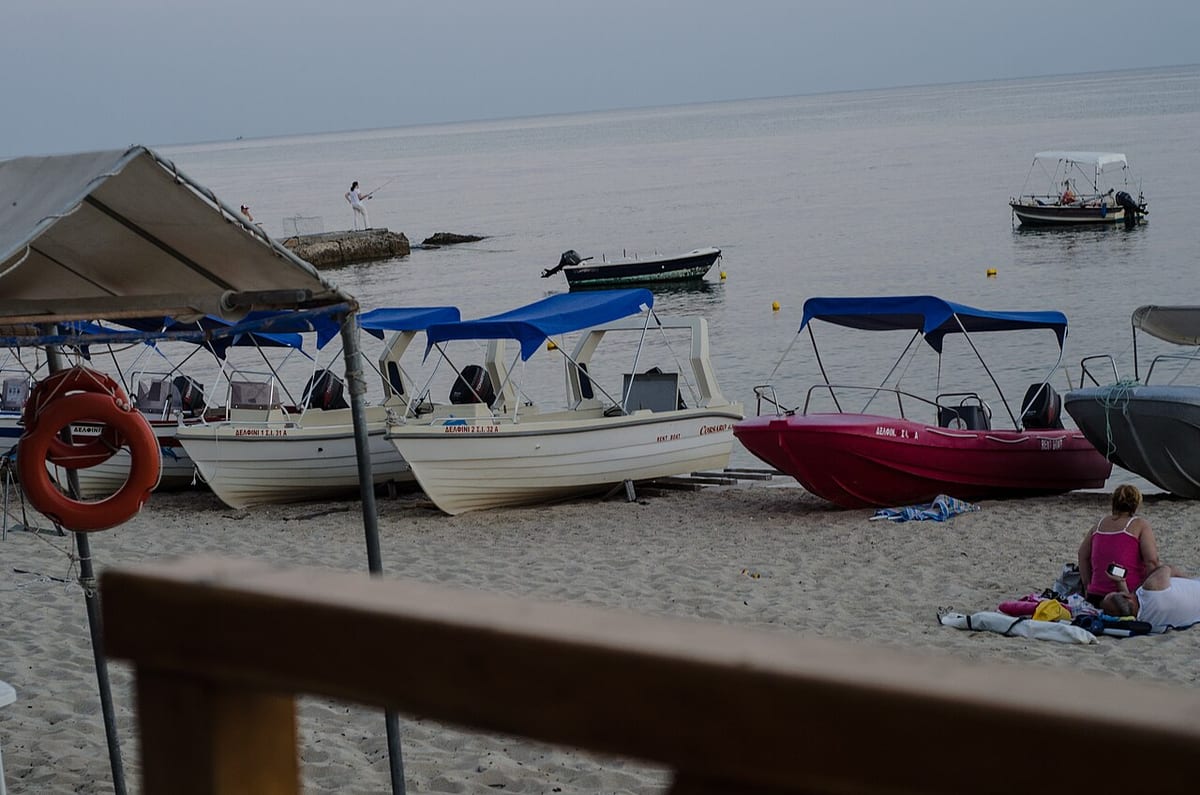
A boat livery is a dock or boathouse where boats are let out for hire. The boats can have motors or sails, or be rowing boats and pedal boats. Their main use is leisure. A motorboat that cruises at a much faster speed is called a speedboat.
On a Milos boat rental, the renter has no sails to set. An outboard motor holds the engine, gearbox and propeller in one unit. It sits at the back of the boat. The driver watches the sea, steers and picks the next stop. Every choice on the water belongs to the renter.
No Cyclades island lies farther to the south-west than Milos. Measured east to west, the island is about 23 kilometres; measured north to south, about 13. The sea cuts into the middle of the island and forms a large natural harbour. Adamas, the main port, lies on this bay.
Boats can stop at beaches that nobody can get to from the land. The renter can also swim in clear water and visit caves. Gerontas beach, between Tsigrado and Agia Kyriaki, is reached only from the sea. A Milos boat rental lets the renter see such places at a chosen pace.
Kleftiko is a group of grey and white rock formations with odd shapes, caves and pits. Over the centuries, air and sea carved them. Pirates once sheltered and based themselves there, and the spot took its name from them. Sarakiniko, on the north shore, has grey-white volcanic rock that waves and north winds carved.
- Boat: A small motorboat runs on its engine.
- Driver: The renter steers and picks stops.
- Coast: Coves, caves and rocks line the shore.
- Bay: A large natural harbour cuts inland.
- Access: Certain beaches are reached by sea.
A Milos boat rental puts a small motorboat in the hands of the renter. The route follows a coast of coves, caves and pale rocks. Private trips with a skipper are a separate choice. The next section looks at the licence question for small boats.

Which boats on a Milos boat rental need no licence?
A Milos boat rental can include small boats that local rules allow without a boating licence. The rules differ by country, by water and by boat. The renter confirms the exact rule with the rental place before setting out to sea.
A boating licence is a document that shows a person can handle a pleasure craft. A pleasure craft is a boat used for leisure. One example is the International Certificate of Competence. It comes from a United Nations resolution. A person earns it through an approved course or an exam.
Whether a document is needed depends on the country, the water, the boat and its use. That is why each boat on a Milos boat rental has its own rule. The International Certificate of Competence is accepted as proof of skill where proof is asked for.
A bareboat charter is a yacht hired without a crew. The renter navigates the yacht and carries the legal and safety duty. Companies that charter bareboat yachts mostly ask for a licence that proves skill. That is a different case from a small boat on a Milos boat rental.
Small boats form the other group. A dinghy is a small boat run by a small engine, sail or muscle power. A runabout is a small powerboat with an engine inside the hull or on the back. Local rules decide which of these a renter can drive without a licence.
The rental place can name the local rules that apply to each boat. A renter with a boating licence from home keeps it at hand. A renter without one asks, before setting out, whether the chosen boat is allowed. The answer applies to that boat only.
- Licence: A document that shows boat-handling skill.
- Certificate: The International Certificate of Competence is one example.
- Bareboat: A bareboat yacht comes without a crew.
- Small boats: Dinghies and runabouts follow local rules.
- Check: The rental place confirms each rule.
For a small boat, a Milos boat rental comes down to local rules. The rental place holds the answer for each boat. A renter with proof of skill brings it along. The next sections cover skippers, the boats on offer and the briefing before departure.

Is a Milos boat rental better with or without a skipper?
A Milos boat rental can be self-drive, or it can come with a skipper. A skipper is a person who drives the boat for the renter. Steering alone suits a calm sea, and a skipper suits first-timers, windy days and longer trips.
Steering alone puts the whole plan in the renter’s hands. Only the sea route leads to certain beaches on Milos. A self-drive Milos boat rental can take a renter to those beaches, one cove at a time.
Steering alone also means doing every job on board. The renter plans the route, ties up the boat, drops the anchor and brings the supplies. In boat hire, the word bareboat means a boat offered without a crew.
Self-drive suits a renter who has driven a small motorboat before. That renter knows how the boat turns and how it slows. Calm water near the coast is the right place for a first outing at the wheel.
A skipper is wiser on a Milos boat rental for a renter with no experience. Wind is a second reason, because the skipper reads the sea. Strong north winds blow over the Aegean Sea in summer, and they can rise without warning.
Longer trips are the third reason to hire a skipper. Open water far from the harbour asks more of a new driver. A skipper knows the coast and the safe ways home, so passengers can relax.
- Freedom: The renter picks every stop and every swim.
- Jobs: The renter handles the route, anchor and dock.
- Skill: A first-timer learns faster with a skipper on board.
- Wind: A skipper reads the sea when the wind rises.
- Distance: A skipper knows the safe way home from far coves.
A Milos boat rental suits a confident driver on a calm sea, and a skipper suits everyone else. A Milos private boat tour is the full skipper option, with the whole boat kept for one group. The next section lists the boats on offer and what each one suits.

Which boats does a Milos boat rental offer?
A Milos boat rental offers small open motorboats with a canopy, a cover that gives shade. Larger boats add seats and room, and a RIB is a rigid inflatable boat. A couple fits a small boat, and a family needs more room.
On a Milos boat rental, the small open motorboat is the basic choice. A motorboat is a small craft with one or more engines. Small boats carry an outboard motor at the back, and a canopy keeps the sun off the seats.
An outboard motor holds the engine and the propeller in one unit at the back of the boat. The whole unit pivots, so it also steers the boat. In shallow water it tilts up to protect the propeller.
Larger motorboats are built in different types, such as bow riders and cabin cruisers. The types differ in size, deck, cabin and seating, so the size of the group matters. A cabin is a small room that gives shelter from sun and spray.
RIB stands for rigid inflatable boat. The hull is hard, with air-filled tubes along its sides. The tubes keep a RIB afloat even if water gets in. Fast rides on a speedboat, led by a crew, have a page of their own.
A couple fits a small open boat with ease. A Milos boat rental for a couple needs seats, shade and calm water. A family needs more seats, more shade, room to move and life jackets sized for each child.
- Open boat: A small motorboat with an outboard motor and canopy.
- Larger boat: More seats, more deck and, on certain boats, a cabin.
- RIB: A hard hull with air-filled tubes along the sides.
- Couple: A small open boat gives enough room.
- Family: More seats, more shade and fitting life jackets.
A Milos boat rental starts with the right boat for the size of the group. A small open boat suits a couple, and a larger boat suits a family with children. Room, shelter and ease of steering decide the match, and the next section covers the briefing.
What does the briefing before a Milos boat rental cover?
A Milos boat rental briefing is a short talk before the boat leaves the dock. It covers starting and stopping the engine, steering, the anchor, the fuel and the life jackets. It ends with a phone number to call.
Starting and stopping the engine comes first. A small outboard has its controls on the motor, and the throttle sets the speed. A kill cord, tied to the driver, cuts the engine if the driver falls overboard.
Steering comes next, and a small outboard has a tiller, a handle that turns the boat. Larger outboards are controlled from the helm, the steering position. A good briefing lets the renter feel the steering before the boat leaves.
On a Milos boat rental, the anchor is the third lesson. An anchor holds the boat in place so wind and current cannot push it away. The rental staff show how to lower and lift it on its line, called the rode.
Fuel is the fourth point of a Milos boat rental briefing. Boat engines burn gasoline or diesel, and the rental staff name the right fuel. The staff also show where it goes and how much fuel the boat carries.
Life jackets and a phone number finish the briefing. The life jacket, a vest, holds its wearer afloat and prevents drowning. It comes in sizes to suit each body weight, and the phone number is for help.
- Engine: How to start it, stop it and use the throttle.
- Steering: How the tiller or wheel turns the boat.
- Anchor: How to lower it, hold it and lift it.
- Fuel: Which fuel the engine takes and where it goes.
- Help: The phone number to call for help.
A short briefing turns a Milos boat rental into a safe outing. It covers the engine, steering, anchor, fuel, life jackets and one phone number to call. Questions are best asked at the dock, where a clear answer saves trouble at sea.
Where does a Milos boat rental start from?
A Milos boat rental starts at a harbour or a small port. Boats leave from Adamas and Pollonia, two ports that both lie in the north. A small port at Kipos beach, on the south coast, also sends boats out.
Adamas, the main port and largest tourist centre of Milos, lies in the north of the gulf. For size and safety, this gulf ranks among the leading natural bays in the Mediterranean. A Milos boat rental from here begins inside that bay.
Boats that come to Milos on their own tie up in the marina of Adamas or Pollonia. The marina at Adamas has basic facilities, such as water and electricity. A boat can also refuel there before it heads out.
After Adamas, Pollonia ranks as the second port on Milos. It lies at the north-eastern tip of the island, around a cove with a sandy beach. A small boat also links this village with the nearby island of Kimolos.
Kipos, which means the Garden, is a beach on the south coast. The beach is sandy, and a small port there is where Kleftiko boats set out. A boat that starts here is already on the south coast, where the other coves lie.
Boats also stop in coves along the coast. Provatas, Kleftiko and Paliochori are coves where boats can moor, or stay put, depending on the wind. A Milos boat rental plan picks the cove that the wind leaves calm.
- Adamas: The main port sits in the north of the gulf.
- Marina: Fuel, water and electricity are on offer there.
- Pollonia: The second port sits at the north-eastern tip.
- Kipos: Boats set off for Kleftiko from a small port on the south coast.
- Coves: Provatas, Kleftiko and Paliochori suit mooring, depending on the wind.
Three starting points cover the north and the south of the island. Adamas has the marina, Pollonia has the north-east cove, and Kipos has the south-coast port. Boats leave from all three, so each is a place to ask about a Milos boat rental.

How is a self-drive Milos boat rental route planned?
A Milos boat rental route is a chain of short hops between named coves. The south coast and the west coast each hold a chain of coves. The plan keeps the fuel and the way back to the harbour in mind.
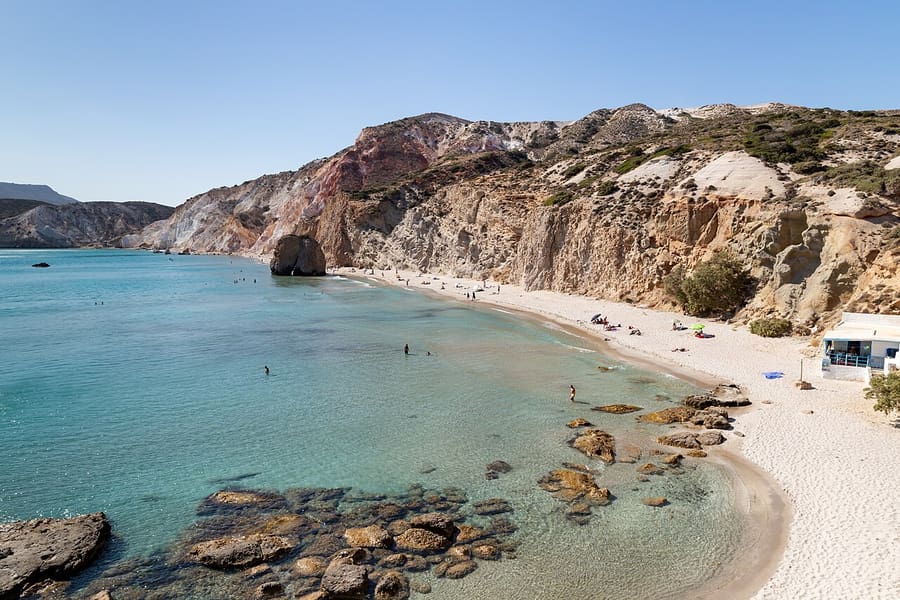
Milos is roughly 23 kilometres long from east to west and 13 kilometres wide from north to south. With a Milos boat rental, a day on the water stays inside a small area. One coast per day keeps each hop short and the plan simple.
The south coast has a long chain of named beaches and coves, one after another. Agia Kyriaki, Paliochori, Firiplaka, Provatas, Kipos and Kleftiko all lie on it. The wider list of beaches of Milos adds more names for extra hops.
Kalogries, Agkathia, Triades, Ammoudaraki, Agios Ioannis and Sykia all sit on the west coast. The west half of the island is the wildest part of Milos. Sykia is a cave with no roof, and a boat is the only way in.
Kleftiko is made up of grey and white rock formations with odd shapes, caves and pits. It is enjoyed from the water, from a boat or sailboat. For the rocks in detail, read about a Kleftiko boat tour.
Fuel sets the limit of any self-drive route. Fuel is on offer at the Adamas marina, while the west of the island has no villages. A Milos boat rental plan therefore turns for home with fuel to spare.
- Start: Adamas, where the marina offers fuel, water and electricity.
- South chain: Paliochori, Firiplaka, Provatas and Kipos link up.
- West chain: Sykia, Triades, Agkathia and Kalogries link up.
- Far stop: Kleftiko is a set of rocks seen from the water.
- Return: The last hop ends near the harbour, with fuel left.
A route like this fits the island: one coast, three or four coves and a full tank. Every hop is short, and the harbour stays within reach of the fuel left in the tank. That is how a Milos boat rental becomes an easy day on the water.

How is the anchor used on a Milos boat rental?
On a Milos boat rental, the anchor goes down on sand with enough rope let out. In moderate conditions, the rope pays out to four times the depth of the water. The boat also keeps clear of swimmers and other boats.
An anchor holds a boat to the sea floor, so wind and current cannot push it away. A line called the rode joins the boat to the anchor. The rode can be made of rope, chain or a mix of both.
The seabed matters as much as the anchor, because it is what holds the anchor. Hard sand gives an anchor a firm grip, but shell gives only a weak one. With a Milos boat rental, the clear water lets the driver spot a sandy patch first.
The ratio of rope length to water depth is called the scope. In moderate conditions, the scope is 4:1, so the rope is four times the depth. A depth of 9 metres, measured from the front of the boat, needs 36 metres of rope.
The anchor goes down under control, and the boat drifts back as the rope goes out slowly. A gentle reverse under engine power then sets the anchor. Smooth tension on the line shows that the anchor is digging in.
A Milos boat rental swings around its anchor when the wind or current shifts. It needs free room on every side, and so do the boats nearby. The driver keeps the boat well away from every swimmer.
- Sand: Hard sand is the seabed to aim for.
- Rough water: The rope goes out up to twice as far.
- Long rope: It keeps the pull along the sea floor.
- Dragging: Jerks on the line mean the anchor is dragging.
- Lifting: The boat moves above the anchor before it is lifted.
Anchoring is a short routine of sand, rope, a gentle reverse and free room around the boat. The boat stays well away from swimmers and from other boats at anchor. A Milos boat rental that follows this routine gives a steady stop for every swim.
How does the wind change a Milos boat rental?
The wind rules every Milos boat rental. The meltemi, a strong and dry north wind, blows across the Aegean Sea. It rises fast in summer. Renters read the forecast, choose the sheltered side, and turn back early when the sea grows rough.
The meltemi is a dominant weather force in the Aegean. Its ancient Greek name means periodic winds, since it comes and goes in spells. The air is dry, the sky stays clear, and the windy days peak in July and August.
With a Milos boat rental, a calm morning does not promise a calm afternoon. A meltemi can start on a clear day with no warning. The wind is strongest in the afternoon, and sometimes a spell lasts for days with no break.
Yachts and inter-island ferries can stop sailing when the wind reaches Beaufort force 7 or 8. A skippered Milos speedboat tour changes route on windy days. A self-drive boat needs the same care, and the renter makes every call.
On a Milos boat rental, land blocks the wind and gives the far coast calmer water. In a meltemi or north wind, the bay is good, and the south side is better. A south wind turns the north side of the island into the better choice.
Forecasts in Greece give wind as a Beaufort force, a scale from 0 to 12. Knots, the speed unit used at sea, are common too. The renter checks both force and direction, and a worse forecast means a shorter plan.
- Forecast: The newest forecast is read just before the boat leaves.
- Direction: The calmer coast is the one facing away from the wind.
- Afternoon: The return trip is planned before the wind peaks.
- Early return: The boat turns back when the sea first turns rough.
- Second check: The sea is checked again at every stop.
A Milos boat rental is safer when the wind is checked twice. The first check is on land, and the second is on the water. Turning back early is a change of plan, and good seamanship asks for that in rough weather.
Which sea rules matter on a Milos boat rental?
A Milos boat rental follows three basic sea habits. The driver keeps a lookout, holds a safe speed, and stays clear of others. Boats keep out of marked swimming areas. A boat that meets another gives way early and clearly.
A lookout means watching and listening all the time on a Milos boat rental. The international rules ask every boat for this, by sight, by sound, and by any other means. On a small boat, that means eyes up and phone down.
Speed has to suit the place. The international rules call for a safe speed, which depends on the view and the traffic. Near a beach, a harbour or other boats, a Milos boat rental goes slow.
Swimmers are hard to see from a boat, and a spinning propeller can injure them. Boats stay far from swimmers and out of marked swimming areas. A slow, wide approach to a beach gives swimmers time to move away.
Two boats on a collision course follow give-way rules, which say who moves and who holds still. The give-way boat acts early, with a big and clear move. The other boat, called the stand-on boat, keeps its course and speed.
Two powered boats that meet head-on both turn to starboard, meaning to the right. In a crossing, the boat with the other on its right side keeps out of the way. A boat that overtakes always keeps clear.
- Lookout: Someone watches ahead and to both sides at all times.
- Speed: The boat slows near beaches, harbours and other boats.
- Swimmers: The boat stays out of marked swimming areas.
- Crossing: The boat with another on its right side gives way.
- Wake: The waves behind a boat stay small when the boat is slow.
No boat ever has right of way, so every driver stays ready to act. In a narrow channel, a small boat never blocks a larger ship. A Milos boat rental goes best when everyone aboard knows these habits and uses them calmly.
What to bring on a Milos boat rental?
A Milos boat rental calls for one light bag. It holds drinking water, snacks, a hat, sun cream, and a charged phone. The phone stays dry in a waterproof pouch. A light layer and soft shoes finish the kit.
On a Milos boat rental, drinking water comes first. Sun, wind and salt air dry out the body fast, even on a cloudy day. Each person brings a full bottle, and a spare one stays in the bag.
Snacks keep energy up between swim stops on a long day on the water. Fruit, nuts and bread rolls travel well and do not melt. A small bag for rubbish brings every wrapper back to the harbour.
A hat with a strap stays on, and sunglasses cut the glare off the water. Put sun cream on before boarding, then top it up after each swim. A small open boat has little shade, so skin needs this cover.
On a Milos boat rental, a charged phone shows the forecast and the map. A waterproof pouch, a sealed clear case, keeps spray and splashes off the screen. The sea has no charging points, so a full battery matters.
The air feels cooler once the boat moves and spray lands on the skin. A light layer, such as a thin windproof jacket, takes care of that. Soft shoes with flat soles grip a wet deck and protect feet on rocky beaches.
- Water: A full bottle for each person on board.
- Snacks: Fruit, nuts and rolls that keep well in the heat.
- Sun cover: A hat with a strap, sunglasses and sun cream.
- Phone: Fully charged and sealed in a waterproof pouch.
- Clothing: A light layer and soft shoes with flat soles.
A packed bag turns a Milos boat rental into an easy day. Water, snacks, sun cover, a charged phone, a light layer and soft shoes cover the basics. Anything extra stays on land, since a small boat has little room and wind takes loose items.
How does a Milos boat rental work for families with children?
A Milos boat rental works for families when the day stays short, calm and well watched. Each child wears a fitted life jacket from dock to dock. Shade is ready. One adult watches the children while another adult drives.
On a boat tour, a crew watches the passengers. On a Milos boat rental, the family is the crew. One adult drives, and a second adult watches the children. The two do not swap jobs while the boat moves.
Life jackets come in different sizes to match body weight, and certain models are made for children. Foam vests for children have straps that pass between the legs. The straps stop the vest from riding up. The family asks for children sizes before the boat leaves the dock.
Shade comes next. Milos has warm to hot, dry summers, and an open boat gives little cover. A canopy over the seats gives children a place to rest. Hats and light shirts help when the canopy is small.
Short hops suit children best. A family anchors in a calm cove, swims, rests and moves on. Wind peaks in the afternoon in summer, so the longest hop belongs in the morning. The family turns back early when a child tires.
- Vests: Every child wears a fitted vest from dock to dock.
- Shade: A canopy and hats keep the sun off children.
- Hops: Short hops between coves suit tired children.
- Watcher: One adult watches the water and never drives.
- Count: The watcher counts the children at every stop.
A Milos boat rental suits a family that plans a slow day. A fitted vest on every child, shade, short hops and a watching adult keep that day easy. Families who want a crew on board can compare a catamaran or a private boat.
How does a visitor choose a Milos boat rental?
A Milos boat rental comes down to four choices. The group picks a half day or a full day. It picks a skipper or none, a start point and the gear on board. Plain questions to the rental place settle each choice.
A half day covers one stretch of coast with a swim or two. A full day reaches farther and adds more stops. A longer day means more sun and more wind. A group with young children or a new driver starts with the half day.
A skipper is a person who drives the boat and knows the coast. A group with little sea experience can hire one. A group that wants to drive asks the rental place which boats it can take out alone.
The start point decides which coast is close. A start near the planned coves means a short first hop. That suits children and new drivers. The group asks where the boat waits and how the return to that place works.
Five plain questions cover the gear. The list below shows them. The answers show how well a rental place knows its boats. The group asks the same five questions at every place and writes the answers down.
- Fuel: The group checks how full the tank is at the start.
- Canopy: The group checks that a cover shades every seat.
- Anchor: The group sees the anchor and its line before leaving.
- Vests: The group counts one vest per person, in the right sizes.
- Phone: The group saves a number to call from the sea.
A clear answer to each question shows a rental place that knows its boats. With those answers, a Milos boat rental becomes a plain choice, not a guess. Visitors with a wider plan can read about activities in Milos and fit a boat day in.

What else do renters want to check before a Milos boat rental?
A Milos boat rental raises eight practical questions. The short answers below cover age, swimming, distant islands, a stopped engine, fuel, darkness, pets and weather. For the rules on one boat, the rental place always gives the final word.
What is the minimum age to drive on a Milos boat rental?
The rental place gives the minimum age for each boat, so the question goes there first. Rules for driving a boat differ from country to country. The size of the boat can change them too. A group with a young driver asks before the trip and brings the answer to the dock.
Can people swim from a Milos boat rental?
A swim stop starts once the anchor holds and the boat stands still. An outboard motor holds the engine and the propeller at the stern. The engine is off before anyone swims. Life jackets protect weak swimmers and swimmers far from safety. Swimmers stay close to the boat, and one adult stays on board.
Can a Milos boat rental go to Kimolos or Polyaigos?
The rental place says which waters each boat is allowed to enter. A channel 1 km wide separates Kimolos from Milos. Polyaigos lies just off Kimolos and is uninhabited. Strong summer wind makes the open sea wavy. A Polyaigos boat trip with a crew is the simpler way to see it.
What happens if the engine stops on a Milos boat rental?
The driver stays calm and keeps everyone seated in life jackets. Anchoring is a sound step whenever a boat is disabled. The anchor goes down if the boat drifts. Then the driver calls the phone support of the rental place and waits. A charged phone, a whistle and paddles all help.
How does fuel work on a Milos boat rental?
Boat engines burn petrol or diesel, and electric boats exist too. Engines differ in size and type, so the answer changes from boat to boat. The rental place names the fuel for each boat and shows the tank at the start. A short route saves fuel too, so the group plans its route first.
Can a Milos boat rental be used at night?
The rental place says whether a boat goes out after dark. Navigation lights belong to a boat safety kit and let other boats see it at night. A flashlight is on the useful gear list too. A day plan that ends well before sunset keeps the question simple and the return easy.
Are pets allowed on a Milos boat rental?
The rental place answers that question for each boat. Life jackets exist for dogs and other pets. The jackets can include a grab handle that helps to lift the animal back on board. Dogs and cats can drown when they tire in the water. A pet owner brings the jacket and fresh water.
Does rain or cloud stop a Milos boat rental?
Milos has warm to hot, dry summers and mild, rainy winters. So rain is rare on a summer boat day. Wind matters more than cloud. In summer the wind can rise on a clear day with no warning. A bright sky does not promise a calm sea. The rental place makes the call on the day.