
A Sykia cave boat tour visits a sea cave in the west of the island of Milos. The cave has lost its roof, so the sky shows overhead. No road leads inside. The whole visit happens on the water, from the deck of a boat.
This page first sums up the Sykia cave boat tour. It then explains how the cave formed. The story runs from the volcanic rock of Milos to the slow work of waves and rain. Later sections cover the route, the light, the boats and the swim.
What is a Sykia cave boat tour at a glance?
A Sykia cave boat tour is a sea trip to the biggest cave on Milos. The cave sits on the west coast and has no roof. Sun shines into the emerald water inside. A boat is the only way to reach it.
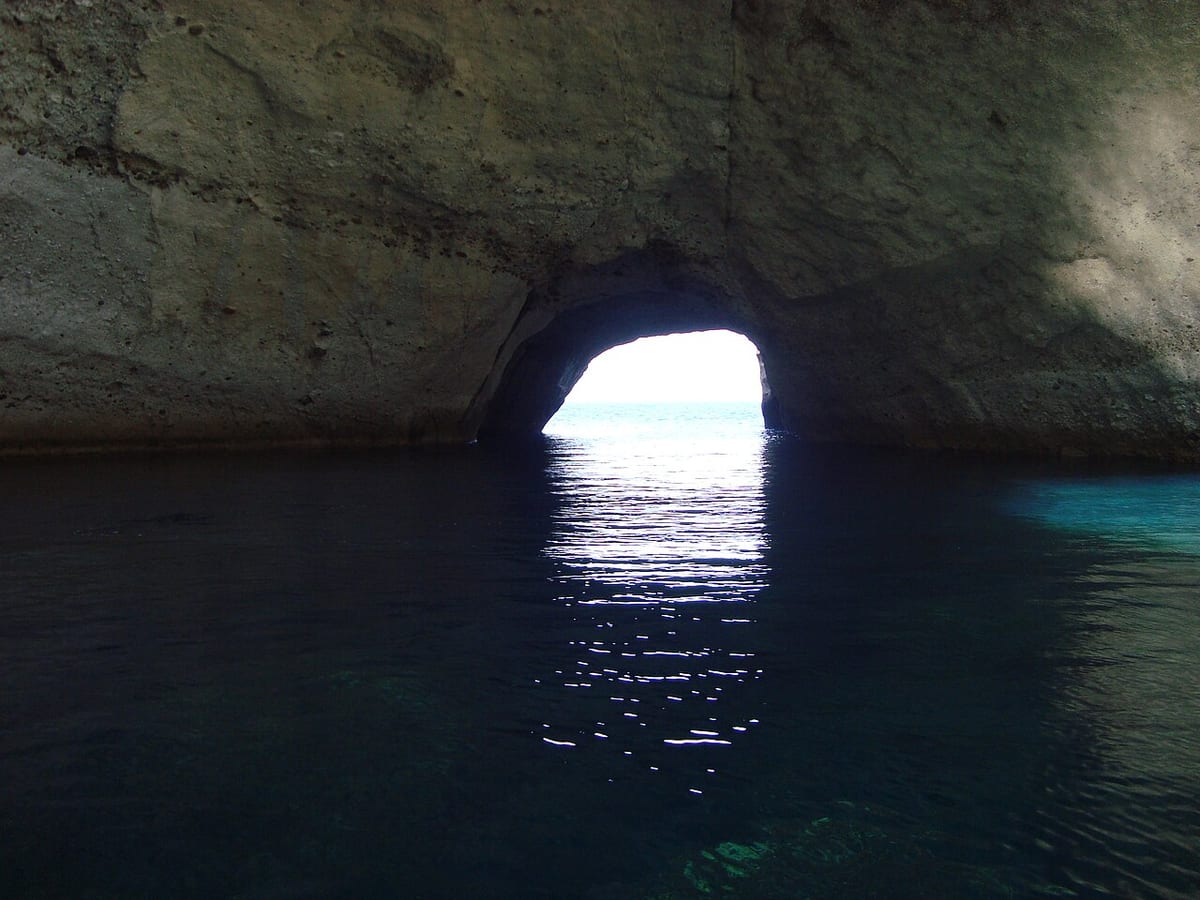
Sykia is a sea cave, meaning a cave that the sea has cut into the coast. Its roof has fallen in, and the cave now lies open to the sky. A Sykia cave boat tour brings passengers there by water, because no road reaches the cave.
Sykia sits on the western shore of Milos. No other cave on the island is bigger. Sea caves come in a wide variety on the Greek islands. From the water, a Sykia cave boat tour shows the rock walls and the sky above.
Sun rays enter through the open top and light the emerald water below. Colour and shine fill the cave as a result. This mix of rock, sky and sea is what a Sykia cave boat tour brings into view.
A Sykia cave boat tour is one kind of sea trip among the boat tours in Milos. Trips of this sort reach beaches and caves that the land does not serve. Boats and sailboats both run them from the harbours of the island.
- Place: The west coast of Milos, an island of the Cyclades.
- Type: A sea cave whose roof has fallen in.
- Size: The largest cave on Milos.
- Access: By sea only, because no road reaches the cave.
- Water: Emerald green, lit by the sun from above.
In short, a Sykia cave boat tour goes to a roofless sea cave. The cave sits on the west coast of Milos. It is the biggest on the island, and only the sea leads in. The next section explains how the cave formed.

How did the cave on a Sykia cave boat tour form?
A Sykia cave boat tour visits a cave carved by the sea on a volcanic island. Waves hit weak spots in coastal rock and widen them. Rain can weaken the stone as well. In time the roof of such a cave can fall in.
Volcanoes built Milos. Among its rocks are tuff, trachyte and obsidian. Tuff is rock made of packed volcanic ash. Trachyte and obsidian formed when lava cooled fast. The volcano started 2 to 3 million years ago. Its last eruption was 90,000 years ago.
A sea cave starts with a weak zone in the rock. That zone can be a crack, or a line where two layers of different hardness meet. Waves strike the weak zone first, and the rest of the coast wears away more slowly.
Waves push water into the crack and squeeze the air inside it. The squeeze forces the crack wider and deeper. Sand and stones in the surf scrape the walls like sandpaper. Crack by crack, the opening grows into a cave.
Rain joins the work. Rainwater carries weak acids from the soil. These acids can help to weaken the rock inside cracks. Sea urchins help too, because they drill into the stone. Over generations, they can remove a lot of rock from the floor and the lower walls.
Sometimes the chamber of a sea cave collapses. The roof drops, and an open hole to the sky is left behind. Sykia is a cave in that state. Its roof is gone, yet the sea still fills the space below.
- Rock: Milos is volcanic, with tuff, trachyte and obsidian among its rocks.
- Start: A crack or weak line in the coast gives the sea a way in.
- Waves: Water, trapped air, sand and stones widen the crack into a cave.
- Rain: Weak acids from the soil can weaken the rock inside cracks.
- Roof: A cave chamber can collapse and leave an open hole to the sky.
A Sykia cave boat tour shows where this process ended. The sea cut a large cave, and the roof then fell in. What remains is a roofless cave on the west coast of Milos. It is open to the sky and to the sea.
What is it like inside the cave on a Sykia cave boat tour?
A Sykia cave boat tour brings passengers to a cave with no roof. The sky is the ceiling, and sunlight falls straight onto emerald water. The cave lies on the west coast of Milos and can be reached from the sea alone.
The cave of Sykia cannot be reached by land. Every approach is across the water, so visitors arrive by boat. That makes a Sykia cave boat tour the plain way to see it. The coast around the cave has no residents.
Excursion boats on Milos stop at Sykia. Sea trips on the island aim at places that roads do not reach. Caves are on that list. The roof of Sykia has fallen in, which is why the sky shows overhead.
Inside, nothing covers the water. The rays of the sun enter the cave and light up its emerald surface. Light reaches the sea directly on a Sykia cave boat tour, because no rock sits above it.
The lit water shows shades of green, and the rays add a play of colour and shine. Milos is a volcanic island, with tuff and trachyte among its common rocks. The cave belongs to that same volcanic coast.
- Access: The cave is reached from the water only.
- Roof: There is none, because it has collapsed.
- Light: Rays of the sun enter the cave directly.
- Water: Emerald in colour where the light strikes it.
- Setting: The uninhabited west coast of Milos.
A Sykia cave boat tour comes down to one change: the roof is gone. The sea is the road in, the sky is the ceiling, and the sun is the light. Everything that visitors see inside the cave follows from that.

Which places does a Sykia cave boat tour pass on the west coast?
A Sykia cave boat tour that sails south along the west coast passes eight named places first. The run starts at Vani in the north. It ends at Agios Ioannis, just before Sykia. Each name is a beach on the west-side list of the island.
Boats for sea trips leave from the ports of Adamas and Pollonia. The harbour at Adamas fills the hollow of a large crater. The bay opens to the north-west. The west coast reaches its northern end on that same side.
Vani and Aspra Gialoudia sit at the northern end of the west coast. Kalogries comes next, in the north-west of the island. After it come Agkathia and Vourlidia. These five names make up the first part of the run.
The three Triades beaches follow, one after the other. Ammoudaraki comes after them. Then come the three beaches named Agios Ioannis. On a Sykia cave boat tour, these are the last names before the cave.
Past the cave, the same coast list continues with Vaisis and then Akrotiri Psalida. The list for the south coast ends at Kleftiko, which therefore lies just beyond Akrotiri Psalida. The shore turns from the west side to the south side there.
The name Sykia also appears on the north coast. That list holds a beach marked Sykia with the word Afalatosi, which means desalination. It is a different place from the cave, which sits on the west coast.
- North end: Vani and Aspra Gialoudia open the run.
- Upper stretch: Kalogries, Agkathia and Vourlidia come next.
- Middle stretch: The Triades beaches and Ammoudaraki follow.
- Last stretch: Agios Ioannis has three beaches.
- After the cave: Vaisis comes first, then Akrotiri Psalida.
The whole run lies along a coast with no residents. The uninhabited west of Milos lies almost entirely inside Natura 2000. That is a European network of nature protection areas. A Sykia cave boat tour therefore passes a shore of beaches and rock with no towns.
Why is a Sykia cave boat tour paired with Kleftiko on one trip?
A Sykia cave boat tour shares a trip with Kleftiko. The excursion boats that call at Kleftiko also stop at Sykia. The two lie close together on the south-west coast. One is a roofless cave, the other a set of white cliffs and islets.
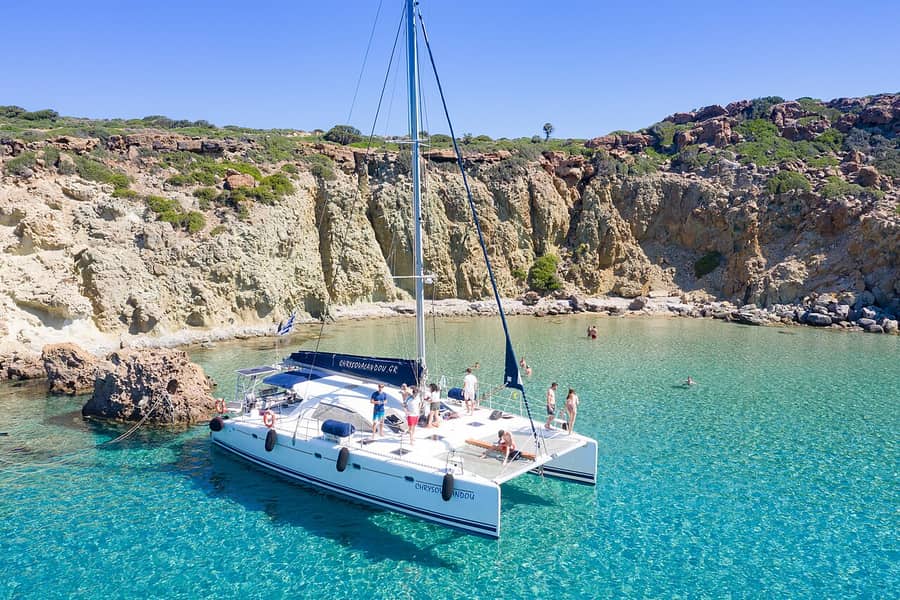
The pairing starts with the boats. Tour boats that visit Kleftiko also stop at Sykia. On the coast lists, only two named places, Akrotiri Psalida and Vaisis, separate the two. Places that close together fit naturally into one outing.
Kleftiko adds scale. White cliffs and islets spread over three small bays in the south-west. The rock is volcanic tuff, and sea and wind have cut hollows and caves into it. A full account sits on the page about a Kleftiko boat tour.
Sykia adds one enclosed scene. It is a single cave, and its fallen roof lets the sun reach the water. Kleftiko shows rock shapes in open light. A Sykia cave boat tour shows light falling onto a pool of sea.
Access ties the two places together. Kleftiko can be reached by boat or by a footpath. Sykia has no land route at all, only the sea. A boat is the one way that serves both, so a single trip covers them.
- Shared ground: Both places sit on the south-west and west coast of Milos.
- Kleftiko adds: White cliffs, islets and caves around three bays.
- Sykia adds: A roofless cave with sunlit emerald water.
- Pirate past: The bays of Kleftiko served as a pirate base, which gave the place its name.
- Protection: Kleftiko lies inside a Natura 2000 area.
Taken together, the two stops show the south-west of Milos in two ways. Kleftiko gives open coast with white cliffs, and Sykia gives one lit cave. A Sykia cave boat tour covers the second part, and the same boats carry passengers to the first.

Why does a Sykia cave boat tour pause at Kalogries beach?
A Sykia cave boat tour on the west-coast route pauses at Kalogries for a first swim. The bay there holds calm water that works like a natural pool. Day cruises add water games at this stop, then the boat sails on toward the cave.
Kalogries lies in the north-west of Milos. The beach is secluded, with sand and clear turquoise water. In English, its name is rendered as the Nuns. It is a place for relaxation, and the sea there is calm.
A bay is a curve in the coastline that holds a pocket of the sea. The land around a bay cuts the strength of the wind. It also blocks waves. That shelter is why the water at Kalogries stays calm enough for an easy swim.
Day cruises along the west coast list Kalogries as a swim stop with water games. Those cruises describe the water there as emerald. On a Sykia cave boat tour, four other beaches pass by before the cave. The next swim happens inside the cave.
The cave and Kalogries both count among the beaches of Milos, in the west group. A Sykia cave boat tour touches two of them in one run. One is a sandy bay. The other is a roofless cave.
- Place: Kalogries is a secluded beach in the north-west.
- Water: The water is clear, turquoise and calm.
- Shape: The bay works like a natural pool.
- Role: Day cruises use it for a first swim.
- Next: Four other beaches pass before the cave.
Kalogries gives the route a calm start. Wind and waves fall away inside the bay. Swimmers settle into the water before the cave comes. Seen this way, a Sykia cave boat tour starts with an easy swim. It then reaches the roofless cave.
How does a Sykia cave boat tour differ from seeing the cave on foot?
A Sykia cave boat tour reaches the water inside the cave, which opens only to the sea. A walk on land ends at the surroundings of the cave. The two views differ because the viewer stands in a different place.
The full walk to Sykia has its own page, so only an outline fits here. A natural path leads toward the cave. The path is counted as easy. Only its last 200 metres run over steep ground.
The walk starts at a monastery in the south-west, and only a dirt road serves it. Western Milos lies inside a Natura 2000 zone. The European Union sets such zones aside to protect habitats and species. Walkers cross that protected land on the way to the cave.
At the end of the path, walkers explore the surroundings of the cave. The cave itself opens only to the sea. The water inside is reached from the sea side. A Sykia cave boat tour takes that second way in.
Water changes colour with the angle of view. The surface reflects the sky, and light also comes back up from below. How much of each reaches the eye depends on where the viewer stands. A passenger on a Sykia cave boat tour sees the water differently from a walker.
- Path: A natural path leads toward the cave.
- Last stretch: The final 200 metres cross steep ground.
- Road: A dirt road serves the monastery where the walk starts.
- Land view: Walkers explore the surroundings of the cave.
- Sea view: The cave itself opens only to the sea.
The two ways of seeing Sykia do not compete. The walk gives the land side and the surroundings. A Sykia cave boat tour gives the sea side and the water inside the cave. Each view adds something that the other cannot show.
What does the light do inside the cave on a Sykia cave boat tour?
On a Sykia cave boat tour, sunlight enters through the open roof. It lights the water inside the cave. The water glows emerald. Moving ripples can add bright lines on the walls. The light changes as the sun and the water move.
The roof of the cave is open. Sunlight therefore comes in from above, not from the side. A bright patch can fall on the water while the walls stay in shade. The edge of that patch follows the shape of the opening above.
The sun moves across the sky, so the bright patch moves too. On a Sykia cave boat tour, it slides over the water and onto the walls. The shaded part of the cave grows and shrinks as it goes.
Ripples bend the light as it passes through the surface. The bending draws bright, wobbling lines on the walls and the floor. These lines are called caustics, meaning patches where light is bunched together. Rippling water forms them when sunlight shines through its waves.
Pale surfaces under the water bounce light back and raise the cyan tone. Cyan is a blue-green colour. A swimming pool with white sides and a white bottom looks cyan, even indoors. No sky is reflected there, yet the colour stays. The same rule applies at sea.
- Entry: Sunlight enters through the open roof.
- Colour: The lit water glows emerald.
- Shade: Walls stay darker than the lit water.
- Ripples: Moving water draws bright lines called caustics.
- Floor: In any pool, pale surfaces below raise the cyan tone.
Light in the cave is never fixed. The sun, the ripples and the eye of the viewer all keep moving. The low glow of a sunset cruise is a different story. A Sykia cave boat tour shows the open-roof cave in the light of the day.
Which boats can reach the cave on a Sykia cave boat tour?
A Sykia cave boat tour can use small boats, speedboats and traditional wooden boats. These can come close to the opening of the cave. Larger boats stay outside in deeper water, and swimmers enter the cave from the sea.
A small boat suits a Sykia cave boat tour best. It sits low in the water and needs little depth. The crew can ease it close to the opening and hold it steady. With fewer people on board, the area near the entrance stays less crowded.
A speedboat covers the west coast fast. Its hull is light, so it turns easily near the rocks. The driver slows down well before the opening. The page on a Milos speedboat tour explains how this boat type works.
A traditional wooden boat moves at an easy pace. Its wide deck gives swimmers room to get ready. On a Sykia cave boat tour, the crew keeps it near the opening. The swimmers go in from the water there.
Larger boats are a different case. They need deep water and room to turn, so they wait outside the opening. Swimmers cover the last stretch in the water. A cruise from the port of Adamas stops at Sykia for a swim inside the cave.
- Small boat: sits low and gets close to the opening.
- Speedboat: light, quick and easy to turn near rocks.
- Wooden boat: slow, wide and steady beside the cave.
- Larger boat: waits outside in deeper water.
- Crew: picks the spot where the boat holds still.
Sykia can be reached only from the sea, so the boat shapes the whole visit. On a calm day, a Sykia cave boat tour can bring a small boat close. Rough water keeps every boat further out. The crew makes that call, because only the crew can judge the waves at the opening.

How do swimmers stay safe on a Sykia cave boat tour?
A Sykia cave boat tour stays safe when the sea is calm and the crew gives the go-ahead. Swimmers stay together, keep clear of the walls and watch for rocks under the surface. A life jacket helps anyone who feels unsure in the water.
Calm sea comes first. Waves shape every sea cave, and they still push into it. On a rough day, the water surges against the walls. Swimmers on a Sykia cave boat tour enter the water only when the sea lies flat.
The crew’s go-ahead comes next. Nobody enters the water before the crew says so. The crew checks the waves at the opening, the wind and the position of the boat. A swimmer who feels unsure tells the crew first.
Rocks sit under the surface too. Sea-cave walls are rough and uneven, and moving water hides the bottom. A swimmer keeps hands and feet off the walls and the sea floor. Swimmers also stay away from the opening while the boat moves.
On a Sykia cave boat tour, swimmers stay together. A close group is easy to count and easy to see from the boat. Anyone who feels unsure wears a life jacket. It floats the wearer with the face clear of the water, so resting takes no effort.
- Sea: calm water only, with no strong waves at the opening.
- Crew: nobody enters before the crew gives the go-ahead.
- Rocks: stay clear of the walls and the hidden bottom.
- Group: swimmers stay close together and in the crew’s view.
- Life jacket: worn by anyone who feels unsure in the water.
Safe swimming rests on simple habits. Calm water, the crew’s word, distance from the rocks and a close group cover the main risks. The page on a Milos snorkeling cruise lists the general rules for sea caves. A Sykia cave boat tour follows the same habits.
How is a Sykia cave boat tour chosen and booked?
A Sykia cave boat tour comes down to five choices. They are the day length, the boat size and the start harbour. The last two are the wording about entering the cave and what to pack. Checking all five first keeps the day simple.
A full-day trip has room for other stops. One cruise out of Adamas stops at the Sykia cave before Kleftiko. A half-day trip, where one runs, keeps fewer stops. Its description must name Sykia as a stop.
Milos has day boats, caiques and sailing boats for sea trips. A caique is a traditional fishing boat made of wood. A small boat holds fewer swimmers at the cave. A larger boat gives more deck space and shade.
Sea trips run from two main ports, Adamas and Pollonia. Sykia lies on the west coast, and Pollonia sits in the north-east. A trip from Pollonia takes a different route. A port near the stay keeps the morning easy.
A clear description names the cave as a stop. It says whether the boat goes inside and whether passengers swim there. One cruise lists swimming inside the cave, and that is the wording to look for.
- Swimwear: A swimsuit and a towel cover the swim.
- Sun cover: A hat, sunglasses and sunscreen protect on the open deck.
- Water: A full bottle of water helps on a hot day.
- Light layer: A thin top keeps the wind off after the swim.
- Remedy: A tablet suits a passenger who feels sea sickness.
Once the five points are clear, the day takes shape. It has one start port, a named stop at Sykia, a stated swim and a ready bag. Other activities in Milos fill the other days around a Sykia cave boat tour.

Which questions come up before a Sykia cave boat tour?
A Sykia cave boat tour brings up eight plain questions. They cover swimming skill, children, rough sea, cave entry, shoes, photos, a land visit and the season. The answers use only facts about the cave and the sea.
Can non-swimmers join a Sykia cave boat tour?
Yes, because the swim inside the cave is a choice. A non-swimmer can stay aboard and watch from the deck. A buoyancy vest, an inflatable collar that keeps a swimmer afloat, helps in the water. Snorkelling venues can require one, so the description needs to say whether vests are on board.
Is a Sykia cave boat tour suitable for children?
It suits children who are calm on boats and wear a vest. The cave is reached only from the sea, so the whole trip is spent on the water. A child-size vest, sun cover and a shaded seat are the key items. An adult stays within arm’s reach at every swim.
What if the sea is rough on a Sykia cave boat tour?
The meltemi is a strong, dry wind from the north. It sweeps the Aegean between late spring and mid-September. It can start in clear weather with no warning. The afternoon brings the strongest gusts. In rough water the crew can skip the cave stop. A spare day in the plan protects the trip.
Does every boat go inside on a Sykia cave boat tour?
A boat can stop near Sykia without entering. Boats come in different sizes, and the sea changes each day. The crew decides at the cave on the day. A stop at the cave does not promise a swim inside it. A passenger who wants that swim asks before the day starts.
Are shoes needed for rocks on a Sykia cave boat tour?
Sykia is reached only from the sea, so the cave stop is a swim, not a walk. Shoes matter where a stop includes a landing on rocks. Light water shoes with a firm sole protect the feet. Sea urchins drill into the rock of sea caves. Bare feet are a poor choice.
Are photos easy to take on a Sykia cave boat tour?
Yes, because the cave has no roof and daylight reaches the water. A phone camera is enough. Spray and wet hands are the real risk to a phone. A waterproof pouch with a wrist strap protects the phone. Photos are best taken from a steady spot on deck before the swim.
Can a Sykia cave boat tour be combined with a land visit?
A half-day sea trip leaves the other half of the day for the land. Plaka, the chief town of Milos, stands on the plateau above the harbour. The Roman theatre near Trypiti is another stop on land. A full-day cruise fills the whole day, so a land visit goes on another day.
Does a Sykia cave boat tour run in spring and autumn?
Early spring and the weeks after mid-September fall outside the meltemi window. Trips in those weeks meet less of the strong wind. The sea is cooler then. A thin wetsuit helps, since it gives warmth and a little buoyancy. The description of each trip states the dates when the boat runs.