
A Milos fishing trip puts visitors on a working boat with local fishers. The boat sets out from a harbour on the island of Milos. The island sits at the southwest edge of the Cyclades. Passengers watch the crew handle lines and nets, then try the gear for themselves.
The first section below gives the basics of a Milos fishing trip. The second looks at the wooden boats and the fishing life of the island. Later parts cover the fish, the cooking, the swim stops, safety and packing. They also help a reader choose a boat.
What is a Milos fishing trip at a glance?
A Milos fishing trip is an outing with local fishers on a working boat. Passengers try lines and nets near the island while the crew picks the spot and shows the gear. The catch depends on the season and the place.
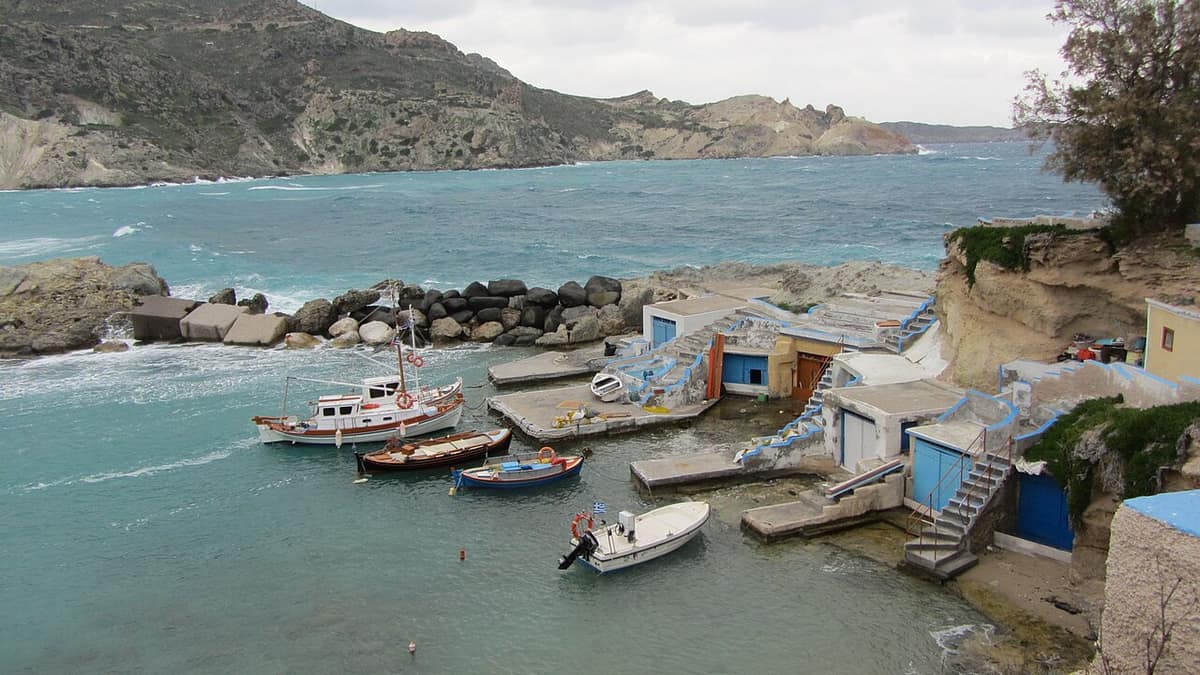
The sea around Milos suits this kind of outing. The island is volcanic. Its reefs, caves and rocky shores give fish plenty of places to live. This outing works these waters beside the people who know them best.
Island fishers work from a boat, from land, or underwater with a spear. A Milos fishing trip is the boat version. The crew leads, and passengers join in rather than watch from the quay or the beach.
On a Milos fishing trip, passengers learn by watching the crew. A fisher shows how to set a line, how to hold it and when to pull. Then each passenger takes a turn. A first-timer can follow along step by step.
What comes aboard shifts with the season and with the stretch of coast. The outing is therefore about the craft, not a promise of fish. A full net on one trip can become a single fish on the next. That is how fishing works.
- Crew: Local fishers run the boat and pick the spots.
- Boat: A working boat carries the gear and the passengers.
- Tools: Nets, long lines with hooks, and rods.
- Catch: Species change with the season and the coast.
- Start: The trip leaves from a harbour.
A Milos fishing trip suits visitors who want to see how island fishers work. It is more than a ride, because it joins fishing with time on the water. The next section looks at the boats and the villages behind the crew.

How do boats and villages shape a Milos fishing trip?
A Milos fishing trip rides on a working boat, and the classic one is the wooden kaiki. Fishing here is ancient, since the first settlers at Phylakopi were Bronze Age tuna fishers. Boat and crew still carry on that trade.
A kaiki is a traditional fishing boat of the Aegean and Ionian seas. The Greek word comes from a Turkish word for a boat. Builders make it of wood. White hulls turn back the strong sun, and bright colours run along the sides.
A builder can work on the shore and shape the hull from pine. Kaikis built the old way come from craft and memory, not from plans. Each kaiki ends up with its own look. The art is fading as plastic and fibreglass hulls take over.
Fishing was a living in the villages by the sea. In the fishing villages of Milos, boats waited out winter in rooms dug into volcanic rock, the syrmata. They stand mainly at Klima, Mandrakia and Fyropotamos. Klima has held traditional-settlement status since 1978.
Across the Greek islands, former fishers now earn a living from summer visitors on the old boats. A Milos fishing trip belongs to that change. The boat and the skills stay in use. Visitors see a real working craft.
- Hull: Pine planks cover sawn ribs and a timber keel.
- Mast: A short mast stands on deck.
- Tiller: The wooden steering arm sits at the stern.
- Bow: The long, sharp bow marks a kaiki among Mediterranean boats.
- Name: The boat’s name sits on a board below the bow.
A Milos fishing trip therefore joins a working boat, an old craft and a village trade. The wooden kaiki is the classic picture, though a trip can also use a modern fishing boat. The next sections turn to the fishing itself, the fish and the cooking.
How is the fishing done on a Milos fishing trip?
A Milos fishing trip uses lines and nets. A hand line is held in the hands, while a rod adds reach. Trolling drags a baited line behind a slow boat. A gillnet traps fish by the gills. Hand lines are among the oldest ways to fish.
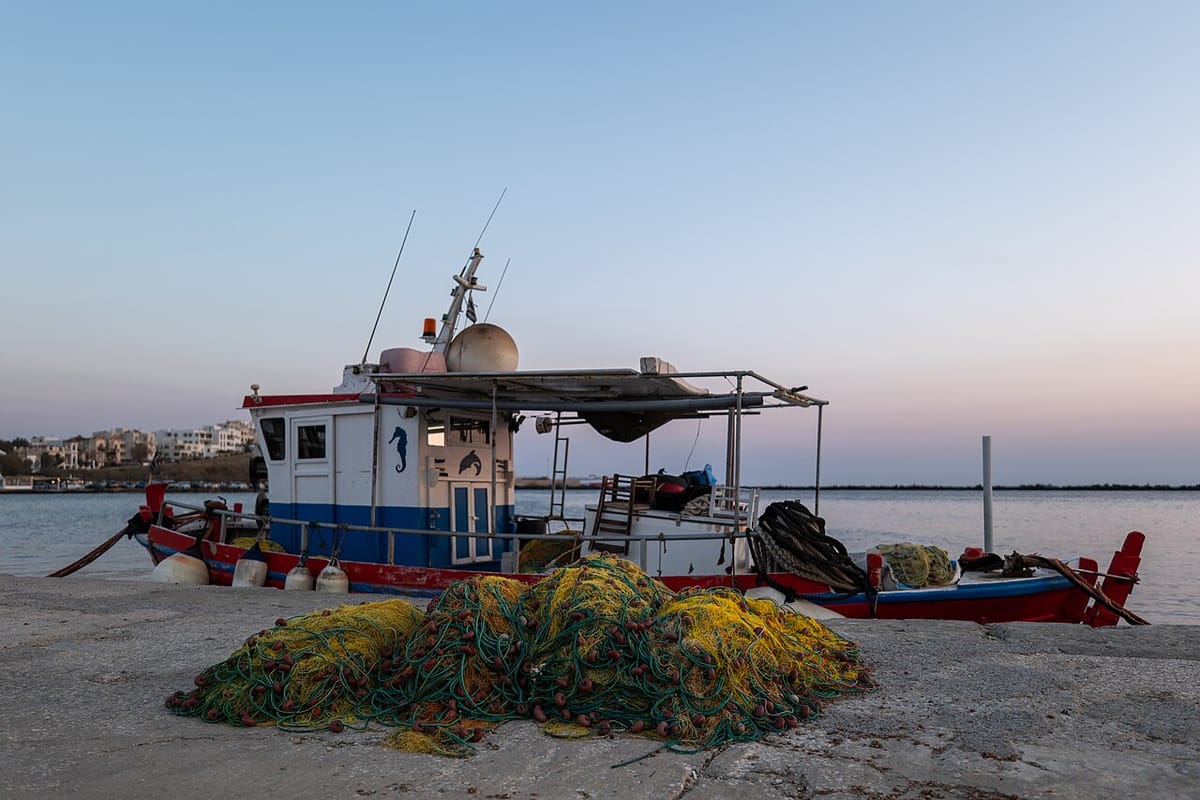
A hand line is one line with no rod. Hooks or lures sit at the end, and a weight can be added to sink it. On a Milos fishing trip, the fisher feels the bite through the fingers, then sets the hook.
A rod is a long, thin pole that carries a line with a hook. It works like a longer arm, so the baited hook travels farther. Trolling puts a lure or a bait fish on the line. The boat moves slowly, and the line trails behind it.
A gillnet is a wall of netting that hangs in the water. Floats hold the top edge up, and a weighted line holds the bottom edge down. A fish swims part way through the mesh. When it struggles, the thread slips behind the gill cover and holds it.
- Kathetí: A Greek line for fishing straight down.
- Weight: A lead weight matches the depth and current.
- Longline: One main line carrying a row of hooks.
- Set net: A gillnet lies in a straight line.
- Bait: Trolling lines carry a lure or bait fish.
Depth shapes the choice of tool. A hand line is fished close to the seabed, though it also works near the surface. Greek fishing splits surface fishing for tuna and sardines from bottom fishing for fish such as red mullet. These tools decide which fish a Milos fishing trip brings aboard.

Which fish does a Milos fishing trip bring up?
A Milos fishing trip can bring up red mullet, scorpionfish, bogue, common pandora and amberjack. All five live in Greek seas. Each prefers a different spot, from sandy bottoms to rocky shores and caves. Small boats take them on lines or in nets.
Red mullet is called barbouni in Greek. It is a reddish fish with two whiskers on the chin. The whiskers help it find food on sandy and muddy bottoms. Boat fishers take it on a line dropped straight down, and shore anglers cast for it. The flesh is tender and tasty.
Scorpionfish is a red fish with a bulky head and sharp spines. The spines carry venom, so removing the hook needs care. By day the fish hides in burrows and caves. At night it comes out to hunt. On a Milos fishing trip, nets and every kind of hook can bring it up.
The bogue, called gópa in Greek, is a silvery fish with large eyes. It lives in schools along rocky shores and weed beds, and Greek seas hold plenty of it. Fishers take bogue in nets and on lines dropped straight down. The flesh tastes good, though the smell is a little strong.
- Common pandora: A pink fish, key to Greek coastal fishing.
- Amberjack: A big hunter that anglers troll for.
- Picarel: A small shoaling fish of weedy bottoms.
- Comber: A banded sea bass relative, caught for food.
- Squid: Hand lines catch squid along with bottom fish.
The fish change with the season and the area. Bogue favours rocky shores, while red mullet favours sandy and muddy bottoms. Rocks, weed and sand each hold different fish. The mix on a Milos fishing trip therefore depends on the spot and the season.
How is the catch cooked after a Milos fishing trip?
A Milos fishing trip leads to Greek fish cooking. Fresh fish is grilled, fried whole or simmered into kakavia, a Greek fish soup. Olive oil and lemon juice flavour the dishes. Fish dishes are common on the islands and along the coast.
The Greek words sti schara mean on the grill. Red porgy and octopus are cooked this way, and sardines are roasted too. After a Milos fishing trip, the island’s taverns serve fresh fish. Octopus comes grilled or cooked in wine.
Small fish suit the frying pan. Marides tiganites are picarel, lightly dusted with flour, then fried. Gopes tiganites are fried bogue. In Greece, picarel is eaten whole, with the head, tail and bones. Fried anchovy and fried cod are other classics.
Kakavia is a Greek soup made from fish, onions, potatoes, olive oil and vegetables. Scorpionfish suits the pot, because its snow-white meat makes a fine broth. In Marseille, cooks use the same fish in bouillabaisse. That soup began as a fishermen’s dish, made from bony rockfish that did not sell.
- Olive oil: The base of Greek cooking.
- Lemon juice: A basic ingredient across Greek cooking.
- Fried squid: Slices served with a lemon wedge.
- Lakerda: Pickled raw fish from Atlantic bonito steaks.
- Wine octopus: Octopus cooked in wine, not just grilled.
Greek fish cooking leans on olive oil and lemon juice, two basic parts of the cuisine. A Milos fishing trip supplies the fresh fish, and these flavours dress it. For the wider menu, readers can turn to food in Milos.
How does a Milos fishing trip mix fishing with swim stops and Kleftiko?
A Milos fishing trip mixes lines and swimming. The reefs and rocky coasts that hold fish sit beside coves where a boat can anchor. The wind of the day picks the cove. A stop near the south-west coast can end the trip.
The volcanic rock of Milos forms reefs, caves and rocky coast where a wide range of fish live. A Milos fishing trip therefore works near the rocks. The same shores hold coves, so the lines and the swim stops sit close together.
Safe days keep fishing and swimming apart. Lines come out of the water before anyone swims. That way a hook never meets a swimmer. Swimmers then slip in from the boat while the crew watches the water.
The wind decides where a boat stops. Each cove suits anchoring in certain wind directions. The skipper picks the cove that the day’s wind leaves calm. Fish also change with the season and the area. The fishing spot and the swim spot can differ.
The south-west coast of Milos holds Kleftiko, a set of white cliffs and rock islets. A Milos fishing trip can borrow this stop for a swim. The place itself has a page on a Kleftiko boat tour.
- Habitat: Reefs and caves shelter fish near the shore.
- Order: Lines come in before swimmers go in.
- Wind: Wind direction decides which cove suits anchoring.
- Season: The catch changes with the season and the area.
- Kleftiko: This stop is a white-rock site on the south-west coast.
A fishing day on Milos holds a swim and a view of white rock. The reefs give the fishing, the coves give the swimming and the south-west coast gives the finish. Each stop has one job. A Milos fishing trip fits all three together.

How does a Milos fishing trip take care of the sea and its fish?
A Milos fishing trip takes care of the sea by keeping only the fish that will be eaten. Small fish go back into the water. Seals and protected places are left alone. These habits protect the fish that stay in the water.
Overfishing means removing fish faster than the species can replace itself. In 2015, the Mediterranean and Black Sea led 16 major areas in unsustainable fish stocks. Keeping only a meal’s worth keeps a Milos fishing trip light on the sea.
Small fish need time to grow and breed, so a careful Milos fishing trip lets them go. A net with larger holes lets fish that are too small escape. Size limits are another tool against overfishing. Staying away from spawning grounds, where fish breed, gives adults a chance to reproduce.
Catch and release means the fish is unhooked and returned live to the water. A barbless hook, one with its barb flattened, causes less injury. Dry hands and hot, rough surfaces damage the skin and slime layer of a fish. Between 18 and 20 percent of released fish still die from injuries and stress.
Monk seals of the Mediterranean are believed to be the rarest seals in the world. Natura 2000 is a European Union network of nature areas. The west end of Milos, where nobody lives, sits almost entirely inside it. Not every site is closed to people, so care at each stop matters.
- Food: Keep only the fish the group will eat.
- Small fish: Return them live to the water.
- Hooks: Barbless hooks cause less injury to a released fish.
- Deep fish: Fish from deep water rarely survive release.
- Seals: Greek law is very strict about hunting monk seals.
A careful Milos fishing trip leaves the rest of the fish in the sea. The group keeps a meal’s worth, frees small fish with care and leaves seals alone. Everyday sea rules, such as taking litter home, apply on a fishing day too.
How does a Milos fishing trip stay safe and free of seasickness?
A Milos fishing trip stays safe with a life jacket on. Hands stay clear of hooks, and feet walk slowly on a wet deck. Seasickness is easier after a good night’s sleep and a light meal. Glances up from the lines help too.
On a Milos fishing trip, hooks need slow hands. Just behind the sharp point sits the barb, a small spike that points backward. It stops the hook sliding out of a fish or a finger. Barbless hooks have no spike, so they come out faster. A line running out fast can cut a palm.
A fish on deck is slippery and still moving. Scorpionfish have sharp spines coated with venomous mucus. Weevers live in the Mediterranean. They have venomous spines on the first back fin and the gills. A weever sting causes severe pain. Passengers leave every unfamiliar fish to the crew.
Slime, spray and spilled bait make a deck slippery. Passengers walk slowly and keep one hand free for a rail. A life jacket holds the head and mouth clear of the water, so no swimming is needed. On a Milos fishing trip, whoever leans out to land a fish is at risk.
- Sleep: Short nights make seasickness easier to start.
- Food: Breakfast stays plain and light.
- Eyes: A glance at the horizon follows each knot.
- Medicine: Tablets can cause sleepiness, so a pharmacist advises.
- Signals: Cold sweat or headache means telling the crew.
Safety on a Milos fishing trip comes down to slow hands, steady feet and a life jacket. A boat that stops to fish rolls in the swell. A rested, fed passenger copes better. On a Milos private boat tour, the skipper can head for a sheltered bay on request.
What does a Milos fishing trip need in the bag?
A Milos fishing trip needs a short packing list. It holds a hat, sun cream, a light layer for the early start and soft-soled shoes. Water, snacks and a bag for wet things complete it. One small bag holds all of it.
On a Milos fishing trip, the boat stops, so the same skin sits in the sun. Water reflects the sun’s rays back at the boat. A wide-brim hat shades the face and neck. Sun cream goes on before boarding and again after swimming or sweating.
An early start feels cool on the water, with wind and spray. A thin layer, such as a light jacket or long sleeves, covers the arms. Soft-soled shoes with a cut grip pattern hold on a wet deck and leave no marks. Bare feet are a poor match for hooks and hard fins.
A small boat offers little shade, and waiting for a bite is slow. Sweat and vomiting both drain water from the body. Headache, tiredness and nausea are signs that water is running low. A full bottle and plain snacks go in the bag.
- Sunglasses: Dark lenses cut glare off the water.
- Wet bag: A sealed bag holds damp towels.
- Plasters: A strip covers a hook scratch.
- Hand cloth: A small cloth wipes slime from hands.
- Spare top: A dry shirt replaces a soaked one.
A Milos fishing trip asks for little gear, but each item has a job. Sun cover stops burns, water keeps energy up, and grip prevents slips. A light bag leaves room to move on a small deck. A sealed pocket keeps the wet things apart.
How is the right Milos fishing trip chosen and booked?
A Milos fishing trip depends on five choices. The first two choices are boat sharing and trip length. The last three concern the meal, the tour description and the start harbour. Each of them changes how the day feels.
A shared boat suits solo travellers and couples. The group is mixed, and the crew sets the plan. A private boat suits families and close friends. The group sets its own pace and picks the spots with the crew.
A half-day outing keeps the plan light. It fits a first try, young children, or a day with other plans. A full-day outing adds more fishing, a longer swim stop and a slower meal on board.
One style grills the catch on board or on a beach. Another serves a set lunch and keeps the fishing separate. The first style ties the meal to luck, so a back-up dish is worth a question. Fish dishes are common on the Greek islands.
Boats leave from Adamas, the main harbour, or from Pollonia, a smaller harbour in the north-east. The start harbour decides the drive from a hotel. A traveller picks the harbour closest to where they sleep. The tour description then needs five plain points.
- Boat type: Names the vessel, such as a wooden kaiki.
- Group size: Says if the boat is shared.
- Gear: Says if rods, lines and bait are on board.
- Meal and stops: Says if a meal and a swim stop are planned.
- Weather plan: Says where the boat goes in strong wind.
The right Milos fishing trip is the one where all five choices match the group. A short, clear description is a good sign. Travellers can also read about activities in Milos. A swim or a paddle pairs well with a day of fishing.
Which questions come up before a Milos fishing trip?
A Milos fishing trip raises questions about skill, children, licences, meals, the catch, empty nets, wind and photos. The answers below are short and plain. A family or a solo traveller then knows what the day holds before boarding.
Is experience needed on a Milos fishing trip?
No experience is needed. Waiting is the main skill, and nothing else is tested. A handline, a hand-held line with no rod, is the simplest style for a first try. Beginners ask the crew for help with bait and hooks. Nobody expects expert moves from a first-timer on the boat.
Are children welcome on a Milos fishing trip?
Families join, and each boat sets its own age rules. The tour description or the crew gives the answer. A fitted life jacket is the first question to ask. Short outings with a swim stop keep young children happy. Parents stay close to the rail and the hooks, and children sit down while the boat moves.
Is a licence needed on a Milos fishing trip?
Much of the world asks for a fishing licence, and rules differ from place to place. On an organised trip, the crew handles that side of the day. A guest does not arrange a licence alone. One question to the crew before the day removes any doubt about the paperwork.
What do vegetarians eat on a Milos fishing trip?
Vegetarians join without trouble. Greek cooking uses vegetables, olive oil and grains, so a plate without fish is easy to build. The meal of the catch is only one style of lunch. Telling the crew in advance lets the kitchen plan a full plate for the day on the water.
Is the catch kept or released on a Milos fishing trip?
The crew decides, fish by fish, using the rules and the size of each one. A guest can say in advance whether a release is preferred. A kept fish goes to the pan and is eaten fresh. A released fish swims on, and the day goes on with the next line.
What happens if no fish bite on a Milos fishing trip?
Luck is part of every fishing day, and the catch changes with the season and the area. A quiet spot is not a failed day. The crew tries another place. The swim stop, the coast and the lunch still stay in the plan. Nobody leaves the boat with an empty day.
Is a windy day bad for a Milos fishing trip?
In summer the Aegean has a strong north wind, the meltemi. The wind season covers the hot months, and gusts peak in the afternoon. They frequently die down at night. An earlier start suits fishing best. When the wind rises, the crew can pick the sheltered side of the island.
Can guests photograph the catch on a Milos fishing trip?
Photos are welcome. A guest asks the crew before lifting a fish. Holding it low over the deck means a slip lands on the boat. A fish meant for release goes back fast, because less handling helps it survive. A phone on a wrist strap stays safe, and a case keeps off the spray.