Very close to the port of Adamantas, you will find the church of the Holy Trinity, which houses the Church Museum.
This church, which is over a thousand years old, is classed as a “cross-shaped three-aisled basilica with troulokamara (arched dome)”, because it has three aisles over which the dome rises vertically, giving the church its cross shape. This type of church is very rare (there is only one other such church, in the Peloponnese, at Levidi, Arcadia) and it is an interesting architectural monument.
It was originally built to serve as a monastery dedicated to the Virgin Mary of Theofani, but in 1839 it was purchased by Cretan refugees, who turned it into their village’s church. The edges and the arches of its bell tower are influenced by Gothic patterns, while the lintels and the pilasters are decorated with traditional sculptures and religious patterns. In the yard, at the church’s entrance, you will see two mosaics, creations of the local artist Giagos Kavroudakis. These two colorful mosaics date from 1937. One of them depicts a dragon in the shape of Milos, while the other depicts the battle of good against evil.
Since 2000, the Church Museum of Milos has been housed in the church of the Holy Trinity. It is a museum where you can admire a great part of the Melian artistic tradition and heritage, as well as the Melian hagiographic tradition. More specifically, you can see icons dating from the 14th century (such as a rare Deposition from the Cross), works of the Cretan school, works by Emmanuel Skordilis, Antonios Skordilis and other Cretan painters, epitaphs and carved wooden lecterns, 17th-century iconostases, the bishop’s throne, icon screens, silver chalices, censers, gold offerings, rings, necklaces, earrings and other exhibits of great artistic value.
Church Museum Milos
Adamas, Milos (Cyclades)
Tel: +30 22870 23956
Very close to the port of Adamantas, you will find the church of the Holy Trinity, which houses the Church Museum.
This church, which is over a thousand years old, is classed as a “cross-shaped three-aisled basilica with troulokamara (arched dome)”, because it has three aisles over which the dome rises vertically, giving the church its cross shape. This type of church is very rare (there is only one other such church, in the Peloponnese, at Levidi, Arcadia) and it is an interesting architectural monument.
It was originally built to serve as a monastery dedicated to the Virgin Mary of Theofani, but in 1839 it was purchased by Cretan refugees, who turned it into their village’s church. The edges and the arches of its bell tower are influenced by Gothic patterns, while the lintels and the pilasters are decorated with traditional sculptures and religious patterns. In the yard, at the church’s entrance, you will see two mosaics, creations of the local artist Giagos Kavroudakis. These two colorful mosaics date from 1937. One of them depicts a dragon in the shape of Milos, while the other depicts the battle of good against evil.
Since 2000, the Church Museum of Milos has been housed in the church of the Holy Trinity. It is a museum where you can admire a great part of the Melian artistic tradition and heritage, as well as the Melian hagiographic tradition. More specifically, you can see icons dating from the 14th century (such as a rare Deposition from the Cross), works of the Cretan school, works by Emmanuel Skordilis, Antonios Skordilis and other Cretan painters, epitaphs and carved wooden lecterns, 17th-century iconostases, the bishop’s throne, icon screens, silver chalices, censers, gold offerings, rings, necklaces, earrings and other exhibits of great artistic value.
Church Museum Milos
Adamas, Milos (Cyclades)
Tel: +30 22870 23956
Tweet
The island of Milos keeps its church art in one building near the port, and the church museum of Milos fills it. The museum is also called the Ecclesiastical Museum of Milos. It stands in the church of the Holy Trinity in Adamantas, and this page explains the building first and the icon collection second.
The church museum of Milos is one of the museums of Milos, and it shows church art inside a church of the port town. The first section follows the building from its first form to its square plan. The second section follows the Cretan painters and the gifts that built the collection.
Which church houses the church museum of Milos?
The church museum of Milos occupies the church of the Holy Trinity, called Agia Triada, on the eastern side of Adamantas near the sea. It is one of the two oldest churches on the island, and its exact date of building is not known.
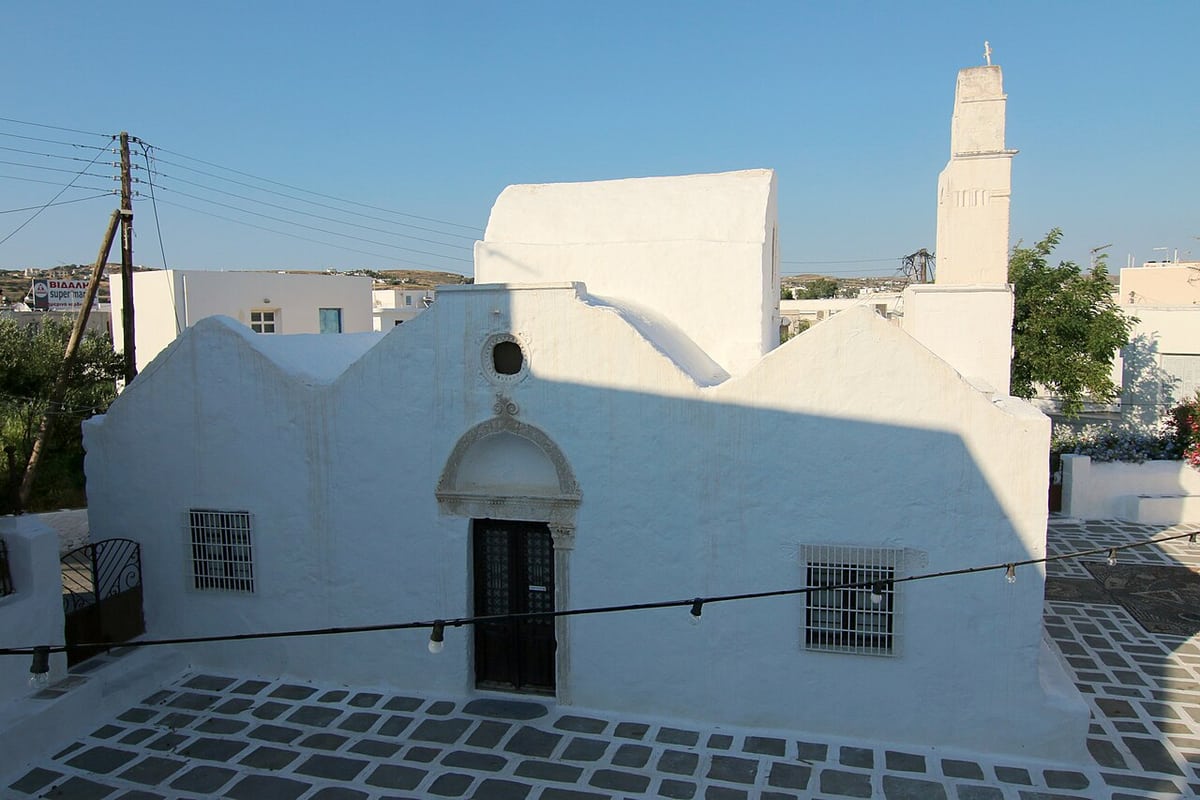
No date of building is known for the church that holds the church museum of Milos, so its age rests on the architecture. The architectural elements point to the start of Frankish rule, when it served as a Latin church, possibly on the ruins of an older Byzantine church. The first Byzantine build belongs possibly to the years after 842 and Iconoclasm. That first roof carried a dome in its middle, and an earthquake brought the dome down together with the larger part of the church.
The church was rebuilt possibly during Frankish rule, from 1207 to 1580, and it needed rebuilding again in the Ottoman period. The present form of the building that houses the church museum of Milos dates from the arrival of the Cretans in 1824, who founded the settlement at the port. Around 1600 the building was used to found a monastery, but the monastery did not run for long. Marshes and mosquitoes made the climate unhealthy, and malaria was the possible reason that the monks died out or left.
The monastery closed before 1650, and the church itself was kept. It then passed into the ownership of Dimitrios Kypraios. Until 1833 the church that now holds the church museum of Milos appears under the name Panagia Theofani. The French traveller Tournefort compiled a list of the churches and monasteries of the island in 1700. The epithet Theofani later dropped away for reasons that are not known, and between 1833 and 1834 the church took its present name, Agia Triada.
The Cretan refugees found the port almost deserted. They began to build their village inside the burial enclosure of Agia Triada, and the enclosure shrank step by step to the courtyard of today. The church was sold completely empty, without interior decoration and in very poor condition, so the residents renovated it. In 1870 a new and large church of the Dormition of the Virgin opened in Adamantas, and the village had two parishes. Signs point to 1916 for their union.
- Plan: The church museum of Milos has a nearly square plan of 11.80 by 11.10 metres.
- Roof: A small chapel-like dome lies across the vault of the middle aisle.
- Courtyard: Three entrances with iron doors lead into a roomy yard paved with Sifnian slabs.
- Steps: Four steps on the west and north sides of the yard rise like theatre seats.
- Bell tower: The upper storey of the tower was demolished in the 1960s and a different tower replaced it.
Because of its age and its distinct architecture, the church was declared a prevailing and listed historical monument. Its interior, with the large number of fine works of art and valuable relics, also makes it a monument worth protecting. For these reasons the church was chosen as the best-suited home for the church museum of Milos. The building and its collection therefore belong together.
What icons does the church museum of Milos keep?
The church museum of Milos keeps post-Byzantine icons of the Cretan school, among them works of the Skordilis family of Cretan painters, who settled on Milos from the middle of the 17th century and worked on the island for at least a century.
Post-Byzantine icon painting in the church museum of Milos follows the Cretan school, which flourished under Venetian rule on Crete and rose to its height after the fall of Constantinople. The school led Greek painting in the 15th, 16th and 17th centuries, and its style shows sharp contours, slim silhouettes and restrained movements. The war with the Ottoman Empire led Cretan painters to the Ionian Islands and Venice, and the Greek painters living on Crete fell from 156 between 1527 and 1630 to 68 between 1631 and 1700.
Emmanuel Skordilis, whose work hangs in the church museum of Milos, was born on Crete and became a priest there. Around 1645, when the region fell to the Turks, he went to the Cyclades and settled on Milos after 1647. His activity runs from 1647 to 1671, and he signed icons with the words Hand of the priest Emmanuel Skordilis. Michael Damaskinos and Georgios Klontzas influenced his style. He did not go to the Ionian Islands and brought the Cretan manner to the Cyclades. Sixty-eight of his works survive.
Antonios Skordilis was born on Crete in 1654, became a priest and lived in Palaia Chora on Milos. He travelled across the Cyclades to paint, and on 20 February 1674 he signed a contract with the holy council of Milos. Thirteen of his works survive, together with two frescoes on the island of Sikinos. The church museum of Milos therefore shows two painters of one family, who carried Cretan icon painting to the island and kept it at work there.
- Templon: The icon screen is largely carved in wood and finely made.
- Odessa gifts: Emigrants from Adamantas, among them a Cretan community in Odessa, gave vestments, chalices, lamps and icons.
- Phelonion: The brothers Xenophon and Pavlos Malandrakis gave a partly gold-embroidered phelonion in 1910.
- Chalice: A silver chalice of Russian craft from the same family stands beside it.
- Worship: The building also works as a church for Orthodox visitors who light a candle and pray.
The idea of a church museum of Milos goes back to 1967, when Ioannis Kavroudakis proposed the change to Manolis Chatzidakis, director of the Byzantine Museum of Athens, in order to gather the icons of the chapels outside the villages and stop looting. The Dictatorship halted the plan. Father Nektarios Tsigkris, parish priest of Adamantas, carried it out, and the museum opened on 23 April 2000.

Which carved iconostasis and church objects does the church museum of Milos keep?
The church museum of Milos keeps an iconostasis carved in wood, believed to come from churches of the old town of Milos, together with vestments, silver, oil lamps and censers. Gifts from Cretan emigrants in Odessa enlarged the collection after the church passed to the refugees.
An iconostasis is a wall of icons that separates the nave from the sanctuary of an Orthodox church, and the high form grew out of the Byzantine templon. The iconostasis in the church museum of Milos is carved in wood for the greater part and shows skilled craft. It is believed to have been moved, like the icons around it, from churches of the old town of Milos. Orthodox teaching nevertheless reads such a screen as a link between sanctuary and nave.
An iconostasis like the one in the church museum of Milos has three openings: the Beautiful Gates in the centre and the north and south doors at the sides. In the Greek tradition the bottom tier carries the large icons of Christ, the Virgin and John the Baptist, with the saint of the church, and smaller icons for veneration hang below them. The screen rarely touches the ceiling, so the voice of the priest carries to the nave.
After Cretan refugees bought the church, gifts from emigrants of Adamantas enriched the church, above all from the flourishing colony of Cretan Adamantines in Odessa. Vestments, chalices, oil lamps, icons and other heirlooms of great value arrived as donations. Two brothers sent a partly gold-embroidered phelonion from Odessa in 1910, and the church museum of Milos keeps it in the north-west showcase beside a silver chalice of fine Russian work given by the same family.
The carved wooden lecterns of the church museum of Milos recall the analogion, a slanted stand that holds an icon or the Gospel Book for veneration and liturgical books for reading. Analogia of intricately carved fine wood exist beside simple frameworks covered with cloth. The epitaphs belong to Good Friday, when the epitaphios, a cloth that shows the dead Christ, is carried in procession and laid on a table in the middle of the church. Censers, metal incense burners hung on chains, add incense to the same services.
- Beautiful Gates: Lay worshippers never pass the central doors, while bishops enter through them at any time.
- Side doors: The north and south doors are also called the Deacons’ Doors, since deacons use them frequently.
- Phelonion: The priest wears this outer vestment over his other vestments at major services.
- Chalice: A chalice is the standing cup that holds the sacramental wine of the Eucharist.
- Oil lamps: Oil lamps, called kandilia in Greek, stand among the gifts of the emigrants.
The iconostasis, the vestments, the silver and the lamps show how a refugee parish furnished its church. The gifts reached the church after the purchase by the Cretan refugees and went on into the 20th century. The church museum of Milos therefore holds two layers side by side: the movable heirlooms of the old town and the donations of the Adamantas emigrants.
How does the church museum of Milos reflect the church traditions of the island?
The church museum of Milos reflects a church shaped by Frankish rule, a Greek Orthodox majority and Cretan refugees. It gathers icons from outlying chapels, stands under the Holy Metropolis of Syros, Tinos, Andros, Kea and Milos, and marks its feast on the Day of the Holy Spirit.
The Orthodox and Catholic past of the island explains the building. The Venetian Marco Sanudo created the Duchy of the Archipelago in 1207, and Milos belonged to it. The Venetians brought the Catholic Church with them, yet the Greek Orthodox majority stayed in place, and a Latin diocese of Milos dates from the same year. The architecture of the church that houses the church museum of Milos points to a start as a Latin church in the early Frankish period, as the history of Milos sets out.
Latin and Orthodox traces sit side by side in churches beyond the church museum of Milos. Panagia Thalassitra, protector of sailors, took the neighbouring Frankish church of Panagia Eleousa into its south aisle, and the arms of a Crispi duke of Naxos mark its west door. The Crispi family took the duchy in 1383, and the last Latin duke was deposed in 1566. Panagia Korfiatissa at Plaka, built in 1810, shelters heirlooms from old abandoned churches and a gilded epitaphios of 1600 that came from Smyrna.
The museum grew from a concern for the outlying chapels. In 1967 a proposal reached Manolis Chatzidakis, director of the Byzantine Museum of Athens, to turn the Holy Trinity into a museum, to gather the valuable icons of the island chapels and avoid looting. The dictatorship stopped the plan. The church museum of Milos opened on 23 April 2000 as the Ecclesiastical Museum of Milos, a non-profit institution under the Holy Metropolis of Syros, Tinos, Andros, Kea and Milos.
The Orthodox feast of Pentecost spans Trinity Sunday, the Monday of the Holy Spirit and the Third Day of the Trinity. The feast of the Holy Trinity church falls on the Day of the Holy Spirit. Three entrances with iron doors lead into the wide courtyard, which is paved with flagstones from Sifnos and has steps that belong to the time when the custom of the festival took hold, and the church museum of Milos still stands inside the same walls.
- Old metropolis: Panagia Portiani at Zefyria was the metropolis of the island, and its icon moved to Adamas in 1864.
- Earthquake: An 18th-century earthquake destroyed the town of Zefyria and left its church empty.
- Courtyard steps: Four steps on the west and north sides form seats like an open-air theatre.
- Festival seating: Women sat on these steps to watch the festival or to take part.
- Place of prayer: Orthodox visitors light a candle and pray in the church as well as the museum.
The church museum of Milos therefore ties together the Latin and Orthodox layers of the island, the heirlooms of emptied chapels and a festival that the courtyard still frames. Each part belongs to one story of an island church kept alive by its own people. A visit shows that story in the objects, in the building and in the calendar of the Holy Trinity.
How does a visit to the church museum of Milos fit with the rest of Adamantas?
The church museum of Milos fits easily into a walk through Adamantas, because the Holy Trinity church stands very close to the port, the Mining Museum and a restored wartime shelter lie in the same town, and the waterfront and gulf beaches complete the route.
Adamas is the main port of the island and the first sight for visitors who arrive by boat. The town stands in the north of a gulf that ranks among the largest and safest natural bays in the Mediterranean, and it is the largest tourist centre of Milos. The church museum of Milos belongs to this port district, since the Holy Trinity church stands very close to the port. The harbour is therefore the starting point of the route.
The town itself is a port of white houses with small flower-decorated courtyards and narrow quiet streets. Rest and tranquillity sit beside nightlife and entertainment, and hotels, inns, cafes, restaurants and bars gather around the harbour and the village. A visit to the church museum of Milos therefore crosses the streets of a living town, and the cafes and restaurants of the harbour area offer a pause before or after the heirlooms inside the church. The village also supplies what a comfortable and pleasant stay requires.
The Mining Museum stands in the same town and covers a different side of island life. Dating from 1998, it follows the minerals and the geology of the island. The church museum of Milos opened two years later and keeps the heirlooms of the church tradition of the island. Together the two museums set the rock of Milos beside its faith, and both can be reached without leaving Adamantas. The church that houses the second museum is among the two oldest on the island.
The large wartime shelter of Adamas adds the history of the occupation to the route. The German occupation army had it built during the Second World War. Twelve large chambers branch off both sides of a central passage below the present settlement. For years it served as a water-supply works. This hidden side of the island contrasts sharply with its Cycladic landscape. A visit to the church museum of Milos and the shelter therefore sets church life beside wartime history in a single town.
- Shelter today: The structure was restored in recent years and is open to the public.
- Art project: 17 visual artists were invited to make works in its cells.
- Lagkada: The nearest beach to the port has clear water and tamarisk trees for shade.
- Papikinou: This large beach lies 1 km east of Adamas and has tamarisk trees, umbrellas, sunbeds and a restaurant.
- Gentle sea: The water at Papikinou deepens slowly, and its waves are among the mildest on the island.
A route through Adamantas joins the port, the Holy Trinity church, the Mining Museum, the shelter and the shore into one account of the town. The church museum of Milos gives that account its religious side, the shelter gives it a wartime side, and the gulf beaches give it a seaside. The wider profile of the settlement sits on the page about the harbour town of Adamantas.


What do visitors ask about the church museum of Milos?
The church museum of Milos draws six practical questions: who runs it, why it was created, whether worship takes place there, where it stands in Adamantas, what its courtyard holds and which European link it has. The answers below cover each one.
Who runs the church museum of Milos?
A non-profit foundation runs it under the control and supervision of the Holy Metropolis of Syros, Tinos, Andros, Kea and Milos. The Metropolis founded it in 2000 to keep, protect and show the valuable heirlooms of the church tradition of the island. Its stated aim is the research, study and presentation of the church history of Milos.
Why was the church museum of Milos created?
In 1967 Ioannis Kavroudakis proposed turning Holy Trinity into a museum and put the idea to Manolis Chatzidakis, the Byzantine scholar with roots in Adamantas who then directed the Byzantine Museum of Athens. The aim was to gather and protect the valuable icons of the island’s chapels and to stop looting. The idea was accepted, but the dictatorship blocked it.
Can visitors pray in the church museum of Milos?
Yes. During the summer season the church works as a museum and as a church at the same time. The order that set up the museum asked for this, to serve Orthodox visitors and holidaymakers who want to light a candle and pray. Father Nektarios Tsigris, the parish priest at the time, arranged Holy Trinity to display the old heirlooms.
Where does the church museum of Milos stand in Adamantas?
Holy Trinity stands about halfway along the east side of Adamantas, close to the sea, and it once stood on the shore, before the land silted up. When Cretan refugees reached the port, the area was almost empty. They began to build the village inside the church’s burial enclosure, and the enclosure shrank step by step to today’s courtyard.
What does the courtyard of the church museum of Milos hold?
The courtyard is roomy, has three entrances with iron doors and is paved with Sifnian flagstones. On the west and north sides, four steps rise like the seats of an open-air theatre. They served as seats for the women who watched or took part in the festival of the church, held on the day of the Holy Spirit.
What European recognition has the church museum of Milos earned?
The museum opened on 23 April 2000. In 2006 it joined the European Museum Forum, a Europe-wide body that works under the auspices of the European Union and cooperates with UNESCO. Its founder, Grigorios Belivanakis, devoted himself to turning Holy Trinity into a true home of church art and Orthodox tradition, and he won a European distinction for his work.