
Tsigrado beach lies on the south coast of the Greek island of Milos, in the Cyclades group. The cove is small and sandy, and tall rocks close it in on both sides. Milos Advisor writes about this island and its coast in plain English, and its pages cover the shore.
The beach sits below a steep rise, so the last part of the trip is on foot. White sand and emerald water fill the small cove at the bottom of the slope. This page looks at Tsigrado beach, the way down, the sand and the open water.
What is Tsigrado beach like at a glance?
Tsigrado beach is a small sandy cove on the south coast of Milos. Tall rocks stand around the sand, and the water inside the cove shows an emerald colour. The cove has no beach facilities of its own.
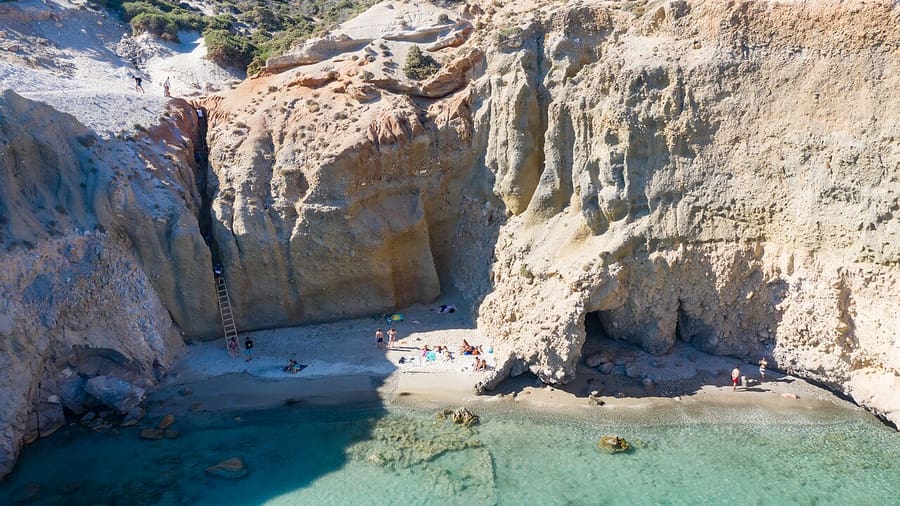
The cove is small and made of sand, with room for a short line of towels. It sits on the south side of the island of Milos, on the open south coast. Rocks stand on both sides, and the cove feels closed and quiet.
A dirt road leads to the top of the slope above the cove. From there the way down runs over a steep path covered with sand. The last stretch of the trip is on foot, and the cars stay behind at the top.
The beach is not organised at all, so nothing is for sale below the rocks. There are no loungers, and there is no place to buy food or drink. Visitors who want the basics walk along to the nearby beach of Firiplaka.
Tsigrado beach stays calm and flat during a north wind. The south coast turns away from that wind, so the water inside stays flat. The open sea lies beyond the mouth of the cove, past the rocks.
Firiplaka lies next door to the west of Tsigrado beach, and it runs much further. Visitors can walk from one beach to the other by the water line. The ground on that walk is uneven and rocky.
The cove carries no buildings, and it has no roads of its own. It keeps the shape of a small bay cut into the soft rock. The sandy path above the beach is the way in from the land.
- Place: The cove faces south, on the lower shore of Milos.
- Sand: The beach holds fine white sand.
- Water: The sea inside the cove shows an emerald colour.
- Facilities: The cove has no facilities of its own.
- Neighbour: Firiplaka beach lies next door to Tsigrado beach.
Tsigrado beach rewards the short climb down with white sand and emerald water. The cove stays small and open to the sea, with no buildings around it at all. The longer beach of Firiplaka lies close by along the same coast.

Where does Tsigrado beach sit on the south coast?
Tsigrado beach sits on the south coast of Milos, between the coves of Kalamos and Firiplaka. The south coast of the island faces open sea, and the shoreline runs east to west. The island lies in the Cyclades group, far out in the Aegean Sea.
South Milos carries a long line of beaches along its rocky coast. The beaches of Milos stretch west from Psarovolada as far as Kleftiko. Tsigrado beach is one small part of that long line.
Two neighbours stand close to the cove, one on each side of the sand. Kalamos lies to the east, and Firiplaka lies to the west of Tsigrado beach. The three beaches share one rocky shoreline, one open sea and one long coast.
The island of Milos belongs to the Cyclades, a group of Greek islands in the Aegean. Milos formed from volcanic rock, and the coast still shows that past. Pale, dark and red rocks stand along this shore and above the sandy cove.
Provatas lies beyond Firiplaka, further west along the same coast. Gerakas and Paliochori sit to the east of the cove. Each of these beaches has its own shape along the shore and its own colour of sand.
The whole south side of Milos faces the open water of the Aegean Sea. Winds from the north leave this whole coast calm through the long summer. South beaches like Tsigrado beach stay quiet and calm on those windy days.
Other beaches on Milos can be reached only from the sea. The cove of Tsigrado beach has a clear walking route in from the land. The south-west coast of the island is also a home for the Mediterranean monk seal.
- Kalamos: This beach lies to the east of Tsigrado beach on the south coast.
- Firiplaka: This long beach lies to the west of the cove.
- Provatas: This beach lies further west, beyond Firiplaka.
- Gerakas: This beach lies to the east, near the start of the south coast line.
- Kleftiko: This rocky place sits at the far west end of the south coast.
Tsigrado beach holds a small place on a long and rocky coast. The map shows it between Kalamos and Firiplaka, two beaches with their own character. The island of Milos sits in the Cyclades, far out in the Aegean Sea.
How does the way down to Tsigrado beach work?
The way down to Tsigrado beach begins at the end of a dirt road above the cove. From the top of the rise, a steep, sandy path drops down to the shore. Care is needed on that sandy slope.
The approach to Tsigrado beach starts on a dirt road. That road is fairly easy to drive, and it climbs to a clear point above the beach. Vehicles stop there, and the rest of the short trip is on foot.
The path from the rise above the cove is steep and fairly short. Sand covers the whole trail, so feet slip on the loose ground. Slow steps and free hands make the whole walk down much easier.
Loose sand moves under the shoes on the whole way down. The slope gives a wide view of the cove and the open sea. The water grows closer with each step, and the last metres land on soft sand.
The return trip goes up the same sandy slope. The climb takes effort, and the sun on the open slope adds more heat. A short pause at the top of the bright rise brings relief.
The cove has no path for cars and no steps of stone at all. The route down is a simple walking trail over rock and sand. Wet shoes make the sandy path much harder on the way back up.
The beach has no facilities at all, so supplies come from Firiplaka beach. Visitors carry water and food down the slope, and carry the empty bags back up. A light bag makes the climb back to Tsigrado beach easier.
- Road: A dirt road climbs to a point above the cove.
- Path: A steep trail covered with sand leads down to the shore.
- Ground: Loose sand and rock sit under the feet on the slope.
- Effort: The return climb takes effort, so a slow pace helps.
- Supplies: Food and drink come from Firiplaka beach, because the cove has none.
The way down to Tsigrado beach is short, steep and covered with sand. The road brings visitors to the top of the rise, and the rest is a walk. The cove holds no facilities, so bags stay light going down the slope.
What are the sand, the rocks and the water like at Tsigrado beach?
Tsigrado beach holds white sand, tall rocks on both sides and water of a deep emerald colour. Milos formed from volcanic rock, and the coast around the cove shows that past. The pale sand under the water lifts the green tone of the sea.
The sand in the cove of Tsigrado beach is white and fine. It fills the space between the rocks and the clear water. Pale sand reflects light, so the beach looks bright through the middle of the day.
The water in the cove shows a strong emerald colour. That green tone comes from pale sand under clear and shallow water. The colour changes with the light, and deeper water further out looks darker.
Tall rocks stand on both sides of the sand at Tsigrado beach. They frame the cove and cut the view to the open sea. The rock faces along this coast carry white, red, yellow and black tones.
Milos formed from volcanic rock, and the shore near the cove shows that past. Rounded shapes and hard stone meet the water along this coast. The island sits in the Cyclades, far out in the Aegean Sea.
Hard rock walls rise above the sand at the back of the cove. They hold the sand in place and block the way inland from the shore. The beach therefore opens only to the open sea.
The colour of the sea inside the cove changes through the day. Light and depth both play a part in that change of tone. The green shows best where the water stays shallow over pale sand.
- Sand: The cove holds fine white sand, spread across the shore and the slope.
- Water colour: The sea inside the cove shows an emerald green tone.
- Rocks: Tall rocks stand on both sides and frame the sandy space.
- Volcanic past: Milos formed from volcanic rock, and the coast shows it.
- Rock tones: The cliffs along this coast carry white, red, yellow and black tones.
Tsigrado beach shows a simple set of colours: white sand, dark rock and green water. The volcanic past of Milos gives this coast its mix of pale and red stone. Shallow water over pale sand brings out the emerald tone of the sea.
What is swimming and snorkelling like at Tsigrado beach?
Swimming at Tsigrado beach takes place in a small cove with clear water. The rocks on both sides give the cove shelter, and the sea stays calm. Visitors swim close to the shore, where the water stays shallow and clear.
The water in the cove of Tsigrado beach is clear and easy to read from above. The sandy floor lies close to the surface near the shore. Visitors can see the sandy bottom through the pale green water.
The cove of Tsigrado beach is small, so swimmers stay inside the mouth of the bay. The rocks at each side mark the edge of the calm water. Open sea begins just beyond that line of dark rock.
Swimming near the rocks at each side of the cove brings more to see. Pale sand and dark stone meet along the shoreline. Visitors who want to look below the surface bring their own gear.
Winds from two directions shape the day inside the cove. A wind from the north leaves the water flat, clear and calm. A wind from the south pushes waves into the cove and makes the water rough.
The cove of Tsigrado beach has no facilities, so swimmers plan ahead. Water, food and shade come down the slope with the visitors. Empty bags and rubbish travel back up the sandy path with them.
Families keep children close in the small cove of Tsigrado beach. The water near the shore stays shallow, and the rocks give a clear edge. Care with the sandy slope matters after a swim, when feet are wet.
- Water: The water in the cove is clear, with a green tone over pale sand.
- Shelter: The rocks on each side give the cove shelter from the wind.
- Wind: A north wind leaves the sea calm inside Tsigrado beach.
- Gear: Visitors bring their own gear, because the cove sells nothing.
- Care: The sandy slope needs slow steps after a swim.
Swimming at Tsigrado beach suits visitors who like small, quiet and simple places. The clear water and the sandy floor make the small cove easy to enjoy. The climb back up the sandy slope stays the last task of the day.
What is Firiplaka beach like next to Tsigrado beach?
Firiplaka beach lies next to Tsigrado beach on the south coast of Milos, between Provatas and Tsigrado. It is a long beach of fine grey sand and white pebbles, with shallow turquoise water. Tall volcanic cliffs stand above the sand.
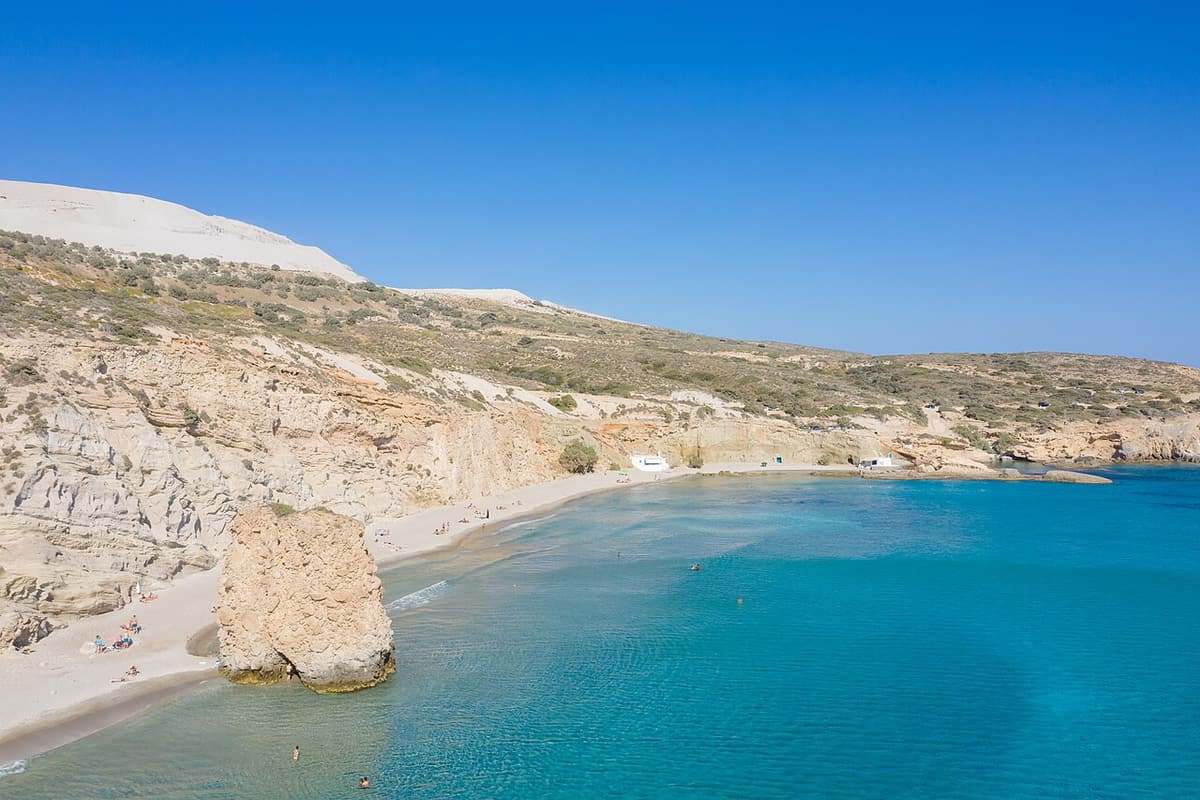
Firiplaka beach runs much further along the coast than its small neighbour. The sand there is fine and grey, mixed with small white pebbles. The beach opens to the sea along a wide and open stretch of shore.
Tall dark cliffs rise high above the sand at Firiplaka beach. The rock carries strong colours, shaped over long years by wind and water. The cliffs give the long open beach its own clear and rocky character.
The water at Firiplaka beach is shallow and turquoise near the shore. The sandy floor slopes away slowly, so the water stays easy to enter. Visitors walk a short way out before the water grows deep.
A huge rock stands in the clear water close to the shore. A cave opens under that rock, cut out by volcanic forces long ago. The shape of the rock makes the spot easy to notice from the sand.
The first part of Firiplaka beach holds loungers, parasols and a place for drinks. Two quieter stretches follow further along, past the volcanic rocks. Visitors reach those quiet stretches by walking beside the calm sea.
The road to Firiplaka beach is asphalt for the greater part of the way. The last part of that road turns into a gravel driveway. The beach draws a crowd in summer, because it is a known spot on the south coast.
- Length: Firiplaka beach runs much further along the coast than Tsigrado beach.
- Sand: Fine grey sand and white pebbles cover the long shore.
- Water: Shallow turquoise water lines the beach near the shore.
- Cliffs: Tall volcanic cliffs rise above the sand at the back of the beach.
- Quiet end: Two quiet stretches lie further along, past the volcanic rocks.
Firiplaka beach offers a longer and more open day than the small cove next door. Its grey sand, white pebbles and turquoise water give it a different look. A walk beside the sea links the two beaches along the coast.
How does a boat reach Tsigrado beach on the south coast?
Tsigrado beach lies on the south coast, and boats reach the cove from the water below the cliffs. Boats set off daily from the harbours at Adamas and Pollonia, and calm days keep the trip short. Sea kayaks follow the same shore.
A sea route suits the south coast. The water there stays calm in the meltemi, the north wind of the Aegean Sea. A boat that follows the coast reaches Tsigrado beach without using the road above the cliffs.
Sea kayaks travel the same shore in small groups, close to the rock. Visitors who join a sea kayak route along the south coast paddle between the coves. The coastline holds sea caves and tunnels, and the paddlers reach deserted beaches with ease.
A rented boat gives a group its own timetable and its own line along the coast. A skipper keeps the hull off the rocks and finds the open water at the cove. From the water, the white sand and the tall cliffs of Tsigrado beach appear together.
Boat trips leave the port in the morning and follow the shore south from Adamas. The sea below the cliffs stays deep close to land, so the boat comes near the sand. Swimmers step off and reach the beach with a short swim.
Water arrives at the cove from the open sea. The bay stays shallow near the sand, so swimmers stand in clear water. A kayak rests on the white beach while the group takes a short break in the shade.
A Milos boat rental gives a family or a small group a private line along the shore. The skipper knows where the rock lies under the surface. A stop at the cove fits between Firiplaka and Kalamos on the south coast.
- Route: Boats follow the south coast from the port of Adamas.
- Trips: Sea excursions reach beaches that no road serves.
- Kayak: Sea kayaks paddle the sheltered water below the cliffs.
- Caves: The volcanic coast holds caves and tunnels to explore.
- Sand: The cove holds white sand and clear emerald water.
The sea gives an easy line to Tsigrado beach from the port at Adamas. A kayak or a small boat follows the shore through the summer months. The long climb on the land side belongs to another route for the day.

When is the best time to visit Tsigrado beach?
Tsigrado beach draws its largest crowds in high summer, when the meltemi blows over the Aegean. The south side of the island stays calmer in those north winds, and the early hours stay quiet. A quiet start serves a swimmer well.
Summer brings the largest number of visitors to the island. The middle of the day carries the strongest wind, and the beach fills after lunch. The meltemi blows at its hardest in the afternoon and then dies down at night.
The climate of Milos is Mediterranean: winters bring mild rain, and summers stay hot and dry. During the meltemi and other north winds, the southern shore has the better water. A south wind turns the north side into the better choice.
The cliffs above the cove give shade at the ends of the day. Water in the bay stays clear, because the cove opens to the sea. A calm morning suits a swim at Tsigrado beach, before the wind builds.
Boats leave the ports of Adamas and Pollonia each day through the warm months. Morning water lies flat before the wind builds in the afternoon. A group that starts early at Tsigrado beach finds the sand in shade.
Kayak trips follow the island shores and the sheltered water below the cliffs. The meltemi eases in September, so the sea lies calmer and the crossing turns easy. Autumn gives a quiet shore and easy water.
The warm months fill the island, and the cove draws its own share of that flow. Visitors who plan a stop gain from an early start and a short descent. The wind arrives later in the day, and the climb back up the slope waits.
- Season: The meltemi blows through the summer months.
- Hour: The wind peaks in the afternoon and drops at night.
- Shelter: The south coast suits a meltemi day.
- Reverse: A south wind makes the north coast better.
- Summer: Warm months bring the largest number of visitors.
Summer holds the busiest weeks, and the meltemi shapes the day at Tsigrado beach. Wind builds after midday and falls again at night, so early hours give the calmest water. The south coast stays the better side while the north wind blows.
Is the ladder down to Tsigrado beach safe to use?
Tsigrado beach sits below a cliff, and the last part of the walk uses a rope. One person moves at a time, with both hands free for the rope and the ladder. A steady, slow descent suits the gap in the rock.
The path drops through a narrow gap in the rock, and sand covers the slope. One person goes down at a time, so the rope stays free for the next hand. Waiting above the gap keeps the line short.
Both hands stay on the rope, and a bag goes on the back. Shoes with a firm, deep tread grip the sand and the rock. Bare feet and smooth soles slip on the loose dust of the slope.
A person who feels unsure at the top turns back before the descent begins. The gap holds a tight space, and two-way traffic there creates risk. A short wait costs nothing, and Tsigrado beach stays in view below.
Children need a grown hand on the rope and one adult in front. The same care protects the sandals and the towels that fall from open bags. A steady pace beats a fast one on a sandy slope.
The cove has no organised services at all, so nothing on the sand offers help. The climb back up takes effort, and the rope is the only aid on the rock. A light bag makes that final climb easier.
A helper at the top keeps watch while another person descends. Hands stay empty on the rope, and the heavy bag goes down on a line of its own. The cove offers no quick way out once a visitor stands on the sand.
- Hands: Both hands stay free for the rope.
- Order: One person moves at a time.
- Shoes: A firm tread grips sand and rock.
- Bags: A light pack stays on the back.
- Choice: A walker who feels unsure turns back.
Care turns a steep, sandy descent into a simple part of the day at Tsigrado beach. One person moves at a time and keeps both hands on the rope. Shoes with grip, a light bag and a steady pace carry a walker to the sand.
What does a visitor pack for Tsigrado beach?
Tsigrado beach has no organised services at the cove. Water, shade, snacks, sun cream and a light bag belong in the pack. The nearby shore of Firiplaka supplies the basics, and a light bag keeps both hands free.
The descent needs both hands, so a backpack leaves the palms free. A shoulder bag slides and pulls a walker off balance on the sandy slope. A light pack with water and a towel serves the day.
No bar, no shop and no sunbed stand on the sand. Nothing sells drinks at the cove, and water for each person covers the walk down and back up. Firiplaka next door is the organised part of the coast.
Shade is scarce on the white sand, and the high rock throws its shadow late. A sun hat, sun cream and a light shirt keep a swimmer cool at midday. Snacks replace a meal that no taverna provides at Tsigrado beach.
Water shoes help on the pebbles and the wet rock at the water line. A dry bag protects a phone and a small camera from spray. Rubbish goes back up the slope, since the cove holds no bin.
A group that arrives by sea keeps a dry bag on the deck. A kayak carries the water and the shade that the walker leaves behind. The cove rewards a simple pack and a free pair of hands.
A first aid kit and a charged phone round out the pack for a remote shore. Times for the return trip stay in the plan, so the climb up starts in daylight. The cove sits on the south coast, away from the harbour town.
- Water: Each person carries enough for the whole visit.
- Shade: A hat and a light shirt cover the skin.
- Snacks: Food comes from home, since the cove has no shop.
- Sun cream: A high factor protects against strong summer sun.
- Bag: A light pack keeps both hands free.
A simple pack serves a day at Tsigrado beach better than a heavy one. Water, shade, snacks and sun cream cover the needs of an unorganised shore. Firiplaka, the next cove along, holds the services that the white sand lacks.
Which coves lie near Tsigrado beach on the south coast?
Tsigrado beach sits between Firiplaka and Kalamos, and coves follow one another along this shore. Provatas, Gerakas, Agia Kyriaki and Paleochori lie along that shore. Kleftiko, Agios Sostis, Kipos and Gerontas also belong to the south side.
Beaches line the south side of Milos from its eastern tip to its western tip. Tsigrado beach lies close to Firiplaka on one side and Kalamos on the other. The line runs past Provatas and Paleochori toward Gerakas.
The south side of the island carries a long list of coves. Firiplaka, Provatas, Agios Sostis, Kipos, Gerontas, Kleftiko, Paleochori, Agia Kyriaki, Gerakas and Kalamos all belong to this shore. The line reaches from the eastern end to the far west.
Boats and sea kayaks open coves that the road cannot reach. A visitor who travels by water sees Firiplaka, Kalamos and Gerakas on one path along the coast. The sea joins the coves into a single line along the cliffs.
The shores of Milos show white, red, yellow and even black rock. Agia Kyriaki and Paleochori sit further east along that line, and the south coast holds those colours. Kleftiko marks the far end of the south side of the island.
Rough roads reach part of the coast, while other coves wait for a boat. A walker who plans a day on this shore picks two coves and stays close. Beyond the water, the island offers other activities in Milos for the week.
A boat trip from the port of Adamas covers one stretch of this rocky shore. The water route holds the coves of Tsigrado beach and Firiplaka close together. A day on the sea ends at the point where it began.
- Firiplaka: A long white shore sits west of the cove.
- Kalamos: A quiet bay lies east of the cove.
- Provatas: A wide shore follows on the south side.
- Gerakas: A small bay closes the eastern run.
- Kleftiko: Rock columns mark the far south-west.
The south coast of Milos gathers its coves along one line of water. Firiplaka and Kalamos sit beside Tsigrado beach, and Provatas, Agia Kyriaki, Paleochori and Gerakas follow further along. A day on this shore fits two coves with ease.

What do visitors ask about Tsigrado beach?
Questions about Tsigrado beach cover children, access, parking and swimming near the rocks. They also cover photography, wind, the shoulder seasons and a day that joins two coves. The answers below stay with the facts of the cove and its neighbours.
Is Tsigrado beach a good choice for children?
Children can manage the descent with one adult in front and a second adult just behind them. The path drops down a steep slope covered with loose sand, between high walls of rock. The water near the sand stays shallow, and a short rope of their own helps small hands.
Can a person with reduced mobility reach Tsigrado beach?
Access to the cove runs over rough, uneven ground and then ends with a ladder and a rope. That line rules out a wheelchair, a pushchair and a visitor with limited balance on sand. Firiplaka, the next cove along the coast, holds the organised shore for visitors who need flat ground.
Where do cars stop near Tsigrado beach?
Access to the cove runs along a dirt road that ends on the high ground above it. Cars stop at the end of the road, and the short walk down to the sand starts there. An early arrival gives the simplest stop, before the space beside the road fills up.
Is swimming near the rocks at Tsigrado beach safe?
The bay opens to the sea, and the clear water deepens away from the white sand. Tall rock walls drop straight down into the deep water on both sides of the small cove. A swimmer who stays over the sand keeps clear of the wet rock, which turns very slippery.
When is the light best for photos at Tsigrado beach?
The cove faces south, so the sun crosses high above the water through much of the day. Rock walls and the white sand take the strongest light around the middle of the day. Low sun at the start and the end of the day throws the high cliffs into shade.
What happens on windy days at Tsigrado beach?
In the meltemi and strong north winds, the calmer water lies on the southern shore. The meltemi blows at force 7 or 8 on the Beaufort scale during its strongest hours. Waves enter the small bay on those days, and a kayak needs much more effort to land.
Are spring and autumn visits to Tsigrado beach quiet?
Kayak trips follow the island shores and the calm water below the tall cliffs of the coast. The meltemi eases in the middle of September, so the sea lies calmer and every crossing turns easy. Winters on Milos are mild and rainy, and the spring weeks bring quiet days.
Can a day join Tsigrado beach with another beach?
Two coves sit close together on this shore, and a single road joins the two of them. Firiplaka lies next to Tsigrado beach, so a walker covers both coves in a single visit. Boats and kayaks also travel from one bay to the next one along the rocky south coast.