
The ancient theatre of Milos stands on a hillside between Trypiti and Klima. The ancient city once spread there. Its marble seats face the bay of Milos. This page gathers what is known about the monument. The pages about the island of Milos set it in its wider setting.
The building dates from the Roman period, and it ranks among the important works of the ancient city. The ancient theatre of Milos still hosts drama and music events. The two sections below give the theatre at a glance. Then they place it on the slope, next to the catacombs and above the water.
What is the ancient theatre of Milos at a glance?
The ancient theatre of Milos is a Roman-period theatre set on the hillside above the bay. Its seating bowl is cut into the slope and carries marble seats in seven sections. A stage building joins the seats, and the view runs down to Klima and the water.
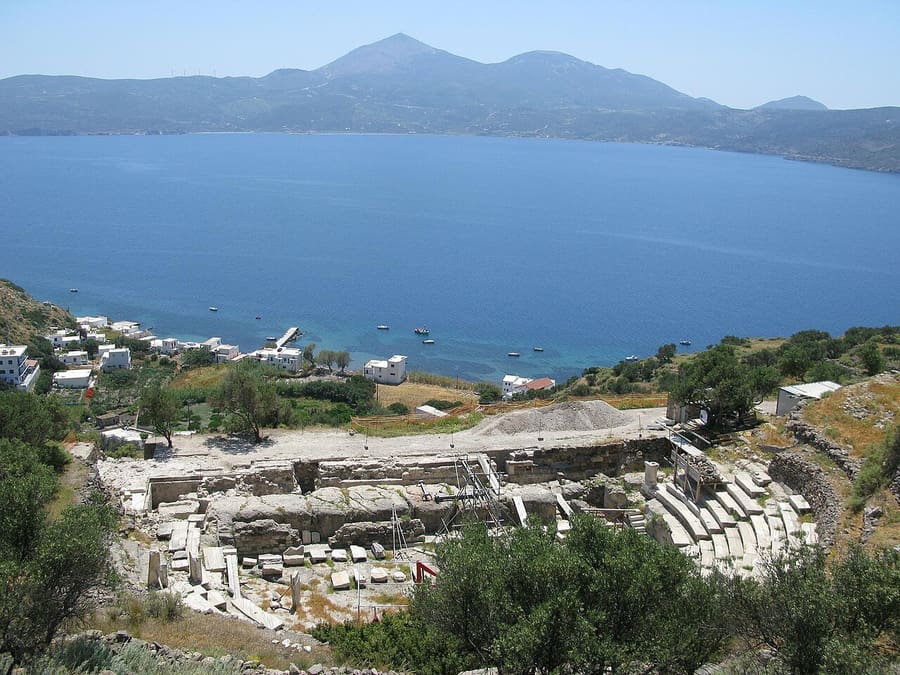
The ancient theatre of Milos belongs to the city that covered this hillside in antiquity. Builders raised it in the Roman period as a costly work, in stages and over a long time. Its form matches Roman theatres in the eastern provinces of the empire. Those theatres took the Greek theatre as their model.
The seating area, called the cavea, has the shape of a horseshoe. Builders cut the larger part of it into the hillside, which is volcanic tuff. The two ends rest on filled ground, held up by strong retaining walls of volcanic stone blocks. Seven sections of marble seats sit between eight marble stairways.
A stage building joins the seating area, which gives the monument its typical Roman form. The orchestra, the flat floor below the first row, is a little more than a half circle. From the seats the view runs over the seaside houses of Klima. Beyond them the bay of Milos opens toward the port.
The theatre stopped working in the fourth century AD, yet the site is alive again. After restoration it reopened to the public in July 2016. The hillside position gives very good acoustics, meaning sound carries well. Today the ancient theatre of Milos hosts drama performances and music events.
- Period: The building dates from the Roman period.
- Seats: Seven marble sections are split by eight marble stairways.
- Rock: The seating area is cut into volcanic tuff.
- View: The seats look over Klima and the bay of Milos.
- Use today: Drama and music events take place in it.
The ancient theatre of Milos sums up the ancient city in one building. Roman builders followed a Greek plan. They used local volcanic rock and marble seats, and they faced the rows toward the sea. Anyone who sits on the marble today sees what the Roman audience saw. The bay opens toward the port.

Where does the ancient theatre of Milos lie?
The ancient theatre of Milos lies on the slope between Trypiti and the shore settlement of Klima. That slope faces the bay of Milos from its east side. The catacombs sit 200 metres to the east. The agora, the stadium and the city wall stood around it.
Trypiti sits at 150 metres on the north coast of the island. It is close to the sea entrance of the bay. The village lies 5 kilometres north-west of Adamantas, the port. It almost touches Plaka. The page about Trypiti describes the village itself.
Klima sits at the mouth of the bay, directly below Trypiti, 6 kilometres from Adamantas. The settlement holds the ruins of old Klima, once the island’s first port. The ancient theatre of Milos stands on the hillside above its seaside houses.
Inside the ancient city, the theatre rose south of the agora. That agora, the market place, was a flat stretch of ground. The stadium lay to its east. The building touched part of the eastern leg of the city wall. Two hills, Profitis Ilias and Pyrgaki, were the two citadels, the strongholds of the city.
The catacombs lie 200 metres east of the ancient theatre of Milos. A road from Trypiti ends at the catacombs, and the church of Panagia Faneromeni stands on it. From the end of the road, a footpath passes the ancient walls. It ends where a farmer dug up the Venus de Milo.
- Above: Trypiti stands at 150 metres on the ridge.
- Below: Klima sits at the mouth of the bay.
- East: The catacombs lie 200 metres from the theatre.
- Walls: The eastern city wall touched the theatre.
- Access: The road from Trypiti ends at the catacombs.
The ancient theatre of Milos sits in the middle of one ancient landscape. The ridge above carries the living village. The slope carries the theatre, the walls and the catacombs. The shore carries the first port. The catacombs and the theatre lie within a short walk of the village.
Which city once stood around the ancient theatre of Milos?
The ancient theatre of Milos stood inside the old city of Melos, founded by Dorian Greeks. That city covered the slope between Trypiti and Klima. It had two hilltop strongholds, a walled market place and its own harbour. In 416 BC Athens starved it into surrender.
Dorian Greeks settled the island in the first millennium BC. They came from the same people as the Spartans, yet they ruled themselves. After Phylakopi fell into ruin, they built the second great town of the island. It ran from Trypiti down to Klima, and it later held the ancient theatre of Milos.
Two hills served as strongholds, the hill of Profitis Ilias and Pyrgaki. The market place had a wall of its own. A temple of Hellenistic and Roman date stood in the town. Pieces of the city wall still cross the slope. The ancient theatre of Milos leaned against the eastern arm of that wall.
Klima was the first harbour of the island, and the town above it grew rich. The Melians sent silver to Sparta during the long war with Athens. Every other important island in the Aegean answered to Athens. Melos alone stayed outside that empire, and that made it a target.
In 416 BC the Athenian army found the walls too strong to storm. So it cut the town off from food and waited. Helpers inside the walls aided the attackers. The town gave in during the winter. The hunger was so severe that Greeks later spoke of a Melian famine.
- Founders: Dorian Greeks built the city after Phylakopi fell.
- Strongholds: Profitis Ilias and Pyrgaki guarded the town from above.
- Harbour: Klima served as the first port of the island.
- Blockade: Athens starved the walled town instead of storming it.
- Aftermath: Athens killed the men and sold the women and children.
Earthquakes in the fifth or sixth century AD wrecked the town, and people left it. Its walls, its market place and the ancient theatre of Milos stayed on the slope. The siege is one chapter in the history of Milos. The stones above Klima still mark where that city stood.
When and how was the ancient theatre of Milos built?
The ancient theatre of Milos is thought to begin in Hellenistic times. The building seen today is Roman work of the first to fourth centuries AD. Builders cut the seating into a slope of volcanic tuff. Strong retaining walls held its ends, and the seats were marble.
The Hellenistic period ran from the late fourth century BC to the first century BC. Graves of that age survive in the rock of the stage front. More lie beside the orchestra, the flat floor below the seats. An underground tomb chamber of the same period was also found.
Roman builders raised the theatre that stands today. It was a costly work built in stages. Parts of it appear to have been altered later. The ancient theatre of Milos follows a type found in Asia Minor. There the stage front is straight and has five doors.
The seating area, called the cavea, is a horseshoe cut into the hillside. The greater part of it rests on natural volcanic tuff, a soft rock. At both ends the ground was built up with fill. Strong retaining walls hold that fill. They are volcanic stone blocks in even courses around a concrete core.
Greek theatres sat on hillsides, while Roman theatres mainly stood on their own foundations. The ancient theatre of Milos joins the two traditions. Its type belongs to the eastern provinces, where builders copied the Greek plan. The seats were marble, and the stage front had marble door frames.
- Origins: Hellenistic graves lie under the Roman stage.
- Date: The visible remains belong to the Roman phase.
- Rock: Soft volcanic tuff let builders carve the seating.
- Walls: Stone-faced retaining walls with a concrete core hold the ends.
- Place: It stood south of the market place and west of the stadium.
Shows ended in the fourth century AD. People then lived and worked inside it into the early seventh century. Two lime kilns went up on the orchestra floor and the stage. Islanders kept taking stone from it for building. The part dug out so far is the lower section of the ancient theatre of Milos.
What are the seats, stage and marble of the ancient theatre of Milos like?
The ancient theatre of Milos keeps a horseshoe of white marble seats. They are cut into a slope of volcanic rock. Eight marble stairways split the lower seats into seven blocks. Below them lies a sunken orchestra, and the remains of the stage house stand in front.
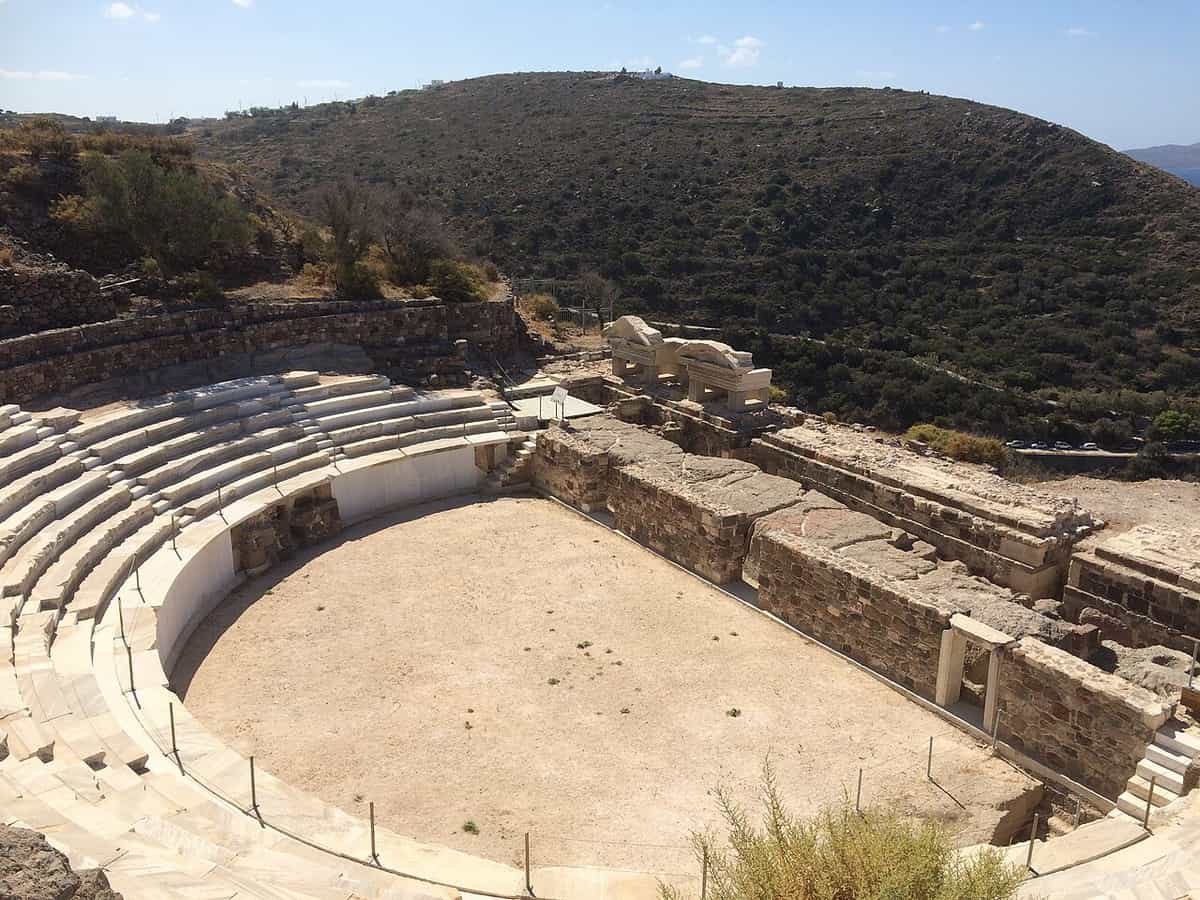
The cavea is the horseshoe-shaped bowl of seats. Its middle is carved into a hillside of soft volcanic tuff. Its two ends rest on earth fills held by walls of volcanic stone blocks. Only a tenth of the bowl has been dug out. Eight marble stairways split that part into seven wedges.
The orchestra is the floor in front of the seats. At the ancient theatre of Milos it is slightly bigger than a half circle. It sits 1.60 metres below the first bench. That drop made it an arena for gladiator and animal fights. The floor was beaten earth with a marble rim.
The stage house joined the two ends of the seating. It is thought to have had two floors. Its front wall, behind the actors, carried rich carving. In front lay the proskenion, a deep platform 2.50 metres above the orchestra floor. Actors played on the logeion, a wooden floor over its rough-cut rock.
White marble from Paros gives the ancient theatre of Milos its colour. Marble benches fill the wedges. The proskenion wall had three marble-framed openings, and the western one survives. Two lime kilns later stood on the orchestra and the stage. They turned marble from the ruin into lime.
- Entrance: A marble-framed west door led under the seats through a vaulted passage.
- Inscriptions: Four carved texts reserve benches for young men, hymn singers and councillors.
- Stage front: Its straight wall with five doors matches theatres in Asia Minor.
- Side passages: Ways onto the logeion at the ancient theatre of Milos had marble thresholds.
- Gables: Stage-front porches carried pointed and rounded gables in turn.
Seats, floor and stage follow one plan. Spectators sat in a marble horseshoe above a sunken arena. Actors worked on a wooden floor before a carved stone wall. This Roman form, built on a Greek model, is what marks the ancient theatre of Milos.
Who excavated and restored the ancient theatre of Milos?
The ancient theatre of Milos was spotted in 1735 by a Jesuit traveller. A German architect first dug there in 1816 and 1817. The Ephorate of Antiquities of the Cyclades, the state archaeology service, dug again in modern times. It then restored the ruin from 2010.
In 1735 the Jesuit monk Nicolas Sarrabat passed through Milos. He opened holes round the bowl and hit three rows of marble seats. The German architect Carl Haller von Hallerstein dug at the ancient theatre of Milos in 1816 and 1817. His trenches exposed parts of the seating and the stage platform.
Haller paid for the site on behalf of Ludwig, heir to the Bavarian throne. King Ludwig reached Milos in 1836 with his son Otto, the king of Greece. Ludwig Ross, the chief antiquities officer, came too. A dig took place, and Ludwig gave the monument to Otto.
The Ephorate of Antiquities of the Cyclades dug again in the 1990s. It found the west entrance, the orchestra and the stage building. In 1994 the cleared orchestra gave up carved marble stage pieces and a headless statue of a woman. A second campaign at the ancient theatre of Milos ran from 2010 to 2015.
A project to showcase the theatre covered the restoration. The state monument-restoration service supervised the work. Crews made the exposed stones firm and rebuilt the front wall of the stage platform. New marble pieces filled gaps in the seats and the orchestra. The restored theatre opened in July 2016.
- Thefts: Ludwig bought the site after thefts and damage there.
- Drawings: French experts drew the ruins in 1838.
- Earlier use: From 1930 the ruin hosted wrestling, school games, plays and concerts.
- Study: A restoration study was drawn up in 2009.
- Finds: The last digs exposed the stage building and a Hellenistic tomb chamber.
Almost three centuries lie between the monk’s first holes and the restorers’ new marble. Kings, architects and archaeologists each left a mark on the ground. The ancient theatre of Milos now stands firm on its slope. Its seats, arena and stage wall are clear to see.

Where was the Venus de Milo found near the ancient theatre of Milos?
The ancient theatre of Milos stands near the field that gave up the Venus de Milo. A farmer dug the statue up there on 8 April 1820. Since 1821 it has been on show at the Louvre in Paris.
The statue came out of a farmer’s plot below Trypiti, near the ancient theatre of Milos. The spot lies a short way beyond the city wall. A lane leads there from the point where the road ends. The ground is thought to have held the gymnasium, the training ground of the ancient town.
The farmer was digging in his terrace when carved marble showed among the old stones. Milos still belonged to the Ottoman Empire then. A French sailor watched and urged him on. The marble lay in a four-sided niche, in separate pieces. A hand holding an apple lay beside it.
One later theory called the niche a lime kiln, a pit for burning marble into lime. Another scholar rejected that idea. A second buyer had made an offer, and the statue was already on board a ship. French officials stepped in and secured it. The king of France then placed it in the Louvre.
Today the statue lives in the Louvre in Paris, far from the ancient theatre of Milos. The statue is Parian marble, over two metres tall, and both arms are missing. Since 2010 the fragments found beside it have shared its room.
- Date: The marble surfaced on 8 April 1820.
- Place: A plot on the slope, a short walk from the ancient theatre of Milos.
- Niche: The pieces lay in a four-sided niche.
- Museum: The statue has been in the Louvre since 1821.
- Copy: A faithful copy, a gift from the Louvre, stands in the museum of Milos.
The find spot and the theatre belong to one walk. A visitor sees the slope where the marble lay, then the seats where the town once gathered. The statue itself is in Paris. The ground that held it is open to the sky on Milos.
How do the catacombs pair with the ancient theatre of Milos?
The ancient theatre of Milos and the catacombs sit 200 metres apart on the same hillside. The theatre is the stage and seating of the ancient town. The catacombs are its underground Christian cemetery, cut into the same soft volcanic rock. One short walk joins them.
The catacombs lie on the hillside south-west of Trypiti, among the ruins of the ancient city. The ancient theatre of Milos stands a short way to their west. It sits on the same slope above the shore. Both monuments lie beside the flat ground of the ancient market place.
The diggers of the catacombs cut halls and corridors into soft volcanic ash. The builders of the theatre shaped its seating into the natural slope. That slope is volcanic tuff, a soft rock made of packed ash. The other runs underground, lined with arched tombs.
The ancient theatre of Milos was built in the Roman period. The first burials in the catacombs date to the first century AD. So the same town used both at the same time. Later, graves were even cut into the walls of the theatre’s arena.
Where the Trypiti road stops at the catacombs, a lane carries on toward the theatre. Only one gallery is open, and a wooden walkway runs through it. The page about the catacombs of Milos covers the tombs and inscriptions in depth.
- Distance: About 200 metres separate the two monuments.
- Rock: Both are cut into the same soft volcanic rock.
- Age: The theatre is Roman; the catacombs began in the first century AD.
- Entrance: Visitors go in through gallery B, the only open gallery.
- Agora: Both lie next to the market place of the ancient town.
A visit to the ancient theatre of Milos gains depth from the cemetery next door. The seats show where the town gathered to watch. The galleries show where it buried its dead. Together they tell the story of one town in the Roman centuries, above ground and below.
How does the walk from Plaka and Trypiti reach the ancient theatre of Milos and Klima?
The walk from Plaka down to Klima passes the ancient theatre of Milos. Trypiti sits almost joined to Plaka on the heights above the ancient city. A road and then a lane lead down past the catacombs and the theatre. Klima waits at the water.
Plaka, the chief town, stands on a large rock over the gulf. Its lanes are too narrow for cars. Trypiti stands next to it at 150 metres above the sea. The houses of Trypiti climb the slope in tiers, above the ruins of the classical city.
From Trypiti the view opens over the bay of Adamantas. A road runs down from the village and ends at the catacombs. From there a lane continues on foot. It passes the city wall, the find spot of the Venus and the ancient theatre of Milos.
The ancient theatre of Milos sits on the hillside above the seaside houses of Klima. Its seats follow the natural curve of the slope, so the rows look out over the port. The ground drops fast from the seats toward the water. The mouth of the bay fills the view.
Klima lies at the mouth of the bay, below Trypiti, six kilometres from Adamantas. Its row of two-storey boathouses stands at the water. The boat lived downstairs in winter, the family upstairs. The page about the fishing village of Klima tells more about the painted doors. The ruins of the first port lie close by.
- Start: Plaka, the chief town, on its rock above the gulf.
- Heights: Trypiti sits 150 metres above the sea.
- Road: The village road ends at the catacombs.
- Theatre: The ancient theatre of Milos overlooks the port from the hillside.
- End: Klima, six kilometres from Adamantas, at the mouth of the bay.
The walk down is easy on the legs and the walk back is not. The slope that gives the ancient theatre of Milos its view has to be climbed again. Water, a hat and an early start make the climb back far simpler.
What do visitors see at the ancient theatre of Milos today?
The ancient theatre of Milos shows visitors seven wedges of marble seats cut into a hillside. Eight marble stairways climb between them. Below the front row lies the orchestra. Beyond it stand the remains of the stage, with the bay behind.
The seating is cut into a natural slope of volcanic tuff, a soft rock made of volcanic ash. The rows mix old marble blocks with new marble pieces. The new pieces filled gaps during the restoration.
The ground is uneven. The marble steps between the wedges are worn. The orchestra floor sits 1.60 metres below the front row. On the west side, an entrance with marble door posts leads under the seats through a vaulted passage.
There is no shade on the seats, and the marble warms up fast under the summer sun. The ancient theatre of Milos has good acoustics and hosts theatre performances and music events. It reopened to the public in 2016 after restoration.
The seats face the bay of Milos and the harbour. Late in the day the light drops low over the water. Boats cross the mouth of the bay below the theatre. The houses of Klima line the shore under the site.
- Seats: Seven wedges of marble seats survive.
- Stairways: Eight marble stairways divide the wedges.
- Orchestra: The floor below the seats once served as an arena.
- Stage wall: Three framed openings faced the seats, and the west one survives.
- Named seats: Four seats carry inscriptions for young men, hymn singers and councillors.
Visitors explore the ancient theatre of Milos on foot. Visitors climb the wedges, cross the orchestra and study the stage wall. The site also fits a wider day of activities in Milos, with the catacombs close by.
What does the museum in Plaka hold from the city of the ancient theatre of Milos?
The ancient theatre of Milos belonged to a city whose finds fill the archaeological museum in Plaka. Three rooms, a porch and a courtyard show them in order of age. Statues, grave stones, inscriptions and pottery from the city and its cemeteries form the display.
The museum stands in Plaka, the chief village above the harbour. Its home is a neoclassical building known as the Katastimata, meaning the shops. The rooms run in order of age, from the New Stone Age to Byzantine times. A front hall holds temporary shows.
Two rooms cover the historic centuries. One holds reliefs, grave stones and statues, among them the copy of the Aphrodite of Milos. The other holds pottery. Inscriptions on grave stones and statue bases survive too. They tell of the city’s rulers, its citizens, its temples and its sculptors.
The copy is modern. The original was found on the island in 1820. The Louvre in Paris has shown it since 1821. The marble is Parian and the figure rises over 2 metres. Both arms are lost. The copy brings her shape back to her island.
The finds come from digs and collections, mainly from the city and its cemeteries. They sketch island life between the 8th century BC and the 5th or 6th century AD. The porch and courtyard hold statues and stone coffins. The ancient theatre of Milos belongs to that same city.
- Obsidian: Tools of obsidian, the island’s volcanic glass, form their own collection.
- Alphabet: Inscriptions use the local form of the Greek alphabet.
- Poseidon: A Poseidon from Milos now stands in Athens.
- Asclepius: An Asclepius from the island is in the British Museum.
- Mosaic: A floor mosaic in the ancient city was dug out in 1896.
The museum and the theatre are two halves of one story. The museum keeps the objects, and the hillside keeps the building the same people used. Seen together, they give the full picture. More about the archaeological museum of Milos is on its own page.

What questions come up about the ancient theatre of Milos?
The ancient theatre of Milos raises the same questions from new visitors. They ask about its age, the view, children and shoes. Others ask about the catacombs, timing, access and photographs. The answers keep to the facts of the site and the ground around it.
How old is the ancient theatre of Milos?
The building visitors see today dates from the Roman period. It stood on ground that earlier held a Hellenistic cemetery. Theatre use ended in the 4th century AD, and houses and workshops then filled the space. Islanders later took its stones for their own walls, and lime kilns burned its marble.
What is the view from the ancient theatre of Milos?
The rows look over the bay of Milos toward the harbour. The village of Klima lies on the shore below, and the mouth of the bay opens beyond it. The rows sit on a hill slope, so water fills the lower half of the view. Ships entering the bay pass below.
Is the ancient theatre of Milos good for children?
Children enjoy the open floor of the orchestra and the climb up the wedges. The front row stands well above the orchestra floor, so an adult stays close to small children. The steps are steep in places. A short visit at a cool hour works best, with water and hats.
Which shoes suit the ancient theatre of Milos?
Closed shoes with a grip suit the site best. The marble steps are smooth and the ground between the rows is uneven. Loose dust from the volcanic rock makes paths slippery in dry weather. Sandals with thin soles slip on polished stone. Trainers or light walking shoes handle the slope.
Does a visit to the ancient theatre of Milos include the catacombs?
Yes. Only 200 metres to the east, on the same hillside, are the catacombs. They are an underground cemetery of the first Christian centuries, cut into soft volcanic rock. The short distance means one walk covers both. The Venus de Milo also came out of the ground in this same area.
Which hour is best at the ancient theatre of Milos?
Early morning and late afternoon are the kindest hours. The marble seats have no shade. The midday sun in summer makes the stone hot to the touch. In the last hour of daylight the bay turns gold and the air cools. Those hours also suit a slow walk over the rows.
How does a visitor reach the ancient theatre of Milos?
By car, the drive from Adamas to Trypiti is about 5 kilometres. The village sits 150 metres above the sea. A lane drops toward the catacombs and the theatre, past the chapel of Panagia Faneromeni. On foot, the theatre lies on the slope below Trypiti, and the road runs on to Klima.
Where are the best photos at the ancient theatre of Milos?
The classic frame looks down from the top row over the wedges to the bay. A second angle stands in the orchestra and looks up at the curved rows. The west entrance with its marble door posts makes a close-up. Late light from the west gives the stone a warm tone.