- Archaeological Museum of Milos
- Church Museum of Milos
- Mineral Museum of Milos
- Naval Museum of Milos
- The Folklore Museum of Milos
The island of Milos keeps its museums in two settlements, Plaka and the port of Adamantas. Together, the museums of Milos cover Bronze Age towns, the obsidian trade, 19th-century home life, mining, church art and the sea. This page starts with the two museums of Plaka, the Archaeological Museum and the Folklore Museum, and the museums of Adamantas follow.
Plaka is the chief town of Milos. It stands at a height of 220 metres and looks over the gulf of Milos. Cars cannot enter the village, so the museums of Milos in Plaka are reached on foot. The Archaeological Museum is on the main square, and the Folklore Museum stands behind the church of Panagia Korfiatissa.
What do the museums of Milos hold in the Archaeological Museum of Plaka?
The museums of Milos include the Archaeological Museum in Plaka, where finds run from the Neolithic age to Roman times. Its halls hold obsidian tools, Phylakopi finds, sculpture and inscriptions, and a plaster copy of the Venus de Milo stands at the entrance.
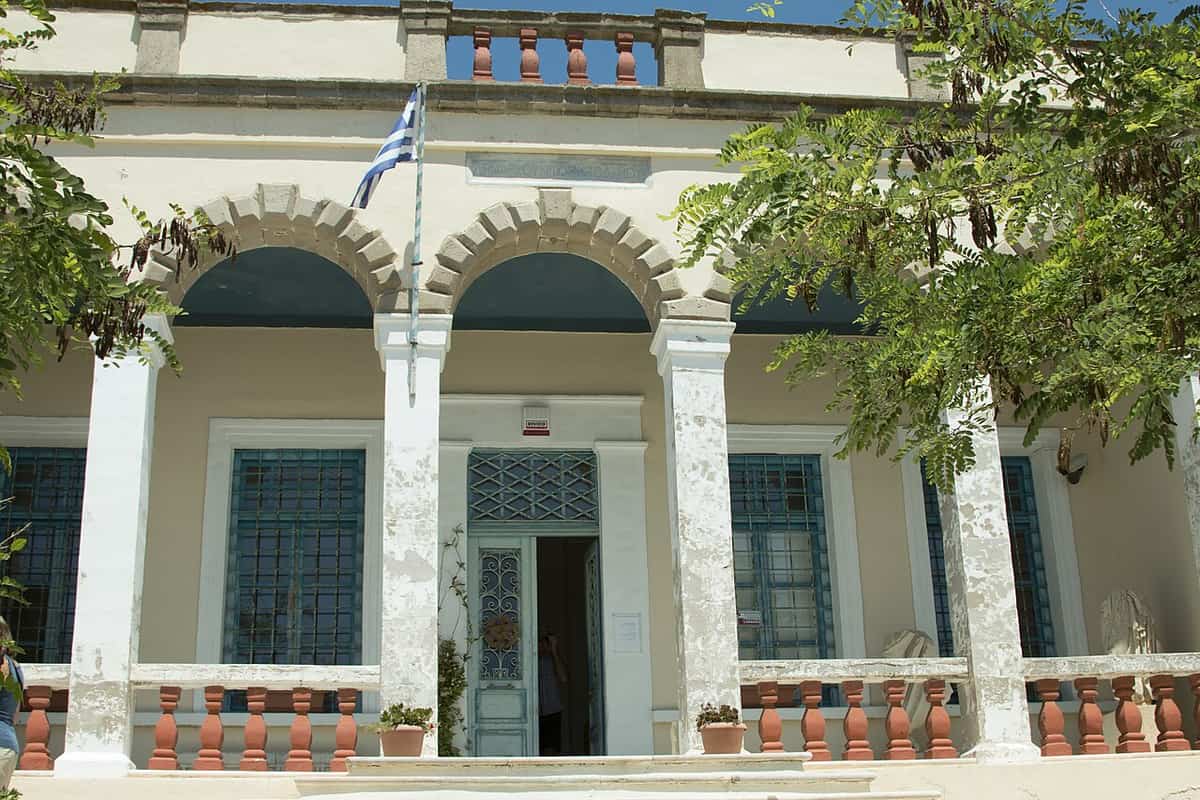
Ernst Ziller designed the neoclassical building on the main square, and it dates from 1870. Its plan follows a strict symmetry, and it is known as “the Shops”. The Municipality of Milos grants it for museum use, architects of the Ephorate of Antiquities of the Cyclades repaired it, and it has worked as a museum since 1985. Among the museums of Milos, this one shows finds from sites across the island in chronological order, as evidence of human activity in antiquity.
The prehistoric hall reaches furthest back in time among the museums of Milos. It shows finds from the Neolithic settlement at Pounta Agali, dated between 4300/4200 and 3800/3700 BC, and finds from Early Cycladic cemeteries of 3300 to 2000 BC at sites across the island. A collection of obsidian tools, made of a glass-like volcanic rock, runs from the Neolithic to the early Bronze Age. The rock of the island made Milos a trade hub from Neolithic times.
The museums of Milos draw their Bronze Age finds mainly from Phylakopi, the town on the north coast that was inhabited from 3300 to 1100 BC. Early Cycladic, Minoan and Mycenaean objects from Phylakopi and other places on the island are on show, and they point to links with Crete and Thera. A terracotta female figurine called the Goddess of the Serpents dates to about 1450 BC. Finds from the archaeological site at Klima are also on display.
A plaster copy of the Venus de Milo stands in the front hall, at the entrance, and the Louvre offered the replica. The original is a Hellenistic statue of Parian marble, over 2 metres high, with both arms missing, and it has stood in the Louvre since 1821. The statue is believed to depict Aphrodite. A hand holding an apple was found next to it. Among the museums of Milos, this copy recalls a statue that left the island for France.
- Collections: Four collections cover Phylakopi finds, sculpture and reliefs, obsidian and inscriptions.
- Antiquity: Pottery, jewellery, funerary stelae and small bronze objects sit beside a marble head of Aphrodite.
- Roman period: Decrees tell of citizens and benefactors, and coins show the economic strength of the island.
- Small finds: Terracotta lamps, toys and idols from domestic shrines fill the smaller halls.
- Athens: The Cycladic collection in Athens adds the four settlement periods of Phylakopi in ground-floor hall 6.
Torsos from late antiquity stand in the porch and the open courtyard with sarcophagi, architectural pieces and grave stelae, and the outdoor exhibits prepare for the halls inside. With the prehistoric hall, the Phylakopi finds and the Venus copy, the Archaeological Museum in Plaka is the first stop among the museums of Milos for the long past of the island, from the Neolithic to the Byzantine period.
What do the museums of Milos show in the Folklore Museum of Plaka?
The museums of Milos include the Folklore and History Museum in Plaka, which shows an urban Melian household of the 19th century. Its rooms hold furniture, textiles, embroidery, clothing, housewares and old photographs from the island’s years of prosperity.
The Folklore and History Museum stands in Plaka, behind the church of Panagia Korfiatissa. That church, the metropolitan church of Milos, was built in 1820 in the Byzantine-Cycladic style and keeps relics and the icon of Panagia Korfiatissa. The Union of the Melians in Athens founded the museum in 1967. Its subject is the life of the Melians after the 17th century, mainly between 1850 and 1930. Among the museums of Milos, it is the one that shows a home.
The museum shows what an urban Melian household of the 19th century was like. It is not an exact copy of one type of Melian home. It starts from objects of mixed kinds and uses them to light up the way islanders lived when Melian society was at its peak. For the museums of Milos, this is the place where daily habits, not ancient finds, form the subject. The list below names the aspects of life that the rooms cover.
Two storeys hold the rooms of a town house. The living room has exhibits of its own, and a loom stands in the work area. The kitchen, the bedroom and the cellar follow, and the cellar also stored farm produce. The top floor works as a historical archive. Furniture, textiles, embroidery, clothes of the period, household utensils, decorative objects, everyday objects and old photographs fill all these rooms. The museums of Milos thus present one household room by room.
The setting of the museums of Milos in Plaka explains the subject. Plaka took its name from the flat ground where houses spread once the Castle no longer held the population. The Venetians built the Castle on a volcanic hill after 1204, and the medieval town grew on the plateau below. The present village arose when the earlier settlement, Zefyria, was abandoned. In 1835 Plaka became the seat of the new Municipality of Milos, and it has been a protected traditional settlement since 1978.
- Work: Exhibits show occupations inside and outside the house.
- Food and dress: The rooms show the food and clothing preferences of the Melians.
- Leisure: The display shows how islanders entertained themselves.
- Influences: Objects reveal influences from other regions.
- Resources: The household shows how local resources were used.
Each museum of Plaka answers a different question. The Archaeological Museum shows how people lived and traded on the island from the Neolithic onward, and the Folklore Museum shows how households of the 19th century ran from day to day. Both museums stand in the same village, so the two museums of Milos in Plaka fit one walk on foot, from the main square to the church of Panagia Korfiatissa.
What does the Mining Museum show among the museums of Milos?
The museums of Milos include the Mining Museum in Adamantas, which follows the minerals of the island from the Neolithic era to the present day. Two exhibition levels, mining films and the stories of old miners show the social, economic and technological side of mining on Milos.
Adamantas is the harbour town of Milos and the cultural and commercial centre of the island, set on the north-east shore of the gulf. Cretan refugees founded the town, and their descendants are called Milokritikoi. The Mining Museum stands in this port town. It is a civil non-profit company that S&B Industrial Minerals created in 1998 to honour and promote the mining history and the geological and natural heritage of the island. Of all the museums of Milos, it is the one devoted to that heritage.
The museum works on two levels. The ground-floor room presents the social, economic and technological side of the mining history and tradition of Milos. The first-floor exhibition is devoted to the natural and geological wealth of the island. It shows the minerals mined there from the Neolithic era to the present day, with a special stress on their uses in daily life. Visitors to the museums of Milos therefore read the rock and its everyday use side by side.
The mineral story told in the museums of Milos begins in the Neolithic era with obsidian, a glass-like volcanic rock traded far afield as early as 15,000 years ago. Crews landed boats in a cove and cut the glass from quarries, mainly at Nychia and Demenegaki. Antiquity added the Melian earth, a substance of chiefly kaolin that artists used as a white pigment, and the painter Apelles counted it among his four basic colours. Pliny the Elder named Milos the richest source of sulphur of antiquity.
Alum from Milos ranked next to the alum of Egypt in antiquity. In later periods the island gave sulphur, mined until the middle of the 20th century, millstones, quarried until the early 20th century, and baryte, mined until 2000, while manganese and gypsum were mined too. Today bentonite, perlite, pozzolana and small amounts of kaolin come from open pits and strip mines and are sold all over the world. The museums of Milos thus connect a Neolithic trade with an industry that still runs.
- Films: Screenings explain how minerals are extracted and how production works.
- Screening room: The stories of old miners take visitors back to earlier periods.
- Geological walks: The museum itself organises geological walks for visitors.
- Education: Programmes on the premises run with skilled bodies and museum educators.
- Visitors: After 12 years of operation, more than 135,000 people from Greece and abroad had come.
A visit to the Mining Museum covers two levels, a film programme and the screening room, so it reads as one account of mining on Milos. The Ecclesiastical Museum stands very close to the port, and the Naval Museum is in Adamantas as well, so the harbour town holds three of the museums of Milos. The mining story and the church art of the museums of Milos can therefore be seen within the same town.

What does the Ecclesiastical Museum hold among the museums of Milos?
The museums of Milos include the Ecclesiastical Museum, housed in the church of the Holy Trinity near the port of Adamantas. It shows 14th-century icons, works of the Cretan school, epitaphs, carved lecterns and church objects in silver and gold.
The Church Museum, the second name of the Ecclesiastical Museum, fills the church of the Holy Trinity, known in Greek as Agia Triada, very close to the port of Adamantas. The building began as a monastery of the Virgin Mary of Theofani. In 1839 Cretan refugees bought it and made it the church of their village. Cretan refugees also founded the harbour town of Adamantas, close to the church. Among the museums of Milos, this is the one set inside a church with a refugee past.
The church is a cross-roofed three-aisled basilica with a dome. The dome rises vertically over the three aisles in the same shape as the church. Only one other church of this type exists, in Levidi in Arcadia, in the Peloponnese. The edges and arches of the bell tower show Gothic influence, and the lintels and pilasters carry carved traditional and religious motifs. The architecture is therefore the first exhibit of this stop among the museums of Milos, before any icon comes into view.
The courtyard at the entrance holds two coloured mosaics from 1937 by the local artist Giagos Kavroudakis. One shows a dragon in the shape of Milos, and the other shows the battle of good and evil. Since 2000 the church has housed one of the museums of Milos, which presents a large part of the artistic and icon-painting tradition of the island. The collection starts with icons from the 14th century, among them a rare Deposition from the Cross.
The painters represented include Emmanuel Skordilis and Antonios Skordilis, together with other Cretan painters and works of the Cretan school. Furnishings include epitaphs, carved wooden lecterns, iconostases of the 17th century and icon screens. Church life on the island has a long record: the first Catholic bishop of Milos was appointed in 1253, and the early 18th century saw two bishops, one Greek Orthodox and one Latin Catholic. Within the museums of Milos, this is the collection devoted to church art.
- Throne: A throne for the bishop belongs to the furnishings of the church museum.
- Chalices: Silver chalices stand among the church objects.
- Censers: Censers for incense form a second group of church metalwork.
- Offerings: Gold offerings are part of the collection.
- Jewellery: Rings, necklaces and earrings are shown with the other exhibits.
A visit to the Ecclesiastical Museum moves from the courtyard mosaics through the icons and furnishings to the objects in silver and gold. The church and its collection show the artistic tradition of the island from the 14th century onward. In the museums of Milos, the building, the courtyard and the icons of this church belong to a single visit, and the port of Adamantas stays close at hand.
What does the Naval Museum add to the museums of Milos?
The museums of Milos include a Naval Museum above the harbour of Adamantas, opened in September 2008 in the building of the old Community. Its exhibits run from prehistoric obsidian tools to the battle of Salamis and recent years, with rare maps and a wooden boat.
The building of the old Community of the island houses the Naval Museum. It stands above the harbour of Adamantas, on the north-east coast of the gulf of Milos. Dr. Petros Armenis led the effort to gather exhibits on the maritime activity of the island. Among the museums of Milos, it is the one that faces the water. Adamantas is the main port of the island, so the museum stands at the point where arrivals by sea begin.
The exhibits follow time in a straight line from the earliest age. The first items are prehistoric tools made of obsidian, the glass-like volcanic rock of Milos. The quarrying brought no permanent settlement or manufacturing to the island. Those who wanted the stone sailed to Milos, pulled their boats up in a suitable cove and cut pieces of the glass from the quarries. The line then runs through the centuries to the battle of Salamis and ends in recent years.
Two events from the sea history of Milos fit this line. In 480 BC the Melians turned down the Persian demand for submission and sent two warships to fight at Salamis. The island joined the Greek revolt of 1821 among the first, and the war’s first sea battle was fought off its coast on 11 April. Earlier, a place between the Greek mainland and Crete, with obsidian to trade, had made Milos a major centre of the early Aegean.
The collection holds rare maps by specialist cartographers. Chart making has a local name behind it, since Antonio Millo, a captain and cartographer active from 1557 to 1590, appears in the list of notable people of Milos. The waters around the island hold Kimolos, 1.6 kilometres to the north-east, and the uninhabited island of Antimilos, 21 kilometres to the north-west. The wooden boat Irene, renowned among the exhibits, adds the vessel itself to the charts of these waters.
- Name: Adamantas comes from the Greek word adamas, which means diamond.
- Gulf: The gulf sits in the hollow of the main crater and ranks among the largest natural harbours in Greece.
- Depth: The water of the gulf is 130 to 55 metres deep, growing shallower as it reaches inland.
- Sea floor: Traces of ancient buildings lie at a depth of about 30 metres off the beach of Adamantas.
- Hot spring: A closed hot spring and a sign for thermal baths mark the foot of the hill by the beach.
The Naval Museum links the harbour below it to the sea story of the whole island. The other museums of Milos cover archaeology, daily life, mining and church art, while the Naval Museum covers the water that carried obsidian, warships and refugees to the coast. The harbour of Adamantas and the sights of Milos nearby give the same story a setting outdoors, with the gulf as its backdrop.
What do visitors ask about the museums of Milos?
The museums of Milos stand in two places: Plaka, with the Archaeological and Folklore Museums, and Adamantas, with the Naval, Ecclesiastical and Mining Museums. The answers below cover their locations, their history and the sights that sit beside them.
Where are the museums of Milos located?
Two of the museums of Milos are in Plaka, the chief town: the Archaeological Museum and the Folklore Museum. Three are in the area of Adamantas, the harbour town: the Mining, Ecclesiastical and Naval Museums. Land rises from Adamantas to a plateau above the harbour, where Plaka stands.
Does the original Venus de Milo stand among the museums of Milos?
No. The original statue, found on the island in 1820, stands in the Louvre in Paris, and the Archaeological Museum in Plaka shows a copy. The island’s other marbles also left Milos: the Poseidon and an archaic Apollo are in Athens, the Asclepius in the British Museum.
Which of the museums of Milos explains the mining past?
The Mining Museum in Adamantas does. Founded in 1998, it celebrates the history of mining on Milos and the geology and nature of the island. Bentonite, perlite, pozzolana and a little kaolin are still dug from open pits, while baryte, sulfur, millstones and gypsum were mined in the past.
Which of the museums of Milos stands inside a church?
The Ecclesiastical Museum does. It stands very close to the port of Adamantas, in the church of the Holy Trinity, a church that is 600 years old. With the Naval Museum and the Mining Museum, it gives the harbour town three of the five museums of Milos.
Which material opens the story in the museums of Milos?
In the Naval Museum, obsidian opens the story with prehistoric tools. This volcanic glass was already a trade good on Milos 15,000 years ago. It travelled long distances and was shaped into very sharp tools before farming began. Bronze later replaced it as the preferred weapon material.
Which foreign fleets appear in the story behind the museums of Milos?
The French fleet used Adamantas as a base in the Crimean War, and a military cemetery of British and French dead lies near the town. A French warship still calls once a year to pay respects. In the 19th century, American and British ships also met at Milos while fighting pirates.
Which sights near the museums of Milos belong to the same story?
The ruins of ancient Milos lie nearer the harbour mouth than Adamantas, on a slope that runs from Trypiti down to Klima. A Roman theatre, stretches of the town walls and a mosaic found in 1896 survive there. Important sculptures came from this site, among them the Venus de Milo.
Who founded Adamantas, the home of three of the museums of Milos?
Cretan refugees settled Adamantas after a decree of the government of Kapodistrias, and their descendants are called Milokritikoi. The town lies on the north-east coast of the gulf. At the 2021 census it had 1,268 residents, and it is the cultural and commercial centre of the island.