The Mineral Museum of Milos, a civil non-profit company, was established by S&B Industrial Minerals S.A. in 1998 with the aim of honoring and promoting the mineral history, as well as the geological and natural heritage, of Milos.
In the ground-floor room, the social, economic and technological dimensions of Milos’s mineral history and tradition are presented. The exhibition on the ground floor is dedicated to the island’s natural and geological wealth. It presents the minerals that have been mined on the island from the Neolithic age to the present day, with special emphasis on their use in our everyday life. In addition, films are shown about mining and the process of mineral production, while in the projection room visitors can “travel” back to earlier periods through the descriptions of the old miners.
The Museum organizes geological walks. Educational programs take place on its premises, and pedagogic and recreational activities are organized in cooperation with skilled educational bodies and museum educators. In its 12 years of operation, the Museum has been visited by more than 135,000 people from Greece and abroad, and it has become a favorite destination for educational tourism.
Mineral Museum Milos
Adamas, Milos (Cyclades)
Tel: + 30 22870 22481
The Mineral Museum of Milos, a civil non-profit company, was established by S&B Industrial Minerals S.A. in 1998 with the aim of honoring and promoting the mineral history, as well as the geological and natural heritage, of Milos.
In the ground-floor room, the social, economic and technological dimensions of Milos’s mineral history and tradition are presented. The exhibition on the ground floor is dedicated to the island’s natural and geological wealth. It presents the minerals that have been mined on the island from the Neolithic age to the present day, with special emphasis on their use in our everyday life. In addition, films are shown about mining and the process of mineral production, while in the projection room visitors can “travel” back to earlier periods through the descriptions of the old miners.
The Museum organizes geological walks. Educational programs take place on its premises, and pedagogic and recreational activities are organized in cooperation with skilled educational bodies and museum educators. In its 12 years of operation, the Museum has been visited by more than 135,000 people from Greece and abroad, and it has become a favorite destination for educational tourism.
Mineral Museum Milos
Adamas, Milos (Cyclades)
Tel: + 30 22870 22481
The mineral museum of Milos stands in Adamantas, the harbour town of the island of Milos. The museum, also called the Milos Mining Museum, shows the rocks and minerals that the volcanoes of the island formed. This page describes the building, its three levels and the nine minerals on show in its cases.
The first section places the mineral museum of Milos in its setting in Adamantas and walks through its floors. The second section sets out what each mineral is and where on the island it comes from. The page on the museums of Milos lists the other museums of the island.
Where is the mineral museum of Milos in Adamantas, and how are its floors laid out?
The mineral museum of Milos stands on the coastal road that runs east from Adamantas, just before Papikinou beach. Its building has a ground floor for mining history, a first floor for the mineral wealth, and a basement for a projection hall and temporary exhibitions.
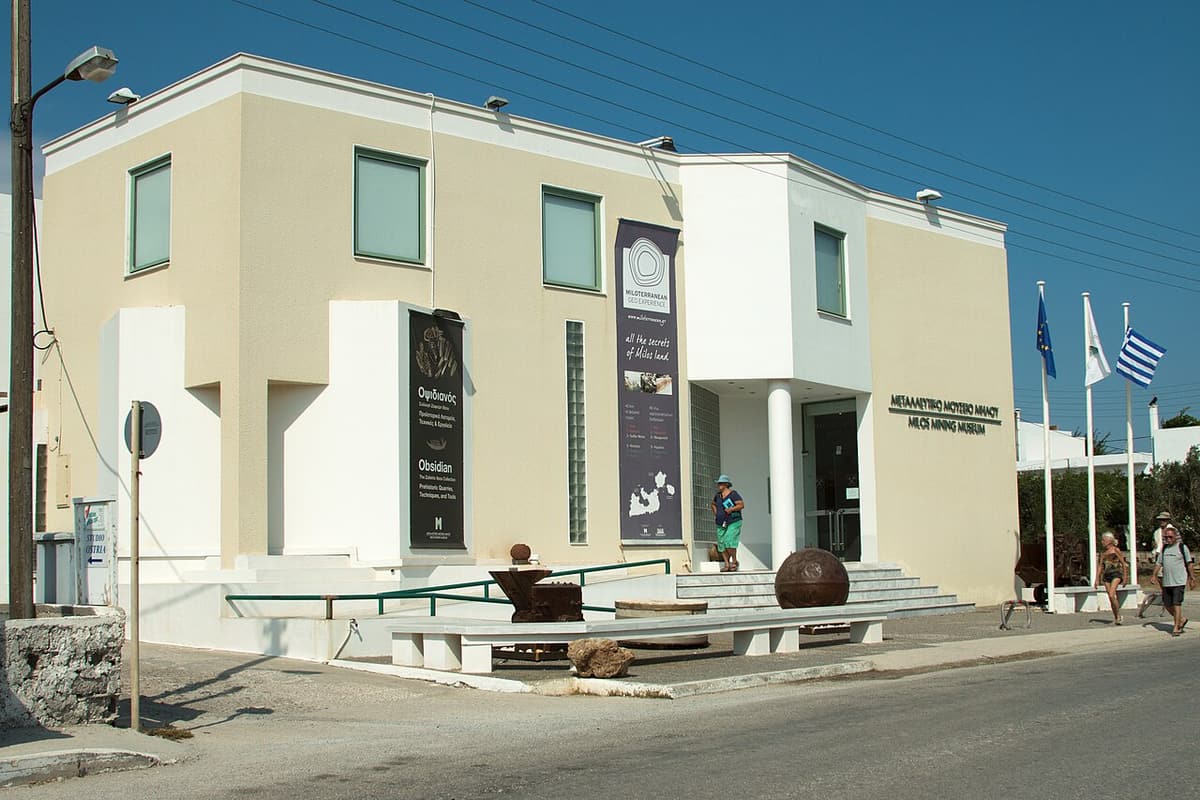
The mineral museum of Milos has a short building history. The first steps toward it were taken in 1995, the building was completed three years later, and it opened to the public in the spring of 1998, as the first museum in Greece dedicated only to mining. It was planned as a miniature of the island itself, whose rocks, ores and minerals are so varied that the whole of Milos works as one great mining museum.
The coastal road leaves Adamantas towards the east, and Papikinou beach begins right after the building of the mineral museum of Milos. Further south the same road passes a restored kaolin processing plant that now serves as a cultural venue, and beyond it the porous tuffs of the hill are reddish brown from leached iron oxides. Next come the old salt pans of Alykes and the lavas of Achivadolimni. The road is itself a lesson in geology.
The ground floor of the mineral museum of Milos tells the mining story in nine displays: the history of the museum, a geological map of Milos, the mining history of the island, the processes of mineral production, two displays on the sulphur mines and Vani, a collection from the work of two mining companies, old tools and photographs, and a scoop-car. Photographs, paintings, maps and authentic tools surround them, and further pictures show current mining and environment restoration.
In the mineral museum of Milos the first floor is Section C, the mineral wealth of Milos. It opens with the creation of the island and then follows nine minerals: obsidian, millstones, kaolin, sulphur, manganese, pozzolan, baryte, perlite and bentonite. Window-cases hold samples with photographs and notes on processing and uses, and a touch unit presents the minerals. The last displays show epithermal gold, fossils and rocks from other areas of Greece, and the geological landscapes of Milos.
- Entrance: Section A holds the information desk, the secretariat and the museum shop.
- Staircase: A volcano model and a diagram of the Earth’s crust stand on the stairs.
- Atria: Two atria host workshops on land reclamation and on educational activities.
- Audio system: Visitors can explore alone with audio commentary in Greek, English, French, German and Italian.
- Basement: Section D of the mineral museum of Milos holds a hall for temporary exhibitions and a projection room for 40 people.
The plan of the mineral museum of Milos moves from the surface to the stone. The ground floor explains how mining on Milos worked, the first floor shows what was mined, and the basement hosts videos and scientific events. The minerals of Section C are the subject of the next section, which follows each one to its place on the island.

Which minerals does the mineral museum of Milos show, and where does each come from?
The mineral museum of Milos shows obsidian, millstones, kaolin, sulphur, manganese, pozzolan, baryte, perlite and bentonite. Obsidian comes from Nychia and Demenegaki, sulphur from Paliorema, manganese from Vani, baryte from Voudia and pozzolan from Xylokeratia. Perlite lava lies near Achivadolimni, and bentonite near Pollonia.
Obsidian is a hard, smooth, grey-to-black rock formed from volcanic lava and characteristic of Milos. The quarries at Nychia and Demenegaki were the main source of obsidian for prehistoric settlements around the Aegean across seven millennia. On the first floor, the mineral museum of Milos shows the obsidian collection of Zafeiris Vaos, a Milos collector who began in 1959 with a permit from the Archaeological Council. A donor family later bought it and gave it to the museum.
Perlite is a natural volcanic glass formed when volcanic ash cooled suddenly and trapped water inside. Heated to between 800 and 950 degrees Celsius, it expands into a white mass of tiny glass bubbles that insulates against heat and sound. Expanded grains also serve as a growing medium and as a filter aid for wine and oils. The mineral museum of Milos places perlite beside notes on these uses, and the lava appears along the coastal road from Achivadolimni to Agia Marina.
Bentonite is a plastic clay that formed in place from altered volcanic ash. It absorbs water, swells and binds, so foundries use it for green sand, drillers for mud and engineers for landfill seals. The Tsantili bentonite mine near Pollonia is restored, and a bentonite store and a drying unit stand beside the road to Voudia. Kaolin is a mixture of hydrous aluminium silicates that includes kaolinite and halloysite, and old kaolin galleries cut the slopes of the Lagada ravine and the area of Mersinia.
The sulphur shown in the mineral museum of Milos comes from Paliorema, where a concession opened mining in 1862, and the ravine there leads down to the old sulphur works, the only industrial complex of Milos protected as a historic site. Baryte is a heavy, inert and stable mineral, and about 80 per cent of production goes into drilling mud for oil wells. Baryte mining began at Voudia in 1934, and old baryte galleries lie at Mersinia beside the kaolin ones.
- Manganese: A pyrolusite deposit at Vani was worked from 1890 until 1928.
- Pozzolan: This volcanic tuff goes into cement, and pozzolan mining began at Xylokeratia.
- Millstones: Trachyte was cut into millstones for grinding cereals and harder materials.
- Siliceous stone: Microcrystalline quartz from the hydrothermal change of volcanic rock goes into glass and ceramics.
- Pumice: This stone was used to polish the mosaics of Roman times.
The cases of the mineral museum of Milos turn the island into a map of raw materials, and a hands-on station adds direct experience with the minerals. The geological map in Section B and the geological landscapes at the end of Section C tie the displays back to the island itself. Each name above marks a place where the stone in a case was dug.
What does the mineral museum of Milos say about obsidian and mining in antiquity?
The mineral museum of Milos presents obsidian as the first mineral wealth of the island. Its first floor shows worked obsidian from the Milos quarries, and its mining history follows the rock, millstones, alunite and pumice from the Neolithic age through Roman and Byzantine times.
The mining chronology of the Milos Mining Museum opens in the Neolithic age, set between 7000 and 2800 BC, with the working of obsidian for tools and weapons. Mineral activity on the island began around 8000 BC with this hard, shiny black stone from the volcanic subsoil. The chronology then records extensive trading in obsidian and pottery in the Bronze Age, and obsidian mining still running in the Archaic period. The mineral museum of Milos therefore starts its story with a rock, not with a metal.
The reach of the trade is the second theme of the mineral museum of Milos. Once commerce began to flourish in the Aegean, the obsidian of Milos went to other Aegean islands, to mainland Greece and to Asia Minor. Small finds on the Greek mainland, linked to Milos, were dated by geochronology to the eleventh millennium BC and to 7250 BC. Those dates point to the oldest known navigation in the world. A trading station for obsidian operated at Phylakopi in the old palace period.
The first floor of the mineral museum of Milos holds the Obsidian Collection of Zafeiris Vaos, a Milos collector, shown in public for the first time. Vaos began to collect obsidian artifacts in 1959, after an official pronouncement and a permit from the Archaeological Council. The pieces show how the rock was processed in the Milos quarries, the main source of obsidian for prehistoric settlements around the Aegean during seven millennia. With the approval of the Ministry of Culture, a family bought the collection and donated it to the museum.
Rome prohibited the working of Greek mines apart from limited periods, but quarries stayed outside the ban. The mineral museum of Milos lists trachyte, alunite, sulphur and pumice among the products of Roman Milos, in demand across the empire and a source of economic prosperity. Pumice polished the mosaics. Alunite counted as the best in the empire and was in short supply. In Byzantine times millstones went as far as Egypt and Italy, and a customs house for minerals was set up on Milos.
- Trachyte: Quarried in large quantities and cut into millstones for grinding cereals and harder materials.
- Porous stone: Used in what were then large buildings and public edifices.
- Pumice: Traded for polishing marbles and mosaics.
- Alunite: Used in preparing medicines, as an active material or an ingredient of drugs.
- Armenian bole: A slightly reddish Melian mineral used in medicine to arrest bleeding.
The mineral museum of Milos keeps the ancient story in order: first obsidian, then quarried stone, then the minerals that Rome and Byzantium bought. Each product had its own use, and the trade carried each one beyond the island. Quarrying continued on Milos through the Roman and early Byzantine periods. The wider setting of these early centuries, with the settlements, the classical city and the later rulers, sits in the history of Milos.
How does the mineral museum of Milos present the sulphur mines of the east coast?
The mineral museum of Milos presents the sulphur mines of the east coast as the start of modern mining on the island. The ground floor holds slides and a collection from the works, and the screening room carries the stories of the old miners.
The sulphur of Milos comes from the volcano under the island. Active solfataras and fumaroles release hot gases at Agia Kyriaki, Paleochori, Pyromenes and Adamas, and sulphur is strongly present in those areas. The vents reach temperatures of up to 100 degrees Celsius. At the vapour points near the Fyriplaka cone, clear yellow crystals of native sulphur form when hydrogen sulphide oxidises in the air. In the mineral museum of Milos, the first-floor display on the mining activity of the island lists sulphur after obsidian, millstones and kaolin.
Sulphur mining is far older than the modern works. Large quantities were mined in the ancient Greek era for disinfecting, antiseptic and religious purposes, and special vessels carried the mineral to Roman ports. Under Ottoman rule the port kept exporting sulphur, alum and salt, while the inhabitants avoided intensive mining to escape heavier taxes. In the mineral museum of Milos, the modern chapter opens in 1862 with the first mine concession, issued for sulphur at the Paliorema site.
By 1890 the sulphur mines were in full production and reached 15,000 tons a year. Production stopped in 1905. In 1938 a patent was taken out for a process that extracts sulphur from sulphate-bearing rocks, and a new enterprise formed in 1952. That enterprise failed in 1958, the year the works were interrupted, and the mines changed hands in 1961 and again in 1978. The mineral museum of Milos sets the span from 1862 to 1958 as the sulphur chapter of the island.
The miners belong to the story as much as the minerals. In the mineral museum of Milos, men and women who worked in the mines recall their lives in the abandoned galleries, and the screening room carries those stories to visitors. The work was manual: the pick and the spade, mules for transport, and small sacks carried to the loading boats and on to the cargo ships. Bulldozers, loaders, trucks and conveyor belts later took over those tasks across the mines of the island.
- Location: The old works stand at the end of the ravine of Paliorema, at Thiorichia on the east coast.
- Status: The works are the only industrial complex of Milos designated as protected, a historic site by decision of the Ministry of Culture.
- Wagons: Wagons still stand on their rails at the old works.
- Tools: Old rusty tools lie at the site.
- Warehouse: Unused spare parts remain in the warehouse.
The mineral museum of Milos and the old works on the east coast tell one story from two ends. The museum holds the slides, the collection and the memories of the miners, and the ravine holds the buildings, the wagons and the rails. At the Paliorema cove, the beach has yellow pebbles and the ruins of the old mines. Together the two places show how a volcanic mineral gave Milos its first modern mining and how the works came to an end.

How does the mineral museum of Milos explain modern mining?
The mineral museum of Milos explains modern mining through the minerals the island produces today: bentonite, perlite, pozzolan, siliceous stone and kaolin. Each rock is shown beside its uses in industry, farming and building, and beside the pits that shape the land.
Bentonite is a plastic clay that forms when volcanic ash alters in place. The mineral museum of Milos lists its working properties: high absorption, high plasticity, ion exchange, thixotropy in thick suspensions, and the power to bind other materials. Foundries bind sand with it, iron works bind ore pellets with it, and drillers mix it into mud. Pet-litter makers, paper mills and wine makers use it too. Buried steel containers of radioactive waste sit in a protective casing of it.
Perlite is a volcanic glass that formed when ash cooled suddenly and trapped water inside. Heat between 800 and 950 degrees Celsius turns that water to steam, and the glass swells into a white mass of tiny bubbles. The expanded glass is porous and insulates against heat and sound. Builders use it in ceiling tiles and plaster, growers use it for greenhouse plants, and filter makers use it for wine, juice and edible oils. Window-cases of the mineral museum of Milos show samples with notes on processing and uses.
Milos is the largest bentonite and perlite production and processing centre in the European Union. Bentonite mining began in 1952, perlite followed in 1954, and pozzolan mining began in 1984. Large quantities leave the island after processing on the spot. Conveyor belts can carry 700 tons per hour and load ships of 25,000 to 30,000 tons capacity. Mining and tourism are the two economic pillars of Milos, and both grow from the volcanic geology that the mineral museum of Milos explains.
Open pits change the shape of a hillside, and restoration follows the digging. The ground floor of the mineral museum of Milos depicts current mining activity together with the restoration works. In the field, the Tsantili bentonite mine is restored: digging has ended, the ground is reshaped and the slopes are planted. A special observation point looks over the large Aggeria mine. The seven signposted routes of the Miloterranean geo walks carry this story into the field.
- Pozzolan: This volcanic tuff has gone into mortar since Roman times and into cement around the world today.
- Siliceous stone: Fine quartz made by hot fluids that altered volcanic rock goes into glass, tiles and foundry sand.
- Kaolin: The kaolin of Milos suits the paper industry and the cement industry.
- Baryte: Small quantities are still mined, and 80 percent of baryte produced goes into drilling fluid for oil wells.
- Landfills: Water cannot pass through bentonite, so it seals municipal landfills, and its swelling closes cracks.
The minerals of present-day Milos link each rock to a finished product that visitors already know, from a ceiling tile to a bottle of wine. The mineral museum of Milos also shows that mining is a living trade, with pits, processing on the island and loading belts that reach beyond the museum walls and into the shape of the land. Visitors leave with a clear picture of how raw rock becomes the goods of daily life.
What does the mineral museum of Milos show about the miners’ life?
The mineral museum of Milos shows the miners’ life through authentic tools, photographs and paintings of each work stage, and filmed memories of men and women who worked in the mines. Visitors compare the old pick and spade with today’s machines and safety gear.
The ground floor holds the social side of the story. A series of photographs, representations and paintings depicts the stages of mining on Milos. Old and new geological and topographical maps surround them, and authentic tools and instruments stand among the pictures. The plan sets aside space for the tools and photographs of past mining, for slides of the sulphur mines and of Vani, and for a scoop-car. The mineral museum of Milos thus puts the worker beside the rock that was cut.
The screening room carries the voices of the old miners. The museum’s short film Those Days at the Mines of Milos lets men and women who worked in the mines trace their memories and the paths of their lives among the abandoned galleries. They recount events from those years in their own words. The mineral museum of Milos thus adds spoken testimony to the tools on display, and the speakers include women as well as men.
Hand labour defines the older part of the story. Workers broke the rock with the pick, filled small sacks with spades and carried the sacks to loading boats, and the boats took the load on to cargo ships. Mules hauled the loads where trucks run now. The mineral museum of Milos was founded to honour all who worked hard to develop the island’s mineral wealth, a wealth that brought the island financial and cultural affluence over its long history.
Conditions changed with the machines. Bulldozers replaced the pick, loaders replaced spades and trucks replaced mules. Dust from chimneys and filters stays ten times under the legal limit, and wet roads keep dust low at the work place. Workers wear helmets, safety boots, work clothing, glasses, face masks, ear plugs and gloves, and continuous medical monitoring follows their health. Noise levels are measured, and technical means suppress the noise. Training in safe practice has helped cut both the number and the gravity of accidents.
- Paliorema: The mineral museum of Milos dates the first mine concession, for sulphur, to 1862, and the right later reached other locations.
- Triades: Silver-bearing galena was mined here from 1884 until the end of the 19th century.
- Vani: Manganese mining began here in 1890 and stopped in 1928, and the mineral museum of Milos shows slides of this site.
- Kaolin: Mining began in 1899, and a processing plant was set up in 1925.
- Voudia: Baryte mining began at this location in 1934, a later addition to the list of mined minerals.
The tools, the photographs, the paintings and the spoken memories together tell how the work of Milos changed from sacks and mules to belts and ships. The mineral museum of Milos keeps the people in view next to the minerals, so that visitors see who did the work as well as what it produced. The same island holds both stages, and the museum places them side by side.
Which mining landscapes extend the mineral museum of Milos outdoors?
The mineral museum of Milos has an outdoor counterpart: old galleries, saved port works, reddish tuffs, yellow sulphur crystals and the white volcanic cliffs of Sarakiniko. Marked geo-routes connect these places, so the displays in Adamas meet the real rock and the real mine sites.
The first trail follows the coastal road past the mineral museum of Milos, and the beach of Papikinou begins directly after the building. About 2 km from Adamas stands the restored building of the old kaolin processing plant. Before the port works at Kanava, the foot of a hill shows porous tuffs in a reddish-brown colour, which the leaching of iron oxides gave them. The church of Agia Marina further on is built from local volcanic rock, lava and tuff, and it holds a re-used marble lintel dated 1616.
Beyond Agia Marina the road from the mineral museum of Milos reaches Mersinia, where old galleries from kaolin and baryte mining remain. Towards the cape of Vani and the mine that carries its name, the rock turns hard, with andesitic lavas. Strong wind that carries salt has eroded the rocks there. On the beach of Agathia, old galleries and open-air workings are visible, and the old port facilities have been saved. The beach has easy access and suits swimming.
The second trail starts at the mineral museum of Milos. After 2.3 km on the coastal road it turns towards Zephyria and follows the Lagada ravine, where galleries on the slopes mark old white kaolin workings. The road ends in the ravine of Palioremata at Thiourychia, the old sulphur mines. The Ministry of Culture named this complex a historic site, and it is the only protected industrial complex on Milos. Near the cove of Paliorema, wagons stand on their rails beside rusty tools and spare parts in the warehouse.
Sarakiniko, on the north coast, shows volcanic rock without any mine. The white stone reflects sunlight by day and moonlight at night, and the lack of green around it adds to the glare. Layers of volcanic material alternate there, and fossils are abundant. Rain water has sculpted its own bed in the gorge between the soft white rocks. Pirates once sheltered in the cove, and ship’s bollards remain carved into the stone. Walkers who want longer paths can turn to hiking in Milos.
- Vani: Manganese was mined at Vani from 1890, and the works stopped in 1928.
- Voudia: Baryte mining at Voudia began in 1934.
- Aggeria: A built observation point faces the large Aggeria mine, and its layers show bright colours in the southern part.
- Tsantili: The Tsantili bentonite mine is restored, with the digging over, the pit shaped and the slopes planted.
- Firopotamos: An abandoned loading ladder stands past the fishing houses, beside the church of Agios Nikolaos.
The mineral museum of Milos gives the background, and these places give the proof. The coastal road holds coloured tuffs and a saved port, the road to Zephyria ends at a protected sulphur complex, and the north coast adds white volcanic rock with fossils. The routes are marked on the island, so a visitor can follow the mining story from the displays in Adamas to the pits, galleries and shores where the rock was dug.


What else do visitors ask about the mineral museum of Milos?
The mineral museum of Milos prompts questions about trails, rock types, old industrial sites and the island’s working mines. The answers below name the places, the rock and the remains that belong to each trail leaving the harbour town of Adamas.
Which geological walk linked to the mineral museum of Milos ends at Sarakiniko?
Route 6 does. It starts at the coastal settlement of Agios Konstantinos and covers about 4.5 km. The path is not visible along its whole length, but it runs parallel to the coast over passable flat rocks. A small island named Kofto, with a colony of silver gulls, lies on the way.
Where can sulphur crystals be seen on a route from the mineral museum of Milos?
Crystals of native sulphur appear at the vapour points near Kalamos, on the edge of the Fyriplaka volcanic cone. Hot vapours rich in hydrogen sulphide altered the older volcanic rock there, and old kaolin galleries mark the same ground. The nearby crater measures 1,700 metres across and 200 metres deep. The crystals are clear and yellow.
Which rock types line the trails from the mineral museum of Milos?
Between Mavra Gremna and the beach of Achivadolimni, broken “sugar” lava lies in large and small blocks. Rhyolitic lavas with a perlitic or glassy texture follow, formed 1.1 to 0.9 million years ago. Between Agia Marina and Xerokampos, altered tuffs and andesites alternate, and the beach of Rivari formed from sand between outcrops of volcanic tuff.
What do the salt pans of Alykes add to the mineral museum of Milos story?
Alykes holds the abandoned salt works of the island, just before the airport, which stopped operating in 1981. Shallow coastal basins split into compartments let seawater pass from pan to pan until it evaporates and the salt crystallises. The site is now an important wetland, and the island has made salt since the Roman period.
Which old port works stand on routes from the mineral museum of Milos?
Agathia has saved its old port facilities, beside old galleries and open-air workings. Before conveyor belts, workers carried small sacks to loading boats, which passed the cargo on to cargo ships. Today conveyor belts fill boats of 25,000 to 30,000 tons capacity, and Milos ranks as the largest bentonite and perlite centre in the European Union.
Which geo-route of the mineral museum of Milos covers Kimolos?
Route 5 does, and it covers about 17 km, with a short side path to Skiadi. Skiadi is a mushroom-shaped rock, a hat of coarse brown ignimbrite on a neck of fine white tuff. From the main track, old mining galleries at Siderokapsia and an active bentonite mine at Prasa come into view.