Once you rent a car, an ATV or a buggy from Rac SA, take the road to Zefiria.
Zefiria is located 5.5 km from Adamas and was the first capital of the island. Today Zefiria is a rural village where you will find the Old Cathedral of Milos (Virgin Portiani), along with the walled church of St. Nicholas.
Milos is a volcanic island in the south-west of the Cyclades, midway between Piraeus and Crete. It measures about 23 kilometres from east to west and 13 kilometres from north to south. An introduction to Milos reads the island as one map. In the east of Milos lies Zefiria, a farming village that once led the island.
Zefiria stands in the inland part of the island, at an elevation of 10 metres. The village lies about 5.5 kilometres from the port of Adamantas and about 9 kilometres from Plaka, the seat of the municipality. Houses, church walls and open fields share the same flat ground, and the sea stays out of sight.
Why was Zefiria the old capital of Milos?
Zefiria was the chief town of Milos before the title passed to Plaka. The Venetians founded the settlement in the 13th century, and it held the leading place for centuries. Strong earthquakes in the middle of the 18th century pushed much of the population towards Adamantas.
Zefiria occupies the eastern half of the island, on flat land at 10 metres above sea level. The village lies in the inner part of Milos, away from the coast and away from the bay that holds the harbour. Plaka, the present seat of the municipality, lies about 9 kilometres north-west of Zefiria, and the port of Adamantas lies about 5.5 kilometres to the north-west as well. The villages of Milos lie far apart, so the inland plain stands on its own.
The Venetian period gave Zefiria its start as a town. The village was founded in the years when Venice held the Cyclades, in the 13th century, and it took the leading place on the island. The title of chief town stayed with the place until it passed to Plaka. After the Ottoman years, in 1835, the settlement was named the seat of the municipality that carried its name, a rank it held at the start of the modern Greek state.
Strong earthquakes shook Milos in the middle of the 18th century, and the shock ran through Zefiria. A large part of the population left the settlement and moved towards Adamantas, the main port of the island, where the work and the ships were. The island as a whole lost people in the same period, and by 1798 the count had fallen below 500. Visitors of that time found up to two thirds of the buildings in ruin.
- Status: Zefiria belongs to the community of Trypiti, in the municipality of Milos.
- Population: The census of 2021 counted 190 residents.
- Height: The village stands at 10 metres above the sea.
- Character: The settlement keeps an agricultural character, and farmland surrounds the houses.
- Setting: The old capital lies in the inner east of Milos, in the plain behind the south-east coast.
Zefiria therefore tells the story of a capital that moved. The village kept the plain, the fields and the old walls, while the ships and the harbour trade went to Adamantas and the seat of government went to Plaka. A stop here today passes a settlement of about 190 people. The history of Milos explains the wider years behind that shift.

What does Zefiria hold today?
Zefiria today keeps the cathedral of Panagia Portiani, also called the Old Cathedral of Milos, the walled church of Saint Nicholas, old houses, and the flat farmland that surrounds the settlement. The village holds about 190 residents and keeps the agricultural character of the inland east.
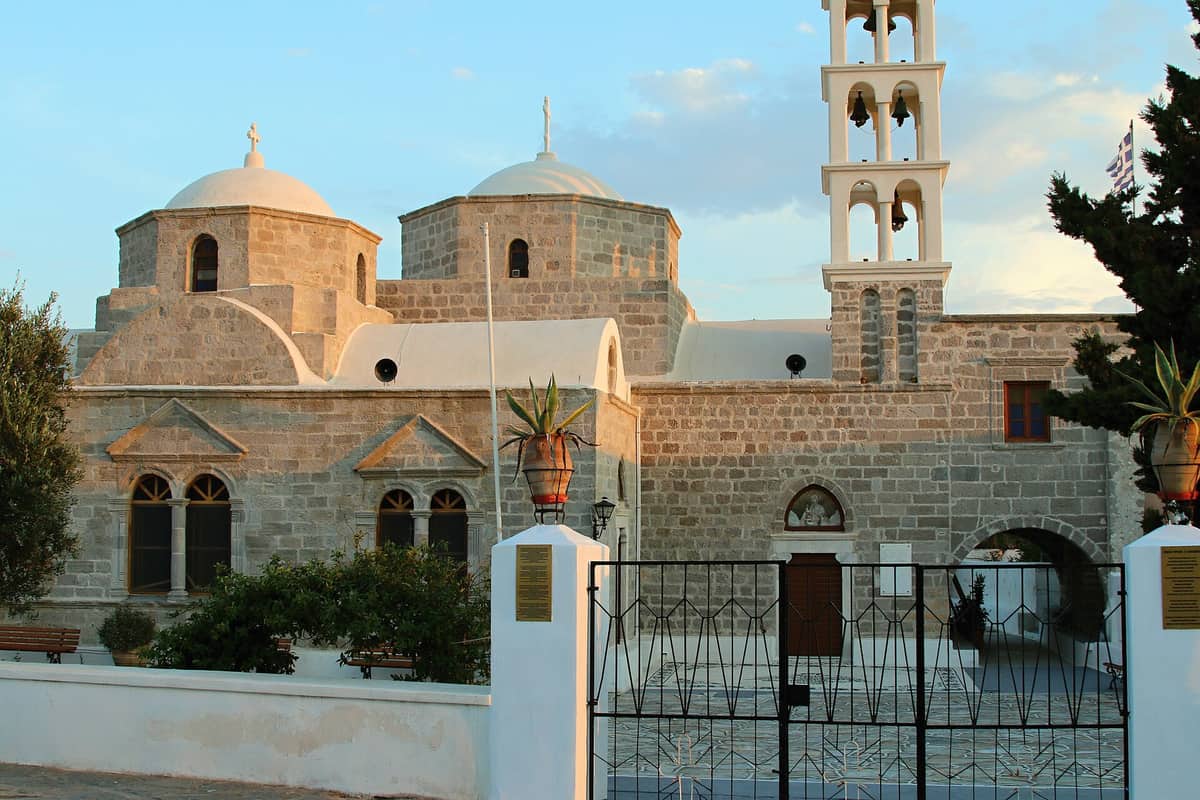
The main monument of Zefiria is the church of Panagia Portiani, known as the Old Cathedral of Milos. It stands in the middle of Zefiria and carries the dedication of the Dormition of the Theotokos, which the Orthodox calendar keeps as the Assumption of the Virgin. The church keeps the rank of cathedral in its name, and its mass gives the low village its shape against the flat ground of the plain of east Milos.
A second church stands near the edge of the settlement. The church of Saint Nicholas is walled, and its enclosure sets it apart from the houses around it. The two churches are the tallest buildings that remain. Between and around them, the houses of Zefiria stand low and close to the ground, and open land runs past the last doors. Fields of the plain begin at the end of the street and reach out towards the south-east coast.
The plain around Zefiria is farmland, and the settlement has kept an agricultural character. Fields, dry stone walls and small farm buildings fill the ground between the village and the coast. Crops and livestock still give the place its daily rhythm, and the harbour is far enough away to leave the evenings quiet. The land stays low across the whole plain. The west of the island holds no villages, so the inland plain of the east carries the farmland of Milos.
Zefiria numbered 190 residents at the census of 2021, while the municipality of Milos counted 5,302 people. Those figures place the village among the smaller settlements of Milos. The village belongs to the community of Trypiti, in the municipality of Milos, and its daily affairs follow the wider island. Nothing here is far from the rest of Milos: the coast lies a short drive away, and the road to Plaka climbs north-west from the plain.
- Cathedral: The church of Panagia Portiani is the Old Cathedral of Milos, in the middle of Zefiria.
- Dedication: The cathedral carries the Dormition of the Theotokos, kept as the Assumption.
- Second church: The walled church of Saint Nicholas stands near the edge of the village.
- Ground: The settlement stands on flat land at 10 metres above the sea, so its streets stay level.
- Census: 190 residents lived here at the count of 2021.
Zefiria today is a small settlement with two churches and a wide plain. The cathedral of Panagia Portiani keeps the memory of the years when the village led the island, and the walled church of Saint Nicholas stands beside the houses. A traveller who leaves the coast road and turns inland finds fields, low buildings and quiet ground. The mineral museum of Milos in Adamantas explains the other wealth of the island, the rocks that shaped it.
What feast does Zefiria keep, and what lies near the village?
Zefiria keeps the feast of Panagia Portiani on 15 August, the Assumption of the Virgin, and the celebration gathers the parish around the old cathedral. Rural life continues in the fields outside feast days. Nearby stand Paleochori, the south-east coast and the old mines of the island.
The feast of Panagia Portiani falls on 15 August, when the Orthodox Church keeps the Assumption of the Virgin. The parish of Zefiria carries that dedication, so the cathedral stands at the centre of the day. Families that left the inland plain return for the holiday, and the whole settlement fills with people for the day. The date joins Zefiria to the wider island of Milos, because other parishes keep the same feast in late summer.
Daily life in Zefiria follows the fields. The settlement keeps an agricultural character, and its 190 residents work the plain around it. The church and a small square give the community its meeting points. A road through the plain links the village to the port and to the south-east coast, and the harbour and the tourist season lie a short drive away. Fields change with the season, and the work of Zefiria moves with them.
Paleochori lies to the south of Zefiria, on the coast, and it counts among the settlements of Milos. The south-east shore holds beaches, and the ground behind them sends up hot water and steam. Fumaroles and hot springs rise at Agia Kyriaki and Paleochori, and the temperature in those vents reaches 100 degrees Celsius. The island also keeps the traces of its mines, and sulfur, baryte, millstones and gypsum were taken from the ground in the past.
- Feast: The feast of Panagia Portiani falls on 15 August, the Assumption of the Virgin.
- Parish: The parish here carries the dedication of the Assumption.
- Paleochori: Paleochori lies on the coast south of Zefiria and counts among the settlements of Milos.
- Hot ground: Fumaroles and hot springs rise at Agia Kyriaki and Paleochori, with vents of 100 degrees Celsius.
- Mining past: Sulfur, baryte, millstones and gypsum were mined here in the past.
A visit to Zefiria fits into a day on the south-east side of Milos. The feast of 15 August gives the village its one crowded date, and the rest of the year belongs to the fields. Paleochori and the old mine ground lie within a short drive, and the hot vents of Agia Kyriaki show how close the volcanic past sits to the surface.

What does a visit to Zefiria include?
A visit to Zefiria includes the cathedral of Panagia Portiani, the walled church of Saint Nicholas, the houses of the old capital and the farmland of the plain. The village lies between Adamantas and the south-east coast, and the 15 August feast gives it one busy day.
How far is Zefiria from the port of Milos?
The village lies about 5.5 kilometres south-east of Adamantas, the main port of Milos, and about 9 kilometres south-east of Plaka, the seat of the municipality. The road runs through the plain of the east and gives a short and level drive. A car or a scooter covers the distance quickly.
What is the church of Panagia Portiani in Zefiria?
Panagia Portiani is the old cathedral of Milos, and it stands in the centre of the settlement. The church carries the dedication of the Dormition of the Theotokos, which the Orthodox calendar keeps as the Assumption of the Virgin. It is the main monument of the settlement, and it holds the place of the cathedral in Zefiria.
Why was Zefiria abandoned as the capital of Milos?
Strong earthquakes in the middle of the 18th century pushed the population away from the village. Much of it moved towards Adamantas, where the harbour gave work and access to the sea. The title of chief town passed to Plaka, and the island lost people in the same years. Zefiria remained a farming settlement from then on.
When is the feast of Zefiria held?
The feast of Panagia Portiani in Zefiria falls on 15 August each year, the day the Orthodox Church keeps the Assumption of the Virgin. The service takes place in the old cathedral, and the village fills with residents, former residents and visitors. Days before and after the feast stay quiet.
What lies near Zefiria on the south-east coast?
Paleochori lies south of the village on the coast, and Agia Kyriaki lies close to the same shore. The coast holds beaches, and the ground behind them sends up hot springs and fumaroles with temperatures that reach 100 degrees Celsius. The old mines of Milos also belong to this part of the island.