Coffee and drinks in Palaioxori, Milos: see our Coffee – Drinks in Milos section for the island.
A small settlement and a long shore share one name on the south coast of Milos. Paleochori stands on the south-western side of the island, where the sea meets rock in strong red and yellow. A small number of places to eat and rooms for rent stand behind the sand. The island of Milos keeps this corner for slow hours and warm ground.
Days here move between the sea and a table. A morning cup comes first, then a swim, then a meal with a cold glass. The settlement behind the sand is small, and the water stays cool and clear. Visitors arrive for the day and settle on the sand. Coffee and drinks in Paleochori belong to that rhythm of shore and table.
What shape does a day of coffee and drinks in Paleochori take?
Coffee and drinks in Paleochori follow the shape of a shore day on the south coast of Milos. Small bars and canteens stand a step from the sand, and the hours move from a first cup through a swim to a cold glass in the afternoon.
Paleochori is a settlement and a beach of the Municipality of Milos, on the south-western side of the island. Rock with strong red and yellow colour surrounds the shore. The coast is sandy, with small multicoloured pebbles mixed into the sand, and the water above it is deep blue and clear. The place counts among the popular destinations of the island, and coffee and drinks in Paleochori draw people to the edge of the water. The shore runs along the coast in a wide line of sand.
The settlement holds a small number of residents, recorded as 17 in the census of 2021. Rooms for rent and a small number of places to eat stand in the area, close to the water. Those places serve food through the day, and they also pour the coffee and drinks in Paleochori for swimmers who leave the sea. The offer is simple, built for people who arrive wet and ready to sit. A towel, a chair and a cold glass cover the needs of a visitor.
Morning brings the first orders, when the air is still cool and the sand has not taken the heat. Midday empties the water as people move to the tables behind the shore. Afternoon returns the crowd to the sea, and the cold glasses come out again. Evening slows the pace, with a last swim and a last drink before the walk back. The hours pass with the light, and the shore keeps its own order. Coffee and drinks in Paleochori mark each of those steps.
Warm ground lies under the sand, because the island carries volcanic rock over the largest part of its surface. The stone, the pebbles and the colour of the water give the shore a character of its own, and visitors return to it each summer. The place is small, so the day keeps a quiet pace beside the crowd. Coffee and drinks in Paleochori fit that calm, with short walks between the water, the table and the sand. The whole place works at the speed of the water.
- Settlement: A small place with 17 residents, recorded in the census of 2021.
- Shore: Sand and small multicoloured pebbles, framed by rock in red and yellow.
- Water: Deep blue and clear, with warm patches near the volcanic ground.
- Places to eat: A small number of them stand close to the sand and the water.
- Hours: A day of coffee and drinks in Paleochori moves from a first cup to a swim, a meal and a cold glass.
The day at this shore is built from water and small tables. Visitors swim, eat and drink in an easy order, and the settlement stays small enough to keep the pace slow. Coffee and drinks in Paleochori carry that pace from the first cup in the morning to the last glass before the walk back over the sand. The next section turns to the morning cup itself, poured at the water’s edge.

Where does morning coffee sit among coffee and drinks in Paleochori?
Coffee and drinks in Paleochori open with Greek coffee in a small cup, and with the iced espresso drinks of Greece, the freddo espresso and the freddo cappuccino. Each one is ordered by the level of sugar and served hot or cold at the table.
Greek coffee starts with finely ground coffee, water and sugar in a small pot that widens at the base. The pot heats until the mixture rises, and a thick foam forms on the surface. That foam counts as much as the drink below it. The powder stays in the cup, and part of it settles at the bottom. A glass of cold water arrives beside it, and a first sip clears the mouth. Coffee and drinks in Paleochori keep this small ritual at the start of the day.
The amount of sugar is named when the drink is ordered, and that choice changes the taste at the bottom of the cup. One order comes with no sugar, another with a little, and a third with a full spoon. The pot, the water and the coffee stay the same in every case. Coffee and drinks in Paleochori follow that habit, and the words used for the order travel with the drink across the country, from the port to the smallest village.
The freddo espresso is the iced coffee built on espresso. It was first made in Athens in 1991 and has grown in popularity since, and it is seen as a higher quality version of the older shaken cold coffee of Greece. The drink is mixed with ice and poured over more ice, so it stays cold to the last mouthful of the glass. Coffee and drinks in Paleochori offer it beside Greek coffee, and swimmers order it as soon as they leave the water.
The freddo cappuccino takes the same iced espresso and adds a cold milk foam on top, called afrógala. The frappé, the older iced coffee of Greece, is made by shaking instant coffee with water and ice until a thick foam forms. A straw comes with that glass, because the foam tastes bitter on its own. The wider range of coffee and drinks in Milos sits beyond this shore. Coffee and drinks in Paleochori keep all three within reach of the sand.
- Greek coffee: Finely ground coffee, water and sugar heated together in a small pot.
- Order: The level of sugar is named before the pot goes on the heat.
- Freddo espresso: An iced espresso, mixed with ice and poured over ice.
- Freddo cappuccino: An iced espresso with cold milk foam, the afrógala, on top.
- Frappé: Instant coffee shaken with water and ice into a thick foam.
The morning drink sets the tone for everything after it. A small cup with foam keeps a table occupied, and a tall iced glass follows a first swim. Both come from the same simple habits, the pot on the heat and the ice in the glass. Coffee and drinks in Paleochori carry those habits to the sand, where the next section looks at the shore itself and at the stone that frames it.
Which colours frame coffee and drinks in Paleochori on the shore?
Coffee and drinks in Paleochori take place against rock in strong red and yellow, a sandy coast and small multicoloured pebbles. The shore counts among the popular destinations of Milos, and the water in front of it is deep blue and clear.
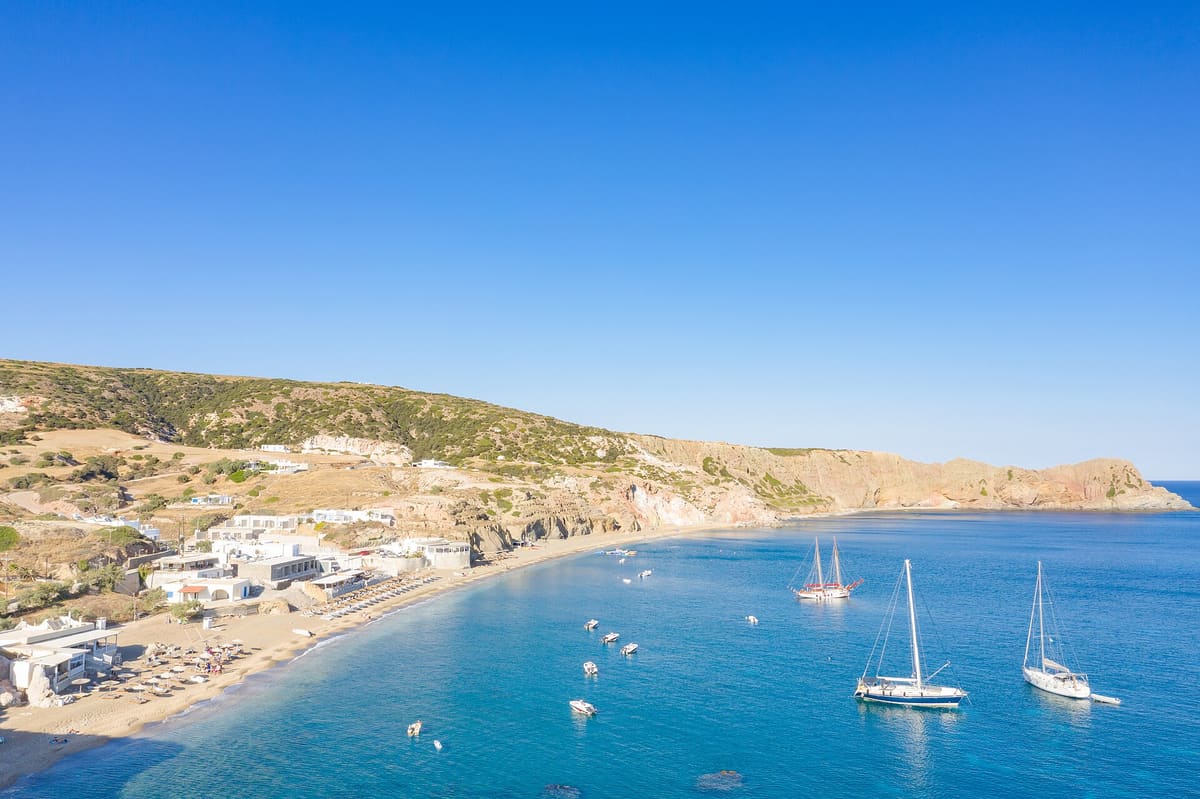
Rock surrounds the shore of Paleochori, and the colour of it is strong. Red and yellow carry the cliff faces, and the same stone runs along the water line. The colour belongs to the volcanic ground under the island, and it shifts with the light through the day. Swimmers see the rock from the sea, where the tones look deeper and the height of it shows against the sky. Coffee and drinks in Paleochori sit against that wall of colour.
The coast itself is sandy, and small multicoloured pebbles lie mixed into the sand. The mix changes underfoot from one step to the next, soft in one place and firm in another. Sand keeps the heat of the sun, and the ground below it stays warm from the volcano. Everything near the water carries the pale tone of the shore in the middle of the day. Coffee and drinks in Paleochori are served on this ground, a short walk from the waves.
The water in front of the beach is deep blue and clear. The shore counts among the popular destinations of the island, and summer brings crowds to the sand. The beaches of Milos each carry their own stone and their own colour, and this one is known for the strength of its red and yellow. Visitors photograph the rock as much as the sea. Coffee and drinks in Paleochori belong to that view, from a chair on the sand.
Stone, sand and pebbles give the place its form. The shore is wide enough for walkers, and the line of it runs along the coast in a curve. The material underfoot decides how the day feels, with cool sand in the morning and hot sand at midday. Coffee and drinks in Paleochori take their setting from those small changes, which pass under the feet of every visitor through the hours of light. The stone keeps its colour even in the shade of the late hours.
- Cliff: Rock with strong red and yellow colour surrounds the shore.
- Coast: A sandy beach, with small multicoloured pebbles mixed into the sand.
- Water: Deep blue and clear in front of the beach.
- Setting: A popular destination of the island for coffee and drinks in Paleochori in the summer months.
- Ground: Warm underfoot, because the island is volcanic, with heat under the sand.
The beach gives the drinks their setting. Red and yellow rock, sand, multicoloured pebbles and deep blue water frame every table and every towel. Visitors come for the colour as much as for the swim, and the shore holds both without effort. Coffee and drinks in Paleochori are taken in the middle of that scene. The next section explains why the ground under all of it stays warm.
Why does the ground stay warm under coffee and drinks in Paleochori?
Coffee and drinks in Paleochori stand on volcanic ground, where vents release gases from inside the Earth and heat reaches the sand. The temperature at those vents climbs to 100 degrees Celsius, and warm water rises near the shore of the beach.
Milos is a volcanic island, and volcanic rock covers the largest part of it. Activity began two to three million years ago and last produced an eruption ninety thousand years ago, and the volcano counts as dormant. Steam has been found at a depth of 1,100 metres, and in one cave on the south coast the heat from the volcano is still great. Two extinct volcanoes stand on the island, and volcanic domes rise above the villages. Coffee and drinks in Paleochori sit above that buried heat.
The heat shows itself at the surface. Fumaroles are vents that release gases from inside the Earth, and solfataras form a class of them. Active solfataras and fumaroles stand at Agia Kyriaki, at Pyromenes, at Adamas and here at Paleochori, where the temperature reaches 100 degrees Celsius. Sulfur is strongly present around those points of the ground. The gas leaves the ground through small openings, and steam rises with it. Coffee and drinks in Paleochori are poured close to earth that still breathes volcanic gas.
Hot springs rise on the island as well, and the water in them reaches 55 degrees Celsius. The springs near this shore join the thermal waters of Milos, which carried a name in antiquity for their mineral content. The heat under the sand comes from the same source as the heat in those springs. Coffee and drinks in Paleochori take place a short walk from that warm ground, where the sea and the volcano meet.
Under the sea, gas from below reaches the surface as bubbles. Underwater vents of this kind work off the island, and swimmers notice the water move where the gas rises. Warm water leaves the sand and mixes with the sea, so a cool swim carries warm patches in places. The ground gives off heat through the day and the night. The bubbles break the surface in lines above the vents. Coffee and drinks in Paleochori are served above a shore that keeps that volcanic warmth underfoot.
- Island: Volcanic rock covers the largest part of Milos, and the ground stays warm.
- Vents: Active fumaroles and solfataras reach 100 degrees Celsius at Paleochori.
- Springs: Thermal water on the island reaches 55 degrees Celsius.
- Bubbles: Gas from underwater vents reaches the surface as bubbles.
- Ground: Warm sand and warm water beside the shore of the beach.
Volcanic heat is part of the experience of the shore. The sand warms, the vents release gas, the springs rise and bubbles cross the surface of the sea. None of it disturbs a day of swimming and drinking, and the warm ground under a towel is felt rather than seen. Coffee and drinks in Paleochori take place on top of that quiet heat, which the next section leaves behind for the water.

How does a swim break the hours of coffee and drinks in Paleochori?
Coffee and drinks in Paleochori sit beside a shore built for swimming, with deep blue and clear water, a curve of rock and warm patches where volcanic heat reaches the sea. Hours pass between a glass and a swim at the edge of the sea.
The sea in front of the beach is deep blue and clear, and it stays cool through the hot months. The colour of the water changes with the light, pale near the sand and darker further out. Swimmers move between the shallow edge and the deeper line a short distance from it. Salt dries on the skin, and a rinse of fresh water is welcome after a long stay in the sea. Coffee and drinks in Paleochori follow the swim, never far behind it.
Rock closes around the shore on both sides, so the beach sits inside a wide curve of stone. That shape gives the water a calm surface for the greater part of the day, and the waves stay small. Walkers take the length of the sand from one end to the other, with the cliff on one side and the sea on the other. Coffee and drinks in Paleochori are taken inside that frame of stone.
Summer days on the island are warm and dry, and the sun over the sand is strong in the middle hours. Sun and shade divide the day, because the shore takes full light around noon and the ends of the day are gentler. Swimmers time their visits to the cooler hours and keep the middle of the day for a table. Coffee and drinks in Paleochori fit the same clock, with the cold glasses arriving when the sun is highest.
A swim, a glass, another swim: the order repeats through the afternoon. Bodies cool in the water and warm again on the sand, and the ground under a towel keeps its heat from the volcano. Visits to the water grow shorter as the day goes on, and the hours at the table grow longer in step. Coffee and drinks in Paleochori keep that rhythm, with the sea a short walk from every chair. The cycle needs nothing more than a towel, a glass and a little patience.
- Sea: Deep blue, clear and cool through the summer months.
- Cove: Rock closes around the shore and leaves a wide curve of sand.
- Middle hours: Strong sun over the sand, best kept for a table.
- Light: Full sun around noon, softer light at either end of the day.
- Rhythm: A swim, a glass and another swim, through the afternoon.
Swimming and drinking share the same hours at this shore. The water cools the skin, the sand warms it again, and the table waits between the two. Visitors move in short cycles from the sea to a chair and back, and the day passes without any need for a plan. Coffee and drinks in Paleochori follow the water rather than the clock. The rhythm stays the same from the first warm morning to the last cool hour.
Which drinks join a meal within coffee and drinks in Paleochori?
Coffee and drinks in Paleochori reach the table as well, where Greek wine, retsina and cold beer stand beside the food. Greece counts among the oldest wine-producing regions in the world, and retsina has been made for at least two thousand years.
Greece counts among the oldest wine-producing regions in the world. The earliest evidence of wine there is dated to 6,500 years ago, when wine was produced on a household or communal basis. Wine travelled the Mediterranean in ancient times, and Greek wine carried high prestige in Italy under the Roman Empire. In the medieval period, wines exported from Crete, Monemvasia and other Greek ports fetched high prices in northern Europe. Coffee and drinks in Paleochori belong to that long history of the vine.
A system of appellations covers the wine of the country, with protected designations of origin and protected geographical indications above the table wines. Native varieties give the wine its character, among them Assyrtiko, a white grape of Santorini that keeps its acidity as it ripens. Savatiano, the main white grape of Attica, makes retsina when it is fermented without cooling. Coffee and drinks in Paleochori sit at the end of that line, with the wine of the islands on the table.
Retsina is a Greek white wine flavoured with pine resin, and it has been made for at least two thousand years. The flavour began with the practice of sealing wine vessels, above all amphorae, with the resin of the Aleppo pine. Pine resin kept air away from the wine and gave it an aroma of its own. The European Union treats the name retsina as a protected designation of origin for Greece. Coffee and drinks in Paleochori include it among the usual glasses on a table by the sand.
Beer is the other cold drink at a table on the sand, and it arrives beside the wine and the retsina. It suits the middle of the day, when the sun is high and the food is simple. A meal at the water’s edge mixes a plate, a salad and a glass, and the second glass follows the first. Coffee and drinks in Paleochori keep that pattern, from the first cup in the morning to the last glass with food.
- Wine: Greece counts among the oldest wine-producing regions in the world.
- Retsina: A white wine flavoured with pine resin, made for at least two thousand years.
- Appellations: Protected designations and geographical indications cover the wines of the country.
- Varieties: Native white grapes, among them Assyrtiko and Savatiano.
- Beer: A cold drink that sits beside wine at a table on the sand.
A meal by the water brings the drinks together. Wine from native grapes, retsina with its pine aroma and cold beer share the table with simple food. The order is unhurried, and the sea stays within sight of every chair. Coffee and drinks in Paleochori follow the meal to its end, and the day closes with the sound of the water and the walk back over the sand.
How does sunset shape coffee and drinks in Paleochori?
The evening of coffee and drinks in Paleochori begins when the sun drops over the sea on the south-western coast of Milos. The rocks around the beach hold strong red and yellow colour, and the low light warms those tones before the sky fades.
The settlement stands on the south-western coast of Milos, so the water lies between the shore and the setting sun. The late light changes the red and yellow tones of the rock before the sky fades. The evening arrives slowly on this side of the island. The census of 2021 counted seventeen residents in the settlement, against twenty-five in 2011, so this shore keeps the quiet of a small place. That hour belongs to coffee and drinks in Paleochori.
Ouzo is the drink of the Greek evening. It is a dry anise-flavoured aperitif, widely consumed in Greece, and it is made from rectified spirits that pass through distillation and flavouring. Mixed with water, the clear spirit turns cloudy white, and it is served with ice cubes in a small glass. Ouzo can also be drunk straight from a shot glass. A cold glass of that kind belongs to coffee and drinks in Paleochori, taken while the light leaves the cliffs.
An ouzeri is a café-like place that serves ouzo with mezedes, and the habit belongs to the early evening. The drink is sipped slowly, mixed with water or ice, and the small plates are shared over a long stretch of hours. Meze is a small plate of appetizers, with small fresh fish, fries, olives and feta cheese, and the kitchen behind it belongs to the wider food in Paleochori. The table of coffee and drinks in Paleochori follows that pattern, with the water close by.
A cold beer suits the same hour. Beer belongs to the warm part of the year, and the summer evenings on Milos stay mild after a hot day. The island has a Mediterranean climate, with warm to hot dry summers, and the night air on this coast stays mild for a while. Rooms to let and a small number of eating places stand in the area, so an evening of coffee and drinks in Paleochori needs no journey back up the hill.
- Sunset side: the settlement stands on the south-western coast, with the sea between the shore and the setting sun.
- Rock colour: the beach is surrounded by rocks of strong red and yellow colour.
- Ouzo: the drink is a dry anise-flavoured aperitif, made from rectified spirits that are distilled and flavoured.
- Meze: a small plate of appetizers holds small fresh fish, fries, olives and feta cheese.
- Evening hour: ouzo is sipped slowly with mezedes in the early evening.
An evening on this coast runs from the low sun on the coloured rock to a cold glass at a table by the water. Ouzo or a beer arrives with a small plate, and the hours pass slowly while the light leaves the cliffs. The settlement is small, so the shore keeps its calm after the day. The last hour of coffee and drinks in Paleochori closes in that plain way, with the sea close and the cliffs in shadow.

What remains of the sulphur past of coffee and drinks in Paleochori?
The past of coffee and drinks in Paleochori reaches back to a coast where sulphur was mined for a long period. Pliny the Elder placed Milos above every other land of the ancient world for its sulphur, and the mineral was taken until the twentieth century.
Milos was built by volcanic activity and forms a stratovolcano without eruptions in historical times. The activity began two to three million years ago and stopped ninety thousand years ago. Two extinct volcanoes stand on the island, the volcano of Fyriplaka and the volcano of Trachilas, and volcanic rocks cover the greater part of the land. The coast of coffee and drinks in Paleochori belongs to that volcanic belt, where mineral work left a clear mark.
Sulphur formed part of the industry of the island. Sulphur mines operated on Milos, and baryte was taken from the ground as well. Steam was found at a depth of 1,100 metres, so the island drew attention for geothermal works. The island has been a mining place for a long period. The old workings left their marks across the land, and mining work still continues there. The ground around coffee and drinks in Paleochori belongs to an island where minerals still matter.
The old sulphur mines stand at Thiorichia, in the small bay of Paliorema on the eastern side of the island. The works produced sulphur there until 1956. Ruins remain today, with wagons on their rails and old rusty tools, and the beach below holds yellowish pebbles. The place counts among the geological sights of Milos. The coast of coffee and drinks in Paleochori shares that volcanic belt, where sulphur shaped both the land and the work of the shore.
Mining on Milos did not stop with sulphur. Bentonite, perlite, pozzolana and small quantities of kaolin are collected today by open-pit methods and sold around the world. In the past, baryte, sulphur, millstones and gypsum came out of the ground as well. The western half of the island keeps old mines, and the pozzolana mine at Xylokeratia is the only one still working. An island that still mines lies behind coffee and drinks in Paleochori.
- Sulphur: Pliny the Elder placed Milos above every other land of the ancient world for its sulphur.
- Working years: the sulphur mines at Thiorichia operated until 1956.
- Remains: ruins, wagons on their rails and old rusty tools survive at the place.
- Baryte: baryte was taken from the island until 2000.
- Depth: steam was found at a depth of 1,100 metres below Milos.
Sulphur gave this coast its first work, and the marks of that work remain in ruins, rails and yellow pebbles. The mines at Thiorichia stopped in 1956, while baryte left the island in 2000. The volcanic ground produced the mineral. The history of coffee and drinks in Paleochori stands on that ground, on a coast where the land was dug, weighed and shipped away.
Which season suits coffee and drinks in Paleochori best?
The season for coffee and drinks in Paleochori runs through the warm months, when the dry summer of Milos brings clear skies and a strong sun. Spring and autumn hold milder air and quieter shores, while the winter months are mild and wet, with rain and lower temperatures.
Summer on Milos is warm to hot and dry. The mean daily maximum reaches 28.1 degrees Celsius in July and 27.6 degrees in August, and the highest temperature measured in July stands at 41.0 degrees, against 39.8 degrees in August. Rain almost leaves the island in those months, with 0.3 millimetres in July and 1.4 millimetres in August. The coast faces the open water, so the sun stays long over the sea, and the light of coffee and drinks in Paleochori lasts into the evening.
Wind is part of the summer picture. Milos has a Mediterranean climate, and the dry hot days are cooled by seasonal winds called the meltemi. Strong winds and the waves of the Aegean have sculpted the coastline over a long period, and the coloured rock of this shore carries the marks of that work. On a windy day the sea moves and the table turns away from the open water. The weather of coffee and drinks in Paleochori changes with those winds.
Spring and autumn bring the gentler hours. The mean daily maximum stands at 18.4 degrees in April, 25.2 degrees in September and 21.3 degrees in October. Rain returns with the seasons, at 20.5 millimetres in April and 42.9 millimetres in October, over about three rainy days in each month. The light is softer and the shore is emptier, and the rock keeps its red and yellow colour. The milder weeks of coffee and drinks in Paleochori take a slower shape.
The quiet months run from late autumn to early spring. The settlement counts seventeen permanent residents, so outside the warm season this coast returns to a small place with a handful of houses. Milos draws lighter traffic than the busier islands of the Cyclades, and the island counted 5,302 residents in 2021. Winter is mild and rainy, with 74.7 millimetres of rain in January and a mean daily maximum of 12.9 degrees. The still shore of coffee and drinks in Paleochori belongs to those months.
- July: the mean daily maximum reaches 28.1 degrees Celsius, and the highest figure for the month stands at 41.0 degrees.
- August: the mean daily maximum stands at 27.6 degrees Celsius, with 1.4 millimetres of rain.
- Winds: seasonal winds called the meltemi cool the dry hot days of summer.
- Spring and autumn: the mean daily maximum runs from 18.4 degrees in April to 21.3 degrees in October.
- Residents: the census of 2021 counted seventeen people in the settlement, against twenty-five in 2011.
The seasons divide the year on this coast in a plain way. Summer brings heat, long light and the meltemi, spring and autumn bring mild air and quiet rock, and winter brings rain and a small population. The coloured cliffs and the warm light stay through all of them. The year of coffee and drinks in Paleochori follows that rhythm, from the crowded weeks of July to the empty months of January.
How does the road reach coffee and drinks in Paleochori from Adamas?
The road to coffee and drinks in Paleochori leaves Adamas and crosses the interior of Milos by way of Zefiria. The settlement lies about fourteen kilometres south-east of the port of Adamas, and about thirteen kilometres south-east of Plaka, the seat of the municipality.
Adamas is the port of Milos, and the harbour is the hollow of the principal crater, cut into the island from the north-west. Above the harbour stands Plaka, the chief town and the seat of the municipality, and the road to the south coast leaves the water for the plateau. From there it runs inland toward Zefiria. That inland section carries the road toward the south coast of the island and on to coffee and drinks in Paleochori.
Zefiria lies inland in the eastern part of the island, at an elevation of ten metres. It stands about nine kilometres south-east of Plaka and five kilometres south-east of Adamas. This makes the village a clear inland point between the port and the south coast. The road through Zefiria carries traffic away from the harbour and toward the southern beaches. The route to coffee and drinks in Paleochori uses that change from the interior to the coast.
Past Zefiria the same road carries on to the beaches of Agia Kyriaki and Paleochori. Agia Kyriaki lies about ten kilometres from Adamas, while Paleochori lies about fourteen kilometres south-east of the port. Both places take the same south-coast direction from the inland route. The last stretch of road from Zefiria is a short one, and it leaves the interior behind for the shore. The journey to coffee and drinks in Paleochori therefore ends beyond Zefiria, at the water.
Paleochori belongs to the Community of Tripiti, together with Tripiti, Zefiria, Kanava, Klima, Agia Kyriaki and Schinopi, inside the Municipality of Milos. The settlement was counted officially as a separate settlement in 2011. Milos measures about twenty-three kilometres from east to west and thirteen kilometres from north to south. The island road is simple to follow. The route to coffee and drinks in Paleochori therefore stays within the compact eastern side of the island, before it closes at the sea.
- Adamas: the port town was founded by Cretan refugees in 1841.
- Zefiria: the village stands inland, about five kilometres south-east of Adamas.
- Plaka: the chief town and the seat of the municipality stands on the plateau above the harbour.
- Paleochori: the settlement lies about fourteen kilometres south-east of Adamas.
- Community: Paleochori belongs to the Community of Tripiti, with Zefiria, Agia Kyriaki and Kanava.
The road from Adamas runs inland first, through the interior, and then turns for the south coast. Zefiria marks the inland part of the way before the road reaches the south coast. From there the distance to the shore is short. The drive to coffee and drinks in Paleochori ends where the interior gives way to the water and the coast.

Which coves lie on the south coast near coffee and drinks in Paleochori?
The coves around coffee and drinks in Paleochori sit on a south coast that holds twenty-one beaches, listed from east to west. Agia Kyriaki lies to the east, with thick sand and white pebbles, while Tourlos, Gerakas, Kalamos, Tsigrado and Fyriplaka follow on the other side.
Agia Kyriaki is the settlement that comes first to the east. It stands on the south coast, about thirteen kilometres south-east of Plaka and ten kilometres from Adamas. The beach has thick sand and white pebbles, and it draws people through the summer months. Its name comes from the small church of the area. The land around it holds an archaeological site with the ancient harbour, where storerooms survive. The shore of coffee and drinks in Paleochori has a neighbour with an old port.
The list of south-coast beaches runs from east to west, and Paleochori is the sixth name on it. To the east stand Tourkaki, Spathi, Fyrligkos, Agia Kyriaki and Psarovolada. Beyond them, in the small bay of Paliorema, the old sulphur mines of Thiorichia mark the eastern end of this shore. The coves of coffee and drinks in Paleochori sit in the middle of that chain, with quieter water on one side and the mining coast on the other.
On the other side of the settlement the list continues with Tourlos, Gerakas, Kalamos, Tsigrado and Fyriplaka. Tsigrado lies under towering cliffs, with white sand, and the way down is steep. Fyriplaka is a well-serviced beach with fine grey sand and a rock in the water. Further along come Provatas, Agios Sostis and Kipos, and at the western end Kleftiko, where sheer white volcanic rocks rise from the sea. The line of coffee and drinks in Paleochori looks out on those coves.
Milos has an intricate coastline with over 70 beaches, and each one differs from the next because of the rocks around it. Part of the coast is reached from the land, while other beaches are reached only from the sea. The island lies at the south-western edge of the Cyclades, roughly midway between Piraeus and Crete. The south side holds twenty-one of those beaches. The rock, the open water and the long view belong to coffee and drinks in Paleochori.
- Agia Kyriaki: the beach lies about ten kilometres from Adamas and takes its name from a small church.
- East side: Tourkaki, Spathi, Fyrligkos and Psarovolada stand between Paleochori and the eastern end of the list.
- West side: Tourlos, Gerakas, Kalamos, Tsigrado and Fyriplaka follow on the other side of the settlement.
- Kleftiko: sheer white volcanic rocks rise from the sea at the western end of the south coast.
- Coastline: the intricate coastline of Milos holds over 70 beaches.
The south coast of Milos gathers a chain of beaches around this settlement. Agia Kyriaki lies east, with its old harbour and its white pebbles, while Tsigrado, Fyriplaka and the coves beyond follow to the other side. Kleftiko closes the line in the west. The middle of that shore holds coffee and drinks in Paleochori, between the mining bay and the white rocks of the far end.
Which questions come up about coffee and drinks in Paleochori?
The questions about coffee and drinks in Paleochori turn on the season, the road from Adamas, the drinks of an evening, the sulphur past of the coast, the neighbouring coves and the size of the settlement. Each answer below takes one point in turn.
When do travellers plan coffee and drinks in Paleochori?
The warm months from late spring to early autumn carry the heat, the dry skies and the long evenings. July and August are the hottest, with mean daily maxima near twenty-eight degrees Celsius. Spring and autumn bring milder air and lighter crowds on the shore, while winter is mild and wet, with rain and quiet rock.
How does the road reach coffee and drinks in Paleochori from Adamas?
The road leaves Adamas, the port of the island, and crosses the interior by way of Zefiria, the inland village. Paleochori lies about fourteen kilometres south-east of the port and thirteen kilometres south-east of Plaka. Past Zefiria the road carries on to the beaches of Agia Kyriaki and Paleochori, on one island road.
Which drink belongs to an evening of coffee and drinks in Paleochori?
Ouzo belongs to that hour. The drink is a dry anise-flavoured aperitif, widely consumed in Greece, and it is made from rectified spirits that pass through distillation and flavouring. Mixed with water, it turns cloudy white and it is served with ice in a small glass. A small plate of appetizers goes with it.
What remains from the sulphur past of coffee and drinks in Paleochori?
Ruins of the old sulphur mines stand at Thiorichia, in the small bay of Paliorema. The works operated until 1956, and wagons on their rails and old rusty tools remain there. Pliny the Elder placed Milos above every other land of the ancient world for its sulphur, and the mineral was taken until the middle of the twentieth century.
Which beaches stand beside coffee and drinks in Paleochori?
Agia Kyriaki lies to the east, with thick sand and white pebbles, about ten kilometres from Adamas. On the other side, the list of south-coast beaches continues with Tourlos, Gerakas, Kalamos, Tsigrado and Fyriplaka. Tsigrado sits under towering cliffs, and Fyriplaka has fine grey sand. The south side holds twenty-one beaches.
How large is the settlement of coffee and drinks in Paleochori?
The settlement is small. The census of 2021 counted seventeen residents there, against twenty-five in 2011, the year it was first counted as a separate settlement. It belongs to the Community of Tripiti, with Tripiti, Zefiria, Kanava, Klima, Agia Kyriaki and Schinopi, inside the Municipality of Milos, and rooms to let stand near the shore.
Which climate meets coffee and drinks in Paleochori in summer?
Milos has a Mediterranean climate, with mild rainy winters and warm to hot dry summers. July brings 0.3 millimetres of rain and a mean daily maximum of 28.1 degrees Celsius, and August follows with 1.4 millimetres and 27.6 degrees. Seasonal winds called the meltemi cool the dry hot days, and the evening air changes after the sun goes down.
Which island holds coffee and drinks in Paleochori?
Milos is a volcanic island at the south-western edge of the Cyclades, and it is the fifth largest island of the group. It measures about twenty-three kilometres from east to west and thirteen kilometres from north to south, with an area of about 151 square kilometres. Plaka is the seat of the municipality and Adamas the port.