
A Milos sailing tour is a sea trip on a yacht that uses the wind. The yacht circles the island of Milos, which is volcanic and lies in the Aegean Sea. Passengers sit on deck and watch beaches, coves and open water pass by. The next sections explain the boat and how it works.
A Milos sailing tour feels different from a ride on a motor boat. The wind drives the boat, and the boat leans a little to one side. A skipper and a crew run the yacht. Plain words explain each part, so first-time sailors can follow along.
What is a Milos sailing tour at a glance?
A Milos sailing tour is a sea trip on a sailing yacht. The boat has one hull, a tall mast, large cloth sails and a heavy keel under the water. The wind drives it along the coast, and the engine only helps.
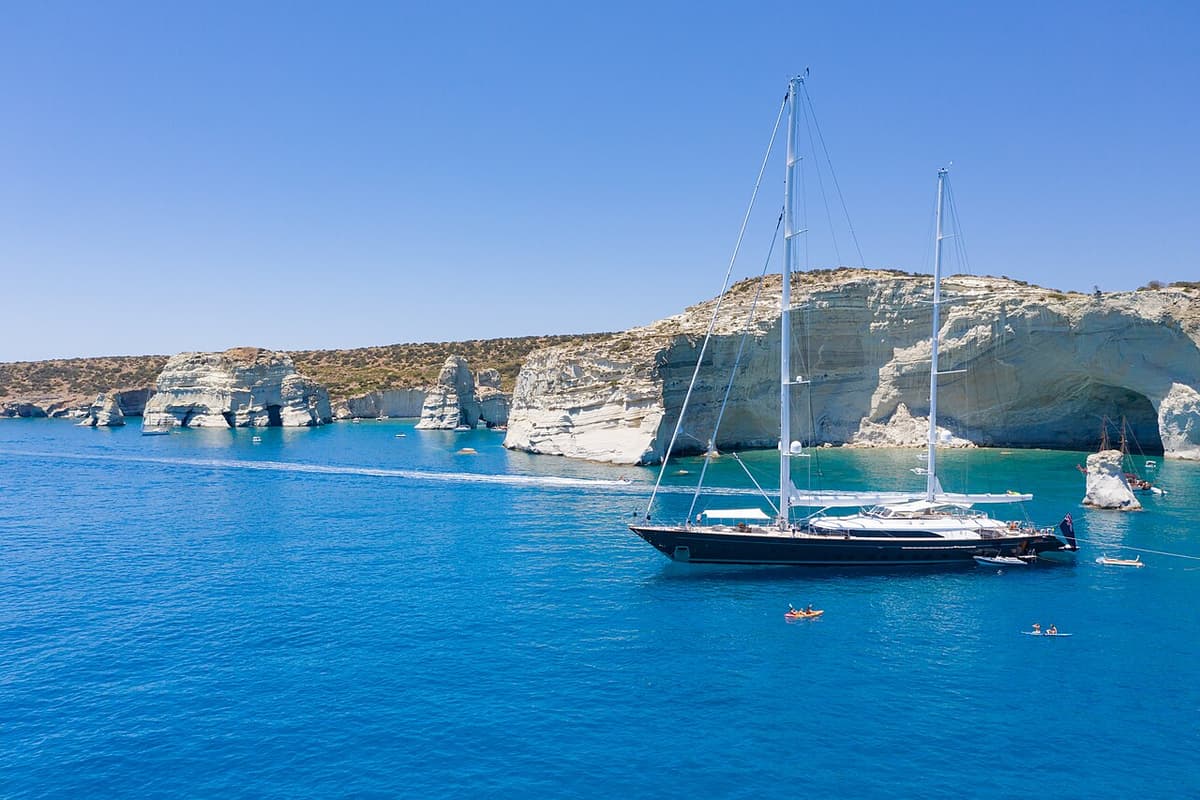
A yacht is a boat built for pleasure trips, cruising or racing. The word covers boats with sails and boats that run on engines alone. A sailing yacht on a Milos sailing tour has a cabin, a covered room inside the hull. Cruising yachts also carry an engine that supports the sails.
A monohull is a boat with one hull. The hull is the watertight body of the boat, the part that floats on the water. Traditional sailboats are monohulls, and this shape is still in use today. A Milos catamaran cruise uses a boat with two hulls, while a sailing yacht keeps one.
The mast is the tall pole that rises straight up from the deck of the boat. It holds the sails up so the wind can fill them. A sloop is the common modern sailboat, with one mast and two sails. A ketch adds a second, shorter mast behind the main mast.
The keel runs along the bottom of the hull like a backbone. On a sailboat, the keel can carry a heavy mass of lead or cast iron. This weight pulls the boat back upright when the wind pushes it over. The keel also stops the hull from sliding sideways through the water.
The Cyclades are a group of about 220 islands in the Aegean Sea. The group’s south-western island is Milos. A narrow channel separates Milos from Kimolos, which lies to the north-east. A Milos sailing tour can use that short distance to cross between the two islands under sail.
Milos has the shape of a horseshoe. The sea fills the gap and forms a large gulf. Among Greece’s natural harbours, this gulf is one of the largest, and it shelters boats. Outside it, the coast is varied, with beaches and coves that suit a Milos sailing tour.
A boat reaches beaches that cannot be reached by land. Passengers swim in clear water, look at the mineral wealth of the island and visit caves. The climate on Milos is Mediterranean, so summers are warm to hot and dry. Such dry, warm weather suits a Milos sailing tour on the open sea.
- Hull: The hull is the watertight body of the boat, and a monohull has just one.
- Mast: The mast is the tall pole that holds the sails up above the deck.
- Keel: The keel carries the heavy weight that keeps a yacht on a Milos sailing tour steady.
- Engine: Cruising yachts carry an engine that supports the sails when needed.
- Cabin: The cabin is the covered room inside the hull of a sailing yacht.
A Milos sailing tour starts with a simple boat. It has one hull, a tall mast, cloth sails and a heavy keel. Milos adds a large natural harbour, a varied coast and warm, dry summers. The next section shows how the sails, the skipper and the crew move the boat.
How do the sails, skipper and crew run a Milos sailing tour?
A Milos sailing tour runs on sails, a skipper and a crew. The mainsail and the jib catch the wind. The skipper steers and plans the route, while the crew adjusts the sails. The keel’s weight keeps the yacht from tipping over in the wind.
The mainsail is the sail that hangs behind the mast. A boom, a pole along the bottom of the sail, holds its lower edge. Modern yachts use a triangular mainsail, which works with the jib when the boat sails upwind. On a Milos sailing tour, the mainsail does the main work of pushing the boat.
The jib is a triangular sail that sits in front of the mast. Its front corner is fixed near the bow, the front of the boat. The jib also helps air flow smoothly past the mainsail, so both sails work better. Together, the two sails drive a sloop through the water.
On a Milos sailing tour, ropes control every sail on the boat. A rope that sets the angle of a sail to the wind is called a sheet. A crew member pulls the sheet in or lets it out. This job is called trimming, and it keeps the sail full of wind.
A boat changes sides by turning its bow through the wind. On a Milos sailing tour, this turn is called a tack. The crew lets go of one jib sheet and pulls in the other one. Then the wind fills the sails from the other side.
The skipper is the person in command of the boat and its crew. The skipper steers with a wheel or a tiller, which is a steering lever. The skipper also plans the route and watches the depth, the wind and the compass. On a Milos sailing tour, these choices decide where the yacht goes.
The crew are the helpers on deck. They raise the sails, pull the ropes and handle the anchor. At the bow, a rail called a bow pulpit helps the crew handle the jib and the anchor. A safety line along the deck protects the crew from falling overboard.
A yacht leans to one side when wind pushes the sails, and this lean is called heeling. The weight in the keel pulls the boat back upright. A smaller sail, made by reefing, also reduces the lean. On a Milos sailing tour, passengers feel the deck tilt while the keel keeps it steady.
- Mainsail: The sail behind the mast does the main work of pushing the yacht.
- Jib: The triangular sail at the front helps air flow smoothly past the mainsail.
- Skipper: On a Milos sailing tour, the skipper commands the boat and the crew.
- Crew: The crew trim the sails, pull the ropes and handle the anchor.
- Heeling: The yacht leans sideways in wind, and the keel pulls it back upright.
A Milos sailing tour works because each part has a job. The mainsail and the jib catch the wind, while the crew trims them. The skipper picks the route, and the keel keeps the yacht steady. The next sections show how this team handles the winds around Milos.

How does a Milos sailing tour use the Cyclades winds and points of sail?
A Milos sailing tour rides the summer meltemi, a strong, dry Aegean wind from the north. The skipper sets the sails for the angle between boat and wind, called the point of sail. When the course points upwind, the boat must zigzag across the wind.
The meltemi is a dry, powerful wind that comes from the north over the Aegean Sea. It dominates the weather across the Aegean Basin and blows through the summer. Leisure sailors favour it on a Milos sailing tour, because it is a good, steady wind.
On a Milos sailing tour the wind keeps a daily rhythm. Its peak comes in the afternoon, it eases overnight, and one spell can run for days. The sky stays clear, the sea turns choppy, and the dry air improves the visibility.
In the central Aegean the meltemi blows from the north, and the local landscape shifts its direction. It comes up without warning. On the Beaufort scale, wind speed can rise to force 7 or 8. That is too much for inter-island ferries and for certain yachts.
On a Milos sailing tour, sailors name the two sides of the wind. Windward means towards the wind, and leeward means away from it. The lee side of an island sits out of the wind, so a stop there is calmer.
A sailboat cannot sail straight into the wind. The sails make no power inside a zone of about 45 degrees on each side of the wind. Sailors call it the no-go zone, and a boat that stays there slows to a stop.
A course towards the north points into a north wind, so the boat must zigzag. Sailors call this beating to windward, and each leg of the zigzag is a tack. Turning the bow through the wind, so the wind changes sides, is called tacking or going about.
When the course turns downwind, the turn is different. The wind crosses the stern, the back of the boat, from one side to the other. Sailors call this turn a gybe, and it switches the boat from one tack to the other.
- Close-hauled: The boat sails as near to the wind as it can, about 45 degrees off it.
- Close reach: The course lies between close-hauled and a beam reach, with the sails eased a little.
- Beam reach: The wind meets the boat side-on at 90 degrees, and a reach gives the highest speeds.
- Broad reach: The wind comes from behind at an angle, about 135 degrees off the bow.
- Running: The wind blows from straight behind, and the sail works like a parachute.
The point of sail also changes how the boat feels. The closer the boat sails to the wind, the more it leans, which sailors call heeling. On a downwind run the lean eases, so the deck of a Milos sailing tour sits flatter.
How does a Milos sailing tour anchor and swim at Kleftiko?
A Milos sailing tour anchors at Kleftiko in a protected spot with good holding ground. The boat needs room to swing, and the crew checks that the anchor holds. Passengers then swim in crystal-clear turquoise water among the grey and white rocks.
Kleftiko is made of grey and white rocks that form odd shapes, caves and pits. Visitors arrive by boat or sailboat. They enjoy the clear water and the shapes of the rocks. A Milos sailing tour reaches the rocks under sail and then drops the anchor.
An anchorage is a place at sea where ships can lower their anchors. A good one for a Milos sailing tour gives protection from the weather and from other hazards. It also needs enough depth and enough room for the boat to swing.
On a Milos sailing tour, holding ground, the part of the sea floor that grips the anchor, matters. Hard sand holds an anchor well, while shell holds it poorly. Modern anchors have metal flukes, flat blades that hook onto rocks or dig into soft seabed.
The boat approaches the chosen spot from downwind and slows to a stop. The crew lowers the anchor quickly, but under control, until it touches the bottom. As the boat drifts back, the crew lets the line out slowly so it stays fairly straight.
The line that joins boat and anchor is the rode, made of rope, chain or both. Its length compared with the depth is the scope, which is 4 to 1 in moderate conditions. In rougher weather the crew lets out up to twice as much.
Once the line is out, the boat backs up gently, by engine or by a backed sail. A smooth pull on the line means the anchor is digging in. Jerks and jolts mean it is dragging, so the crew lifts it and tries again.
The water at Kleftiko is crystal clear and turquoise, which suits a swim on a Milos sailing tour. Water with a low amount of particles in it looks cyan, a blue-green. On the south coast of Milos, white-grey fine sand under shallow water gives the same turquoise colour.
- Choose: The skipper picks a spot with shelter, enough depth and room for the boat to swing.
- Drop: The anchor goes down quickly but under control until it touches the bottom.
- Pay out: The line goes out slowly while the boat drifts back, so it stays fairly straight.
- Set: A gentle pull astern, by engine or backed sail, digs the anchor into the seabed.
- Lift: The crew shortens the line until the boat sits right above the anchor.
When the swim ends, the boat moves up over the anchor, and the chain is up and down. A thin trip line tied to the anchor’s crown can free it from an underwater hazard. Then the Milos sailing tour sails on to its next stop.

How does a Milos sailing tour cross to Kimolos and Poliegos?
A Milos sailing tour crosses a channel one kilometre wide to reach Kimolos, its north-east neighbour. The island shares its name with kimolia, the Greek word for chalk. Its harbour is Psathi, and the main village, Chorio, sits on a hill close to the harbour.
Kimolos lies north-east of Milos, across the Ammoni strait, a channel only one kilometre wide. With a north wind, the course to Kimolos lies about 45 degrees off the wind. That angle is the edge of the no-go zone, where a boat sails close-hauled.
The small port of Pollonia, in the north-east of Milos, serves the link with Kimolos. The page on day cruises from Pollonia covers the boats that start at this port. A Milos sailing tour can use that port for the short crossing.
Kimolos has the rough shape of a pentagon, and its coast is about 40 kilometres long. The highest point, Paleokastro, rises to 364 metres. A sail around the island covers about 18 miles, a route a Milos sailing tour can follow.
From a Milos sailing tour, the south coast of Kimolos shows rocks the colour of silver. In the Middle Ages these rocks gave the island the name Argentiera. They also gave Kimolian earth, a valuable trade good that made the island a trade hub.
A Milos sailing tour arrives at Psathi, the port of Kimolos. Whitewashed houses, narrow cobbled streets, small boat houses and flower-filled courtyards surround the harbour. Slipways cut into the rock, which locals call syrmata, still stand along the shore.
Chorio, the capital, stands on a hill in the south-east, 800 metres from Psathi, and has two parts. Mesa Kastro is built around the original core of the medieval castle, with domes and arches. Exo Kastro has square and plain buildings.
The islet of Agios Efstathios carries a lighthouse that serves ships at sea. It marks the passage between Kimolos and Poliegos, called the Pyrgi strait. Poliegos itself is uninhabited and lies about two kilometres south-east of Kimolos.
- Strait: A channel only one kilometre wide divides Milos from Kimolos.
- Harbour: Psathi is the port of Kimolos and lies 800 metres from Chorio.
- Chalk: The island shares its name with kimolia, the white rock known as chalk.
- Village: Chorio stands on a hill, in the south-east part of Kimolos.
- Circuit: A sail around Kimolos covers about 18 miles of sea.
The short crossing makes Kimolos an easy stop for a Milos sailing tour. The harbour, the hill village and the silver south coast can all be seen from the water. The sail back crosses the same narrow channel to Milos.

What does a Milos sailing tour show along the north coast?
A Milos sailing tour along the north coast shows white rock, a narrow inlet and small islands. Sarakiniko, Papafragas and the Glaronisia lie along the same stretch of shore. Lava, wind and waves shaped this coast, and the boat gives a clear view of the result.
Sarakiniko lies on the north shore of Milos and is the island’s best-known beach. Its volcanic rock is white and bare, and no plants grow on it at all. From the deck, the pale cliffs stand against the deep blue water below.
Waves driven by north winds carved the greyish-white rock into strange shapes. Wind and waves wore the stone down over a very long time, and it now looks bone-white. People compare the scene to a moonscape, and locals call it Lunar.
A small natural harbour sits closed in by rocks, with a sandy beach and green-blue water. Pirates once used the place as a shelter, and the name comes from them. Bollards, the posts that hold a ship’s rope, are still carved into the rock.
East of Sarakiniko, a Milos sailing tour reaches Papafragas, close to the ruins of ancient Fylakopi. Three caves lie close to those ruins, including a deep sea cave. Swimmers can enter its turquoise water, between grey and white rocks.
The water runs between the rocks and leads out to the open sea. From the deck, the inlet shows as a narrow gap in the cliff. The beach there is small, and bright, light rock surrounds it on every side.
On a Milos sailing tour, the Glaronisia appear as small islets off the north coast, opposite Pachaina. The islets are uninhabited, and they belong to the community of Triovasalos. Their shape comes from volcanic lava that flowed about 700 to 800 thousand years ago.
As hot lava cools, it shrinks, and the shrinking rock cracks into tall columns. On the islets, thousands of upright columns have five or six sides. Each column is 20 to 30 centimetres across, about the width of a large plate.
- Layers: Sarakiniko’s cliffs hold sandstone, pumice and fossil-rich mud rock, about 50 metres thick.
- Pirates: Pirates sheltered at Sarakiniko, and in Byzantine times they used Papafragas as a base.
- Order: A Milos sailing tour heading east passes Sarakiniko, then Pachaina, then Papafragas along the shore.
- Rock types: Columns like these form in lava rocks such as basalt and andesite.
- Climbing: The Glaronisia hold one of the island’s two climbing fields, and the other lies at Cape Vani.
A Milos sailing tour on the north coast is a short lesson in how the island formed. Waves cut the white rock, lava made the columns, and pirates left marks in the cliffs. All of it is easy to see from the water, without a single step on land.
What does a Milos sailing tour show along the south coast?
A Milos sailing tour along the south coast passes Paliochori, Tsigrado, Firiplaka and Provatas. These four beaches sit in a line along the same shore of the island. A boat shows them as one long edge, and swimmers enter the water from the deck.
The south coast of Milos has 21 named beaches, and lists place them from east to west. Sea trips can also reach beaches that the roads of the island do not reach. A Milos sailing tour keeps the whole coast in view as it moves from east to west.
Paliochori is the first stop of the four and lies furthest east. The beach is almost 2 kilometres long, so it fills a wide stretch of shore. The beach is extremely popular, and its water is clear, cool and deep.
Tsigrado is a beach held in the arms of tall rocks, with white sand and emerald water. It is not organised, so visitors on land fetch the basics from Firiplaka. A sailing boat carries its own shade and water, so this matters less.
On a Milos sailing tour, Firiplaka sits east of Provatas and west of Tsigrado. Tall volcanic rocks rise above the white-grey sand, the white pebbles and the shallow turquoise water. Near the shore, a huge rock with a cave under it sits in the water.
Firiplaka is organised and popular, with sunbeds, umbrellas and a beach bar. Past the organised part, two quieter beaches follow along the same shore, with volcanic rock beside them. Walkers reach them on foot, and a boat reaches them from the sea.
Provatas is the last stop of the four, at the west end. The beach has golden-red sand and very shallow water, with sunbeds and umbrellas. A paved road runs 7 kilometres to the main port, yet a boat needs no road.
The page on the beaches of Milos gives the view from land for each of these stops. A Milos sailing tour adds the view from the sea, where swimmers enter from the boat. From the water, the four beaches line up as one long coast.
- Paliochori: Warm water gushes up at the beach, in an area shaped by volcanic energy.
- Tsigrado: On land, a dirt road ends at a steep path covered in sand.
- Firiplaka: The beach can be reached by car, taxi, bus or boat.
- Provatas: The beach has a hotel, rooms to let, taverns and a frequent bus service.
- Depth: On a Milos sailing tour, Paliochori has deep water, while Firiplaka and Provatas have shallow water.
A Milos sailing tour on the south coast turns four beaches into one view. The boat moves from the deep water at Paliochori to the shallow water at Firiplaka and Provatas. Each stop gives a different kind of swim, and the boat waits close by.

How do shared, semi-private and private sailing differ on a Milos sailing tour?
On a Milos sailing tour, shared, semi-private and private describe who else is aboard. A shared sail mixes separate parties, and a semi-private sail keeps the group small. A private sail gives one party the whole boat, the skipper and the crew.
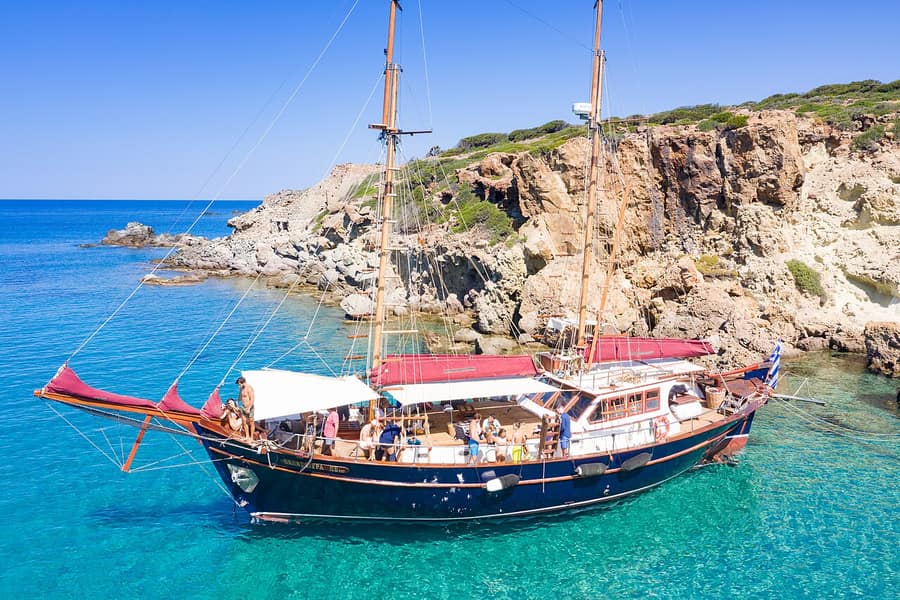
On a Milos sailing tour, a shared sail puts separate groups of travellers on one boat. The route and the swim stops are planned for the whole boat. Strangers swim, share the deck and talk side by side, so the mood is social.
A shared sail suits solo travellers, pairs and anyone who likes company. Nobody needs to plan the route or the stops, because the skipper sets the course. The boat feels lively, and there is always someone to talk to or swim with.
On a Milos sailing tour, a semi-private sail sits between the other two styles. The boat carries a small group, and each party keeps its own space on deck. Fewer people share the swim ladder, the shade and the view.
A semi-private sail suits friends or relatives who want company without a crowd. A small group can agree on swim stops with the skipper, within what wind and sea allow. The sail feels calm and unhurried, with room to move around the deck.
A private sail gives one party the whole boat, the skipper and the crew. Nobody else is aboard, so the deck belongs to one group. On a private Milos sailing tour, the party picks the pace, the music and the swim spots.
A private sail suits couples, close friends and groups with a plan of their own. It also suits travellers who want a quiet, calm sail and space to themselves. Because nobody else is aboard, the skipper can follow the group’s wishes closely.
The coast looks the same in all three styles, but the sail feels different. Shared sails feel lively, semi-private sails feel relaxed, and private sails feel personal. In every style, wind and sea decide the final route, not the label on the boat.
- Shared: Separate parties split one boat, one route and one set of swim stops.
- Semi-private: A small group shares the boat, so there is more room on deck.
- Private: One party holds the whole boat and sets the mood on board.
- Company: Shared sails bring new faces, while private sails keep the company fixed.
- Space: On a Milos sailing tour, deck space grows as the group gets smaller.
A Milos sailing tour works in all three styles; the choice rests on company, space and pace. A traveller who knows how much company feels right can pick the style that fits. The coast stays the same, and only the mood on board changes.
What is life on board like on a Milos sailing tour?
A Milos sailing tour turns a yacht into a small floating home with three main spaces. It has a cockpit for sitting, a cabin for resting and a tiny kitchen called a galley. Life on board is simple, shaded and slow.
The cockpit is the seating area near the back of the yacht. It is separate from the main deck and holds the steering controls. On a Milos sailing tour, the cockpit is the living room. It has a clear view of the coast.
Shade comes from a Bimini top, an open-front canvas roof over the cockpit. A metal frame holds it up. A Bimini top blocks the sun but gives no cover from wind or spray. A dodger, a hood in front of the cockpit, shields the crew from wind and spray.
Below deck sits the cabin, an enclosed space inside the yacht. It holds built-in beds called bunks. On a Milos sailing tour, the cabin is a quiet place to rest. It is out of the sun and wind.
Going below on a Milos sailing tour means using a ladder. On a boat, stairs are called ladders, and they are narrow and nearly vertical. The covered entrance at the top is the companionway. The toilet is called the head, a name from the front of old sailing ships.
The galley is the small kitchen of a boat. Food is cooked and prepared there. Space is limited, so the units run along the boat and cabinets sit above. A galley stove can sit on a pivot, so liquid does not spill from the pans.
Wind in the sails makes a yacht lean to one side, and this lean is called heel. On the sloping deck, people walk slowly and hold on. Posts called stanchions along the edge carry safety ropes called lifelines. The heavy keel under the hull works against the lean.
On a Milos sailing tour, lunch is simple and happens at anchor. An anchor is a heavy object that grips the seabed and holds the boat in place. When the wind no longer fills the sails, the lean fades. A level deck makes the galley easy to use.
- Cockpit: The outdoor seating area near the back, where the steering controls sit.
- Cabin: An enclosed space below deck with built-in beds called bunks.
- Galley: The small kitchen of a boat, where food is cooked and prepared.
- Head: The boat’s toilet, named after the front of old sailing ships.
- Heel: The lean of a yacht to one side when wind fills the sails.
Life on board follows the pace of the yacht. A Milos sailing tour mixes shade, a rest in the cabin and a simple meal at anchor. Each space is small, so everything has a place. The water below the hull holds the next sight of the trip.
What lives under the water on a Milos sailing tour?
A Milos sailing tour passes seagrass meadows, rocky reefs and sea caves. Posidonia, a flowering sea plant, shelters fish and young sea life. Red mullet, sea bream and octopus live here. The rare monk seal stays shy and out of sight.
Posidonia oceanica is a seagrass, which means a plant that lives in the sea. It has roots, stems, long green leaves and flowers, so it is a true plant, not seaweed. The name comes from Poseidon, the Greek god of the sea. It grows only in the Mediterranean Sea.
The leaves are flat green ribbons that grow in bunches. The bunches form dense meadows on the seabed. Meadows grow from 1 to 35 metres deep, depending on how clear the water is. A healthy meadow is a sign of clean water.
More than 300 plant species and over 1,000 sea animal species live in Posidonia meadows. The meadows give food and shelter to fish, and they act as a nursery for young animals. Damage from anchors is one known threat to them.
Meadows also protect the shore, because their roots and leaves stop sand from washing away. On a Milos sailing tour, piles of dead leaves on a beach point to a meadow nearby. Round balls of plant fibre also wash up on the shore, and they are called Neptune balls.
On a Milos sailing tour, the coast shows reefs, caves and rocky shores. These are natural homes for a wide variety of fish. Red mullet and sea bream live in these waters, and so do octopus, squid and cuttlefish. Volcanic rock makes the sea around Milos rich in life.
Snorkelling shows this world from the surface. The swimmer floats face-down and breathes through a snorkel, a bent tube. A mask or goggles help the eyes see, and fins help push the body along. On a Milos sailing tour, snorkellers watch the reefs with little effort.
The Mediterranean monk seal is thought to be the rarest seal species. Between 800 and 1,000 survive, and the Aegean Sea is one of its two key homes. The seal is shy and avoids people, and it rests and gives birth in sea caves. On a Milos sailing tour, a sighting is rare luck.
- Posidonia: A flowering sea plant that forms dense meadows on the seabed.
- Neptune balls: Round balls of plant fibre that wash up on beaches.
- Reef fish: Red mullet and sea bream live along reefs and rocky shores.
- Soft-bodied animals: Octopus, squid and cuttlefish live in the same waters.
- Monk seal: Believed to be the rarest seal species in the world.
The sea below a yacht is a living place. A Milos sailing tour shows the surface, and snorkellers see more. Careless diving trips scare seals away from their caves, so calm behaviour protects them. The meadows, the fish and the seal all depend on clean, quiet water.

Which sailing basics help on a Milos sailing tour?
A Milos sailing tour is easier to follow with three basics. The helm steers the yacht, and the sheet is a rope that sets a sail. Plain sailing words name the parts of the boat. Each one is simple to learn.
The helm is the steering of a boat. It can be a wheel, a tiller, or the whole system that turns the rudder. The rudder is the blade at the back that sets the direction. On a Milos sailing tour, the helm sits in the cockpit.
With a wheel, turning left sends the boat left. A tiller is a lever that works the other way. Push it to the left, and the bow, the front of the boat, turns right. The helmsman pushes or pulls it by hand.
Learners remember this with the phrase Tiller Towards Trouble. It means moving the tiller toward trouble, so the bow swings away from it. Quick, hard moves add drag and slow the boat, so small, steady moves keep it fast. On a Milos sailing tour, a helmsman steers with a light touch.
Dinghies, small open sailing boats, are a common choice for beginner training instead of full-sized yachts. On a Milos sailing tour, the same skills appear on a bigger boat. Watching the helmsman at work makes each move easier to understand.
A sheet is a rope that controls a sail. Sailors call a rope a line, and a sheet is the line on a sail’s lower corner. Pulling it in or letting it out changes the angle of the sail to the wind. On a Milos sailing tour, this keeps the sail just full.
The mainsheet controls the big mainsail, and the jib sheet controls the triangular sail at the front. On a small boat, a sheet is pulled by hand. On a bigger one, a winch, a machine for pulling a rope, helps. A cleat is a fitting that holds the rope fast.
Four plain words help on deck. The bow is the front of the boat, and the stern is the rear. Port is the left side when facing the bow, and starboard is the right. At night, port shows a red light and starboard shows a green one.
- Helm: The steering of a boat, which works by wheel or tiller.
- Tiller: A lever that steers and moves opposite to the way the bow turns.
- Sheet: A rope that sets the angle of a sail to the wind.
- Winch: A machine that helps pull a rope in.
- Cleat: A fitting that holds a rope fast.
These basics make a day on deck easier to follow. A Milos sailing tour then feels less like watching and more like taking part. A slower way to see the same coast is kayaking in Milos. Its sea caves and tunnels are ideal for exploration.
How does the sea’s history shape a Milos sailing tour?
A Milos sailing tour crosses waters that people have used for thousands of years. Boats carried obsidian away from the island in prehistoric times. A Bronze Age town grew on the north coast. Later, a large natural harbour drew foreign ships.
Obsidian is a natural glass made by volcanoes. It forms when lava cools very fast. The glass is hard but brittle, so it breaks into pieces with very sharp edges. Early people shaped those pieces into cutting tools. Obsidian from Milos was already in use 15,000 years ago.
Milos obsidian travelled far. By the 6th millennium BC, it had reached Knossos on Crete. Pieces also reached Nea Nikomedeia in Macedonia, in northern Greece. Such trips needed boats, so sailing was known very early. Today a Milos sailing tour crosses the same sea.
Mining did not create a permanent village. Instead, people sailed in and beached the boat in a cove. They cut pieces of glass from the quarries. Crews on a Milos sailing tour use the island’s coves too. They drop an anchor instead of beaching the boat.
Phylakopi was an ancient town on the north coast of Milos. It was one of the main Bronze Age towns in the Aegean Sea. The Bronze Age is the time when people made tools and weapons from bronze. Bronze replaced obsidian for weapons, and Milos lost that trade. The first settlers there were tuna fishermen.
The town lasted from about 2300 BC until the 12th century BC. Its potters shipped Melian bird jugs to Knossos. A wall painting of flying fish came from the Pillar Room. Part of the site is now gone, washed away by the sea. A Milos sailing tour along this coast sails the same waters.
Milos is shaped like a horseshoe. From the north-west side, a large bay cuts into the island. It fills the hollow of a volcanic crater. Among the natural harbours of Greece, it is one of the largest. A natural harbour is a bay where ships find shelter from open water.
Milos was a major meeting point for American and British ships in the 19th century. In April 1821, the first naval battle of the Greek War of Independence took place off Milos. A Milos sailing tour therefore sails over waters with a naval past. The full story is on the history of Milos page.
- Origin test: X-ray tests show whether a piece of obsidian came from Milos, Nisyros or Gyali.
- First dig: The British School at Athens began digging at Phylakopi in 1896.
- Salamis: Milos sent two warships to the Battle of Salamis in 480 BC.
- Pilots: Islanders are known as skilled sailors and pilots, meaning navigators.
- Depth: The water in the bay is between 55 and 130 metres deep.
The naval museum above the harbour at Adamas shows this sea story indoors. Its rooms hold obsidian tools, rare sea maps and a wooden boat. A visit there adds context before or after a Milos sailing tour. The coast looks different once its history is clear.
Who does a Milos sailing tour suit, and how is it kept safe?
A Milos sailing tour suits travellers who are happy on a moving boat. Life jackets, a firm grip, water and a view of the horizon make the day safer and easier. People who feel sick easily do better on a calmer boat.
A life jacket holds the wearer afloat, so the head and mouth stay above the water. Swimming skill is not needed, and the jacket works even when the person is unconscious. On commercial vessels, life jackets must be supplied and reachable for all crew and passengers. Wearing one from the start is the safe habit.
Fit matters. Sizes differ by body weight, so a child needs a smaller jacket. A jacket that sits too loose gives too little lift. Children’s vests have understraps and a headrest flap, which hold the vest down and support the head. Passengers on a Milos sailing tour pull the straps tight before the boat leaves.
A sailing boat leans when wind pushes on its sails. This lean is called heeling. A stronger wind tilts the boat further. On a Milos sailing tour, passengers hold a rail or rope when the deck slopes. They move around only when the boat is steady.
In warm weather, the body loses water fast through sweat. Dehydration is a shortfall: the body has lost more water than it has taken in. Drinking water through the day replaces the loss. Seawater makes dehydration worse, so it never replaces drinking water. A bottle of water belongs in every bag for a Milos sailing tour.
Seasickness on a Milos sailing tour comes from the rocking of the boat. The inner ears feel motion, but the eyes see a still deck. This mismatch brings nausea, cold sweat, headache and dizziness. Nearly everyone feels it at least once. About one in three people is prone to it.
Simple habits help. Passengers who stay on deck feel better, because going below deck makes seasickness worse. Looking at the horizon, keeping the head still and not reading also help. Music and slow, mindful breathing are other techniques. Medicine works better when taken before symptoms start.
Pregnancy and migraines raise the risk of motion sickness. Travellers with either do better on a calmer boat for a Milos sailing tour. A boat with a wide stance, such as a catamaran, leans less. The body also adapts to the motion, which sailors call gaining sea legs.
- Colour: Life jackets are commonly yellow or orange, so rescuers spot them easily.
- Whistle: A commercial passenger life jacket is commonly fitted with a plastic whistle.
- Reefing: The crew of a Milos sailing tour can shorten the sails, keeping the boat more upright.
- Lying down: Lying on the back with the head still eases motion sickness.
- Steering: Being the one who steers is one more technique against motion sickness.
A Milos sailing tour works best when each person knows their own limits. Travellers prone to sickness choose a calmer boat and stay on deck. Everyone else needs a snug life jacket, a firm grip and a bottle of water. These habits protect the whole day.
How does a visitor choose a Milos sailing tour?
A Milos sailing tour begins with one choice: a sailing yacht or a catamaran. Next come the length of the day, what the tour includes and what to pack. The tour description answers each of these points in plain words.
A sailing yacht is a yacht whose main drive comes from its sails. The classic sailboat is a monohull, a boat with one hull. Ballast, a heavy weight low in the hull, keeps it upright. In a steady wind, it leans to one side.
A catamaran carries two hulls of equal size, set side by side. The wide gap between the hulls keeps it steady without ballast. A catamaran can lean less than a yacht in the same wind. Its draft is shallower, which means less of the boat sits under water.
The choice depends on the guest. A yacht gives the classic sailboat feel, with a deck that leans in the wind. A catamaran gives a wider, flatter deck. A Milos sailing tour on either boat is driven by the wind in the sails.
Next comes the length of the day. A half-day tour covers one part of the coast. A full-day tour has room for a longer route and more swim stops. From east to west, Milos stretches about 23 km, and from north to south about 13 km. The coast offers room for both.
Tours differ in what they include. The description names the skipper and crew. It also lists extras, such as snorkel gear, water, snacks or a meal. What the list leaves out, the guest packs. A reader checks it line by line.
A clear description gives three details: the boat type, the named stops and the meeting point. It also says whether the boat sails or runs on its engine. Boats for sea excursions depart from ports such as Adamas and Pollonia. Other boats and trips are covered under the broader subject of boat tours in Milos.
Packing follows three facts: sun, salt water and wind. The surface water of the Aegean reaches 19 to 24 degrees Celsius in summer. On deck, the north wind cools the air. Sun and spray reach everyone on board, so five items cover the day.
- Hat: A chin strap keeps a hat on in the breeze, and the hat shades the face.
- Sun cream: Sun cream helps protect against sunburn, and a cloudy sky still lets UV rays through.
- Swimwear and towel: Swimwear goes on before boarding, and a thin towel dries fast in the wind.
- Soft-soled shoes: Non-marking rubber soles grip a wet deck and leave it clean.
- Light layer: A thin jacket or long shirt helps when the wind cools the air on the water.
With the boat, the day and the bag settled, the choice is done. A Milos sailing tour then fits well alongside the rest of the trip plans. Anyone who prefers a blend of sea and land can browse more activities in Milos. A second day can stay on land.

What do first-timers still want to know about a Milos sailing tour?
Before the day starts, a Milos sailing tour brings up practical questions. They cover experience, steering, calm days, swimming, phones, seasons, weather and pickup. Each reply is short and written in plain words, which tells a first-time visitor what to expect.
Does a Milos sailing tour need any sailing experience?
No sailing experience is needed on a Milos sailing tour. A skippered trip comes with a professional skipper, and the skipper runs the boat. Guests sit, swim and watch the sails. Only a bareboat, a boat rented without crew, makes the renter skipper it alone. A tour with a skipper asks for no such task.
Can guests steer on a Milos sailing tour?
The skipper has command of the boat. On a yacht, the skipper is also the helmsman, the person who steers. Whether a guest holds the wheel is the skipper’s choice. A guest who wants a turn asks the skipper at the start of the day. The question comes before the boat leaves the port.
What happens on a Milos sailing tour when the wind drops?
A sailboat can carry a second way to move, in case the wind dies. Certain sailboats have an inboard engine, an engine inside the hull that turns a propeller. On a windless stretch, the skipper can switch to that engine. The engine also helps in tight spaces, where handling the boat under sail is hard.
Can non-swimmers join a Milos sailing tour?
Yes, a non-swimmer can join. A life jacket works like a vest and keeps the wearer afloat, head and mouth above the water. With the jacket on, a guest who is not a swimmer can enter the water safely. At swim stops, a non-swimmer can also stay on deck. The skipper plans around a guest who mentions it at boarding.
Are phones and cameras safe on a Milos sailing tour?
A sailboat leans in the wind, so a loose phone can slide across the deck. Seawater is corrosive, and spray reaches electronics. A waterproof pouch on a neck strap keeps a phone dry and close. A camera rests in a dry bag between photos, and a wrist strap holds it during shots.
Does a Milos sailing tour run in spring and autumn?
The Aegean meltemi is a strong, dry north wind, and its highest frequency falls in July and August. Spring and autumn fall outside that peak, so strong wind is less frequent. The air is also cooler than in the warm to hot summer, so a warm layer helps. The tour decides whether a boat sails then.
What do rain and clouds mean for a Milos sailing tour?
Summer weather in Greece is mostly sunny and dry, and any rain falls as showers or thunderstorms. A sail works on wind, not sun, so clouds alone do not stop a Milos sailing tour. Strong wind matters more than a shower. Clouds block only part of the UV rays, so sun cream stays on.
Does a Milos sailing tour include hotel pickup?
Hotel pickup belongs to certain tours only, while others start at the port. The tour description settles the question. Boats for sea excursions depart from ports such as Adamas and Pollonia. On a port-start tour, the guest reaches the boat alone. A tour with pickup names the collection point in its text.