
A Milos snorkeling cruise is a boat trip with stops in clear bays. At each stop, swimmers watch the sea floor through a mask. The trip circles the island of Milos. This volcanic island lies in the Cyclades. This page explains what the trip is and which gear it uses.
The coast of Milos is built of volcanic rock. It has caves, sculpted rocks and bays of clear water. A Milos snorkeling cruise can reach bays that have no road. The first section explains how the trip works. The second section covers the mask, the snorkel and the fins.
What is a Milos snorkeling cruise at a glance?
A Milos snorkeling cruise is a boat trip built around swim stops with a mask and snorkel. The boat anchors in a bay, and swimmers float face-down to watch the sea. The volcanic coast of Milos, with its rocks, caves and clear bays, suits this trip.
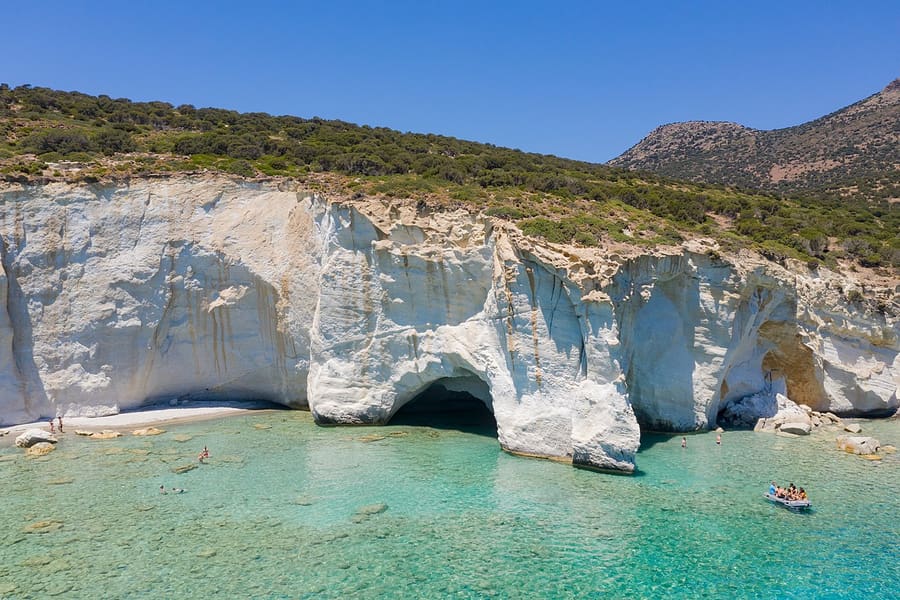
Snorkeling means swimming face-down while breathing air through a tube. The swimmer wears a mask to see and fins to move. Nobody needs special training. Basic swimming skill and the ability to breathe through the tube are enough. A Milos snorkeling cruise builds the whole trip on this simple skill.
Scuba diving needs complicated gear and training. Snorkeling skips both, because the swimmer stays at the surface. The effort is low, so the activity appeals to all ages. The boat does the travelling, and the swimmer saves energy for the water.
The boat is the second half of a Milos snorkeling cruise. It carries swimmers to places that roads do not reach. Certain beaches of Milos open only from the sea. Swimmers enter clear water at spots with no road. Sea excursion boats depart from the harbours of Adamas and Pollonia.
Each stop follows the same pattern. The boat anchors in a bay, and swimmers put on mask, snorkel and fins. They slip into the water and float face-down. The rocks and the sea floor pass slowly below. Then they return to the boat. A Milos snorkeling cruise repeats this at a new bay.
Wind decides where the water is calm. With a north wind, the beaches in the bay and along the island’s southern side stay calmer. In south winds, the north side is the better choice. A Milos snorkeling cruise can follow this rule and swim on the sheltered side.
Volcanic rock forms the larger part of the land on Milos, a volcanic island. The shore has colorful, sculpted rocks in white, red, yellow and even black. The last eruption was about 90,000 years ago. A Milos snorkeling cruise floats swimmers right beside this stone.
Snorkelers favor spots where waves are small and something interesting lies near the surface. Rocks and caves give that. The bays of Milos add clear blue water, so the view is sharp. Over 75 beaches ring the island, and each one looks different. Each stop on a Milos snorkeling cruise shows a new scene.
Other boat trips also stop for a swim. A Milos catamaran cruise, for example, shows the coast from a wide deck. On a Milos snorkeling cruise, the swim is the main part of the trip. The mask and snorkel come first.
- Boat: The boat carries swimmers to bays that roads do not reach.
- Gear: A mask, a snorkel and fins make up the basic set.
- Skill: A Milos snorkeling cruise needs only basic swimming ability and steady breathing through the tube.
- Coast: Volcanic rock, caves and clear bays give the swimmer plenty to watch.
- Wind: Wind direction decides which side of the island has calm water.
A Milos snorkeling cruise joins a boat that reaches the coast with a swim in clear water. The volcanic shore supplies the rocks, the caves and the bays. The gear is simple. The next section explains the mask, the snorkel and the fins one by one.

How do the mask, snorkel and fins work on a Milos snorkeling cruise?
A Milos snorkeling cruise relies on three tools. A mask gives sight, a snorkel gives air and fins give push. The mask traps air in front of the eyes. The tube lets the face stay down. The fins make each kick go further.
A mask is the first tool of a Milos snorkeling cruise. Eyes cannot focus in water, because light bends at a different angle there. The mask holds a pocket of air in front of the eyes, and sight returns to nearly normal. It also makes things look about 34 percent bigger and 25 percent nearer.
A mask has a glass or plastic faceplate, a soft skirt and a strap. The skirt is silicone or rubber. It seals against the face. It wraps the nose, so a swimmer can breathe out into the mask on a dive. Plain goggles leave the nose open and suit a swimmer at the surface.
To test a mask on land, press it to the face without the strap. Then breathe in gently through the nose. If the mask stays on, the skirt seals all the way round. Hair under the skirt lets water leak in. A swimmer on a Milos snorkeling cruise brushes the forehead hairline back.
Comfort matters as much as the seal. The frame must not press on the nose bridge or the forehead. The lashes must not brush the glass when the swimmer blinks. The strap sits across the back of the head. A loose strap lets the mask slip, and a tight one hurts.
Fog is condensation. It forms as droplets on the glass and blurs the view. A film of saliva makes the droplets spread into one clear layer. Spit in the dry mask, rub it round the glass and rinse it with a little water. Store-bought products can do the same job, and certain ones last longer.
On a Milos snorkeling cruise, the snorkel is a curved tube shaped like a J or an L. The mouthpiece sits between the lips, and the top stays above the water. A clip or loop fixes the tube to the mask strap. Tucking it under the strap can cause leaks and loss.
The mouthpiece is soft and flexible. The swimmer bites it gently, since a hard grip tires the jaw and makes breathing harder. Certain tubes have a valve at the top that keeps water out when it goes under. Slow, deep breaths work best, because stale air stays in the tube.
Fins make up for small human feet, which give little push on their own. A blade on each foot adds thrust to every kick. Full-foot fins fit like shoes and suit surface swimming. Open-heel fins have a strap and fit over boots. On a Milos snorkeling cruise, light and flexible fins are the usual pick.
- Mask: A faceplate, a soft skirt and a head strap form the mask.
- Fit: A mask that holds on after a gentle breath in through the nose has a good seal.
- Fog: A film of saliva, rinsed with a little water, keeps the glass clear.
- Tube: The snorkel lets the face stay down while the swimmer breathes air from above.
- Fins: Light, flexible fins are the usual pick for recreational snorkelers.
On a Milos snorkeling cruise, the mask stays over the eyes. A mask pushed up on the forehead falls off more easily. A hand on the mask during entry stops the splash from knocking it off. Masks can also take lenses ground to a swimmer’s own prescription.
How does a first-timer begin on a Milos snorkeling cruise?
A Milos snorkeling cruise asks only for basic swimming skills and comfort with breathing through a tube. A beginner floats face down, breathes slowly, and clears the tube with one sharp puff. An inflatable snorkel vest adds lift and makes resting on the surface easy.
Snorkeling is swimming face down and drawing air through a shaped tube, which is called a snorkel. On a Milos snorkeling cruise, the tube lets a swimmer watch the sea floor without lifting the head. No special training is needed for the activity. Basic swimming ability and steady breathing through the tube are enough.
A snorkel on a Milos snorkeling cruise is a tube bent like the letter L or J. A mouthpiece sits at the lower end. The lips close around the mouthpiece. The teeth hold it lightly, since a tight bite makes breathing harder and tires the jaw.
Each breath in through the tube pulls back a little of the air just breathed out. That stale air is called dead space. Slow, deep breaths shrink the effect. Calm, steady breathing is the first habit on a Milos snorkeling cruise.
Water can splash into the tube. Blast clearing fixes this: one sharp puff of breath pushes the water out. The puff is followed by a slow breath in, which keeps leftover drops from being pulled back. Splash water at the surface always needs this puff, even on a calm day.
A plain tube simply floods and clears with a puff. Other tubes add a sump, a low pocket that holds a little water away from the mouth. A splash guard on top cuts down the water that splashes in. These parts can fail if they are rarely used or poorly kept.
Floating face down is the core skill of a Milos snorkeling cruise. The mask traps a pocket of air in front of the eyes. This lets the snorkeler see clearly underwater. The tube handles the breathing. The head stays down, and the swimmer watches the sea below with little effort.
A snorkel vest is an inflatable buoyancy aid, meaning a garment that helps a body float. It is shaped like a collar or an airline life jacket. The wearer inflates it by mouth, and a gas cartridge serves in an emergency. The vest makes floating easier and less tiring.
Vest sizes are matched to the weight of the wearer. A loose vest gives less lift in an emergency. The wearer adds or lets out air to adjust the lift. A vest also blocks deep dives. That suits a first-timer on a Milos snorkeling cruise who stays on the surface.
- Mouthpiece: The lips seal around it, and a gentle bite spares the jaw.
- Breathing: Slow, deep breaths cut down on stale air from the tube.
- Clearing: One sharp puff pushes water out of the tube.
- Vest: An adjustable vest keeps a beginner afloat and rested.
- Company: A Milos snorkeling cruise keeps a beginner in a group, since snorkeling alone is not advised.
Three habits carry a first-timer through a Milos snorkeling cruise. They are slow breathing, one sharp puff to clear the tube, and a vest for rest. Each habit is simple, and each one builds calm. A calm swimmer notices more of the sea floor and enjoys the clear water.
Why is the water so clear on a Milos snorkeling cruise?
A Milos snorkeling cruise runs through water known for being crystal clear and blue. Visibility is the distance at which an object can still be seen, and floating particles shorten it. White-gold sand and white rock help shapes stand out.
Visibility is the distance at which an object or a light can still be seen. On a Milos snorkeling cruise, it decides how much of the sea floor a swimmer sees. It also decides how well the group stays in view. Clear water shows both from far away. Cloudy water hides them.
The standard test uses a black and white disk. The disk is lowered into the water until it can no longer be seen. The depth where it vanishes shows how transparent the water is. The deeper the disk stays in view, the clearer the water.
The view depends on sunlight, the length of the light path, and particles that scatter light. Dissolved colors that absorb light also matter, and so do layers of water with different salt or warmth. Each factor can blur the view on a Milos snorkeling cruise.
Turbidity is the cloudiness of water caused by huge numbers of tiny particles. The particles are too small to see one by one. Together they scatter light and blur the view. On a Milos snorkeling cruise, turbidity is the main limit on how far a swimmer sees.
Plankton growth can cloud open water. Land disturbed by building, mining, or farming sends sediment into the water when storm rain runs off. Rivers and lakes can carry dissolved plant matter, which turns the water red-brown. Coastal water can look green for the same reason.
Fine particles settle slowly, and stirring keeps them afloat. A swimmer who kicks near a sandy bottom can cloud the water for the group behind. Even very clear water loses its view when the seabed is stirred up. Gentle kicks keep the view sharp for everyone.
Milos has white-gold beaches and bays of pebbles ringed by white, red, yellow, or black rocks. The soil is volcanic, so the coast changes from bay to bay. Along that coast, a Milos snorkeling cruise meets a sea of different colors and depths. The water is crystal clear.
Dark colors such as gray or black are the hardest to see at the edge of visibility. Pale colors are easier to pick out. White sand and white rock therefore show up well from the surface. Water also absorbs red light first and blue light last, so blue stays.
- Visibility: The distance at which an object or a light can still be seen.
- Turbidity: Cloudiness from huge numbers of tiny particles in the water.
- Runoff: Storm rain carries soil from disturbed land into the water.
- Pale ground: White sand and white rock stand out on a Milos snorkeling cruise.
- Light: Water absorbs red light first and blue light last.
Crystal clear water has little in it to scatter light, such as plankton, sediment, or dissolved color. That is the view on a Milos snorkeling cruise over pale sand and rock. A swimmer sees far, and the group stays easy to spot in the water.

What does a Milos snorkeling cruise show around the Kleftiko rocks?
A Milos snorkeling cruise at Kleftiko shows crystal clear turquoise water around gray and white rocks. The rocks have caves and pits. The snorkeler stays close to the boat and the group, and keeps a safe gap from the rocks.
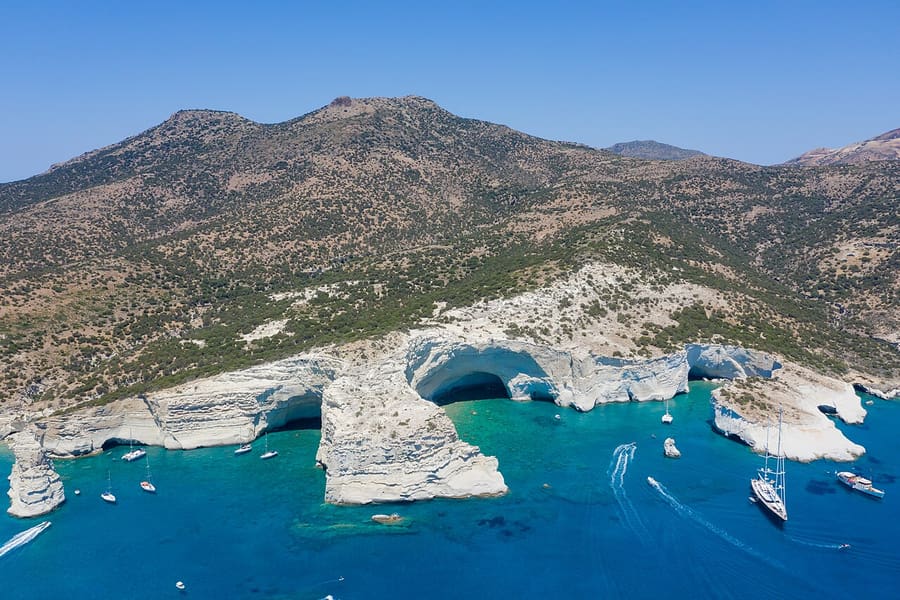
In the south-west of Milos sits Kleftiko, where white cliffs and islets rise from the sea. They form three joined coves. Excursion boats reach the area on boat tours in Milos, and a trail leads there as well. A Milos snorkeling cruise brings swimmers into the water in front of the cliffs.
The rocks are gray and white, with strange shapes, caves, and pits. The water around them is crystal clear and turquoise. Pale rock is easy to see in water. On a Milos snorkeling cruise, the shapes read clearly from the surface.
On a Milos snorkeling cruise, a mask makes everything look bigger and closer. In salt water, objects look 34 percent larger, or 25 percent nearer, than they are. Rock faces at Kleftiko are therefore farther away than they seem. A snorkeler keeps a gap and does not reach out.
Snorkelers favor shallow structures from 1 to 4 meters deep. The water needs to be deep enough to swim over a rock without touching it. A rock that rises close to the surface is approached from the side. This keeps fins and hands clear of the stone.
Boats and swimmers share the same water. A snorkeler floating face down shows only the tube above the water. A boat driver can miss the swimmer. Staying close to the cruise boat and inside the group keeps everyone in sight. Sailboats are quiet, so a swimmer cannot count on hearing one.
A bright tube or swimsuit helps others spot the swimmer. A high-visibility band around the top of the tube does the same job. Swimmers can also tow a float with a dive flag to mark their position near the rocks.
Snorkeling alone is not advised. A buddy or a tour group is the safer choice. A swimmer who watches the buddy at all times spots trouble early. On a Milos snorkeling cruise at Kleftiko, the group stays within reach of the boat.
Natural light weakens quickly as it travels through water, so a cave mouth looks darker than open water. Fishermen report that Mediterranean seals once bred in caves here, and the south-west coast is still seal habitat. Seals can turn alarmed when approached, so snorkelers watch and do not touch.
- Rocks: Gray and white shapes with caves and pits line the coves.
- Water: Crystal clear turquoise water shows the rock faces.
- Distance: Masks magnify, so rocks sit farther away than they look.
- Group: Staying near the boat and the group keeps every swimmer in sight.
- Boats: Only the tube shows above the surface, so bright colors or a float help others notice the swimmer.
At Kleftiko, a Milos snorkeling cruise is a slow float along white and gray rock in clear water. The good habits are simple. Swimmers stay near the boat and group, keep a gap from the rocks, and look without touching. This area belongs to the Natura 2000 network.

What does a Milos snorkeling cruise show in the water at Sykia and the south-west coast?
A Milos snorkeling cruise brings swimmers to Sykia, a cave that has no roof. Sun shines in from above and brightens the emerald water inside the cave. Only the sea leads into the cave. Swimmers slip into the water from the boat with a mask and snorkel and swim in.
Sykia lies on the west coast of Milos. No road reaches the cave, because it opens only to the sea. A swimmer on a Milos snorkeling cruise steps into the water from the boat. Then the swimmer floats face-down, breathes through the tube and kicks slowly toward the cave.
The roof of Sykia is gone, so the sky is the ceiling. Sun rays enter the cave and light the emerald water. On a Milos snorkeling cruise, a swimmer floating face-down sees colour and shine on every side. Rolling onto the back shows open sky instead of rock, framed by the cave walls.
Sea water takes in red light first. Orange and yellow fade next, and green, cyan and blue are left over. That leftover mix is the start of the emerald tone at Sykia. The same rule colours every bay on a Milos snorkeling cruise.
Light also bounces off tiny particles in the water. Without that scatter, no light returns to the eye and the sea looks black. A trace of particles pulls the colour toward green. That helps to explain the emerald tone that a Milos snorkeling cruise swimmer sees at Sykia.
Depth changes the colour again. The deeper the water, the stronger the blue. Tens of metres of water swallow all light, so deep water looks dark. On a Milos snorkeling cruise, a swimmer near the surface sees the full range of colour. Colour drains away as the water deepens.
Tuff is one of the rocks of Milos, which is a volcanic island. Tuff is a soft stone made of volcanic ash. Rock like this breaks off piece by piece. Sea-cave walls end up irregular and chunky. Swimmers look at the walls below and beside them but do not touch.
Sykia is one stop on a rugged coast. The volcanic makeup of Milos gives the island sea caves and tunnels, and the water is clear. Boat trips to Kleftiko or Sykia follow the south-west coast. A Milos snorkeling cruise can add more stops along the same line. Underwater caves also draw divers to the island.
- Entry: Swimmers reach Sykia from the sea, because no road serves the cave.
- Light: Sun enters through the open roof and lights the emerald water inside the cave.
- Colour: Water absorbs red light first, so green and blue remain for the swimmer to see.
- Scatter: Tiny particles bounce light back to the eye and pull the colour toward green.
- Walls: Sea-cave walls are irregular and chunky, so swimmers look at them and keep clear.
Sykia gives a Milos snorkeling cruise a cave with the sky for a ceiling. The swimmer sees sun, emerald water and rough volcanic rock. A slow pace and a wide gap from the walls keep the visit easy. The same habits suit every stop along the south-west coast of Milos.
What makes the sandy bays of Poliegos easy on a Milos snorkeling cruise?
A Milos snorkeling cruise finds easy water in the sandy bays of Poliegos. A pale sand floor stays in clear view below the surface, even from a floating swimmer. Snorkeling suits water one to four metres deep. There, a swimmer floats over the floor and never touches it.
Among uninhabited islands of the Aegean, Poliegos is the largest. Its sandy beaches lie at Pano Mersini and Kato Mersini, and the names mean upper and lower. Both beaches are white. Kato Mersini is the larger one. A wetland, which is low ground that stays wet, forms at its edge.
Two more bays have names that say a lot. Chochlakia is also called Blue Bay, a name that visitors gave it. Pisina means swimming pool, and the name suggests calm, pool-like water. On a Milos snorkeling cruise, each bay is a different place to float and look.
Sand makes snorkeling simple. A sand floor is flat and bright, so a swimmer sees the whole bottom from the surface. Enough water covers it to swim over the top without kicking it. Small waves keep the view steady. On a Milos snorkeling cruise, this is a gentle way to start.
Small waves matter. Two small bays at Pano Mersini form safe anchorages, which are places where a boat can hold still. Sheltered water like this is easy on a swimmer. On a Milos snorkeling cruise, less effort goes into staying put and more into looking down.
The sky is not the only reason the sea looks blue. The floor also colours the water. A pool with a white bottom looks cyan, a light blue-green, even indoors. White sand does the same in a bay. On a Milos snorkeling cruise, pale water marks the shallows, and a stronger blue marks deeper water.
The swim zone is the shallow part of the bay. Risk grows with depth and with every long breath-hold, so swimmers stay where the floor is in view. Diving down is not the aim here. Deeper water asks for more fitness and skill. Floating and looking is enough on a Milos snorkeling cruise.
Poliegos has no facilities at all, so swimmers carry what they need. The packing list holds water, sun cover, swimwear, a mask and a medical kit. Rare monk seals dwell in the sea caves along the shore. A swimmer who comes close can alarm them. Swimmers also respect the plants and animals on shore.
- Sand: Pano and Kato Mersini are white sandy beaches, and Kato Mersini is the larger one.
- Names: Chochlakia is called Blue Bay by visitors, and Pisina means swimming pool in Greek.
- Floor: A flat sand floor lets a swimmer float over it and look down without touching it.
- Zone: Risk grows with depth, so swimmers stay over the shallow floor.
- Supplies: The island has no facilities, so swimmers bring a mask and everything else they need.
Poliegos gives a Milos snorkeling cruise white sand, calm water and room to float. Swimmers stay over the shallow floor, carry what they need and leave seals alone. Shells, rocks and sand stay on the beach, and rubbish goes home with the swimmer. More sandy places appear on a page about the beaches of Milos.

What does a Milos snorkeling cruise show at Gerakas and Tsigrado from the water?
A Milos snorkeling cruise reaches Gerakas and Tsigrado from the sea, on the south coast of Milos. Tsigrado is a cove with towering rocks, white sand and emerald water. Gerakas lies between Tsigrado and Agia Kyriaki. Both coves are quiet places to swim.
Tsigrado is a quiet cove held in the arms of towering rocks. The cove has white sand and emerald water. From the water, a swimmer sees the rock walls rise around the cove and the white sand below. Snorkeling here is excellent, and that is why swimmers come.
On land, the way down to Tsigrado is steep and uses a rope and a ladder. A swimmer who arrives by boat skips that climb. On a Milos snorkeling cruise, the sea itself is the way in. Sea trips also reach beaches that land routes cannot.
The main reason to swim at Tsigrado is the seabed. A quiet bay with bright blue water invites a swimmer to float and look down at the floor. The pale sand is easy to read, so a slow float is enough. White sand lines the shore, and rock frames the cove.
Gerakas lies on the same coast, between Tsigrado and Agia Kyriaki. Cruise boats reach it from the sea. The beach is secluded, so the water around it is a quiet place to float. It suits swimmers who want more seclusion. A Milos snorkeling cruise treats it as a stop of its own.
The shore changes along this stretch. Tsigrado has white sand. Agia Kyriaki, a large organised beach, offers sunbeds, umbrellas and beach bars, plus coloured pebbles and cool water. Gerakas sits between the two and is the quiet one. A swimmer who wants calm picks Gerakas, and one who wants services picks Agia Kyriaki.
The south coast of Milos lists 21 beaches. Counted from east to west, Gerakas, Kalamos, Tsigrado and Firiplaka follow one another. Firiplaka has fine grey sand, white pebbles and shallow turquoise water. On a Milos snorkeling cruise, the floor changes from cove to cove along this run.
Kayaks reach these coves too. A kayak route links Firiplaka, Tsigrado and Gerakas and covers six kilometres. It starts at Firiplaka, the beach just west of Tsigrado. Sea kayaks also visit deserted beaches and the neighbouring islands. Readers who want to paddle between swims can read about kayaking in Milos.
- Tsigrado: A quiet cove held by towering rocks, with white sand, emerald water and excellent snorkeling.
- Access: The way down on land is steep, and a boat skips the climb.
- Gerakas: A secluded beach between Tsigrado and Agia Kyriaki on the south coast, reached by cruise boats.
- Neighbour: Agia Kyriaki is large and organised, with coloured pebbles, thick sand and cool water.
- Kayak: A six-kilometre kayak route links Firiplaka, Tsigrado and Gerakas along the south coast.
From the water, Gerakas and Tsigrado show a south coast of white sand, towering rock and quiet coves. A Milos snorkeling cruise reaches them without a climb, and a kayak route links them. Swimmers float and look down at a floor that changes from cove to cove. Agia Kyriaki, beyond Gerakas, ends the stretch.
How do snorkelers swim into sea caves safely on a Milos snorkeling cruise?
A Milos snorkeling cruise enters a sea cave only with the crew’s go-ahead. The sea must be calm. Swimmers watch the swell and keep the cave mouth in sight. They never dive under a ledge, because a rock roof blocks the way up.
A sea cave is a hollow that waves cut into a cliff. The sea hits the rock again and again and wears it away. Cracks and weak spots give way first. Milos holds a lot of underwater caves, and a Milos snorkeling cruise views them from the water.
Inside a cave, the sea has little room to move. Waves push in hard, and the air inside gets squeezed. A blowhole is a cave that throws spray out as the wave pulls back. A cave can be rougher than the open water outside it.
Caves that face the open sea take the strongest waves. Caves in sheltered bays and calm seas stay smaller, because less wave force reaches them. That is why calm water comes first on a Milos snorkeling cruise. The crew checks the sea and decides if a cave is safe.
Swell is a set of long, steady waves that travel far from the storm that made them. A distant storm can send swell to a coast where the local wind is calm. A flat-looking day can still push waves into a cave. Snorkelers watch the water at the cave mouth before they go in.
Cavern divers stay in the part of a cave where daylight shows the exit. In that zone, the risk of getting lost is small. A Milos snorkeling cruise follows the same rule. Swimmers go only as far as daylight reaches and keep the bright cave mouth in view.
A ledge or a cave roof is an overhead. Under an overhead, a swimmer cannot swim straight up for air. In an emergency, the only way out is back the way in. So snorkelers stay on the surface and never dive under a ledge, however clear the water looks.
Caves hold sand, mud and fine silt on the floor. One kick stirs it up, and the water turns cloudy at once. Sight can be worse on the way out than on the way in. Snorkelers keep their fins high, kick gently and stay clear of the floor.
A buddy swims close by. Snorkeling with a buddy, and watching the buddy at all times, helps avoid trouble. The crew keeps watch from the boat. On a Milos snorkeling cruise, swimmers leave the cave if the waves grow. They also leave when the crew calls them back.
- Go-ahead: The crew decides if a sea cave is safe to enter on a Milos snorkeling cruise.
- Sea state: Calm water and a low swell come before any cave visit begins.
- Exit: The bright cave mouth stays in view at all times during a visit.
- Roof: Swimmers stay on the surface and never dive under a ledge or a roof.
- Buddy: A partner swims close and watches for any change in the water.
A sea cave has its own rules on a Milos snorkeling cruise. The crew gives the go-ahead, the sea is calm, and the exit stays in sight. No one dives under a roof. These plain rules keep every cave visit calm and safe for each swimmer.
What sea life can swimmers see on a Milos snorkeling cruise?
A Milos snorkeling cruise passes over rocky shallows full of small life. Damselfish, wrasses, sea urchins, starfish and sea cucumbers live on rocky coasts like these. Dusky groupers and jellyfish swim in Mediterranean waters too. Snorkelers look closely and touch nothing.
Rocky shallows are rich in life. Sunlight reaches the bottom, so seaweed and algae grow well. The sea also brings in plankton, which are tiny drifting plants and animals. This gives small fish and sea-floor animals plenty to eat on a Milos snorkeling cruise.
The Mediterranean chromis is a small damselfish. It lives in small shoals above rocky reefs and feeds on algae and tiny animals. Young fish are blue and adults are dark brown. Snorkelers on a Milos snorkeling cruise can look for the shoals. The fish seems more common off islands than off the mainland.
Wrasses live near the rocky bottom of shallow water, the ground a Milos snorkeling cruise covers. The bulk of them are under 20 centimetres long. Smaller wrasses follow bigger fish and pick up the small animals that the bigger fish stir up. Certain wrasses crack open urchins and crabs against a rock.
A sea urchin is a round animal covered in spines. It crawls slowly on small tube feet and feeds mainly on algae. A common size is 3 to 10 centimetres across. Urchins even drill into rock. Over generations, they wear away the floors and lower walls of sea caves.
Urchin spines cause puncture wounds, and these wounds are a common injury for ocean swimmers. The spines can also cause infection. For this reason, snorkelers keep hands and feet off the rocks and look from above. A Milos snorkeling cruise is a trip for watching, not touching.
Starfish and sea cucumbers belong to the same group as urchins. The group is called echinoderms. Starfish live on sand, mud and rock, and they can regrow a lost arm. A sea cucumber has leathery skin and a long, soft body. It lies on the sea floor and breaks down waste matter, which recycles nutrients.
The dusky grouper is a large fish of the rocky reefs. It lives alone and defends its patch. Adults are commonly 90 centimetres long and can reach 150. The species is rated vulnerable. In protected waters, both adults and young fish swim in the shallows.
Jellyfish drift in the open sea. Their tentacles carry stinging cells. A sting ranges from mild discomfort to serious injury. Jellyfish can gather in large groups called blooms, and blooms are recorded across the Mediterranean. Swimmers on a Milos snorkeling cruise keep clear of jellyfish. They tell the crew when one is close.
- Damselfish: Small blue and brown fish gather in shoals above rocky reefs.
- Wrasses: Small fish that stay close to the rocky bottom of the shallows.
- Urchins: Round, spiny animals that crawl on rock and eat algae.
- Cave mouths: Red algae grow where daylight still reaches into a sea cave.
- Jellyfish: Drifting animals whose tentacles carry stinging cells.
A Milos snorkeling cruise is a chance to watch small life on rocky ground. Seagrass, larger fish and the monk seal belong to the page on a Milos sailing tour. Here the focus stays on damselfish, wrasses, urchins and starfish. Look, count, and leave every animal where it lives.

What are the underwater hot springs near Paliochori on a Milos snorkeling cruise?
A Milos snorkeling cruise near the south coast reaches spots with warm water and gas bubbles. These come from the sea floor. They are hydrothermal vents, meaning cracks in the ground where water heated by hot rock flows out.
Paliochori is a beach on the south-west coast of Milos. It is almost 2 kilometres long. The beach has colourful pebbles, coarse sand and deep, clear water. Warm water gushes up at Paliochori. That is the hot spring part of a Milos snorkeling cruise along this coast.
Volcanic activity began on Milos 2 to 3 million years ago. The last eruption was 90,000 years ago. The volcano is dormant, which means it is resting but can erupt again. A cave on the south coast still feels strong heat from the volcano.
A hydrothermal vent is a crack in the sea floor where heated water flows out. Vents exist where the Earth is active and water is close by. They form near places with volcanic activity, and Milos is one of them. A Milos snorkeling cruise along a volcanic coast passes this kind of ground.
The water at a vent is mainly seawater. It sinks into cracks and porous rock near the volcano. Hot rock heats it, and it rises back up through the cracks. On the way, it picks up dissolved minerals. On a Milos snorkeling cruise near Paliochori, vent water is seawater that came back up hot.
Other vents release gas instead. The gas escapes from deep inside the Earth. Under the sea, it rises to the surface as bubbles. Milos has underwater gas vents of this kind. Snorkelers on a Milos snorkeling cruise watch for the bubbles rising from the sea floor.
Fumaroles are vents on land that release steam and hot gas. On Milos, they reach 100 degrees Celsius, including the ones at Paliochori. Water in the hot springs of the island reaches 55 degrees Celsius. Sulfur is strongly present around these areas, and warm water leaves the ground in the same places.
The heat is real. Water that hot can scald, and an active fumarole can release hot, poisonous gas. So swimmers on a Milos snorkeling cruise follow the crew’s advice near any warm patch. They float on the surface and never dig into the sand or touch the sea floor.
Vents feed tiny life. Around the world, microbes at vents use chemicals in the water as food. They form the base of the food chain. On Milos, the hot springs build separate small communities of life. This is one reason that diving on Milos stands out.
- Vent: A crack in the sea floor where heated water or gas leaves the ground.
- Warm water: Warm water gushes up at the beach of Paliochori.
- Bubbles: Gas from deep below rises to the surface as bubbles.
- Heat: Fumaroles on the island reach 100 degrees Celsius.
- Life: Hot springs build separate small communities of life.
A Milos snorkeling cruise near Paliochori shows a volcano at work under calm water. Warm water and gas bubbles rise from cracks in the sea floor. The heat is real, so swimmers keep to the crew’s advice and watch from the surface.
How warm is the sea on a Milos snorkeling cruise, and when does a wetsuit help?
A Milos snorkeling cruise meets summer sea water of 19 to 24 °C near the surface. Water pulls heat from the body faster than air does. A light wetsuit, a thin suit that holds in body heat, helps swimmers who chill easily.
The Aegean Sea has a warm top layer called the surface water. This layer is 40 to 50 metres thick. In summer, it holds a temperature between 19 and 24 °C. A Milos snorkeling cruise swims in this layer, because snorkelers float at the top of the sea.
Sea surface temperature means the temperature of the water near the top. The term covers water from one millimetre to 20 metres below the surface. The sun warms the top, and deeper water follows the air temperature later. Below the Aegean surface layer, the water is cooler, at 11 to 18 °C.
The sea also changes during one day. It rises and falls like the air does, but by less. On a calm day, the surface water can vary by 6 °C. On a breezy day, it varies less. So a calm day brings the biggest swings on a Milos snorkeling cruise.
Sun and light wind build a warm layer on the very top of the sea. Below that layer, the temperature drops quickly with depth. A snorkeler who dives down a little meets cooler water. This effect is strongest in the daytime, when the wind is low and the sun is high.
Milos has a Mediterranean climate. Winters are mild and rainy. Summers are warm to hot and dry. In winter, the Aegean surface water cools. In the north it drops to 8 °C, and in the far south to 13 °C. The warm months are the season for a Milos snorkeling cruise and day cruises from Adamas.
Water pulls heat from the body about 20 to 25 times faster than still air does. A swimmer on a Milos snorkeling cruise can get cold even in water that feels warm. The medical word for a body core below 35 °C is hypothermia. Early signs of mild hypothermia are shivering and confusion.
A wetsuit is a close-fitting suit of foamed neoprene, a synthetic rubber full of tiny gas bubbles. The bubbles slow the loss of heat. A thin suit called a shortie covers only the torso, upper arms and thighs. It is 2 millimetres thick or less. Thicker suits cover the arms and legs.
- Buoyancy: Foamed neoprene floats, so a wetsuit also helps a swimmer stay afloat.
- Protection: A wetsuit guards the skin from scrapes, sun and stings from sea animals.
- Fit: A snug fit keeps a thin water layer warm, but a loose suit lets cold water in.
- Rash vest: This stretchy shirt gives light cover on a Milos snorkeling cruise in warm water.
- Sea breeze: At the coast, the cooler sea and its breeze make heat waves milder.
On a Milos snorkeling cruise, a light wetsuit helps a swimmer who shivers or chills easily. The right thickness depends on the water temperature. Above 25 °C, divers wear a dive skin instead. It is a thin Lycra suit that adds little warmth. It still guards the skin from sun, scrapes and stings.
How do swimmers stay safe on a Milos snorkeling cruise?
A Milos snorkeling cruise stays safe with simple habits. Every swimmer has a buddy, stays near the boat and watches for other boats. Sun cover and plenty of water protect the body. Bright colours and a float make swimmers easy to see.
Safety groups advise that nobody snorkels alone. A buddy is a partner who swims close and keeps watch. All that snorkeling asks is basic swimming skill and steady breathing through the tube. It is non-competitive, more a leisure activity than a sport. Each swimmer on a Milos snorkeling cruise keeps the buddy in sight at all times.
A snorkel lets a swimmer breathe while floating at the surface. Fast, deep breathing before a dive, done to stay under longer, is a known danger. It can cause a blackout in shallow water. A buddy who watches closely can spot trouble early. Calm, normal breaths are the safe way to snorkel.
On a Milos snorkeling cruise, the greatest danger to a snorkeler is a moving boat. A snorkeler floats with only the tube above the water, so a driver can miss the swimmer. Jet skis and speed boats use the same bays. Sailboats run quietly, which gives a swimmer little warning.
A swimmer can come up under a boat and be struck. Hardly any places mark snorkeling areas with buoys, unlike swimming beaches. Bright colours help others spot a snorkeler. A float with a dive flag warns boats that swimmers are near. On a Milos snorkeling cruise, swimmers stay near the boat, in the crew’s view.
A snorkeler floats face down, so the back, ankles and back of the thighs face the sun. Skin can burn badly there, even when slightly under water, and nobody notices in time. On a Milos snorkeling cruise, a rash vest, T-shirt, wetsuit or waterproof sunblock cuts the risk.
Dehydration means the body holds too little water. It begins when less water goes into the body than comes out. Heavy sweating in the sun is one cause. Even time in the water can cause mild dehydration. Thirst and headaches are warning signs. Drinking well before the swim also helps prevent cramps.
Jellyfish have little control over where they go. Their tentacles carry stinging cells that fire on touch. Only certain species cause a bad reaction in people. Stings range from mild discomfort to extreme pain. On a Milos snorkeling cruise, a swimmer who sees a jellyfish swims away and tells the crew.
- Vest: An inflatable snorkeling vest holds a swimmer up, but it blocks deep dives.
- Stinger suit: A dive skin has this second name because it blocks jellyfish stings.
- Cream: Sun cream needs a fresh layer during the day, especially after time in the water.
- Tentacles: Clearing jelly and tentacles from the skin reduces further stinging.
- Myth: Urine on a sting does not ease the pain and can make it worse.
A swimmer who shivers, feels dizzy or gets a headache leaves the water and rests on deck. Shivering is a sign of mild hypothermia. Dizziness and headaches can point to dehydration. A Milos snorkeling cruise stays calm and safe when swimmers follow these simple rules.
How can swimmers protect the sea on a Milos snorkeling cruise?
A Milos snorkeling cruise protects the sea with four habits. Swimmers touch nothing alive, choose careful sun cream, take every piece of litter back and respect protected areas. Nearly the whole uninhabited west of Milos is a Natura 2000 site.
The first rule is to look and never touch. Coral breaks easily, even the hard, boulder-shaped kind. Fin contact is a well-known cause of reef damage. Seals and sea turtles can look calm, yet they become alarmed when approached. On a Milos snorkeling cruise, snorkelers keep fins up and never stand on living things.
Posidonia is a seagrass, a flowering plant that grows in the sea. It grows only in the Mediterranean, in meadows from 1 to 35 metres deep. The meadows are in decline. They give food and shelter to animals and plants, and they protect the coast from erosion. Anchors and warming water damage them.
Swimmers on a Milos snorkeling cruise pick their sun cream with care. Certain ingredients are toxic to marine life and coral. Two sun-cream chemicals, oxybenzone and octinoxate, can damage coral DNA. They also make coral weaker against bleaching. Bleaching is when coral turns white after losing its algae. A bleached coral is under stress.
Brands print “reef-safe” or “reef-friendly” on sun cream to signal that it has no coral-harming chemicals. No agency regulates these words, and they have no agreed meaning. The list of ingredients tells more than the label. Environmental groups favour mineral creams, which use zinc oxide or titanium dioxide, as a careful choice.
Health bodies agree that skin cancer is a bigger risk than unproven worries about approved sun filters. So skin still needs cover. A rash vest or a shirt blocks the sun without any cream. On a Milos snorkeling cruise, cream goes only on the skin that stays bare.
Litter spoils the sea. Plastic bags, bottles, rope and cigarette stubs reach the sea by wind, by drains or by accident. Plastics do not rot quickly. Sea turtles eat plastic bags, because they mistake them for jellyfish. A Milos snorkeling cruise takes every wrapper and bottle back to a bin on land.
Natura 2000 is a network of protected nature areas in the European Union, on land and at sea. A Natura 2000 site takes in nearly the entire uninhabited west of Milos. It holds over 800 groups of living things, 35 found only in Greece. Swimmers on a Milos snorkeling cruise respect this protected area.
- Monk seal: The south-west coast of Milos is a home of the Mediterranean monk seal.
- Seal caves: Monk seals bear their young in sea caves, which people cannot easily reach.
- Bans: Hawaii bans the sale of sun creams with oxybenzone and octinoxate to protect coral.
- Nets: Lost fishing nets trap animals and add to the plastic in the sea.
- Clean water: Posidonia grows best in clean water, so healthy meadows mark a clean sea.
A Milos snorkeling cruise leaves the sea as it finds it. Swimmers touch nothing alive, cover up before using cream, and carry every scrap of litter back. These small habits keep the water clear and the seagrass green. They also keep the monk seal’s coast quiet for the next visitor.
How are underwater photos taken on a Milos snorkeling cruise?
A Milos snorkeling cruise suits a small waterproof camera or a phone in a sealed pouch. The photographer stays near the surface, where the light is strongest. A calm swimmer shoots close to the subject and never chases an animal.
An action camera is a compact, rugged camera made for sport. It is waterproof at the surface level, which covers floating and shallow swimming. It is also built to need little handling once it records. On a Milos snorkeling cruise, that suits a swimmer who wants both hands free.
A phone can go in a waterproof pouch, the simplest kind of phone housing. A pouch works best in shallow water. Housings stay watertight with soft rings called O-rings. One small leak can destroy the electronics inside, so the seal is checked before the swim.
Water strips the colour from sunlight. Red and orange fade first, so everything looks blue-green, even to the naked eye. The deeper the swimmer, the less red, orange and yellow remains. A Milos snorkeling cruise photo keeps more colour when the camera stays near the surface.
Colour also fades with distance. A fish far from the camera looks grey and blurry. Serious underwater photographers treat anything beyond about one metre as too far. A wide-angle lens helps, because it lets the camera sit close to the subject.
On a Milos snorkeling cruise, a flash causes trouble. Its light bounces off tiny floating specks and shows up as bright dots, called backscatter. Even clear-looking sea holds huge amounts of them. In shallow water, a colour setting called white balance gives good colour without any flash.
A calm swimmer frightens fewer animals. Seals and turtles can seem gentle, yet they become alarmed when approached. Bright lights can also make sea animals back away. The rule is to watch and not touch. On a Milos snorkeling cruise, the photographer waits for the animal to come near.
A split photo shows about half the scene above the water and half below. The part above the surface is brighter, so the camera must balance the light. Drops left on the lens blur the shot, and a soft cloth wipes them away.
The white cliffs and islets of Kleftiko fill the top half of a split photo. A digital camera shows each shot at once, so the photographer can check it and adjust. Photos taken from the boat deck belong to a Milos private boat tour, not to this swim.
- Camera: A waterproof action camera or a phone in a pouch is enough on a Milos snorkeling cruise.
- Float: A camera that floats back up when dropped suits swimmers who hold their breath.
- Light: The light is strongest near the surface, where more colour remains.
- Distance: A subject within about one metre keeps its colour better than a far one.
- Animals: Seals and turtles are watched, never touched or chased.
A Milos snorkeling cruise gives plenty of photo chances, and a short plan covers them. The camera is sealed, the swimmer stays near the surface and the subject comes close. No flash is used and no animal is chased. The result is a calm swim and cleaner pictures.
Is a Milos snorkeling cruise suitable for children and non-swimmers?
A Milos snorkeling cruise can work for children and non-swimmers. Each one wears a snorkel vest and a mask that fits well. An adult stays within reach, the swims stay short and the boat ladder leads back on board.
Snorkeling is a swim on the surface with the face down. The swimmer breathes through a tube called a snorkel and sees through a mask. It needs only basic swimming skill and little effort, so it suits all ages. On a Milos snorkeling cruise, children join in at their own pace.
A snorkel vest is a float worn on the body for swimming at the surface. A vest or life jacket also makes it safe for a non-swimmer to enter the water. For a non-swimmer on a Milos snorkeling cruise, the vest stays on for the whole swim.
A vest works only when it fits. A loose life jacket can give too little lift, so every strap is fastened. Bright yellow or orange helps others spot a small swimmer. A vest also keeps a child at the surface, because it makes diving down hard.
Masks come in child sizes, but the choice is smaller than for adults. A mask must seal on the face, and one shape does not fit every face. A low-volume mask is easier to empty when water gets in. A child tries the mask on dry land before the cruise.
The snorkel matters too. Part of each breath that goes out stays in the tube and comes back in. A tube that is too big for the lungs lets carbon dioxide build up. A child therefore needs a smaller snorkel than an adult.
A child in the water stays within arm’s reach of an adult. Drowning can be silent. A swimmer in trouble can be unable to wave, shout or even speak. On a Milos snorkeling cruise, the adult watches the child’s face and breathing, not only the water.
On a Milos snorkeling cruise, children swim in short spells because small bodies lose heat fast. They warm up on deck between swims. Backs, ankles and thighs burn even when slightly under water. A thin swim shirt or a T-shirt covers them. A drink before the swim helps against cramps.
A boat with a high side needs a ladder for the way back on board. A ladder is easier to climb with the fins off. The crew can take the fins from the swimmer. A line from the stern gives something to hold while waiting.
- Vest: On a Milos snorkeling cruise, a snorkel vest holds a child at the surface.
- Mask: A child-size mask is tried on dry land, because one shape does not fit every face.
- Adult: An adult stays within arm’s reach, because drowning can be silent.
- Cover: A thin swim shirt or a T-shirt covers the back, ankles and thighs.
- Wind: In a north wind, the bays and the south side of the island give calmer swimming.
A Milos snorkeling cruise asks little of a child. A vest, a mask that fits and a close adult are enough. Calm water and short swims do the rest. Families planning the day can also read about day cruises from Pollonia, the second harbour of Milos.
How does a visitor choose a Milos snorkeling cruise?
A Milos snorkeling cruise is easy to choose with five checks. The checks are the day length, the group size, the gear, the swim stops and the packing list. A clear tour description answers the first four before anyone reserves a seat.
A half-day Milos snorkeling cruise suits first-time snorkelers and families with children. It keeps the sun exposure low and the schedule light. A full-day trip reaches farther coasts and adds more swim stops. The ports of Adamas and Pollonia are the main starting points.
A small group means fewer swimmers at each stop. The tour leader can watch everyone in the water and point out fish. A larger boat has more deck space for resting between swims. The stops feel busier, and the water near the ladder fills fast.
A tour description for a Milos snorkeling cruise lists the gear in plain words. It names the mask, the snorkel and the fins, and says if each is included. A boat can also lend an inflatable vest. This buoyancy aid keeps a swimmer afloat.
The description also lists the swim stops by name. Named stops like Kleftiko and Sykia are easier to compare than vague phrases like coves and clear water. The text says if a stop is a beach, a cave mouth or open sea. It also says how swimmers climb back on board.
Safety clubs advise snorkeling with a buddy or a tour group, never alone. The description says if the tour leader swims with the group or watches from the boat. That one line tells a first-timer how close the help is.
Snorkelers float face-down, so the back faces the sun. Back, ankles and thighs can burn badly, even when just under the surface. Nobody notices the burn in time. A rash vest, which is a thin stretch shirt, adds cover.
Sun cream washes off the skin and into the sea. Two filters, oxybenzone and octinoxate, can damage coral, and Hawaii bans the sale of cream that holds them. A bottle of water completes the bag. Drinking well before swimming also prevents cramps.
- Swimwear: Worn under clothes, it leaves no changing for the first stop.
- Towel: A thin towel dries fast on the deck and packs small.
- Hat: A strap under the chin keeps a hat on in a sea breeze.
- Sun cream: Reef-safe has no agreed meaning, so the ingredient list counts more than the front label.
- Water: A full bottle in the bag covers the deck time between swims.
With the day length, group size, gear and stops clear, the choice is simple. Then a Milos snorkeling cruise is easy to compare with any other trip. Visitors who want more sea and land plans can browse activities in Milos for ideas.

What else is worth knowing before a Milos snorkeling cruise?
A Milos snorkeling cruise brings up small practical questions before the day begins. Masks, lenses, beards, sea urchins, sharks, cold water, gear and rough seas are all covered. Each answer below is short and plain, so nothing comes as a surprise on the day.
Can glasses or a prescription mask be used on a Milos snorkeling cruise?
Normal glasses cannot sit under a mask, because the frame arms break the seal. A mask can carry prescription lenses instead. Each lens is cemented inside the mask and gives the same correction above and below the water. Certain masks take removable lenses in standard strengths. Stick-on lenses can fall off if the mask floods.
Are contact lenses safe on a Milos snorkeling cruise?
Contact lenses can be worn under a mask. The mask keeps the water off the eyes while it stays in place. The risk is losing a lens if the mask is knocked loose in rough water. A snorkeler keeps the eyes shut until the mask is refitted. A spare pair in the bag solves a lost lens.
Does a beard break the mask seal on a Milos snorkeling cruise?
A beard rarely ruins the seal. Hair that crosses under the edge of the mask skirt lets water in. That is more a problem at the forehead than at the beard. Water that pools at the bottom clears with a small breath out through the nose. A bearded snorkeler can learn to manage the slight leak.
When is the water clearest on a Milos snorkeling cruise?
Clear water depends on light and on a calm sea. Sunlight and floating particles change how far a swimmer can see. Wind that stirs the sea cuts the view. The summer winds of the Aegean, called etesians, are strongest in the afternoon. A morning swim tends to meet calmer water and a steadier view of the sea floor.
Are sea urchin spines a risk on a Milos snorkeling cruise?
Sea urchins live on rocky shores and move slowly. Swimmers get hurt when they touch or step on them. The spines are brittle and break off in the skin. A snorkeler looks first and keeps hands and fins off the rocks. Tweezers can remove a spine, but lasting pain or infection needs a doctor.
Are there sharks on a Milos snorkeling cruise?
Sharks do live in the Mediterranean, and the Aegean is part of it. The white shark, the species people fear, is critically endangered there. Experts estimate fewer than 250 mature white sharks remain in European waters. Worldwide, only around 80 unprovoked attacks are reported each year. A bite on a Milos snorkeling cruise is a very small risk.
Does a Milos snorkeling cruise need a wetsuit for people who feel the cold?
Water pulls heat from the body 20 to 25 times better than air. A person can get cold even in warm water on a warm day. A wetsuit is a foam rubber suit. It traps a thin layer of water that warms to skin temperature. A thin short suit covers just the torso, arms and thighs.
Is own gear better than boat gear on a Milos snorkeling cruise?
Both work, and what counts is a mask that fits. Own gear brings a known fit. To test a fit, press the mask on the face without the strap. Then breathe in gently through the nose. If it stays up, the seal is good. Boat gear saves luggage, and the tour description lists what the boat lends.
Is it safe to snorkel after lunch on a Milos snorkeling cruise?
A meal or a sugary drink raises the chance of a side stitch. That is a sharp pain under the ribs that can strike during swimming. Slow, deep breathing helps if it starts. A snorkeler who feels it rests on the deck until it fades. A light lunch and an easy first swim are a safe plan.
What happens on a rough-sea day on a Milos snorkeling cruise?
Etesians are strong, dry north winds that blow across the Aegean in summer. They arrive in clear weather and give no warning. Their force can reach 7 to 8 on the Beaufort scale. In that case, a crew picks a coast sheltered from the wind or skips a stop. A snorkeler stays aboard when waves are high.