
Agia Kyriaki beach lies on the south coast of Milos, at the south-western corner of the Cyclades. Its wide shore mixes thick, coarse sand with white and coloured pebbles. The water is cool. In the summer months, it is a popular spot on the island of Milos.
This page covers the sand, the water, the chapel and the services at Agia Kyriaki beach. They also trace the road from Zefyria, the old inland capital of Milos. Later parts look at nearby Paleochori, the quieter coves and the best time to go.
What is Agia Kyriaki beach on Milos like at a glance?
Agia Kyriaki beach is a large, organised beach on the south-east coast of Milos. Its long shore has thick, coarse sand with white and coloured pebbles. Beach bars, sunbeds, umbrellas and a volleyball court line the sand, and the water is cool.
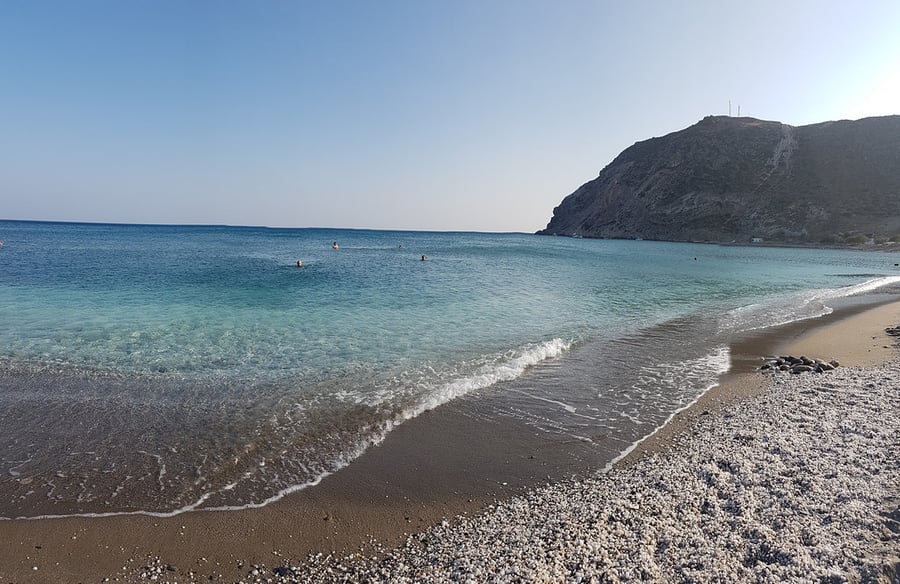
At Agia Kyriaki beach, the shore looks south over the Sea of Crete. The same name belongs to a tiny settlement on this stretch of the Milos coast. Only 12 people lived there at the census of 2021, against 31 ten years before.
The shore is coarse, thick sand with white and coloured pebbles spread through it. This sandy strip is broad and runs a long way along the coast. The sea in front of it feels cool. A later section looks closer at the sand and the water.
Agia Kyriaki beach counts as organised, meaning sunbeds and umbrellas stand ready on the sand. Beach bars stand along the shore as well. There is also a court for beach volleyball, a team game played on sand. Rooms to rent and a place to eat lie within walking distance.
In summer, the beach is a popular stop. It ranks among the leading tourist beaches of Milos. The island as a whole draws visitors with its varied coastline and its traditional Greek buildings. It also stays less crowded than Santorini and Mykonos, which see more visitors.
- Type: A large beach with organised services, facing south.
- Shore: Coarse sand mixes with white and coloured pebbles.
- Services: Sunbeds, umbrellas, bars and a volleyball court share the sand.
- Nearby: Rooms to rent and a restaurant are a short walk away.
- Season: It is a popular stop in the summer months.
In short, Agia Kyriaki beach pairs a broad shore of coarse sand with sunbeds, umbrellas and bars. A tiny settlement shares its name. Rooms and a place to eat sit close by. That mix keeps it high on the list of summer beaches on Milos.

Where does Agia Kyriaki beach lie on the coast of Milos?
Agia Kyriaki beach lies near the east end of the south coast of Milos. Only Psarovolada sits further east along this shore. Firlingos and Paleochori lie on the same stretch of coast. The road there passes through the village of Zefyria.
From Agia Kyriaki beach, the port of Adamas lies about 10 km to the north-west. Plaka, the capital, sits about 13 km away in the same direction. It stands on high ground above the port. Paleochori is also about 13 km from Plaka, but 14 km from Adamas.
Counted from the east, Agia Kyriaki beach is second of the 21 south-side beaches on Milos. Psarovolada comes first, at the eastern end of that line. In one list of south-coast beaches, Firlingos, Spathi, Tourkaki and Paleochori come right after it. Further on come Gerakas and Firiplaka, and Kleftiko closes the list in the south-west.
The road to the beach passes through Zefyria, a farming village inland in the east of Milos. Zefyria sits 9 km from Plaka and about 5.5 km from the port. It once served as the island’s capital, before that role moved to Plaka. Past the village, the same road carries on to Paleochori too.
The beach can also be seen from the west, from high ground near Cape Kalamos. That cape lies on the outer slopes of the Fyriplaka crater. There, hot vents leave yellow sulfur crystals on the rocks. From the hilltop just south of the vents, the long beach shows up to the east.
- East: Psarovolada is the only south-side beach further east.
- Next in the list: Firlingos, Spathi and Tourkaki come before Paleochori.
- Port: Adamas sits about 10 km to the north-west.
- Inland: Zefyria stands just 10 m above sea level.
- Community: Agia Kyriaki, Zefyria and Paleochori all belong to Trypiti.
In short, Agia Kyriaki beach sits near the eastern end of the south coast. It lies about 10 km from the port, on a road that runs through Zefyria. The overview of the beaches of Milos sets it beside the other shores around the island.
What kind of sand and water does Agia Kyriaki beach have?
Agia Kyriaki beach has a long shore of thick, coarse sand on the south coast of Milos. White and coloured pebbles lie mixed into the sand. The sea in front of it stays cool, and the whole island is known for clear blue water.
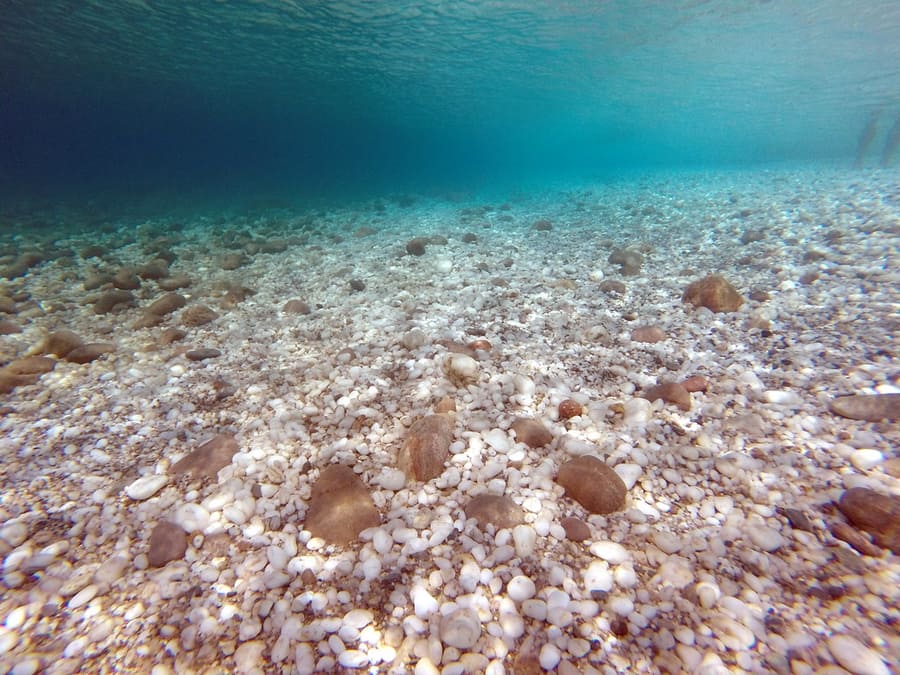
Agia Kyriaki beach is a large beach on the south side of Milos. Its sand runs a long way beside the water. The shore draws a crowd of swimmers in the summer months. To the south of the island lies the Sea of Crete.
The sand here is thick and coarse, not fine. Coarse sand has grains between half a millimetre and one millimetre across. Sand grains are larger than silt but smaller than gravel. At Agia Kyriaki beach, this rough sand covers a wide area.
Pebbles lie scattered through the sand, in white and in a mix of colours. A pebble is a rounded stone between 4 and 64 millimetres across. Beach pebbles form as sea water washes over loose bits of rock. Over time the stones turn smooth and round.
Milos is a volcanic island with rock in white, red, yellow and even black. Its coast holds white sandy beaches and pebble bays ringed by coloured stone. Agia Kyriaki beach brings the two together, with sand and coloured pebbles on one shore.
The water off this shore is cool. Around Milos, the sea is clear and blue. It shows a wide range of colours and depths. The island counts more than 75 beaches, large and small, along its varied coast.
- Sand: Thick, coarse grains cover a wide shore.
- Pebbles: White and coloured stones lie in the sand.
- Water: The sea off the beach is cool.
- Coast: It belongs to the south-coast beaches of Milos.
- Season: The shore draws visitors in the summer months.
Agia Kyriaki beach pairs coarse sand with white and coloured pebbles on one wide shore. The water in front of it is cool to swim in. Across Milos, one beach offers white sand and the next a pebble bay. This south-coast shore holds both.
Why does Agia Kyriaki beach carry the name of a saint?
Agia Kyriaki beach takes its name from a small chapel of the same name in the area. The chapel bears the name of Saint Kyriaki, a Christian martyr. Her name is the Greek word for Sunday. Agia Kyriaki is simply Greek for Saint Kyriaki.
A small chapel stands in the area around Agia Kyriaki beach. The beach owes its name to this little church. The small settlement there carries the same name. On Milos, one saint’s name covers the chapel, the beach and the houses.
A chapel is a small Christian place of prayer and worship. The word comes from the Latin cappella, which means little cape. A church can also build one as a small outpost in a remote area.
Saint Kyriaki was a Christian woman put to death for her faith under a Roman emperor. She was born in Nicomedia to Greek parents who were devout Christians. She died at the age of 21. She is also known as Saint Kyriaki the Great Martyr.
Her parents gave her the name Kyriaki because she was born on a Sunday. In Greek, Kyriaki means Sunday, the Lord’s Day. Catholic tradition turns the same name into Saint Dominica, which also points to Sunday.
The Eastern Orthodox Church holds her feast day on 7 July. Villages named Agia Kyriaki also stand in Chania, Kilkis, Samos and Ikaria. Small islands with the name lie off Astypalaia, Kalymnos and Leros. The Milos settlement joins that long list.
- Chapel: A small church of the same name stands nearby.
- Saint: Kyriaki died as a Christian martyr in Roman times.
- Meaning: Kyriaki is the Greek word for Sunday.
- Feast day: The Orthodox Church honours her on 7 July.
- Patron: She is patron saint of Servia in Western Macedonia.
The name of Agia Kyriaki beach ties this part of Milos to a Christian martyr. It also carries the Greek word for Sunday. A small chapel in the area keeps that name on the map. The settlement there does the same.
What does the organised part of Agia Kyriaki beach offer?
Agia Kyriaki beach is one of the organised beaches of Milos, and it covers a large area. Sunbeds, umbrellas and beach bars stand on the sand, along with a beach volleyball court. Rooms to rent and a restaurant lie a short walk away.
An organised beach is a shore with services set out for visitors, such as sunbeds and umbrellas. Agia Kyriaki beach is one of these fully organised shores on Milos. The island also has lonely, wild beaches without such services.
At Agia Kyriaki beach, sunbeds and umbrellas are part of the organised set-up. An umbrella gives shade on the open sand. A sunbed lifts a swimmer off the coarse grains. Beach bars on the shore serve drinks.
The beach also has a court for beach volleyball. In this sport, two teams face each other across a net on sand. Each side has two to six players. The aim is to ground the ball on the other side.
A court built to the official rules is 16 metres long and 8 metres wide. Players need no shoes. Soft sand makes it harder to move and jump. It also lowers the risk of injuries such as jumper’s knee.
Rooms for rent and a restaurant stand close to Agia Kyriaki beach. Hotels and rented rooms across Milos have made the island a tourist centre. Its varied coast draws visitors, and the island feels less crowded than Santorini or Mykonos.
- Sunbeds: Lounge chairs are set out on the sand.
- Umbrellas: They give shade on the open shore.
- Beach bars: Bars on the sand serve drinks to swimmers.
- Volleyball: A sand court hosts games of beach volleyball.
- Nearby: Rooms for rent and a restaurant lie a short walk away.
Agia Kyriaki beach gives Milos a large shore with shade, drinks and a sand court. Rooms to rent and a restaurant stand close to the sand. A separate page tells more about Firiplaka beach, further west along the same south coast.
Why does Agia Kyriaki beach stay calm on north-wind days?
Agia Kyriaki beach stays calm on north-wind days because it lies on the south coast of Milos. The meltemi, a hard summer wind over the Aegean, comes from the north. The bulk of the island stands between those gusts and this southern shore.
The meltemi is a dry wind that crosses the Aegean Sea through the summer months. Over the central Aegean it blows straight from the north. Further south it swings round and comes from the north-west. Milos sits at the far south-west corner of the Cyclades, close to the Sea of Crete.
On Milos, a beach is picked for the wind as much as for the view. When the meltemi blows, beaches inside the large bay of the island are a fair choice. The south side is better still. Agia Kyriaki beach belongs to that southern row, so it suits these days.
The wind gathers strength through the day and is at its height in the afternoon. It tends to drop after dark. At times, though, it keeps going for days without a pause. The sky stays clear the whole time, so a bright morning gives no hint of a rough afternoon.
At full force the meltemi rates 7 or 8 on the Beaufort wind scale. Trips by small boat are then called off, and open shores turn choppy. The water at Agia Kyriaki beach is cool. The shore sits out of the wind’s path, so swimmers on Milos find calmer water there.
- Wind: The meltemi is a dry summer wind from the north.
- Peak: Afternoons bring the hardest gusts, and the wind tends to fall at night.
- Best side: Agia Kyriaki beach sits on the sheltered south coast.
- Second choice: Beaches inside the bay of Milos also suit it.
- South wind: The north coast then becomes the calmer side.
Agia Kyriaki beach is a reliable pick when the north wind rises over Milos. The ancient Greeks named this wind etesian, from their word for year, since it returns year after year. A glance at the wind before setting out decides between the south coast and the north.

How do visitors get to Agia Kyriaki beach on Milos?
To reach Agia Kyriaki beach, visitors drive south-east from Adamas, the port of Milos. The road passes through the inland village of Zefyria and then runs down to the south coast. The beach lies about 10 kilometres from Adamas and about 13 kilometres from Plaka.
Adamas, set on the big bay of Milos, is where the drive begins. From there the road leaves the bay and heads inland toward the village of Zefyria. Zefyria is 5.5 kilometres from the port and 9 kilometres from Plaka. It stands in the centre of eastern Milos.
Zefyria was the capital of Milos before that role moved to Plaka. Today it is a farming village of about 150 people, only 10 metres above the sea. Its old cathedral, Panagia Portiani, shares a wall with the church of Agios Nikolaos. Drivers heading for the south coast pass right through it.
Beyond Zefyria, the road continues to two shores on the south coast, Agia Kyriaki and Paleochori. Of the two, Agia Kyriaki beach lies further east, near the eastern end of that coast. Zefyria, Agia Kyriaki and Paleochori all belong to the local community of Trypiti.
City buses run to certain areas of Milos, and their summer routes are quite frequent. Riders buy a ticket on the bus itself. Milos also has 15 taxis. Visitors find them at the harbour and at the airport. A car or a taxi follows the road through Zefyria to Agia Kyriaki beach.
- From Adamas: The beach lies about 10 kilometres to the south-east.
- From Plaka: The distance is about 13 kilometres, also south-east.
- Via: The road runs through Zefyria, the old capital of Milos.
- Bus: City buses serve parts of Milos on frequent summer routes.
- Taxi: The island’s 15 taxis stand ready at the harbour and the airport.
Agia Kyriaki beach rounds off a short drive across eastern Milos. The way runs from the port, through the old capital, and down to the southern shore. A pause in Zefyria adds a look at the island’s past to a day by the sea.
What are Paleochori and its warm springs near Agia Kyriaki beach?
Near Agia Kyriaki beach, the long shore of Paleochori runs for almost 2 km. It lies on the south coast of Milos, framed by rock in red, pink, yellow and white-grey. Warm water also rises from the ground there, a sign of volcanic heat.
Paleochori counts as a settlement of the Milos municipality, and its beach carries the same name. The village lies about 14 km south-east of Adamas, the main port, and about 13 km from Plaka. Agia Kyriaki beach sits closer to the port, at about 10 km, on the same southern shore.
The beach at Paleochori is very popular, with rooms to rent and a handful of eating places nearby. Coarse sand and small, colourful pebbles cover its shore from one end to the other. The sea there is cool, clear and deep, and its colour is a strong, bright blue.
Warm water gushes from the ground at Paleochori, fed by the volcanic energy of the whole area. Milos also has active fumaroles, meaning vents that let gas escape from deep inside the earth. At Paleochori and around Agia Kyriaki beach, the heat of these vents reaches up to 100°C.
Sulphur marks these hot spots, and other vents sit under the sea, where gas rises as bubbles. Paleochori also has hot springs of its own, and springs on Milos reach up to 55°C. The island’s healing waters were known in ancient times, and an ancient Greek doctor wrote about them.
- Names: The place also goes by the spellings Paliochori and Palaiochori.
- Deep heat: Milos, Kimolos and Polyaigos hold the country’s first high-temperature geothermal field, a source of deep heat.
- Volcano: Volcanic activity shaped Milos from 2–3 million years ago until 90,000 years ago.
- History: In 1717, a French professor of botany also wrote about the healing baths of Milos.
- Other hot spots: Pyromenes and Adamas also release volcanic gas from active vents on Milos.
Paleochori adds warm ground, coloured cliffs and deep water to a day spent around Agia Kyriaki beach. The two shores belong to the same community and share one volcanic story under the sand. Side by side, they show how the heat of Milos still reaches its southern sea.
Which quieter coves lie near Agia Kyriaki beach?
Agia Kyriaki beach has four neighbouring coves on Milos: Psarovolada, Firlingos, Spathi and Tourkaki. With Paleochori, they form a group of six named shores on the south coast of the island. A sea-kayak route of 6.6 km joins two of them, Paleochori and Firlingos.
The south side of Milos holds 21 beaches, and this group of six is one part of it. Inside the group, the coves of Spathi and Tourkaki sit between Firlingos and Paleochori. Psarovolada and Agia Kyriaki beach complete the set of six names on this part of the coast.
Milos owes its sea caves and tunnels to volcanic rock, and kayaks reach its deserted beaches. The kayak route from Paleochori covers 6.6 km and passes the coves in between. For a day out from Agia Kyriaki beach, that paddle shows the nearby coves from the water.
Agia Kyriaki and Paleochori are small villages as well as beaches, and both belong to the Trypiti community. In 2021, Agia Kyriaki counted 12 residents, against 31 at the census ten years earlier. Paleochori counted 17, so only a small number of people live along this stretch of Milos.
Visitors come to Milos for its varied coast and for thinner crowds than Santorini or Mykonos. The coves near Agia Kyriaki beach show that quieter side of the island on a small scale. Boats moor in south-coast coves such as Paleochori, picked by the direction of the wind.
- Base: Agia Kyriaki offers sunbeds and umbrellas on a large, organised beach within this group.
- Paddle: Firlingos marks the far end of the kayak route that leaves from Paleochori.
- Greek names: In Greek script, the coves read Ψαροβολάδα, Φύρλιγκος, Σπαθί and Τουρκάκι.
- Neighbours: Trypiti, Zefyria, Kanava, Klima and Schinopi share the same community as the two villages.
- Status: Both villages appear as separate settlements in the census of 2011.
Agia Kyriaki beach anchors this part of Milos, and four more coves sit around it on the shore. Paleochori, with its warm springs and long beach, completes the group of six. A paddle from Paleochori to Firlingos links the shore, and the wind decides where boats can stop.
Which months suit a day at Agia Kyriaki beach?
Agia Kyriaki beach is busiest in summer, the main season for visitors on Milos. Spring and autumn bring warm days and more room on the sand. Winters on the island are mild and rainy, while summers stay hot and dry.
Summer is the high season on Milos, when visitors arrive in the largest numbers. The beach has sunbeds, umbrellas and beach bars. It draws a steady crowd in those weeks. Even so, Santorini and Mykonos see bigger summer crowds than Milos does.
Spring warms Milos step by step, before the summer crowds arrive. April days average 18.4 °C. Rain falls to 20.5 mm for the whole month. Late spring turns drier and warmer still, and the sand has space to spare.
Autumn keeps the summer warmth for a while. September days average 25.2 °C, with only 5.8 mm of rain. The meltemi, the strong north wind of summer, fades around mid-September. October cools to 21.3 °C and brings the first real rain, at 42.9 mm.
Milos has a Mediterranean climate. Its winters are mild and wet, and its summers turn hot and dry. July brings the peak heat, and almost no rain falls from June to August. Midday brings the strongest heat, so mornings and late afternoons suit a long stay.
- Summer: The island sees its largest number of visitors.
- Spring: April days average 18.4 °C, with light rain.
- Autumn: September stays warm and almost dry.
- Heat: Daytime highs peak in July at 28.1 °C.
- Winter: The heaviest rain falls in December and January.
Agia Kyriaki beach works in every warm month, but the mood changes with the season. Summer brings full sunbeds and a busy shore. Spring and autumn offer milder heat and quieter sand. Winter rain turns the beach into a place for walks, not swims.
What belongs in the bag for Agia Kyriaki beach?
Agia Kyriaki beach needs a light bag with drinking water, a sun hat and sun cream. Sandals or beach shoes protect the feet on hot sand at midday. Umbrellas stand in the organised part, and all litter leaves with the visitor.
The summer air on Milos is hot and dry. The south coast gets strong sun from morning on. Each person carries a full bottle of water, though the beach bars sell cold drinks too. A bottle in the bag saves walks across the hot sand.
Sun cream protects the skin before the first swim. A fresh layer follows each dip in the sea. A wide hat shades the face and neck, and a light shirt covers the shoulders. Umbrellas shade the organised area, while open stretches of sand take the full sun.
The thick sand heats up fast under the July sun. Bare feet feel it first. Light sandals or water shoes protect the soles on the walk to the sea. They also grip on the colourful pebbles of the shore, where wet stones turn slippery.
Litter goes home in the same bag that carried the food and drinks. Cans, caps and wrappers never end up on the beach or in the water. The Mediterranean monk seal lives on the south-west side of Milos. Clean seas protect it.
- Water: A full bottle per person covers the hottest hours.
- Sun cream: A fresh layer goes on after each swim.
- Hat: A wide brim shades the face, ears and neck.
- Shoes: Sandals protect the soles on hot sand and pebbles.
- Litter: Every wrapper and bottle leaves in the visitor’s bag.
A light, well-packed bag keeps the day at Agia Kyriaki beach simple. Water, shade and sandals deal with the heat. A rubbish bag keeps the shore clean. The same kit serves other activities in Milos, from walks to boat trips.

What do first-time visitors ask about Agia Kyriaki beach?
On the south coast of Milos, Agia Kyriaki beach is a large, organised shore. It has sunbeds, umbrellas and thick sand. The answers below cover families, shade, snorkelling, food and wind. They also cover evening light, parking and a day that adds Paleochori.
How well does Agia Kyriaki beach suit families with children?
Families pick this beach for its easy access and calm water. The organised part offers sunbeds and umbrellas. Small children rest in the shade between swims. The beach volleyball court gives older children a game on the sand. Adults stay close at the water line, since the beach is large and busy in summer.
Where can visitors find shade at Agia Kyriaki beach?
Umbrellas and sunbeds stand side by side across the organised part of the beach. Visitors who settle outside that area bring their own shade. A wide hat, a light shirt and a small beach shade cover the gap. Early morning and late afternoon bring softer sun, which suits a long swim.
Is the water at Agia Kyriaki beach good for snorkelling?
A mask and snorkel suit the cool water off the beach. Colourful pebbles line the shore. Swimmers bring their own mask and fins. Milos also has undersea vents, where gas from deep in the earth rises as bubbles. For deeper water and remote coves, a Milos snorkelling cruise stops at beaches that only boats reach.
Can visitors buy food and drinks at Agia Kyriaki beach?
Beach bars stand in the organised part. Cold drinks and light snacks are close at hand there. A restaurant lies within walking distance of the sand. Visitors who bring a packed lunch take every wrapper home. Water still belongs in the bag, since hot sand slows each walk to the bar.
What happens at Agia Kyriaki beach when the meltemi blows?
Each summer, the meltemi brings strong, dry air down from the north. Its peak comes after midday, and the gusts tend to fade by night. On north-wind days, the south side of Milos holds the calmer beaches. Agia Kyriaki beach lies on that side. A south wind turns the north coast into the better pick.
How does the evening light change Agia Kyriaki beach?
Late in the day, the low sun warms the colourful pebbles and the thick sand. The cool water darkens as the light fades. The summer wind tends to ease toward night, so the sea grows calmer. A last swim closes the day. The walk back to the car is cooler, too.
Where do drivers leave the car near Agia Kyriaki beach?
The beach is easy to reach, which is one reason families choose it. Drivers leave the car off the sand and keep the way clear for others. In high summer the beach fills, so an early arrival makes parking simpler. Visitors without a car find taxis at the airport and the harbour.
Can one day cover Agia Kyriaki beach and Paleochori?
Paleochori lies on the same south coast. Three small beaches sit between the two. Paleochori is almost 2 km long. Red, pink, yellow and white-grey rocks line its shore, and warm water gushes up there. A morning at Agia Kyriaki beach and an afternoon at Paleochori fit into one day.