
Firiplaka beach stretches along the south shore of the island of Milos, one of the Cyclades. It is known for pale sand, volcanic cliffs and shallow turquoise water. The first two sections give a quick, plain portrait of the beach. They also show where it sits along the island’s south coast, among its neighbours.
Milos is a volcanic island, and the cliffs at Firiplaka beach show it clearly. The first part of the beach has a bar and loungers, while the far parts are quieter. Later sections cover the cliffs, the sand and the water. They also cover the quiet stretches, the way in and the time to go.
What is Firiplaka beach like at a glance?
Firiplaka beach is a long beach on the south side of Milos. It has fine pale sand, white pebbles, volcanic cliffs and shallow turquoise water. The beach is popular on the island, and its first part is organised. Two quieter beaches lie beyond it, along the shore.
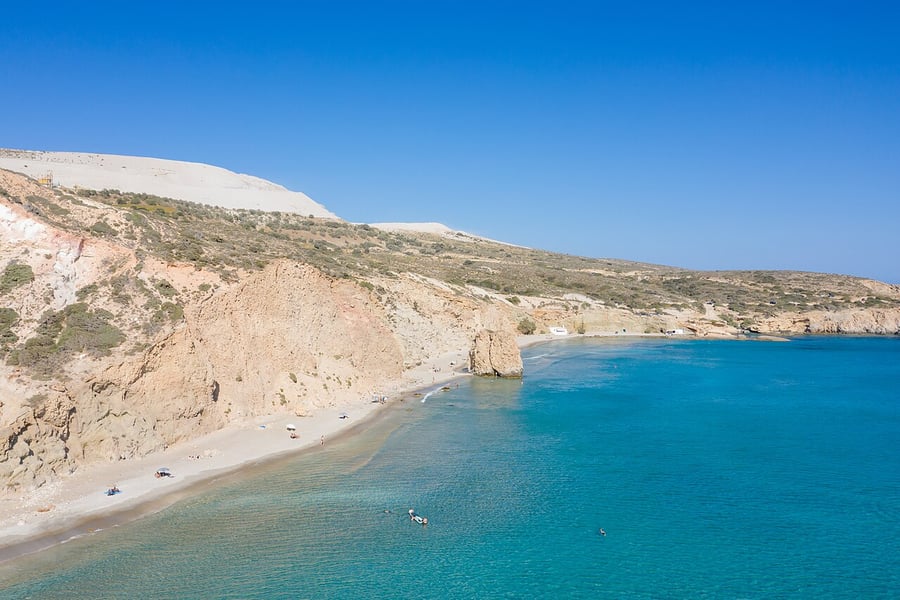
Firiplaka beach sits in the south of Milos. This island of volcanic origin lies in the Aegean Sea. The Sea of Crete lies to its south. The beach is extensive, so it runs along a long stretch of shore. Its name has two spellings, Firiplaka and Fyriplaka, and both point to the same place.
Cliffs of volcanic rock tower behind the sand. The same kind of rock covers the larger part of Milos, because the whole island is volcanic. At Firiplaka beach, it rises in tall walls above the shore. These walls look imposing, meaning grand and huge. The sea lies open in front of them, past the shallows.
The sand is fine, and its colour is snow-grey, a pale tone between white and grey. White pebbles come with it. Both the sand and the stones are pale. The shore therefore has two textures, soft sand and small stones, side by side. Walkers feel the change underfoot as they move along the beach.
The water along Firiplaka beach is shallow and turquoise, a blue-green colour. Shallow means the sea floor is close to the surface. A huge rock stands in that water near the shore, with a cave under it. Time and the sea have sculpted rocks across Milos. This one was carved from volcanic stone long ago.
The beach has three parts. The first is organised, with a beach bar and sun loungers under parasols, which give shade. Two lonelier beaches follow the organised part. Walkers reach them on foot, going parallel to the sea and the volcanic rocks. Water lies on one side of that walk, and rock on the other.
- Place: It lies on the south side of Milos.
- Sand: The sand is fine and pale.
- Cliffs: Volcanic cliffs rise behind the shore.
- Water: The sea is shallow and turquoise.
- Landmark: A huge rock with a cave stands offshore.
Firiplaka beach puts pale sand, white pebbles, volcanic cliffs and shallow turquoise water on one long shore. One part is organised, and two are quieter. Those who prefer to escape the crowds can walk on to the two quieter parts. A huge rock with a cave sits in the water near the shore.

Where does Firiplaka beach lie on the south coast?
Firiplaka beach lies on the south coast of Milos. This island is the south-westernmost of the Cyclades. It sits in a long row of south-coast beaches. Provatas lies west of the beach, and Tsigrado lies east of it. Kalamos and Gerakas lie further east.
Milos is shaped like a horseshoe, with a large gulf cutting in from the north-west. Firiplaka beach sits on the southern side of that shape. The south coast is a long edge that holds a whole row of the beaches of Milos. Each one has its own look, because the rock around it is different.
One count of the island’s beaches reaches 90, and the list is not complete. That count sorts them by coast: north, east, south, west and inside the gulf. The gulf holds the largest group. The south side comes next, ahead of the north, the west and the east. Firiplaka beach belongs to one of these two big groups.
East of Firiplaka beach, the first neighbour is Tsigrado. Kalamos and Gerakas come after it, then Tourlos and Paliochori. Paliochori is popular and runs almost 2 km along the shore. It has coloured pebbles, coarse sand and deep water, with warm water gushing up. The sand at Firiplaka is finer, and its water is shallower.
Agia Kyriaki lies further east, beyond Paliochori. Sunbeds, umbrellas, beach bars and a volleyball court make it a large, organised beach. Firlingos, Spathi and Tourkaki sit between it and Paliochori. The list of south beaches starts at Psarovolada on the far east end. Read from there, Firiplaka beach is the eleventh name on the list.
Going west, Provatas comes first. Agios Sostis follows, a small, shallow sandy beach that extends Provatas. Kipos comes next, with a sandy beach and a small port. Gerontas, the farthest south beach, sits near the end. The list ends at Kleftiko, a place of grey and white rocks and caves, reached by boat.
- East neighbour: Tsigrado lies next door.
- Beyond Tsigrado: Kalamos and Gerakas come next.
- West neighbour: Provatas lies next door.
- Beyond Provatas: Agios Sostis and Kipos come next.
- West end: Kleftiko closes the list.
The beach sits near the middle of the south side’s list, with a close neighbour on each side. Read from east to west, the list reaches Tsigrado just before Firiplaka beach and Provatas just after it. A large organised beach marks the east end. A rocky place reached by boat marks the west end.
What do the volcanic cliffs at Firiplaka beach look like?
Firiplaka beach lies below towering volcanic cliffs. Across the island, the rocks of Milos show white, red, yellow and black tones. Such volcanic rock started out as hot lava or as fallen ash. It covers the larger part of the island.
Towering volcanic cliffs rise behind the sand at Firiplaka beach. The beach below them is extensive, a long stretch of shore in front of the rock. A volcano made this stone, and the eruptions of that volcano ended long ago.
When a volcano erupts, molten rock comes out onto the surface. This molten rock is called lava. As lava cools, it turns solid and becomes volcanic rock. The lavas of different volcanoes look different once they have set hard.
An eruption also blasts out ash, which is made of tiny pieces of crushed rock and glass. The ash falls and settles, and over time it hardens into solid rock. That rock is called tuff, one of the ordinary rocks of Milos.
The same kind of lava can set into different rocks. If it cools fast, it can freeze into obsidian, a black glass-like rock found on Milos. If it cools slowly, it forms a light-coloured rock that is solid and even all the way through.
Lava also sets into different shapes, and the cooled surface shows it. One type sets smooth and ropy, like twisted rope, and another sets rough and jagged. Trachyte is one more volcanic rock of Milos, along with tuff and obsidian.
- Cliffs: Towering volcanic cliffs rise behind the sand of the beach.
- Colours: White, red, yellow and black rocks surround the beaches of Milos.
- Lava: Molten rock that cools on the surface turns into volcanic rock.
- Ash: Fallen ash hardens over time into a rock called tuff.
- Obsidian: Fast-cooling lava can freeze into a black glass-like rock.
The cliffs at Firiplaka beach show how lava and ash turn into solid rock. Milos holds more volcanic shapes than this one shore, and each one has its own colours. Readers who want a wider view of the volcanic island can look at a Milos island tour.
What are the sand, pebbles and water like at Firiplaka beach?
Firiplaka beach has fine sand in a grey-white shade, white pebbles and shallow turquoise water. Turquoise is a blue-green colour, somewhere between blue and green. The beach is extensive, so this pale shore covers a long stretch of the south coast.
The sand at Firiplaka beach is fine, which means each grain is small. Its shade falls between white and grey, and snow-grey describes it well. That pale tone is close to the colour of the white pebbles on the same beach.
A pebble is a small stone, bigger than a grain of sand and smaller than a boulder. White pebbles lie beside the fine sand on the shore of Firiplaka beach. Together, the sand and the pebbles give the shore a pale look.
Milos has over 75 small and large beaches, and each one looks different. The volcanic origin of its soil gives the island this wide variety of beaches. One bay has white-gold sand, while another has pebbles with stones around them.
The sea in front of Firiplaka beach is shallow and has a turquoise colour. Turquoise is a blue-green shade, so the sea looks halfway between blue and green. The clear sea around Milos shows its own colours and depths in each bay.
- Sand: Each grain is small, and the shade falls between white and grey.
- Pebbles: White pebbles lie beside the sand on the same shore.
- Water: The water is shallow, with a turquoise colour.
- Colour: Turquoise is a shade between blue and green.
- Length: The beach is extensive, a long stretch of shore.
Pale sand, white pebbles and shallow blue-green water share one long shore at Firiplaka beach. Volcanic cliffs stand behind that shore, and the open sea lies in front of it. Near the water, a huge rock with a cave adds one more feature to the bay.
What is the huge rock with a cave at Firiplaka beach?
Firiplaka beach has a huge rock standing in the water near the shore. A cave lies under it. The rock was shaped from volcanic stone a long time ago. It belongs to the same volcanic coast as the cliffs behind the sand.
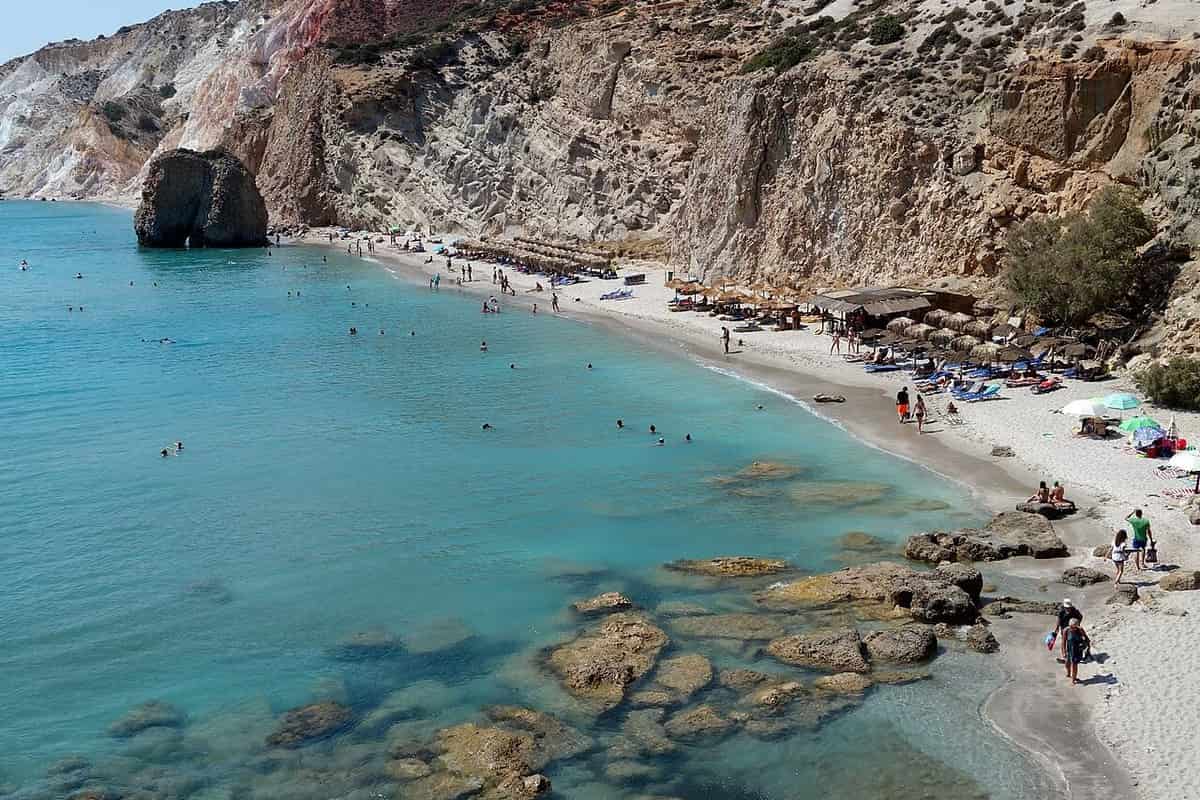
The huge rock stands in the water, close to the shore of Firiplaka beach. It stands out in the sea and not on the dry sand. A cave lies beneath it, in the water near the sand.
A cave is a hollow space in solid rock. The hollow here sits under the big rock, close to the edge of the beach. Both the rock and the cave are natural shapes, not built ones.
Milos holds rocks that time and the sea have sculpted, and these shapes stand along its coast. The huge rock at Firiplaka beach is one such shape, formed from volcanic stone long ago. Its stone is volcanic, like the cliffs behind the beach.
Tuff is a relatively soft rock, and Milos has tuff among its rocks. On the island, people dug small shelters for boats into volcanic tuff beside the sea. Soft stone is easier to cut than hard stone, and people also dug catacombs into volcanic ground.
Volcanic rock can also hold small empty pockets, and these pockets are called voids. Gas trapped in the lava leaves them behind when the lava sets. Pumice is a rock full of such pockets, and it forms in explosive eruptions.
- Rock: A huge rock stands in the water near the shore.
- Cave: A cave lies under the rock.
- Origin: The rock was shaped from volcanic stone long ago.
- Tuff: This volcanic rock is relatively soft, and it is found on Milos.
- Sculpting: The sea, given long ages, has carved rock all over Milos.
The huge rock and its cave are natural features of Firiplaka beach, close to the sand. Both were shaped from volcanic stone long ago, like the cliffs behind the beach. Rock, cliffs, sand and sea together give Firiplaka beach its look.
What is the organised part of Firiplaka beach like?
Firiplaka beach is set up for visitors on its first stretch. Sunbeds with parasols stand on the sand, and a beach bar sits close by. The sea along the beach is shallow and turquoise, so the spot suits an easy day.
The first stretch of Firiplaka beach is the part with facilities. Organised means that the place has things ready for visitors. Here that means sunbeds, parasols and a small bar, all set out together on the sand.
A sunbed is a long seat for lying in the sun. A parasol is a large umbrella that throws shade over it. Together they make a resting spot close to the water, ready for a long day on the beach.
The beach bar is a small hut on the sand. It belongs to the organised stretch, so the facilities all sit in one place. A visitor on the first stretch finds a drink and a seat without leaving the beach.
The facilities stand in a wide natural setting. Fine, light-grey sand mixes with white pebbles along the shore, so the beach is not only soft sand. Huge volcanic rocks tower over the beach, and the sea in front of them is shallow.
Firiplaka beach is one of the best-known beaches on Milos. Its organised stretch is the simplest way to enjoy it, since the facilities are already in place. The two lonelier stretches lie further along the same shore.
- Sunbeds: Long seats stand on the sand for lying in the sun.
- Parasols: Large umbrellas give shade beside the sunbeds.
- Beach bar: A small hut on the sand holds the bar.
- Water: The sea along the beach is shallow and turquoise.
- Position: The organised stretch comes first, and two lonelier stretches follow it.
The organised part of Firiplaka beach suits visitors who want comfort at the water’s edge. Sunbeds, parasols and a beach bar are all in one place. Anyone who wants more space can walk on past it, to the two lonelier stretches described next.
Where are the quieter far stretches of Firiplaka beach?
Firiplaka beach holds two lonelier stretches beyond the organised start. Visitors reach them on foot, following the water’s edge below the volcanic rocks. The walk leads away from the crowd and suits anyone who wants more peace and space.
Past the first stretch, Firiplaka beach carries on as two more beaches. Both lie further along the same shore, which makes Firiplaka beach a long beach overall. Both are lonelier than the organised stretch where the sunbeds stand.
The way to them is on foot, parallel to the sea. A visitor leaves the organised stretch and follows the line where the water meets the volcanic rocks. The sea stays on one side the whole way.
Volcanic rock is stone that formed from hot lava. Milos has two old volcanoes that have gone quiet, and the Firiplaka volcano is one of them. The last eruption came 90,000 years ago, after 2 to 3 million years of activity.
The route runs between the sea and the rocks, so each step needs a little care. A visitor who wants peace on Firiplaka beach takes the walk at a calm pace. The reward is a quieter spot on the sand.
These stretches suit visitors who want to avoid the crowd but enjoy the grand view. The organised stretch is the place for sunbeds and a bar. The far stretches are the place for peace, and the only effort is a walk.
- Stretches: Two lonelier beaches follow the organised one.
- Route: The path keeps the sea on one side and the rock on the other.
- Crowd: The far stretches suit visitors who want to avoid the crowd.
- Rocks: Huge volcanic rocks stand along the whole beach.
- Volcano: One of the two quiet volcanoes of Milos is the volcano of Firiplaka.
The far stretches give Firiplaka beach a calm side. The organised part draws the crowd, and the walk beyond it leaves the crowd behind. Visitors who want that quiet follow the sea and the volcanic rocks until they reach it.

How do visitors get to Firiplaka beach?
Firiplaka beach can be reached by own vehicle, taxi, bus or boat. The road is asphalt for the larger part and turns to gravel at the end. A boat sets out from the port of Adamas and sails around the island.
Firiplaka beach lies on the south side of Milos, between Tsigrado and Provatas. A visitor with an own vehicle drives there by road. Asphalt covers the longer part of the drive, and gravel covers the end.
The road ends on a driveway paved with gravel, a surface of loose, small stones. Gravel feels rougher than asphalt, so a driver slows down for the last part of the trip. The change in surface tells a driver that the beach is close.
Travellers without a car of their own can look at renting a car on Milos. A rented car follows the same road, asphalt first and gravel at the end. It also lets a driver set a personal pace for the day.
A taxi is another way to reach the beach. Milos has 15 taxis, and both the port and the airport have taxis on hand. A taxi saves a visitor from driving the gravel end of the road.
A bus also reaches the beach, so a visitor without a car still has a way there. A boat from the port of Adamas goes around the island and also reaches Firiplaka beach. The boat is the one route that uses the sea instead of the road.
- Own vehicle: A car or another vehicle drives the whole road to the beach.
- Taxi: The island has 15 taxis, ready at its port and its airport.
- Bus: A bus is another way to reach the beach.
- Boat: A boat from the port of Adamas goes around the island.
- Road: Asphalt covers the longer part, and gravel covers the end.
A visitor to Firiplaka beach has four ways in: own vehicle, taxi, bus and boat. The road is paved for the larger part, and only the last stretch is gravel. A slow final drive is the one thing to plan.
What do Tsigrado and Provatas offer next to Firiplaka beach?
Firiplaka beach has Tsigrado, a small cove with white sand, on its east side. Provatas, a family beach with golden-red sand, lies on its west side. Tsigrado has no organised services. Provatas has sunbeds, umbrellas and taverns along the shore.
Firiplaka beach sits between two neighbours on the south side of Milos. Tsigrado lies to the east. Provatas lies to the west. The three beaches share one stretch of coast on the southern side of the island. Each one has its own sand and its own water.
The cove of Tsigrado beach is wrapped in huge rocks. Its sand is pure white. Its water has an emerald tint. A dirt road gets close to it. Then a steep, sandy trail leads down the hill to the shore. The last stretch is a walk.
Nobody runs Tsigrado as an organised beach. The cove has no services of its own. Visitors pick up the basic things at Firiplaka, which is close by. That close link makes the longer beach next door the supply point for the little cove.
Provatas lies on the west side and feels very different from the white cove. Iron oxides give the sand its plentiful golden-red colour. The water is very shallow. Children can play in the shallows, so Provatas is a good beach for families.
Provatas is an organised beach with sunbeds and umbrellas. Visitors find a hotel, rented rooms and taverns there. A paved road leads to it from Adamas, which is 7 km away. Good signs show the way. A frequent bus service also runs to the beach.
- East: Tsigrado, the small white cove, lies on the east side of Firiplaka beach.
- Tsigrado: White sand and emerald water fill a cove with no organised services.
- West: Provatas lies on the west side of Firiplaka beach.
- Provatas: Golden-red sand and very shallow water suit children.
- Roads: A dirt road serves Tsigrado, and a paved road serves Provatas.
The three beaches sit side by side, yet they offer three kinds of day. Tsigrado is a small white cove. Firiplaka beach is the long beach in the middle. Provatas is an organised family beach. Visitors can pick the shore that matches the day and the group.
Which season suits Firiplaka beach best?
Firiplaka beach is popular in summer. Summer also brings the meltemi, a dry wind that sweeps the Aegean from the north. The island’s southern shore is the better pick in that wind, so the beach suits windy days. Spring and autumn bring fewer people.
Meltemi is the name of a strong, dry wind that comes from the north. It forms when high pressure over the Balkans meets low pressure over Asia Minor. The air dries on its way across Europe, so the sky looks deep blue. The sea turns choppy. The wind also cools the summer heat.
Light north winds come first, from late spring into early June. After a short pause, the full meltemi begins. It then lasts until mid-September or early October. The average strength is 6 to 7 on the Beaufort scale. That scale measures wind. The wind is strongest in the hottest part of the day.
On meltemi days, beaches in the bay work well. Beaches on the southern coast work even better. Firiplaka beach lies on that southern coast, so it fits the advice. A wind from the south flips the rule. Then the northern shore holds the better beaches.
Summer is the high season on Milos. Firiplaka is also a popular beach on the island. Even so, Milos receives fewer visitors than the busier islands of Santorini and Mykonos. The wind season and the busy season overlap. A summer visit meets both at once.
Winter weather on Milos is mild and wet, while summer weather is warm to hot and dry. In between come spring and autumn. The meltemi has not started yet in early spring. Milos is a summer destination, so the weeks outside summer bring fewer people to Firiplaka beach.
- Wind season: The meltemi runs from late spring until mid-September or early October.
- Wind strength: The average strength is 6 to 7 on the Beaufort scale.
- North wind: The south side of the island is the better choice.
- South wind: The north side of the island is the better choice.
- Crowds: Summer is the popular season on Milos.
A north-wind day points toward the southern coast, and Firiplaka beach lies there. Spring and autumn weeks bring fewer visitors and no full meltemi. The wind direction on the day decides which coast is the right one for a swim.
How can visitors see Firiplaka beach from the sea?
Firiplaka beach can be seen from the sea on a boat trip or by kayak. Both routes follow the south coast. Trips start at the harbour of Adamas and go round the island. From the water, the cliffs, the grey sand and the big rock appear together.
Sea excursions use boats and sailboats that leave the ports of Adamas and Pollonia. They visit beaches that no road reaches and stop for swims in clear water. A boat that goes around the island passes the south coast and Firiplaka beach.
The view from the water shows the whole shape of the shore. Towering volcanic cliffs stand at the back, and a long band of snow-grey sand lies below them. The huge rock with the cave under it sits in the shallow water near the shore.
From the sea, the shore reads in three parts. The first part is organised, with umbrellas and sunbeds. Two quieter beaches follow beside the volcanic rocks, and a boat passes all three at an easy pace.
A sea kayak gives a slower look at the same coast. The kayak route along the south coast links Firiplaka, Tsigrado and Gerakas. Paddlers follow the shoreline, so the cliffs stay in view all the way.
Boat trips also visit caves and show the mineral wealth of the island. Heat from the volcano is still strong inside one cave on the south coast. Boats and sailboats are both on offer, so each group picks the one that suits its mood.
- Ports: Boats leave from Adamas and Pollonia.
- Sailing: Boats go around the island to reach the south coast.
- Kayak: Route 4 links Firiplaka, Tsigrado and Gerakas.
- View: Cliffs, grey sand and the big rock show in one frame.
- Caves: Sea trips also visit caves along the shore.
The sea gives the widest view of Firiplaka beach. Boats and kayaks show the cliffs, the sand and the rock side by side. The water also opens the coast on both sides: Tsigrado to the east, Provatas to the west.
What do visitors bring to Firiplaka beach, and how do they protect it?
Firiplaka beach calls for water, sun cream, a hat and shoes for the pebbles. Visitors take litter home and leave the rock with the cave as it is. Summers on Milos are hot and dry, so shade and drinks matter.
Summers on Milos are warm to hot and dry. Water, sun cream and a hat protect visitors on a long, open beach. Umbrellas stand in the organised first part, while the quieter beaches beyond it are reached on foot.
Shoes help on the white pebbles that mix with the sand. The walk to the quieter beaches runs along the sea and the volcanic rocks. Sandals with a firm sole keep the feet safe there, and a small bag keeps both hands free.
Litter stays off the sand and out of the sea. Visitors carry empty bottles and wrappers away with them. The Mediterranean monk seal has its habitat along the south-west of Milos. Clean shores matter on the whole coast.
The huge rock with the cave was shaped by volcanic forces long ago. Nothing can replace it, so visitors look and take photos, but never climb, chip or carve it. Boats and kayaks keep clear of the cave mouth.
The beach is long, so there is room for everyone. Visitors who keep to the sand and the shoreline leave the cliffs and rocks undisturbed. Low voices and a tidy spot also help the people on the quieter beaches.
- Water: Carry enough for the beach and the walk.
- Sun: Sun cream and a hat cover the skin.
- Feet: Shoes protect against the white pebbles.
- Litter: Everything brought to the beach leaves with the visitor.
- Rock: The rock with the cave stays untouched.
A light bag and a little care cover the whole visit. Water, shade and shoes make the day easy, and a clean shore keeps the place as it is. The same habits suit the other activities in Milos, on land and at sea.

Which questions come up about Firiplaka beach?
Firiplaka beach is a long south coast beach with shallow water and volcanic cliffs. Its first part is organised, with umbrellas and sunbeds. The answers cover children, shade, snorkelling, food, evening light, parking, spring and autumn, and a day with Tsigrado.
Is Firiplaka beach a good choice for children?
The water is shallow and turquoise near the shore, which suits children who are learning to swim. The sand is fine, but white pebbles mix in, so water shoes help small feet. Adults stay within reach, because the beach is long and open. The organised part also has umbrellas for rest.
Where is the shade at Firiplaka beach?
Umbrellas and sunbeds stand in the organised first part of the beach. The two quieter beaches beyond it are not organised, so shade there comes from what visitors bring. A hat, a light shirt and a small sunshade of their own cover the skin. The cliffs stand behind the sand.
Is Firiplaka beach good for snorkelling?
The shallow water lets swimmers look down at the sand and the pebbles from the surface. The huge rock with the cave beneath it rises from the water close to the shore. It gives the swim a clear target. Mask and fins come with the visitor. Swimmers keep clear of the cave mouth.
Can visitors find food and drink at Firiplaka beach?
The organised first part has a beach bar beside the umbrellas and sunbeds, so refreshments are close. The quieter beaches further along are not organised and have no such stand. Visitors who walk there carry water and a snack from the first part. Empty bottles and wrappers go home with them.
How does the evening light look at Firiplaka beach?
Low sun at the end of the day warms the volcanic cliffs. The grey sand, the white pebbles and the turquoise water change tone too. The huge rock stands out against the sea. The long shore gives wide views both ways, so a slow walk along the water suits the evening.
Where do cars stop near Firiplaka beach?
Visitors arrive by their own vehicle, by taxi, by bus or by boat. Asphalt covers the bigger share of the road. The final stretch is a gravel driveway. Cars finish the drive on that gravel stretch, so slow driving suits it. A taxi, a bus or a boat removes the question of parking.
Is Firiplaka beach worth a visit in spring or autumn?
Milos draws its largest crowds in summer, so spring and autumn bring a calmer beach. Rain falls in winter, and summers stay dry, so the weeks between carry less heat. A hat and water still belong in the bag. A light layer helps on a cool day by the sea.
Can a day combine Firiplaka beach with Tsigrado?
Tsigrado lies east of Firiplaka beach on the same south coast, so the two beaches pair well. Tsigrado is not organised, and visitors fetch the essentials from the longer beach next door. A kayak route also links the two beaches, so a day on the water can join them both.