
A Milos sunset cruise is a boat trip that ends with the sun going down over the sea. It sails from the island of Milos. Among the Cyclades, that island sits furthest to the south-west. This page explains how the trip works and why the west side of the island suits it.
Among the boat tours in Milos, the sunset trip is built around the close of the day. The first section defines a Milos sunset cruise and says why Milos suits it. The second explains why the west coast faces the setting sun. Each section ends with a short list.
What is a Milos sunset cruise at a glance?
A Milos sunset cruise is a boat trip timed to watch the sun go down from the water. It runs late in the day. Milos suits it well. The island is the south-westernmost of the Cyclades, so open sea lies to its west.
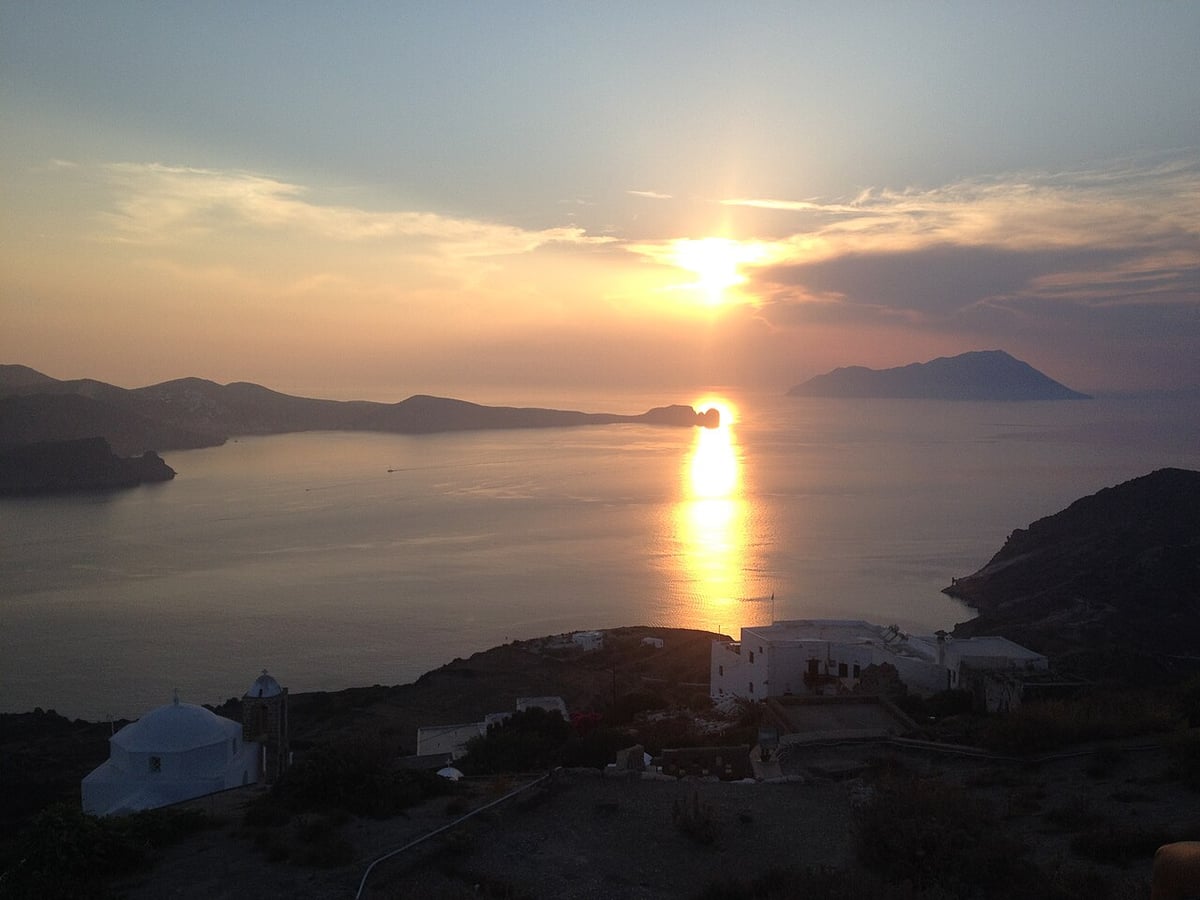
A sunset is the moment the sun slips below the horizon. Astronomers define it as the instant the upper edge of the sun disappears. A Milos sunset cruise has the boat out on the water by then. The whole trip is timed to reach that moment.
A Milos sunset cruise belongs to the end of the day. The sky is the main sight, more than any single cove or beach. Passengers sit back and watch the light change over the sea. That sets the trip apart from a swim stop in the middle of the day.
On the map, Milos holds the south-western corner of the Cyclades. No other island of that group lies further out in that direction. For a boat on the west side, the view ahead is open water. A Milos sunset cruise makes use of that wide horizon.
The island curls like a horseshoe around a very large bay. That bay is a natural harbour. It is one of the biggest in Greece. Adamas, the main port, stands on its shore. A boat can leave the harbour and head for open sea.
The climate is Mediterranean, with dry summers that are warm to hot. It is a popular place to visit in that season. Dry summer weather suits evenings spent outdoors on the water. A Milos sunset cruise fits that pattern.
Visitors are drawn to the island by its varied coast and its beaches. The rock is volcanic, since the whole island is of volcanic origin. Each beach looks different from the next. So the backdrop changes as a Milos sunset cruise moves along the shore.
Santorini and Mykonos draw more visitors, so Milos has a less crowded setting. Visitors also come for its traditional Greek architecture. It is still a popular place in summer. The sea trip adds a quiet way to end a day on the island.
- Idea: The trip is timed so that passengers watch the sun go down from the water.
- Position: The island is the south-westernmost of the Cyclades, so the western horizon is wide.
- Harbour: One very large natural bay forms one of the biggest harbours in Greece.
- Season: Summers are dry and warm to hot, and the island is popular then.
- Setting: Milos draws fewer visitors than Santorini and Mykonos.
A Milos sunset cruise is a simple idea with clear reasons behind it. The island sits at the south-western edge of its group. Open sea lies in front, and a huge harbour lies behind. The next section looks at the west coast itself. It shows why that shore faces the setting sun.

Why does the west coast suit a Milos sunset cruise?
A Milos sunset cruise looks west, because the summer sun goes down in the north-west. The great bay of Milos opens that way too. The west side holds no villages, so the shore stays wild and open to the sea.
Twice a year, at the equinoxes, the sun stands directly above the equator. On those days it sets due west. These are the spring and autumn equinoxes. In the Northern Hemisphere, the sun sets to the north-west in spring and summer. In autumn and winter, it sets to the south-west.
Milos lies north of the equator, so its sunsets follow the northern pattern. In summer, a Milos sunset cruise watches the sun sink towards the north-west. As the year turns, the sunset slides along the horizon towards the south-west. The view from the boat changes with it.
The great bay of Milos fills the island’s main crater. The bay enters from the north-west. It leaves two portions of land that are fairly equal in size. Its mouth therefore faces the same way as the summer sunset. A boat on a Milos sunset cruise that leaves the bay sails towards that side.
The wildest stretch of Milos lies in its western half. The land there holds old mines and a handful of settlements. Nearly all of it belongs to Natura 2000, a network of nature protection areas. Plants, herbs and wildflowers grow there, together with protected birds.
Profitis Elias, the highest mountain of Milos, rises in the west. The coast of Laconia, on the Peloponnese peninsula, lies 120 kilometres due west of Milos. The island’s list of beaches names 15 on the west side, and they are remote.
Antimilos is an uninhabited island north-west of Milos. A rare kind of goat lives there. It is a mass of trachyte, a rock formed when lava cools fast. It rises to 671 metres, and the old crater on top is still easy to make out. Locals call it Erimomilos, meaning Desert Milos.
In summer, the sun sets in the north-west. Antimilos lies on that side of Milos. So the island and the sunset share one part of the sky. A Milos sunset cruise in that season looks out across the sea towards both.
- Summer: In spring and summer, the sun sets to the north-west.
- Winter: In autumn and winter, the sun sets to the south-west instead.
- Bay: The bay enters the island from the north-west.
- West: No villages stand on this half, and it belongs to the Natura 2000 network.
- Antimilos: This empty island of volcanic rock lies north-west of Milos.
The west coast suits a Milos sunset cruise because sea, sky and island line up on one side. Separate pages cover the catamaran trip towards Klima and the trip to Polyaigos. Others cover the private boat tour and Kleftiko. Kleftiko is an area of white cliffs in the south-west. Each one adds its own route.
What does the afternoon route of a Milos sunset cruise cover before dusk?
A Milos sunset cruise leaves the bay, follows the empty west coast, and heads home at sunset. The stops come in coast order. They run from the bay villages to Cape Vani, the west beaches, Sykia and Kleftiko’s white cliffs.
A Milos sunset cruise from Adamas starts in the bay, a natural harbour inside the main crater. Among the natural bays of the Mediterranean, this one counts as large and very safe. Its mouth opens to the north-west, so the boat leaves the bay in that direction.
Adamas, the port town, stands on the north shore of the bay. Inside the bay, a Milos sunset cruise passes the fishing villages of the shore. Near the exit, it passes the rocks called the Bears, close to Plathiena beach.
The west coast starts at Cape Vani, where an old mine shares the name of the cape. The land beyond has no villages, only very small settlements and old mines. Natura 2000, a European scheme for protected nature, covers nearly all of western Milos.
The wildest part of the island lies in the west. Its highest peak, Mount Profitis Elias, rises there to 748 metres above the sea. A Milos sunset cruise keeps this rugged side on one hand and the open sea on the other.
After Cape Vani, the boat runs south along a chain of beaches. Kalogries comes first, in the north-west of the island, and Agkathia comes next. Triades and Ammoudaraki lie side by side after them, and Agios Ioannis closes the run.
On a Milos sunset cruise, Sykia comes after Agios Ioannis. This sea cave has no roof, so the sun lights the water inside, and only boats can enter. Beyond it lies Kleftiko in the south-west, with white cliffs and islets in three bays.
After Kleftiko, the boat turns back toward Adamas and the bay. On a Milos sunset cruise, the sun goes down on this final stretch. The bay villages and the Bears come into view again as the light fades.
- Start: The route in this order begins at Adamas, on the north shore of the bay.
- Bay exit: The bay opens to the north-west, near the Bears and Plathiena beach.
- Cape Vani: The cape marks the north end of the west coast and has an old mine.
- Beach count: The west side holds 15 beaches, from Cape Psalida in the south up to Vani.
- Final stretch: The sun sets on the run from Kleftiko back to Adamas.
This order follows the coast, so each stop leads straight to the next one. A Milos sunset cruise covers the whole west side in a single run. Each stop on this list is viewed from the deck, and the sunset comes last.

How does a Milos sunset cruise compare with the sunset view from Plaka?
A Milos sunset cruise and the view from Plaka show the same sun in two ways. Plaka gives a high view of the bay from 220 metres up. The boat gives a low view from the water, and it reaches the wild west coast.
The village of Plaka, capital of the island, sits on a rock 220 metres above the sea. Its lanes are too narrow for cars, and the view runs out over the gulf of Milos. Stone-paved alleys run past small shops and cafes.
The flat ground under its first houses gave Plaka its name. That ground lies on a plateau just below the Castle, which no longer had room for everyone. The medieval town grew there, as a natural extension of the fortress.
Venetians raised the Castle in the 13th century, on a volcanic hill at the top of Plaka. This hill is the classic land spot for sunsets. It offers a wide view of the bay and the nearby Cycladic islands.
The Castle dates from after 1204, and its rocky hill rises over the ancient town. Its height gave command over ships moving through the bay of Adamas. A church, Mesa Panagia, stands at the very top of the Castle.
At the western edge of Plaka, on steep rocks, sits the church of Panagia Korfiatissa. A visit to the church brings wide sea views and sunsets. Marble tombstones from the old town pave the ground in front of the church.
A Milos sunset cruise adds the wild west coast. This coast has no villages, and dirt roads lead to the beaches of Agkathia, Ammoudaraki and Agios Ioannis. A sea trip reaches beaches that are not accessible from land, and Sykia opens only to the sea.
The boat also gives a view of Plaka itself. From the bay, the village sits 220 metres up, with the Castle on the hill above it. A Milos sunset cruise shows this skyline from below, rising from the bay to the Castle.
- Height: Plaka stands 220 metres above the sea, so the land view looks down on the bay.
- Castle: The Venetian Castle gives sunset views of the bay and the nearby islands.
- Church: Panagia Korfiatissa, at the western edge of Plaka, is another place to watch the sunset.
- Sea trips: A boat reaches beaches and caves that are not accessible from land.
- Access: No cars can enter Plaka, and only motorbikes and mopeds fit its lanes.
Plaka offers the classic land view, from a hill high above the bay. A Milos sunset cruise offers the sea view, with open water and the west coast in sight. Each one shows the sunset from a different height, so the two views do not repeat each other.
Which fishing villages does a Milos sunset cruise pass at the end of the day?
A Milos sunset cruise passes Klima, Fourkovouni and Areti, three fishing villages along the bay. Klima sits right at the mouth of the bay, six kilometres from Adamas. The other two are very small, each with its own little beach.
Klima is a village on the sea, at the entrance to the bay of Milos. It lies below the village of Trypiti, six kilometres from Adamas. A boat that returns from the west coast enters the bay at this point.
Klima counted only 8 residents in the 2021 census, so the village is tiny. Since 1978, it has been listed as a traditional settlement. Its houses are the syrmata, and a separate page covers the fishing village of Klima.
Strong colours cover the doors and windows of Klima, and cats lie in the sun beside them. The houses stand at the water’s edge, in hollows of the rock. On the way home, a Milos sunset cruise sees this whole shore from the water.
The ruins of the ancient town of Milos lie on the slope between Trypiti and Klima. Klima was its landing place. An ancient theatre stands above the shore, and the Venus de Milo statue came to light nearby.
The village also holds a cave church of Agia Paraskevi. Its beach, like the nearby beach of Skinopi, is fit for swimming. Both beaches lie on the bay shore that a Milos sunset cruise passes on the way home.
On Klimatovouni, the hill above Klima, stands the church of Panagia Tourliani. From there, the eye reaches the villages higher up and the mouth of the bay. Visitors on land watch the sunset there, while a Milos sunset cruise sees the hill from below.
Fourkovouni and Areti are very small fishing villages with a little beach and painted syrmata. The bay holds 25 beaches in all, and these two are among them. On the way home, a Milos sunset cruise passes both of them.
- Klima: This seaside village stands at the bay entrance, below the village of Trypiti.
- Fourkovouni: A very small fishing village with a little beach and painted syrmata.
- Areti: A second very small fishing village, with its own little beach.
- Tourliani: The church on the hill above Klima looks over the entrance of the bay.
- Ancient town: The ancient theatre stands high above the seaside houses of Klima.
The three villages sit along one shore of the bay. A Milos sunset cruise passes them on its way between the harbour of Adamas and the open sea. Each village is small, with painted houses, a little beach and the sea at its door.

What are golden hour and blue hour on a Milos sunset cruise?
A Milos sunset cruise moves through two named stretches of light. Golden hour is the warm, soft light just before the sun sets. Blue hour is the cool, blue light after the sun has gone down. Each one gives the sea and the rock a different colour.
Golden hour is the photographers’ name for the time when the sun hangs low. On a Milos sunset cruise, it is the stretch before the sun touches the sea. The light looks softer and redder than it does at noon, when the sun stands high.
A low sun sends its light through a thicker layer of air before it reaches the eye. The air scatters the blue and green light out of the beam. What is left is warm, reddish light, with orange and red near the horizon.
A Milos sunset cruise reaches blue hour once the sun sinks well below the horizon. Orange fades from the sky, and blue takes over. Sharp shadows vanish, because no direct sunlight reaches the sea, and the water looks calm and even.
This blue differs from the daytime blue, which comes from air scattering the sunlight. A layer of ozone high in the air absorbs part of the leftover light. Blue is what remains, and the term has no official start or end.
Milos is a volcanic island, and its bays hold white, red, yellow and even black rock. At Kleftiko in the south-west, the cliffs are white tuff, a rock formed from volcanic material. That tuff is made of pumice, which is light in colour.
A pale surface throws back much of the light that lands on it. So pale rock has no strong colour of its own and shows the colour of the light. In golden light, white cliffs look gold or rose, and in blue hour they turn cool.
The sea shows colour in two ways. Its surface mirrors the sky, and the deeper water below gives back its own blue-green glow. On a Milos sunset cruise, the viewing angle decides which one wins as the boat turns.
- Golden hour: Warm, soft light fills the stretch before the sun meets the horizon.
- Blue hour: Cool blue light follows once the sun is well below the horizon.
- Shadows: Long, soft shadows replace the harsh dark ones cast by a high midday sun.
- Length: On a Milos sunset cruise, neither hour has a fixed length, because the season moves both.
- Sea: The surface mirrors the sky while the water below keeps its blue-green glow.
On a Milos sunset cruise, golden hour hands over to blue hour without a break. Warm gold fades, cool blue grows, and the white cliffs change with every shift of the light. A passenger who knows both names can spot each change as it arrives.
How can a passenger take good low-light photos on a Milos sunset cruise?
Low-light photos on a Milos sunset cruise need three things. The camera faces the light, the grip stays steady, and the flash stays off. Dark shapes against a glowing sky then look bold, and the natural colour of the sea stays true.
A silhouette is a dark shape with no detail inside it, set against a bright background. A rock tower, a sail or a person at the rail can make one. The sky behind must be brighter than the shape.
To make a silhouette on a Milos sunset cruise, a photographer points the camera towards the setting sun. The camera then reads the bright sky, and everything in front of it turns dark. Photographers call this shooting against the light.
After the sun sets, objects still stand out as dark outlines against the lit sky. Shadows fade, so the scene looks calm and even. Lit buildings on the shore show up well, since the sky and the lamps match in brightness.
Dim light forces a camera to keep its shutter open longer to gather enough light. The shutter is the part that lets light reach the sensor. A longer opening turns every small movement into blur, and a moving deck makes plenty of them.
On a Milos sunset cruise, the deck keeps moving. A photographer can stand with the feet apart, the knees bent and the elbows tucked in. A solid rail or mast adds a second point of support, which steadies the camera further.
Image stabilization in a phone or camera reduces blur from small hand shakes. It does not fix big movements, so a rolling deck can still beat it. Pressing the button just as the deck settles gives a sharper frame and fewer ruined shots.
A built-in flash lights only what stands within about 3 metres of the camera. Past that distance, the pictures turn dark and murky, with a speckled grain. The cliffs and the sky sit far beyond that reach, and a harsh flash flattens soft shadows.
- Silhouettes: A dark shape against a glowing sky gives a clear, bold outline.
- Direction: On a Milos sunset cruise, facing the light keeps the sky’s colour and darkens the foreground.
- Shutter: Dim light means a longer opening, so movement shows up as blur.
- Stance: Feet apart, knees bent and elbows in cut the shake from the deck.
- Flash: Switched off, it leaves the natural colour of the sky and sea untouched.
Low-light photos on a Milos sunset cruise reward patience and a steady hand. The best frames use the sky’s own light, a steady stance and a switched-off flash. A photographer who waits for blue hour gets an even sky behind the dark coast.
Which boat suits a Milos sunset cruise best?
A Milos sunset cruise suits three boat types. A catamaran feels steady, a sailing yacht feels quiet, and a wooden boat feels close to the sea. The right pick depends on how the passenger wants to spend the last light.
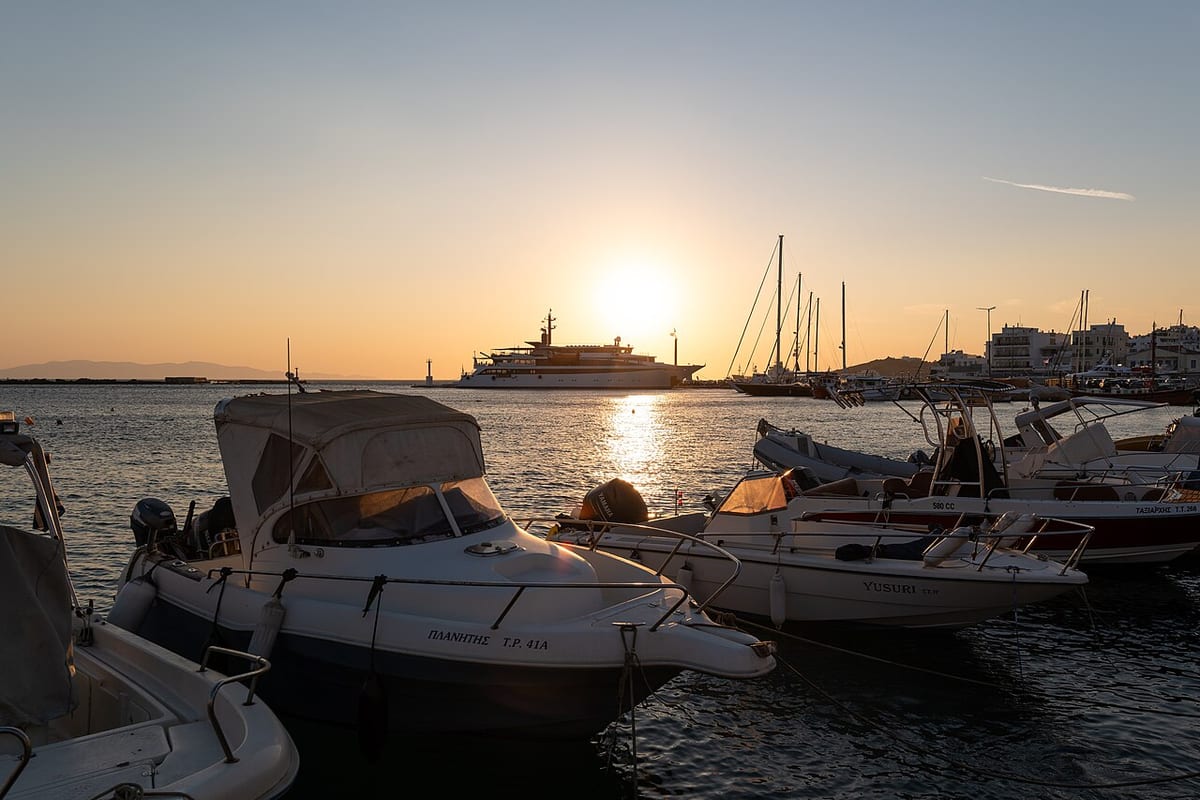
A catamaran rides on two hulls of the same size, set side by side. A monohull, by contrast, has just one hull. The wide gap between the two hulls resists rolling and tipping, which keeps the deck steady at dusk.
Next to a monohull, a catamaran leans less under sail and rocks less in waves. The page on a Milos catamaran cruise shows how this boat works by day. At dusk, its wide deck gives room to follow the sun.
A sailing yacht is a leisure boat built to move by sail. A boat under sail makes little engine noise, since the wind does the pushing. On a Milos sunset cruise, that leaves room for the sound of water, wind and rope.
A yacht with a single hull leans to one side when the wind fills the sails. Passengers lean with it or sit on the high side. The page on a Milos sailing tour covers how a yacht handles the wind by day.
Greek waters have an old wooden boat called the caique, found around the Aegean and Ionian seas. Pine is a common wood for the hull, and the boat is painted in bright colours. Fishermen used caiques first, and today they also carry passengers.
On a Milos sunset cruise, a small wooden boat sits lower than a large catamaran. Passengers sit nearer the water, and the pace of the evening feels slow and easy. Wind and waves are easier to feel there, which suits a quiet evening.
Each type also treats a camera differently on a Milos sunset cruise. A steady deck helps in dim light, when the shutter stays open longer. A leaning or bobbing deck calls for a firm stance and patient timing.
- Catamaran: Two hulls, a wide deck and little leaning make it the steadiest choice.
- Sailing yacht: Sails replace engine noise, and the deck tilts with the wind.
- Wooden boat: A caique is a pine boat, brightly painted, that sits close to the water.
- Motion: On a Milos sunset cruise, wide boats roll less in waves than boats with one hull.
- Feel: Steady, quiet or traditional are the three moods a boat can give the evening.
No boat type is wrong for a Milos sunset cruise, because all three share the same evening sky. The choice comes down to feel: steady, quiet or traditional. Knowing that before choosing keeps the focus on the sunset instead of the boat.

Is a Milos sunset cruise better shared or private for couples and groups?
A Milos sunset cruise works shared or private, and the sky is the same on both. A shared boat brings company and a lively deck. A private boat hands the entire deck, the pace and the quiet to one couple or one group.
A shared Milos sunset cruise puts separate parties on one boat. The deck feels social. People gather along the rail that faces the sun. Strangers point at the sky together and share the same view. Solo travellers and pairs who like company find it easy to join in.
A shared boat follows a single plan. The skipper picks the spot where the boat waits for the sun. Every party watches from there. Nobody has to decide anything. The trade-off is space, since the rail and the seats are shared by all.
A sunset happens once a day, so the moment cannot be repeated. On a Milos sunset cruise, the boat must be in place before the sun reaches the horizon. A shared boat keeps one schedule for every party. A private boat can fit the schedule to the people on board.
A couple on a private boat keeps the whole deck to itself. No other party stands in the view. The two can sit still and watch the sky change. Honeymoons, proposals and parties have their own page on a Milos private boat tour. This section stays with the sunset.
A group of friends or a family sets its own mood on a private boat. The sun does not set in the same spot all year. In autumn, it sinks toward the south-west. A private group can ask the skipper to face that way. Wind and sea still decide what is safe.
Groups with a young child or an older relative have needs of their own. They want a calm pace and an easy seat near the rail. A private boat lets them keep that pace, and no other party sets the rhythm.
Three things stay equal on both boats. The sun sets at the same moment for every party. The sea and the wind are the same for all. The skipper still decides the final route on the day, because weather and sea come first.
- Company: A shared Milos sunset cruise brings new faces to the rail.
- Space: A private boat leaves the whole deck and every seat to one party.
- Pace: A shared boat keeps one plan, while a private group sets its own.
- Couples: A pair can pick a lively shared deck or a quiet private one.
- Groups: Friends and families keep their own plan and mood on a private boat.
A Milos sunset cruise gives couples and groups the same sky. The choice is about company and space. A shared boat is lively and social. A private boat is calm and personal. Either way, the sun sets only once, and the whole evening is planned around that moment.

Which food and drink suit a Milos sunset cruise?
A Milos sunset cruise suits light bites, local island products and a glass of Greek wine. Cheese, bread and small sweets need no cooking. Water comes with every glass of wine, so the evening stays comfortable for everyone on board.
Food on a Milos sunset cruise works best when it is small. Hands stay free for the rail. A bite that needs no knife is easy to eat standing up. Boats differ in what they serve, so the crew explains what is on the tray.
Cheese is a good start. On Milos, cheesemakers turn sheep or goat milk into arseniko. It ripens in stone storerooms and turns spicy. Xino tyri is the island’s sour cheese. It is eaten fresh and has a gentle tang. Both come in small pieces and need no cooking, which suits a Milos sunset cruise.
Bread carries the cheese. Fouskoma is a sourdough loaf. A wood-fired oven bakes it. Paximadi is hard bread, baked from wheat, barley and rye. The tomato paste of Milos is called beltes. At times it comes as a starter with a little olive oil. Together they make a plain tray with no cooking.
Small sweets fit the end of a Milos sunset cruise. Pasteli is a bar of sesame and honey. Koufeta are little almond sweets coated with icing sugar. Karpouzopita is a pie made with watermelon. Each one is easy to share.
Wine has a long past in Greece. The oldest signs of Greek wine are 6,500 years old. Wine, olive oil and wheat formed the base of ancient Greek food. A glass of Greek wine on a Milos sunset cruise belongs to that long story.
Winemaking on Milos has revived in recent years. Local makers produce wines that show the volcanic soil of Milos. Roditis is a Greek grape that makes light white wines with citrus flavours. Retsina is flavoured with pine resin, so its taste is distinct.
Drinking water matters at sea, even at sunset. Dehydration means too little water in the body. Strong drinks make it worse, so a glass of water goes beside each glass of wine. Food adds water too. Children and older adults are at higher risk, so they get water first.
- Cheese: Arseniko is spicy, and xino tyri is fresh with a gentle tang.
- Bread: Fouskoma is a sourdough loaf, and paximadi is a hard bread from three grains.
- Sweets: Pasteli, koufeta and karpouzopita are easy to share.
- Wine: Roditis is a light white, and retsina has a pine resin taste.
- Water: A glass of water goes beside each glass of wine on a Milos sunset cruise.
A Milos sunset cruise needs only a small table. Local cheese, bread, a sweet and a glass of Greek wine are enough. The tray stays simple, so nobody misses the sky. Water stays within reach all evening. Full hot meze plates suit a Milos catamaran cruise instead.
How do evening wind and the ride back after dark change a Milos sunset cruise?
A Milos sunset cruise can meet a calmer sea than the afternoon. The air turns cool and the light fades. The boat shows its red, green and white navigation lights. Passengers stay seated on the ride back to harbour.
The summer north wind of the Aegean, the meltemi, belongs to the day. It pushes hardest in the afternoon, when the land is hottest. A Kleftiko boat tour in the afternoon meets a livelier sea. A Milos sunset cruise sails as that push fades.
Not every evening follows that pattern. The wind can die down at night, yet a spell can also run for days without a break. So the evening sea changes from day to day. On a Milos sunset cruise, that decides how much the boat rocks.
On a Milos sunset cruise, the island adds its own wind after dusk. Land cools faster than the sea once the sun is gone. Cool air then drifts from the land out over the water. This land breeze is shallower than the sea breeze of the day.
On a Milos sunset cruise, the cool air reaches the deck first. The sun stops warming the boards, and the north wind cools the summer heat. A moving boat adds a breeze of its own. Someone hot at the dock can feel cold on the ride back.
After sunset, a boat needs lights so other boats can see it. These navigation lights show where the boat is, which way it points and what it is doing. Other skippers use them to judge the risk of a crash. International agreements set the rules for them.
The lights follow a colour code. Red marks the left side of the boat. Green marks the right side. Left and right are seen from on board, facing forward. A white light shows the back of the boat. The colours glow as the harbour comes into view.
On a Milos sunset cruise, the ride back is the time to stay seated. In low light, steps, ropes and edges are hard to see. A deck that rocks makes standing unsafe. A seat also keeps the head still, which helps against seasickness. Fresh air in the open beats a spot below deck.
- Wind: The north wind is strongest by day and can settle once night falls.
- Land breeze: Cool air from the island can drift out over the sea after dusk.
- Chill: The deck feels cooler than the dock, so a layer waits in the bag.
- Anchor: A boat at anchor shows white lights that can be seen from all sides.
- Seat: A seat in the open air keeps the head still and the eyes on the horizon.
A Milos sunset cruise ends with a calmer sea, a cooler deck and a lit boat. Passengers who know this plan for it. They sit down early, watch the horizon and let the crew bring the boat home. The evening wind then becomes a small detail.
What belongs in the bag for a Milos sunset cruise?
A Milos sunset cruise calls for five items. These are a warm layer, a hat, sun cream, a small torch and a bag that closes. The warm layer earns its place on the ride back, after the air has cooled.
The warm layer matters because the evening is cooler than the afternoon. The sun stops heating the deck, and the land cools faster than the sea. A fleece or a long-sleeved top works well. A scarf can cover the shoulders. On a Milos sunset cruise, the layer goes on when the boat heads home.
A hat is the next item. On a Milos sunset cruise, the sun hangs low in the west at day’s end. It shines level into the eyes. A cap or a hat with a brim gives shade. A chin strap or a clip keeps it on the head when the boat picks up speed.
Sun cream still has a job in the evening. Skin on an open deck stays uncovered until the sun is gone. A coat before boarding protects the face, neck and arms. Wind and spray wear it off, so a small tube stays in the bag for a second coat.
A small torch or a phone light helps after dark. It finds the way down the steps and across the dock. It also finds a dropped item under a bench. Pointed at the floor, it keeps glare away from the crew. Small craft can even use a hand-held flashlight in place of fixed lights.
A bag that closes keeps small things safe. A zip or a fold-over top stops a phone or a hat from sliding across a moving deck. A shoulder strap leaves both hands free for rails and steps. On a Milos sunset cruise, the bag also keeps the warm layer dry.
Motion sickness comes from a clash between what the eyes see and what the inner ear feels. On a Milos sunset cruise, a look at the horizon helps. So does keeping the head still. Reading or watching a small screen makes the clash worse. The phone waits until the boat is still.
Dusk takes the horizon away, and poor visibility can worsen seasickness. A seat in the open air, facing the last light, gives the eyes a target. Below deck, the eyes lose the view. Ginger and acupuncture have mixed results. Medicines carry side effects, so that choice stays personal.
- Layer: A fleece or windproof jacket goes on before the boat turns for harbour.
- Hat: A cap with a strap stays on when the wind rises.
- Cream: A small tube goes in the bag for a second coat.
- Light: A torch or phone light waits in an easy pocket.
- Bag: A closing bag with a shoulder strap holds it all.
With these items packed, a Milos sunset cruise stays comfortable. That holds from the golden hour to the last lamp on the dock. Each item is small. Together they cover cold, glare, sun and the dark. A camera for the colours over the water is the only extra.
How does a traveller choose a Milos sunset cruise?
Four checks make a Milos sunset cruise simple to choose. The first is the start harbour, and the second is the boat type. The third is shared or private. The fourth is what the tour description says about the swim stop and the return sail.
The port of Adamas sits inside a natural harbour. This harbour fills the hollow of a volcanic crater. Adamas is also the commercial centre of the island. A trip from here begins inside the wide bay. The boat reaches open sea only at the harbour entrance.
The village of Pollonia lies by the sea on the north-east side. Its harbour ranks second on the island, behind Adamas. A traveller who sleeps in the north-east can start from Pollonia. This saves the drive across the island, if the tour offers that harbour.
The boat type is the second check. Sailing boats, catamarans and motorboats all run sunset trips. The type changes the noise, the speed and the feel of the deck. A traveller matches the type to the group, so the description has to name it.
The third check is shared or private. A shared boat mixes parties, and a private boat belongs to one group. Passengers drift to the rail as the sun drops. The passenger limit therefore matters more than the label. A description that gives the limit shows how full the deck gets.
A clear tour description names the swim stop. It says whether swimming is part of the trip at all. It also tells the reader if a ladder or a platform helps swimmers climb back on board. Swimmers then know what to pack before the day starts.
The same description explains the return. It names the harbour where the boat docks. It also says whether the sail back happens after dark. These lines show how the evening ends, which matters for children and for anyone with reduced mobility.
Vague wording is a warning sign. A line such as sunset views, with no harbour, boat type or return point, leaves the traveller guessing. A short message to the operator can fill the gaps before a choice is made.
- Harbour: The description names Adamas or Pollonia as the start and the end point.
- Boat: The description names the type, such as a sailing boat, a catamaran with two hulls, or a motorboat.
- Group: The description says in plain words if the trip is shared or private.
- Swim stop: The description says if swimming is included and where the stop is.
- Return: The description says where the boat docks once the sun has set.
These five checks turn a vague offer into a clear plan. A traveller who reads them before booking knows the harbour, the boat, the group and the way back. The evening then holds no surprises. The sunset can take all the attention.

What else do travellers ask about a Milos sunset cruise?
A Milos sunset cruise raises eight common questions. They cover swimming, children, cloud, seasickness and reduced mobility. They also cover the season, the way back to the hotel and day tours. Each answer below takes one clear point and stays short.
Can passengers swim on a Milos sunset cruise?
Swimming depends on the boat and the route. A swim stop, when the tour offers one, takes place while the sky is still bright. Twilight follows the sunset, then night falls, and rocks and depth are hard to see in dim light. Passengers who want to swim wear swimwear under their clothes.
Is a Milos sunset cruise suitable for children?
A Milos sunset cruise suits children who can sit still on a moving boat. Life jackets come in sizes for body weight, from infants to adults. A good description lists the child sizes. An adult stays within reach of each child on deck. A snack and a quiet game help young passengers settle.
What happens on a Milos sunset cruise in cloudy weather?
A cloudy evening changes the view, but it does not end it. Cloud droplets scatter the reddened light of the low sun. The glow can then spread along the horizon in red and orange. A thick bank of cloud hides the sun itself. The colour then shows on the clouds above the horizon.
Does a Milos sunset cruise cause seasickness in the evening?
Motion sickness affects about a third of all people. The rest feel it only in very rough conditions. Car sickness does not predict seasickness, since the two differ from person to person. Sea legs build up with time on board. A pharmacist can advise on medicine before a Milos sunset cruise, because side effects limit its use.
Is a Milos sunset cruise possible with reduced mobility?
Boarding is the main question for a Milos sunset cruise with reduced mobility. Quays and decks sit at different heights. A small boat can need a ladder or a narrow step. A traveller asks the operator about the boarding method, the seats, the handrails and the toilet. This is best done before choosing a trip.
How does a Milos sunset cruise change through the year?
The evening changes with the season. At the summer solstice, the longest day of the year, the sun sets late. At the winter solstice, the shortest day, it sets early. Between the two, the moment of sunset shifts back and forth. A tour description therefore names the season, because June and December bring different skies.
How do passengers get to the hotel after a Milos sunset cruise?
The way to the hotel starts at the quay where the boat docks. The island is about 23 kilometres long and 13 kilometres wide. A drive from any harbour to a hotel is therefore short. Hotel staff can name the easiest route before the trip. A plan for the way back keeps the end of the evening easy.
Can a Milos sunset cruise follow a day tour on Milos?
A Milos sunset cruise can follow a day tour if the two trips fit one day. Sun, wind and boat motion add up. A day on land before the cruise is therefore gentler than two trips at sea. The page on activities in Milos lists the options for the rest of the day.