
The Venus de Milo is an ancient Greek marble statue of a goddess. In 1820 a farmer unearthed it in the south-west Cyclades, on the island of Milos. Today the statue stands in the Louvre museum in Paris. It is one of the best-known works of ancient Greek sculpture. Both arms are missing.
This page follows the Venus de Milo from the find to the Louvre. It explains the missing arms, the sculptor, the date and the marble. It also covers the copies of the statue and the calls for its return. The last sections cover the places on Milos tied to the statue today.
What is the Venus de Milo at a glance?
The Venus de Milo is an ancient Greek marble statue of a woman, believed to be Aphrodite. It was found on the island of Milos in 1820. The Louvre museum in Paris has displayed it since 1821, and it remains there today.
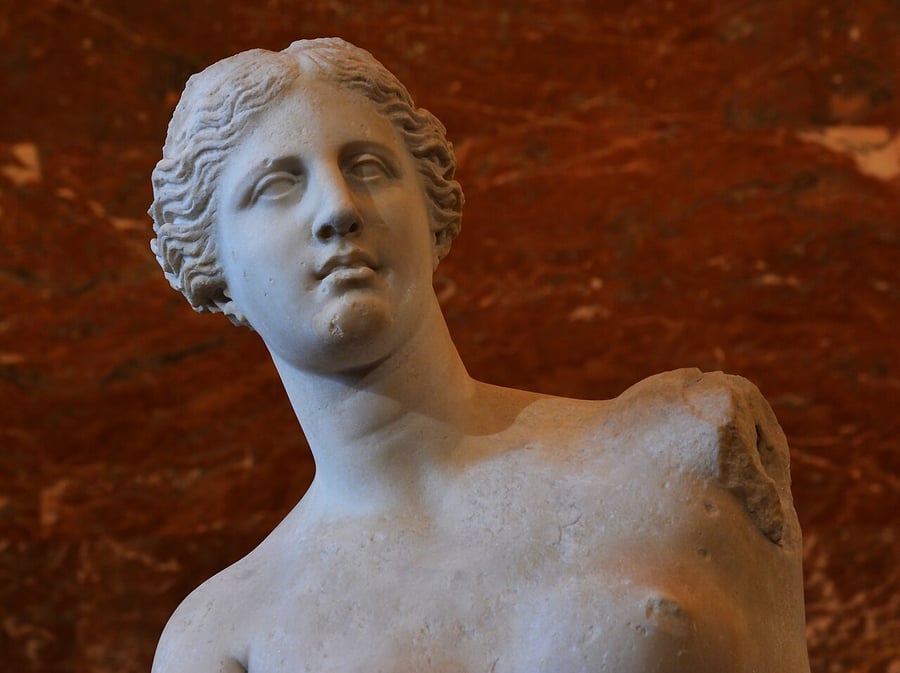
The Venus de Milo is larger than life size, with a height of over two metres. It is carved from Parian marble, a stone from the island of Paros. The upper body is bare, and drapery covers the lower half. The skin is polished smooth, while chisel marks remain on other surfaces.
A farmer on Milos unearthed the statue in 1820. France acquired it almost at once, and the king of France gave it to the Louvre in 1821. The Venus de Milo has been in the museum since then. In all that time it has left France only once.
Experts place the statue in the late Hellenistic period. That is the age after Classical Greece. Alexander the Great had by then spread Greek culture far beyond Greece. The Venus de Milo joins features of two styles. The small eyes and the strong brow look classical. The torso and the deep drapery look Hellenistic.
Both arms of the Venus de Milo are missing. So are the left foot and the earlobes. Below the right breast, a filled hole once held a metal peg for the right arm. Restoration was minimal. Only the nose tip, the lower lip, the right big toe and parts of the drapery were restored.
The Louvre counts the statue among the three great ladies of the museum. The other two are the Mona Lisa and the Victory of Samothrace. More than seven million visitors see the statue each year. On Milos, the Venus de Milo is a trademark of the island and of its tourism.
- Type: A marble statue of a woman, shown as a goddess and larger than life size.
- Found: In 1820, on Milos, an island of the Cyclades group in the Aegean Sea.
- Home: The Louvre museum in Paris, in a hall of the Sully wing named after the statue.
- Period: The Hellenistic age, a late chapter of ancient Greek art.
- Missing: The two arms, the left foot and the earlobes have all been lost.
The statue is one chapter in a longer story. The island that gave it its name has a past far older than the statue. A settlement at Phylakopi on the island dates back to the Bronze Age. The history of Milos sets out that background. It shows where the statue fits.

Which goddess does the Venus de Milo show, and why is it called Venus?
The Venus de Milo is believed to show Aphrodite, the Greek goddess of love and beauty. Venus is the Roman goddess who was matched with her. The words “de Milo” name the Greek island where the statue was found in 1820.
Aphrodite was an ancient Greek goddess of love and beauty. One poem calls her the daughter of Zeus and Dione. Another poem says she rose from the foam of the sea. Her symbols included the sea, conch shells and roses. Her main places of worship were Cythera, Cyprus, Corinth and Athens.
Venus began as a Roman goddess of farm fertility, plants and springtime. The Roman historian Livy places the official match with Aphrodite in the third century BC. After that, the Romans gave Venus the myths and the images of Aphrodite. Venus was later honoured as the mother of the whole Roman nation.
Two names point to one goddess. Aphrodite is the Greek name, and Venus is the Roman one. The Venus de Milo is a Greek work, yet its best-known name is the Roman form. English texts spell the island Milos or Melos, so the figure is also the Aphrodite of Melos.
The missing arms make the identity hard to settle. Objects in the hands help to identify a Greek god, and these hands are gone. At the time of the find, opinions differed. Was the Venus de Milo the sea goddess Amphitrite, honoured on Milos? Other ideas were a Muse, Nemesis or the poet Sappho.
Three clues point the Venus de Milo to Aphrodite. The body is half bare, which suits the goddess of beauty. Marks left on the ears show that the statue wore earrings. A hand holding an apple was found nearby, carved in the same Parian marble. The apple is a sign of Aphrodite.
- Greek goddess: Aphrodite, the ancient Greek goddess linked with love and beauty.
- Roman goddess: Venus, the Roman goddess whom the Romans matched with Aphrodite.
- Greek title: Aphrodite of Milos, the form of the name used in Greece today.
- Island names: Milos and Melos are two English spellings of the same island.
- Rival idea: Amphitrite, a sea goddess honoured on Milos, was one early suggestion for the figure.
In short, the title holds three facts. The goddess is Greek, the label Venus is Roman, and the place of the find is Milos. The Venus de Milo thus joins two ancient cultures and one island in a single name. That mix explains why the statue has more than one title.
Where and how was the Venus de Milo found on Milos?
The Venus de Milo came out of a farmer’s field on Milos in the spring of 1820. He was digging stones from the ruins of the ancient city when he found carved marble. French sailors beside his field ran over and helped free the goddess.
The ancient city of Milos once covered a slope. It ran from the village of Trypiti to the landing place at Klima. The ancient theatre of Milos, built in Roman times, and stretches of the town wall still stand there. The farmer’s plot lay inside this ruined city. The Venus de Milo lay buried in its soil until 1820.
The farmer worked a terrace. A terrace is a flat step cut into a hillside. On 8 April 1820 he was digging old building stones out of the ruins in its soil. The ruins were what remained of the ancient city. Milos was still part of the Ottoman Empire then. The modern Greek state did not yet exist.
Frenchmen from the navy were digging for antiquities right beside his field. When the farmer struck carved marble, two of them ran to help. Among the Frenchmen was Olivier Voutier, a young man who had studied a little archaeology. Voutier watched the marble appear. He pressed the farmer to dig on, and the two men uncovered the figure together.
Two large pieces of the Venus de Milo came out: the torso and the legs. A smaller third piece followed. A hand that held an apple lay close by, with a broken piece of an arm. The farmer feared that the French meant to grab the figure or buy it cheaply. He tried to cover it again.
Jules Dumont d’Urville was a French naval officer. He landed on Milos soon after. He wrote an account of the Venus de Milo find. His report puts the statue in a four-sided niche, a hollow set into a wall. If that niche was her first home, she stood in the town’s gymnasium. A gymnasium was a public training ground.
- Sketch: Voutier drew the Venus de Milo on the spot, before the statue left the field.
- Pillars: Two herms, which are square pillars topped with a carved head, lay beside the figure.
- Sheepfold: The farmer moved the broken pieces to his sheepfold to keep them safe.
- Lost lettering: Both inscriptions found near the statue have since vanished, so only copies and drawings remain.
- Dedication: One inscription recorded a gift from Bakchios, son of Satios, the assistant gymnasiarch, a gymnasium official.
The find was a chance meeting of three groups. A Melian farmer held the marble in his sheepfold. French sailors wanted it for France. Ottoman rulers controlled the island and its antiquities. Each group had its own plan for the Venus de Milo, and the plans clashed. The story now turns to the French officers and their purchase.
Which French officers helped buy the Venus de Milo?
The Venus de Milo was bought for France by an ambassador’s aide named Marcellus. French navy men and a vice-consul saw its worth and raised the alarm. Marcellus reached Milos just as a rival buyer was loading the marble. The ship was bound for Constantinople.
Voutier lacked the money to buy the Venus de Milo, so he sought help. He told Louis Brest, the French vice-consul on Milos. A vice-consul is the official who looks after his country’s interests abroad. Brest came to see the marble and began to bargain. He also sent word at once to the French ambassador, the marquis de Rivière.
Jules Dumont d’Urville called at Milos days later. He was a French naval officer. His ship, the Chevrette, was surveying the Greek islands for sea charts. He saw the worth of the Venus de Milo at once and wanted to take it. His captain refused, because the ship had no room for it and stormy seas lay ahead.
So Dumont d’Urville wrote to the ambassador instead. His ship reached Constantinople on 22 April. There he argued for the purchase and told the tale to Marcellus, an assistant at the embassy. The ambassador was won over and agreed to buy the Venus de Milo for France. He sent his assistant Marcellus to Milos to close the deal.
Bargaining dragged on, and the French ship meant to carry the statue was late. The whole island had joined the haggling. The farmer and the elders grew tired of waiting. A second offer came, linked to an Ottoman interpreter of high rank. The marble was loaded onto a ship bound for Constantinople, the capital of the Ottoman Empire.
Marcellus arrived just as the loading began. He spent two days in talks with the island’s primates, its chief citizens. He asked them to cancel the first sale. He used argument and the threat of force. A priest fought the French officers. In the end Marcellus bought the Venus de Milo, and it went aboard a French ship.
- Olivier Voutier: A young French navy man who drew the find and raised the alarm.
- Louis Brest: The French vice-consul on Milos, who bargained and sent word to the ambassador.
- Jules Dumont d’Urville: A naval officer whose plea in Constantinople won over the ambassador.
- Marquis de Rivière: The ambassador who agreed to buy and later gave the statue to King Louis XVIII.
- Marcellus: The embassy aide who reached Milos in time and closed the purchase.
The purchase paid off for the men involved. Dumont d’Urville became a knight of the Legion of Honour, an award for service to France. The French Academy of Sciences took notice of him. He also rose to the rank of lieutenant. France, in turn, gained a new statue for the Louvre, the Venus de Milo.
How did the Venus de Milo travel from Milos to Paris?
The Venus de Milo left Milos on a French ship bound for France. It was offered to King Louis XVIII, and he passed it to the Louvre in March 1821. There, in Paris, it went on show exactly as found, with the arms still missing.
Two ships mattered on Milos. One was bound for Constantinople, the other for France. Ottoman law sent every ancient find to Constantinople. There the sultan used such finds to please other nations. Marcellus, who spoke for the French, talked the island leaders into choosing the French ship. That choice sent the Venus de Milo to France instead of Constantinople.
The statue left Milos in separate pieces. Two of the pieces were large, the upper body and the legs. The sculptor had built it that way, from two blocks joined at the hips. Fragments found beside the statue reached Paris as well. Since 2010, the Louvre has shown them in the same room as the Venus de Milo.
In France the statue became a royal gift. Louis XVIII had won back his throne after Napoleon lost the Battle of Waterloo in 1815. The Venus de Milo was then offered to this king. In March 1821 the king gave it on to the Louvre. A royal present, not a museum purchase, opened the statue’s life in Paris.
The Louvre had just lost a number of major works. After Napoleon fell, a large number of works taken by his armies went home. Their former owners had asked for them. During their reigns, Louis XVIII and his brother Charles X added to the collections. The Venus de Milo soon became a cornerstone of the antiquities there.
Paris noticed the Venus de Milo at once. Within a month of the Louvre gaining it, three French scholars published papers on it. They disagreed on every point. The statue first stood in the gallery of Antiques. Napoleon’s architects had rebuilt that gallery, which opened in 1811. They used grey and red marble, which makes white statues stand out.
- Report: Dumont d’Urville, a French naval officer, sailed on to Constantinople and reported the find.
- Plan: The marquis de Rivière agreed to send Marcellus to Milos to buy the statue.
- Rival: Nikolaos Mourouzis, a senior Ottoman fleet official, had persuaded the islanders to sell to him.
- Reign: Louis XVIII ruled France from 1814 until 1824, apart from the short Hundred Days in 1815.
- Moves: The statue’s arrival in 1821 began a long series of moves inside the museum.
So the Venus de Milo reached Paris as a royal gift. A ship, a diplomat and a king carried it from a farmer’s field on Milos to the Louvre. The statue has belonged to the museum since 1821. The Louvre counts her among its three great ladies, with the Mona Lisa and the Winged Victory.
What happened to the arms of the Venus de Milo?
The arms of the Venus de Milo were already missing when the statue was first found. A drawing made on the spot by an eyewitness shows her without arms. Fragments found nearby feed later ideas about her pose, yet nobody can prove a single final answer.
The Venus de Milo lacks her left arm and a large part of her right arm. The arms are not the only losses, since her left foot and earlobes are gone too. A filled hole sits below the right breast. It once held a metal peg, called a tenon. That peg was there to support the right arm.
One story says the arms of the Venus de Milo broke off in a fight over the statue. A scuffle did take place, yet the arms were not lost in it. Olivier Voutier was a French sailor keen on archaeology. He sketched the find on the spot. His sketch already shows her armless, from the very start.
Parts of arms came out of the ground near the statue. They include an arm fragment and a hand holding an apple. Two more arms and a foot in a sandal turned up around then. Tests were run during the 2010 restoration. They support the view that the arm piece and apple hand belonged to the Venus de Milo.
The sculptor built the statue in parts. The left arm was a separate piece, fitted into a socket. Small holes show where bronze extras sat: a diadem, or headband, and a bracelet on the right arm. The apple hand looks a little rough. Experts link that to the left side, which was meant to stay out of sight.
When the Venus de Milo entered the Louvre, the idea of adding new arms was discussed. The idea was dropped to avoid changing the work. The French scholar Quatremère de Quincy backed that choice. He believed she once stood in a group with a statue of Mars. That whole figure was gone, so a restoration was impossible.
- Apple idea: De Clarac held that she was a single figure, with an apple in her hand.
- Group idea: Quatremère thought her arms were around another figure, as part of a group.
- Cloth idea: In 1876, Fröhner pictured the right hand gripping slipping cloth and the left holding the apple.
- Modern view: One modern scholar calls Fröhner’s picture, which Furtwängler expanded, the best fit of all.
- Other ideas: Wreaths, a dove, spears, a mirror and a shield were named, and so was bathing.
Every pose in this list is an idea, and none is proven. Only the apple hand has firm support from testing in 2010. For all other details, the arms of the Venus de Milo remain an open question. The Louvre shows her as she was found, so the question stays open for every visitor.
Who made the Venus de Milo, and where did the signed block go?
The Venus de Milo is credited to a sculptor from Antioch on the Maeander, in modern Turkey. A block of stone found near the statue carried part of his signature, ending in “-andros”. The block is lost, so the name Alexandros is a reading, not a proven fact.
In 1820, diggers on Milos found more than a statue. Near the Venus de Milo lay a block of stone with Greek letters cut into it. An artist named Auguste Debay drew the block. His drawing shows it filling a missing section of the statue’s plinth. The plinth is the stone slab that a figure stands on.
The drawing preserves one line of Greek. It names a sculptor, but the first letters of his name are broken off. What remains ends in “-andros”. The line adds that he was a son of Menides. It gives his home city, Antioch on the Maeander. The name is uncertain, and its tie to the Venus de Milo is disputed.
Antioch on the Maeander was a city of ancient Caria, in what is now Turkey. It stood between two rivers, near their meeting point, and had a bridge over the Maeander. Its earlier name was Pythopolis. Antiochus I enlarged it and renamed it. The town has never been excavated. Its scanty ruins lie on a hill in Aydın Province.
Inscriptions at Thespiae, an ancient city near Mount Helicon in Greece, name an Alexandros, son of Menides. They record him as a winner in contests for composing and singing. He is thought to be the same man as the sculptor of the Venus de Milo. He seems to have been a travelling artist who made works to order.
The signed block vanished soon after the statue reached Paris. Its loss dates to the 1820s, when the Venus de Milo stood in the Louvre. The French of that time said the corner with the name was lost in lime plaster. They also said it belonged to another age. Yet the drawing shows it fitting the base exactly.
- Name: The surviving letters end in “-andros”, and the first letters are broken off.
- Father: Every inscription that names this sculptor gives his father’s name as Menides.
- Home city: The block gives his home as Antioch on the Maeander, in ancient Caria.
- Second text: A second inscription, also lost, recorded a dedication by Bakchios, son of Satios.
- Sketches: Olivier Voutier drew the block as the base of a herm, a type of pillar statue.
A widespread suspicion blames national pride. The Louvre’s leaders are said to have removed the block. Their aim was to claim a work by Praxiteles. The drawings leave room for doubt, since Debay shows no sign of the missing left foot. Nobody can now prove or disprove the block’s link to the Venus de Milo.
When was the Venus de Milo made, and why did experts once think it older?
The Venus de Milo was made in the late Hellenistic period, around the 2nd century BC. Experts in the 1800s placed it in the 4th century BC, the peak of classical art. In 1893 Adolf Furtwängler argued for the later date, and experts widely accept it even today.
The Hellenistic period began when Alexander the Great died in 323 BC. His empire split into smaller realms founded by his generals. Greek language and culture spread into all of them, as far as modern-day India. The word Hellenistic comes from Hellas, the Greek name for Greece. It marks a Greek world mixed with local customs from Asia.
Rome took the Greek mainland in 146 BC and later won the last big Greek kingdom, Egypt. That ended the age. In between, sculpture grew more natural and more full of feeling, even showing suffering. Artists studied how thin cloth falls over a body and made poses more flexible. Sculptors also began to show everyday people, children and animals.
The Venus de Milo shows these new habits. Her hips twist, and the folds of her robe are cut deep into the marble. Yet the statue also looks back to older art. Its small, regular eyes and mouth and its strong brow and nose follow the classical style. That is the earlier Greek style, from before Alexander the Great.
The date was disputed from the start. Within a month of the Louvre acquiring the Venus de Milo, three scholars in France wrote about it. Each reached a different view. The first placed it between the times of the sculptors Phidias and Praxiteles. One chose the mid-4th century. The third called it a later copy of a work by Praxiteles.
Through the 19th century, the 4th century stayed the accepted date. The Venus de Milo won wide praise for its skill. In 1893 Adolf Furtwängler argued that the statue was late Hellenistic. The lettering on the lost block also suggests the 2nd or 1st century BC. The exact year is uncertain, so experts give a period, not a date.
- Rare survivor: Hellenistic originals are rare, and the Venus de Milo is one of them.
- Classical traits: The eyes, the mouth, the brow and the nose follow the older classical style.
- Hellenistic traits: The shape of the torso and the deeply carved drapery belong to the later age.
- Praxiteles: Early scholars linked the statue to this master sculptor from Attica, in Greece.
- Doubt: The style of the inscription’s lettering cast doubt on that link to Praxiteles.
The later date also fits the island’s history. One scholar suggests the statue was ordered when Milos grew richer, as Rome took part in its affairs. Since 1893 the Venus de Milo has been read as a Hellenistic work that echoes older Greek art. That reading explains the classical look of its face.
What is the Venus de Milo made of, and how was it built?
The Venus de Milo is a Greek statue carved from Parian marble. This fine white stone was cut on the island of Paros. The sculptor worked the statue in separate pieces and joined them. It stands over two metres tall, which is larger than life size.
The marble of the Venus de Milo is called Parian. The name comes from Paros, an island in the Aegean Sea. Parian marble is fine-grained, which means its grains are tiny and even. It is also semi-translucent, so light sinks a little way into the stone. Its colour is pure white. The stone therefore came from another island.
Ancient Greeks prized Parian marble for statues. One type, called Parian lychnites, was famous as a sculpting stone. The Medici Venus and the Winged Victory of Samothrace were carved from it, like the Venus de Milo. Pentelic marble was its main rival. That stone is white as well, but a faint yellow tint makes it glow gold in sunlight.
Workers cut Parian marble on Paros in two ways. Open-pit quarries are wide holes dug open to the sky. Shaft quarries are narrow mines that run down into the rock. Two large shafts in the valley of Agios Minas are named after carvings near their entrances. They are the Grotto of the Nymphs and the Grotto of Pan.
A statue this large was built from parts. The Venus de Milo has two main pieces. They were fixed together below the waist, where the folds of the cloth fall. A join is the place where two separately carved blocks meet. The left arm was carved as a separate part too, so the finished figure was assembled.
A hole below the right breast of the Venus de Milo shows one more fixing. It once held a tenon, which is a metal peg. The peg supported the right arm, which is now lost. The hole is filled today. The sculptor polished the skin until it was smooth, while chisel marks still show on the other surfaces.
- Right side: The cloth on the right is carved in finer detail than the cloth on the left.
- Back: The rear is less finished, which points to a statue made for a front view.
- Lost parts: The two arms, the left foot and the lobes of both ears have not survived.
- Quarries: The main open-pit quarry sites on Paros are Chorodaki, Marathi and Agios Minas.
- Paint: No colour remains on the marble today, though the surface was possibly painted once.
Very little of the Venus de Milo was rebuilt in modern times. Only four small spots were repaired. The nose, the lower lip, one big toe and a bit of the cloth were fixed. Everything else is ancient marble from Paros, shaped with a chisel. Every join and peg hole records how the statue was made.
How does the Venus de Milo stand, and what is its style?
The Venus de Milo puts her weight on the right leg. The left leg is raised, and the head turns to the left. The torso is bare, and a cloth wraps the lower body. The style mixes the older classical look with the new Hellenistic taste for movement.
The Venus de Milo rests her weight on the right leg. The left leg is raised, and the hips twist. Her head turns to the left, and both arms are lost. The upper body is bare, and a cloth covers everything below the waist. A pose like this gives an illusion of movement before and after the moment shown.
A stance with the weight on one foot is called contrapposto. The word is Italian for counterpoise, meaning a balance of opposite forces. The shoulders and arms twist away from the hips and legs. The leg that carries the weight is the engaged leg. The other is the free leg. If one hip rises, that shoulder drops.
Greek sculptors first used contrapposto in the early 5th century BC. Earlier statues of young men and women stood straight. The new pose let a body show a relaxed mood for the first time in Western art. Later sculptors pushed the idea further. The twist of the hips marks the Venus de Milo, though the pose echoes an older model.
The Hellenistic age started with the death of Alexander the Great in 323 BC. Artists of that time made bodies look more natural and full of feeling. They studied how cloth falls and how thin cloth shows the body. They liked supple poses too. The Venus de Milo joins this interest to features borrowed from classical art.
Classical art is the earlier Greek style, from before that age. The face follows its habits. The eyes and the mouth are small and regular, and the brow and the nose are strong. The lips are slightly open, so the teeth show. The body is realistic, but the head is idealised, meaning shaped toward an ideal of beauty.
- Cloth: Deeply carved folds are a Hellenistic trait, and the cloth of the Venus de Milo has them.
- Slipping: A proposal from 1876 puts the right hand on the cloth as it slips from the hips.
- Torso: The torso looks calm, yet its broad surfaces turn through more angles than a first look shows.
- Hair: A band holds the hair in place, and loose curls escape behind it.
- Ears: Marks left on the ears show that she once wore earrings in them.
The Venus de Milo therefore joins two eras of Greek art in one figure. The small, even features belong to the classical past. The twisting hips and the deep folds belong to the Hellenistic age. One critic called her a baroque design with a classic effect. Baroque means rich in curves and movement.

Where does the Venus de Milo stand in the Louvre in Paris today?
The Venus de Milo is on display at the Louvre in Paris, its home since 1821. In 2010 the statue was restored and installed in a new setting. The fragments found beside it, including a hand holding an apple, share the same room.
The Louvre put the statue on show in 1821, the year after its discovery on Milos. Within a short time it was moved twice. Then it settled in the Salle du Tibre, its first long-term home, until 1848. The French word salle means hall. After that it moved to the Salle de l’Isis, where it stayed until 1870.
The Salle de l’Isis was renovated in the 1880s. The statue then received a new pedestal that let visitors turn it around. The approach to it was filled with other ancient statues of Venus. After the First World War, a curator suggested showing the Venus de Milo with the Mona Lisa. It was never carried out.
In 1936 the statue moved again, to the Salle de la Vénus de Milo. The room made space for the growing crowds. The other Venus statues along its approach were taken away, to focus visitors on this one. The route through the museum now ran in time order. The Venus de Milo stood between the classical and Hellenistic galleries.
The statue belongs to the Greek, Etruscan and Roman department. Its pieces come from around the Mediterranean. They date from the Neolithic, or New Stone Age, to the 6th century. The department is one of the oldest in the museum and holds works acquired by Francis I. Marble sculpture came first, with pieces such as the Venus de Milo.
In 1972 the Louvre tried out a new site for the statue. Renovation work in the 1980s and 1990s meant a temporary move. By 1999 the crowds around the statue were causing problems. The museum weighed going back to the old setting. In 2010 the Venus de Milo went into a new setting, which is where it stands today.
- Hidden away: In 1870 the statue was taken out of the museum to keep it safe.
- First World War: The statue went to the Church of the Jacobins in Toulouse, away from Paris.
- Second World War: The Venus de Milo moved to the Château de Valençay. A plaster copy stood in its place.
- Return: After the liberation of France, in early 1945, art began returning to the Louvre in Paris.
- Japan: In 1964 the statue was shown in Tokyo and Kyoto, its only trip out of France.
The Venus de Milo has changed rooms, pedestals and neighbours since 1821. The moves had two clear reasons: protection in troubled times and room for large crowds. Today the statue anchors the Greek, Etruscan and Roman collection in its 2010 setting. The Louvre counts it among its key acquisitions, and the fragments found beside it share the room.
Why is the Venus de Milo so famous, and which artists and works did it inspire?
The Venus de Milo became famous within years of its discovery in 1820 on the island of Milos. Plaster casts, photographs and bronze copies carried its image across Europe in the 19th century. Poets, painters and Surrealist artists then kept it in the public eye.
Its fame is modern. Nobody can say how ancient Greeks judged the statue, because too little evidence survives. Within years, the Venus de Milo took the central position once held by an older favourite. That favourite was the Venus de’ Medici. Soon the statue ranked among the best-known antiquities in Europe.
Copies of the Venus de Milo spread fast in the 19th century. They came as plaster casts, photographs and bronze figures. The Berlin Academy received a plaster cast in 1822, only a year after the Louvre acquired the statue. Another cast went on display at the Crystal Palace. These copies made the statue known far beyond Paris.
The statue has inspired poets since its discovery in 1820. More than 70 poems about it have been published. In the 19th century, poets of the Parnassian group and others wrote verse about it. That verse helped make the statue a key work in art history. In the early 20th century, poems turned to its physical attraction.
Painters of the 19th century used the statue as a subject and as a model. Honoré Daumier showed statuettes of the figure in his painting The Connoisseur. Max Klinger based the figure of Minerva in his Judgement of Paris on the Venus de Milo. Eugène Delacroix’s Liberty Leading the People has also been linked to the statue.
In the early 20th century the Surrealist art movement took notice. Erwin Blumenfeld made photo collages based on the statue, and Max Ernst used it in his instruction manuals. René Magritte painted a plaster copy with a pink body, a blue robe and a white head. Salvador Dalí based paintings and sculptures on it, including The Hallucinogenic Toreador.
- Photo collages: Clarence Sinclair Bull also made photo collages based on the statue.
- Performance: Niki de Saint-Phalle used a reproduction of the statue in a performance.
- Colour: Yves Klein made a copy of the statue in the colour called International Klein Blue.
- Film: A poster for the 1932 film Blonde Venus showed an actress posed as the Venus de Milo.
- Advertising: Adverts for breakfast cereal, jeans, cars and an early speakerphone have all used the statue.
One historian of Greek art argued that the statue’s reputation owes more to propaganda than to merit. Scholars have studied copies of the Aphrodite of Knidos, named in ancient texts, more than this statue. Even so, the Venus de Milo has kept its place in popular imagery as a symbol of beauty.
What claims did Milos make over the Venus de Milo?
The Venus de Milo caused one settled claim. In 1826 French authorities agreed to repay the people of Milos for losses linked to the sale. The islanders then gave up every further claim. The statue stayed in Paris, and Milos later received a faithful copy of it.
In 1820 Milos belonged to the Ottoman Empire, and Greece did not yet exist. Ottoman law sent every ancient find to Constantinople, where the government chose who received it. The sultan used such gifts to please nations that suited him. Handing out antiquities was a tool of foreign policy. The Venus de Milo was found under that law.
Soon the whole island joined the bargaining. The French vice-consul on Milos had already begun haggling. Then the chief interpreter of the Ottoman fleet arrived. He persuaded the islanders to sell the find to him. A French envoy talked them round with arguments and a threat of force. The Venus de Milo went on a French ship instead.
The talks with the island’s leaders lasted two days. During them, a priest resisted the French officers with violence. In the end the farmer who held the statue received a payment from the French envoy. On 1 March 1821 the Venus de Milo was handed to King Louis XVIII of France. He gave it to the Louvre.
One theory explains why the sculptor’s name on the Venus de Milo vanished. It says the French wanted to stop the Ottoman Empire asking for the statue back. Greece did not yet exist, so any request had to come from the Ottoman Empire. The inscription with the name was lost around 1825, while the statue stood in the Louvre.
On 25 January 1826 the French authorities made a deal with the people of Milos. They agreed to pay compensation, meaning money for a loss. It covered any harm done by the Ottoman interpreter and officials because of the sale. The islanders and all their descendants then gave up any further compensation. Clergymen and the French vice-consul witnessed the signing.
- Rule: Ottoman law sent every ancient find to Constantinople for a central decision.
- Rival buyer: The Ottoman fleet’s chief interpreter persuaded the islanders to sell to him.
- Delivery: The Venus de Milo was handed to the French king on 1 March 1821.
- Deal: In 1826 the islanders and their descendants gave up any further compensation.
- Copy: The Louvre later sent the museum on Milos a faithful copy as a gift.
Today the Venus de Milo stands in Paris. Milos keeps a plaster cast at the door of its museum in Plaka. The island sees the cast as a symbol of homecoming and remembrance, a focal point of its identity. The return of the Venus de Milo to Milos has taken the form of a copy.
What does the Venus de Milo find spot on Milos look like today?
The Venus de Milo find spot lies on the slope between Trypiti and Klima. This ground once belonged to the ancient city. A sign marks the place where the statue lay. The old city walls stand close by, and the ancient theatre lies further along the same route.
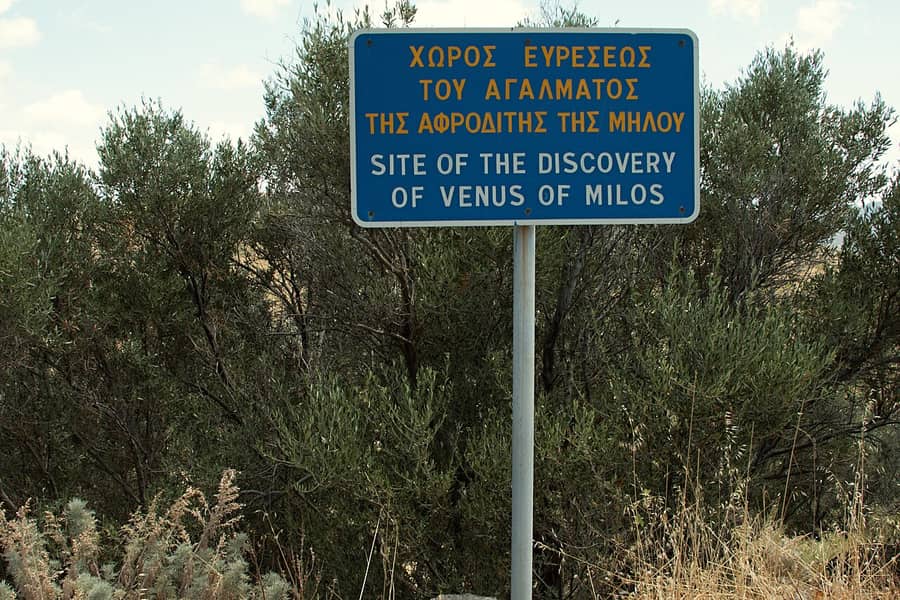
The ancient city of Milos covered the slope between Trypiti and Klima. The Venus de Milo was found on that slope in 1820. Above the spot, Trypiti climbs the hillside in tiers above the old classical town. Below it, Klima lies at the water’s edge, at the mouth of the bay. The find spot sits between the two.
After Fylakopi fell, the Dorians, a Greek people, built the island’s second-largest city here. It ran from the south of Trypiti to the area of today’s Klima. Klima still holds the ruins of old Klima, the first port of the island. The statue came out of the ground in this old landscape of walls, hills and shore.
A sign marks the place where the statue came out of the ground. It stands a short way below a turn on the dirt road. The turn comes 100 metres after the parking area. The road carries on for 400 metres and ends in front of the ancient theatre. Old olive trees stand along the walk.
The walls of the ancient city come first along the lane. More of the old city survives close by. Parts of the market wall remain. So do parts of a temple from Greek and Roman times, and of the theatre. A citadel, a fortified high point, stood on the hill of Prophet Elias. A second stood at Pyrgaki.
From the dirt road, a signed path of 850 metres runs down to the area called Tramythia. Ancient Milos was built there. The path splits after 180 metres. One side trail, 150 metres long, climbs to the chapel of Prophet Elias at the top. The main path drops to the shore and ends at the chapel of Agios Nikolaos.
- Setting: The Venus de Milo came out of the ground on the slope between Trypiti and Klima.
- Sign: A sign stands a short way below a turn on the dirt road.
- Walls: The ancient city walls are the first ruins met along the lane, before the find spot.
- Theatre: The dirt road ends in front of the ancient theatre, 400 metres on.
- Citadel: The hill of Prophet Elias carried one of the two citadels of the old city.
The Venus de Milo left this slope in 1820, yet the place still marks the find. The sign, the walls and the ruins hold the story. Another ruined building on the slope held a mosaic, dug up in 1896. The statue is in Paris, but the ground where it lay is still on Milos.
What does the museum in Plaka show besides its copy of the Venus de Milo?
A copy of the Venus de Milo is on show in the archaeological museum in Plaka. Plaka is the chief village of Milos. The same museum holds grave stones, reliefs, statues, pottery and inscriptions from the ancient city and its cemeteries. Its finds run in order of age.
The original Venus de Milo is in the Louvre in Paris. The copy in Plaka is a modern replica. The Louvre made it in its own workshops and sent it as a gift. It stands in for a statue that left the island long ago. Visitors see her shape on the island where she was found.
The copy fills a gap. The majority of finds from the ancient city came by chance or from illegal digs. Among them are important works of sculpture and pottery. A large part now sits in museums and collections abroad. The museum in Plaka shows what stayed on Milos. A copy of the Venus de Milo joins those finds.
Inscriptions hold a notable place among the exhibits. Cut into grave stones and statue bases, they give valuable facts about the city. They tell how Milos was governed and who its leading citizens were. They also name ordinary residents, temples, cults and public buildings. Other lines name the sculptors of statues in town and the people who dedicated them.
Daily life has its place. A marble head of Aphrodite recalls the Hellenistic age of the Venus de Milo. Coins show the economic strength of an island that was a hub of the Cyclades. Terracotta lamps, children’s toys and household idols add a home view. One small clay horse is a child’s toy about 2,500 years old.
Grave gifts add a human side. A past show in the front hall displayed Roman-age finds from the cemetery of the ancient city. These were a bronze mirror with a handle, gold earrings with glass beads and a glass cup. Such gifts went into graves with the dead. They reveal part of what people believed about the afterlife.
- Copy: The replica of the Venus de Milo shows the shape of the statue now in Paris.
- Stones: Reliefs, grave stones and statues come from the ancient city and its cemeteries.
- Small finds: Pottery, jewellery and small bronze objects from antiquity are on show.
- Texts: Inscriptions and Roman decrees tell of citizens, benefactors, temples and sculptors of the ancient city.
- Courtyard: The porch and courtyard hold statues, stone coffins, grave stones and torsos from late antiquity.
The Venus de Milo is the famous name tied to this museum. The other finds explain the city behind the statue. Stones, texts and grave gifts put the Venus de Milo back into its island world. The page about the archaeological museum of Milos covers the building, its architect and the earlier finds.
What was ancient Milos like when the Venus de Milo was made?
The Venus de Milo was made in Hellenistic times. Milos was then a port city on the slope above Klima. It had a harbour, a market square and temples, and a wall around two hills. Mineral trade brought wealth, and Rome gained influence from 197 BC.
The ancient city of Milos stood on the east side of the bay’s narrow entrance. Dorian Greeks from Laconia founded it in a spot that watches over the sea. People lived there for more than a thousand years. The ruins cover the slope between Trypiti and Klima. They climb the hill of Profitis Ilias and spread into two valleys.
The cove below the village of Klima was once the city harbour. Silt from the valley now covers a large part of it, and part lies under the sea. The fishermen’s boat shelters, called syrmata, mark the old shoreline. The bay is a safe anchorage. Milos lay at a crossroads of sea routes between West and East.
Strong walls once enclosed both hills, and parts still stand tall. Remains suggest that the agora, the market square, lay on flat ground between them. The marble theatre came later, in Roman times. When the Venus de Milo was made, that ground seems to have held graves. Later villages, Plaka and Trypiti, rose outside the old walls.
In 338 BC, Macedon became overlord of the Cyclades. Around then, Milos and Kimolos argued over three islands. Instead of war, they took the case to Argos. Argos gave the islands to Kimolos. In 197 BC, Philip V had to leave Greece under Roman pressure. Milos then came under Roman influence. The Venus de Milo was carved later.
Mineral products such as Melian earth, alum, pumice and sulfur were a basic source of wealth. Their trade drew interest from outside the island. Pliny the Elder noted that Milos was the richest source of sulfur in the ancient world. The alum of Milos ranked next to that of Egypt. Ancient artists used Melian earth as a pigment.
- Period: The Hellenistic period ran from the late 4th century BC to the 1st century BC.
- Cemetery: The dead were buried east of the walls, and the catacombs are part of that burial ground.
- Gaps: No systematic dig of the whole city has taken place, so the picture stays patchy.
- Reuse: Later villagers took stone and marble from the ruins for houses, churches and lime.
- Find: The statue was dug up close to the walls of this city.
The Venus de Milo came from a walled port city, not from an empty hillside. One archaeologist links the order for the statue to the island’s rising wealth under Rome. The finds that stayed on Milos now fill the museum in Plaka. Walls above Klima still mark where the city stood.

How do visitors walk to the Venus de Milo find spot from Trypiti?
The Venus de Milo find spot sits on the slope below Trypiti. A concrete road ends at a car park. A signed dirt road leads on from there. A sign just below the turn marks the ground. The track ends at the ancient theatre of Milos.
Visitors to the Venus de Milo site start in Trypiti. This village is almost joined to Plaka. The name Trypiti points to soft volcanic stone that looked pierced. Holes are cut into that stone too. At the heart of the village rises the church of Agios Nikolaos. Old windmills in the village once ground grain.
A concrete road runs downhill from the village. It stops at a car park. This is the end of the road for cars heading to the catacombs. A path through old olive trees leads on from here. The way to the find spot is on foot.
A left turn past the car park leads onto a dirt road. Signs along it point toward the archaeological site. The surface is rough, so closed shoes grip better than sandals. The slope here once held the ancient town of Milos. That town reached the shore at Klima, the island’s earliest port.
Just below the turn, a sign marks the place of the find. A local farmer found the statue here in 1820. The marble itself is far away in Paris. The visit is about the ground and its story. The dirt road then carries on to the ancient theatre.
The slope is open, so water and sun protection matter in summer. A phone or camera helps for the sign and the view. Trypiti has meze bars and restaurants for a meal before or after the walk. The return climbs uphill. It is the harder half of the trip.
- Start: Trypiti, built in tiers above the ruins, with a wide view of the bay of Adamas.
- Car park: The concrete road ends here, and a path through the olive trees leads to the catacombs.
- Turn: A left turn past the car park leads onto the signed dirt road.
- Sign: A sign just below the turn marks the spot where the statue lay.
- End: The dirt road stops in front of the ancient theatre of Milos.
The walk joins three sights in one trip. These are the find spot, the ancient theatre and the early Christian tombs. Each lies within walking distance of Trypiti. For the tombs themselves, the page about the catacombs of Milos goes into detail.
Which other famous finds came from Milos besides the Venus de Milo?
Besides the Venus de Milo, Milos gave up a Poseidon, an Asclepius head and an archaic Apollo. The Poseidon and the Apollo are in Athens. The Asclepius head is in the British Museum. Finds from Phylakopi are in Athens and Plaka.
The ancient town between Trypiti and Klima gave up more than one famous work. A fine mosaic also came from a building there. The British School at Athens dug it up in 1896. The best known find went to Paris. Others went to London and Athens.
The Poseidon of Melos shows the sea god. It was found in pieces on Milos in the 1870s. The Parian marble figure stands 2.35 metres tall, more than life size. A dolphin behind the figure helps carry the weight. It now belongs to the National Archaeological Museum in Athens.
The head of Asclepius, the god of healing, comes from a statue twice life size. It was found at his shrine on Milos in the mid-19th century. The British Museum bought it in 1867 together with a larger collection. Drill holes and lead pegs once held a gold wreath on the head.
An archaic Apollo from the same ancient town is also in Athens. Beside the statue, diggers found a hand holding an apple. They also found two herms, which are stone posts topped with a head. Since 2010 these pieces share a room with the statue in the Louvre.
Older finds come from Phylakopi, a Bronze Age town on the north-east coast. Its ruins gave a wall painting of flying fish. In the 1970s, diggers found a shrine there with figurines. The National Archaeological Museum in Athens shows its finds. More are in the Archaeological Museum of Milos at Plaka.
- Poseidon: This sea god, found in the 1870s, stands 2.35 metres tall and is now in Athens.
- Asclepius: The marble head has been in the British Museum in London since 1867.
- Apollo: This archaic statue from the ancient town is in the National Archaeological Museum.
- Phylakopi: Wall paintings and figurines from the Bronze Age town are shown in Athens and Plaka.
- Fragments: The apple hand and the herms now share a room with the statue in Paris.
Works found on Milos now sit in Paris, London and Athens. The ground they came from is still there. The ancient town held a wealth of fine art. The page about activities in Milos lists more ways to explore the island.
What do visitors ask about the Venus de Milo?
The Venus de Milo is a marble goddess from the Hellenistic age. A farmer dug her up on Milos in spring 1820. The Louvre has shown her since 1821. These answers cover her age, material, missing arms, size, find spot and the copy on the island.
Where is the Venus de Milo now?
The Louvre museum in Paris holds the Venus de Milo. She has been on show there since 1821. Renovations in the 1980s and 1990s moved her for a time. A new setting followed in 2010. The pieces found beside her now share the same room. Her one trip abroad was a 1964 show in Tokyo and Kyoto.
Can the Venus de Milo be seen on Milos?
The original cannot be seen on Milos. Inside the Archaeological Museum in Plaka, visitors meet a plaster cast of the Venus de Milo. The Louvre sent the island a faithful copy as a gift too. The find spot near the ancient theatre can be visited as well. Together they link the island to the statue.
Who found the Venus de Milo?
On 8 April 1820 a local farmer came across the Venus de Milo. He was clearing stones from old ruins on his plot. A visiting Frenchman, Olivier Voutier, saw the carved marble. He urged the farmer to keep digging and sketched the find at once. The Ottoman Empire ruled Milos at that time.
How old is the Venus de Milo?
The Venus de Milo is more than 2,000 years old. She belongs to the Hellenistic period, in the last two centuries BC. The exact decades are uncertain. In the 19th century, scholars placed her in the fourth century BC. A scholar argued for a later date in 1893, and it is widely accepted today.
What is the Venus de Milo made of?
The Venus de Milo is carved from Parian marble. The Poseidon and the Asclepius head from Milos use the same kind of stone. The sculptor built her from separate pieces that fit together. Her skin has a smooth, polished finish. Chisel marks stay visible on the other surfaces. Repairs are small, such as the nose tip.
Why does the Venus de Milo have no arms?
She was found without her arms. A hand holding an apple and part of an arm lay beside her. Tests in 2010 supported that these pieces belong to her. A hole below her right breast once held a metal support for the right arm. How the arms stood is still unknown.
Does the Venus de Milo show Aphrodite?
Yes, scholars believe the statue shows Aphrodite, the Greek goddess of love. The Romans called the same goddess Venus, which gave the statue its common name. The first written accounts describe her holding the apple of discord. Other proposals include the sea goddess Amphitrite, a Muse, Nemesis and Sappho. Aphrodite is still the accepted answer today.
How tall is the Venus de Milo?
The Venus de Milo stands over two metres tall. She is bigger than a real person. The Poseidon found on Milos is taller, at 2.35 metres. She lacks both arms, her left foot and her earlobes. The back is less finely finished than the front. This suggests the sculptor planned a front view.
Will the Venus de Milo ever return to Milos?
The Venus de Milo remains in the Louvre. The museum received her from a French king soon after the find. No move back to Milos has taken place. The island keeps her memory alive with a copy in the museum at Plaka. The marked find spot near the ancient theatre does the same.
How do visitors reach the Venus de Milo find spot?
The find spot lies a short walk from the catacombs near Trypiti. Drivers stop where the concrete road ends and continue on foot. Signs lead along a dirt road to a marker for the spot. The road then ends at the ancient theatre. The way back to the village climbs uphill. Closed shoes help on the rough track.