Sweets in Palaioxori, Milos: see our Sweets in Milos section for the island.
Paleochori is a settlement and a beach on the south-western side of the island of Milos. Summers there are warm to hot and dry, and a sweet has a place in that weather. This page sets out the sweets in Paleochori in order: the cold ones first, then fruit, sesame and honey, slow baking, the evening hour and a beach day around a sweet.
The first two sections open the page. The first section sets out the sweets in Paleochori at a glance and fits them to the hours of a beach day. The second section turns to ice cream, frozen yoghurt and the milk-free ices that cool a swimmer on the sand in the dry heat of a Milos summer.
What are the sweets in Paleochori at a glance?
Sweets in Paleochori are the sweets of Greece eaten at a beach on the south-western coast of Milos. Cold scoops, fruit, sesame and honey bars, and syrup pastries each find a moment between the first swim and the last light of the evening.
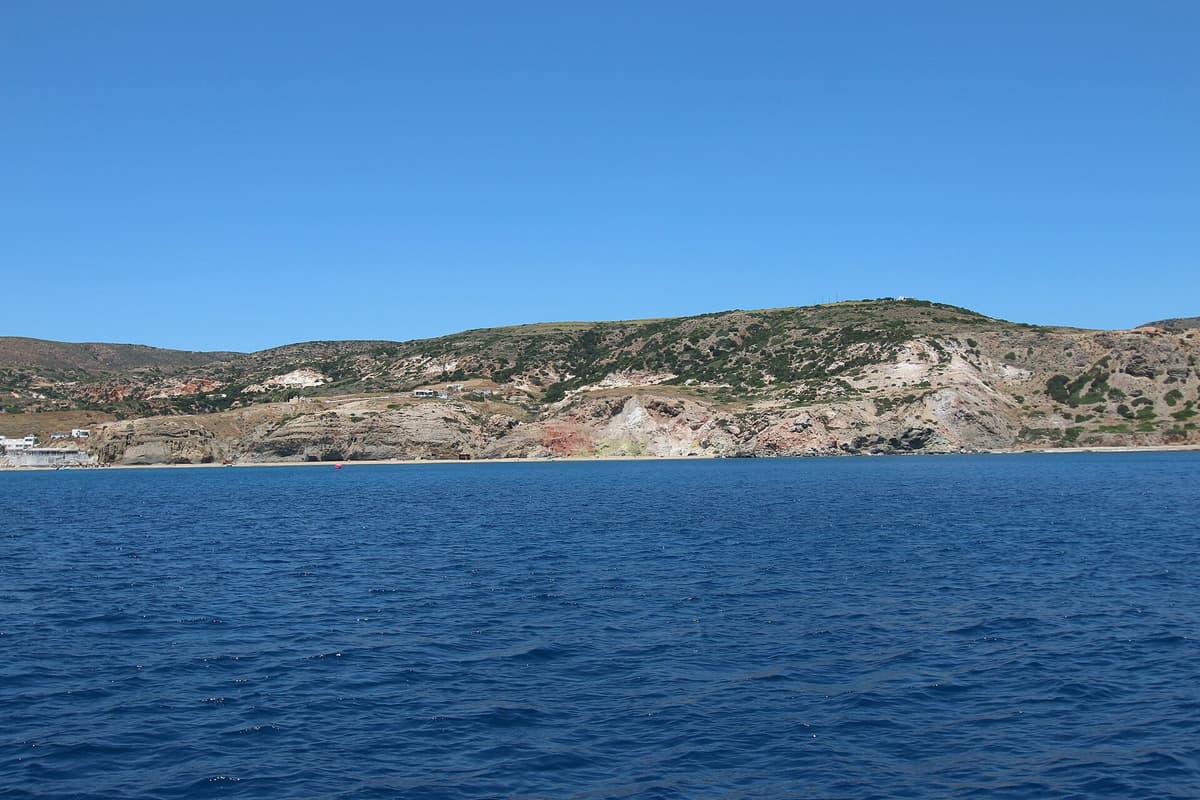
Paleochori counts as both a settlement and a beach of the municipality of Milos, and it lies on the south-western coast of the island. The beach is a popular destination, and rooms to rent and a small number of dining places stand in the area. Milos is a popular tourist destination in summer. A place of this size keeps a short list, so the useful question about sweets in Paleochori is which sweet suits which hour.
Greek desserts draw on a short set of ingredients: nuts, honey, fruit, sesame and filo pastry. Greek vocabulary treats ice cream as a sweet too, because the word pagoto names a frozen sweet, a glykisma. That gives the sweets in Paleochori four clear families: cold sweets, fruit, snacks of sesame and honey, and baked or syrup sweets. Each family answers a different moment of a long day by the water, and the cold family comes first.
Milos adds two sweets of its own to the Greek list. The island names a watermelon pie and a sweet of pumpkin, honey and almonds among the representative dishes of its cooking, and Greek cuisine lists both under the name of Milos. Both are cooked sweets, and the page on sweets in Milos describes them in full. The beach adds the cold side, so the sweets in Paleochori pair a cooked sweet of the island with a cold scoop.
A beach day leaves clear gaps for a sweet. A cold scoop suits the minutes after a swim, because ice cream softens as it warms. Fruit and yoghurt suit the long middle of the day. A spoon sweet fits beside a coffee, a sesame bar fits a snack, and a pie or a syrup pastry fits the cooler evening. The sweets in Paleochori follow that order on this page, and each gap gets a section of its own.
- Place: A settlement and a beach on the south-western coast of Milos.
- Season: Summers on the island are warm to hot and dry.
- Ingredients: Nuts, honey, fruit, sesame and filo carry the Greek dessert list.
- Cold side: Greek counts ice cream as a frozen sweet.
- Island pair: Watermelon pie and the pumpkin and almond sweet belong to Milos.
The shape of the day matters more than any single dish. Heat decides the first sweet, a meal decides the second, and the cooler hours decide the last. The sweets in Paleochori draw on the whole Greek list, with two sweets of Milos added to it. The next section starts with the cold end of that list, where ice cream, frozen yoghurt and ices meet the summer heat.

Which ice creams and cold sweets belong among the sweets in Paleochori?
Sweets in Paleochori include the cold sweets of Greece: pagoto, the Greek ice cream, frozen yoghurt and the milk-free granita. Milk or cream, yoghurt, fruit and sugar make them, and each one softens as it warms in the summer air.
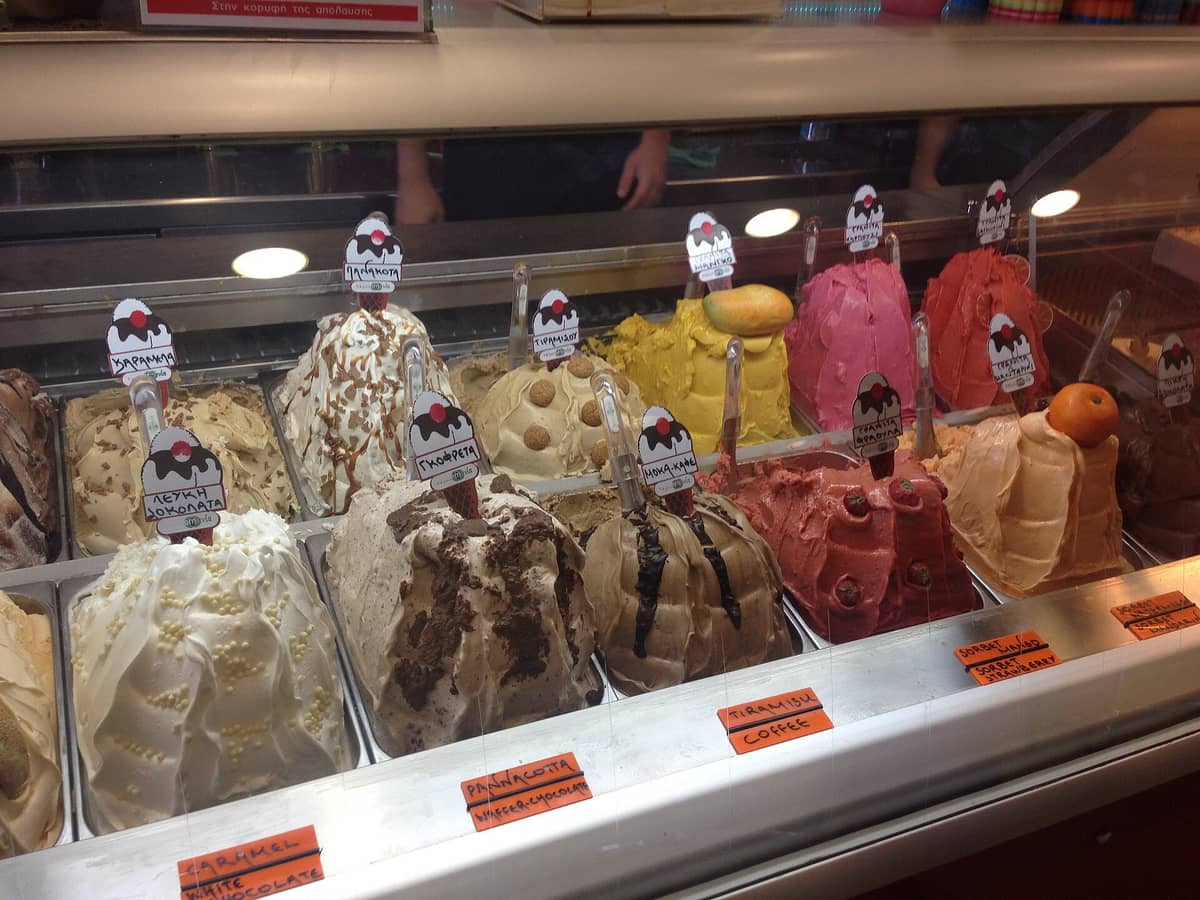
Frozen sweets need cold, and the history of ice cream shows it. A Roman cookbook of the first century includes recipes for sweet desserts sprinkled with snow, and the discovery that salt lowers the melting point of ice later let cream freeze. Greek has used the word pagoto in its modern sense since the 19th century. It names a frozen sweet made from cream and milk, and it heads the list of cold sweets in Paleochori.
The mix explains the behaviour on a warm beach. Ice cream holds water, milk fat, milk protein, sugar and air, cooled below freezing and stirred so that no detectable ice crystals form. It can hold as much as half air by volume. It is solid at very low temperatures and turns softer as it warms, so among the sweets in Paleochori it is the one that asks for a cone, a cup or a wide glass and a quick spoon.
Frozen yoghurt gives the sweets in Paleochori a tart option: it takes the same base as ice cream and adds live bacterial cultures. It tends to taste more tart because of the lactic acid in the yoghurt, and it is lower in fat because milk takes the place of cream. It came from New England in the 1970s. Greek lists already carry frozen yoghurt among the flavours of pagoto, and Greek tables serve strained yoghurt with honey and walnuts, a creamy sweet that needs no freezer.
Granita is the light, fruity end of the sweets in Paleochori. Greek gives that name to ice cream without milk, and fruit flavours such as lemon or apricot fill it. The sorbet follows the same idea, a fruit ice with no dairy, and ice cream shops sell it beside the creamy kinds. Italian gelato is a milk-based ice with less fat than a standard ice cream. Together the three widen the choice beside the cream scoop.
- Pagoto: The Greek name for ice cream, a frozen sweet of cream and milk.
- Serving: Loose ice cream goes into a cone, a cup or a wide glass with a long spoon.
- Frozen yoghurt: The same base as ice cream, with live bacterial cultures.
- Granita: Ice cream without milk, in fruit flavours such as lemon or apricot.
- Sorbet: A fruit ice without dairy that sits beside ice cream on the list.
The cold end of the sweets in Paleochori is short and clear. Pagoto answers the heat of the first hour after a swim, frozen yoghurt gives a tart and lighter option, and granita or sorbet gives a milk-free ice built on fruit. Each one softens in warm air, so each one belongs close to the water. The next section moves from the freezer to the fruit bowl, where summer fruit stands in for a made dessert.
Which fresh summer fruits count as sweets in Paleochori?
Sweets in Paleochori include the fresh fruit of the Greek summer: watermelon, melon, figs and grapes, eaten as dessert beside the sea. Each fruit ripens in dry summer heat and arrives ready to eat, with no syrup and no oven.
Watermelon heads the sweets in Paleochori in summer. The plant needs temperatures above 25 degrees Celsius to thrive, and Milos has warm to hot, dry summers. Growers first valued the fruit for its water, and stored it to eat in dry seasons as both food and drink. Dessert types spread across the Mediterranean in Roman times. The flesh runs from red and pink to orange, yellow, green and white, and the fruit is served freshly sliced, diced into fruit salad or pressed to juice.
Melon follows watermelon among the sweets in Paleochori, and its name is Greek. The word melon comes from Latin melopepo, which latinized the Greek mēlopepōn, a compound of mēlon, meaning apple or tree fruit, and pepōn, a kind of gourd or melon. Botanically the fruit is a berry of the pepo type. The Argos melon, a large oblong fruit with wrinkled orange skin, orange flesh and a strong aroma, grows in parts of Greece. The cantaloupe is eaten fresh, in salad or as a dessert with custard.
Figs belong to the late summer among the sweets in Paleochori. The tree grows wild in dry, sunny and rocky places and tolerates moderate seasonal drought. Kimolos, the island beside Milos, was famous in antiquity for its figs, and the fruit was widespread across ancient Greece. A ripe fresh fig is plump and soft, without splits, and a sour smell marks an over-ripe one. Ripe figs bruise and keep badly, so commercial production leans on dried forms. Unlike watermelon, a fig tastes fullest at room temperature.
Grapes close the fruit list among the sweets in Paleochori. Table grapes tend to have thin skins and large, seedless fruit, while wine grapes are smaller with thick skins. The sweetness of a grape depends on the harvest date, because the berries do not ripen further once picked. Ripening darkens the berries, enlarges them and builds their sugar, and it begins in August. The flesh holds 75 to 85 percent water. A currant is a dried Zante Black Corinth grape, and the name comes from the French for Corinth grape.
- Watermelon: The black seeds taste nutty when dried and roasted.
- Melon: The cantaloupe has sweet, aromatic, orange flesh.
- Fig: A spring crop comes first, and the main crop ripens in late summer.
- Grape: A single cluster carries between 15 and 300 berries.
- Raisin: Any dried grape is a raisin, while the French word names the fresh fruit.
Four fruits cover the fresh side of the sweets in Paleochori, and each one needs only a knife or a hand. Watermelon and melon bring water to a hot day, figs bring a late-summer harvest that travels poorly, and grapes bring sugar in the bunch. Nothing in this list needs cooking, so the fresh fruit sits easily beside the sesame and honey snacks, the next group of sweets in Paleochori.
Which sesame and honey snacks belong to the sweets in Paleochori?
Sweets in Paleochori include the sesame and honey snacks of Greece: pasteli, sesame bars and thyme honey. Seeds bound with honey make a firm bar that fits a beach bag, and the honey comes from the wild thyme of dry, rocky ground.
Pasteli has relatives older than its name. Ancient Greek cooks made itrion, a thin biscuit or cake of sesame seeds and honey, and the Cretan koptoplakous, a layer of ground nuts set between two layers of sesame crushed with honey. A third cake, the kopte sesamis, was a cake of pounded sesame, and its ingredients point to the modern bar. A bar taken from the sweets in Paleochori therefore follows a recipe that Greek cooks have known since antiquity.
In the Byzantine Empire the sweet was ordinary food, and it was eaten at weddings for fertility and good offspring, as it is in Greece today. The bar travels under other names across the islands, and on Rhodes a similar candy is called melekouni. Late in the twentieth century pasteli sold in rectangular pieces of 120 to 150 grams, and smaller packs exist now. Pasteli is one of the sweets in Paleochori that Greece shares with Cyprus, where the bar carries the same name.
The seed behind the bar suits dry land. The word sesame comes from the Greek sēsamon, and the plant is one of the oldest oilseed crops known. It tolerates drought and grows in high heat where other crops fail. The seeds measure three to four millimetres and are white or black, with pale seeds common in Europe. Half the weight of a dried seed is fat, which gives the sweets in Paleochori their rich, nutty flavour.
Honey is the other half of the bar, and among the sweets in Paleochori it is the ingredient that ties the snack to the land. Honey is monofloral when bees work mainly one kind of flower, and thyme is a European example. Wild thyme covers droughty, rocky soils in southern Europe, and Greece is especially famous for its wild thyme honey. Pine honey makes up 60 to 65 percent of Greek production, so thyme honey sits outside that majority.
- Itrion: This ancient Greek biscuit joined sesame seeds with honey.
- Melekouni: Rhodes uses this name for its sesame and honey candy.
- Sesame: The crop was domesticated well over 3,000 years ago.
- Bees: A bee needs visits to more than a thousand flowers to fill its honey stomach of about 40 milligrams.
- Crystals: Honey that sets into crystals is not spoiled and turns liquid again when warmed.
Sesame and honey give the sweets in Paleochori a firm, portable side, from the ancient itrion to the modern bar. Honey absorbs moisture from the air, so a closed jar protects it, and thyme links the snack to the dry ground of southern Europe. The same bars and jars sit beside the fish, pies and cheeses described in the page on food in Paleochori.

How does slow baking in hot sand relate to the sweets in Paleochori?
The sweets in Paleochori belong to a beach where volcanic heat warms the ground from below. Vents at Paleochori reach 100 degrees Celsius, and the heat of the earth is even used for traditional meals cooked slowly in the sand, an old way of baking.
A fumarole is a vent in the ground that lets out hot volcanic gas and steam, with no liquid or solid. The steam forms when groundwater is superheated by hot rock. The word comes from the French fumerolle, a domed structure with side openings built over a kitchen to let smoke escape. Solfataras are fumaroles rich in sulphur, and both kinds reach 100 degrees Celsius at Paleochori. That kitchen origin fits the sweets in Paleochori, where the ground itself gives off heat.
Gas leaves a fumarole at about 100 to 1,000 degrees Celsius, and steam is the main vapour. The vents of Milos sit at the cool end of that range, topping out at 100 degrees. Beneath the seabed the same volcanic activity makes warm patches in the shallow water, so cool and warm water lie side by side at the shore where the sweets in Paleochori are eaten. The heat also reaches the sand, because traditional meals at the beach cook in it.
An earth oven is one of the simplest and oldest cooking structures: a pit in the ground that traps heat to bake, smoke or steam food. The earliest known one, found in Central Europe, dates to 29,000 BC. In the usual method a fire is built and left to burn down to a smoulder, and the food goes in and is covered. At Paleochori the volcano takes the place of the fire, and the sand holds the heat.
Greek cooks know the pit too. Kleftiko dishes wrap food in clay and cook it in a covered pit, a method ascribed to fighters of the Greek War of Independence, allegedly to avoid detection. Desert nomads bake bread in hot sand: a dough of flour, water and salt goes into the sand beneath a camp fire, hot coal covers it, and the sand is knocked off afterwards. A yeast batter given time to rise shows the same patience, and it is where the sweets in Paleochori begin.
- Fumarole: A vent that lets out hot volcanic gas and steam.
- Kitchen word: Fumerolle was a hood built over a kitchen to let smoke out.
- Earth oven: A pit that traps heat to bake, smoke or steam food.
- Sand meals: Traditional sand-cooked meals share the beach with the sweets in Paleochori.
- Desert bread: Dough of flour, water and salt bakes in hot sand.
The ground of Paleochori gives a clear picture of slow heat: vents at 100 degrees Celsius, warm patches in the sea and a tradition of meals cooked in the sand. The sand cooks meals, but the sweets in Paleochori take their heat from oil, so the evening plates in the next section start in a pan. Two kinds of warmth meet on this shore, the one under the beach and the one in the kitchen.
Which warm evening sweets follow a beach day among the sweets in Paleochori?
Sweets in Paleochori for the evening centre on loukoumades, balls of yeast dough fried in hot oil and served with honey. Milos calls them kourtalides, and the pitaraki pie, xerotigana and other fried doughs carry honey in the same way.
Loukoumades start as a thick, smooth yeast batter that rises until it turns soft and foamy. Spoonfuls drop into hot oil and fry to a golden brown. Balls are the usual shape, and doughnut-shaped rings also appear. Honey goes over them, with cinnamon, and powdered sugar sometimes joins the cinnamon. Traditional batters rise on yeast, while modern ones sometimes use baking powder. These fried balls suit an evening after the beach among the sweets in Paleochori.
Ancient Greek texts already knew a deep-fried dough soaked in honey syrup, called enkrides. An ancient food writer described them as cakes boiled in oil and seasoned in honey. A related cake, the charisios, took its name from the Greek word for joy and was eaten at nocturnal festivals called pannychis. It was also given as a prize at drinking games. Loukoumades have been likened to those joy cakes, which makes honey cakes at night an old habit behind the sweets in Paleochori.
The dessert travels under different names. Turkish lokma and Greek loukoumades both come from the Arabic luqma, a word for morsel, mouthful or bite, and 13th-century Arabic cookery books list the dish as the judge’s morsels. Cypriot Greek says loukoumades or lokmades, spiced with cinnamon in a honey syrup and dusted lightly with powdered sugar. Pontic Greeks, who migrated from the Black Sea, call them tsirichta and serve them at weddings. Among the sweets in Paleochori the name changes once more, because Milos says kourtalides.
Fried dough carries honey in other forms. The pitaraki of Milos, a small fried pie with peppery dry cheese or myzithra and mint, is served hot with honey. Xerotigana are thin strips of dough fried in spirals; once cool, a syrup based on honey goes over them, with sesame and cinnamon. In the Peloponnese the same dessert is called diples, and traditional makers use honey in place of syrup, with cinnamon and chopped walnut. Together they widen the sweets in Paleochori beyond one plate.
- Batter: A thick, smooth yeast batter rises until soft and foamy.
- Joy cakes: The ancient charisios was eaten at nocturnal festivals.
- Names: Loukoumades, lokmades, tsirichta and kourtalides name one dough among the sweets in Paleochori.
- Xerotigana: Thin fried strips that take a honey syrup once cool.
- Weddings: Honey in the sweet buffet stands for the sweet life of the couple.
Loukoumades lead the warm sweets in Paleochori after the beach, with a long line of fried honey cakes behind them. Pitarakia, xerotigana and diples show how far honey and hot oil reach across Greek kitchens. At Milos weddings and engagements the mother of the bride sets out the sweet buffet. A coffee beside the plate belongs to the same hour, and the page on coffee and drinks in Paleochori covers that side.
How is a beach day planned around sweets in Paleochori?
Sweets in Paleochori set the pace of a beach day in four steps: a sesame and honey bar in the morning, a cold spoon sweet in the heat of midday, hot dough balls with honey after the afternoon swim, and a slow walk back at sunset.
The morning belongs to pasteli, the sesame and honey bar on the sweet list of Milos. In modern Greece the sweet is a flat, oblong bar made with honey, and nuts can join the sesame. The texture of sesame candy runs from chewy to crisp, and the name comes from the Italian word pastello. A bar goes into the beach bag with the towel, and sweets in Paleochori begin there, before the first swim in cool, clear, deep water.
Midday asks for something cold. Watermelon appears twice on the sweet table of Milos, as a spoon sweet and as a fragrant pie. A watermelon spoon sweet is traditionally made from the rind, because the flesh is too delicate to keep its texture in syrup. Figs and quinces go into the pot as well. Hosts in Greece serve a spoon sweet on a teaspoon as a gesture of hospitality, with a glass of cold water beside it. That pairing suits sweets in Paleochori when the sun stands at its highest.
The afternoon swim ends with hot dough balls. Loukoumades are a mainstay of Greek cooking, above all in the south of the country, and a popular street food. Milos calls them kourtalides. The thick, smooth yeast batter rises to a very soft, foamy consistency before it is dropped into hot oil and fried to a golden brown. Honey, cinnamon, walnuts and chocolate sauce are the toppings, in any combination. Sweets in Paleochori finish the swim with a warm, sticky plate beside the cool sea.
The walk back at sunset runs along almost two kilometres of coloured pebbles and coarse sand. Another day can carry the same plan to the coves of the south coast, and the services at each cove decide what goes in the bag. Provatas has sunbeds and umbrellas, a hotel, rooms to let and taverns. Fyriplaka has sunbeds, parasols and a beach bar. Agios Sostis, beside Provatas, has a restaurant and rooms to let. Tsigrado is not organised, and its essentials come from the nearby beach of Fyriplaka.
- Provatas: Golden red sand, coloured by iron oxides, meets very shallow water.
- Agios Sostis: A small, shallow sandy beach takes its name from the church above it.
- Fyriplaka: Fine white-grey sand lies beside a huge rock with a cave in the water.
- Tsigrado: White sand and emerald water sit inside a ring of rocks.
- Kipos: A sandy beach has a small port where boats start for Kleftiko.
Each stage of the day takes one sweet: pasteli in the morning, a watermelon spoon sweet at midday and kourtalides after the swim. The coves add variety on other days, and the services at each one decide the bag for sweets in Paleochori. Adamas, the port town of Milos, has its own sweets, set out on the page about sweets in Adamas, for readers who move on from the south coast to the harbour.

Which quick answers cover sweets in Paleochori?
Sweets in Paleochori raise six short questions about the age of pasteli, the keeping power of honey, the making of a spoon sweet, the origin of loukoumades, the rocks of Kleftiko and the organised beach of Agia Kyriaki. Each answer takes one point in turn.
How old is pasteli among sweets in Paleochori?
Sweets of sesame and honey are very old. Herodotus mentions sweet cakes of sesame and honey, and ancient Greek cuisine knew itrion, a thin cake of sesame seeds and honey. A Byzantine sesame sweet called sesamous is regarded as the ancestor of modern pasteli, and a writer of the time says it was eaten at weddings.
Why does a honey sweet keep well among sweets in Paleochori?
Honey has a high sugar concentration and an acidic pH, which limit the growth of microorganisms. While its water content does not rise much above 18%, honey has an indefinite shelf life. Small units on Milos produce thyme honey, along with the herbs thyme, oregano and sage, and wild thyme honey is famous across Greece.
How is a spoon sweet cooked among sweets in Paleochori?
Cooks boil whole fruit slowly in water and sugar, over hours or days, until the syrup sets. Patience and a heavy pot are the main prerequisites. Lemon juice keeps the original colour, because its citric acid prevents oxidation. A good spoon sweet keeps the shape, aroma and taste of the fruit, and it stays chewy.
Where did loukoumades begin among sweets in Paleochori?
Loukoumades trace back to enkrides, a dough fried in oil and eaten with honey in Ancient Greece. Athenaeus describes enkrides as cakes boiled in oil and seasoned in honey. In the Byzantine period the treat was popular during Lent, because flour, yeast and water, sweetened with honey, met the rules of Orthodox fasting. The Greek name comes from Arabic.
Which rocks near sweets in Paleochori need a boat?
Kleftiko is a set of gray and white rocks with strange shapes, caves and pits that air and sea carved over the centuries. Its waters are crystal clear and turquoise, and the place is reached by boat or sailboat. Pirates once used it as a shelter and base, and the name comes from that past.
Which organised beach lies near sweets in Paleochori?
Agia Kyriaki is a large, organised beach on the south coast. Sunbeds, umbrellas, beach bars and a beach volleyball court stand on the sand. The waters are cool, the pebbles are colourful, and the thick sand forms an extensive shore. Rooms for rent and a restaurant stand within walking distance of the beach.