Sweets in Provatas, Milos: see our Sweets in Milos section for the island.
Provatas is a small settlement on the south coast of the island of Milos, with a sandy beach and taverns on the shore. The sweets in Provatas belong to that shore and the Greek table.
The first section sets out the sweets in Provatas at a glance. The second takes semolina halva and tahini halva: how each is made and eaten.
What are the sweets in Provatas at a glance?
Sweets in Provatas are the sweets of the Greek table, eaten on a sandy beach on the south coast of Milos. A sweet opens the morning with bread, closes a taverna meal and marks a wedding or a village feast.
The sandy beach of Provatas lies on the south coast of Milos, and the wind decides which beach suits a day. In summer the Aegean brings the meltemi, a dry north wind with fine, clear weather. On days of meltemi and north wind, the beaches inside the gulf of Milos are a good choice and those on the south side of the island are better still. Provatas stands on that south side, so the sweets in Provatas are eaten on the side of the island that suits those days.
A beach day starts with breakfast, and the first of the sweets in Provatas can be a spread. In Greece, tahini, a paste of ground sesame seeds, goes on bread either alone or topped with honey or jam. Supermarkets in Greece sell jars of tahini already mixed with honey or with cocoa, and those jars stand in the breakfast aisle. The same paste also becomes halva, the sweet that the second section of this page takes up.
A sweet also closes a meal. A typical taverna menu includes bread, meat, salads, appetizers, soups, pasta, fish and seafood, baked dishes, grilled dishes, wine, beer and spirits, and its list closes with fruit and desserts such as baklava and galaktoboureko. The word taverna comes from the Latin taberna, which means shop. The beach of Provatas has taverns, so the sweets in Provatas can end a meal at the shore, at a table that began with fish or salad.
Sweets on Milos also mark occasions. At weddings and engagements the mother of the bride serves the sweet buffet. Small almond sweets covered in icing sugar, the koufeta, are commonly served at weddings and celebrations, and Milos names them, together with its watermelon pie, among its representative dishes. Those two belong to the full list of sweets in Milos, while the sweets in Provatas turn to the halva, cakes and pastries of the wider Greek table.
- Season: The meltemi blows through the summer, until about mid-September.
- Afternoon: The wind is strongest in the afternoon.
- Name: Etesian, an old name for the meltemi, comes from the Greek word etos, which means year.
- Triad: Greek cuisine is founded on wheat, olive oil and wine.
- Wedding: Honey stands for the sweet life of the couple, and almonds stand for fertility.
Four moments hold the sweets in Provatas on this page: breakfast bread with tahini, the dessert at the end of a taverna meal, the wedding buffet and the fasting table. The south coast gives the sweets in Provatas a shore on the side of the island that suits days of north wind. The next section turns to halva, the sweet that joins the breakfast jar of tahini to the fasting table of Lent.

Which halva belongs among the sweets in Provatas, semolina or tahini?
Sweets in Provatas include halva in two forms: semolina halva, a moist sweet of toasted semolina and syrup, and tahini halva, a fibrous sweet of ground sesame paste and sugar syrup. Both can be fasting sweets of the Greek table.
Halva is the name of a family of sweets found across the Balkans, parts of the Mediterranean and the Middle East. The name seems to come from an Arabic root that means sweet. A fat such as butter, olive oil, sunflower oil or tahini, a starch such as semolina, and a sweetener such as sugar or honey are the raw materials of halva. Sesame halva and semolina halva are among the best-known in Greece, and the sweets in Provatas begin with those two.
Semolina halva is the traditional home halva among the sweets in Provatas, and it is the quickest and easiest to make. Semolina is a coarse flour of durum wheat, and Greek calls it simigdali. The best-known method is named after its ratio, one, two, three, four: one part butter or oil, two parts semolina, three parts sugar and four parts water, by volume. The cook toasts the semolina in hot butter, adds the syrup of sugar and water, and boils the pot until the semolina has absorbed the liquid.
Tahini halva starts with tahini, the paste that spreads on breakfast bread among the sweets in Provatas. The seeds are soaked and crushed to separate the bran from the kernels, then soaked again in salt water so that the bran sinks. The floating kernels are skimmed off, toasted and ground into an oily paste. A beaten, heated syrup of sugar or honey turns into white caramel before the tahini goes in. A bitter liquid from the soapwort root gives the caramel its elastic bite.
Halva is a traditional fasting food in Greece. The Orthodox fast keeps meat off the table on Wednesdays and Fridays all year and through all of Great Lent, and sesame halva suits it, holding no ingredient that fasting forbids. On Clean Monday, the first day of Great Lent, people across Greece go outdoors, fly kites and eat halva with unleavened bread and seafood. In the custom of haska, a parent ties halva to a thread on a stick, and each player waits with open mouth and hands behind the back.
- Scent: Cinnamon, cloves and orange zest flavour the semolina pot, and raisins go in at the end.
- Serving: Semolina halva is served hot in small bowls or, more commonly, pressed into a round patterned mould, turned out onto a platter and cut.
- Texture: Semolina halva runs from moist and buttery to gelatinous, while sesame halva is drier and more crumbly.
- Packs: Sesame halva is sold in rectangular packs, plain or with vanilla, honey, almonds, hazelnuts, raisins or cocoa.
- Grocer: Sesame halva is also called the grocer’s halva, because grocery shops once sold it.
Semolina halva and tahini halva are the two roads of halva among the sweets in Provatas: a pot for one, a mixer and a paste for the other. Both reach the Greek table through fasting, and sesame halva spread in Greece after the Asia Minor Catastrophe, when refugees brought the craft with them. The next sections move from the fasting table to fried dough, honey pastries and cakes.
Which diples and honey pastries belong among the sweets in Provatas?
Sweets in Provatas include diples, thin Greek dough that is folded and fried in hot oil, then dipped in a sugar or honey syrup. Samsades, melopita and sweet kalitsounia add three more honey pastries, from Limnos, Crete and the Cyclades.
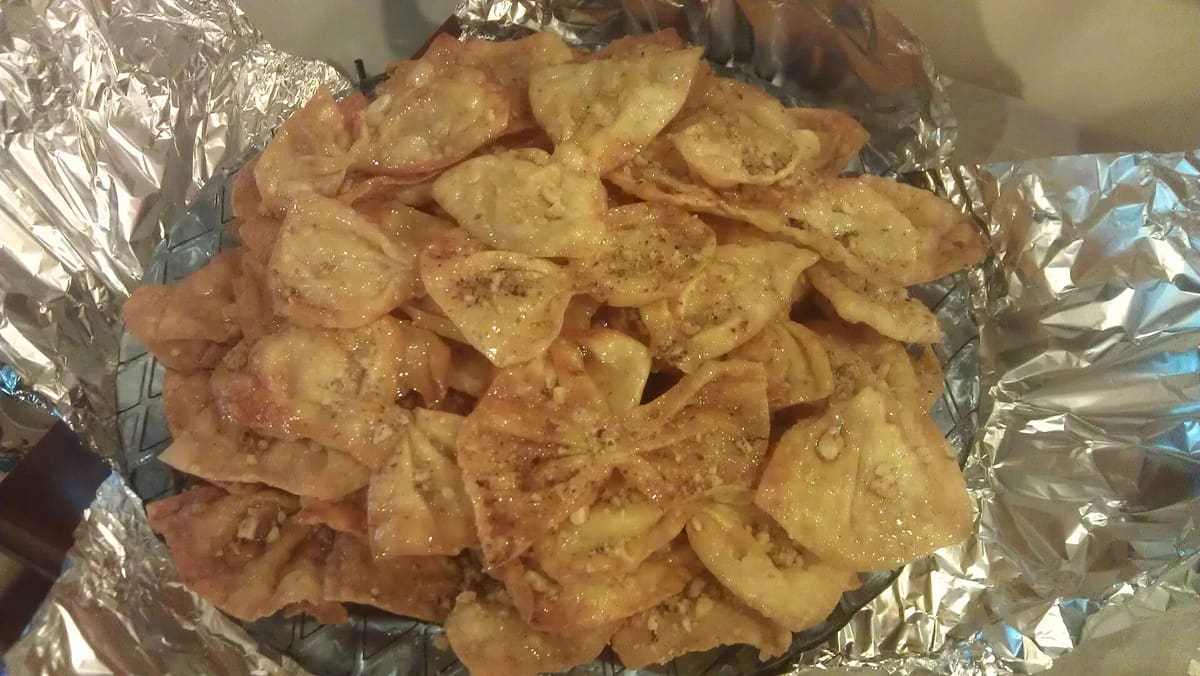
Diples are a Greek dessert from the Peloponnese, with roots in Mani, Kalamata and Arcadia. The cook rolls thin, sheet-like dough into long strips, folds and fries them in hot oil, and then dips them in a sugar or honey syrup. Three steps define the diples among the sweets in Provatas: rolling, frying and dipping. Greek homes serve them at holidays, weddings and engagements, which makes the dessert part of the festive table. English spells the name diples or thiples, and Greek writes Δίπλες.
Diples are essentially angel wings, the fried pastry served dry, except that diples take a dip in syrup. The dough folds into different shapes, and the common ones are bow ties, spirals and flowers. The folding happens in the hot oil, which gives each strip its final shape. A bow tie, a spiral and a flower give a plate of diples three looks from one dough, and the sweets in Provatas gain a shape that stands out from the cakes and pies of the same table.
A second form of diples uses an iron mould. The cook dips the mould in a batter and cooks it in oil until the diples separate from the mould. Syrup, crushed walnuts and cinnamon go on top. A walnut kernel is the edible seed that is left after the shell is discarded. Here a batter, not a rolled dough, makes the sweet, and the walnuts link this version of the sweets in Provatas to the walnut cake in the next section.
Other honey pastries come from the islands. Samsades of Limnos are filo rolled around a filling of nuts, baked, and then drenched in sugar or honey syrup. Melopita is an Easter pie of the Cyclades, linked with Sifnos, built on cheese, honey and dough, and its history goes back to Byzantium. In the Chania region of Crete, sweet kalitsounia hold mizithra with honey poured on top. Honey finishes a filo roll, fills a cheese pie and tops a mizithra pastry among the sweets in Provatas.
- Festive table: Diples also appear at New Year celebrations in the Peloponnese.
- Syrup: A thick, honey-based syrup douses the fried sheets after they leave the oil.
- Arcadia: Fir honey of Mount Mainalo in Arcadia is the only Greek honey with protected designation of origin since 1992.
- Sugars: Honey holds 77 to 78 percent sugars, mainly fructose and glucose.
- Citrus: Honey in Greece also comes from the nectar of lemon, orange and bitter orange trees.
After a day on the beach at Provatas, a plate of diples brings a festive sweet to the table, and the honey that coats the strips also fills the pies of Limnos, Sifnos and Crete. The sweets in Provatas read as a small map of the islands, from the Peloponnese to the Aegean. The cakes of the next section leave the frying pan for the oven and take their syrup after the bake.

How do portokalopita and karydopita fit among the sweets in Provatas?
Sweets in Provatas include portokalopita, the orange cake, and karydopita, the walnut cake. Both are syrup-soaked cakes of Greek kitchens: portokalopita rests on orange, yogurt and filo shreds, and karydopita on walnuts baked in a pan and bathed in syrup.
Portokalopita is a typical Greek cake whose main ingredient is sweet orange, and its name joins portokali, the orange, with pita, the cake. Orange is a staple ingredient of Greek cuisine, and the cake puts it first. The cake is very popular in Greece and is eaten as a dessert with coffee. It belongs to the siropiasta, the sweets bathed in syrup, such as baklava. Among the sweets in Provatas, portokalopita is the cake of citrus, and coffee is its partner at the table.
Portokalopita looks like a sponge, but its dough is made from dry shreds of filo. A mixture of Greek yogurt, egg and orange juice goes into the shreds. A syrup simmered with oranges, sometimes flavoured with vanilla or cinnamon, bathes the top. The cake is at its best the next day or the day after, once the syrup is fully absorbed. The mouthfeel is fluffy and juicy, never compact, which suits the sweets in Provatas after a day outdoors.
Karydopita means walnut pie in Greek, and its name joins karydi, the walnut, with pita, the same ending as portokalopita. The cake is made primarily with walnuts and is partly soaked in syrup. It is one of the glyka tapsiou, desserts such as pies and breads baked in baking pans, like galaktoboureko, amygdalopita and kadaifi. Variations add orange zest, cloves, brown sugar, and spiced rum or cognac, so the two cakes meet in the zest, and both rank among the sweets in Provatas baked in a pan.
The traditional karydopita beats egg yolks with sugar, then adds rusk, chopped walnut, baking powder, soda, vanilla and cinnamon, and folds in whipped egg whites. After baking, the cook cuts the cake into pieces and pours over a hot syrup of water, sugar and lemon juice. The cake is ready when the syrup is absorbed and the pan has cooled well. A fasting recipe uses flour, oil, sugar, black raisins, walnuts, cinnamon with a little clove and baking powder. Both recipes keep walnut among the sweets in Provatas.
- Orange groves: Orange trees grow in Laconia and Argolis, in Arta and on Chios.
- Blossom: The orange tree flowers once a year, with white, fragrant flowers in spring.
- Filo: The word filo comes from the Greek fýllo, meaning leaf.
- Royal nut: The Byzantine and Ottoman eras also called the walnut the royal nut.
- Harvest: Walnuts ripen between September and November in the northern hemisphere.
A slice of portokalopita or karydopita ends a day on the beach at Provatas with a coffee and a cake that has soaked up its syrup. Portokalopita brings citrus and karydopita brings the nut, and the syrup joins them. The walnut kernel also goes with honey, which ties karydopita to the diples before it. The savoury dishes that come before these sweets in Provatas appear on the page about food in Provatas.
Which semolina syrup cakes belong with the sweets in Provatas?
Sweets in Provatas include revani, a semolina cake baked in a tray and soaked in sugar syrup. Greek cooks make the batter from semolina, eggs and yogurt, pour the syrup over the baked cake, and cut it into squares or diamonds.
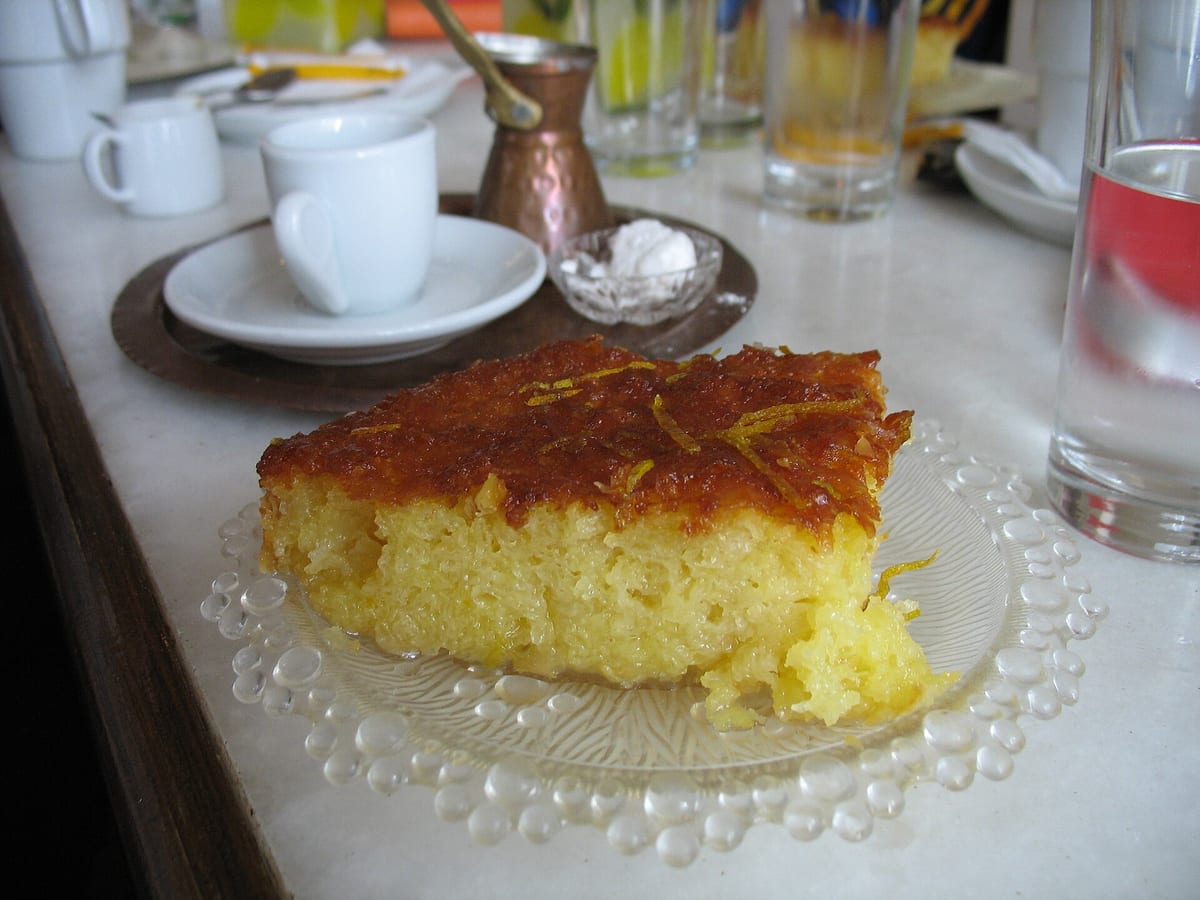
Revani is a traditional pastry of the Middle East, and the sweets in Provatas share it with the whole of Greece. Cooks mix semolina, eggs and yogurt, bake the batter in the oven, and pour syrup over the cake once it is baked. The name takes three forms: revani, ravani and rivani. In southern Greece the cake is known mainly as ravani. The revani of Veria is a traditional sweet of that city and is famed across the country. Greek cooks do not confuse it with shamali.
Turkey bakes the cake under the same name, revani, the Arab world calls it basbousa, and the rest of the eastern Mediterranean uses other names. Basbousa is popular across the Middle East, North Africa, the Caucasus and the Balkans, so the sweets in Provatas belong to a wide family of semolina cakes. An Ottoman recipe of 1844 bakes semolina, butter, sugar and eggs, soaks the cake in sugar syrup and cuts it into baklava shapes. The Greek name came through Turkish from a Persian word.
Semolina gives revani its grain. It is a coarse flour traditionally made from durum wheat, and Greek cooks call it simigdali, in a coarse grade and a fine grade. The sweets in Provatas that rely on it come in different forms: variations add grated coconut, rose water or citrus, denser versions add eggs, and modern recipes add baking powder. In one variation the cake combines with kaimaki, a Greek ice cream, so a cold scoop meets the syrup cake.
Two related cakes join revani among the sweets in Provatas. Shamali, also spelled sambali, is made with syrup, yogurt and semolina, and it is popular in Greece and in Izmir. In Aetolia-Acarnania the name ravani belongs to a cake that resembles semolina halva: it is made with semolina, oil and sugar like halva, and then baked. Provatas lies in the south of Milos, an island with barley among its main crops, and the Cyclades grow wheat, the grain that semolina comes from.
- Semolina: A coarse flour made from durum wheat forms the body of the cake.
- Syrup: Sugar syrup poured over the baked cake soaks into the crumb.
- Shapes: Cooks cut the tray into squares or diamonds.
- Veria: The revani of this city is famed across Greece.
- Additions: Coconut, rose water and citrus appear in variations of the cake.
Revani, shamali and the baked ravani of Aetolia-Acarnania share one idea: semolina, an oven and syrup. Each region gives the idea its own name and its own flavour, from the Balkans to North Africa, and Veria, Aetolia-Acarnania and Izmir each hold a version. The sweets in Provatas that follow this idea come from a shared table of the eastern Mediterranean, and the next sweets in Provatas come from the vine instead of the grain.
What are moustalevria and moustokouloura among the sweets in Provatas?
Sweets in Provatas include moustalevria, a pudding of grape must and flour boiled until thick, and moustokouloura, the cookies made with the same must. Greek cooks make both at the time of the grape harvest, when the must is fresh.
Must is the juice of pressed grapes before it ferments. It takes its colour from the grape skins, so it runs from whitish to red, and it holds a high share of sugar. Winemakers crush large amounts in presses, and households tread small amounts at home for their own use. Fermentation turns must into wine, but the same juice also becomes petimezi, moustalevria and moustokouloura, so the sweets in Provatas that start from must begin with the grape harvest.
Moustalevria is a traditional Greek pudding of grape must mixed with flour and boiled until thick. The pudding goes back to ancient Greece, where it was called oinouta, and English-speaking cooks call it must jelly. In the Byzantine era it carried the names mustopita and pastellos. Today the name changes from place to place: kefteria on Crete, kourkouta on Samos and palouzes on Cyprus. Cooks now thicken the cream with corn starch, alone or with flour, and the sweets in Provatas of this kind follow the same method.
The cook boils the must on a low fire and adds a little white clay, called argil, to clean the juice. After the boil, flour, sugar, semolina, petimezi, sesame, vanilla, almonds or walnuts go into the pot, and cinnamon, basil or flower water can join them. Moustalevria is widely available at the grape harvest in autumn, while the must is fresh. Ancient Cretan moustalevria was poured onto a tray, cut into baklava shapes, dried in the sun and kept in clay jars for winter.
Moustokouloura are the cookie version. The dough joins must, flour, vegetable oil, cinnamon and powdered clove, and raisins can join too. More flour makes the cookie firmer and crunchier. Cooks shape the dough into rings, long pieces or plaits, bake them, and sesame can go on top. They are made with must from late August to early December and with petimezi all year. Grapes rank among the main crops of Milos, so the sweets in Provatas of this kind start from a crop that the island grows.
- Must: The juice of pressed grapes before fermentation is rich in sugar.
- Petimezi: Must boiled down to a thick syrup replaces fresh must outside the harvest.
- Names: Moustalevria is kefteria on Crete, kourkouta on Samos and palouzes on Cyprus.
- Season: Moustokouloura are made with fresh must from late August to early December.
- Shapes: Rings with or without a hole, long pieces and plaits are all baked.
Moustalevria and moustokouloura show how the sweets in Provatas follow the farming year, from the pressing of grapes to the tray and the oven, and with revani they form the grain-and-vine sweets in Provatas. Provatas is a small settlement and beach in the south of Milos, with 33 permanent residents. A cube of pudding or a cookie goes with a cup, and the page on coffee drinks in Provatas covers the drinks of the settlement.

What do mastic and rose add to sweets in Provatas?
Sweets in Provatas draw two scents from the Greek sweet table: mastic, the resin of a tree grown on Chios, and rose, taken from rose water. Mastic brings a refreshing pine-like flavour, and rose water perfumes loukoumi and other confections.
Mastic is the resin of the mastic tree, Pistacia lentiscus, and it forms in droplets called tears. The droplets dry into brittle, translucent pieces. When chewed, the resin softens and turns bright white and opaque. The taste is bitter at first, then it releases a refreshing flavour close to pine and cedar. The Greek word for mastic relates to the verb for chewing, and chewing gum was among its earliest uses. Sweets in Provatas that carry this flavour taste of the tree, not of sugar alone.
The tree grows wild across the Mediterranean, yet the south of Chios is the one place where it is cultivated regularly. Growers cut the bark every four to five days from the start of July to the start of October, and the tears take fifteen to twenty days to harden and fall. Spring water washes them, and hands clean them through the winter. The name Masticha Chiou carries a protected designation of origin in the European Union, so sweets in Provatas flavoured with Chios mastiha rest on a protected name.
Greek spoon sweets use mastic in a snow-white paste called vanilla, though no vanilla goes into it. Makers beat mastic resin with table sugar into a thick paste. Served cold, it has the consistency of hard caramel candy, and it is meant to be licked like a lollipop. At body temperature it softens and becomes chewable. The spoon is dipped in ice-cold water, which earns the sweet its nickname, the vanilla submarine. The cold glass suits a hot day, a natural match for sweets in Provatas.
Rose water is a flavoured water made by steeping rose petals in water, and it forms as a by-product when petals are distilled for rose oil. Its typical scent comes from phenylethyl alcohol. Rose water flavours loukoumi, nougat and baklava, and marzipan has long carried it. A Byzantine starch candy was described as sugar dissolved with rose water, an early relative of loukoumi. Sweets in Provatas that follow the loukoumi tradition therefore meet rose in both the flavour and the history.
- Colours: In Greece, rose loukoumi is red, bergamot loukoumi is green and mastic loukoumi is yellow.
- Base: A gel of starch and sugar forms loukoumi, and its cubes are dusted with icing sugar to stop clinging.
- Stabiliser: Mastic also steadies the texture of loukoumi and ice cream.
- Makers: Loukoumi is famously produced in Patras and on the island of Syros.
- Abroad: The Greek diaspora carried the vanilla spoon sweet as far as Japan, far from sweets in Provatas.
Mastic and rose are the two flavours of the Greek sweet table that come from a resin and a water. Loukoumi carries both, in yellow and red cubes, and the white mastic spoon sweet carries one. These are the flavours behind sweets in Provatas that are not built on fruit, honey or syrup. The next section places them on the beach, between the swims of a long day.
Where do sweets in Provatas fit into a beach day?
Sweets in Provatas fit a beach day in the pauses between swims: a cold mastic spoon sweet after a dip, and loukoumi with coffee under an umbrella. Small, slow sweets suit a settlement of 33 permanent residents whose beach is its best-known feature.
Provatas is both a settlement and a beach, on the south side of Milos. It was counted as a separate settlement for the first time in the census of 2011, with 27 permanent residents, and the census of 2021 found 33. A place of that size centres its day on the sand and the sea. Sweets in Provatas therefore belong to the rhythm of swimmers, who move between the water, the umbrellas and a table in the shade.
Sand takes its make-up from local rock, and Milos is a volcanic island, so its coastal sand reflects volcanic ground. Calm summer seas move sand up the beach, and on a sandy beach the backwash leaves a gently sloping shore. That slope matches the very shallow water of Provatas, where a swimmer stays within reach of the umbrellas. A sweet kept small and slow suits that rhythm, because sweets in Provatas ask for a spoon, not a plate.
Warmth shapes the choice of sweet. Raw mastic is dried away from the sun, because warmth starts to melt it again, so a mastic sweet belongs under the umbrella with a glass of ice-cold water beside it. The season matters as well. September still brings a mean daily maximum of 25.2 degrees Celsius on Milos, and October 21.3. Sweets in Provatas stay a beach habit well into September, not only in the peak of summer.
Two moments of the day suit the two flavours. After a swim, the cold mastic spoon sweet is licked slowly beside the sea. Later, in the shade, coffee arrives, and in Greece loukoumi is routinely served with coffee in place of biscuits. The word behind loukoumi comes from an Arabic term for a morsel, and a cube is eaten in a bite or two. Sweets in Provatas thus fill the pauses and leave the swimming hours free.
- Sand: The composition of sand depends on the local rock sources and conditions.
- October: The mean daily minimum on Milos is 16.1 degrees Celsius and the daily mean is 18.5.
- September: The daily mean is 22.3 degrees Celsius and the mean daily minimum is 19.6.
- Rain: Rain of 1 mm or more falls on 0.9 days in September and on 3.9 days in October, so September is still a dry month for sweets in Provatas.
- Humidity: Relative humidity stands at 66.8 percent in September and 71.3 percent in October.
A beach day at Provatas asks for a small settlement, a gently sloping sandy shore, shade and a calm sea. The sweet of the day is small and slow: a mastic spoon sweet in ice-cold water, or a cube of loukoumi with coffee. For the other bays along this coast, the page on the beaches of Milos sets out what each shore offers, and sweets in Provatas keep the same easy pace.
Which sweets in Provatas end a day in the last light over the south coast?
Sweets in Provatas end a day that closes in pink and purple light in the sky above the south coast of Milos. Koufeto, the sweet of the island, joins the crumb of sweet pumpkin with honey and almonds, and it rounds off the evening.
Near the horizon, the air bends the rays of the Sun so far that the solar disc already lies about one diameter below the horizon when sunset is seen. The last light that reaches sweets in Provatas has therefore crossed a long path through the air. Cloud droplets and other large particles scatter that reddened light and light up the horizon in red and orange. This is Mie scattering, which acts on particles larger than 600 nanometres.
After the Sun has gone, the sky keeps its light. Afterglow is a broad arch of whitish or pinkish sunlight in the twilight sky after sunset, and it consists of purple light and a bright segment. The purple light shows mainly when the Sun stands 2 to 6 degrees below the horizon, during civil twilight, and the bright segment lasts until the end of nautical twilight. Sunsets are a common subject of visual artworks and photography, and the afterglow ends that picture.
Milos is a volcanic island at the south-western end of the Cyclades, and volcanic dust can colour evening skies across the whole world. After the eruption of Krakatoa in 1883, a remarkable series of red sunsets appeared worldwide. An enormous amount of exceedingly fine dust rose to a great height, and the high winds of the atmosphere then spread it around the globe. In an eruption, fine particles such as dust hang in the air and scatter the light.
In Orthodox Christianity the day starts at sunset, so a sweet taken after the Sun goes down already belongs to the next day in the calendar of the church. For that moment, the sweet of Milos is koufeto, one of the representative foods of the island’s cooking. Koufeto is the sweet to choose among sweets in Provatas for the taste of the island itself, and the list below sets out what it holds and what it means.
- Pumpkin: Koufeto takes its body from the crumb of sweet pumpkin.
- Honey: The honey in koufeto symbolises the sweet life that the couple will live.
- Almonds: The almonds in koufeto symbolise the fruits of fertility.
- Service: The mother of the bride traditionally serves koufeto at weddings and engagements.
- Type: Greek cuisine lists koufeto of Milos as a spoon sweet from the island.
Each step of the evening has its own cause: bending of the rays, scattering by cloud droplets, afterglow in the twilight sky and the fall of night. Koufeto closes that sequence with pumpkin, honey and almonds. Palaioxori is a settlement and a beach on the south side of Milos, like Provatas, and the page on sweets in Palaioxori sets out its own sweets.

Which quick answers cover sweets in Provatas?
Sweets in Provatas raise eight short questions about the ingredients of Greek desserts, galaktoboureko, baklava, the almond cookies of the Cyclades, mastic ice cream, strained yogurt with honey, halva and the dry summer weather. Each answer takes one point in turn.
Which ingredients fill sweets in Provatas?
Nuts, honey, fruits, sesame and filo pastries are the common dessert ingredients of Greek cooking. Honey in Greece comes mainly from the nectar of fruit trees and citrus trees, such as lemon, orange and bitter orange trees, and from thyme and pine. That pantry stands behind the sweets of Milos, koufeto among them.
What is galaktoboureko among sweets in Provatas?
Galaktoboureko is a dessert popular in Greece, made of custard and layers of filo dough and covered in syrup. The semolina custard can carry the flavour of lemon, orange or rose, and it is baked with the pastry, not added afterwards. The earliest known references date back to the Byzantine period.
How is baklava built among sweets in Provatas?
Baklava is a layered pastry dessert made of filo pastry, filled with chopped nuts and sweetened with syrup or honey. An archaic version was prepared in the Byzantine empire, and Ancient Greek desserts of nuts and honey had no dough. The dessert is traditional in the cuisines of West Asia, Southeast Europe, Central Asia and North Africa.
What are amygdalota among sweets in Provatas?
Amygdalota are almond cookies associated with the Cyclades, the island group that holds Milos. The cookies are small enough to eat in one bite, and they can take the shape of pears or balls. Honey can sweeten them, and rose water can flavour them. In other regions they go by the names rozethes, ergolavoi or troufes.
What is kaimaki ice cream among sweets in Provatas?
Kaimaki is a soft cream cheese in Greek cooking, and it also appears as a chewy ice cream flavoured with mastic. Mastic is a resin from the mastic tree, traditionally produced on the island of Chios. When chewed, the resin softens and releases a refreshing flavour similar to pine and cedar.
How is strained yogurt served among sweets in Provatas?
Strained yogurt is used in Greek food as the base for tzatziki and as a dessert. Honey, sour cherry syrup or spoon sweets are served on top of it. In Greece the yogurt is traditionally made from sheep’s milk. Greek cuisine lists strained yogurt with honey among its desserts, and walnuts can join the bowl.
How does halva fit among sweets in Provatas?
Halva is a traditional fasting food among Greeks, who keep Orthodox fasting periods from meat on Wednesdays and Fridays and during all of Great Lent. It is also served as a dessert and at village festivals. Across Greece it is made of sesame or semolina, and one regional version from Farsala is made of cornflour.
How dry is the summer for sweets in Provatas?
Summer rain on Milos is slight. June records 3.3 millimetres of rain, July 0.3 and August 1.4, and July averages only 0.1 day with 1 millimetre of rain or more. The mean daily maximum reaches 28.1 degrees Celsius in July. A beach day built around sweets in Provatas meets little rain.