We suggest booking your accommodation in Milos for July and August! Like many Greek islands, prices in Milos are very reasonable in all months except July and August. The hotels and rooms in Milos are mostly in quiet areas, and their services are quite sufficient for a pleasant summer stay.
The accommodations blend with the natural landscape of the island and give off an aristocratic charm, with white predominating. Handcrafted furniture and accents in warm tones help create a welcoming atmosphere and a pleasant, luxurious stay in Milos.
The luxurious accommodations in Milos are ideal for couples looking for a getaway in a peaceful haven near the sea. They invite visitors to discover the beautiful island of Milos and give themselves up to the magic of the Cyclades.
Accommodation in Milos is spread around the coast of the island of Milos, which lies at the south-western tip of the Cyclades. Two things decide the choice: the type of building and the part of the island where it stands. The east half holds the villages, while the west half stays empty of them. Milos has a horseshoe shape, and its large bay cuts in from the north-west.
Hotels and rooms to let are the places to stay on the island, and the beaches and the number of places to stay help make Milos a tourist destination. Studios, apartments, suites, villas and converted fishing boathouses complete the picture. The sections below treat accommodation in Milos by type first and by area second.
What kinds of accommodation in Milos can visitors choose from?
Accommodation in Milos comes as hotels, rooms to let, studios, apartments, suites, villas and converted syrmata boathouses. Hotels and rooms to let both stand at Pollonia, the second port of the island, and at Provatas on the south coast.
A hotel offers rooms inside one managed building, with a reception desk and shared facilities. Hotel accommodation in Milos is found at Pollonia, the second port of the island, and at Provatas on the south coast. Pollonia has a sandy main beach, and Provatas is organised with sunbeds and umbrellas. Both settlements also offer rooms to let, so the two types of accommodation in Milos sit side by side there.
Rooms to let are the second group of accommodation in Milos. A room to let is a guest room in a small building, offered without the full range of hotel services. Such rooms stand in Pollonia, in Mandrakia on the north coast, within walking distance of Agia Kyriaki beach, at the Kipos port where boats leave for Kleftiko, and at the old commercial port of Empourios, which also has a beach and a traditional tavern.
Studios, apartments, suites and villas are labels for layout and size. A studio combines sleeping space and a kitchen area in one room. An apartment adds a separate bedroom. A suite offers a bedroom with a sitting area, and a villa is a detached house. When choosing accommodation in Milos, the label says what is inside, while the area decides access: in Plaka, no cars can enter the village, and motorbikes and mopeds are the only usable vehicles.
Converted boathouses are the island’s own type of accommodation in Milos. The syrmata are cave dwellings by the sea, painted in bright colours and built in small coves to shelter fishermen’s boats in winter and in bad weather. They later became fishermen’s houses and summer accommodation. At Klima the houses have two floors, with the family above and the boat below. A portion of these houses now serves as tourist accommodation.
- Hotels: one managed building with a reception desk, found at Pollonia and Provatas.
- Rooms to let: single guest rooms in small buildings, found at Pollonia, Mandrakia, Kipos, Agia Kyriaki and Empourios.
- Studios and apartments: one room with a kitchen area, or a separate bedroom beside a living area.
- Suites and villas: a bedroom with a sitting area, or a detached house.
- Syrmata: two-floor fishermen’s houses cut into the rock of a cove and turned into summer accommodation.
The page on hotels in Milos covers the first type in detail. Across all seven types, two questions decide the choice: how much service the building gives, and how the place is reached. Accommodation in Milos answers the first question through the type and the second through the area, so the next section turns to the spread of places across the island.
How is accommodation in Milos spread across the island?
Accommodation in Milos gathers at the bay with its harbour town and hill villages, at Pollonia, on the south coast and in the fishing coves. The west half has no villages at all, only minimal settlements and old mines.
The west half of Milos is the wildest part of the island. No villages stand there, only minimal settlements and old mines, and the one mine still working is a pozzolana mine at Xylokeratia. Almost all of the west belongs to the Natura 2000 network, and the highest summit of the island, Profitis Elias, rises there. For accommodation in Milos, that leaves the west without a village base.
The villages sit in the other half. Adamas, the harbour town, lies on the north-east shore of the bay, one of the largest and safest natural bays in the Mediterranean, and it is the largest tourist centre of Milos. On the height above it stand Plaka, the chief town, Trypiti, Triovasalos and Pera Triovasalos, the last two on neighbouring cliffs. The bay is the first area to check for accommodation in Milos.
Away from the bay, accommodation in Milos follows the coast. Pollonia sits at the north-eastern tip of the island, almost 10 km from Adamas and 14 km from Plaka, with rooms for rent and hotels beside a beach of rich sand. On the south coast, Provatas lies 7 km from Adamas along a paved road with a bus service, and Agios Sostis, an extension of Provatas beach, also has a restaurant and rooms for rent.
The last pattern is the string of fishing coves. Klima, Mandrakia, Firopotamos, Areti, Agios Konstantinos, Fourkovouni and Empourios are the main traditional settlements of Milos. All are small fishing ports built in coves, dug into soft rock or into natural cavities of the rock. The syrmata are a special feature of these settlements, which links the coves to the converted boathouses that count as accommodation in Milos.
- West half: no villages, only minimal settlements and old mines, with almost all of it in the Natura 2000 network.
- The bay: the harbour town on the north-east shore, with the hill villages on the height above it.
- North-east: Pollonia, the second port, almost 10 km from Adamas.
- South coast: Provatas, Agios Sostis, Agia Kyriaki and Kipos, with rooms to let and, at Provatas, a hotel.
- Fishing coves: seven traditional settlements, small ports built in coves and dug into the rock.
In short, the places to stay on Milos group in four areas: the bay with its hill villages, the north-east harbour, the south coast and the fishing coves. A search for accommodation in Milos therefore starts with the area, because the area sets the access and the setting, and then moves to the type of building. The next sections take each area in turn.


What does accommodation in Milos look like in the port town of Adamantas?
Accommodation in Milos at Adamantas stands on the north-eastern shore of the gulf, beside the main port. The town is the largest tourist centre and the commercial centre of the island, and taxis are found at the port and at the airport for arriving travellers.
Adamantas lies on the north-eastern coast of the gulf of Milos. The gulf fills the hollow of the principal crater, and it is one of the largest and safest natural bays in the Mediterranean. Adamantas is a lowland settlement. For accommodation in Milos, the bay and the harbour therefore set the scene for every stay in the town, and the main port is the first sight of the island for a traveller who arrives by boat.
Adamantas is the cultural and commercial centre of the island and the largest tourist centre of Milos. It is also the seat of its own community. Cretan refugees from Sfakia built the town, which has been inhabited since 1824 and has 1,268 inhabitants. Rest and quiet combine in the village with nightlife and entertainment, and the village provides everything needed for a comfortable holiday. For accommodation in Milos, this places the port, the shops and the evening life of the island in one settlement.
Taxis and buses decide how far accommodation in Milos at the port reaches across the island. Milos has 15 taxis, and they are found at the port and at the airport. They are spacious cars with air conditioning, and separate taxi contacts serve Adamas and Triovasalos. Local buses serve certain areas of Milos, the summer routes run quite frequently, and the ticket is bought on board. From the harbour town, an ascent leads to the plateau above it, where Plaka and Kastro stand.
Adamantas also serves travellers who arrive on their own boat. A boat can moor in the marina of Adamas, where fuel, water and electricity are available. The page on the village of Adamantas tells the history and the sights of the settlement. This page keeps to the practical side of a stay, such as access, services and surroundings, and accommodation in Milos at the port is judged by those points.
- Streets: White houses with flower-decorated courtyards line narrow and quiet streets.
- Museums: The Milos Mining Museum and the Maritime Museum are highlights of the town.
- Cemetery: A French cemetery from the Crimean war is another highlight.
- Church: A 600-year-old church of the Holy Trinity is a highlight as well.
- Moorings: Other coves, such as Provatas, Kleftiko and Paliochori, suit mooring depending on the wind direction.
A base in Adamantas suits travellers who arrive by boat and want services, taxis and evening life in one lowland settlement. The marina takes visiting boats, and local buses reach certain areas of the island. Accommodation in Milos on the heights above the harbour has a different character, with car-free lanes, hill views and ancient ruins close by, and the next section turns to Plaka and Tripiti.
What is accommodation in Milos like in the hill villages of Plaka and Tripiti?
Accommodation in Milos in Plaka and Tripiti stands on the heights above the bay, at 220 and 150 metres above the sea. Plaka admits no cars, and Tripiti, almost joined to it, is built over the ruins of the classical city of Klima.
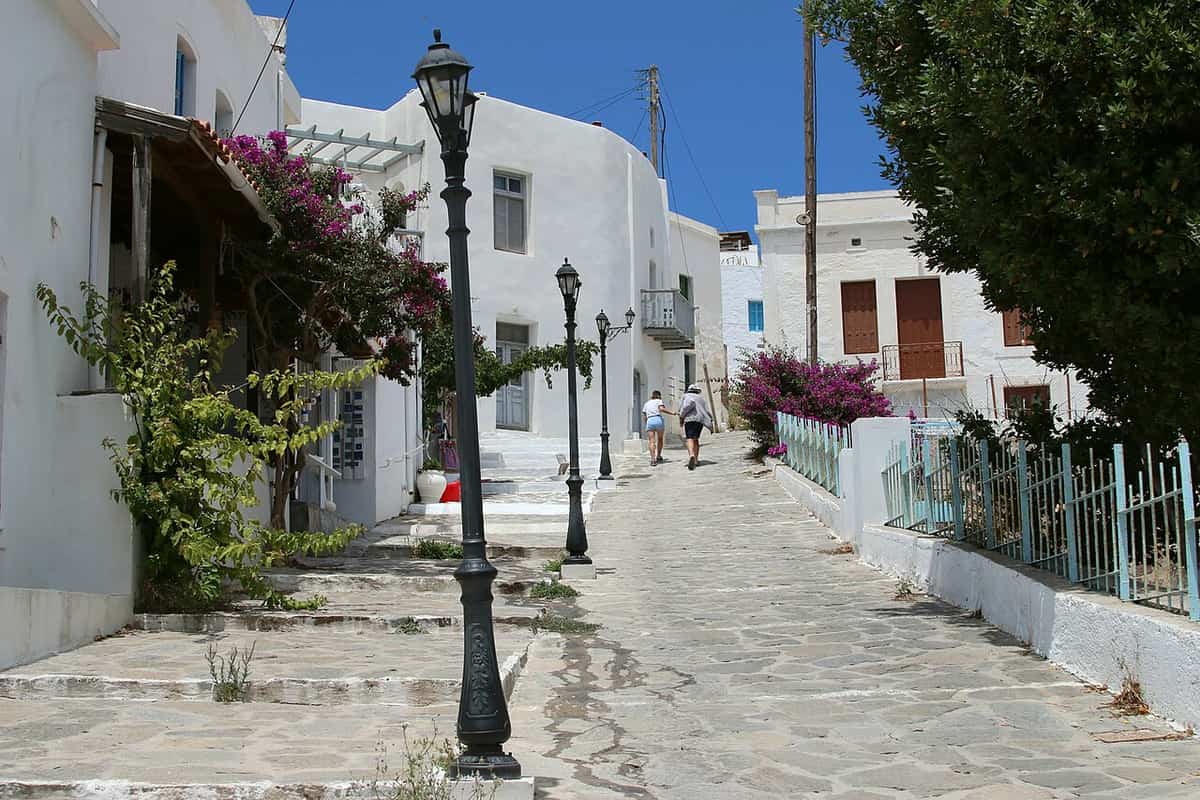
Plaka, the capital of Milos, looks over the gulf from 220 metres, perched on top of a large rock, and it has 902 residents. No cars can enter the village because of the narrow spaces between walls and buildings, and motorbikes and mopeds are the only usable vehicles. For accommodation in Milos, a stay in Plaka therefore begins on foot, with the car left outside. The church of the Dormition stands at the top of the castle, and Panagia Korfiatissa, built in 1820, is the cathedral of Milos.
Tripiti is almost united with Plaka and is a traditional, well-preserved settlement built like an amphitheatre. It has been classed as a traditional settlement since 1978 and stands at a height of 150 metres. The word Tripiti refers to the holes in the soft volcanic rock, and the caves cut into it still serve the inhabitants as storerooms and stables. Accommodation in Milos in Tripiti therefore stands on a rock full of holes and caves.
The greater part of the restored windmills of Tripiti, which ground grain in the past, are used as lodgings today. Accommodation in Milos in a windmill is therefore a building type that belongs to this village. The village stands near the sea entrance of the bay of Milos. The taverns and restaurants of the village offer gastronomic dishes, and the village gives panoramic views of Adamas Bay.
Walks link accommodation in Milos on the hill with the ancient sites. The catacombs and the ancient theatre lie within walking distance of Tripiti. The catacombs stand near the village in caves at 150 metres, 200 metres east of the ancient theatre. The ancient town of Milos occupied the slope between Tripiti and the landing place at Klima. A walking route also runs between Tripiti and Plaka.
- Church: Agios Nikolaos stands in the centre of Tripiti and dates from 1888.
- Chapel: Panagia Faneromeni stands on the road to the catacombs and holds two arched tombs.
- Theatre: The Roman theatre has a view of the port and holds up to 700 people today.
- Catacombs: Gallery B is the one open to visits, and a wooden platform runs through it.
- Klima: This seaside village counts 8 residents and lies near the spot where the Venus de Milo was found.
Both villages keep accommodation in Milos on the heights above the harbour, with car-free lanes in Plaka, converted windmills in Tripiti, and walks to the catacombs, the Roman theatre and Klima. Cars stay outside Plaka, so walking replaces driving in the lanes. Flats and apartment buildings form another type of stay on the island, and the page about apartments in Milos covers it in detail.
What is accommodation in Milos like at Pollonia, the north-east harbour?
Accommodation in Milos at Pollonia means rooms to let and hotels in a harbour village almost 10 kilometres from Adamantas and 14 from Plaka. Taverns run along the village, a beach with rich sand fills the cove, and the sea link to Kimolos starts here.
Pollonia is a fishing village built around a creek at the north-eastern tip of the island, and it is the second port of Milos after Adamas. The settlement has a beach of rich sand, rooms for rent and hotels. It has taverns, restaurants and island cafes, and the village is easy to reach by car and by public transport. Accommodation in Milos at Pollonia therefore comes with food, a beach and transport in one place, while Adamantas, the main port, lies almost 10 kilometres away.
Taverns and restaurants extend as far as the right end of the village, where the church of Agia Paraskevi stands. The pier in front of that church receives the boats of the local fishermen every morning, loaded with fish, octopus and lobsters. The main beach is sandy, and two more beaches lie near the village, Polychroni’s beach and Piso Thalassa. The pier end is therefore the working side of the harbour, and accommodation in Milos near it sits next to the daily catch of the village.
The connection with neighbouring Kimolos and the Glaronisia is made from Pollonia. A regular connection by small boat runs to Kimolos, and Pollonia is the smaller port of Milos, used mainly for the Milos and Kimolos link. For accommodation in Milos, this puts the departure point for Kimolos in the same village as the bed, so a traveller who sleeps here does not need the road from Adamantas to reach the boat.
The left side of the village holds the chapel of Agios Nikolas and the Pelekouda peninsula. The temple of Apollo once stood at the lighthouse of Pelekouda, on the left of the settlement, so the cape marks the edge of the village. Accommodation in Milos on that side of Pollonia lies at the cape end, opposite the pier and its church at the other end.
- Distances: Adamantas lies almost 10 kilometres away and Plaka 14 kilometres.
- Lodging: Rooms for rent and hotels are the kinds of accommodation in Milos at Pollonia.
- Food: Taverns, restaurants and island cafes serve the village.
- Access: The village is easy to reach by car and by public transport.
- Sea links: Boats to Kimolos and the Glaronisia leave from the village.
Accommodation in Milos at Pollonia suits a stay built around a harbour, a beach and a crossing to Kimolos, with a cape at one end and a church at the other. The village stands apart from both the port, Adamantas, and the chief town, Plaka, and it keeps its own lodging, food and sea link. The page on the village of Pollonia covers the settlement itself, while this section deals only with the stay.
What is accommodation in Milos like inside a converted syrma boathouse?
Accommodation in Milos inside a syrma means a stay in a boathouse dug into the volcanic rock at Klima, Mandrakia or Firopotamos. The greater part of the Klima syrmata are rented out today, and Mandrakia has rooms for rent and a restaurant.
Klima is a traditional fishing village with a minimal number of residents and colourful two-storey houses in natural hollows of the rocks. Boats stood on the ground floor, and families lived above. Today the greater part of these houses are rented out, so accommodation in Milos at Klima means a rented house in a rock hollow. Painted doors and windows and cats lying in the sun make the houses a subject for photographs.
Klima had 8 residents in 2021, so accommodation in Milos here means a stay in a very small village. The wider area holds the ruins of the old town and first harbour of the island. They include the two acropoleis of the settlement, the hill of Prophet Elias and Pyrgaki, together with parts of the market wall, of a temple of the Hellenistic and Roman periods and of the ancient theatre, and the spot where the Venus de Milo was found.
Mandrakia is a settlement, beach and small harbour on the north coast, a traditional fishing village 4 kilometres north of Adamantas and about 9 kilometres east-north-east of Plaka. The church of Zoodochos Pigi rises above the syrmata, and a small sandy beach of almost 150 metres, with fine dark grey pebbles and tamarisk trees, lies in front of the houses. Mandrakia has rooms for rent and a restaurant, so accommodation in Milos at Mandrakia pairs rooms with a beach.
Firopotamos is a seaside settlement with a creek surrounded by syrmata, a small organised sandy beach suited to swimming and fishing, and a beach bar. Past the fishing houses stand an abandoned loading ladder and the church of Agios Nikolaos. The syrmata of Mandrakia store boats and fishing gear and serve as temporary homes for fishermen, so accommodation in Milos in these cove settlements shares the shore with working equipment.
- Klima: Two-storey syrmata with bright doors and windows sit in natural hollows of the rock.
- Mandrakia: Accommodation in Milos here lies beside a beach of almost 150 metres with dark grey pebbles.
- Firopotamos: A small organised beach with a beach bar lies beside the cove.
- Churches: A cave church of Agia Paraskevi stands at Klima, Zoodochos Pigi stands above Mandrakia, and Agios Nikolaos stands at the edge of Firopotamos.
- Old town: The wider area of Klima holds the ruins of the first harbour and town of the island.
Accommodation in Milos in a syrma differs from a stay in a village house by its size, its setting and its link to fishing. Klima, Mandrakia and Firopotamos each have a church, and the houses are cut into rock beside the sea. Syrmata are places for keeping small boats, dug into volcanic tuff beside the sea. Another building type, the suite, is covered on the page about suites in Milos.
Where does accommodation in Milos sit along the south coast, from Zefyria to Provatas?
Accommodation in Milos on the south coast means small settlements, not towns. Rooms to let stand near Agia Kyriaki and Paleochori, Provatas adds a hotel and taverns, and Zefyria, an inland village in the centre of East Milos, lies on the road down to the beaches.
Zefyria is the inland base on this route. The village lies in the centre of East Milos, 5.5 km from Adamas and 9 km from Plaka, and the road through it leads on to the beaches of Agia Kyriaki and Paleochori. Zefyria is a village in the inner part of the island, also written as Zefyria (Kampos). Accommodation in Milos here therefore sits among farmland, with the south coast further along the same road.
Provatas is the south-coast settlement with a hotel beside rooms to let and taverns. Its beach has golden-red sand, coloured by iron oxides, and very shallow water that suits children, with sunbeds and umbrellas. Provatas is both a settlement and a beach in the southern part of the island. Accommodation in Milos at Provatas therefore centres on a family shore with a small group of permanent residents.
Distance from the port separates these bases. Provatas lies between 7 and 9 km from Adamas, with a paved road, good signage and frequent bus service. Agia Kyriaki lies about 10 km from Adamas and Paleochori about 14 km, so the ride lengthens along the coast. Agia Kyriaki is a large organised beach with sunbeds, umbrellas and beach bars. Rooms to rent also stand in the Paleochori area. Accommodation in Milos at the far end of this coast therefore starts with the longest journey from the island’s port.
Zefyria was abandoned in 1767 after earthquakes destroyed it and epidemics spread from the gases of the faults. The old metropolis of Milos, Panagia Portiani, still stands in the village beside the church of Agios Nikolaos, which shares a wall with it. A major festival of the island is held there each 15 August in honour of the Virgin. Accommodation in Milos around Zefyria in mid-August is therefore planned around that festival.
- Provatas residents: Provatas had 33 permanent residents in 2021 and 27 in 2011.
- Provatas status: The settlement first counted as a separate settlement in 2011.
- Provatas and the seat: The settlement lies about 12 km from the municipal seat.
- Zefyria residents: The village has about 150 residents and is a living agricultural settlement.
- Zefyria seat: The village became the seat of its own municipality in 1835.
Accommodation in Milos on the south coast divides into an inland village and small shore settlements. Zefyria offers a base among farmland on the road south, Provatas has a hotel, rooms to let and taverns beside shallow water, and Agia Kyriaki and Paleochori have rooms near the sand. The page about the beaches of Milos covers the island-wide range of shores, and distance from Adamas decides the base.
How does accommodation in Milos work in Triovasalos, Pera Triovasalos and along the bay?
Accommodation in Milos around Triovasalos and Pera Triovasalos means two hill villages that were one settlement until 1908, with banks, shops and coffee houses above Adamas. Along the bay, Lagada, Papikinou and Achivadolimni serve as shore bases, and Achivadolimni has organised camping.
Triovasalos and Pera Triovasalos occupy two neighbouring hills and formed one settlement until 1908. Triovasalos stands at 143 m and Pera Triovasalos at 120 m. Both villages are densely built and amphitheatrical, and both lie on the way from the port to Plaka. They stand on a rise above Adamas, like Plaka. Pera Triovasalos is about 1 km from Plaka and 3 km from Adamas. Accommodation in Milos here therefore sits between the port and the chief town.
Together the two villages form the commercial and everyday core of Milos, with banks, public services, coffee houses, shops and small businesses, while they keep a traditional Cycladic character. Pera Triovasalos also has bakeries and traditional coffee houses that serve residents and visitors. The Karodromos is a central point of the island. Accommodation in Milos in these villages therefore puts a stay beside daily services rather than beside a beach.
Each village has its church. Agios Spyridon in Triovasalos dates from the early 19th century, and Agios Georgios in Pera Triovasalos dates from 1849, with a marble iconostasis and mosaics in the courtyard. At Easter, the custom of burning Judas takes place: a figure is burned and dynamite is thrown in a field between the two villages. Accommodation in Milos chosen for Easter therefore sits beside that custom, whose field lies between the two villages.
Along the bay, three beaches work as shore bases. Lagada is the beach nearest to the port of Adamas, with clear water and tamarisk shade, and Papikinou, a large beach, lies 1 km east of Adamas, with sunbeds, umbrellas and a restaurant. Achivadolimni is the largest beach on the island, split into a quieter first stretch and a busy organised second stretch, with camping and a bus link. Accommodation in Milos along the bay therefore ranges from the port end at Lagada to the camping at Achivadolimni.
- Triovasalos: Triovasalos had 1,001 residents in 2021.
- Pera Triovasalos: The community counted 844 residents in 2021, together with Katsaronas and Komia.
- Services: Bakeries and traditional coffee houses serve residents and visitors in Pera Triovasalos.
- Shops: Shops operate along the pedestrian street of Triovasalos.
- Separate status: Pera Triovasalos became its own settlement in 1908 and its own community seat in 1912.
Accommodation in Milos around Triovasalos and Pera Triovasalos places a stay among banks, shops, bakeries and coffee houses on the rise above Adamas, with Pera Triovasalos 3 km from the port and 1 km from Plaka. Accommodation in Milos along the bay places it at the shore instead, from Lagada by the port to the camping at Achivadolimni. The page on studios in Milos covers studio stays across the island in more detail.
How does the season change the choice of accommodation in Milos?
Accommodation in Milos follows the season. Summer calls for shade and cooling, the meltemi months for a sheltered terrace and a base near the port, spring and autumn for a walkable village, and winter for heating and dry access, since the island has mild, rainy winters.
Milos is a popular tourist destination during the summer, so the summer peak is the first test for accommodation in Milos. Summers there are warm to hot and dry, the highest temperature measured reaches 41.0 °C in July and 39.8 °C in August, and July humidity averages 60.1%. In such heat a room with shade, cooling and cross-ventilation matters more than a sea view, and a roofed terrace keeps the middle of the day usable.
The meltemi sets the second test. Very windy days occur especially in the Cyclades, and the etesian winds reach their highest frequency in July and August. The northerly wind tempers the summer heat, is strongest in the afternoon and can ease at night. A terrace that faces north takes a north wind head-on, so accommodation in Milos with a sheltered side or a courtyard keeps the afternoon usable.
Spring and autumn suit a base chosen for walking and outdoor space. In late spring the daily mean is 19.3 °C with 1.4 rainy days, and in September it is 22.3 °C with 0.9 rainy days. The mean minimum is 15.9 °C in late spring and 16.1 °C in October, so evenings outdoors need a light layer. Accommodation in Milos within walking distance of the harbour or the sights makes full use of these months.
Winter turns the question to warmth and rain. Winters are wet, and any snow that falls does not last long. February has 7.3 rainy days and 50.6 mm of rain, January humidity averages 73.3%, and the lowest temperature measured is -2.0 °C in both January and February. In these months accommodation in Milos needs heating, a dry entrance and a short walk to the harbour more than a terrace.
- Summer peak: the June mean minimum is 19.8 °C, so ventilation matters.
- Meltemi months: a base in Adamantas shortens the wait when ferries cannot sail.
- Spring: March has 5.7 rainy days, so a covered entrance still helps.
- Autumn: November has 5.8 rainy days, so rain starts to matter.
- Winter: January has 8.8 rainy days, so heating comes first.
Season is the first filter for accommodation in Milos, because the same room reads differently in July and in February. Shade and cooling lead in summer, a sheltered terrace and port access lead in the meltemi months, a walkable village leads in spring and autumn, and heating leads in winter. Once the season is set, the trip type narrows the choice of accommodation in Milos further, as the next section shows.


Which accommodation in Milos suits families, couples, walkers and travellers without a car?
Accommodation in Milos suits a trip type through access and setting: families need a short transfer from the port, couples a quiet village or seaside setting, walkers open ground within reach, and travellers without a car a settlement on the east half of the island.
Families plan around short transfers and easy days. Milos measures about 23 km from east to west and 13 km from north to south, so the position of the base sets the length of each day. The island has 90 beaches, 25 of them inside the large bay formed by its horseshoe shape. The bay holds more beaches than any other side, so accommodation in Milos on the bay keeps the choice of beach wide.
Couples choose setting before access. Visitors are drawn to Milos by its traditional Greek architecture, its varied coastline and beaches. The gulf is one of the largest natural harbours in Greece, and part of the beaches are reached by land while the rest are reached only by sea. A village or seaside base therefore suits a couple that plans one boat day for the sea-only beaches and chooses accommodation in Milos for its setting.
Travellers without a car begin with the island map. The west half has no villages, while Plaka, Triovasalos, Pera Triovasalos and Trypiti stand on a rise above Adamantas. A traveller who relies on local buses and on foot therefore picks accommodation in Milos at the port or in a village on the east half. A base outside the settlements adds distance to every errand, every meal and every ferry departure.
Walkers weigh relief and season together. The greater portion of the island is rugged and hilly, with Mount Profitis Elias reaching 748 metres in the west, and the west half is the wildest part of Milos. Cool months suit walking: the daily mean is 12.1 °C in March and 15.2 °C in April. Accommodation in Milos in the east half puts the villages behind the walker and the open ground ahead.
- Families: Adamantas is the main port, so a base there simplifies departure days.
- Couples: Milos offers a less crowded setting than Santorini and Mykonos.
- No car: one ascent from Adamantas reaches Plaka, Kastro and the plateau villages.
- Walkers: the uninhabited west is almost all a Natura 2000 site.
- Boat links: Pollonia is the smaller harbour, mainly for the Kimolos link.
Trip type and season work together when choosing accommodation in Milos. A family in July looks for cooling and a short transfer from the harbour, a couple in late spring looks for a village in mild weather, a walker in April takes a base on the east half, and a traveller without a car stays inside a settlement. Day plans for each base continue on the page about activities in Milos.
How do travellers get from the port and the airport to accommodation in Milos?
Accommodation in Milos begins at one of two arrival points. Adamantas is the main port, and the island airport lies 5 kilometres southeast of its harbour. From the port, an ascent leads to the plateau villages, and the airport has taxi and bus links.
Adamantas is the harbour town and main port of Milos, on the north-eastern coast of the gulf. It is the seat of its own municipal community, which is a rural lowland settlement with an area of 3.970 square kilometres in 2011. The beach of Adamantas lies at the foot of a hill, so the town stands on low ground beside the water. A transfer from the main port to accommodation in Milos therefore starts at sea level and climbs from there.
Four settlements stand on a height above Adamantas: Plaka, Triovasalos, Peran Triovasalos and Tripiti. An ascent leads from the harbour town to the plateau above it. Plaka, the chief town, stands on that plateau, Kastro rises on a hill above it, and other villages are situated there as well. The capital of the island carries the name Milos and consists of two settlements, Plaka and Plakes. Travellers who choose accommodation in Milos on the plateau therefore leave the port by that ascent.
Milos Island National Airport lies 5 kilometres southeast of the harbour of the island. It lies about 9 kilometres from the centre of the town of Adamantas. The two figures start from different points, the harbour and the town centre. The runway is only 1,030 metres long, and it received a new asphalt surface in 1995, when the new terminal building was completed. A short runway limits the airport to small aircraft.
Other than by car, the airport is linked to the rest of the island by taxi, and bus connections also link to the airport. A car, a taxi and a bus are therefore the three ways to travel from the airport to accommodation in Milos. For arrivals by sea, Pollonia is the smaller harbour of Milos, used mainly for the connection between Milos and Kimolos, while Adamantas remains the main port of the island.
- Main port: Adamantas is the main port of Milos, on the north-eastern coast of the gulf.
- Gulf: The gulf of Milos is one of the largest natural harbours in Greece.
- Height above the port: Plaka, Triovasalos, Peran Triovasalos and Tripiti stand above Adamantas.
- Airport distance: The airport lies 5 kilometres southeast of the harbour and about 9 kilometres from the town centre.
- Airport links: A taxi serves the airport, and bus connections link to it.
Travellers who plan the crossing or the flight before choosing accommodation in Milos can read the route details on the page about how to go to Milos. The arrival point fixes the first leg of the journey, and the port, the airport and the plateau villages each need a different transfer. The questions below collect further practical facts that travellers ask about the port, the airport and the settlements around them.


What do travellers ask about getting to accommodation in Milos?
Accommodation in Milos is reached through the main port of Adamantas, the smaller harbour of Pollonia or the island airport. Villages stand on the height above Adamantas and on the slope of the ancient town, and taxis and bus connections serve the airport.
Which harbour besides Adamantas serves accommodation in Milos?
Pollonia is the smaller harbour of Milos, used mainly for the connection between Milos and Kimolos. It is listed among the other villages of the island, next to Triovasalos, Peran Triovasalos and Zefyria, also called Kampos. Adamantas remains the main port, on the north-eastern coast of the gulf.
Where is accommodation in Milos close to museums?
At Adamantas, the Maritime Museum shows rare maps and a wooden boat named Eirini, the Ecclesiastical Museum stands very close to the harbour at the church of Holy Trinity, and the Mining Museum presents the mining history of Milos. In Plaka, the Archaeological Museum and the Folklore Museum stand.
Which villages above Adamantas hold accommodation in Milos?
Four settlements stand on a height above Adamantas: Plaka, Triovasalos, Peran Triovasalos and Tripiti. Plaka is the chief town of the island, and Kastro rises on a hill above it. An ascent leads from the harbour town to the plateau above the harbour, where these villages are situated.
Is there accommodation in Milos near the ancient theatre and Klima?
Tripiti and Klima mark the ends of the slope where the ancient town of Milos stood, nearer to the harbour entrance than Adamantas. A theatre of Roman date and remains of town walls and other buildings stand there. Klima is a smaller settlement, just like Mandrakia and Firopotamos.
Can travellers reach accommodation in Milos from the airport without a car?
Other than by car, a taxi links the airport with the rest of the island, and bus connections also link to the airport. These two links serve travellers without a car. The airport lies 5 kilometres southeast of the harbour and about 9 kilometres from the centre of Adamantas.
Which aircraft can land for accommodation in Milos?
The runway of the airport is 1,030 metres long and quite short. Only aircraft of the Dash 8 type or smaller can use it. A new asphalt surface was laid on the runway and the apron was built in 1995, when the new terminal building was also completed.
What lies on the Adamantas shore near accommodation in Milos?
A hot spring lies at the foot of the hill on the Adamantas beach. The hot spring site is closed, but a sign marks the hot baths. Traces of ancient buildings are visible about 30 metres down, which points to an old settlement that sank as the ground subsided.
Why does the gulf matter for sea arrivals to accommodation in Milos?
The natural harbour is the hollow of the principal crater, with a depth diminishing from 70 to 30 fathoms, or 130 to 55 metres. Hot sulfurous springs also lie on the eastern shore of the harbour. The gulf of Milos is one of the largest natural harbours in Greece.