Miland Suites
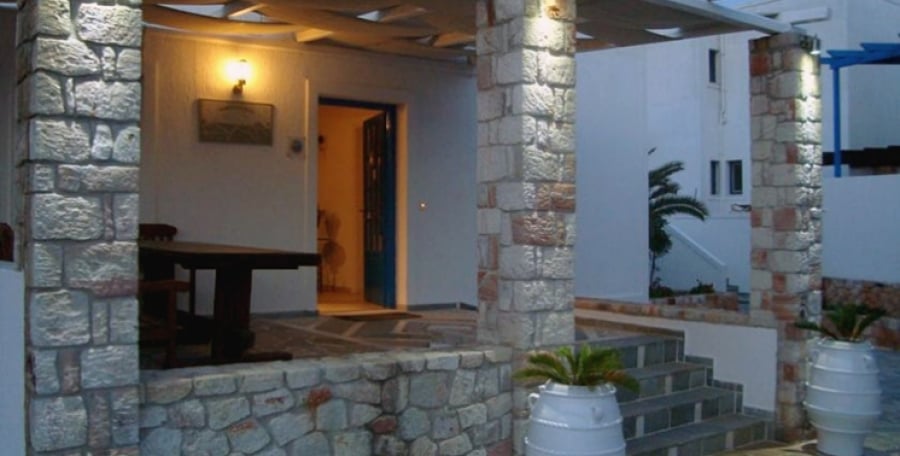
Kapetan Tasos Suites
Suites in Milos are stays built around a living area apart from the bedroom and an outdoor space that belongs to the guest. They stand on the island of Milos, at the south-western end of the Cyclades, where a terrace or a courtyard turns the gulf, the cove or the shore into part of the room.
This page sets out two points. The first section explains what suites in Milos are: a separate living space, a terrace and other private outdoor areas. The second section shows where suites in Milos are found, from the rock of Plaka and Tripiti to Pollonia, Adamantas, Klima and the south coast.
What are suites in Milos, and how do the living space and the terrace work?
Suites in Milos are places to stay with a living area apart from the bedroom, plus a terrace or another private outdoor space. The living area holds the daytime, the bedroom holds the night, and the terrace carries the setting to the door.
The living area is the first mark of a suite. Besides the beds and the bathroom, a hotel suite has a living or sitting area, and dining, office and kitchen facilities can join that area. A living room is a room for relaxing and socialising in a house or an apartment. Suites in Milos therefore give a stay a second space for sitting and eating, and the bedroom keeps only the night.
The terrace is the second mark. A terrace is an external, raised, open, flat area near a building, or a roof terrace on a flat roof. It serves for sitting, strolling and resting, it is always open to the sky, and it can be paved or unpaved. Suites in Milos with a terrace move the sitting area outdoors, so the daylight and the open air belong to the stay from morning to evening.
Other private outdoor areas follow the same idea. A balcony is a platform that projects from the wall of a building, enclosed by a balustrade and set above the ground floor. A patio is a paved outdoor space beside a structure, used for dining or recreation. A courtyard is an area surrounded by a building and open to the sky. A suite with any of these keeps an outdoor room of its own.
Roofed and open areas differ. A veranda is a roofed, open-air porch attached to the outside of a building. It gives protection from sun and rain, while a terrace has no roof and stays open to the sky. A suite with a veranda therefore offers cover at the door, and a suite with a terrace offers the open sky. Suites in Milos differ by outdoor area as well as by living area.
- Living area: A suite adds a living or sitting area.
- Facilities: Dining, office and kitchen facilities can join the living area.
- Terrace: A raised, open, flat area beside a building or on a flat roof.
- Balcony: A balcony projects from a building wall and has a balustrade.
- Veranda: A veranda is a roofed, open-air porch attached to a building.
Suites in Milos therefore combine two parts: a living area apart from the bedroom, and an outdoor space such as a terrace, a balcony, a patio or a courtyard. The living area gives the stay a daytime room, and the outdoor space opens that room to the air. The next section names where suites in Milos are found.
Where are suites in Milos found, from Plaka and Tripiti to the south coast?
Suites in Milos are found on the rock of Plaka and Tripiti, in the cove of Pollonia, in the port of Adamantas, in the fishing village of Klima and along the south coast. Each place gives the terrace a different outlook over the island.
Plaka and Tripiti form the first group. Plaka takes its name from the flat ground on which its first inhabitants built their houses, and it stands at 220 metres above the sea, with cobbled alleys first built for protection from pirates. Tripiti, almost united with Plaka, is built amphitheatrically over the ruins of the classic city of Klima and offers panoramic views of Adamas Bay. Suites in Milos on this height look out over the gulf.
Pollonia and Adamantas are the two harbours. Pollonia is a fishing village built around a cove at the north-eastern tip of the island, with tamarisk trees, a sandy beach and island cafes, and the boats to Kimolos and the Glaronisia leave from it. Adamantas lies in the bay, is the largest tourist centre of Milos and has white houses, small flower-decorated courtyards and narrow, quiet streets. Suites in Milos at both harbours stand beside the water.
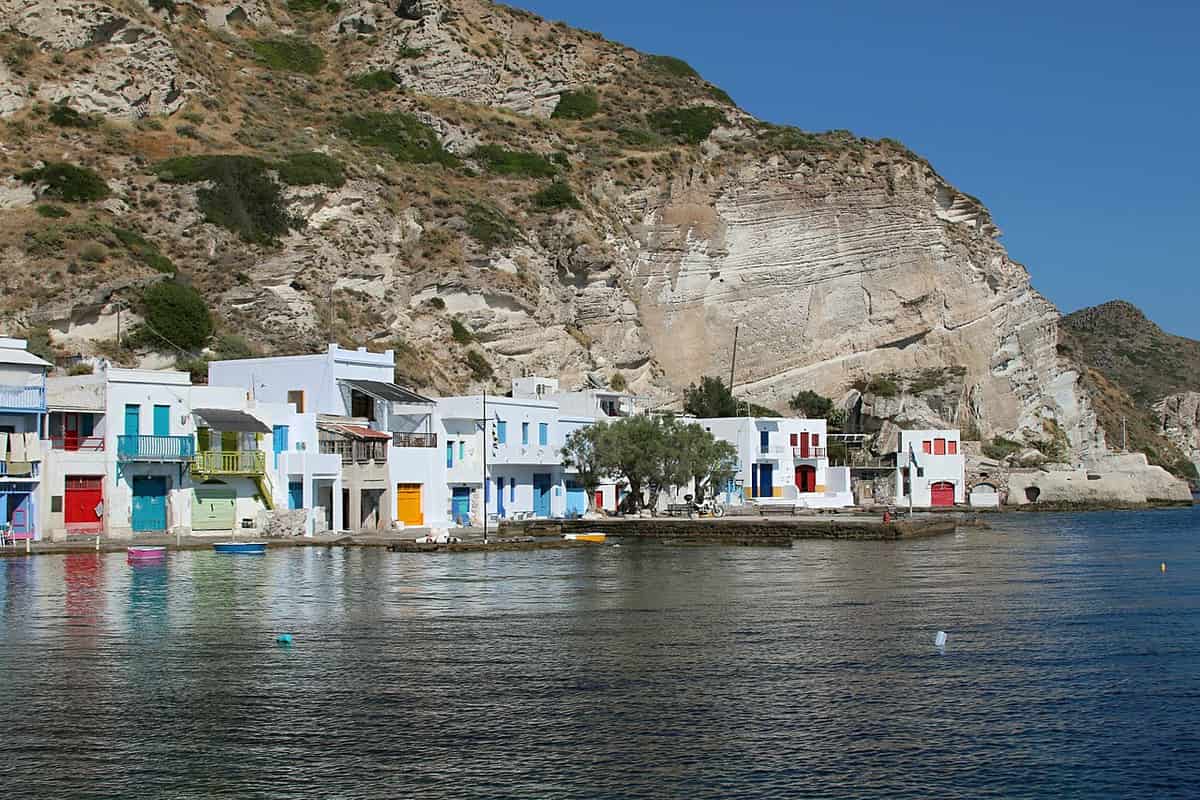
Klima is a seaside village with 8 residents at the 2021 census. Its fishermen houses, the syrmata, have two floors, with the family above and the boat below, and painted doors and windows. Tourist accommodation is one of the present uses of these houses. The village lies near ancient Milos and its theatre and near the place where the Venus de Milo was found. Suites in Milos at Klima stand in a very small village.
The south coast holds the last group. Provatas has golden-red sand, coloured by iron oxides, and very shallow water. Agios Sostis, an extension of Provatas beach, takes its name from a church that stands a little above the sand. Paliochori beach is almost 2 km long, with colourful pebbles and rocks in red, pink, yellow and white-grey, and warm waters gush there. Suites in Milos along this coast look out over sand, pebbles and coloured rock.
- Hill villages: Plaka stands at 220 metres, and Tripiti has panoramic views of the bay.
- Pollonia: The village has a cove, a sandy beach and tamarisk trees.
- Adamantas: The harbour town is the largest tourist centre of Milos.
- Klima: The fishermen houses have two floors and painted doors.
- South coast: Paliochori beach is almost 2 km long, with colourful pebbles.
Suites in Milos therefore spread over five settings: the rock of Plaka and Tripiti, the cove of Pollonia, the port of Adamantas, the fishing houses of Klima and the shores of the south coast. The outlook changes with each place, while the living area and the terrace stay the same. The page on every type of place to stay on the island compares suites with the other types.
What are rock-cut and cave-style suites in Milos?
Suites in Milos of the rock-cut kind follow an old island habit of carving rooms into soft volcanic tuff. The catacombs near Tripiti, the holes that give Tripiti its name and the syrmata of Klima all show this habit in stone.
Tuff is a rock made of volcanic ash that hardens into solid stone after an eruption. It is relatively soft, so it has been used for construction since ancient times. Milos is volcanic, and tuff is among the ordinary rocks of the island. Suites in Milos with cut stone walls therefore start from the local ground itself, not from an imported style, and the carving on this island has a long record behind it.
The clearest proof lies on the hillside south-west of Tripiti. A complex of spacious halls and corridors was cut there into soft porous volcanic rock during the first Christian centuries, and artificial corridors link the halls. A family burial chamber completes the cluster. Two kinds of tomb were carved into the walls, arched recesses and horizontal recesses, and pit graves were cut into the floor. Slabs of different sizes once covered every tomb.
The scale can be measured. The galleries have a total length of about 200 metres, a width between 1 and 5 metres and a height between 1.6 and 2.5 metres. Halls of that size, cut into the rock of a hillside, show how workable tuff is. Suites in Milos with rock walls therefore rest on a stone that people have shaped for centuries, and the carved ground of the hill villages is part of the same story.
Cut rock on Milos keeps changing its use. The caves around Tripiti served as family burial chambers in ancient times and now hold the storerooms and stables of the inhabitants. On the coast, cavities of the rock became boat shelters, and the shelters became houses. A number of those houses now take guests. Cave-style suites in Milos belong to that chain of reuse, and the chain starts inland, on the carved ground of the hill.
- Rock: Tuff is a relatively soft volcanic rock, which is why suites in Milos can be cut into it.
- Galleries: The catacombs form three large underground galleries joined by five corridors and a rectangular funerary chamber.
- Tombs: A total of 126 carved arched tombs are preserved on the gallery walls.
- Local name: Local people knew the catacombs as the Greek cave.
- Decoration: Painted decoration survives on a number of the arched tombs.
Suites in Milos that use cut rock draw on a tradition at least as old as the catacombs of the first Christian centuries. Tuff is soft enough to carve, the hill villages stand on carved ground, and the coves keep their cave dwellings. The same hill villages also face the sea at sunset, so the next section turns from the rock to the view.
Where are suites in Milos with sea and sunset views?
Suites in Milos with sea and sunset views stand on the slopes above the gulf, in Plaka, Tripiti and Klima. Plaka holds the Kastro and the church of Panagia Korfiatissa, both named for sunsets, while Tripiti and Klima step down the hillside toward the water.
Plaka stands highest of the three villages and holds the first sunset point. It is perched on a large rock above the gulf, and a Venetian castle of the 13th century crowns the hill at the top. From there the sunsets show strong colours over the bay and the neighbouring Cycladic islands. Suites in Milos in the upper lanes of Plaka sit closest to that point, and the walk to the castle is made on foot, because no car enters the village.
The western end of Plaka holds the second point. The church of Panagia Korfiatissa stands there on steep rocks, at a place called Halara, and the sea views and sunsets are part of a visit. The area in front of the church is called Marbles, because its courtyard is paved with marble tombstones from the old town. Suites in Milos at this end of the village sit nearest to that view over the sea.
Tripiti stands almost joined to Plaka, at 150 metres and lower than the chief town. The gulf of Milos strikes in from the north-west, and the ancient town occupied the slope between Tripiti and the landing place at Klima, nearer to the entrance of the harbour than Adamantas. Suites in Milos on this slope face the mouth of the gulf, and the houses of the village climb the hill in steps.
Klima lies at the foot of the slope, at the entrance of the gulf below Tripiti. Cave-style houses stand in hollows of the rock beside the water, and the beach of the village lies inside the gulf. The page on the fishing village of Klima covers the settlement itself. Suites in Milos here look out from sea level, while the suites of Plaka look down from a height of 220 metres.
- Kastro: The Venetian castle of the 13th century stands at the top of Plaka hill.
- Korfiatissa: The church stands at the western end of Plaka on steep rocks.
- Gulf: The natural harbour strikes in from the north-west and divides the island into two parts of nearly equal size.
- Hillside: The slope south-west of Tripiti holds the catacombs and the ruins of the ancient town.
- Light: Daylight is redder and softer shortly before sunset than when the sun stands higher.
Suites in Milos with sea and sunset views therefore follow the slope from Plaka at 220 metres down to Klima at the water, and each level frames the gulf in its own way. Light turns redder and softer shortly before sunset, so the hour before it gives the richest colours at all three villages. A western aspect is the first point to check in a description of any suite.


Which suites in Milos suit couples and honeymoons?
Suites in Milos suit couples and honeymoons when the setting offers quiet, a sunset view and privacy. Plaka offers sunsets from its castle hill, quiet sandy coves slow the days, and a suite adds a sitting area that the pair keeps to itself.
A suite is a set of connected rooms under one room number. Its sitting area separates the bedroom from the place where a pair spends the evening, and that separation is the privacy that couples look for. Honeymoon suites are rooms with specialised amenities aimed at couples or newlyweds. Suites in Milos give that privacy inside the building, while the village or cove outside decides how quiet the stay feels, so the settings below matter as much as the room.
Sunset shapes the evening of a honeymoon, and Plaka offers two places to watch it. The Venetian castle of the 13th century stands at the top of the Plaka hill, with sunsets over the bay and the neighbouring Cycladic islands. Panagia Korfiatissa stands at the western end of Plaka on steep rocks, with sea views and sunsets. Suites in Milos inside Plaka sit near both, and car traffic is prohibited in the village, so the lanes stay free of engines.
A quieter sunset stop lies on Klimatovouni, the hill above the fishing village of Klima. The church of Panagia Tourliani stands there, and its courtyard looks over the upper villages of the island and the entrance of Adamas Bay. A pair can lie down in that courtyard at sunset. Suites in Milos near Klima keep this viewpoint close, and the hill gives an evening outing that needs no booking and no crowd.
Quiet water fills the days. Agios Konstantinos is a quiet sandy beach in a harbour surrounded by rocks, and Fatourena is a quiet blue beach that overlooks the whole port, reached by a dirt road down to the sea. At Fyriplaka the first beach is organised, while the two beyond it, reached on foot along the sea and the volcanic rocks, give those who avoid the crowds more room. A pair that books suites in Milos near these shores can plan slow days.
- Castle: The Venetian castle on the Plaka hill gives sunsets over the bay and the neighbouring Cycladic islands.
- Courtyard: The courtyard of Panagia Tourliani looks over the upper villages and the entrance of Adamas Bay.
- Sitting area: The sitting area of a suite lets one half of a pair read or rest while the other sleeps.
- Quiet beaches: Agios Konstantinos and Fatourena are both described as quiet beaches.
- Pelekouda: Tradition says that a couple who sit on the small chair-shaped rock at Pollonia stay together forever.
Suites in Milos suit couples through three things: a sitting area for privacy, a viewpoint for the sunset and a quiet shore for the day. Plaka, Klimatovouni, Agios Konstantinos and Fyriplaka each supply one of them. The page on the sights of Milos covers the castle, the churches and the other viewpoints, and the next section turns to families and groups.
Which suites in Milos suit families and groups?
Suites in Milos suit families and groups because connected rooms under one room number give each household its own space and a shared sitting area. Shallow sandy beaches, shade and dry summer evenings outdoors then decide which base fits a larger party.
More than one room is the first thing a family needs from a suite. The rooms share one room number, so parents and children stay behind one door while each keeps a separate space. A sitting area can hold a sofa bed, and dining and kitchen facilities are added to a suite as well. Suites in Milos therefore suit a family of four or a group of friends that shares meals in one room and sleeps in separate ones.
Beaches decide the days of a family. Papikinou, beside the port town, is ideal for children because its waters deepen slowly, and it is one of the beaches with the mildest waves on the island. Agios Sostis, an extension of Provatas beach, is a small and shallow sandy beach with a restaurant. Suites in Milos near these two shores keep the beach day short on travel, and children can stand in the water long before it deepens.
Older children and adults in a group want more than shallow water. Agia Kyriaki is a large organised beach with sunbeds, umbrellas, beach bars and a beach volleyball court. Achivadolimni is the largest beach of the island, with white sand and shallow water, and it is an ideal choice for surf and kite-surf lovers. A group that splits its interests can therefore share one of the suites in Milos at the end of the day.
Outdoor space completes the choice for a larger party. July averages 0.3 mm of rain and August 1.4 mm, so a terrace or a yard stays dry through July and August. The mean daily minimum in August is 21.6 °C, so evening meals can run outdoors long after dark. Tamarisk trees stand on Pachaina, a spacious beach with rich sand that overlooks the Glaronissia. Suites in Milos with an outdoor table extend the family day past the beach.
- Rooms: Connected rooms of suites in Milos share one room number, so a whole party stays behind one door.
- Sitting area: The sitting area can hold a sofa bed for an extra guest.
- Children: Papikinou has waters that deepen slowly and is one of the beaches with the mildest waves on the island.
- Older children: Agia Kyriaki has a beach volleyball court, and Achivadolimni suits surf and kite-surf lovers.
- Evenings: August nights keep a mean daily minimum of 21.6 °C, which suits a table outdoors.
Families and groups choose suites in Milos by room count, beach and outdoor space. More than one room gives each household a place to sleep, a shallow sandy beach suits children, and a dry summer keeps the terrace in use. Read together, the two sections show how suites in Milos serve a pair on a honeymoon and a larger party on a family holiday.

What do private pools and outdoor spaces at suites in Milos look like on a dry island?
Suites in Milos that offer a private pool or a yard follow the rules of a dry island. Tourism has brought water shortages to the Cyclades, summer rain is close to zero, and Milos has produced fresh water from seawater with geothermal energy.
A private pool needs water, and water is the scarce resource of the island. In recent decades the Cyclades became popular with tourists, and the result was problems with erosion, pollution and water shortages. Milos is too dry for a profusion of vegetation, yet the island is a popular tourist destination during the summer, while only 5,193 inhabitants lived there at the 2021 census. A pool at suites in Milos therefore draws on the same supply as the rest of the island.
The supply for suites in Milos has a visible history on the ground. The Municipality of Milos built water intake facilities for the water supply of the island, and the old buildings stand beside a dirt road through a ravine on the Volcano walking route. Breeders dug artificial pits on the hillsides below Kedrolivado to hold rainwater. Desalination, which removes minerals from seawater to make fresh water, has a place on Milos too, because the Milos Island Project relied entirely on geothermal energy.
Rain does not refill a pool in the hot months. June receives 3.3 mm of rain, while the wet months fall in winter and early spring, with February at 50.6 mm and March at 47.2 mm. The sea needs no supply at all, and Aegean surface water reaches 19 to 24 °C in summer. For suites in Milos, a pool is therefore a private extra beside the sea, and a swim in the bay draws nothing from the island supply.
Outdoor space at suites in Milos does not depend on a pool. In yards and gardens on the island, capers dry, pitarakia bake in the oven and tomatoes are picked, and orange, olive, cypress, tamarisk, juniper and arbutus trees grow throughout the island. At the western end of Plaka, the church of Panagia Korfiatissa stands on steep rocks with sea views and sunsets. A yard or a garden belongs to the same everyday setting.
- Shortage: Water shortages followed the growth of tourism across the Cyclades.
- Supply: The Municipality of Milos built water intake facilities for the island.
- Desalination: The Milos Island Project produced desalinated water with geothermal energy alone.
- Rain: February brings 50.6 mm of rain and June only 3.3 mm.
- Trees: Olive, tamarisk, juniper and arbutus trees grow throughout the island.
Taken together, the facts set the terms for suites in Milos: a private pool is an option on a dry island, while the sea and the view ask nothing of the water supply. The bays of the island offer the open water, and the page about the beaches of Milos lists them, so suites in Milos pair a private corner with a swim in the sea.
What are the best months for suites in Milos?
The best months for suites in Milos are late spring, June, September and early October, when nights stay mild, rain is rare and the meltemi blows less frequently. July and August bring the strongest heat and the highest wind frequency, and winter brings the rain.
July and August bring the peak heat. The daily mean reaches 25.0 °C in July, the record highs stand at 41.0 °C in July and 39.8 °C in August, and relative humidity averages 60.1% in July and 63.4% in August. Rain is almost absent in both months. A private pool or a yard at suites in Milos therefore stays dry and open through the two hottest months of the year.
The meltemi shapes these two months. The etesian winds blow from late spring to mid-September, and the climate record of Greece extends the window to October, with the highest frequency in July and August. The wind is dry, the weather stays fine and clear, and the northerly flow tempers the fierce summer heat. Spells of days without a break occur, though the wind frequently dies down at night, so the late evening is the calm part of the day for suites in Milos.
Late spring opens the season. The last month of spring has a daily mean of 19.3 °C, nights average 15.9 °C and rain falls on 1.4 days, while June moves to a daily mean of 23.5 °C and nights of 19.8 °C. The meltemi has begun by then but blows less frequently than at the peak, and humidity sits at 63.5%. An outdoor space at suites in Milos in these weeks has warm days and cool evenings.
Early autumn keeps the warmth. September has a daily mean of 22.3 °C, nights average 19.6 °C and rain falls on 0.9 days, and the etesian window closes about mid-September. October cools to nights of 16.1 °C, with a record high of 32.0 °C and humidity at 71.3%. By November the daily mean falls to 15.3 °C and rain falls on 5.8 days, so suites in Milos meet the wet season there.
- Late spring: Nights average 15.9 °C and rain falls on 1.4 days.
- June: Nights average 19.8 °C and the daily mean is 23.5 °C.
- July: The record high is 41.0 °C and humidity averages 60.1%.
- September: Nights average 19.6 °C and rain falls on 0.9 days.
- October: Nights average 16.1 °C and humidity averages 71.3%.
For suites in Milos, the climate figures favour late spring, June, September and early October, with warm days, mild nights and little rain. July and August suit guests who want the peak heat and accept the meltemi at its highest frequency. From November the daily mean drops to 15.3 °C and rain falls on 5.8 days, so a private pool or a yard sees less use.
How do travellers reach suites in Milos from the port and the airport?
Suites in Milos are reached through the main port of Adamas or the island airport, then by a road that climbs to the plateau villages. Taxis wait at both arrival points, and cars stop at the edge of Plaka, where traffic is prohibited.
Adamas is the main port of Milos, built on low ground on the north-eastern coast of the gulf. Suites in Milos on the plateau stand above it, so every transfer from the quay climbs. The island airport takes 2 or 3 direct flights from Athens each day, and taxis wait there as well as at the port. From Adamas to Plaka the road takes 10 to 15 minutes, and a short walk in Plaka follows.
Three villages stand between the port and Plaka. Triovasalos and Pera Triovasalos occupy two neighbouring hills, and both are densely built and show notable commercial activity. Plakes lies between Plaka and Triovasalos, with white houses and lanes. Together the three villages fill the stretch of road between the harbour and Plaka, so a traveller who books suites in Milos in one of them rides the same ascent that leads on to the chief town, and each village comes before the car-free alleys begin.
Plaka sets the last rule of the journey. The chief town of the island is also the seat of its municipality, with Cycladic architecture, small traditional shops, restaurants and cafes along its cobbled alleys, which were originally built for protection from pirates. Car traffic is prohibited inside the village. A car therefore stops at the edge of Plaka, and the walk to suites in Milos inside the village follows the alleys from that point to the door.
- Port: Adamas is the main port, on low ground beside the gulf.
- Airport: 2 or 3 direct flights from Athens land on the island each day.
- Road: From Adamas to Plaka the road takes 10 to 15 minutes, followed by a short walk.
- Villages: Triovasalos, Pera Triovasalos and Plakes lie between the port and Plaka.
- Plaka: Cars cannot enter, so the walk to the door starts at the edge of the village.
The route to suites in Milos therefore has three parts: a crossing or a flight, a road up to the plateau, and a walk through the alleys of Plaka. The map of Milos shows how the port, the plateau villages and the coves lie on the island, and it helps to place each village before the transfer is arranged.
What do travellers ask about reaching suites in Milos?
Suites in Milos raise questions about the port, the flights, the taxis and the village roads. Boats and flights arrive at Adamas and at the island airport, taxis wait at both, and Plaka admits no cars, so the last stretch to a suite inside the village is walked.
Which port do travellers use to reach suites in Milos?
Boats sail from Piraeus to the port of Adamas on Milos, either direct or by way of Kythnos, Serifos and Sifnos, and sometimes Kimolos. Adamas is the main port of the island, so travellers bound for the plateau villages arrive there, and the climb to them starts at the quay.
Which flights bring travellers to suites in Milos?
The island airport receives 2 or 3 daily flights directly from Athens, and the journey takes just 30 minutes. Taxis wait at the airport as well as at the port. Travellers who fly in reach the plateau by taxi, and the last stretch inside Plaka is walked, since cars cannot enter the village.
Do taxis wait for travellers who head to suites in Milos?
Fifteen taxis serve the island, and they wait at both the port and the airport. Air conditioning is fitted in every taxi, and certain taxis even carry wireless internet. The taxi is the direct link from the quay or the runway to the villages of the plateau, so it serves travellers without a car.
Can a car drive into Plaka to reach suites in Milos?
Cars cannot drive into Plaka, as the passages between its walls and buildings are too tight for them. Only motorbikes, mopeds and similar vehicles can use the village. A driver bound for suites in Milos in Plaka therefore leaves the car at the edge of the village and continues on foot through the alleys.
What is Plakes for travellers who choose suites in Milos near Plaka?
Plakes is a small village of white houses and lanes. It stands at the foot of the castle, and its name means flat ground, because the area was flat. The church of Agios Charalambos holds one of the oldest icons of the island, and the beach of Plathiena is quickly reached from the village.
Where does the road end for suites in Milos at Tripiti?
At Tripiti, a downhill concrete road runs 700 metres to a parking lot. From the lot, a path leads on among age-old olive trees to the catacombs. Tripiti is almost united with Plaka and is built amphitheatrically, and the ancient theatre of Milos also lies within walking distance of the village.
Which way does the main road run to suites in Milos?
The main road to Plaka leaves the port of Adamas to the north. Further along it continues north or north-west and reaches Tripiti. A junction on the way leads to Klimatovouni, a settlement with a narrow cement road that ends at the old chapel of Panagia Tourliani, so side roads branch off beside the villages.
Can travellers reach suites in Milos from other islands?
In summer the port of Adamas has a frequent connection with islands such as Syros, Paros, Naxos, Tinos, Ios, Sikinos, Folegandros, Santorini, Crete and Rhodes. Adamas is the main port, so island-hoppers arrive at the same harbour as travellers from Piraeus, and the road up to the plateau villages is the same for both.