Mirabeli Studios
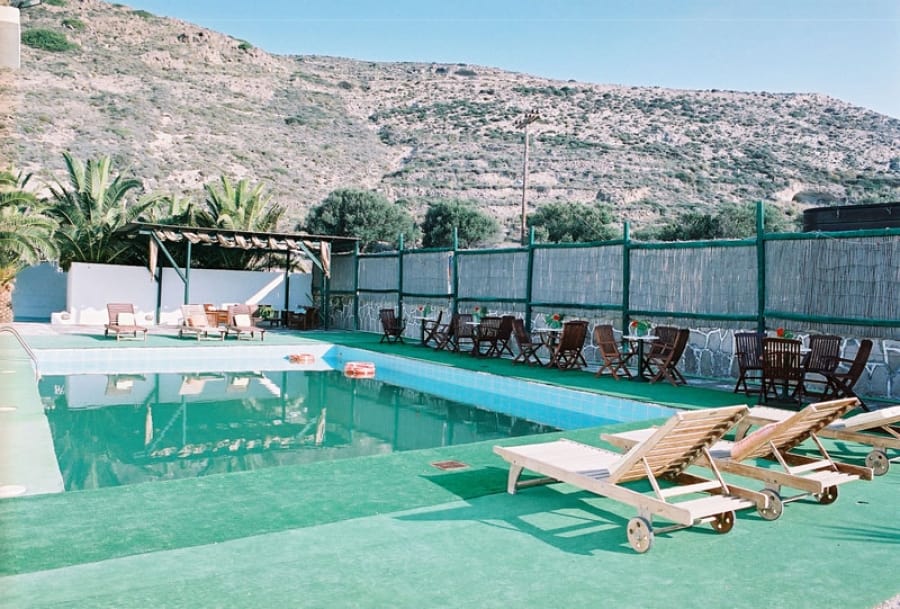
Niriides Studios
Studios in Milos are compact self-catering places to stay on the south-western Cycladic island of Milos. Each holds sleeping, sitting and cooking space in a single room. This page explains what a studio is, how it sits beside the rooms to let of the island, and where it differs from an apartment or a hotel room.
Studios and rooms to let are the smaller kinds of places to stay on the island. For the full range of lodging, the page on accommodation in Milos is the starting point. This page deals with studios in Milos first by what the type contains, then by how it differs from apartments and hotel rooms.
What are studios in Milos, and how do they sit beside rooms to let?
Studios in Milos are one-room units that combine sleeping, sitting and cooking space, with a kitchenette and a bathroom of its own. They stand alongside rooms to let, which are single guest rooms in houses and small buildings of the island.
A studio is a small dwelling in which the functions of the living room, bedroom and kitchen are combined into a single room. Studios in Milos follow that plan. A guest sleeps, sits and eats in the same space, and the bathroom normally has a smaller room of its own. The kitchen facilities stand either in the main room or in a small separate area, so the cooking corner differs from one studio to the next.
The cooking area of a studio is a kitchenette. A kitchenette is a small cooking area that normally holds a refrigerator and a microwave oven, and sometimes a sink or other appliances. Hotel and motel guest rooms carry kitchenettes as a common feature too, with a coffeemaker and a bar refrigerator. In studios in Milos, the kitchenette is the working part of the room: it keeps food cold, heats meals in the microwave and, where a sink is fitted, handles the washing up.
Tourism reached the Cyclades after a rural exodus and renewed them, mass tourism to Greece took off in the 1950s, and Milos has become an increasingly popular tourist destination in recent decades. The pattern repeats along the coast: rooms for rent come with a restaurant close by at Mandrakia, Kipos, Agios Sostis and Agia Kyriaki, and with a traditional tavern at the old commercial port of Empourios. Studios in Milos add a kitchenette to that same small-scale lodging.
- Layout: one room serves for living, sleeping and cooking, and the bathroom stands apart.
- Kitchenette: a small cooking area with a refrigerator, a microwave oven and, where fitted, a sink.
- Room to let: a guest room in a house or small building, offered without the services of a hotel.
- Greek terms: γκαρσονιέρα, from the French garçonnière, is the traditional name, and στούντιο is the loanword.
- Setting: rooms for rent stand close to a restaurant at Mandrakia, Kipos, Agios Sostis and Agia Kyriaki.
In short, studios in Milos are single-room, self-catering units built around a kitchenette, and they sit among the small-scale lettings of the island. Rooms to let give a bed close to a restaurant, while a studio adds the means to cook. The next section sets studios in Milos against apartments and hotel rooms, so that the choice between the three rests on space, kitchen, service and length of stay.
How do studios in Milos differ from apartments and hotel rooms?
Studios in Milos differ from apartments in space, with one room instead of separate rooms, and from hotel rooms in kitchen, service and stay length. A studio brings a cooking area, is arranged with its owner or an agency, and is let nightly or weekly.
Space is the first difference. A studio puts living, dining and sleeping in one room, while an apartment spreads them over separate rooms. Studio sizes vary considerably by country: in Australia and Austria a studio normally measures 20 to 40 square metres. In Greek, γκαρσονιέρα and στούντιο are both in use, and dictionary entries draw no clear line between them. Yet γκαρσονιέρα is sometimes read as an apartment with a separate bedroom, so the bedroom is worth checking in studios in Milos.
Kitchen is the second difference. A hotel room that carries a kitchenette holds a coffeemaker and a bar refrigerator, and large suites add other kitchen facilities. A studio normally includes kitchen facilities, in the main room or in a small separate area, so cooking is part of the type. Studios in Milos therefore suit stays in which breakfast, drinks and simple meals are prepared at the studio, while the restaurants of the coves and beaches cover the rest.
Service and stay length are the third and fourth differences. A hotel is an establishment that provides paid lodging on a short-term basis, and extended-stay hotels offer longer terms with full service. Rentals are arranged either directly with the owner or through an agency, and rentals run as apartments can match hotel services such as front-desk check-in and housekeeping. Studios in Milos fit that pattern: a rental studio is let by the night or by the week, and weekly letting is the more prevalent practice.
- Space: a studio is one room, and an apartment has separate rooms.
- Kitchen: a studio includes a kitchenette, and a hotel room holds a bar refrigerator and a coffeemaker.
- Service: a hotel provides lodging on its own premises, and a studio is arranged with an owner or an agency.
- Stay length: hotel lodging is short-term, and a rental studio is let by the night or the week.
- Bedroom: γκαρσονιέρα can mean an apartment with a separate bedroom, so the bedroom is worth checking.
Studios in Milos therefore sit between two neighbours. They give more cooking space than a hotel room and less room to spread out than an apartment, and they are arranged with an owner or an agency. A traveller who weighs space, kitchen, service and length of stay can place studios in Milos against both alternatives before choosing a village or a cove.

Where do studios in Milos stand by the sea, from Pollonia to the fishing coves?
Studios in Milos by the sea stand in the harbour village of Pollonia, on the south coast at Provatas and Paleochori, beside the bay of Adamas and in the fishing coves of the north. Each shore gives a studio a different outlook.
Studios in Milos at Pollonia stand in a fishing village at the north-eastern tip of the island. Taverns and restaurants run along the waterfront as far as the church of Agia Paraskevi, which marks the right end of the settlement. The church of Agios Nikolaos and the Pelekouda peninsula lie at the left end. A studio folds the bed and the kitchenette into one room, so the harbour village leaves the evening meal to the taverns.
Studios in Milos on the south coast belong to two small settlements. Provatas counted 33 permanent residents in 2021, and its beach lies between those of Firiplaka and Kipos, with taverns and rooms to let beside it. Paleochori lies on the south-western shore, 13 kilometres from Plaka, and its sandy beach of small coloured pebbles meets bright blue water. The beach is extremely popular, and rooms to rent stand in the settlement.
Studios in Milos around the bay look onto a shore inside the gulf. Achivadolimni is the largest beach of the island, with white sand and shallow water of deep blue. It divides into two sandy beaches: the first is quieter and secluded, while the second is busy and organised, with a beach bar and restaurants. A bus reaches the beach, and the pond opposite it, full of clams, gave the beach its name.
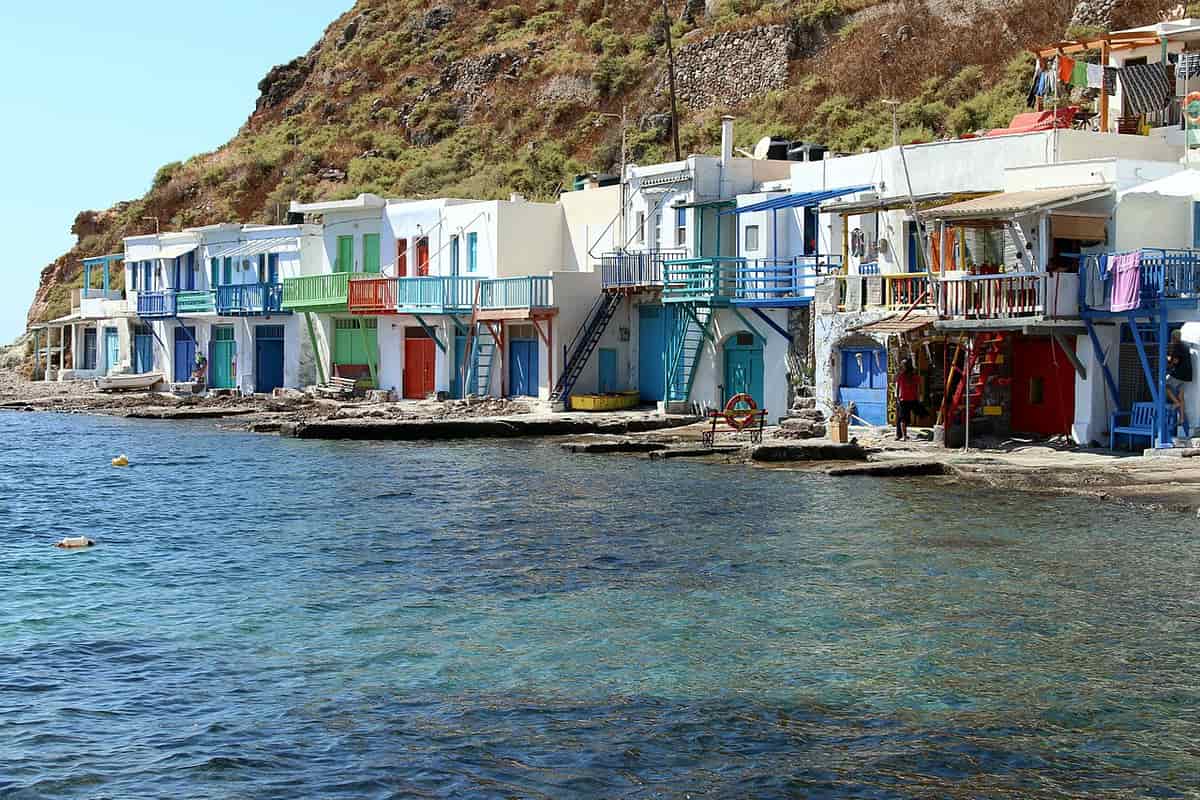
Studios in Milos in the fishing coves take over a building type made for boats. The syrmata of Mandrakia, 4 kilometres north of Adamas, stored the boats and tackle of the fishermen and served as their temporary homes, and the church of Zoodochos Pigi stands above them. Klima lies at the entrance of the bay, below Tripiti, 6 kilometres from Adamas. Firopotamos and tiny Areti keep their own rows of syrmata around small creeks.
- Pollonia: The name comes from the temple of Apollo that stood east of the settlement.
- Provatas: Iron oxides give the sand of the beach its golden red colour.
- Paleochori: Rocks in intense red and yellow surround the beach of the settlement.
- Mandrakia: The small sandy beach is almost 150 metres long, with fine dark grey pebbles and tamarisk trees.
- Firopotamos: A small organised sandy beach has a beach bar, and the church of Agios Nikolaos stands past the fishing houses.
Studios in Milos by the sea divide into the harbour of Pollonia, the south coast, the bay and the boathouse coves, and each gives a different edge of the island. The beaches of Milos are set out on their own page, which covers every shore beyond these. The hill villages above the bay come next, with lanes and views of their own.
Why choose studios in Milos in the hill villages of Plaka, Tripiti and Triovasalos?
Studios in Milos in the hill villages stand in Plaka, Tripiti and Triovasalos, above the bay. Narrow lanes lead to the doors, cars stay out of Plaka, and views open over the gulf of Adamas and the castle hill.
Plaka took its name from the flat ground on which the first inhabitants built their houses once the castle no longer housed the whole population. The medieval town grew on the plateau directly below the castle, and its lanes are still narrow and paved with stone. Studios in Milos in Plaka therefore stand in lanes laid out between walls and houses, where no car can enter and the way to a door is walked.
The castle of Plaka stands on a rocky hill above the ancient city, and it was built to watch the movement of ships in the gulf of Adamas. Its founding falls after 1204. The church of the Dormition, known as Mesa Panagia, crowns the top, while the church of Panagia Thalassitra stands lower on the hill. Studios in Milos below the castle share that outlook over the water the castle once watched.
Tripiti owes its name to the soft volcanic rock on which it stands, rock that looks pierced and carries holes carved into it. The church of Agios Nikolaos dominates the village centre, and old windmills that once ground grain still stand there. The village has been classed as a traditional settlement since 1978. Studios in Milos in Tripiti sit in a well-preserved village, almost joined to Plaka, close to the site of ancient Milos and its theatre.
Triovasalos and Pera Triovasalos formed a single settlement until 1908, on two neighbouring hills, and together they remain the commercial and everyday core of Milos. Public services, coffee houses and small businesses keep their Cycladic character. The church of Agios Spyridon dates from the start of the 19th century. Studios in Milos in Triovasalos therefore sit in the working centre of the island, on the road between the port and Plaka.
- Korfiatissa: The church was built in 1820 in the Byzantine-Cycladic style.
- Castle: The castle of Plaka is classed as an ancient monument.
- Museums: The archaeological museum stands in a neoclassical building by Ernst Ziller in Plaka.
- Tripiti: The community of Tripiti also takes in Klima, Zefyria, Kanava, Agia Kyriaki and Schinopi.
- Pera Triovasalos: The church of Agios Georgios dates from 1849 and has a marble templon and mosaics in its yard.
Studios in Milos in the hill villages suit a stay built around lanes, a castle outlook and village life. Plaka brings the castle hill, Tripiti the soft rock and the windmills, and Triovasalos the working core between port and chief town. The villages of Milos are described one by one on their own page, which covers every settlement beyond these three.
What do studios in Milos offer solo travellers and couples?
Studios in Milos suit solo travellers and couples because one room holds the bed and the kitchen area, so the choice rests on location. A solo traveller needs transport and company close by, and a couple needs a quiet setting with a view.
Solo travellers start with the port. Adamas is the main port of Milos and its largest tourist centre, a coastal village of about 1100 inhabitants, built by refugees from Sfakia in Crete. It has white houses, small courtyards decorated with flowers and narrow quiet streets. The village joins rest and tranquility with nightlife and entertainment, so studios in Milos at Adamas give a solo traveller company after dark and silence in the lanes.
A studio fits one traveller without wasted space. In a studio the living, sleeping and kitchen functions share a single room, and the kitchen facilities stand either in that room or in a small separate area. An alcove studio adds a very small separate nook, which serves for dining or sleeping. Studios in Milos therefore let a solo traveller cook a simple meal and keep the evenings free for the village.
Couples choose the setting before the access. Plaka, the capital of the island, stands at 220 metres above sea level, and the Venetian castle of the 13th century crowns its hill. From the castle, visitors watch the sunset and take in panoramic views of the bay of Milos and the neighbouring Cycladic islands. Studios in Milos within Plaka sit among cobbled alleys, small traditional shops, restaurants and cafes, all within the village.
The north holds a second setting. Pollonia, a fishing village of 300 inhabitants built around a creek, has a beach with rich sand, and the Pelekouda peninsula lies on its left side beside the church of Agios Nikolas. Local tradition holds that a couple sitting on the small rock in the shape of a chair there stays together forever. Firopotamos adds a seaside settlement with a small organised beach, tamarisk trees and a creek.
- Adamas: the main port and largest tourist centre joins rest with nightlife for a solo traveller.
- Layout: one room holds the living, sleeping and kitchen functions, and an alcove studio adds a small nook.
- Plaka: the Venetian castle of the 13th century looks over the bay at sunset.
- Pollonia: a fishing village of 300 inhabitants with a sandy beach and the Pelekouda peninsula.
- Firopotamos: a seaside settlement with a small organised beach and a beach bar.
Studios in Milos therefore match two kinds of trip. A solo traveller takes the port village of Adamas for its company, its nightlife and its services, while a couple takes Plaka for the sunset at the castle or the north coast for a cove with a beach bar. One room with a kitchen area serves both. The next section turns to studios in Milos as a base for walkers, divers and kayakers.
Why do walkers, divers and kayakers choose studios in Milos as a base?
Studios in Milos give walkers, divers and kayakers a base beside the start of a route or the departure point of a boat. Walkers need a path start within reach, while divers and kayakers need a harbour, a bay or a coast close to the water.
Walkers pick the studio by the start of the route. The marked geo-routes of the island begin at different places, and route 1 starts at Adamas, where the Mining Museum stands about 500 metres east on the coastal road. Route 3 unfolds from Zefyria, reached by turning left at the central crossroads 2.3 km beyond the museum, and it ends at the old sulfur mines. Studios in Milos at those two settlements therefore sit at the start of a walk.
Divers look at what lies below the surface. The sea floor holds underwater caves, shipwrecks of World War II and earlier, and hot springs that create separate micro-communities of sea life. The diving schools of the island work with modern equipment. Studios in Milos beside a harbour keep a diver close to the water, and the kitchen area of the room handles a meal between one dive and the next.
Kayakers look at the coast. Milos has a volcanic coastline with sea caves and tunnels, clear waters and neighbouring uninhabited islands that suit paddling. Day trips by canoe-kayak run from April to October, and a sea-kayak reaches the deserted beaches of the island. The bay of Adamas is one of the largest and safest natural bays in the Mediterranean, so studios in Milos on its shore sit beside sheltered water.
Harbours decide where a boat trip starts. Boats for sea excursions leave daily from the ports of Adamas and Pollonia, which makes both ports natural bases for studios in Milos. Kipos has a small port from which boats start for Kleftiko, beside a sandy beach, a restaurant and rooms for rent. A studio at one of these harbours keeps the morning departure close, whether the day is a boat trip, a dive or a paddle.
- Route 6: a coastal walk of about 4.5 km runs from Agios Konstantinos to Sarakiniko over flat rocks beside the sea.
- Return: the path from Sarakiniko leads south to a parking lot and a bus stop.
- Diving: underwater caves, wrecks and hot springs lie off the coast of the island.
- Canoe-kayak: sea caves, tunnels and uninhabited islands suit paddlers from April to October.
- Harbours: Adamas and Pollonia are the ports of daily boat departures, and Kipos serves Kleftiko.
Walkers, divers and kayakers each use studios in Milos for a different reason: path starts at Adamas and Zefyria, a sea floor of caves and wrecks, and a coast of sea caves and sheltered bays. The harbours of Adamas, Pollonia and Kipos tie the three groups together. The page about activities in Milos covers the routes, the dives and the paddles in detail.

How does settling into studios in Milos work after the port?
Settling into studios in Milos starts at Adamas, the main port and the largest tourist centre of the island. Arrivals find taxis at the port, and buses serve the villages, while Plaka admits no cars and the water of a studio comes from a dry volcanic island.
Adamas is the main port of Milos and its largest tourist centre, with white houses, small courtyards and narrow, quiet streets. It is also the cultural and commercial centre of the island. Milos has 15 taxis, and arrivals find them at the port. City buses serve areas of the island, the summer routes run quite frequently, and the ticket is bought on the bus. These two links carry arrivals from the port to studios in Milos in the first hours.
Triovasalos lies on the road from the port to Plaka. The village is densely built and shows noteworthy commercial activity, and together with Pera Triovasalos it occupies two neighbouring cliffs. The village counted 1,379 residents in the 2021 census, against 902 in Plaka. Its Karodromos is a central point of the island, where banks, public services, cafes and shops stand together. A studio in Triovasalos therefore has the daily errands of the island within the same village.
Plaka is the chief town of Milos, perched on top of a large rock above the gulf. No cars can enter the village because of the narrow spaces between walls and buildings, and motorbikes, mopeds and the like are the only usable vehicles. The cobbled alleys were first built as protection from pirates. Luggage for studios in Milos in Plaka therefore travels the last stretch on foot or on two wheels.
Water is the first limit on a dry island. Water resources are especially scarce on the Greek islands, where tanker ships and seawater desalination fill the gap, and the Cyclades have met water shortages as tourism grew. Milos used its volcano against the problem: the Milos Island Project produced desalinated water with geothermal energy alone. Studios in Milos stand on that volcanic heat, and the summer climate keeps rain scarce.
- Port: Adamas is the main port of Milos and the largest tourist centre of the island.
- Taxis: The island has 15 taxis, and arrivals find them at the port.
- Buses: City buses serve areas of Milos, and the summer routes are quite frequent.
- Plaka: No cars can enter the village, and motorbikes and mopeds are the only usable vehicles.
- Water: Water resources are especially scarce on the Greek islands, and July brings 0.3 mm of rain on average in Milos.
Arrival, transfer, village lane and water form one chain for studios in Milos, and each link depends on the village. Travellers who still plan the sea or air leg of that chain can read the ferry and flight routes on the how to go page. The port fixes the first transfer, and the village fixes the last stretch.
What do travellers ask about water, power and luggage at studios in Milos?
Studios in Milos raise six practical questions about summer rain, fresh water, volcanic heat, temperatures, fishing villages and the second port. The answers follow the climate record, the water works of the island and the layout of each village.
How dry are summers for studios in Milos?
Milos has mild, rainy winters and warm to hot dry summers. Rainfall averages 3.3 mm in June, 0.3 mm in July and 1.4 mm in August, while December receives 90.3 mm. July records only 0.1 rainy day on average, and the yearly total is 410.8 mm.
Where does fresh water come from for studios in Milos?
The Municipality of Milos built water intake facilities for the water supply of the island, and their old buildings stand beside a dirt road through a ravine. Breeders also dug pits on the hillsides to hold rainwater, and island families historically harvested winter rain from rooftops for use in summer.
What does volcanic heat mean for studios in Milos?
Milos is a dormant volcano that last erupted 90,000 years ago. In one cave on the south coast the heat from the volcano is still great, and high-temperature geothermal energy lies 1 to 2 kilometres below the island. That heat powered the geothermal desalination of the Milos Island Project.
How warm do studios in Milos get in summer and winter?
July has a mean daily maximum of 28.1 degrees Celsius and a mean daily minimum of 21.8 degrees. June has recorded 44.0 degrees as the highest temperature. January reaches 12.9 degrees by day and 8.5 degrees at night, and relative humidity averages 60.1 percent in July.
Are studios in Milos found in Klima and Mandrakia?
Klima is a seaside village of eight residents with two-storey fishermen’s houses called syrmata, set in the natural cavities of the rocks. Boats stood on the ground floor and families lived above, and rented syrmata stand there today. Mandrakia has rooms for rent, a restaurant and a small sandy beach of almost 150 metres.
Do studios in Milos at Pollonia sit beside a working harbour?
Pollonia is the second port of Milos after Adamas. Fishing boats reach the pier in front of the church of Agia Paraskevi each morning loaded with fish, octopuses and lobsters. The village has a sandy beach, rooms for rent, hotels, taverns and restaurants, and 268 residents were counted in the 2021 census.