- Best Western Hotel Del Mar
- Golden Milos Beach
- Lagada Beach Hotel
- Glaronisia Hotel
- Hotel Delfini
- Santa Maria Village Hotel
Hotels in Milos stand on the east half of Milos, the south-western island of the Cyclades. The island measures about 23 km from east to west and 13 km from north to south, and a large bay cuts in from the north-west. That bay, the harbour town on its shore and the coastal villages decide where a hotel is built.
Hotels in Milos come in four main types: seafront hotels by the port, small hotels in the villages, beach hotels, and suites or villas. The first section describes each type and the place where it stands. The second section shows how hotels in Milos spread over the whole island and why the west half has none.
What types of hotels in Milos can travellers choose from?
Hotels in Milos fall into four types: seafront hotels by the port, small hotels in the villages, beach hotels, and suites or villas. Each type ties a building to a place, and the place sets the transfer from the port and the distance to the sea.
The first type stands beside the water at Adamantas. The harbour town lies in the bay, one of the largest and safest natural bays in the Mediterranean, and it is the largest tourist centre of Milos. Hotels in Milos at the port stand where boats arrive, because Adamas is the main port and the first image of the island from the sea. Taxis serve the port, so a hotel there shortens the first transfer.
The second type is the small hotel in a village. A boutique hotel is a small-capacity hotel with fewer than a hundred rooms, built around a concept that reflects the local culture of its neighbourhood. Plaka is perched on top of a large rock and admits no cars because of the narrow spaces between its walls and buildings. Tripiti, almost united with Plaka, is a traditional well-preserved settlement. Hotels in Milos at this height suit that small scale.
The third type stands at a beach. Pollonia is the second harbour of Milos, at the north-eastern tip of the island, its main beach is sandy, and two more beaches lie near the village, Polychroni’s beach and Piso Thalassa. The village has hotels beside rooms to let. Provatas adds a hotel to a beach organised with sunbeds and umbrellas. Hotels in Milos at a beach therefore place the sea at the door.
The fourth type is the suite or the villa. A suite is a class of accommodation with more space than a standard hotel room, and strictly it holds connected rooms under one room number. A villa is a type of house, and around the Mediterranean the word names a residence of above average size in the countryside. Hotels in Milos that offer these two types give a stay more floor area than a single room does.
- Port: Adamantas is the main port and the largest tourist centre of Milos.
- Villages: Plaka admits no cars, and Tripiti is a traditional settlement.
- Pollonia: The village has a sandy main beach, hotels and rooms to let.
- Provatas: A hotel, rooms to let and taverns stand beside sunbeds and umbrellas.
- Suites: A suite has more space than a standard hotel room.
Hotels in Milos therefore split by place before they split by label. The port gives the shortest transfer, the plateau villages give small buildings reached on foot, the beaches give a shore at the door, and suites or villas give extra space. The next section follows the same map across the island and explains why the west half holds no hotel.
How do hotels in Milos spread across the island, and why does the west have none?
Hotels in Milos spread across the east half of the island, from the bay and its hill villages to Pollonia and Provatas on the coast. The west half has no villages, only minimal settlements and old mines, so no hotel base exists there.
Population shows where the settled ground lies. The municipality of Milos counted 5,193 inhabitants at the 2021 census, and the harbour town of Adamantas had 1,268 of them, while Plaka had 902. A hotel needs a village, a port or a road beside it, so hotels in Milos group where the settlements are. The bay also splits the island, because it cuts in from the north-west and separates the island into two fairly equal portions.
Away from the bay, the pattern turns to small clusters. Pollonia counted 268 inhabitants in 2021, and the regular small-boat connection to Kimolos starts there. Provatas lies on the south coast, counted 33 permanent residents in 2021 and holds a hotel beside rooms to let and taverns. Hotels in Milos at these two places therefore serve a harbour or a beach rather than a town with a large population behind them.
Protection is the first reason for the empty west. Almost all of the uninhabited western region of Milos is a Natura 2000 site, part of a network of nature protection areas of the European Union, and it holds over 800 taxa, of which 35 are endemic to Greece. A hotel needs settled ground, and the west keeps minimal settlements and old mines instead of villages. Hotels in Milos therefore have no base there.
Access is the second reason. The beaches of the west lie at the end of dirt roads. Agkathia is described as quite inaccessible because of its dirt road, and Agios Ioannis lies at the end of a dirt road of about 12 kilometres, with only the first of its three parts reachable by car. Sykia, a cave without a roof, is accessible only from the sea. Hotels in Milos stay in the east, where the paved road and the bus service already run.
- Bay: Adamantas counted 1,268 inhabitants and Plaka 902 at the 2021 census.
- North-east: Pollonia is the second port of Milos after Adamas.
- South coast: Provatas is reached by a paved road with frequent bus service.
- West: Over 800 taxa live in the Natura 2000 site, and 35 are endemic to Greece.
- Roads: A dirt road of about 12 kilometres leads to Agios Ioannis.
Hotels in Milos therefore group in three places: the bay with its port and plateau villages, the harbour of Pollonia and the south coast at Provatas. The west half stays free of them because it has no villages, lies under Natura 2000 protection and ends in dirt roads. The full range of places to stay, from rooms to villas, is set out on the page about accommodation in Milos.


What are hotels in Milos like beside the port of Adamantas?
Hotels in Milos at Adamantas stand in the largest tourist centre of the island, on the north-eastern shore of the gulf. The main port receives the ferries from Piraeus, taxis wait at the port, and local buses serve certain areas of the island.
The ferry decides the first hours of a stay in Adamantas. A conventional boat runs from Piraeus straight to the port of Milos, and the journey takes 5 hours. Other boats call first at Kythnos, Serifos, Sifnos and sometimes Kimolos, and on those routes the journey takes 7 to 8 hours. Hotels in Milos at the port therefore keep the end of a long crossing short, because the boat berths in the same town where the bed is.
In the summer months the port also links Milos with other islands. The connections are frequent and reach Syros, Paros, Naxos, Tinos, Ios, Sikinos, Folegandros, Santorini, Crete and Rhodes. Boats and sailboats offer sea excursions as well, and departures run daily from the ports of Adamas and Pollonia. These trips reach beaches that cannot be reached from land, so hotels in Milos at the port give a base for island hopping and for days at sea.
On land, local buses serve certain areas of Milos, and the summer routes run quite frequently. A ticket is bought on the bus. Provatas lies 7 km from Adamantas on a paved road with good signage and a frequent bus service, and the beach of Achivadolimni is accessible by bus too. A traveller without a car therefore reaches the south coast and the bay beaches from hotels in Milos at the port, and the taxis of the island add a second way to travel.
The bay completes the case for the port. The gulf is one of the largest and safest natural bays in the Mediterranean, and it cuts in from the north-west so far that an isthmus no more than 2.2 km broad joins the two halves of the island. Adamantas served as the base of the French fleet during the Crimean war, and a warship of that fleet still sails in once a year. Hotels in Milos on this shore stand beside sheltered water.
- Port: Adamas is the main port and the first sight of the island for travellers who arrive by boat.
- Marina: Visiting boats refuel at the marina of Adamas and take on water and electricity.
- Taxis: The island runs 15 taxis, spacious and air-conditioned, and they are found at the port.
- Evenings: Rest and tranquillity combine with nightlife and entertainment in the town.
- Comfort: The town provides everything needed for a comfortable and pleasant holiday.
Hotels in Milos at Adamantas put a stay beside the main port, the bay and the bus and taxi services of the island. The page on the port town of Adamantas tells the history and the sights of the settlement, while this section keeps to the practical side of a stay. The second harbour, Pollonia, offers a different base, as the next section shows.
Why choose hotels in Milos at Pollonia, beside the crossing to Kimolos?
Hotels in Milos at Pollonia stand in a seaside village at the north-eastern tip of the island, the second harbour after Adamantas. A small boat links the village with Kimolos, and a sandy main beach and two more beaches lie beside it.
Pollonia lies at the north-eastern tip of Milos, 10 metres above the sea, and 268 inhabitants were counted there in 2021. The village belongs to the community of Triovasalos. Hotels in Milos here therefore suit a stay in a small harbour village rather than in the port town, while Adamas, the main port, lies almost 10 kilometres away and Plaka, the chief town, lies 14 kilometres away. The village is easy to reach by car and by public transport.
Kimolos lies to the north-east of Milos, separated from it by a channel 1 km wide. A regular connection by small boat runs from Pollonia to the island, and transport via Milos is possible because the two islands share a frequent local ferry link. Psathi, the main harbour of Kimolos, has hotels, rooms to let, cafes, taverns and a small beach. Hotels in Milos at Pollonia sit at one end of a short sea route that offers hotels at the other end as well.
The same village serves the Glaronisia. The connection to these islets is made from Pollonia, and they are the only islands of basalt in the shape of hexagonal bars. Climbers know the group, because one of the best climbing fields in Greece lies there. Pollonia is also a departure point for boats on sea excursions, so hotels in Milos at this harbour sit where the neighbouring islands and the coast meet.
Beaches fill the rest of a stay at Pollonia. The village is built around a cove, and its main beach has rich sand and tamarisk trees and is popular with holidaymakers. Polychroni’s beach is organised, and Piso Thalassa, which translates as Back Sea, completes the three beaches of the village. Hotels in Milos at Pollonia therefore stay within reach of three shores, and two more beaches on the north coast, Kapros and Pachaina, lie beyond the village.
- Kapros: A small cove between white rocks with fine sand can be seen from the main road to the village.
- Pachaina: A spacious sandy beach with tamarisk trees overlooks the Glaronisia.
- Climbing: The Glaronisia count as one of the best climbing fields in Greece.
- Kimolos: The island has 810 inhabitants and a land area of 36 square kilometres.
- Stay: Hotels in Milos at Pollonia share the village with rooms for rent.
Hotels in Milos at Pollonia suit a stay built around a small harbour, the short sea route to Kimolos and the northern beaches, while Adamantas keeps the main port and the bay. The page on the village of Pollonia covers the history and the sights of the settlement, and this section leaves those topics to that page.

Which hotels in Milos stand in the hill villages of Plaka, Tripiti and Triovasalos?
Hotels in Milos in the hill villages share the setting of Plaka, Tripiti and Triovasalos above the bay. Plaka admits no cars, its Venetian castle gives sunsets and panoramic views, and Tripiti lies within walking distance of the catacombs and the ancient theatre.
Plaka is the capital of the island and stands at 220 metres above the sea. At the top of its hill is the Venetian castle of the 13th century, and from there sunsets and panoramic views open over the bay and the neighbouring Cycladic islands. Hotels in Milos in Plaka share that outlook, because the village looks towards the gulf from its height. The view, not the beach, is what a stay on this hill is built around.
The western end of Plaka is the sunset side. The church of Panagia Korfiatissa stands there on steep rocks, and a visit brings sea views and sunsets. The cobbled lanes of the village were first built as protection from pirates, and car traffic is banned inside the settlement. The village has been classed as a traditional settlement since 1978. For hotels in Milos in Plaka, a walk to the church therefore follows stone lanes on rising ground, with no road traffic to share them.
Tripiti stands at 150 metres on the north side of the island, at the sea entrance of the bay and 5 kilometres from Adamas. The village is built like an amphitheatre over the ruins of the classical city of Klima, and its taverns and restaurants give panoramic views of Adamas Bay. Hotels in Milos in Tripiti keep the catacombs and the ancient theatre close, and the road down to the catacombs ends where the walking alley starts.
Triovasalos stands on the way up from the port, before Plaka, and it is built like an amphitheatre on two neighbouring hills at 143 metres. Its houses are densely built and close together. The heights set the climb on foot: 143 metres at Triovasalos, 150 metres at Tripiti and 220 metres at Plaka. A walking route links Tripiti with Plaka, so hotels in Milos in either village put the other within reach on foot.
- Castle: The Venetian castle of the 13th century crowns the hill of Plaka.
- Sunsets: Sunsets are watched from the castle and from the church of Panagia Korfiatissa.
- Heights: For hotels in Milos on the hill, Plaka stands at 220 metres, Tripiti at 150 metres and Triovasalos at 143 metres.
- Walks: A walking route links Tripiti and Plaka, and an alley leads from Tripiti to the catacombs.
- Cars: Car traffic is banned inside Plaka, so the last stretch of every arrival is walked.
Hotels in Milos in the hill villages suit a stay built around views, sunsets and walks, not around a beach. Plaka brings the castle hill and the western sunset, Tripiti brings the bay views and the way to the catacombs, and Triovasalos brings the first height above the port. The villages of Milos are described one by one on their own page, and the shore hotels follow below.
Where do beach hotels in Milos stand on the south coast and around the bay?
Hotels in Milos by the sea stand at Provatas on the south coast, a beach with a hotel, rooms to let and taverns. Paleochori lies further along the coast, while Lagada and Papikinou are the bay beaches beside the port of Adamas.
Provatas is a small settlement on the south coast, 7 kilometres from Adamas along a paved road, and a frequent bus service runs along it. Its beach is made of three small coves divided by rocks, so the shore comes in short stretches, not one long strip. The sand is golden red and the water is very shallow, which suits children. Hotels in Milos at Provatas therefore work as a base for short beach days beside the taverns.
Paleochori lies 14 kilometres from Adamas, and its beach is almost 2 kilometres long. Colourful pebbles and coarse sand make up the shore, the water is cool, clear and deep, and rocks in red, pink, yellow and white-grey frame it. Warm water gushes at the beach, a result of the volcanic energy of the area. Rooms to rent stand around the settlement. Next to the hotels in Milos at Provatas, a stay here means a coloured shore and a long ride from the port.
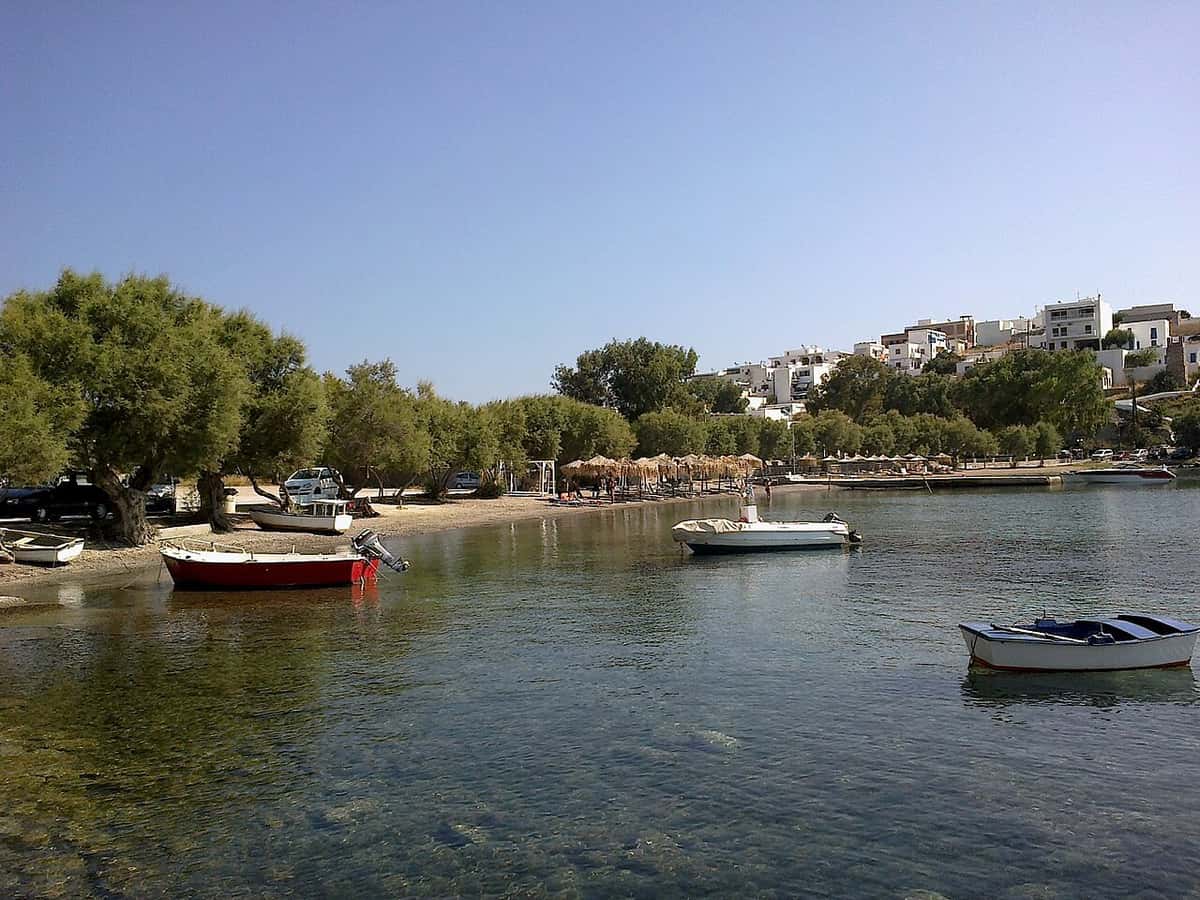
Around the bay, Lagada is the nearest beach to the port of Adamas. The beach is large and organised, with golden white sand, clear water and tamarisk trees for natural shade. Hotels in Milos near Lagada keep the port close, which suits the days of arrival and departure. The south coast asks for a drive of 7 or 14 kilometres to reach the sand, while this stretch of the bay sits at the edge of the harbour town.
Papikinou lies 1 kilometre east of Adamas. The beach is large, with tamarisk trees, sunbeds, umbrellas and a restaurant, and its waters deepen slowly. It is one of the beaches with the mildest waves on the island. Both bay beaches lie inside the gulf, a short way from the harbour town. That slow slope contrasts with the deep water of Paleochori, so beach hotels in Milos on the bay and on the south coast give two different kinds of swim.
- Provatas: Three small coves divided by rocks lie 7 kilometres from Adamas.
- Paleochori: Almost 2 kilometres of colourful pebbles and coarse sand lie 14 kilometres from Adamas.
- Lagada: The nearest beach to the port has golden white sand.
- Papikinou: The beach lies 1 kilometre east of Adamas and is one of the beaches with the mildest waves.
- Water: For beach hotels in Milos, Provatas has very shallow water, Papikinou a slow slope and Paleochori deep water.
Beach hotels in Milos divide into the south coast and the bay, and the water sets the choice. Provatas offers a hotel by shallow water, Paleochori a coloured shore with a long ride from the port, and the bay side offers Lagada and Papikinou close to Adamas. The beaches of Milos are described on their own page, which covers the shores of the whole island beyond these four.
When is the right time to book hotels in Milos?
Hotels in Milos fill fastest in the summer months, when the island is a popular tourist destination and the meltemi blows from late spring to mid-September. Spring and autumn bring milder weather, and winter brings the heaviest rain, so the month of travel sets the booking plan.
Summer is the first test for hotels in Milos. The island is a popular tourist destination during the summer, and its beaches, varied coastline and traditional architecture have drawn more visitors in recent decades. The summer months also bring frequent ferry links with Syros, Paros, Naxos, Tinos, Ios, Sikinos, Folegandros and Santorini. Travellers who combine Milos with those islands fix the dates of their hotels in Milos around the ferry timetable and book early for July and August.
June is close to the summer peak in temperature. The mean daily maximum is 27.1 °C, against 28.1 °C in July and 27.6 °C in August, and June has only 0.3 rainy days. The meltemi reaches its highest frequency in July and August, so June and September fall outside those two months. Booking hotels in Milos for those shoulder months keeps the stay in warm weather. April reaches 18.4 °C and October reaches 21.3 °C.
Winter changes the question from demand to opening months. Winters are mild and rainy, December is the wettest month with 90.3 mm of rain and 9.0 rainy days, and the mean daily maximum in January is 12.9 °C, against a mean daily minimum of 8.5 °C. A traveller who plans a winter stay asks each property for its opening months, its heating and its dry access before booking hotels in Milos for those months.
The meltemi adds a second timing rule. These strong, dry north winds blow from late spring to mid-September and arrive in clear weather without warning. They reach force 7 or 8 on the Beaufort scale, can last for days without a break, and can stop the ferries between islands. A night at one of the hotels in Milos before a departure leaves one spare night in the plan, because a wind that stops the ferries moves the departure day.
- June: The mean daily maximum is 27.1 °C with 0.3 rainy days, below the 28.1 °C of July.
- July and August: The meltemi reaches its highest frequency, and July has 0.1 rainy days.
- September: The mean daily maximum is 25.2 °C, and the wind season ends in mid-September.
- October: The mean daily maximum is 21.3 °C with 3.9 rainy days.
- December: The wettest month brings 90.3 mm of rain over 9.0 rainy days.
The month of travel sets the booking lead for hotels in Milos: July and August first, June and September next, April and October after them, and the winter months last. The wind adds a ferry check from late spring to mid-September. Once the dates are fixed, the type of trip narrows the choice of hotels in Milos further, as the next section shows.

Which hotels in Milos suit different kinds of trips?
Hotels in Milos suit a trip through setting and access: couples look to a harbour village, families to a shallow sandy beach, travellers with reduced mobility to low ground, and travellers without a car to a base on a bus or taxi route.
Couples choose the setting first. Pollonia is a fishing village built around a creek at the north-eastern tip of the island, almost 10 km from Adamas, with a beach of rich sand, rooms for rent and hotels. Taverns, restaurants and island cafes serve the village, and the boat to Kimolos and the Glaronisia leaves from it. Couples who want a bedroom with a sitting area can read about suites in Milos beside the hotel stays.
Families look at the beach before the building. Provatas has golden red sand, coloured by iron oxides, and very shallow water where children play. The beach is organised with sunbeds and umbrellas, and the settlement has a hotel, rooms to let and taverns. Hotels in Milos at Provatas therefore keep the beach day inside the same settlement as the room, and Agia Kyriaki, about 10 km from Adamas, adds a large organised beach along the coast.
Terrain decides the choice for travellers with reduced mobility. Adamantas is a lowland settlement on the shore of the gulf, while Plaka stands at 220 metres on top of a large rock and admits no cars. Tripiti, at 150 metres, is built like an amphitheatre, and an ascent from the harbour leads to the plateau above it, where Plaka and Kastro stand. Hotels in Milos on low ground avoid that climb, and each property can say what steps and entrances a stay involves.
Travellers without a car depend on buses and taxis. City buses serve certain areas, the summer routes are quite frequent, and the ticket is bought on board. Milos has 15 taxis, found at the port and at the airport. Provatas has a paved road and a frequent bus service, and Pollonia is easy to reach by public transport, so hotels in Milos at those two settlements sit on routes that public transport serves.
- Couples: Pollonia pairs a sandy beach with taverns, island cafes and the boat to Kimolos.
- Families: Provatas has very shallow water and a beach organised with sunbeds and umbrellas.
- Reduced mobility: Adamantas is a lowland settlement, while Plaka admits no cars.
- Without a car: Provatas lies on a paved road 7 km from Adamas, with a frequent bus service.
- Arrival: Taxis wait at the port and at the airport.
Setting and access narrow the choice of hotels in Milos before any room is compared. Pollonia suits couples and day trips to Kimolos, Provatas suits families on a shallow beach, low ground suits travellers with reduced mobility, and a bus route suits travellers without a car. The season then fixes the dates, and the travel month decides which of these hotels in Milos fill first.
What do hotels in Milos offer, from sea views to transfers?
Hotels in Milos offer sea views, a breakfast table, car parking and transfers from the port or the airport. Hotels stand at Pollonia and Provatas, beside beaches and taverns, while the hill villages above the bay give panoramic views of the gulf.
Sea views depend on position, and the gulf gives hotels in Milos plenty to look at. The gulf is one of the largest natural harbours in Greece, and the horseshoe shape of the island wraps around it. Plaka stands at 220 metres and looks over the gulf. From the Venetian castle on Plaka hill, sunsets and panoramic views of the bay reach the neighbouring Cycladic islands. Tripiti, almost joined to Plaka, offers panoramic views of Adamas Bay too.
A pool and a breakfast table are the daily comforts. Milos has 90 beaches, and 25 of them lie inside the bay, so a hotel pool adds to the sea and does not replace it. At breakfast, island produce gives hotels in Milos a local character, because small units on the island produce thyme honey and herbs, and the local cooking is closely linked to nature and the self-sufficiency of its inhabitants.
Parking depends on how a village is reached. Pollonia is easily accessible by car, and a beach of rich sand fills its cove. Provatas sits on a paved road with good signage, and its beach has sunbeds and umbrellas. Hotels in Milos at these two settlements suit a stay by car, since both are reached by an easy road. Taverns and beaches lie beside them, so a parked car stays parked for the evening meal and the swim.
Transfers connect the hotel with the harbour and the airport. Milos has 15 taxis, all spacious and equipped with air conditioning, and they wait at the port and at the airport. Local buses serve certain areas, the summer routes are quite frequent, and the ticket is bought on board. A hotel that arranges a pickup meets the ferry or the flight in person, so hotels in Milos with transfers remove the search for a taxi on arrival.
- Sea views: Plaka looks over the gulf from 220 metres, and Tripiti shows Adamas Bay.
- Pool: A hotel pool adds swimming beside the 90 beaches of the island.
- Breakfast: Thyme honey and herbs are produced by small units on Milos.
- Parking: Pollonia and Provatas are reached by car, while Plaka admits no cars.
- Transfers: Taxis wait at the port and at the airport.
Taken together, the five features set how hotels in Milos fit a stay: the shore settlements favour a car and a beach, and the hill villages favour views and a walk. Travellers who plan the crossing or the flight first can read the ferry and flight routes on the page about how to go to Milos, and then match the transfer to the hotel.
What do travellers ask about hotels in Milos?
Hotels in Milos raise questions about location, distance from the port, car access, beaches, taverns and local food. Pollonia and Provatas have hotels on the island, and taxis, local buses and a paved road link them with the main port of Adamas.
Where are hotels in Milos found?
Pollonia, a seaside village at the north-eastern tip of the island, has rooms for rent and hotels beside a beach of rich sand. Provatas, a settlement and beach in the southern part of the island, has a hotel, rooms to let and taverns. Both stand outside Adamantas, the largest tourist centre of Milos.
How far are hotels in Milos from the port of Adamas?
Pollonia lies almost 10 kilometres from Adamas and 14 from Plaka. Provatas lies between 7 and 9 kilometres from Adamas, on a paved road with good signage. Both distances call for a road transfer from the main port, so a hotel at either settlement is reached by taxi, bus or car.
Can travellers reach hotels in Milos without a car?
Taxis wait at the port and at the airport, and Milos has 15 of them. Local buses serve certain areas, and the summer routes are quite frequent. Provatas has a frequent bus service along its paved road, and Pollonia is reached by public transport as well. Both settlements are therefore reached without a car.
Do hotels in Milos stand close to a beach?
At Provatas, the organised beach with sunbeds and umbrellas shares the settlement with a hotel, rooms to let and taverns. The sand is golden red from iron oxides, and the water is very shallow, so children can play there. Pollonia has a sandy main beach, with taverns and island cafes along the village.
Which local produce can breakfast at hotels in Milos include?
Pitarakia, small fried pies with cheese or herbs and served hot with honey, are a distinctive product of the island. Milos also makes arseniko from sheep’s or goat’s milk, xino tyri, a fresh cheese with a mild acidity, and manoura from goat’s milk. Small units produce thyme honey and herbs such as oregano and sage.
Which hotels in Milos stand beside the boat link to Kimolos?
Pollonia is the smaller port of Milos, used mainly for the link with Kimolos, and a regular small boat runs from the village to the neighbouring island. Hotels at Pollonia therefore stand where the boat leaves. The link to the Glaronisia starts there too, while Adamantas remains the main port.
Do cars reach hotels in Milos near Plaka?
No cars can enter Plaka, because the spaces between walls and buildings are narrow, and motorbikes and mopeds are the only usable vehicles. Pera Triovasalos lies about 1 kilometre from Plaka and 3 kilometres from Adamas, so a hotel near Plaka is reached by car only as far as the edge of the village.
Do hotels in Milos stand near taverns and restaurants?
Pollonia has taverns, restaurants and island cafes, and the taverns extend to the church of Agia Paraskevi at the right end of the village. Provatas has taverns beside its hotel and rooms to let. On the hill, Tripiti has taverns and restaurants with gastronomic dishes, plus panoramic views of Adamas Bay.