
A Milos catamaran cruise is a boat trip on a twin-hulled boat around the island of Milos. Volcanic rock forms the island, which sits in the south-west part of the Cyclades group. Below, you learn what a catamaran is and how it differs from other boats. You also see why twin hulls suit this coast.
A catamaran has two hulls and a wide deck between them. Milos has bays, sea caves and rock formations cut into volcanic stone. These facts explain why a Milos catamaran cruise fits the island. The first section looks at the boat. The second section compares it with other boats.
What does a Milos catamaran cruise look like at a glance?
A Milos catamaran cruise is a boat trip on a vessel with two hulls joined by a deck. The wide gap between the hulls keeps the boat steady. Its shallow draft suits a volcanic coast of bays, caves and rock formations.
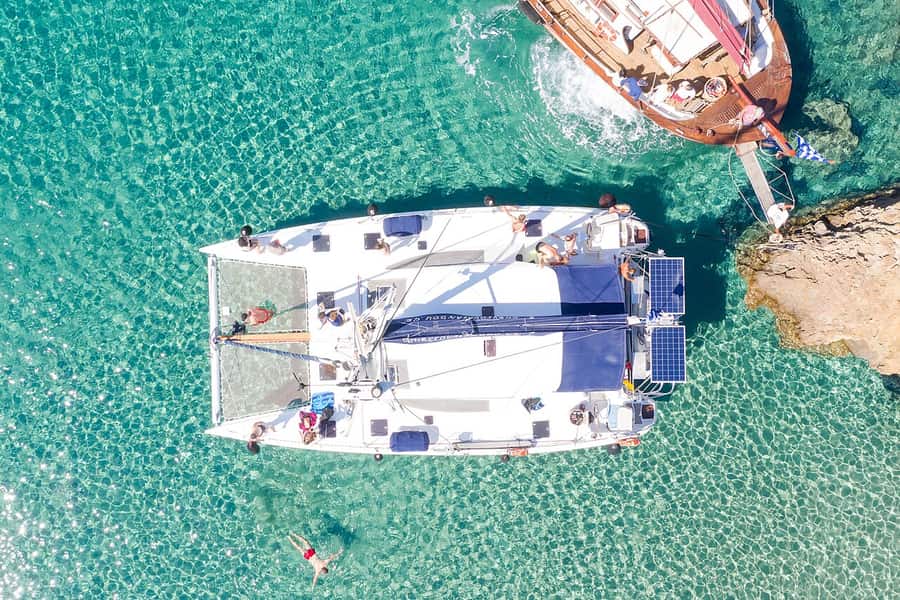
The two hulls of a catamaran are equal in size and run side by side. The word comes from the Tamil term kattumaram, which means logs bound together. English later applied the word to twin-hulled boats. A Milos catamaran cruise uses this twin-hull design to carry passengers along the coast.
The two hulls are joined by a deck called a bridgedeck. Simpler cruising catamarans have a trampoline instead. A trampoline is a net stretched between the crossbeams. Larger designs add a bridging structure with cabin space. On a Milos catamaran cruise, the deck or net forms a wide platform between the hulls.
The wide gap between the hulls keeps a catamaran steady. It resists rolling, which is a tilt from side to side. It also resists overturning. A wide stance reduces heeling, which is leaning over to one side. It cuts the motion caused by waves and gives a smaller wake.
Milos is a volcanic island of the Aegean Sea, at the far south-west of the Cyclades. Over 70 beaches ring its coast. White sandy shores and rocks sculpted by time and the sea line the shore. A Milos catamaran cruise follows this varied coastline from the water.
The volcanic past of Milos is etched into caves and unusual coastal formations. The rocks along the coast are white, red, yellow and black. In places, air and sea have cut caves and pits into the stone. This work took place over the centuries. A Milos catamaran cruise shows these shapes up close.
Certain beaches on Milos cannot be reached from land. A boat is the way in. It lets passengers swim in clear water at spots with no road. The boat also shows the mineral wealth of the island from the sea. It reaches into caves too. That is the core of a Milos catamaran cruise.
The twin-hull design suits a Milos catamaran cruise for three reasons. These are steadiness, a shallow draft and added space. The island has a large bay shaped like a horseshoe. A boat that sits high in the water can enter shallow water near the shore. The next section explains how.
- Hulls: Two parallel hulls of the same size make up a catamaran.
- Deck: A bridgedeck, or a trampoline net, joins the two hulls.
- Steadiness: Because the hulls sit far apart, the boat resists rolling and overturning.
- Setting: A Milos catamaran cruise follows a volcanic island’s shore, far south-west in the Cyclades.
- Coast: Caves, rock formations and beaches without road access line the shore.
A Milos catamaran cruise joins a wide, steady boat to a volcanic coast. The coast has rock, bays and caves. The two hulls give stability and space. The island supplies the sights. The next section sets the catamaran beside the sailboat and the motor boat.
How does a Milos catamaran cruise compare with a sailboat or motor boat?
A Milos catamaran cruise differs from a sailboat or motor boat mainly in hull design. Two hulls give a catamaran a steadier deck, a shallower draft and added space. A traditional sailboat has one hull, and a motor boat runs on an engine.
Boat tours in Milos run on boats and sailboats, with the catamaran as a twin-hull choice. A traditional sailboat is a monohull, meaning a boat with one hull. A monohull relies on ballast for stability. Ballast is heavy weight placed low in a hull. In racing designs, it can reach 50% of the boat’s weight.
A catamaran needs no ballast. The wide stance of its hulls gives the stability instead. A multihull is any boat with more than one hull. With no ballast to carry, a multihull is much lighter than a one-hull sailboat. On a Milos catamaran cruise, this light build helps the boat reach shallow water.
To heel means to lean over to one side in the wind. A catamaran resists that lean with its wide stance. Even at full speed, a cruising catamaran leans no more than 10 to 12 degrees. A fifty-foot catamaran needs four times the force to tip over as an equal one-hull boat.
Draft is the depth of a boat below the waterline, measured to its lowest point. A shallow draft means little water is needed under the boat. A catamaran draws less water than a one-hull boat, as little as 3 feet. A Milos catamaran cruise can enter shallow water where a ballasted one-hull boat cannot.
A catamaran also gives more room on board. Its deck spans the gap between the hulls. On powered models, the main cabin spans both hulls. The trade-off is size. A one-hull boat for a long voyage can be as short as 30 feet. A cruising catamaran with the same crew and supplies needs 40 feet.
Two slim hulls move through water with less drag than one broad hull. Drag is the water pushing back against a boat. A catamaran therefore needs less power from sails or motors. Its slim hulls make very small bow waves and wakes. A catamaran is harder to tack, meaning to turn through the wind.
A motor boat gets all its power from a motor, with none from the wind. A faster motor boat is a speedboat. Catamarans can also run on engines. A Milos catamaran cruise under engine keeps the stable deck, the safety and the added space. Twin hulls also keep boat motion low in waves.
- Stability: A catamaran resists heeling and capsize through its wide stance and needs no ballast.
- Draft: A shallow draft lets a catamaran enter shallow water.
- Deck: The deck spans the gap between the hulls and adds space on board.
- Speed: Two slim hulls need less power from sails or motors.
- Motor: A motor boat runs on an engine alone, and a powered catamaran keeps the stable deck.
A Milos catamaran cruise trades a longer, wider boat for a steadier deck. It also brings a shallow draft and added space. A sailboat or motor boat keeps a single hull and a narrower shape. The next sections follow the routes, caves and swim stops a catamaran reaches.

How does a Milos catamaran cruise change between the half-day and the full-day route?
A Milos catamaran cruise on the half-day route follows the west coast to Sykia and Kleftiko. The full-day route adds Poliegos, an uninhabited island near Milos and Kimolos. Both routes reach beaches and caves that no road serves.
The half-day route is a west-coast loop. It can run as a morning outing or an afternoon outing. On this Milos catamaran cruise, the boat heads out along the open west side of the island. The stops include beaches that neither walkers nor drivers can get to.
The loop passes the Arkoudes rocks near the bay entrance, then Cape Vani with its old mines. Three beaches farther on lie at the end of dirt roads: Agkathia, Ammoudaraki and Agios Ioannis. The road to Agios Ioannis runs for about 12 kilometres. A boat passes all three without a road.
Day cruises from Adamas follow the island’s west side and carry on to Kleftiko. A Milos catamaran cruise can follow the same line. It passes Kalogries, Agkathia, Triades, Ammoudaraki and Agios Ioannis before it reaches Sykia cave and Kleftiko.
Two stops define the loop. Excursion boats call at Kleftiko, a group of white rocks in the south-west. Sykia, a cave on the west coast, is the second call. A footpath also leads to Kleftiko. Only the sea leads to Sykia.
The full-day route adds a second part. After the west coast, the boat visits Poliegos, an uninhabited island near Milos and Kimolos. Its beaches lie mainly on the southern part. Roads do not reach them, so a Milos catamaran cruise is a way to see them.
The two routes share one west-coast line. The half-day route turns back at Kleftiko. The full-day route adds Poliegos to that line and then returns to the bay. Cruises from Pollonia in the north-east can also head for Poliegos and add Kleftiko.
A catamaran has a pair of parallel hulls that match in size. Rolling is resisted because the hulls sit far apart, so the boat stays steady. That wide stance also cuts the motion that waves cause. A Milos catamaran cruise therefore gives the deck a steadier ride along the open west coast.
- Kalogries: A secluded north-west beach, where calm water and a bay act as a natural pool.
- Agkathia: A sheltered bay holding a long sandy beach and shallow blue water.
- Triades: Three sandy beaches that follow one another, with blonde sand between rocks.
- Ammoudaraki: A beach of rich blonde sand that lies next to Triades.
- Agios Ioannis: A beach in three parts, named after the monastery of Agios Ioannis Siderianos.
In short, the half-day route follows the west coast to Kleftiko. The full-day route adds Poliegos to the same line. On either plan, a Milos catamaran cruise views the coast from the water instead of the road. The next two sections visit Kleftiko first, then the roofless cave of Sykia.
What does a Milos catamaran cruise show at Kleftiko’s white rocks and sea caves?
A Milos catamaran cruise shows Kleftiko, where grey and white rocks form strange shapes, caves and pits. Across the centuries, wind and sea carved them. Long ago, pirates hid in its bays, and the place took its name from them.
Kleftiko lies in the south-west of Milos, and a Milos catamaran cruise approaches it from the sea. There, white cliffs and islets rise from the water across three small bays in a row. It is the typical example of the special rock shapes along the coast of Milos.
The rock is tuff, a volcanic rock made of hardened ash. Here it holds pieces of pumice, a rough volcanic rock full of tiny holes. Its colour shifts from white and pale yellow to dark. The pumice lies in layers. A Milos catamaran cruise sails past this rock.
Erosion made the shapes. Sea and wind wore into the rock for centuries and left hollows and caves. Time and the sea sculpted the rocks. On a Milos catamaran cruise, the caves and rock shapes show the volcanic past of the island.
A sea cave starts at a weak zone in the rock. Waves remove rock faster there than elsewhere. Surf, carried sand and squeezed air all push at the crack. Over time the crack widens and deepens into a cave.
Kleftiko is also known as Thalassina Meteora, which means sea Meteora. In Greece, Meteora is a rock formation with giant natural pillars, and its name means lofty. The nickname compares the white rocks of Kleftiko with those pillars.
Pirates gave the place its name. In the Ottoman period, the three small bays served as a base from which pirates attacked ships. The Greek word kleftiko comes from an old root meaning to steal, which fits a pirate base.
To enjoy the turquoise water and the formations of Kleftiko, travellers come by boat or sailboat. A Milos catamaran cruise is one way to arrive by boat. Excursion boats call at Kleftiko, and a footpath also leads there.
- Age: The pumice layers formed about 3.1 million years ago.
- Basalt: This fine-grained volcanic rock, formed from fast-cooling lava, also lies around the site.
- Status: The area is a landscape of special natural beauty in the Natura 2000 network of protected areas.
- Shelter: In bad weather, the caves nearby gave shelter.
- Mooring: Kleftiko is one of the coves where boats can moor, depending on the wind direction.
At Kleftiko, a Milos catamaran cruise meets white tuff, dark rock and caves worn by wind and sea. A pirate past stands behind the name of the place. The next stop, Sykia, is a different kind of sea cave, one without a roof.

What does a Milos catamaran cruise show at Sykia cave and the south-west coast?
A Milos catamaran cruise shows Sykia, a west-coast sea cave with a collapsed roof. Sunlight falls from above onto the emerald water inside the cave. The shore around it is part of the wildest half of the island.
On the west coast of Milos lies Sykia, a cave whose roof has collapsed. The sea is the only way in. For that reason, a Milos catamaran cruise is a natural way to see it.
Sea caves can collapse. A chamber falls in, and an open hole is left. Such a hole is called a littoral sinkhole, meaning a sinkhole on the shore. At Sykia the roof has gone, so the sea fills a cave open to the sky.
Light changes from cave to cave. In the Blue Grotto of Capri, light enters through openings under the water. At Sykia the light comes from above, through the gap where the roof used to be. A Milos catamaran cruise sees it fall on emerald water.
Boats that visit Kleftiko stop at Sykia too. Going from east to west, the south-coast beaches end with Kleftiko. The west-coast beaches are ordered from south to north. Sykia stands third on that list, after Cape Psalida and Vaisis.
The island’s wildest part is its west half. It has no villages, just tiny settlements and old mines. A Milos catamaran cruise sees this empty shore from the water, not from a road.
Natura 2000 status covers nearly all of the western region where nobody lives. The Mediterranean monk seal also has a habitat on the south-west side. Sykia on the west coast and Kleftiko in the south-west lie within this wild stretch.
A catamaran suits a rocky coast like this. Its two hulls sit far apart, which resists rolling. It also sits shallower in the water than a monohull, a boat with one hull, of similar length. A Milos catamaran cruise therefore gives a steady view of the cave mouth.
- Walls: Sea cave walls look rough and chunky, because the sea breaks rock off piece by piece.
- Blowholes: Partly submerged caves throw sea spray into the air as the waves pull back.
- Greek islands: The Greek islands are noted for the variety of their sea caves.
- Fingal’s Cave: About 70 metres long, this Scottish cave on Staffa is cut into columns of basalt.
- Heat: Inside one cave on Milos’s south coast, volcanic heat is still strong.
Sykia gives a Milos catamaran cruise a cave with no roof, light from above and emerald water. Kleftiko gives the white rocks and the pirate story. Together they are the two stops where excursion boats call along this coast. Both lie in the west of Milos.
What does a full-day Milos catamaran cruise show at Poliegos?
A Milos catamaran cruise reaches Poliegos, an uninhabited island of the Cyclades, on a full-day route. The island lies 6.2 kilometres east of Milos. Its name is Greek for a great number of goats, and the Natura 2000 network protects it.
Poliegos sits between Milos and Kimolos. Kimolos is the closer neighbour, 2 kilometres to the north-west. The island is 6 kilometres long at its longest and 4.3 kilometres wide at its narrowest. The island’s coast is 22 to 27 kilometres long, which gives a Milos catamaran cruise plenty to view.
The name Poliegos, also spelled Polyaigos, is Greek for a great number of goats. Goats graze on the island and keep the land barren. A geographer of the second century AD already called it a deserted island. Nobody lives there today, so a Milos catamaran cruise sees no village.
The larger part of the island is owned by the Greek Orthodox church. The church lets herdsmen from Milos and Kimolos use parts of it as pasture. From the deck, a Milos catamaran cruise sees grazing land and bare hills.
Greece has placed Poliegos in the Natura 2000 network, a European Union list of protected areas. Eleonora’s falcon, a bird of prey, has a special protection zone on the island. Greece also treats it as an important habitat, free of human disturbance. The Mediterranean monk seal gives birth there too.
The island has beaches named Panagia, Pano Mersini, Kato Mersini and Ammoura. Ammoura is also called the Lighthouse beach. Its beaches lie mainly in the south, and sea caves line the coast. A separate page gives details about the beaches of Milos.
Only the west coast of Poliegos has good harbours. Two small bays at Pano Mersini make safe anchorages, spots where a boat can drop its anchor. Sheltered water gives a calm place for the swim stops of a Milos catamaran cruise. The anchor then holds the boat in place.
People left marks on Poliegos long ago. At Pano Mersini, finds of flint, obsidian and pottery range from prehistoric to Byzantine times. Obsidian is a glass-like volcanic rock. On the east side stands a lighthouse, in place since 1898. In the north-west lie the ruins of a monastery founded in 1622.
- Setting: Kimolos is 2 kilometres from Poliegos, and Milos is 6.2 kilometres from it.
- Protection: The island joins the Natura 2000 network and protects a falcon.
- Anchorages: A Milos catamaran cruise finds shelter in the two small bays at Pano Mersini.
- Hills: Stroggylo rises to 330 metres and Psilo Vouno to 370 metres.
- Lighthouse: The lighthouse sits 138 metres above the sea on Cape Maskoula, on the east side.
A full-day Milos catamaran cruise treats Poliegos as a place to see, not to build on. The island has goats, bare hills, a lighthouse and protected wildlife. Passengers swim from the boat, keep the shore clean and leave the animals alone.

How does a swim, snorkel and paddle-board stop work on a Milos catamaran cruise?
A Milos catamaran cruise stops in a sheltered bay and drops the anchor. Passengers enter the sea by a swim ladder. They swim, snorkel with a mask or try a paddle board. A buddy and sun cover keep the stop safe.
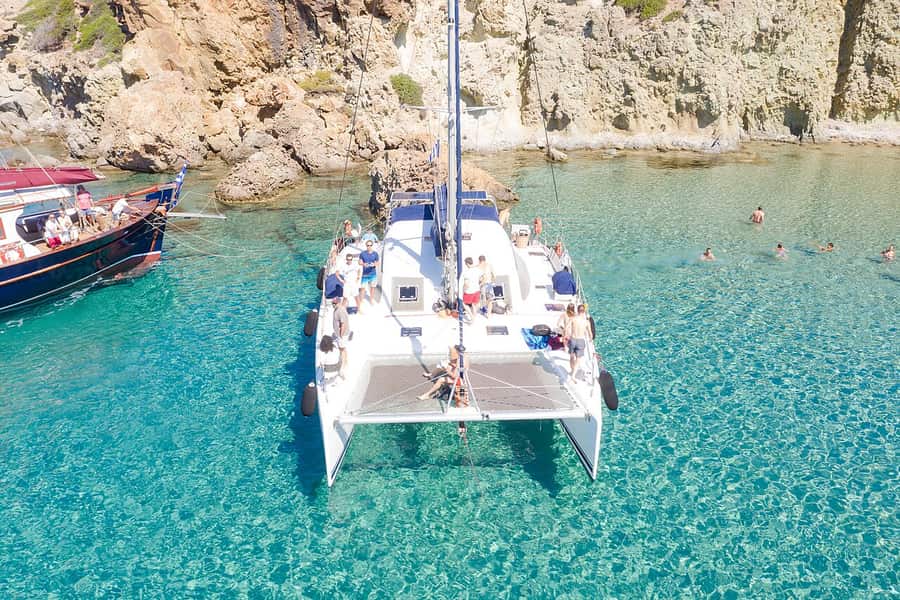
An anchor is a metal device that holds a boat to the sea floor. On a Milos catamaran cruise, it stops the boat from drifting with wind or current. The crew looks for a protected spot with firm ground. On hard sand an anchor digs in well, yet on shell it slips.
A rope or chain, called the rode, joins the boat to the anchor. Its length compared with the water depth is called the scope. The boat then backs gently so the anchor digs in. A Milos catamaran cruise needs room to swing around its anchor. The crew checks the space first.
Swimmers on a Milos catamaran cruise enter the water at the back of the boat, called the stern. A catamaran can have a spacious deck and stern steps with a swim ladder. A swim ladder is a set of steps that reaches into the water. Climbing back is easier when the fins come off first.
A plain snorkel floods when the swimmer dives below the surface. The swimmer blows the water out with one sharp breath on the way back up. This is called blast clearing. A snorkeller needs no special training. Simple swimming ability and slow, calm breaths through the tube are enough.
A snorkel is a tube that lets a swimmer breathe with the face in the water. A mask holds an air space in front of the eyes, so the view underwater is clear. Fins push the swimmer along with less effort.
A paddle board is a long board that floats. The rider stands on it and pushes with one paddle. A wider board is steadier for beginners. The rider keeps the feet hip-width apart and the knees slightly bent. A leash links the ankle to the board, so a fall does not send it drifting.
Snorkelling alone is not advised, so a buddy joins every snorkeler. Moving boats are the main danger to snorkelers, because only the tube shows above the water. A bright colour or flotation vest helps the crew spot each swimmer. Swimmers on a Milos catamaran cruise stay close to the boat.
- Buddy: A partner watches each snorkeler, and nobody snorkels alone.
- Sun cover: A rash vest, a shirt or waterproof sunblock protects the back, ankles and thighs.
- Water: Drinking well before the swim helps prevent cramps.
- Wildlife: Snorkelers look at sea animals but do not touch them.
- Inflatable boards: An inflatable board, once deflated, fits into a backpack.
A stop on a Milos catamaran cruise follows a clear order: anchor down, ladder out, then swim. Everyone enters and leaves the water by the ladder and stays in view of the crew. This routine keeps swimming, snorkelling and paddle boarding easy for all ages.

Which Greek dishes and drinks suit a Milos catamaran cruise at sea?
A Milos catamaran cruise pairs well with simple Greek food served at sea. Meze are small shared plates, served with salads, cheese, olives and seafood. Milos adds pitarakia, small half-moon pies filled with mizithra, a soft whey cheese.
Meze are a set of small dishes that arrive as starters. The word comes from Persian, where it means taste. Meze can fill part of a long meal, or the whole meal. In Greece, meze comes on small plates and goes with drinks such as ouzo and tsipouro.
Greek meze include olives, tzatziki, taramosalata, octopus, sardines and fried cheese. Tzatziki is a dip of strained yoghurt, cucumber and garlic. Taramosalata is a dip of fish roe, olive oil and lemon juice. Small plates like these are easy to share on a Milos catamaran cruise.
A Milos catamaran cruise table suits seafood, since fish dishes are common on the coast and the islands. Grilled octopus is one example, and fried squid comes with a lemon wedge. Marides are small fish dusted with flour and fried. Shrimp saganaki is cooked in tomato sauce and topped with feta.
Horiatiki is the Greek village salad. It holds tomato, cucumber, onion, feta and olives, dressed with oregano and olive oil. Feta is a white Greek cheese made from sheep milk or from sheep and goat milk. Bread is an essential part of a meze table.
Pitarakia are small half-moon pies from Milos. Their filling is mizithra, a Greek whey cheese made from sheep milk, goat milk or both. Fresh mizithra is soft and similar to Italian ricotta. A Milos catamaran cruise lunch can include a taste of this local cheese.
Cycladic cooking rests on pulses, meat, fresh vegetables, virgin olive oil, spices and herbs. Pulses are beans and lentils. The nearby island of Kimolos has its own dish, ladenia. It is a crisp dough topped with tomato, onion, herbs and olive oil. Cheese is added to it at times.
Ouzo is a dry spirit flavoured with anise, a spice. It is mixed with water and turns cloudy white. Tsipouro is a strong brandy made from grape pomace, the solid residue left after pressing wine. Fresh water suits the swim stops, since drinking well prevents cramps.
- Meze: Small shared plates of cheese, olives, dips and seafood for a Milos catamaran cruise table.
- Pitarakia: Half-moon pies from Milos, filled with mizithra cheese.
- Horiatiki: A village salad of tomato, cucumber, onion, feta and olives.
- Ladenia: A crisp dough with tomato and onion from nearby Kimolos.
- Ouzo: A dry anise spirit that is mixed with water and served with meze.
On a Milos catamaran cruise, food at sea stays simple: small plates, fresh salads, local cheese and seafood. Everyone shares from the middle of the table, and the meal fits between the swim stops. Cold water keeps the day comfortable for all ages.

Where does a Milos catamaran cruise start, and why does the bay matter?
A Milos catamaran cruise starts at a harbour on a huge natural bay. The boats leave from Adamas, the main port, or from Pollonia, the second port. The bay formed inside an old volcano, so the water there is deep and sheltered.
The harbour town of Adamas works as the main port of Milos. Cretan refugees founded the town. Its name is the Greek word adamas, which means diamond. Today it serves as the island’s centre for culture and trade, on the bay’s north-eastern shore.
Milos has the shape of a horseshoe on the map. The bay opens to the northwest and takes up the hollow of the main volcanic crater. A crater is the bowl-shaped dip at the top of a volcano, where the eruptions came out.
Milos first saw volcanic activity between two and three million years ago. The last eruption came 90,000 years ago, so the volcano is now asleep, or dormant. Today the sea fills the old crater, and that water is the bay where the boats gather.
In the bay, a Milos catamaran cruise sails over water between 55 and 130 metres deep. The bay reaches so far inland that the island is almost cut into two equal halves. The strip of land between the halves is no wider than 2.2 kilometres.
In the nineteenth century, American and British ships met at Milos while fighting pirates in the Mediterranean. During the Crimean war, the French fleet used Adamas as its base. An Anglo-French military cemetery near the town dates from those years.
A Milos catamaran cruise from Adamas starts in the harbour on the bay. This natural harbour is one of the largest in Greece. In north winds, the beaches inside the bay are the better choice for swimming.
Pollonia, the second port of Milos, is at the island’s north-eastern tip, about 10 kilometres away from Adamas. A temple of Apollo gave the port its name. A Milos catamaran cruise can begin there too, because boats leave from both ports.
- Adamas: The island’s main port, and a place to begin a Milos catamaran cruise.
- Pollonia: The second port, a fishing village with a large sandy beach.
- Mandrakia: A fishing village where the harbour keeps the fishermen’s boats safe.
- Firopotamos: A small fishing port built in a small cove, with houses dug into soft rock.
- Other ports: Small fishing ports also include Areti, Agios Konstantinos, Fourkovouni and Empourios.
Small fishing ports line the coast, but the large bay holds the main harbour. A visitor who plans a Milos catamaran cruise first has to reach the island by sea or air. The separate page about getting to Milos covers the port and the airport.
What do the volcanic rocks look like from a Milos catamaran cruise?
A Milos catamaran cruise passes volcanic cliffs in white, red, yellow and black. Volcanic ash, minerals and weathering all colour the rock. The same rocks hold bentonite and perlite, two minerals that Milos mines and sells around the world.
Volcanic rock covers the larger part of Milos, so a Milos catamaran cruise runs beside it. Tuff, a soft rock made of packed volcanic ash, and obsidian, a volcanic glass, are common there. Mount Profitis Elias, the highest peak, is a dome of lava that set solid before it spread.
On a Milos catamaran cruise, the cliffs show bands of white, yellow, red and black rock. Obsidian is a glass that forms when lava cools very fast, and it is dark. Iron in the glass can turn it dark brown or black.
Bentonite is a clay that forms when volcanic ash breaks down. Fresh bentonite is white or pale blue or green, and Milos has a deposit of it. Weather and traces of iron then turn it cream, and later yellow, red or brown.
Perlite is a volcanic glass that has a high water content, trapped inside the rock. At 850 to 900 degrees Celsius, perlite swells to 7 to 16 times its size. The swollen perlite is bright white, because the trapped bubbles reflect light.
A Milos catamaran cruise along the north coast can pass Sarakiniko. Its greyish-white volcanic rock built up in repeated layers, and waves driven by north winds still shape it. Fossils, the remains of ancient life, lie inside the rock, and the stone looks like the Moon’s surface.
Sulfur is a bright yellow mineral, and Milos mined it until the middle of the 20th century. Vents called fumaroles still release hot gas rich in sulfur, for example at Adamas and Palaiochori. At the old sulfur mines on the east coast, the pebbles on the beach look yellowish.
Open pits on Milos yield bentonite, perlite, pozzolana and a little kaolin. A Milos catamaran cruise sails along the coast of the island that sells them all over the world. Ancient painters already used a white earth from Milos, made mainly of kaolin, as paint.
- Bentonite: A clay that swells when wet, so it goes into drilling mud and sealants.
- Perlite: A light white material that goes into plaster, concrete, mortar and insulation.
- Pozzolana: A volcanic earth that cement makers add to their mix.
- Kaolin: A soft white clay used to make paper and ceramics.
- Obsidian: A dark volcanic glass with sharp edges that early people cut into tools.
The Mineral Museum of Milos in Adamas shows the minerals mined on the island. They range from the New Stone Age to the present day, with a focus on daily life. After a Milos catamaran cruise, a visit there shows what the cliffs are made of.
What is the meltemi, and how does it change a Milos catamaran cruise?
A Milos catamaran cruise changes route when the meltemi blows. Strong and dry, the meltemi is a north wind over the Aegean Sea. On those days, the boat uses the sheltered south side of Milos or stays inside the bay.
The meltemi blows across the Aegean Sea from late spring to the end of summer. The sky stays clear, but the sea turns rough and full of waves. Thanks to the dry air, the sky is deep blue and the coast is clearly visible.
A big zone of high air pressure sits over the Balkans, north of Greece. A zone of low pressure sits over Asia Minor and the eastern Mediterranean. Air from southern Russia crosses Europe and dries out on the way.
Ancient Greeks called it the etesian wind, from the Greek word for year. The wind returns every summer, so the name fits, and writers have described it since ancient times. Greeks now call it the meltemi, and Turkish speakers call it meltem.
The Beaufort scale rates wind by its effect on the sea and on the land. The meltemi averages 6 to 7 on this scale, and it can reach 7 to 8. At that strength, the sea is full of waves, and trips by small boats can stop.
On a meltemi day, a Milos catamaran cruise looks for shelter from the north. Beaches inside the bay are a good choice for swimming in a north wind. The south side of the island, which faces away from the wind, is better still.
The rule flips when the wind blows from the south. Then the island’s north shore has the better beaches for swimming. A Milos catamaran cruise follows the same rule and picks the sheltered coast of the day.
The meltemi has a good side too, because it cools the fierce summer heat of the region. It also gives sailing boats a good, steady push. On a Milos catamaran cruise, the wind decides which coast is calm enough for a swim stop.
- Direction: It blows from the north in the central Aegean and from the northwest further south.
- Duration: Once it starts, the wind can last for days without a break.
- Similar winds: Winds like the meltemi also blow over the Adriatic and Ionian seas.
- Monsoon: People sometimes call it a monsoon wind, but the meltemi is dry.
- Shelter: On those days, a Milos catamaran cruise heads for the bay or the south side.
On a windy day, a Milos catamaran cruise changes its stops, not its purpose. A north wind sends it into the bay or south, and a south wind sends it north. The wide stance of two hulls also keeps the deck steadier in the waves.
How does a Milos catamaran cruise work at sunset?
A Milos catamaran cruise at sunset runs along the west side of the island in the afternoon. The boat turns back toward the harbour as the sun goes down. Two wide hulls keep the deck steady while the sky changes colour.
On a Milos catamaran cruise at sunset, the day ends on the water. One west-coast route passes Kleftiko and then turns back to Adamas, the main port. The sunset falls on that last stretch home. The boat is still at sea as the light fades.
The sun sets in the west. In spring and summer, it sets toward the north-west. No villages stand on the west side of Milos, only tiny settlements and old mines. Almost all of that land is in Natura 2000, a European network that protects wildlife.
The summer north wind, called the meltemi, is strongest in the afternoon. It can die down at night. The sea can start to settle as evening comes. On a Milos catamaran cruise, the captain still reads the wind on the day. The wind can rise in clear weather without warning.
On the way out of the bay, the boat passes the fishing village of Klima. Klima stands where the bay opens to the sea, just below the village of Trypiti. It lies about 6 kilometres from Adamas. A Milos catamaran cruise sees it from the sea, right at the water’s edge.
The houses of Klima are called syrmata, and the word means wires. Each house has two floors and sits in a hollow of the rock. The boat stayed on the ground floor in winter. The family lived on the floor above. Bright colours coat the doors and windows.
Today the greater part of the syrmata are rented out as places to stay. The 2021 census counted 8 residents in the village. Cats lie in the sun. On a Milos catamaran cruise, the painted doors and windows show where each boat house stands.
Klima also stands on the spot of the island’s first port. The ruins of ancient Milos and its theatre lie near the village. Parts of the old market wall survive there. Close by, people found the statue called the Venus de Milo. The old port served the same shore that the boat passes.
- Direction: In spring and summer, the sun sets toward the north-west.
- Coast: The west side of Milos has no villages, only tiny settlements and old mines.
- Wind: The summer meltemi peaks in the afternoon and can fade at night.
- Village: A Milos catamaran cruise passes Klima, which sits under Trypiti at the mouth of the bay.
- Houses: A syrma is a fisherman’s house of two floors, with the boat downstairs and the family upstairs.
A Milos catamaran cruise at sunset joins three things. They are the west coast, the end of the day and the boat houses of Klima. The wide hulls keep the deck steady while the sun goes down. The next section explains why that steadiness matters to children and families.
Is a Milos catamaran cruise good for children and families?
A Milos catamaran cruise rocks less than a one-hull boat, because two wide hulls resist rolling. That helps children, families and anyone who gets seasick. Life jackets, shade, simple habits and a word with the crew complete the plan.
A catamaran has two hulls, the floating bodies of the boat, and they are equal in size. Because they sit far apart, the boat resists rolling and overturning. A yacht with one hull, as on a Milos sailing tour, leans more. On a Milos catamaran cruise, the deck stays calmer for children.
Seasickness starts when the body feels motion that the eyes do not match. Signs are nausea, cold sweat, headache and dizziness. Water gives the eyes no fixed point, and fog makes it worse. The biggest cause is going below deck. The open deck and the horizon are the better choice.
Other habits help too. Holding the head still and lying on the back can ease the feeling. Music and slow breathing also help. Reading or looking at a phone is better left for land. After a while the body adjusts, which sailors call getting sea legs.
Medicines work better when taken before the first signs, and they have side effects. A pharmacist or doctor decides what suits a child. Pregnancy is also a risk factor, so expectant mothers ask first. All of this is settled before the day, not on the boat.
A life jacket keeps the head and mouth above the water. Jackets come in sizes by body weight, and models exist for children, from infants up. Straps between the legs stop a jacket from riding up. On a Milos catamaran cruise, each child wears a jacket that fits.
Strong sun is another risk for young skin. Hats and sunglasses help, and so does shade. A cabin between the two hulls gives a roofed place out of the sun. Shade reduces sun exposure but does not block every ray.
On a Milos catamaran cruise, a deck that leans less is easier to walk on. People with reduced mobility still check the boarding. This covers wheelchair users and people who use a frame or a stick. Steps, ladders and narrow doors differ from boat to boat. Telling the crew early lets them plan.
- Hulls: Two equal hulls set wide apart resist rolling better than one hull.
- Horizon: Looking at the horizon from the open deck of a Milos catamaran cruise can ease seasickness.
- Habits: Holding the head still, calm breathing and music help, while reading does not.
- Jackets: Life jackets come in sizes by body weight, with models for infants and children.
- Mobility: A word with the crew before the day makes boarding easier for a person with reduced mobility.
A Milos catamaran cruise suits families because the boat rocks less and the open deck eases seasickness. Jackets in the right size, shade and a talk with the crew about boarding finish the preparation. Each step is simple, and each one is settled before the boat leaves the harbour.
How does a visitor choose a Milos catamaran cruise?
Four checks make a Milos catamaran cruise easy to choose. The checks are shared or private, half or full day, what is included, and what to pack. A clear tour description answers all four before anyone reserves a seat.
A shared Milos catamaran cruise carries travellers who reserved separately. The route and the swim stops are set in advance. The crew keeps to that plan for everyone on board, which keeps the day simple for first-time visitors. A shared boat also suits solo travellers, since nobody needs a full party to sail.
A private boat carries one party only. That party talks through the stops, the pace and the swim breaks with the crew before departure. The whole deck belongs to one family or one group of friends. Nobody else shares it.
A half-day cruise suits families with small children and anyone new to the sea. It asks for less time in the sun and fits fewer stops. A full-day cruise reaches farther coasts. It adds a longer swim, a lunch stop and more time to rest between swims.
A tour description lists what is included, in general words. The list covers the boat and the crew. It names the swim time and any gear for the water, such as a mask or a snorkel. A meal, a drink or a paddle board appear only when they are part of the trip.
A good description names the boat type, the stops and the meeting point. Named places let you compare trips, which loose words such as coves and views do not. Two descriptions of the same route can then sit side by side, and the differences show up fast.
Gaps in a description deserve a closer look. A text with no boat type, no stops or no inclusions leaves too much open. A second description for the same kind of trip shows what a complete text looks like.
The packing list is short. Sun, salt and water are the main concerns on a deck, so five items cover the whole day. A small bag holds all of them, and a bag that closes keeps sand and spray out.
- Hat: A cap with a strap or a wide brim shields the face from sun and wind.
- Sun cream: Put a thick layer on before boarding, then again after every swim.
- Swimwear: Wearing it under clothes saves time at the first swim stop.
- Towel: A light, quick-dry towel stays small in the bag.
- Soft shoes: Flat shoes with soft soles grip the deck and protect the feet.
Each point on the checklist narrows the choice. Once the boat, the day length and the packing list are clear, the choice is easy. After that, a Milos catamaran cruise stands up well against any other trip. A mix of sea and land is easy with the activities in Milos listed for the holiday.

Which other questions come up about a Milos catamaran cruise?
Before the day starts, a Milos catamaran cruise raises small practical questions. They cover swimming, shade, dolphins, seasons, phones, shoes, weather and pickup. Every answer below is brief and uses plain words, so nothing surprising waits on deck.
Can a non-swimmer join a Milos catamaran cruise?
Yes, a non-swimmer can enjoy the day. The two hulls of a catamaran sit far apart. That stance resists rolling, so the deck stays steady. At swim stops, a non-swimmer stays on board, sunbathes or watches the water from the deck. Anyone unsure about deep water tells the crew before the first stop.
Is there shade and a toilet on a Milos catamaran cruise?
A catamaran can join its two hulls with a covered cabin area. That space gives shade from the midday sun. Shade and a toilet are the first two lines to look for in a tour description. When the text is silent, one short question to the organiser settles it before the day.
Are dolphins seen on a Milos catamaran cruise?
Dolphins live in the Mediterranean, and a bottlenose pod holds about 15 animals. Common dolphins are known to bow ride, which means swimming at the front of a boat. Even so, wild animals keep their own plans. A sighting on a Milos catamaran cruise is a bonus, never a promise.
Is a Milos catamaran cruise possible in spring and autumn?
Milos has dry summers and mild, rainy winters. By day, April averages 18.4 °C and October 21.3 °C. On average, rain falls on 2.9 days in April and 3.9 in October. A light layer helps in both months. The tour description shows which months a boat sails.
Are cameras and phones safe on a Milos catamaran cruise?
Salt spray, wind and wet hands put a phone at risk. A waterproof pouch with a neck strap keeps it dry and close. A camera needs a wrist strap and a dry bag for swim stops. Devices stay off rails and seats, because one knock sends them overboard. A soft cloth wipes salt off the lens.
Which shoes suit a Milos catamaran cruise?
Flat shoes with soft rubber soles grip a wet deck and spare the surface. High heels, hard black soles and loose flip-flops fail on both counts. A boat can ask guests to go barefoot on deck. The crew explains the house rule at boarding. Shoes that dry fast are the safest choice after a swim.
What happens to a Milos catamaran cruise in rain or clouds?
Rain is rare in summer. June averages 0.3 rainy days, and July and August average 0.1 each. Thin cloud still lets the sun reach the skin, so sun cream stays on. A light jacket handles a cool breeze or a short shower. The tour description states the rule for a grey day.
Does a Milos catamaran cruise include hotel pickup?
Pickup depends on the tour. One description lists a pickup from a hotel or village. Another names a meeting point at the harbour. The text states which one applies. Without a pickup, guests plan their own way to the harbour. A clear address or a map pin in the text makes that trip easy.