Once you rent a car, an ATV or a buggy from Rac SA, take the road to Triovasalos.
On the road to Plaka you will meet the villages of Triovasalos and Pera Triovasalos.
These two villages are built like an amphitheater on two neighboring hills, and you can visit the churches of the villages, St. Spyridon and St. George respectively. Along the “cart road” you will find several banks, public offices, cafes and shops.
Triovasalos is a village on Milos, the volcanic island in the western Cyclades, and it stands on a hill above the harbour of Adamantas, on the road that climbs to Plaka. The two lanes of the village, the churches on their rocks and the coffee houses on the main street give a first image of the island of Milos before the beach days begin.
Travellers reach the village from the port, three kilometres below, or from Plaka, one kilometre above the other half of the pair. Houses rise like steps on two neighbouring hills, shops and services fill the ground floors, and the lanes stay narrow. The pages that follow treat the twin settlement, its calendar of feast days and the walks that start at its door.
Where do Triovasalos and Pera Triovasalos stand on Milos?
Triovasalos and Pera Triovasalos stand on two neighbouring hills between Plaka and Adamantas, at 143 and 120 metres above the sea. Until 1908 the two villages formed one settlement, and today they hold the shops, banks and public offices of the island.
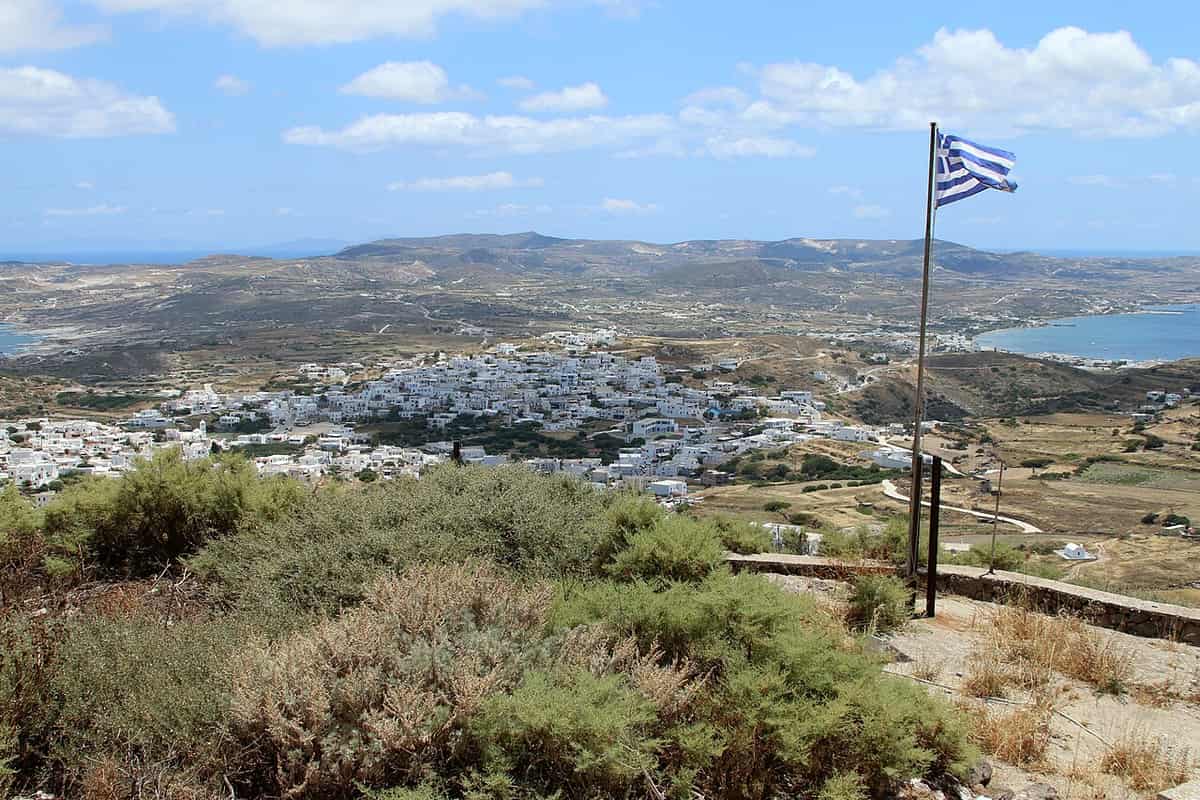
The community of Triovasalos counts 1,379 residents at the census of 2021. The village of Triovasalos itself holds 1,001 of them, and the second village holds 844. Pera Triovasalos lies one kilometre east-south-east of Plaka, the seat of the municipality, and three kilometres north-west of Adamantas, the port. The same community covers Mandrakia, Mytikas, Pachaina, Fylakopi, Agioi Anargyroi, Agios Gerasimos, Pollonia and the islet of Glaronisia. Pollonia holds 268 residents and Mandrakia 13 in the same community.
The village was attached to the municipality of Milos in 1835, and in 1926 it became the seat of a new community. The abolished settlement of Perkarika was added to it in 1928. The second village was counted as a separate settlement from the older one in 1908, became the seat of its own community in 1912, and took in the abolished settlement of Enteuthen Triovasalos in 1928. The pair therefore grew apart inside one administrative frame.
Between the two hills the village keeps the everyday trade of Milos. Banks, public offices, bakeries, small shops and coffee houses serve residents and visitors, and the pedestrian street holds the main row of stores. Houses stand close together, with thick walls, small openings and courtyards, in the Cycladic manner of the island. The result is a working village rather than a summer settlement, busy in winter as well as in August, when the feast days arrive.
- Height: Triovasalos stands at 143 metres and Pera Triovasalos at 120 metres above the sea.
- Distance: The second village lies one kilometre from Plaka and three kilometres from Adamantas.
- Population: The community counts 1,379 residents, the village 1,001 and the second village 844.
- Churches: Agios Spyridon in Triovasalos dates to the start of the 19th century, and Agios Georgios in Pera Triovasalos to 1849.
- Union: The two settlements formed one village until 1908.
Triovasalos and its partner village take the middle ground of Milos: below them the port and the ferry, above them the capital and its castle. The pair holds the banks and the shops that the hill needs, and the two churches carry dates from the first half of the 19th century. The page on the villages of Milos sets the pair beside the other settlements of the island.

How does village life shape Triovasalos through the year?
Village life in Triovasalos follows the Orthodox calendar, the parish church of Agios Spyridon and the Easter custom of the Burning of Judas. Shops on the pedestrian street, coffee houses and feast days keep the two hills busy through winter and summer alike.
Agios Spyridon stands in Triovasalos, and its date belongs to the start of the 19th century. Agios Georgios stands in Pera Triovasalos and dates to 1849. The later church has a marble iconostasis, mosaics in its courtyard, and a marble plaque at the entrance that shows Saint George on horseback. Mandrakia, with the church of Zoodochos Pigi above its sirmata, lies inside the same community, so the parish reaches from the hill down to the north coast.
The calendar gives the two villages fixed points in the year. The memory of Saint Spyridon is kept on 12 December in the Orthodox Church, and the memory of Saint George falls on 23 April, or on the Monday of Renewal Week when the date lands before the Resurrection. Zoodochos Pigi is celebrated on the Friday of Easter week. Each date brings the parish together in the church that carries the name, and the feast fills the lane outside.
Easter brings the custom of the Burning of Judas. An effigy of Judas is burned, and dynamite is thrown in a field that lies between the two villages. The field sits in the gap between the two hills, so both villages watch the same fire from their own side. The rest of the year keeps quieter habits: the morning coffee, the evening walk along the pedestrian street, and the talk on the benches outside the shops.
- Parish: Agios Spyridon serves Triovasalos and Agios Georgios serves Pera Triovasalos.
- Feast day: Saint Spyridon is remembered on 12 December in the Orthodox Church.
- Saint George: His memory falls on 23 April, or on the Monday of Renewal Week.
- Easter: The Burning of Judas takes place in a field between the two villages.
- Coffee: The coffee and drinks of Triovasalos keep the pedestrian street busy through the day.
Village life in Triovasalos runs on the church calendar and on the street outside the church door. The two parishes carry the names of Saint Spyridon and Saint George, the Easter fire carries the memory of Judas, and the coffee houses carry the daily business of a place where people live all year. The customs belong to the residents first and to the visitor second.
Which walk from Triovasalos reaches Plaka, Tripiti and the north coast?
Triovasalos sits at the low end of a short ridge, so a walk from the village reaches Plaka, Tripiti and the north coast in stages. The second village lies one kilometre from Plaka, Tripiti stands at 150 metres, and Firopotamos lies three kilometres north of Plaka.
The first stage climbs from the two hills to Plaka, the capital and the seat of the municipality. Plaka stands at 220 metres on a rock above the gulf of Milos, and its name comes from the flat ground where the houses were built when the castle was no longer enough to house the population. Cars cannot enter the village, because the space between the buildings is narrow. The lane ends at the castle, which the Venetians built in the 13th century.
From Plaka the ridge runs on to Trypiti, which stands at 150 metres near the northern coast and the sea entrance to the gulf. Trypiti has held the rank of a traditional settlement since 1978, and its name comes from the volcanic rock full of holes. The village sits east of the site of ancient Milos, where the ancient theatre stands and where the Aphrodite of Milos was found. Restored windmills above the houses once ground grain and now serve as lodgings.
The last stage drops to the north coast. Klima, a coastal settlement at the entrance of the gulf, lies six kilometres from Adamantas and below Trypiti, and its sirmata once kept boats through the winter, with the fisherman’s family above and the boat below. Further along the coast, Mandrakia holds a small harbour lined with sirmata, a church of Zoodochos Pigi above them and a beach about 150 metres long. Firopotamos, three kilometres north of Plaka, keeps its own sirmata around a small bay.
- To Plaka: The capital stands 220 metres above the sea and one kilometre from the second village.
- To Trypiti: The village lies at 150 metres, beside the site of ancient Milos.
- To the theatre: The ancient theatre stands on the slope between Trypiti and Klima.
- To the catacombs: The underground Christian cemetery near Trypiti lies close to the agora of ancient Melos.
- To the coast: The fishing village of Mandrakia lies on the north coast, inside the community of Triovasalos.
A walk that starts in Triovasalos can end at the castle of Plaka, at the theatre below Trypiti or at a boathouse cove on the north coast, and each stage covers a short distance. The height gained is modest, the lanes are narrow, and the sea is never far from the path. The pair of villages makes a natural base for the whole ridge.

What do visitors ask about Triovasalos?
Visitors ask about Triovasalos and its partner village for three things: how to reach the two hills, what stands on the pedestrian street, and which walks start from the village. The answers below treat the settlement, its churches and its neighbours on the ridge.
How does a traveller reach Triovasalos?
The village lies on the road between Adamantas and Plaka. The second village stands three kilometres north-west of the port and one kilometre east-south-east of the capital, so the drive from the harbour is short. Buses, taxis and rented cars use the same road, and the pedestrian street holds the shops, the banks and the coffee houses of the village.
What can visitors see in Triovasalos itself?
The two churches are the main sights. Agios Spyridon in Triovasalos dates to the start of the 19th century, and Agios Georgios in the second village dates to 1849, with a marble iconostasis, courtyard mosaics and a marble plaque that shows Saint George on horseback. The pedestrian street holds the shops of the village.
Which feast days does Triovasalos keep?
The parish keeps the memory of Saint Spyridon on 12 December, and the memory of Saint George falls on 23 April, or on the Monday of Renewal Week when the date lands before the Resurrection. Zoodochos Pigi is celebrated on the Friday of Easter week. The Easter custom of the Burning of Judas belongs to the two villages together.
How far is Triovasalos from Plaka and Adamantas?
The second village lies one kilometre east-south-east of Plaka, the seat of the municipality, and three kilometres north-west of Adamantas, the port of the island. The two villages stand at 143 metres and 120 metres above the sea, so the climb from the harbour road is short but steady, and the capital sits at 220 metres above them.
Which walk from Triovasalos leads to the north coast?
A walk leaves the ridge at Plaka and follows the coast north. Firopotamos lies three kilometres north of Plaka, in a small bay with sirmata around the water. Mandrakia stands on the north coast with a small harbour, a beach about 150 metres long and the church of Zoodochos Pigi above the boathouses.
How large is Triovasalos today?
The community of Triovasalos counts 1,379 residents at the census of 2021. The village of Triovasalos holds 1,001 of them, and the second village holds 844. The community also covers Pollonia, Mytikas, Mandrakia, Pachaina, Fylakopi, Agioi Anargyroi, Agios Gerasimos and the islet of Glaronisia, so the two hills share one administrative frame with the north coast.