Coffee and drinks in Triovasalos, Milos: see our Coffee – Drinks in Milos section for the island.
Triovasalos is a hill village above the port of Adamantas, on the road that climbs towards Plaka on the island of Milos, in the Cyclades. This page treats coffee and drinks in Triovasalos as part of everyday village life, where the coffee house stands in one line with banks, public offices and shops along the cart road.
Two sections follow. The first sets out what coffee and drinks in Triovasalos mean in a village of trade and public services. The second turns to the coffee house as a meeting place, the board game tavli and the working rhythm of the street. Churches, feast days and the walks to nearby villages come in the later sections.
What stands out about coffee and drinks in Triovasalos at a glance?
Coffee and drinks in Triovasalos belong to a commercial hill village on the road from the port to Plaka. Kafenia stand beside banks, public offices and shops on the Karodromos, the cart road that is a central point of the island.
Triovasalos stands on one of two neighbouring hills, and the village is densely populated. It belongs to the rise that carries Plaka, Pera Triovasalos and Trypiti above Adamantas, and a traveller who starts at the port meets the village before Plaka. Coffee and drinks in Triovasalos therefore belong to a village on the way up, not to a quay at the water or to a lane of the capital. With Pera Triovasalos it forms the commercial and daily core of Milos, the setting for coffee and drinks in Triovasalos.
Triovasalos is also a unit of local government. The municipality of Milos grew from five communities. Four of them, Plaka, Pera Triovasalos, Triovasalos and Trypiti, merged voluntarily in 1986, and Adamantas followed in 1998. Each former community is now a local district with a council of five members, and the municipal council has seventeen seats, ten elected by the majority and seven by the minority lists. Coffee and drinks in Triovasalos serve a village with a district of its own, matching the old community.
The street holds the trade. The Karodromos is lined with banks, public services, kafenia and shops, and the commercial movement along it is lively. Coffee and drinks in Triovasalos sit in the same list as the services. Next door, Pera Triovasalos counts bakeries, small shops and traditional kafenia among its local businesses. Greek coffee culture has two main settings. The kafeteria turns from café to bar at night and draws young people under 35. The kafenio is the older room, where older men used to meet.
- Street: The Karodromos is a central point of the island, with banks, public services, kafenia and shops.
- Trade: The village shows a busy commercial movement along its street.
- Rise: Plaka, Triovasalos, Pera Triovasalos and Trypiti stand on a height above Adamantas.
- District: Triovasalos is one of the five local districts of the municipality of Milos.
- Plakes: A small village of white houses and lanes lies between Plaka and Triovasalos.
At a glance, coffee and drinks in Triovasalos are those of a working hill village: a street of banks, offices and shops, a district council of its own and kafenia in the same line as the services. The wider page on coffee and drinks across Milos sets this village beside the port and the other settlements of the island. The next section looks at the coffee house as a meeting place and at tavli, its board game.

What does daily village life add to coffee and drinks in Triovasalos?
Coffee and drinks in Triovasalos follow the rhythm of a working village, where the coffee house is a meeting place for talk, news and tavli, the Greek board game, between visits to the bank, the office and the shop.
The coffee house began as a room for talk. In the Ottoman Empire it became a popular meeting place where people drank coffee, held conversations, played chess and backgammon, listened to stories and music and discussed news and politics. The rooms earned the name schools of wisdom for their free and frank talk. In Greece the kafenio kept the same part, and the older men filled it. The kafenia on the Karodromos belong to that long line of rooms, and coffee and drinks in Triovasalos begin there.
Tavli is the board game of the coffee house. The name means tables games in Greek, and the game is three games in one: portes, plakoto and fevga, also called moultezim. They are played in that order, in a cycle, until a player reaches an agreed score, commonly three, five or seven points. Each player moves fifteen men round the board by the throw of two dice and wins a game by bearing them all off first. The winner of one game takes the first throw in the next.
Tavli is tied to the kafenia and the cafes of Greece, and people of every age play it, so it shares its setting with coffee and drinks in Triovasalos. Portes carries the largest share of luck, and fevga the largest share of strategy. A decision of 1947 lists tavli among the technical games and allows it in public places such as coffee houses, though the manager of each place decides whether to offer it, since the game turns noisy.
- Portes: The first game is a hitting game that comes closest to western backgammon.
- Plakoto: The second game is a pinning game, and hitting is not allowed.
- Fevga: The third game is a running game with no hitting and no pinning.
- Men: Each player moves fifteen men by the throw of two dice.
- Dice: A player who stops the opponent’s throw by hand gives the opponent the choice of the combination.
The day in Triovasalos is set by the street. Banks, public offices and shops draw people to the Karodromos, the commercial movement is lively, and the coffee house takes the pauses between one errand and the next. Talk and a game of tavli fill those pauses. Coffee and drinks in Triovasalos therefore follow a working rhythm, in which the table is a short stop on the way through a busy village. Pera Triovasalos, next door, shares the same rhythm.
Which hills and churches frame coffee and drinks in Triovasalos?
Coffee and drinks in Triovasalos sit on two neighbouring hills between the port and Plaka, and each hill has its own central church: Agios Spyridon for Triovasalos and Agios Georgios for Pera Triovasalos. Each church anchors a parish, and a field lies between the two villages.
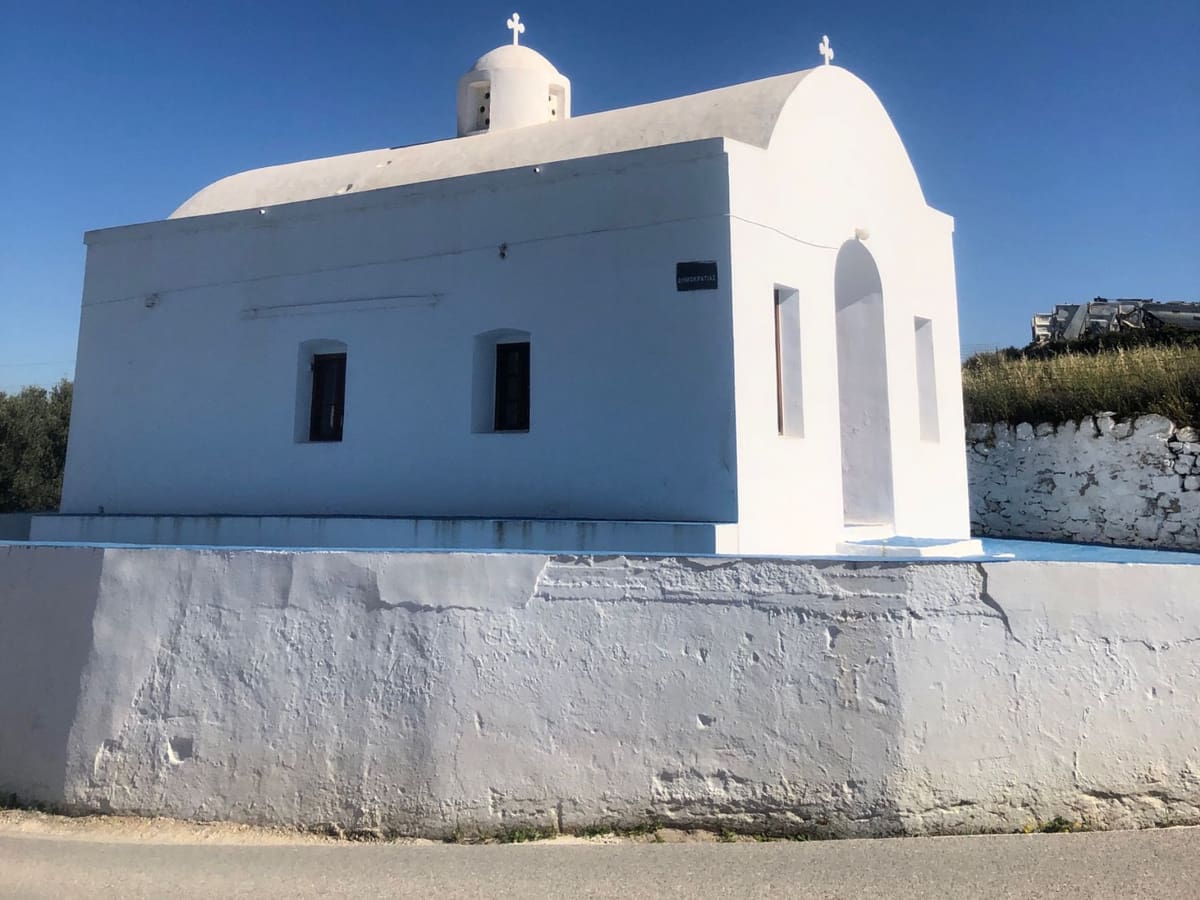
On the road from the port to Plaka, Pera Triovasalos is the first village reached, and Triovasalos is met before Plaka. Both are densely settled, and their houses climb the slopes in tiers. Until 1908 the pair formed a single settlement, and today each village has its own community. Together the hills form the commercial and everyday core of Milos, with banks, public services, coffee houses and shops, so coffee and drinks in Triovasalos sit in the working centre of the island.
Agios Spyridon is the central church of Triovasalos. The smaller church of Agia Marina forms a single building with it, and four large arches mark its architecture. Icons from the ruined churches of old Zefyria are kept inside. Zefyria was the capital of Milos before Plaka, founded in the Venetian period, and it began to empty after strong earthquakes in the middle of the 18th century. Coffee and drinks in Triovasalos therefore sit in a village whose church keeps the images of a former capital.
Agios Georgios is the central church of Pera Triovasalos and dates to 1849. A marble plaque dominates the entrance and shows Saint George on horseback. Inside stands a marble iconostasis, and the courtyard holds a mosaic made by a folk artist. Pera Triovasalos is one of the densest settlements of Milos, and its small shops, bakeries and traditional coffee houses serve residents and visitors, so the coffee houses of the second village belong to coffee and drinks in Triovasalos as much as those of the first.
- Triovasalos: Agios Spyridon is the central church of the village.
- Pera Triovasalos: Agios Georgios is the central church, dated to 1849.
- Agia Marina: The smaller church forms one building with Agios Spyridon.
- Zefyria: Icons from the ruined churches of the old capital are kept in Agios Spyridon.
- King of Kings: The icon of that title is the work of a Cretan icon painter.
Two churches, two parishes and one shared field define the ground of coffee and drinks in Triovasalos. Each church belongs to its own hill and its own parish. The page on the village of Triovasalos gives the history and the census figures of the pair. The icons from Zefyria link the village to the older capital of the island, and the plaque of Saint George marks the door of its twin.

Which customs and feast days shape coffee and drinks in Triovasalos?
Coffee and drinks in Triovasalos follow the Easter customs of the two villages: the Burning of Judas and the contest of dynamite in the space between the two churches. The feast table, with its pastries and its morning coffee, completes the calendar.
On Easter Day, coffee and drinks in Triovasalos share the village with the Burning of Judas, which a visitor can watch at either church. The custom goes back to the early Christian years and is revived to this day. It joins the gunpowder custom, in which the young men of Triovasalos and Pera Triovasalos throw dynamite into the space between the two churches. Each village claims the title of winner, and the winner is the village that makes the greater noise and sets off the larger number of dynamites.
The seven days that begin on Easter Day are called Bright Week or Renewal Week, and they change the habits of the table. Ordinary fasting is suspended for the whole week, red Easter eggs blessed at the Paschal Vigil are eaten, and the Holy Doors of the iconostasis stay open, the only time of the year when this happens. Coffee and drinks in Triovasalos therefore sit in a week without fasting, beside the Paschal foods eaten every day.
Greek Easter has foods of its own. Mageiritsa, a stew of chopped lamb liver and wild greens in egg-and-lemon sauce, is the traditional Easter meal. Red eggs are cracked together to celebrate the opening of the Tomb of Christ, and tsoureki is a sweet bread with dyed eggs pressed into the dough. Koulourakia are butter pastries with sesame seeds, made for eating after Holy Saturday. Because the pastry is commonly eaten with morning coffee, coffee and drinks in Triovasalos take their place at the start of the Easter table.
In the community of Triovasalos, Agios Gerasimos lies on the road to Pollonia and keeps two festivals, so the calendar of coffee and drinks in Triovasalos reaches beyond the two hills. The festival of Agios Aimilianos falls on 17 July, with traditional music and celebration until morning, and the festival of Agios Gerasimos falls on 19 October. Skoufomakarono, pasta with myzithra cheese and browned butter, and goat cooked with lemon are found at traditional festivals. For drinks, local winemakers make wines that reflect the volcanic soil.
- Burning of Judas: The custom dates from the early Christian years and is revived to this day.
- Dynamite: The young men of both villages compete for the title of winner.
- Bright Week: Fasting is suspended for the whole week after Easter.
- Koulourakia: The sesame pastries are commonly eaten with morning coffee.
- Festivals: Agios Gerasimos keeps festivals on 17 July and 19 October.
Easter carries the main customs of the two hills: the burning of Judas, the contest of dynamite and the open doors of Bright Week. Koulourakia, tsoureki and red eggs fill the table, and a morning cup of coffee goes with them. The festivals of Agios Gerasimos add music and a late night in July and a second feast in October, so the church year gives coffee and drinks in Triovasalos a calendar from spring to autumn.
How does the road join coffee and drinks in Triovasalos to Plaka, Tripiti and Adamas?
Coffee and drinks in Triovasalos sit on the first rise above the port of Adamas, with Plaka and Tripiti on the same height. The village is the first one reached from the harbour before Plaka, and Tripiti is almost joined to the capital.
Milos measures about 23 kilometres from east to west and 13 kilometres from north to south, and the gulf of its harbour splits the island into two fairly equal portions. Adamas, the harbour town, stands on that water. Above it, on a height, stand Plaka, Triovasalos, Pera Triovasalos and Tripiti. Coffee and drinks in Triovasalos therefore belong to a cluster of four settlements, and a traveller who starts from the port meets Triovasalos first, before Plaka.
The climb from Triovasalos reaches Plaka at 220 metres. The present settlement grew after the older capital, Zefyria or Chora, was abandoned, so Plaka is not called Chora. Its paved lanes were first built as a defence against pirates. The castle rises on a rocky hill above the ancient city, and its foundation is placed after 1204. That position allowed control over the movement of ships in the gulf. The page on coffee and drinks in Plaka continues the walk.
Tripiti is almost united with Plaka. The village is built in the form of an amphitheatre above the ruins of the classical city. Its church of Agios Nikolaos stands in the centre and dates to 1888, with a marble iconostasis. On the road to the Catacombs, the chapel of Panagia Faneromeni holds two arched tombs and traces of wall paintings in the sanctuary. A hiking route joins Tripiti and Plaka, so the two settlements work as one walk.
Going down, the road reaches Adamas, a lowland settlement whose name comes from the Greek word adamas, meaning diamond. Tripiti lies five kilometres north-west of the port. The island is divided into five municipal districts: Milos, the official name of Plaka, then Adamas, Pera Triovasalos, Triovasalos and Tripiti. Four of them stand on the height, and Adamas alone stands by the water, so coffee and drinks in Triovasalos sit on the climb that starts at the harbour.
- Metropolis: The church of Panagia Korfiatissa in Plaka was built in 1820 in the Byzantine-Cycladic style.
- Castle church: Mesa Panagia, the church of the Dormition, stands at the top of the castle.
- Lower church: Panagia Thalassitra, the church of the Presentation of Christ, stands lower down.
- Views: Tripiti looks over the bay of Adamas, and the castle looks over the gulf.
- Plan: Agios Nikolaos in Tripiti follows the plan of Agios Nikolaos in Syros.
Seen from the road, coffee and drinks in Triovasalos occupy the middle step of a short climb. The port lies below, the capital and the castle rise above, and Pera Triovasalos and Tripiti stand beside the village on the same height. Each settlement keeps its own churches and lanes. Triovasalos is the village passed on the way up and again on the way down.

What do travellers ask about coffee and drinks in Triovasalos?
Coffee and drinks in Triovasalos raise six practical questions: what a kafeneio adds, how taxis and buses serve the village, how Plaka differs, how the name is spelled, what stands on the neighbouring hill and which community holds Tripiti.
What does a kafeneio add to coffee and drinks in Triovasalos?
A kafeneio is a Greek café that serves Greek coffee, frappé, beer, retsina and ouzo, with meze or free snacks beside the glass. It acts as a social centre of the village, where people meet after work or play cards. The two villages of Triovasalos hold coffee houses beside banks, public services and shops.
How do taxis and buses serve coffee and drinks in Triovasalos?
Town buses serve certain areas of Milos, and the island has 15 taxis, found at the port and at the airport. Triovasalos has a taxi contact of its own beside the one for Adamas. A traveller can therefore reach the village from the harbour by taxi, and the road continues from there to Plaka.
How do the lanes of Plaka differ from coffee and drinks in Triovasalos?
Plaka holds small traditional shops, restaurants and cafeterias along narrow paved lanes, at 220 metres above the sea. Triovasalos holds coffee houses beside banks and public services, at 143 metres. The two settings sit on one road, so a traveller meets the village first and the paved lanes of the capital after the climb.
Which spelling suits coffee and drinks in Triovasalos in Greek?
The village is written Τριοβάσαλος and Τριοβασάλος in Greek, and both forms name the same place, with the stress on a different syllable. Its neighbour on the next hill is Πέρα Τριοβάσαλος, which English texts write as Pera Triovasalos or Peran Triovasalos. English texts write the village itself as Triovasalos, without any stress mark.
What stands on the neighbouring hill beside coffee and drinks in Triovasalos?
Pera Triovasalos lies in the northern part of the island, near the north coast, at 120 metres above the sea. It is one of the more densely populated settlements of Milos and shows notable commercial activity, with small shops, bakeries, traditional coffee houses and local businesses that serve residents and visitors.
Which community covers Tripiti, on the same height as coffee and drinks in Triovasalos?
The community of Tripiti also covers Agia Kyriaki, Zefyria, Kanava, Klima, Paliochori and Schinopi, and it counted 502 residents in 2021. The village joined the municipality of Milos in 1835 and became the seat of its own community in 1912. Klima, a coastal settlement of the same community, lies below the village.