
The Milos hot springs come from heat deep under the volcanic island of Milos. Warm water flows out on beaches, inside rock caves and even on the floor of the sea. Hot gas and steam also leak from vents in the ground and under the sea.
The Milos hot springs owe their heat to a volcano that is quiet today but not dead. Steam, sulfur and warm water across the island all share this one deep source. The volcano last erupted long ago, yet the rock below it is still hot.
What are the Milos hot springs at a glance?
The Milos hot springs are warm and hot waters that rise out of volcanic ground. They appear on beaches, in caves, beside the main bay and even under the sea. Steam vents rich in sulfur sit in the same parts of the island.
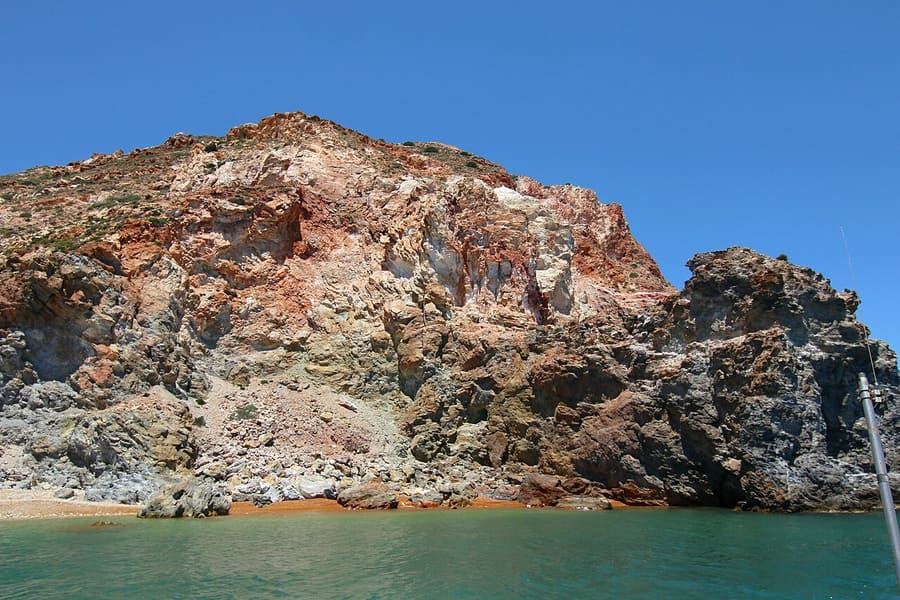
Among the Milos hot springs, the warmest water reaches 55 °C. Hot springs rich in sulfur rise along the eastern shore of the big harbour. The harbour itself fills the hollow of the main crater, a deep bowl left by the volcano.
Warm water gushes out at Paleochori, whose shore on the south coast stretches for almost 2 km. At Kanavas, very hot water full of salts spills onto the sand and then flows into the sea. The salts in this water shimmer with colour in the daylight.
Steam vents, known as fumaroles, breathe out hot gas at four places on the island. These are Agia Kyriaki, Paleochori, Pyromenes and Adamas, where the heat climbs to 100 °C. The gas rises from deep inside the Earth, and sulfur is plentiful in these areas.
Under the sea, gas from hidden vents rises through the water as strings of bubbles. On the seabed, the Milos hot springs create small, separate communities of living things. Inside one cave on the south coast, the volcanic heat stays strong to this day.
- Warm springs: Hot water rises beside the bay and on the south coast.
- Steam vents: Fumaroles let hot gas escape from far below.
- Bubbles: Underwater vents send gas up to the sea surface.
- Sulfur: Yellow sulfur crystals form where hot vapour meets the air.
- Changed rock: Acidic fluids from hot vapours turned older rock near Fyriplaka into white kaolin clay.
The Milos hot springs form part of a wider volcanic coastline. Warm water, steam and sulfur meet along the south-coast beaches of Milos, from Paleochori to Agia Kyriaki. Each of these spots shows the same deep heat at work in its own way.

What heats the water of the Milos hot springs?
The Milos hot springs take their heat from very hot rock deep under the island. That heat comes from the long volcanic history of Milos and its quiet volcano. Water in the ground picks it up far below and carries it back to the surface.
Eruptions on Milos began between 2 and 3 million years ago, during the Pliocene age. The last one came 90,000 years ago, in the Pleistocene age. Even so, the island still counts as a dormant volcano, meaning a sleeping one that can erupt again.
Milos sits on the South Aegean Volcanic Arc, a curved chain of volcanoes about 450 km long. The chain formed through subduction, meaning the African plate slides under the Eurasian plate. Santorini, Nisyros and Methana are other volcanoes along this same chain in the southern Aegean.
Geothermal energy, the natural heat of the Earth, is what warms the Milos hot springs. This heat flows from the hot inside of the planet up towards the surface. The flow is much stronger near plate edges, where the crust, or outer rock layer, is thinner.
Water in the ground seeps down along faults, meaning long cracks in the rock. Deep down it meets hot rock, heats up and rises back to the surface as a hot spring. If it boils off as fast as it collects, only steam escapes from a fumarole.
- Normal ground: Rock warms by 25 to 30 °C for each kilometre of depth.
- Greek ground: In parts of Greece, that rise passes 100 °C per kilometre.
- Under Milos: Temperatures up to 325 °C were measured 1,000 metres down.
- Steam: At 1,100 metres under the island, the rock holds steam.
- Wells: Five production wells have been drilled into this heat.
The Milos hot springs are the visible end of a long chain of natural events. Plates move, magma rises and the rock deep down stays hot. Water carries that heat up, and each warm spring on the shore points to the sleeping volcano below.
How do the Milos hot springs warm the shore at Paleochori?
Among the Milos hot springs, Paleochori rises on a busy beach almost 2 km long. Warm water wells up there from below. Vents in the same area release volcanic gas at up to 100°C. Heat comes from both the water and the ground.

Paleochori is both a beach and a small village on the southern side of Milos. Adamas, the main port, lies about 14 km to the north-west. Plaka, the main town, sits about 13 km away.
The shore mixes coarse sand with small, colourful pebbles. Rocks in strong reds and yellows ring the beach. Offshore, the water stays cool, clear and deep. The cool sea contrasts with the warm water that gushes here.
Hot and warm springs are not split by one fixed rule. A common test calls a spring hot when its water passes body heat, about 37°C. By one older idea, a warm spring stays below body heat but above the average air temperature.
At Paleochori, the Milos hot springs are only part of the heat. Fumaroles, meaning cracks that let out gas from deep in the earth, sit in the same area. Their gas reaches 100°C, and sulphur is strong around them. Agia Kyriaki beach has vents of the same kind.
- Spellings: Paleochori also appears as Paliochori or Palaiochori.
- Census: Residents fell from 25 in 2011 to 17 in 2021.
- Community: Kanava and Agia Kyriaki share Paleochori’s local community.
- Colour: The water off the beach is deep blue.
- Spring list: Paleochori counts among the Milos hot springs.
Paleochori brings warm water, hot ground and cool sea together on one long beach. That mix shows the Milos hot springs at work in plain view. Kanava and Agia Kyriaki, in the same local community, share the same buried volcanic heat.
Where are the other Milos hot springs and old baths?
The other Milos hot springs and old baths lie at Adamas, Kanava, Provatas, Mandrakia and Alyki. The best known are the Lakkos baths, set inside a natural cave beside the Adamas harbour. Tubs carved into the cave fill with warm, salty water.
Bathing in the Milos hot springs goes back to ancient times. Back then, the baths had a name for healing. The fifth book of Epidemics, a medical text from ancient Greece, mentions them. A French botany professor wrote about them again in 1717.
Among the Milos hot springs, the Lakkos baths draw the widest notice. Inside the cave, chambers with bathtubs have been cut, and the spring wells up from them. The water holds sodium chloride, or common salt, along with iron compounds.
The Lakkos water reaches 39–41°C. The exact reading changes with the height of the sea and the weather. That puts it just above body heat, one common line for a hot spring. Today only a small number of springs see use.
Another notable spring feeds the old baths at Kanava. Its hot water comes out on the sand, south-west of the island’s power station. From there it pours into the sea. These waters are said to help with arthritis, a painful joint illness.
- Provatas: The village has old baths of its own.
- Alyki: Baths lie by salt pans that closed in 1981.
- Wetland: The old Alyki salt pans now form a wetland.
- Mandrakia: A spring named Pikropigi, or bitter spring, rises here.
- Adamas: A shut site on the town beach holds a warm spring.
The Milos hot springs once gave the island a name for its baths. Lakkos and Kanava lead the list, while Provatas, Mandrakia and Alyki add more names. All of them rise from the same deep volcanic heat that warms Paleochori.
Where do the Milos hot springs flow under the sea?
The Milos hot springs also flow under the sea. Vents on the seabed let out gas that rises to the surface as bubbles. Off Kanava, steam from the same source as the beach spring warms the sea. Small, separate communities of life grow around these spots.
Scientists call these openings hydrothermal vents. The name means cracks in the seabed where water heated by the earth flows out. Such vents tend to form near places with volcanic activity. Milos, a volcanic island, fits that pattern.
Water from sea vents starts mainly as seawater. It sinks down through cracks and porous rock, meaning rock full of tiny holes, close to the volcano. There it heats up and returns. On land, steam vents run mainly on rain and groundwater instead.
Gas vents also sit on the seabed off Milos, and their gas rises to the surface as bubbles. At Kanava, steam vents a short way into the sea share a source with the beach spring. Their heat warms the water just off the sand.
Around vents, bacteria can draw energy from chemicals such as sulphide instead of sunlight. Off Milos, microbes live on hard crusts of carbonate, a chalky mineral, close to the vents. These warm spots give divers a strong reason to explore the Milos hot springs.
- Bubbles: Gas from seabed vents climbs to the surface.
- Kanava: Offshore steam warms the sea beside the beach spring.
- Microbes: Tiny life grows on carbonate crusts near the vents.
- Divers: Warm seabed springs draw divers below the surface.
- Deep ocean: Far deeper vents can release water at 464°C.
Below the waves, the Milos hot springs keep working out of sight. Bubbles, steam and small pockets of life mark the places where they rise. Together they show that the volcano under the island still sends heat into the sea.

How do steam vents colour the ground near the Milos hot springs?
Near the Milos hot springs, small cracks called fumaroles let steam and volcanic gas out of the ground. The gas carries sulfur, which leaves yellow crystals behind. Acid in the steam also breaks down the rock and stains it white, yellow, pink or red.
A fumarole is a steam vent, meaning a gap in the earth that breathes out hot volcanic gas. Water under the ground flows through hot rock and becomes superheated, meaning hotter than boiling. Near the surface the pressure drops, and that water suddenly flashes into steam.
Steam is the main gas rising from vents around the Milos hot springs, but others come with it. They include carbon dioxide and hydrogen sulfide, the gas behind the smell of rotten eggs. A vent rich in sulfur gas is called a solfatara, after an old Italian word for sulfur.
Both kinds of vent are still active close to the Milos hot springs. Steam escapes from the ground at Adamas, at Pyromenes, and on the shores of Agia Kyriaki and Paleochori. Sulfur is strong in all four places, and Paleochori shows red, pink, yellow and white-grey rock.
At the old Firiplaka crater, steam full of hydrogen sulfide turned rock into kaolin, a soft clay. Iron in the ground keeps this Milos kaolin from turning fully white. Where the vapour meets the air, the gas turns into clear yellow crystals of pure sulfur.
- Fumarole: A crack that lets out steam and volcanic gas.
- Solfatara: A fumarole that gives off strong sulfur gas.
- Kaolin: A soft clay left where acid steam breaks down rock.
- Yellow crystals: Sulfur that forms where the hot gas meets the air.
- Firiplaka: An extinct crater that shares its name with Firiplaka beach.
The sulfur around the Milos hot springs has a long story behind it. One writer of the ancient world called Milos its richest source of sulfur. The east-coast sulfur mines, which worked until 1956, are the only industrial site on Milos under protection.
How do visitors stay safe around the Milos hot springs?
Around the Milos hot springs, the water, the sand and the steam can all burn skin. Test the water and the sand with a fingertip before stepping in or sitting down. Keep children close, wear shoes on warm ground and never touch a steam vent.
Water in the Milos hot springs reaches up to 55 degrees Celsius. Water that hot can scald, which means it burns the skin. In volcanic places, people have been badly scalded after stepping into hot springs by accident.
The heat of the water is not the same on every visit. In a cave bath near Adamas, it rises and falls with the sea level and the weather. At Kanavas, hot water flows out across the sand and into the sea, so bare feet need care.
Steam vents are hotter still, and the gas at the island’s vents reaches 100 degrees Celsius. Never touch a vent, sit on it or lean over it to look inside. The gas is poisonous, and it can build up inside deep cracks in the ground.
A strong rotten-egg smell near the Milos hot springs means hydrogen sulfide is in the air. At high levels this gas numbs the nose, so a fading smell is no all-clear. Move to fresh air at once, and bring any children along too.
- Test first: Touch the water and sand briefly before stepping in.
- Children: Keep young swimmers within arm’s reach near warm water.
- Shoes: Wear closed shoes on warm or steaming ground.
- Vents: Stay well back from any crack that lets out steam.
- Crystals: Leave yellow sulfur in place and keep it away from eyes.
Rock beside a vent is weaker than it looks, because the acid gas slowly breaks it down. Stay on firm paths and keep off loose, brightly coloured edges. These simple habits lower the risk of burns and falls at the Milos hot springs.
Which season suits the Milos hot springs, and what goes in the bag?
The Milos hot springs suit the dry months from June to September. The air is hot then, and rain is rare. Spring and autumn bring fewer people to the shore. Water, sun cream, a hat and firm shoes cover the basics.
Peak heat comes in June, July and August, when average highs sit at 27 to 28 °C. Summer is also the busy season on the island. Paleochori, where warm water gushes from the ground, draws large numbers of swimmers.
Spring and autumn bring calmer beaches. September still averages a high of 25.2 °C with almost no rain, and April 18.4 °C. A month-by-month view sits on the page about the best time to visit Milos.
Firm shoes come first, because steam vents heat the ground at Paleochori and Agia Kyriaki. The sand near the Milos hot springs can grow hot enough to hurt bare feet. Paleochori also mixes coarse sand with colourful pebbles.
From June to September, rain falls on fewer than one day a month. Water and sun cream therefore belong in every bag. A hat and a towel complete the kit for a long day by the sea.
- Shoes: Sandals or water shoes guard feet on hot sand.
- Water: One full bottle per person suits each hot day.
- Sun cream: A high-factor cream goes on before the first swim.
- Towel: A towel gives a dry place to sit between swims.
- Mask: A swim mask shows bubbles rising from the seabed.
Season and packing together shape each visit. Summer brings the hottest air and the biggest crowds, while spring and autumn leave more room. Plans for the hours after a warm swim can draw on the wider range of activities in Milos.

What do first-time visitors ask about the Milos hot springs?
The Milos hot springs are natural outlets of warm water and steam on a volcanic island. Just a handful of springs see use today, and little has been built around them. The answers below cover safety, timing, sea life and transport.
Is the water at the Milos hot springs safe for swimming?
The open sea is the place for a swim. At Paleochori, the warm flow mixes into cool, deep water. The real risk lies at the outlets, since hot springs in volcanic ground can scald the skin. Swimmers test each warm patch with a hand first and keep clear of steam vents.
Are the Milos hot springs suitable for children?
Children need an adult within arm’s reach near every warm spot. Spring water on the island reaches up to 55 °C. That is far above normal body heat of about 37 °C. Agia Kyriaki has a wide sandy beach with umbrellas, while Paleochori has deep water. Small swimmers stay near the edge there.
Where is the warmest spot at the Milos hot springs?
Steam vents, not pools, hold the top heat, at up to 100 °C. Four spots have them: Adamas, Pyromenes, Paleochori and Agia Kyriaki. For bathing, a natural cave near the port of Adamas has carved tubs. Its water sits at 39 to 41 °C, rising and falling with sea level and weather.
Can visitors enjoy the Milos hot springs in winter?
Yes. The heat comes from inside the earth, so cold weather does not shut it off. January averages highs near 13 °C and lows of 8.5 °C. In winter, the sea surface in the south Aegean cools to about 13 °C. Both December and January see rain on about nine days.
Can snorkellers see warm vents near the Milos hot springs?
Yes. Snorkelling means swimming face-down at the surface while breathing through a tube. Off Milos, gas vents on the seabed send streams of bubbles to the surface. At Kanava, steam escapes just metres from the beach and warms the sea. These warm spots also host their own small communities of sea life.
Why do the Milos hot springs smell of sulphur?
The smell comes from hydrogen sulphide, a gas carried up in the hot steam. Even a trace of it smells of rotten eggs. Near the vents, the gas meets the air and forms yellow crystals of pure sulphur. In ancient times, Milos was the richest source of sulphur in the known world.
Can one day cover the Milos hot springs, Paleochori and Agia Kyriaki?
Yes. Both beaches sit on the south coast, and both have active steam vents. Paleochori runs for almost 2 km, with red, pink, yellow and grey-white rocks. Agia Kyriaki is an organised beach with sunbeds, umbrellas and a volleyball court. Its wide, thick sand suits a rest after a warm swim.
How do visitors reach the Milos hot springs?
On the east side of the island’s deep natural harbour, hot sulphur springs flow. Paleochori and Agia Kyriaki, two beaches with warm vents, sit on the south coast. Island buses serve parts of Milos, and their summer runs are frequent. Arriving visitors find taxis at the port and at the airport.